Mr. Miller AP Physics Fall 2012
                            Pages 682-698

Ray Miller
Edu. 290              Fundamentals of Physics
Dr. Merril                   9th Edition
February 28, 2012        Halliday & Resnick
Current: Flowing movement in a liquid gas, plasma, or
other forms of mater. (stream of moving charges)


Resistance: Measure of the degree to which a substance
impedes the flow of electric current induced by a voltage.
      - good insulators have a high resistance
Knowledge of current and resistance is essential in many careers
    Meteorologists
    Biologists
    Physiologists
    Engineers
    Electric Engineers
    Etc….

Eg: A meteorologist concerned with lightning uses the flow of charge through the
atmosphere to predict whether or not lightning is likely.


        Ps: It’s also good to know electrical components such as current
        and resistance to fix devices, check dead wires, and to prevent
                    starting a electrical fire or shocking yourself!
 Although though the definition of a current was a stream of
moving charges. Not all moving charges produce an electric
current.
The unit of current is ampere (A) also known as the amp
The ampere is a measure of the amount of electric charge
passing a point in a electric circuit
1 ampere = 1A = 1 coulomb per second = 1 C/s


  i = dq/dt       (definition of current)
  dq = deritive of charge
  dt = deritative of time

        i = (charge per electron) (electrons per molecule) (molecules per second)
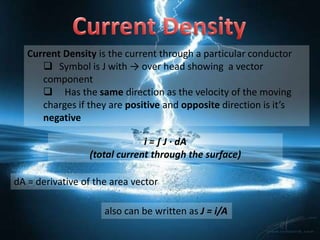
Current Density is the current through a particular conductor
       Symbol is J with → over head showing a vector
      component
       Has the same direction as the velocity of the moving
      charges if they are positive and opposite direction is it’s
      negative

                              i = ∫ J ∙ dA
                 (total current through the surface)

dA = derivative of the area vector

                     also can be written as J = i/A
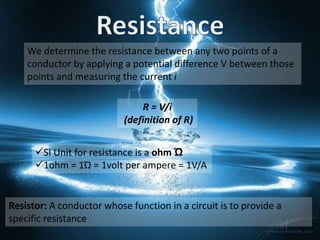
We determine the resistance between any two points of a
    conductor by applying a potential difference V between those
    points and measuring the current i

                               R = V/i
                           (definition of R)


      SI Unit for resistance is a ohm Ώ
      1ohm = 1Ώ = 1volt per ampere = 1V/A


Resistor: A conductor whose function in a circuit is to provide a
specific resistance
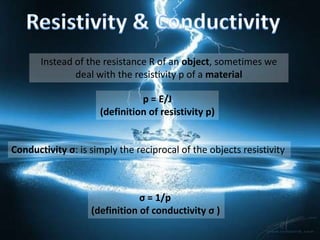
Instead of the resistance R of an object, sometimes we
               deal with the resistivity p of a material

                               p = E/J
                     (definition of resistivity p)


Conductivity σ: is simply the reciprocal of the objects resistivity


                               σ = 1/p
                   (definition of conductivity σ )
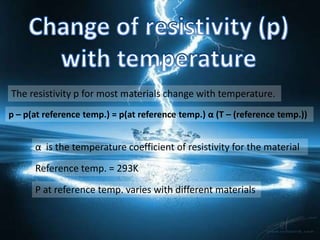
The resistivity p for most materials change with temperature.
p – p(at reference temp.) = p(at reference temp.) α (T – (reference temp.))


      α is the temperature coefficient of resistivity for the material

      Reference temp. = 293K

      P at reference temp. varies with different materials
Ohm’s law is an assertion that the current through a device is
always directly proportional to the potential difference applied to
the device

A conducting device obeys Ohm’s law when the resistance of the
device is independent of the magnitude and polarity of the applied
potential difference.

A conducting material obeys Ohm’s law when the resistivity of the
material is independent o the magnitude and direction o the applied
electric force .
The power P, or rate of energy transfer, in an
electrical device across with a potential difference V
is maintained as

                          P = iV
          (rate of electrical energy transfer)

  The SI unit of power is the volt-ampere (V x A)
Semiconductors are materials that have few
conduction electrons but can become conductors
when they are doped with other atoms that contribute
free electrons
Superconductors are materials that lose all electrical
resistance at low temperatures. Research has
discovered materials that are superconducting at
surprisingly high temps
•What are the SI units of electric current?
Resistance? Resistivity?

•How do you find the electric current? Current
density? Resistance? Conductivity? Power?

•Can resistivity change by varying the temperature?
If yes how so

•Do you have any questions regarding the material
we just covered?
Pg 698-699 do 1-9 ALL!


Next class we will be going over the homework then starting chapter 27
“Fundamentals of Physics 9th Edition”
By Halliday & Resnick
Pages 682-698

Background Image
http://mobile.brothersoft.com/29876.html

Edu290 physics powerpoint

  • 1.
    Mr. Miller APPhysics Fall 2012 Pages 682-698 Ray Miller Edu. 290 Fundamentals of Physics Dr. Merril 9th Edition February 28, 2012 Halliday & Resnick
  • 2.
    Current: Flowing movementin a liquid gas, plasma, or other forms of mater. (stream of moving charges) Resistance: Measure of the degree to which a substance impedes the flow of electric current induced by a voltage. - good insulators have a high resistance
  • 3.
    Knowledge of currentand resistance is essential in many careers Meteorologists Biologists Physiologists Engineers Electric Engineers Etc…. Eg: A meteorologist concerned with lightning uses the flow of charge through the atmosphere to predict whether or not lightning is likely. Ps: It’s also good to know electrical components such as current and resistance to fix devices, check dead wires, and to prevent starting a electrical fire or shocking yourself!
  • 4.
     Although thoughthe definition of a current was a stream of moving charges. Not all moving charges produce an electric current. The unit of current is ampere (A) also known as the amp The ampere is a measure of the amount of electric charge passing a point in a electric circuit 1 ampere = 1A = 1 coulomb per second = 1 C/s i = dq/dt (definition of current) dq = deritive of charge dt = deritative of time i = (charge per electron) (electrons per molecule) (molecules per second)
  • 5.
    Current Density isthe current through a particular conductor  Symbol is J with → over head showing a vector component  Has the same direction as the velocity of the moving charges if they are positive and opposite direction is it’s negative i = ∫ J ∙ dA (total current through the surface) dA = derivative of the area vector also can be written as J = i/A
  • 6.
    We determine theresistance between any two points of a conductor by applying a potential difference V between those points and measuring the current i R = V/i (definition of R) SI Unit for resistance is a ohm Ώ 1ohm = 1Ώ = 1volt per ampere = 1V/A Resistor: A conductor whose function in a circuit is to provide a specific resistance
  • 7.
    Instead of theresistance R of an object, sometimes we deal with the resistivity p of a material p = E/J (definition of resistivity p) Conductivity σ: is simply the reciprocal of the objects resistivity σ = 1/p (definition of conductivity σ )
  • 8.
    The resistivity pfor most materials change with temperature. p – p(at reference temp.) = p(at reference temp.) α (T – (reference temp.)) α is the temperature coefficient of resistivity for the material Reference temp. = 293K P at reference temp. varies with different materials
  • 9.
    Ohm’s law isan assertion that the current through a device is always directly proportional to the potential difference applied to the device A conducting device obeys Ohm’s law when the resistance of the device is independent of the magnitude and polarity of the applied potential difference. A conducting material obeys Ohm’s law when the resistivity of the material is independent o the magnitude and direction o the applied electric force .
  • 10.
    The power P,or rate of energy transfer, in an electrical device across with a potential difference V is maintained as P = iV (rate of electrical energy transfer) The SI unit of power is the volt-ampere (V x A)
  • 11.
    Semiconductors are materialsthat have few conduction electrons but can become conductors when they are doped with other atoms that contribute free electrons
  • 12.
    Superconductors are materialsthat lose all electrical resistance at low temperatures. Research has discovered materials that are superconducting at surprisingly high temps
  • 13.
    •What are theSI units of electric current? Resistance? Resistivity? •How do you find the electric current? Current density? Resistance? Conductivity? Power? •Can resistivity change by varying the temperature? If yes how so •Do you have any questions regarding the material we just covered?
  • 14.
    Pg 698-699 do1-9 ALL! Next class we will be going over the homework then starting chapter 27
  • 15.
    “Fundamentals of Physics9th Edition” By Halliday & Resnick Pages 682-698 Background Image http://mobile.brothersoft.com/29876.html