Current
2
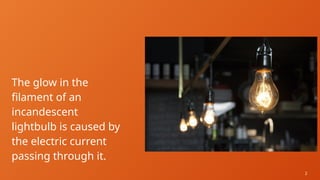
The glow in the
filament of an
incandescent
lightbulb is caused by
the electric current
passing through it.
3
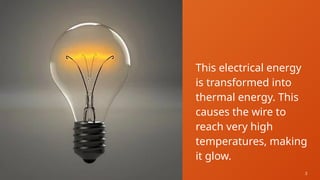
This electrical energy
is transformed into
thermal energy. This
causes the wire to
reach very high
temperatures, making
it glow.
4
Every day, we observe the application of electric
current in several electrical devices.
5
Electric current exists in conductors such as
wires, semiconductors, and even in human
cells.
In this lesson, we will learn about the motion of
charges and other factors affecting it.
6
How do charges move in a
conductor?
7
Electricity
What examples in real life do you use electricity?
8
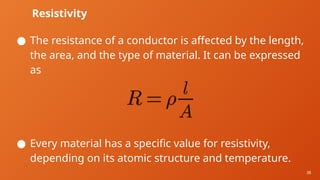
Electric Current
● Any movement of charges from one region to another
is called current.
● Specifically, the electric current is defined as the net
charge flowing through an area per unit time.
9
Electric Current
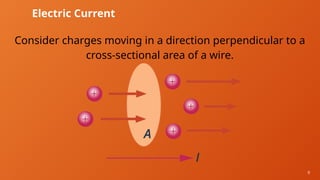
Consider charges moving in a direction perpendicular to a
cross-sectional area of a wire.
10
Electric Current
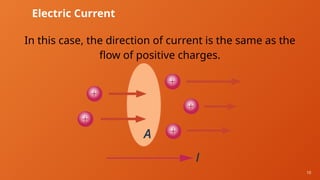
In this case, the direction of current is the same as the
flow of positive charges.
11
Electric Current
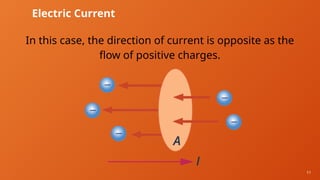
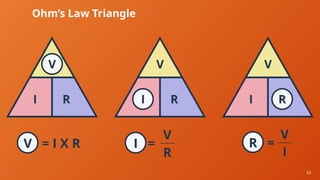
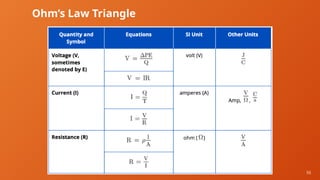
In this case, the direction of current is opposite as the
flow of positive charges.
12
Electric Current
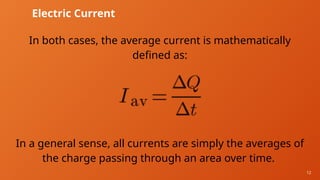
In both cases, the average current is mathematically
defined as:
In a general sense, all currents are simply the averages of
the charge passing through an area over time.
13
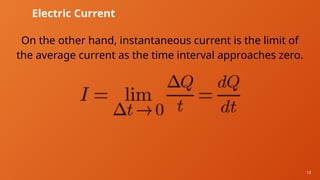
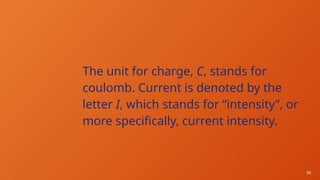
Electric Current
On the other hand, instantaneous current is the limit of
the average current as the time interval approaches zero.
14
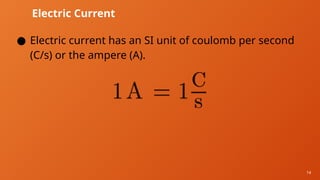
Electric Current
● Electric current has an SI unit of coulomb per second
(C/s) or the ampere (A).
15
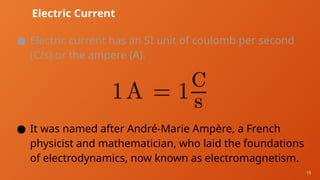
Electric Current
● Electric current has an SI unit of coulomb per second
(C/s) or the ampere (A).
● It was named after André-Marie Ampère, a French
physicist and mathematician, who laid the foundations
of electrodynamics, now known as electromagnetism.
16
Electric Current
● Charges flowing through a surface can be positive,
negative, or both.
17
Electric Current
● Charges flowing through a surface can be positive,
negative, or both.
● In metals, moving charges or charge carriers are
always negative.
18
Electric Current
● Charges flowing through a surface can be positive,
negative, or both.
● In metals, moving charges or charge carriers are
always negative.
● In plasma, these charges may include both positively-
and negatively-charged ions.
19
Electric Current
● The conventional current is defined based on the
direction of the flow of positive charges.
20
Electric Current
● The conventional current is defined based on the
direction of the flow of positive charges.
● The opposite of the conventional current is electron
flow.
21
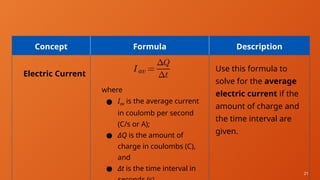
Concept Formula Description
Electric Current
where
● Iav is the average current
in coulomb per second
(C/s or A);
● ΔQ is the amount of
charge in coulombs (C),
and
● Δt is the time interval in
Use this formula to
solve for the average
electric current if the
amount of charge and
the time interval are
given.
Resistance
23
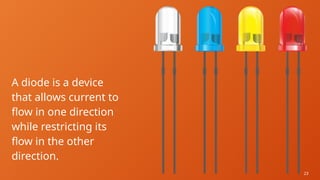
A diode is a device
that allows current to
flow in one direction
while restricting its
flow in the other
direction.
24
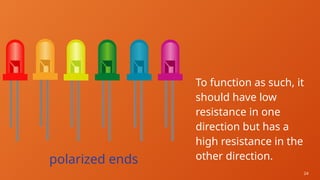
To function as such, it
should have low
resistance in one
direction but has a
high resistance in the
other direction.
polarized ends
25
Semiconductors, such as silicon, can be
effectively used in this specific application.
26
What is resistance?
27
Resistance
When you hear the word resistance, what comes in your
mind?
28
Resistance
Is it something you fight for?
29
Resistance
Or is it something that fights over all else?
30
Resistance
● Resistance is the opposition of a material to the flow of
charges.
31
Resistance
● Resistance is the opposition of a material to the flow of
charges.
● This flow is hindered by the collisions of atoms within
the conductor.
32
Resistance
● Resistance is the opposition of a material to the flow of
charges.
● This flow is hindered by the collisions of atoms within
the conductor.
● Resistance is also defined as the proportionality factor
between the voltage and the current passing through
the wire, expressed as R = V/I.
33
Resistance
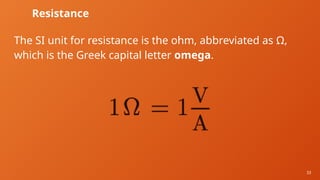
The SI unit for resistance is the ohm, abbreviated as Ω,
which is the Greek capital letter omega.
34
Resistance
● All electrical devices have a specific resistance to the
current.
○ load: electric heaters, filaments in light bulbs
○ wires
35
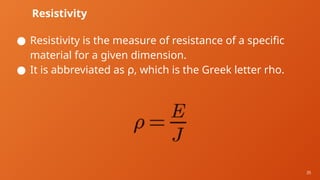
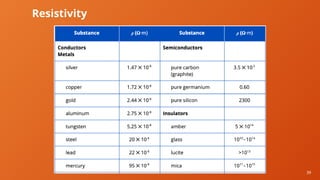
Resistivity
● Resistivity is the measure of resistance of a specific
material for a given dimension.
● It is abbreviated as ⍴, which is the Greek letter rho.
36
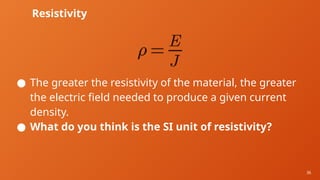
Resistivity
● The greater the resistivity of the material, the greater
the electric field needed to produce a given current
density.
● What do you think is the SI unit of resistivity?
37
How is resistance related to
resistivity?
38
Resistivity
● The resistance of a conductor is affected by the length,
the area, and the type of material. It can be expressed
as
● Every material has a specific value for resistivity,
depending on its atomic structure and temperature.
39
Resistivity
40
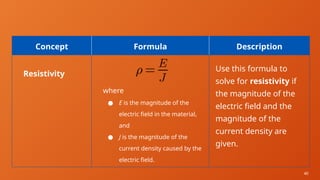
Concept Formula Description
Resistivity
where
● E is the magnitude of the
electric field in the material,
and
● J is the magnitude of the
current density caused by the
electric field.
Use this formula to
solve for resistivity if
the magnitude of the
electric field and the
magnitude of the
current density are
given.
41
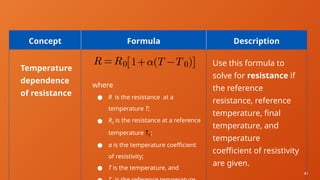
Concept Formula Description
Temperature
dependence
of resistance
where
● R is the resistance at a
temperature T;
● R0 is the resistance at a reference
temperature T0;
● α is the temperature coefficient
of resistivity;
● T is the temperature, and
Use this formula to
solve for resistance if
the reference
resistance, reference
temperature, final
temperature, and
temperature
coefficient of resistivity
are given.
Ohm’s Law
43
Ohm’s law is
considered as one of
the foundations of
electronics. Its uses
span across both
domestic and
industrial
applications.
44
It is so prevalent that
even our own nervous
system operates in
accordance with it.
45
Our nerve cells store electrochemical potentials
that then become responsible for the production
of signals essential for the various functions.
46
What does Ohm’s law state?
47
What relations among current,
resistance, and voltage can we
deduce from the formula V = IR?
48
Recall
Can you define current, voltage, and resistance?
What analogy can you think of these variables?
Can you identify real-life scenarios that involve these
variables?
49
Recall
A conductive path that permits the continuous flow of
charge, called current, driven by the voltage and
opposed to some degree by resistance, forms an electric
circuit.
50
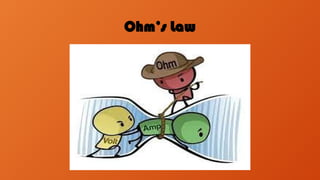
Ohm’s Law
Ohm’s law states that the amount of current in a given
circuit is determined by the amount of voltage and
resistance present in the system.
51
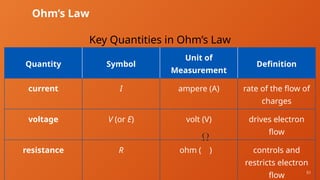
Ohm’s Law
Key Quantities in Ohm’s Law
Quantity Symbol
Unit of
Measurement
Definition
current I ampere (A) rate of the flow of
charges
voltage V (or E) volt (V) drives electron
flow
resistance R ohm ( ) controls and
restricts electron
flow
52
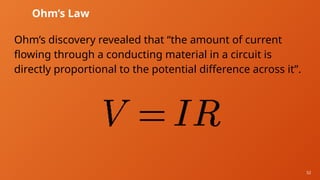
Ohm’s Law
Ohm’s discovery revealed that “the amount of current
flowing through a conducting material in a circuit is
directly proportional to the potential difference across it”.
53
Ohm’s Law Triangle
54
What does the Ohm’s law state?
55
Ohm’s Law Triangle
56
The unit for charge, C, stands for
coulomb. Current is denoted by the
letter I, which stands for “intensity”, or
more specifically, current intensity.

Current and Resistance/Resistivity .pptx

  • 1.
  • 2.
    2 The glow inthe filament of an incandescent lightbulb is caused by the electric current passing through it.
  • 3.
    3 This electrical energy istransformed into thermal energy. This causes the wire to reach very high temperatures, making it glow.
  • 4.
    4 Every day, weobserve the application of electric current in several electrical devices.
  • 5.
    5 Electric current existsin conductors such as wires, semiconductors, and even in human cells. In this lesson, we will learn about the motion of charges and other factors affecting it.
  • 6.
    6 How do chargesmove in a conductor?
  • 7.
    7 Electricity What examples inreal life do you use electricity?
  • 8.
    8 Electric Current ● Anymovement of charges from one region to another is called current. ● Specifically, the electric current is defined as the net charge flowing through an area per unit time.
  • 9.
    9 Electric Current Consider chargesmoving in a direction perpendicular to a cross-sectional area of a wire.
  • 10.
    10 Electric Current In thiscase, the direction of current is the same as the flow of positive charges.
  • 11.
    11 Electric Current In thiscase, the direction of current is opposite as the flow of positive charges.
  • 12.
    12 Electric Current In bothcases, the average current is mathematically defined as: In a general sense, all currents are simply the averages of the charge passing through an area over time.
  • 13.
    13 Electric Current On theother hand, instantaneous current is the limit of the average current as the time interval approaches zero.
  • 14.
    14 Electric Current ● Electriccurrent has an SI unit of coulomb per second (C/s) or the ampere (A).
  • 15.
    15 Electric Current ● Electriccurrent has an SI unit of coulomb per second (C/s) or the ampere (A). ● It was named after André-Marie Ampère, a French physicist and mathematician, who laid the foundations of electrodynamics, now known as electromagnetism.
  • 16.
    16 Electric Current ● Chargesflowing through a surface can be positive, negative, or both.
  • 17.
    17 Electric Current ● Chargesflowing through a surface can be positive, negative, or both. ● In metals, moving charges or charge carriers are always negative.
  • 18.
    18 Electric Current ● Chargesflowing through a surface can be positive, negative, or both. ● In metals, moving charges or charge carriers are always negative. ● In plasma, these charges may include both positively- and negatively-charged ions.
  • 19.
    19 Electric Current ● Theconventional current is defined based on the direction of the flow of positive charges.
  • 20.
    20 Electric Current ● Theconventional current is defined based on the direction of the flow of positive charges. ● The opposite of the conventional current is electron flow.
  • 21.
    21 Concept Formula Description ElectricCurrent where ● Iav is the average current in coulomb per second (C/s or A); ● ΔQ is the amount of charge in coulombs (C), and ● Δt is the time interval in Use this formula to solve for the average electric current if the amount of charge and the time interval are given.
  • 22.
  • 23.
    23 A diode isa device that allows current to flow in one direction while restricting its flow in the other direction.
  • 24.
    24 To function assuch, it should have low resistance in one direction but has a high resistance in the other direction. polarized ends
  • 25.
    25 Semiconductors, such assilicon, can be effectively used in this specific application.
  • 26.
  • 27.
    27 Resistance When you hearthe word resistance, what comes in your mind?
  • 28.
  • 29.
    29 Resistance Or is itsomething that fights over all else?
  • 30.
    30 Resistance ● Resistance isthe opposition of a material to the flow of charges.
  • 31.
    31 Resistance ● Resistance isthe opposition of a material to the flow of charges. ● This flow is hindered by the collisions of atoms within the conductor.
  • 32.
    32 Resistance ● Resistance isthe opposition of a material to the flow of charges. ● This flow is hindered by the collisions of atoms within the conductor. ● Resistance is also defined as the proportionality factor between the voltage and the current passing through the wire, expressed as R = V/I.
  • 33.
    33 Resistance The SI unitfor resistance is the ohm, abbreviated as Ω, which is the Greek capital letter omega.
  • 34.
    34 Resistance ● All electricaldevices have a specific resistance to the current. ○ load: electric heaters, filaments in light bulbs ○ wires
  • 35.
    35 Resistivity ● Resistivity isthe measure of resistance of a specific material for a given dimension. ● It is abbreviated as ⍴, which is the Greek letter rho.
  • 36.
    36 Resistivity ● The greaterthe resistivity of the material, the greater the electric field needed to produce a given current density. ● What do you think is the SI unit of resistivity?
  • 37.
    37 How is resistancerelated to resistivity?
  • 38.
    38 Resistivity ● The resistanceof a conductor is affected by the length, the area, and the type of material. It can be expressed as ● Every material has a specific value for resistivity, depending on its atomic structure and temperature.
  • 39.
  • 40.
    40 Concept Formula Description Resistivity where ●E is the magnitude of the electric field in the material, and ● J is the magnitude of the current density caused by the electric field. Use this formula to solve for resistivity if the magnitude of the electric field and the magnitude of the current density are given.
  • 41.
    41 Concept Formula Description Temperature dependence ofresistance where ● R is the resistance at a temperature T; ● R0 is the resistance at a reference temperature T0; ● α is the temperature coefficient of resistivity; ● T is the temperature, and Use this formula to solve for resistance if the reference resistance, reference temperature, final temperature, and temperature coefficient of resistivity are given.
  • 42.
  • 43.
    43 Ohm’s law is consideredas one of the foundations of electronics. Its uses span across both domestic and industrial applications.
  • 44.
    44 It is soprevalent that even our own nervous system operates in accordance with it.
  • 45.
    45 Our nerve cellsstore electrochemical potentials that then become responsible for the production of signals essential for the various functions.
  • 46.
  • 47.
    47 What relations amongcurrent, resistance, and voltage can we deduce from the formula V = IR?
  • 48.
    48 Recall Can you definecurrent, voltage, and resistance? What analogy can you think of these variables? Can you identify real-life scenarios that involve these variables?
  • 49.
    49 Recall A conductive paththat permits the continuous flow of charge, called current, driven by the voltage and opposed to some degree by resistance, forms an electric circuit.
  • 50.
    50 Ohm’s Law Ohm’s lawstates that the amount of current in a given circuit is determined by the amount of voltage and resistance present in the system.
  • 51.
    51 Ohm’s Law Key Quantitiesin Ohm’s Law Quantity Symbol Unit of Measurement Definition current I ampere (A) rate of the flow of charges voltage V (or E) volt (V) drives electron flow resistance R ohm ( ) controls and restricts electron flow
  • 52.
    52 Ohm’s Law Ohm’s discoveryrevealed that “the amount of current flowing through a conducting material in a circuit is directly proportional to the potential difference across it”.
  • 53.
  • 54.
    54 What does theOhm’s law state?
  • 55.
  • 56.
    56 The unit forcharge, C, stands for coulomb. Current is denoted by the letter I, which stands for “intensity”, or more specifically, current intensity.