Made by:
Shreyaans M. Nahata
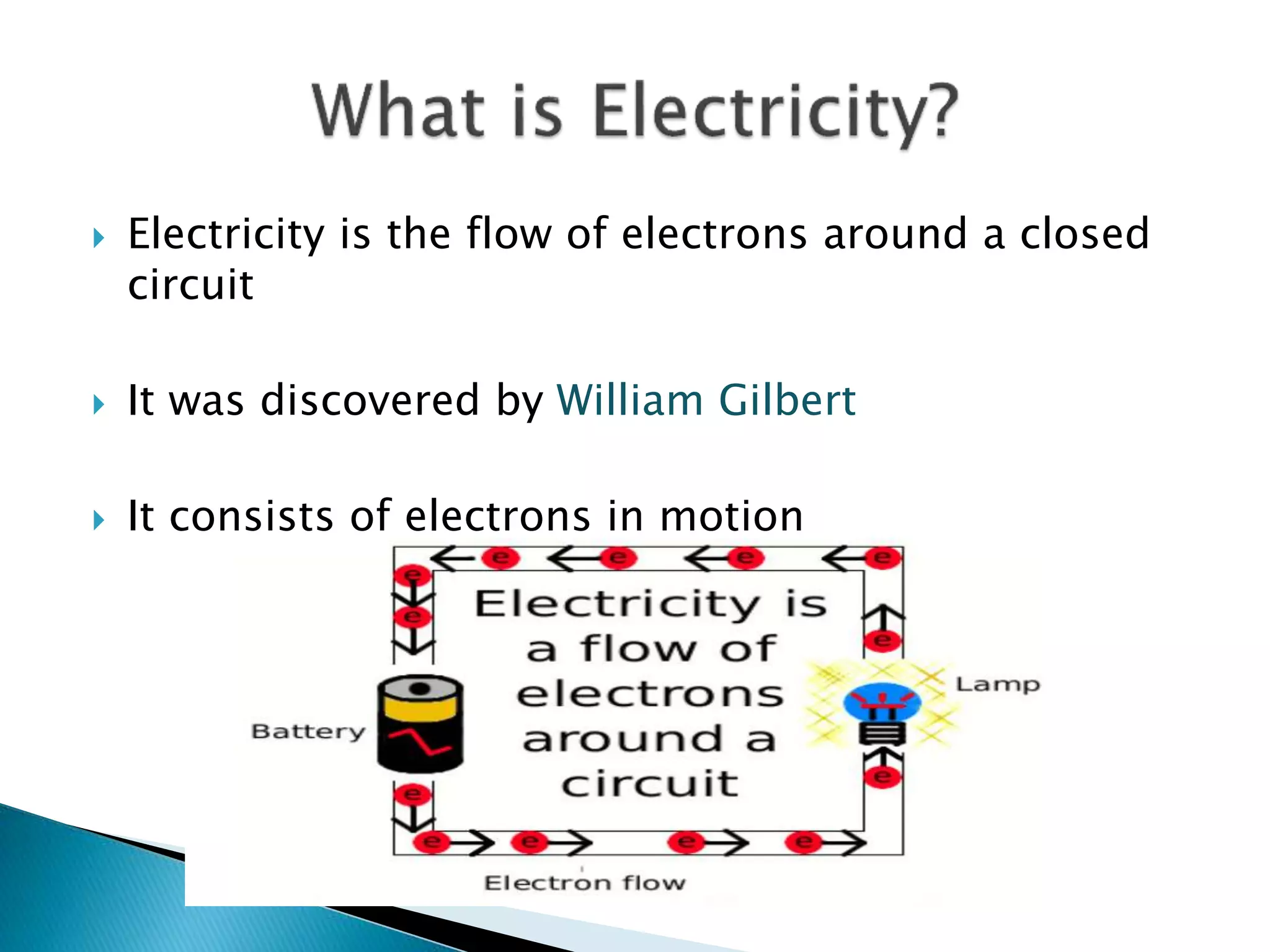
 Electricity is the flow of electrons around a closed
circuit
 It was discovered by William Gilbert
 It consists of electrons in motion
 Conductors are those materials that allow
flow of electricity through them
 They can conduct electricity because of the
presence of free electrons between the atoms
of the substance
 All the metals are good conductors of
electricity and graphite (the only non metal)
can also conduct electricity
 Insulators are those materials that do not
allow flow of electricity through them
 They cannot conduct electricity because they
don’t have free electrons between their atoms
 All the non metals (except graphite) are
insulators
 When a glass rod is rubbed with a silk cloth,
it acquires the ability to attract small
particles of paper and is said to have
acquired an ‘Electric Charge’
 S.I. unit of electric charge is ‘Coulomb’
 Symbol for coulomb is ‘C’
 Electric current is the flow of electrons
through a conducting material (like copper,
iron, etc.)
 The device that causes the flow of electrons
is called a cell (or a battery if 2 or more
cells are connected in a row)
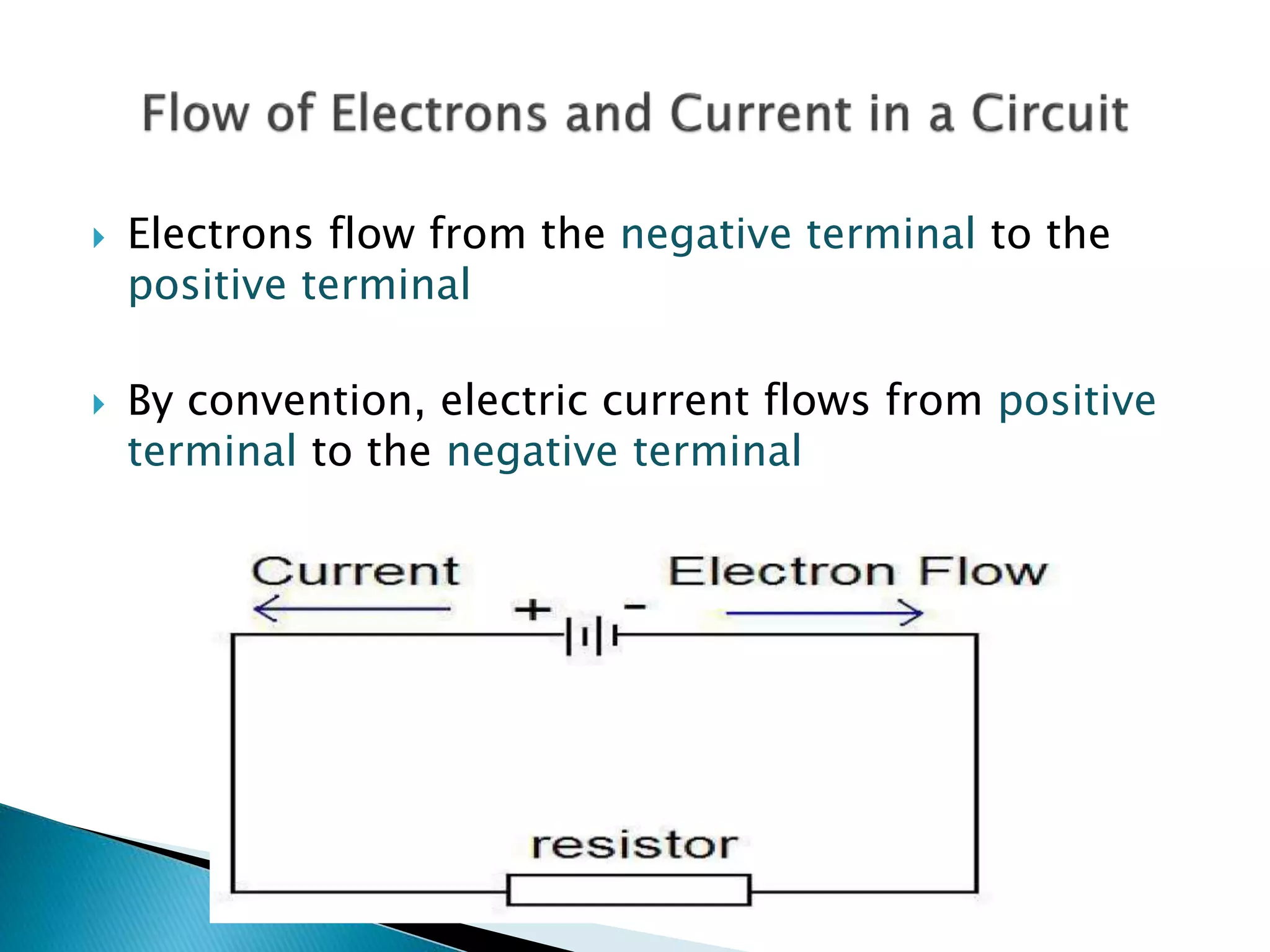
 Electrons flow from the negative terminal to the
positive terminal
 By convention, electric current flows from positive
terminal to the negative terminal
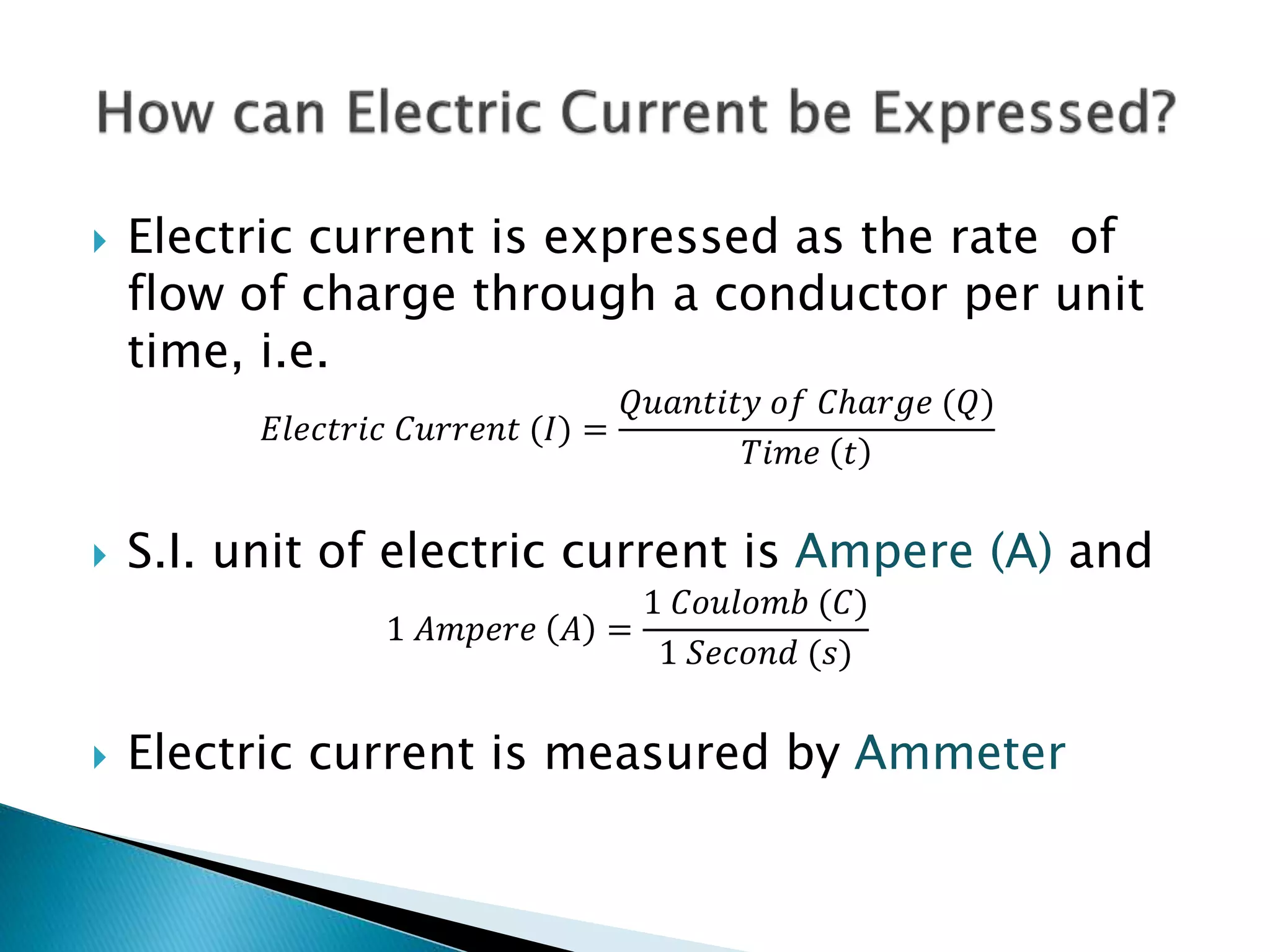
 Electric current is expressed as the rate of
flow of charge through a conductor per unit
time, i.e.
𝐸𝑙𝑒𝑐𝑡𝑟𝑖𝑐 𝐶𝑢𝑟𝑟𝑒𝑛𝑡 (𝐼) =
𝑄𝑢𝑎𝑛𝑡𝑖𝑡𝑦 𝑜𝑓 𝐶ℎ𝑎𝑟𝑔𝑒 (𝑄)
𝑇𝑖𝑚𝑒 𝑡
 S.I. unit of electric current is Ampere (A) and
1 𝐴𝑚𝑝𝑒𝑟𝑒 𝐴 =
1 𝐶𝑜𝑢𝑙𝑜𝑚𝑏 (𝐶)
1 𝑆𝑒𝑐𝑜𝑛𝑑 (𝑠)
 Electric current is measured by Ammeter
 Electric potential is the capability of a charge to
move unit positive charge from one point to
another
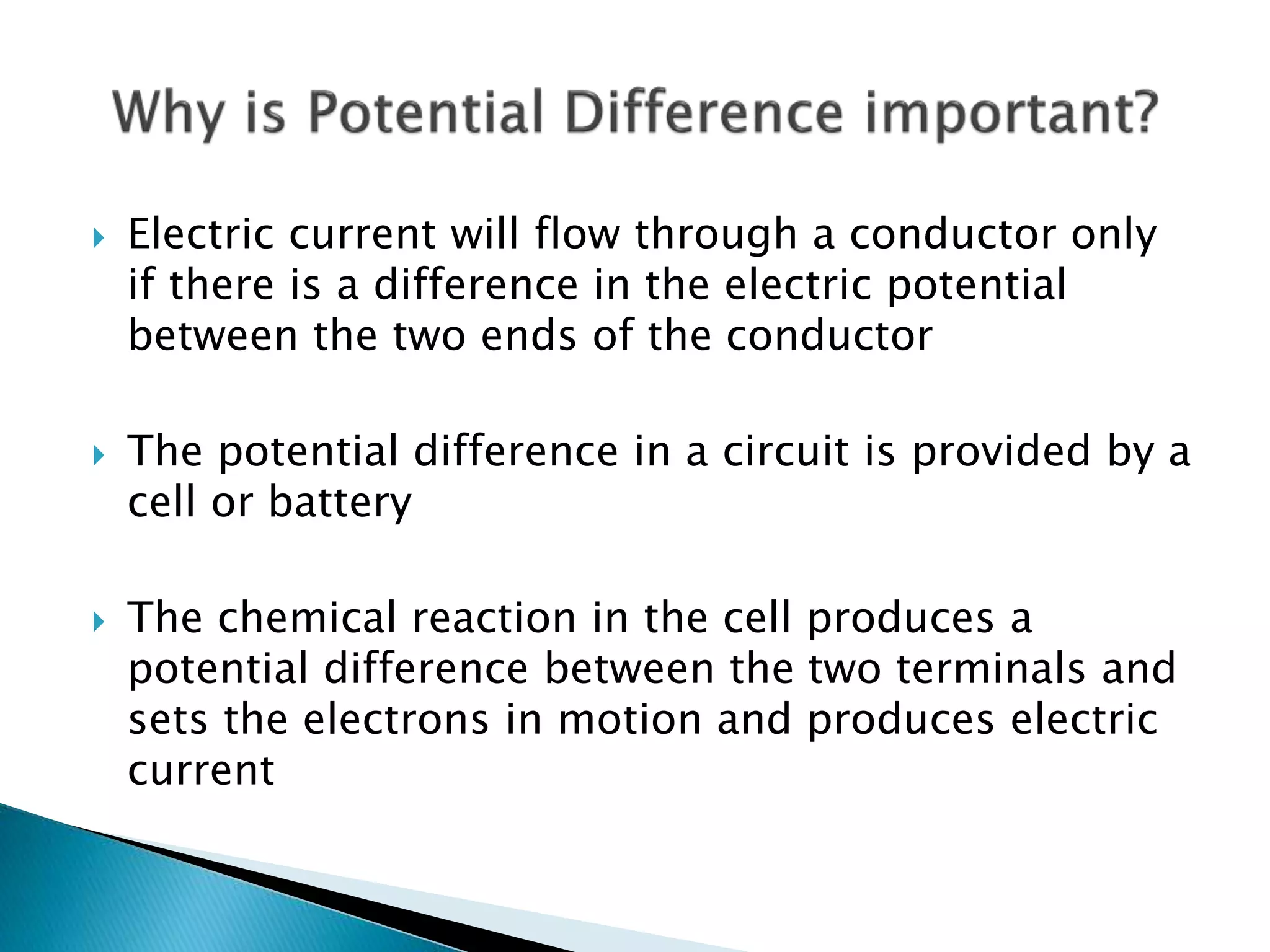
 Electric potential difference is the work done to
bring unit positive charge from one point to
another, i.e.
P𝑜𝑡𝑒𝑛𝑡𝑖𝑎𝑙 𝐷𝑖𝑓𝑓𝑒𝑟𝑒𝑛𝑐𝑒 (𝑉) =
𝑊𝑜𝑟𝑘 𝑑𝑜𝑛𝑒 (𝑊)
𝐶ℎ𝑎𝑟𝑔𝑒 (𝑄)
 S.I unit of potential difference is Voltage (V) and is
measured by Voltmeter
 Electric current will flow through a conductor only
if there is a difference in the electric potential
between the two ends of the conductor
 The potential difference in a circuit is provided by a
cell or battery
 The chemical reaction in the cell produces a
potential difference between the two terminals and
sets the electrons in motion and produces electric
current
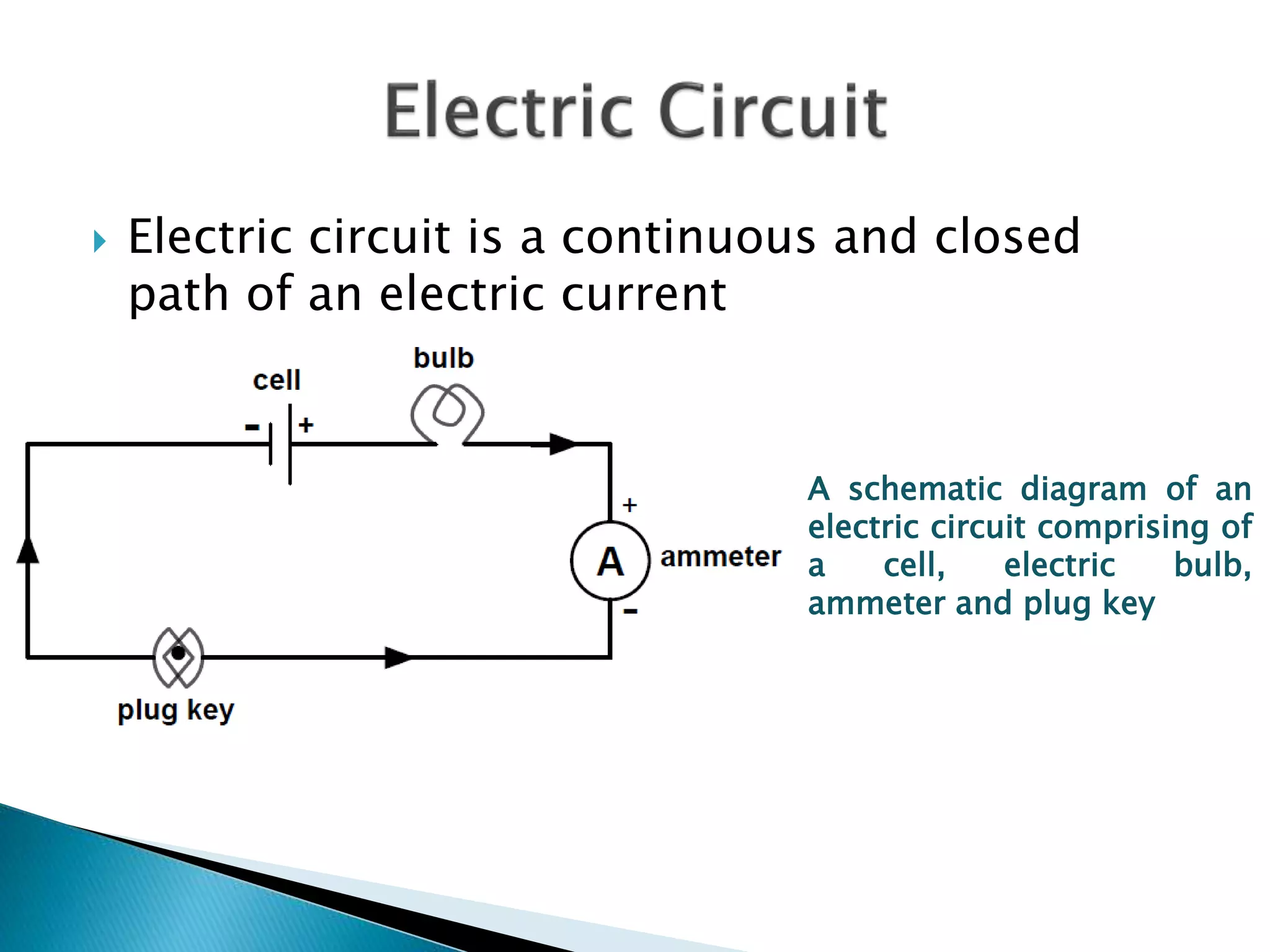
 Electric circuit is a continuous and closed
path of an electric current
A schematic diagram of an
electric circuit comprising of
a cell, electric bulb,
ammeter and plug key
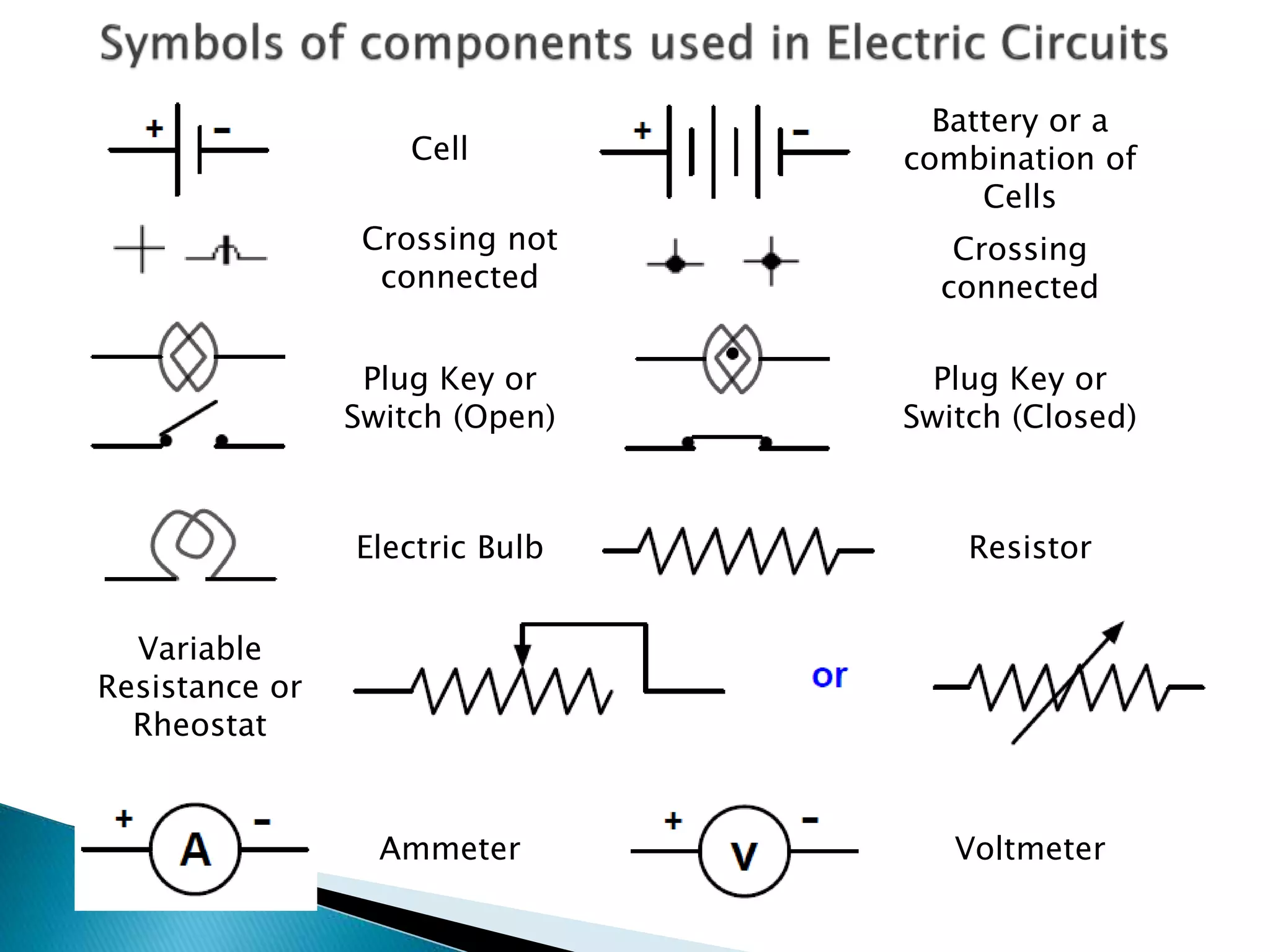
Cell
Plug Key or
Switch (Open)
Battery or a
combination of
Cells
Plug Key or
Switch (Closed)
Electric Bulb Resistor
Variable
Resistance or
Rheostat
Ammeter Voltmeter
Crossing not
connected
Crossing
connected
 Voltmeter is a device that measures the
potential difference across the ends of any
conducting material
 It is connected in parallel to the ends of the
conducting material
 It has high resistance
 Ammeter is a device that measures
the current flowing through any
conducting material
 It is connected in series to the
conducting material
 It has low resistance
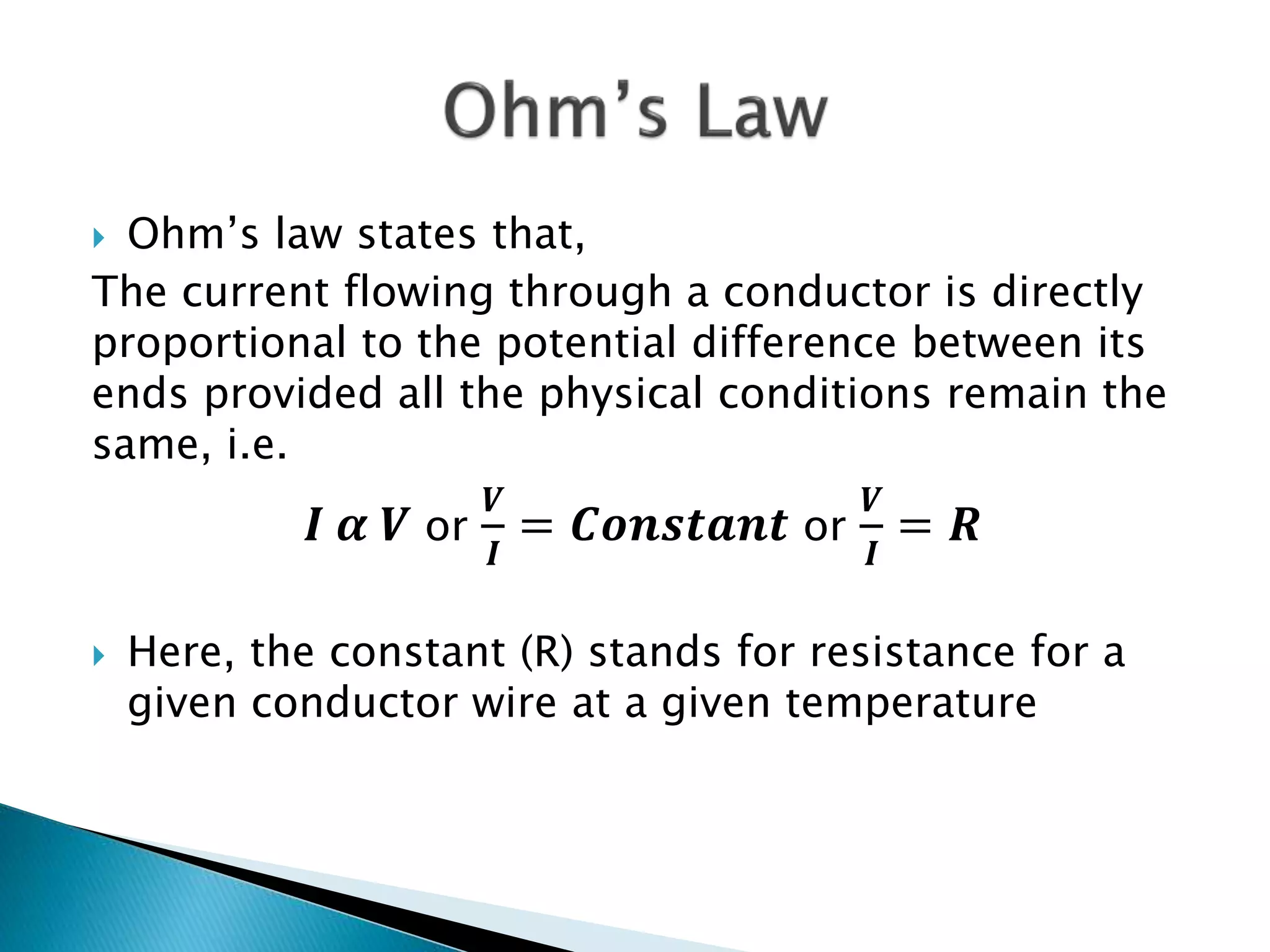
 Ohm’s law states that,
The current flowing through a conductor is directly
proportional to the potential difference between its
ends provided all the physical conditions remain the
same, i.e.
𝑰 𝜶 𝑽 or
𝑽
𝑰
= 𝑪𝒐𝒏𝒔𝒕𝒂𝒏𝒕 or
𝑽
𝑰
= 𝑹
 Here, the constant (R) stands for resistance for a
given conductor wire at a given temperature
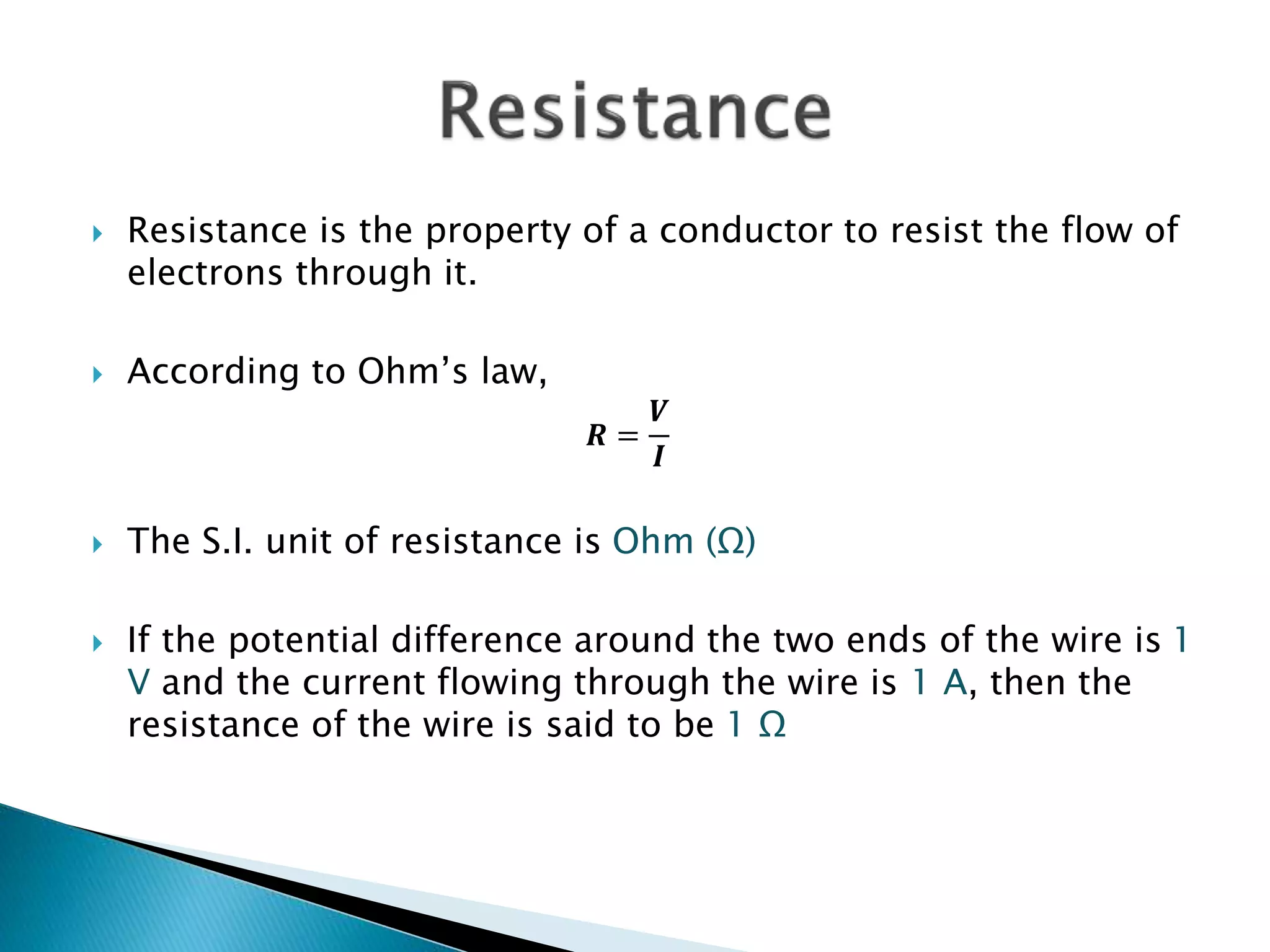
 Resistance is the property of a conductor to resist the flow of
electrons through it.
 According to Ohm’s law,
𝑹 =
𝑽
𝑰
 The S.I. unit of resistance is Ohm (Ω)
 If the potential difference around the two ends of the wire is 1
V and the current flowing through the wire is 1 A, then the
resistance of the wire is said to be 1 Ω
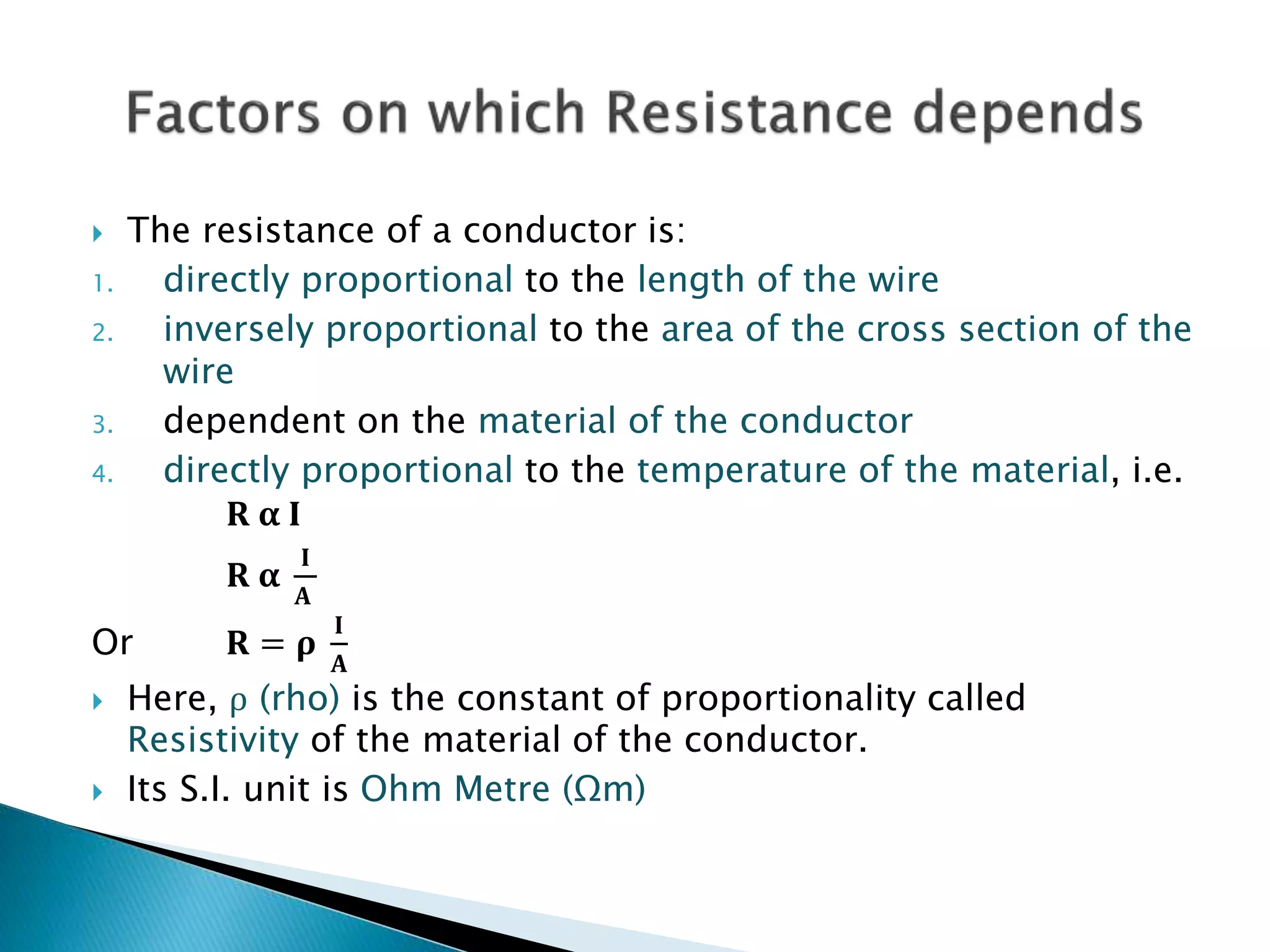
 The resistance of a conductor is:
1. directly proportional to the length of the wire
2. inversely proportional to the area of the cross section of the
wire
3. dependent on the material of the conductor
4. directly proportional to the temperature of the material, i.e.
𝐑 𝛂 𝐈
𝐑 𝛂
𝐈
𝐀
Or 𝐑 = 𝛒
𝐈
𝐀
 Here, ρ (rho) is the constant of proportionality called
Resistivity of the material of the conductor.
 Its S.I. unit is Ohm Metre (Ωm)
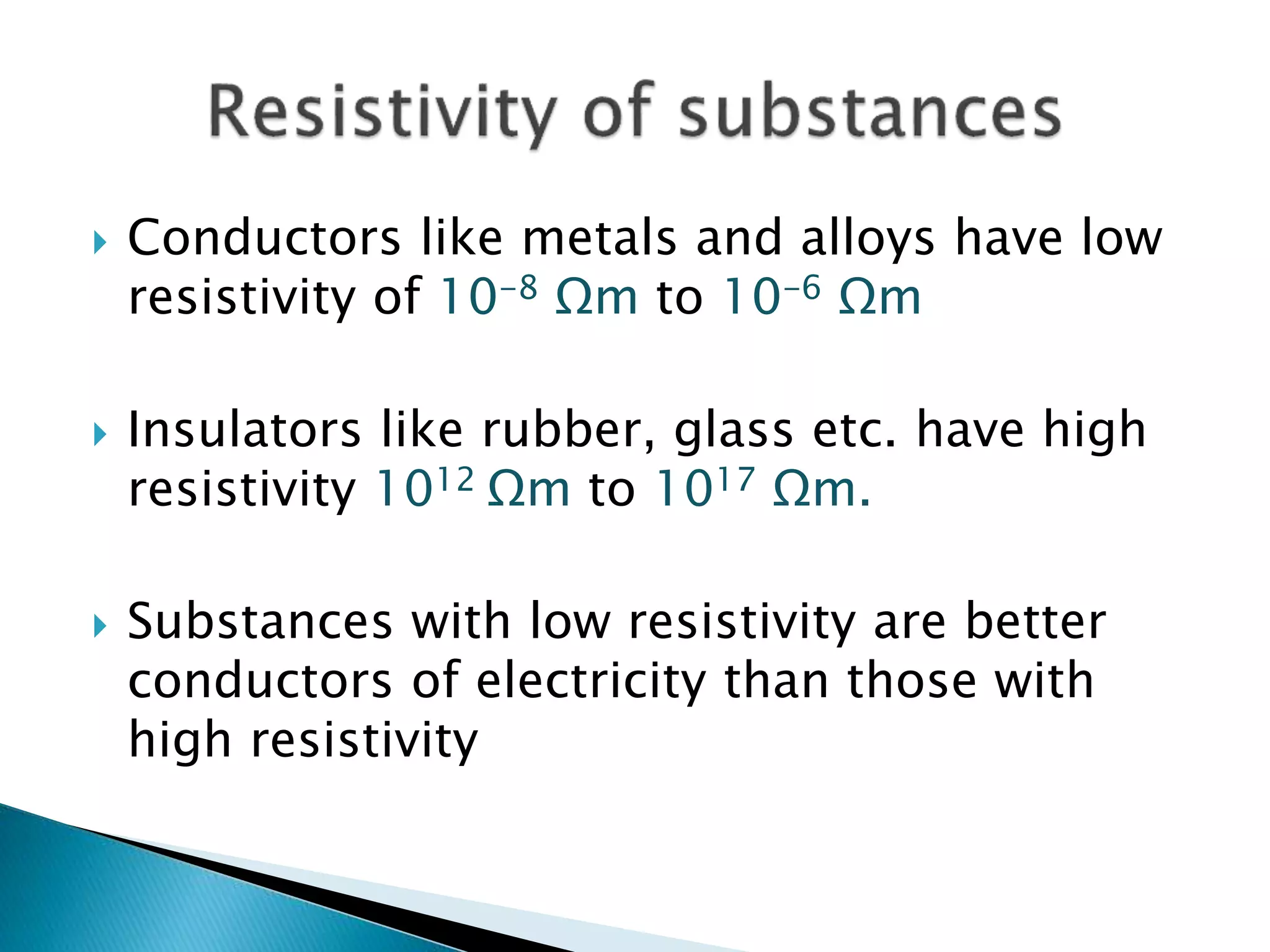
 Conductors like metals and alloys have low
resistivity of 10-8 Ωm to 10-6 Ωm
 Insulators like rubber, glass etc. have high
resistivity 1012 Ωm to 1017 Ωm.
 Substances with low resistivity are better
conductors of electricity than those with
high resistivity
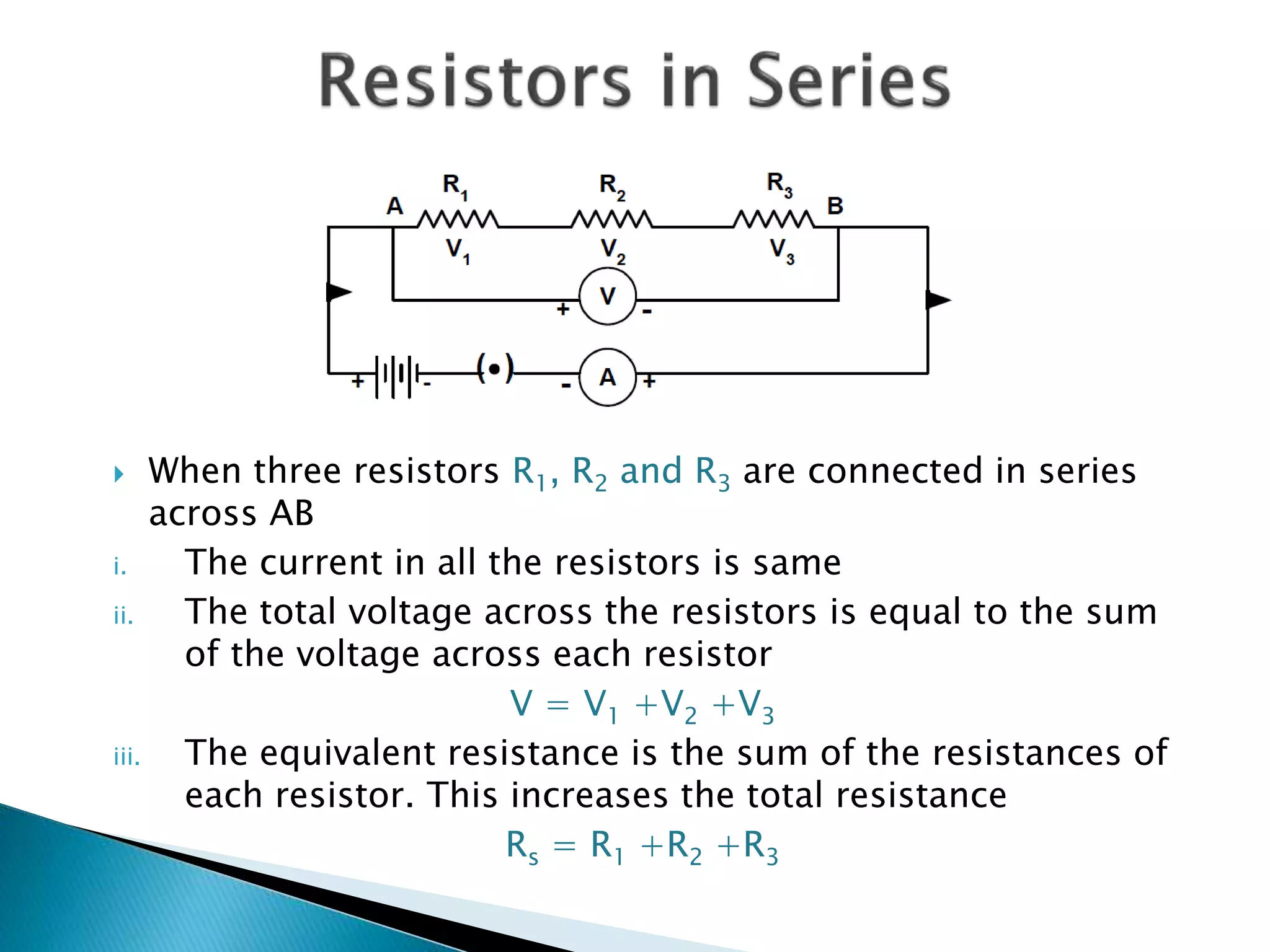
 When three resistors R1, R2 and R3 are connected in series
across AB
i. The current in all the resistors is same
ii. The total voltage across the resistors is equal to the sum
of the voltage across each resistor
V = V1 +V2 +V3
iii. The equivalent resistance is the sum of the resistances of
each resistor. This increases the total resistance
Rs = R1 +R2 +R3
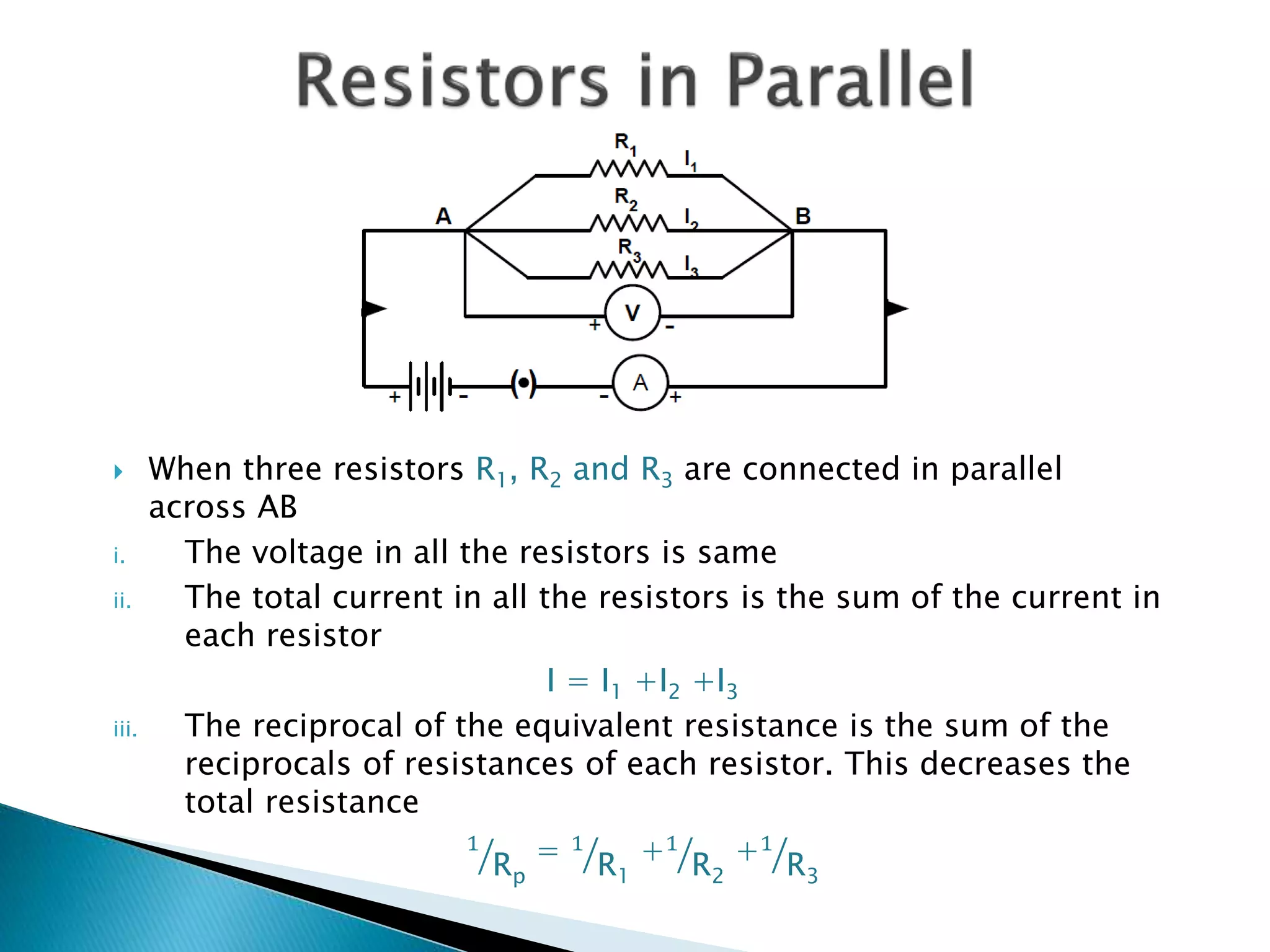
 When three resistors R1, R2 and R3 are connected in parallel
across AB
i. The voltage in all the resistors is same
ii. The total current in all the resistors is the sum of the current in
each resistor
I = I1 +I2 +I3
iii. The reciprocal of the equivalent resistance is the sum of the
reciprocals of resistances of each resistor. This decreases the
total resistance
1
Rp
= 1
R1
+1
R2
+1
R3
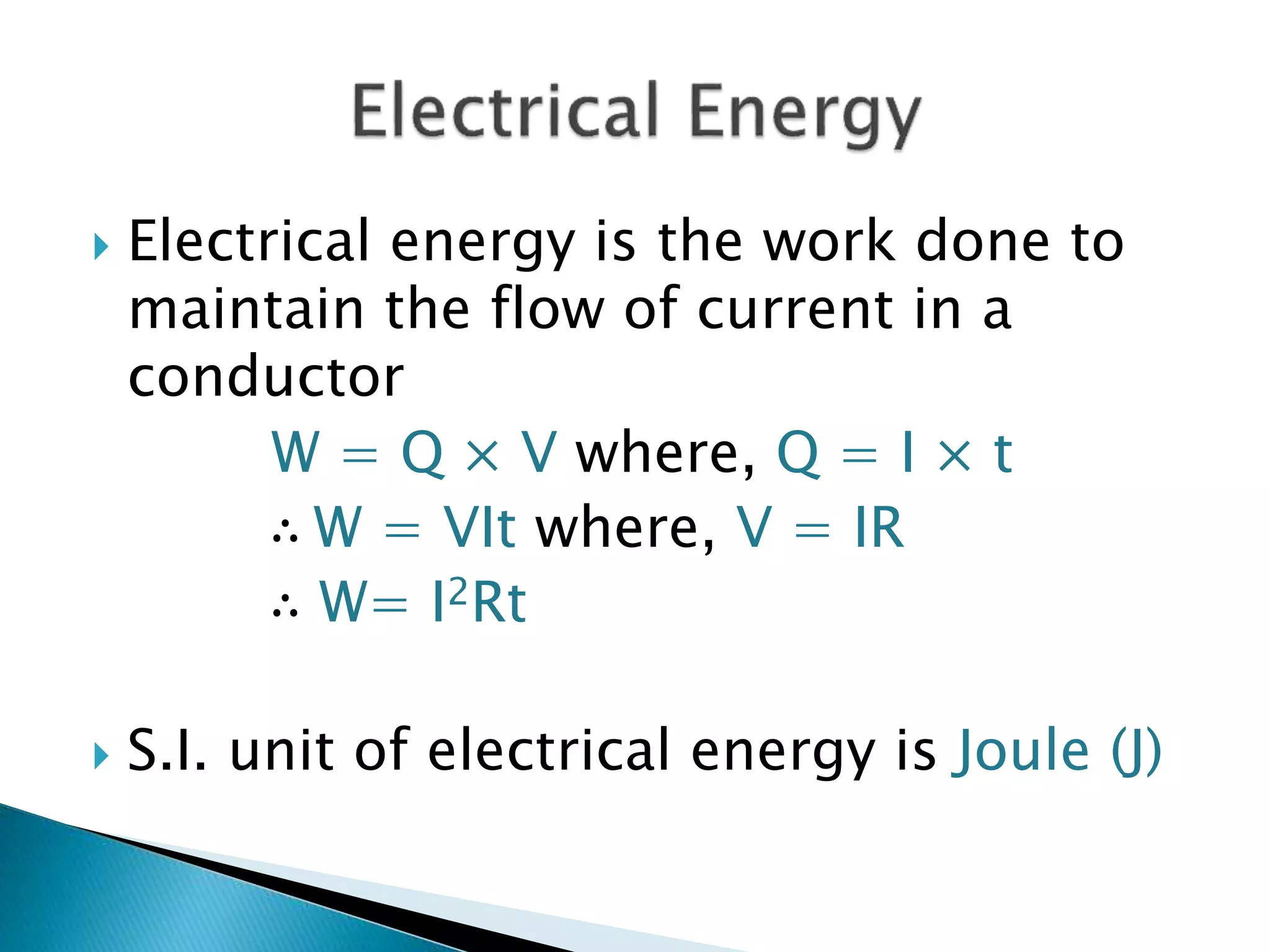
 Electrical energy is the work done to
maintain the flow of current in a
conductor
W = Q × V where, Q = I × t
∴ W = VIt where, V = IR
∴ W= I2Rt
 S.I. unit of electrical energy is Joule (J)
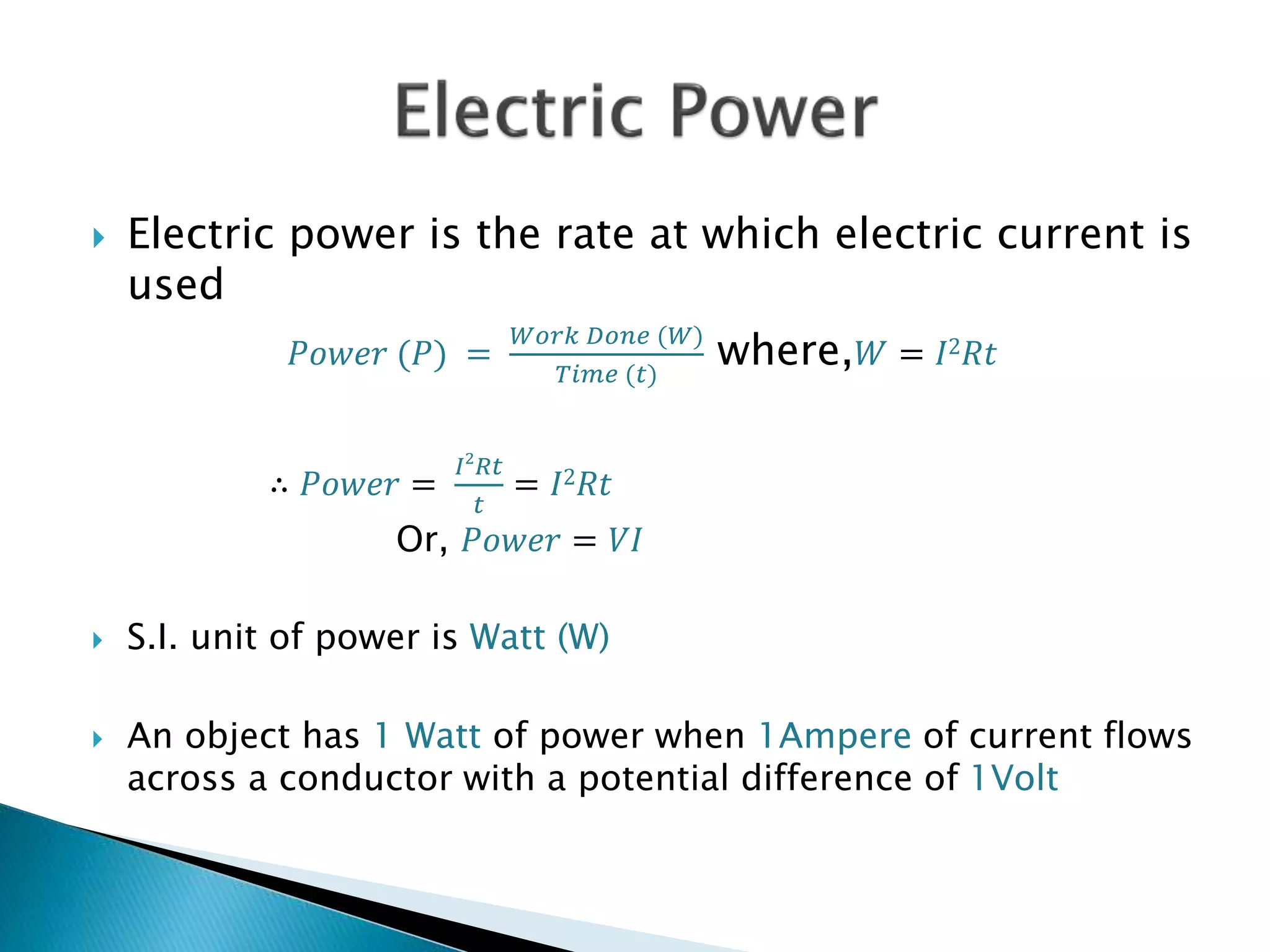
 Electric power is the rate at which electric current is
used
𝑃𝑜𝑤𝑒𝑟 (𝑃) =
𝑊𝑜𝑟𝑘 𝐷𝑜𝑛𝑒 (𝑊)
𝑇𝑖𝑚𝑒 (𝑡)
where, 𝑊 = 𝐼2 𝑅𝑡
∴ 𝑃𝑜𝑤𝑒𝑟 =
𝐼2
𝑅𝑡
𝑡
= 𝐼2 𝑅𝑡
Or, 𝑃𝑜𝑤𝑒𝑟 = 𝑉𝐼
 S.I. unit of power is Watt (W)
 An object has 1 Watt of power when 1Ampere of current flows
across a conductor with a potential difference of 1Volt
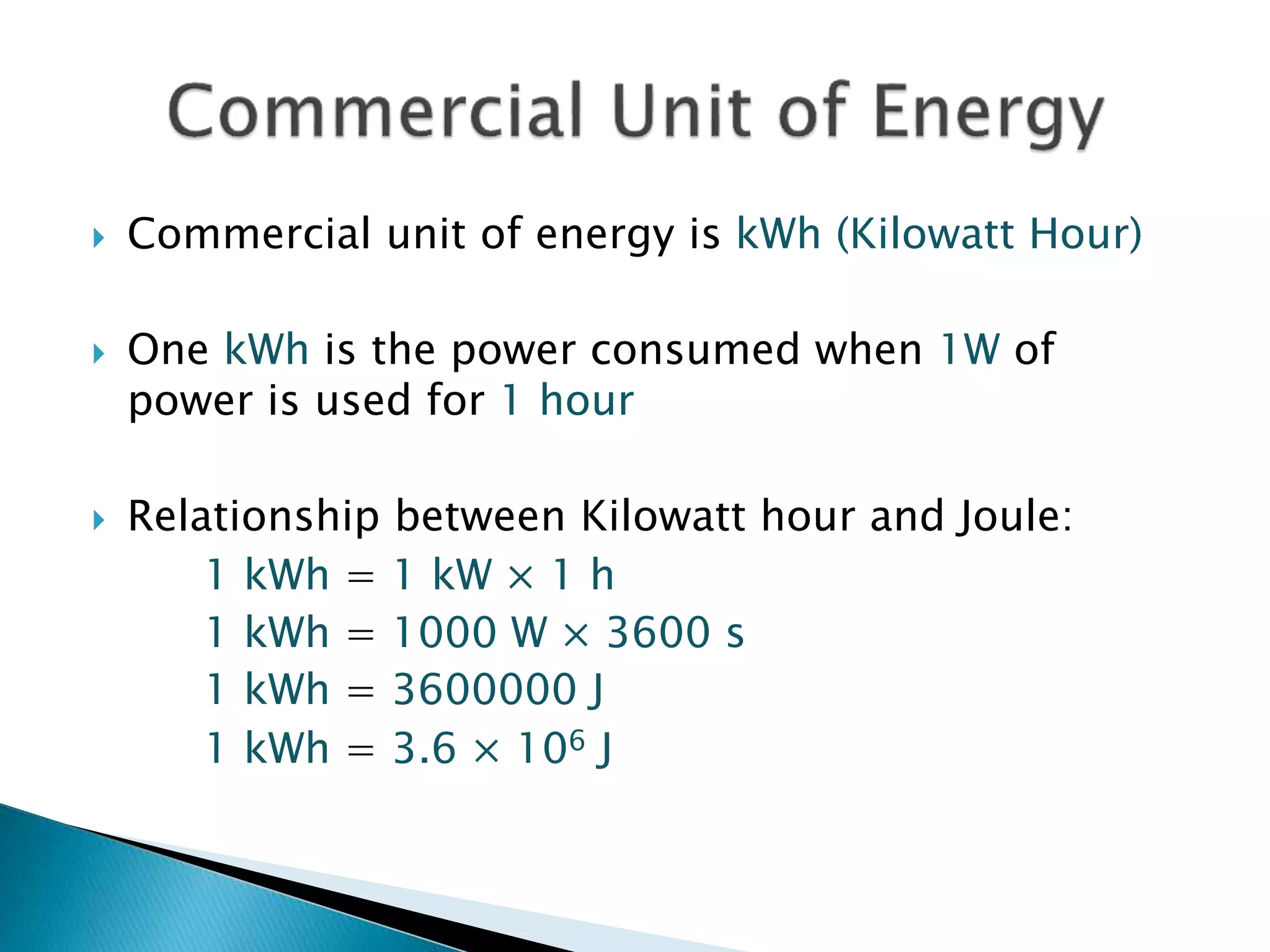
 Commercial unit of energy is kWh (Kilowatt Hour)
 One kWh is the power consumed when 1W of
power is used for 1 hour
 Relationship between Kilowatt hour and Joule:
1 kWh = 1 kW × 1 h
1 kWh = 1000 W × 3600 s
1 kWh = 3600000 J
1 kWh = 3.6 × 10⁶ J
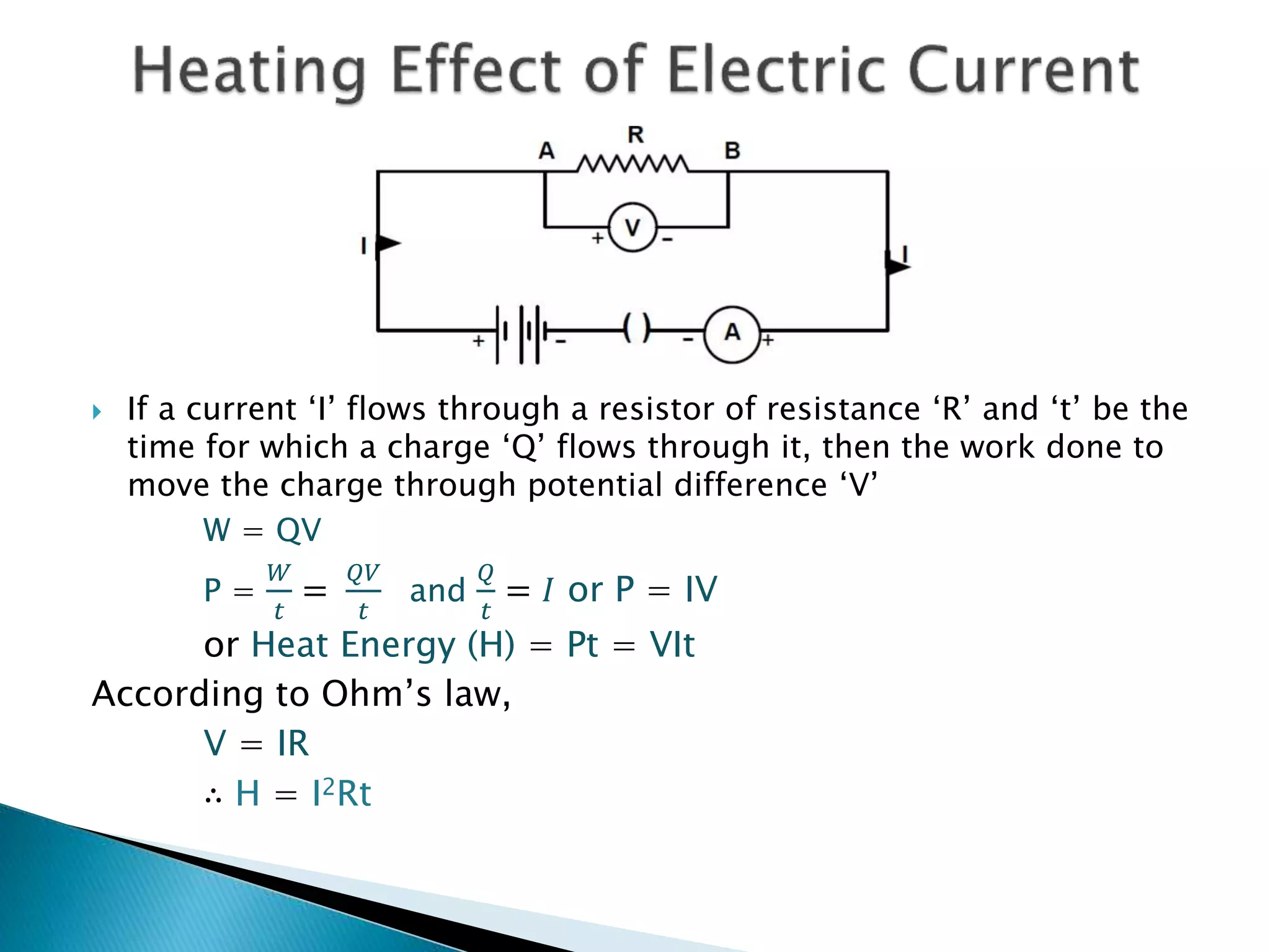
 If a current ‘I’ flows through a resistor of resistance ‘R’ and ‘t’ be the
time for which a charge ‘Q’ flows through it, then the work done to
move the charge through potential difference ‘V’
W = QV
P =
𝑊
𝑡
=
𝑄𝑉
𝑡
and
𝑄
𝑡
= 𝐼 or P = IV
or Heat Energy (H) = Pt = VIt
According to Ohm’s law,
V = IR
∴ H = I2Rt
That’s it folks…
Electricity Class 10 Physics Chapter Complete with Formulae

Electricity Class 10 Physics Chapter Complete with Formulae

  • 1.
  • 2.
     Electricity isthe flow of electrons around a closed circuit  It was discovered by William Gilbert  It consists of electrons in motion
  • 3.
     Conductors arethose materials that allow flow of electricity through them  They can conduct electricity because of the presence of free electrons between the atoms of the substance  All the metals are good conductors of electricity and graphite (the only non metal) can also conduct electricity
  • 4.
     Insulators arethose materials that do not allow flow of electricity through them  They cannot conduct electricity because they don’t have free electrons between their atoms  All the non metals (except graphite) are insulators
  • 5.
     When aglass rod is rubbed with a silk cloth, it acquires the ability to attract small particles of paper and is said to have acquired an ‘Electric Charge’  S.I. unit of electric charge is ‘Coulomb’  Symbol for coulomb is ‘C’
  • 6.
     Electric currentis the flow of electrons through a conducting material (like copper, iron, etc.)  The device that causes the flow of electrons is called a cell (or a battery if 2 or more cells are connected in a row)
  • 7.
     Electrons flowfrom the negative terminal to the positive terminal  By convention, electric current flows from positive terminal to the negative terminal
  • 8.
     Electric currentis expressed as the rate of flow of charge through a conductor per unit time, i.e. 𝐸𝑙𝑒𝑐𝑡𝑟𝑖𝑐 𝐶𝑢𝑟𝑟𝑒𝑛𝑡 (𝐼) = 𝑄𝑢𝑎𝑛𝑡𝑖𝑡𝑦 𝑜𝑓 𝐶ℎ𝑎𝑟𝑔𝑒 (𝑄) 𝑇𝑖𝑚𝑒 𝑡  S.I. unit of electric current is Ampere (A) and 1 𝐴𝑚𝑝𝑒𝑟𝑒 𝐴 = 1 𝐶𝑜𝑢𝑙𝑜𝑚𝑏 (𝐶) 1 𝑆𝑒𝑐𝑜𝑛𝑑 (𝑠)  Electric current is measured by Ammeter
  • 9.
     Electric potentialis the capability of a charge to move unit positive charge from one point to another  Electric potential difference is the work done to bring unit positive charge from one point to another, i.e. P𝑜𝑡𝑒𝑛𝑡𝑖𝑎𝑙 𝐷𝑖𝑓𝑓𝑒𝑟𝑒𝑛𝑐𝑒 (𝑉) = 𝑊𝑜𝑟𝑘 𝑑𝑜𝑛𝑒 (𝑊) 𝐶ℎ𝑎𝑟𝑔𝑒 (𝑄)  S.I unit of potential difference is Voltage (V) and is measured by Voltmeter
  • 10.
     Electric currentwill flow through a conductor only if there is a difference in the electric potential between the two ends of the conductor  The potential difference in a circuit is provided by a cell or battery  The chemical reaction in the cell produces a potential difference between the two terminals and sets the electrons in motion and produces electric current
  • 11.
     Electric circuitis a continuous and closed path of an electric current A schematic diagram of an electric circuit comprising of a cell, electric bulb, ammeter and plug key
  • 12.
    Cell Plug Key or Switch(Open) Battery or a combination of Cells Plug Key or Switch (Closed) Electric Bulb Resistor Variable Resistance or Rheostat Ammeter Voltmeter Crossing not connected Crossing connected
  • 13.
     Voltmeter isa device that measures the potential difference across the ends of any conducting material  It is connected in parallel to the ends of the conducting material  It has high resistance
  • 14.
     Ammeter isa device that measures the current flowing through any conducting material  It is connected in series to the conducting material  It has low resistance
  • 15.
     Ohm’s lawstates that, The current flowing through a conductor is directly proportional to the potential difference between its ends provided all the physical conditions remain the same, i.e. 𝑰 𝜶 𝑽 or 𝑽 𝑰 = 𝑪𝒐𝒏𝒔𝒕𝒂𝒏𝒕 or 𝑽 𝑰 = 𝑹  Here, the constant (R) stands for resistance for a given conductor wire at a given temperature
  • 16.
     Resistance isthe property of a conductor to resist the flow of electrons through it.  According to Ohm’s law, 𝑹 = 𝑽 𝑰  The S.I. unit of resistance is Ohm (Ω)  If the potential difference around the two ends of the wire is 1 V and the current flowing through the wire is 1 A, then the resistance of the wire is said to be 1 Ω
  • 17.
     The resistanceof a conductor is: 1. directly proportional to the length of the wire 2. inversely proportional to the area of the cross section of the wire 3. dependent on the material of the conductor 4. directly proportional to the temperature of the material, i.e. 𝐑 𝛂 𝐈 𝐑 𝛂 𝐈 𝐀 Or 𝐑 = 𝛒 𝐈 𝐀  Here, ρ (rho) is the constant of proportionality called Resistivity of the material of the conductor.  Its S.I. unit is Ohm Metre (Ωm)
  • 18.
     Conductors likemetals and alloys have low resistivity of 10-8 Ωm to 10-6 Ωm  Insulators like rubber, glass etc. have high resistivity 1012 Ωm to 1017 Ωm.  Substances with low resistivity are better conductors of electricity than those with high resistivity
  • 19.
     When threeresistors R1, R2 and R3 are connected in series across AB i. The current in all the resistors is same ii. The total voltage across the resistors is equal to the sum of the voltage across each resistor V = V1 +V2 +V3 iii. The equivalent resistance is the sum of the resistances of each resistor. This increases the total resistance Rs = R1 +R2 +R3
  • 20.
     When threeresistors R1, R2 and R3 are connected in parallel across AB i. The voltage in all the resistors is same ii. The total current in all the resistors is the sum of the current in each resistor I = I1 +I2 +I3 iii. The reciprocal of the equivalent resistance is the sum of the reciprocals of resistances of each resistor. This decreases the total resistance 1 Rp = 1 R1 +1 R2 +1 R3
  • 21.
     Electrical energyis the work done to maintain the flow of current in a conductor W = Q × V where, Q = I × t ∴ W = VIt where, V = IR ∴ W= I2Rt  S.I. unit of electrical energy is Joule (J)
  • 22.
     Electric poweris the rate at which electric current is used 𝑃𝑜𝑤𝑒𝑟 (𝑃) = 𝑊𝑜𝑟𝑘 𝐷𝑜𝑛𝑒 (𝑊) 𝑇𝑖𝑚𝑒 (𝑡) where, 𝑊 = 𝐼2 𝑅𝑡 ∴ 𝑃𝑜𝑤𝑒𝑟 = 𝐼2 𝑅𝑡 𝑡 = 𝐼2 𝑅𝑡 Or, 𝑃𝑜𝑤𝑒𝑟 = 𝑉𝐼  S.I. unit of power is Watt (W)  An object has 1 Watt of power when 1Ampere of current flows across a conductor with a potential difference of 1Volt
  • 23.
     Commercial unitof energy is kWh (Kilowatt Hour)  One kWh is the power consumed when 1W of power is used for 1 hour  Relationship between Kilowatt hour and Joule: 1 kWh = 1 kW × 1 h 1 kWh = 1000 W × 3600 s 1 kWh = 3600000 J 1 kWh = 3.6 × 10⁶ J
  • 24.
     If acurrent ‘I’ flows through a resistor of resistance ‘R’ and ‘t’ be the time for which a charge ‘Q’ flows through it, then the work done to move the charge through potential difference ‘V’ W = QV P = 𝑊 𝑡 = 𝑄𝑉 𝑡 and 𝑄 𝑡 = 𝐼 or P = IV or Heat Energy (H) = Pt = VIt According to Ohm’s law, V = IR ∴ H = I2Rt
  • 25.