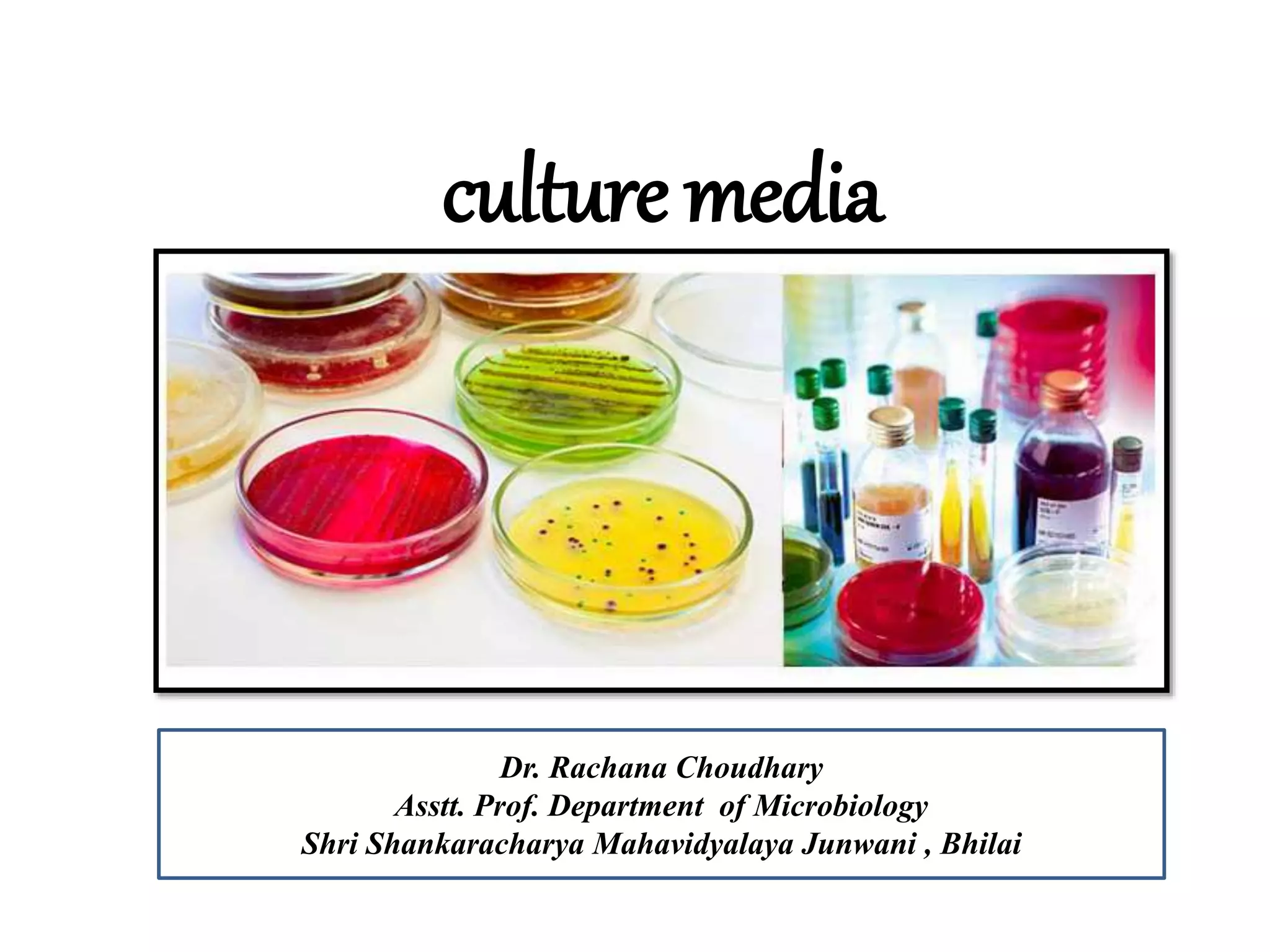
culture media
Dr. Rachana Choudhary
Asstt. Prof. Department of Microbiology
Shri Shankaracharya Mahavidyalaya Junwani , Bhilai
What is culturemedium
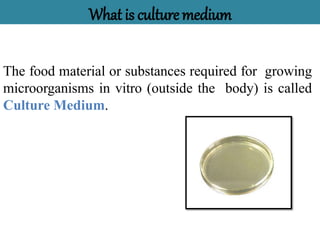
The food material or substances required for growing
microorganisms in vitro (outside the body) is called
Culture Medium.
Uses of culturemedium
It is important to grow microorganisms outside the body for the
following purposes:
1. to identify the cause of infection from the clinical sample, so
that proper treatment can be given.
2. to study the characteristics of microorganisms.
3. to prepare biological products like vaccines, toxoides,
antigens…etc.
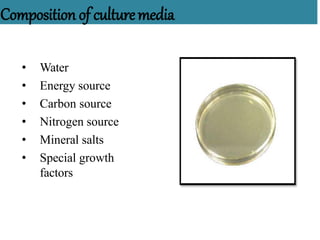
Composition of culturemedia
• Water
• Energy source
• Carbon source
• Nitrogen source
• Mineral salts
• Special growth
factors
I. Based on their consistency/Physical State
1. Solid medium
2. Liquid medium
3. Semi solid medium
II. Based on the constituents/ ingredients
1. Simple medium
2. Complex medium
3. Synthetic or defined medium
4. Special media
TYPESOF CULTUREMEDIA
Specialmedia
I. Enriched media
II. Enrichment media
III. Selective media
IV. Indicator media
V. Differential media
VI. Transport media
III .Based on Oxygenrequirement
a) Anaerobic media
b) Aerobic media
Classificationbasedon physicalstate
.
1.Solidmedium
agar is the most commonly used solidifying agent.
What is agar
• Golden –yellow granular powder
• Prepared from seaweeds.
• Not affected by the growth of the bacteria
• Melts at 98oC & sets at 42oC
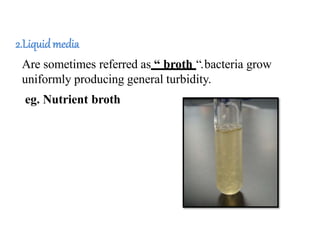
2.Liquidmedia
Are sometimes referred as “ broth “.bacteria grow
uniformly producing general turbidity.
eg. Nutrient broth
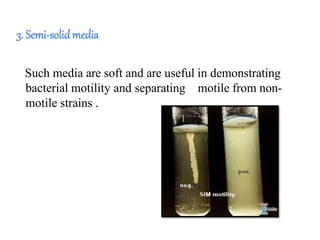
3. Semi-solidmedia
Such media are soft and are useful in demonstrating
bacterial motility and separating motile from non-
motile strains .
Classificationbasedon theingredients
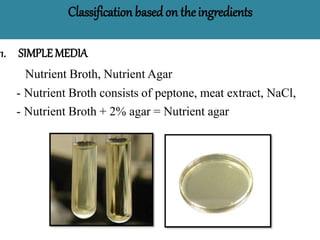
1. SIMPLEMEDIA
Nutrient Broth, Nutrient Agar
- Nutrient Broth consists of peptone, meat extract, NaCl,
- Nutrient Broth + 2% agar = Nutrient agar
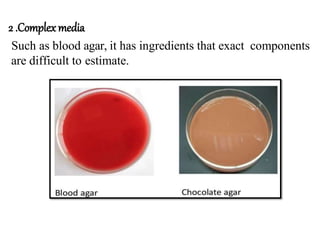
2 .Complexmedia
Such as blood agar, it has ingredients that exact components
are difficult to estimate.
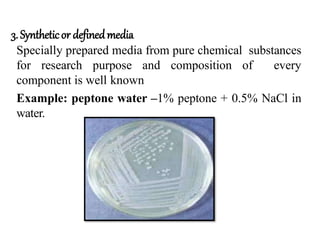
3.Syntheticor definedmedia
Specially prepared media from pure chemical substances
for research purpose and composition of every
component is well known
Example: peptone water –1% peptone + 0.5% NaCl in
water.
4. Specialmedia
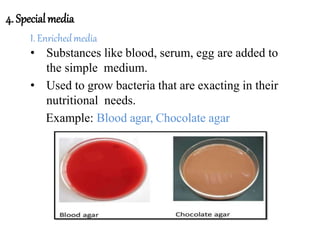
I. Enrichedmedia
• Substances like blood, serum, egg are added to
the simple medium.
• Used to grow bacteria that are exacting in their
nutritional needs.
Example: Blood agar, Chocolate agar
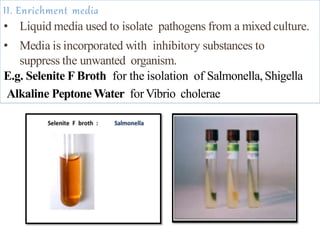
II. Enrichment media
• Liquid media used to isolate pathogens from a mixed culture.
• Media is incorporated with inhibitory substances to
suppress the unwanted organism.
E.g. Selenite F Broth for the isolation of Salmonella, Shigella
Alkaline Peptone Water forVibrio cholerae
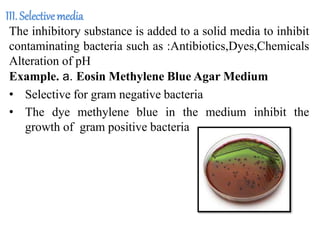
III. Selectivemedia
The inhibitory substance is added to a solid media to inhibit
contaminating bacteria such as :Antibiotics,Dyes,Chemicals
Alteration of pH
Example. a. Eosin Methylene Blue Agar Medium
• Selective for gram negative bacteria
• The dye methylene blue in the medium inhibit the
growth of gram positive bacteria
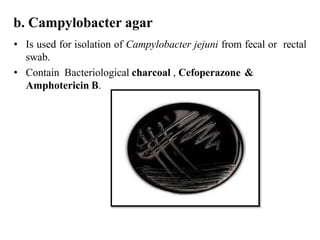
b. Campylobacter agar
• Is used for isolation of Campylobacter jejuni from fecal or rectal
swab.
• Contain Bacteriological charcoal , Cefoperazone &
Amphotericin B.
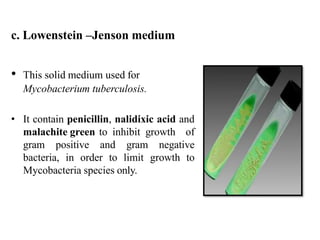
c. Lowenstein –Jenson medium
• This solid medium used for
Mycobacterium tuberculosis.
• It contain penicillin, nalidixic acid and
malachite green to inhibit growth of
gram positive and gram negative
bacteria, in order to limit growth to
Mycobacteria species only.
IV. Differentialmedia
are designed in such a way that different bacteria can be
recognized on the basis of their colony color.
Dyes and metabolic substrates are incorporated so that those
bacteria that utilize them appear as differently colored colonies.
Examples: MacConkey agar
CLED agar
TCBS agar
XLD agar
Examples of Differential media
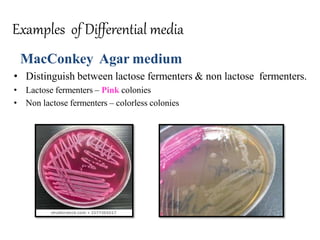
MacConkey Agar medium
• Distinguish between lactose fermenters & non lactose fermenters.
• Lactose fermenters – Pink colonies
• Non lactose fermenters – colorless colonies
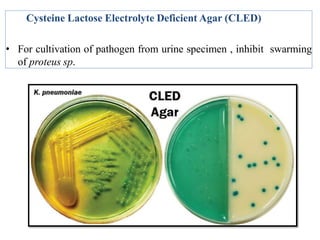
Cysteine Lactose Electrolyte Deficient Agar (CLED)
• For cultivation of pathogen from urine specimen , inhibit swarming
of proteus sp.
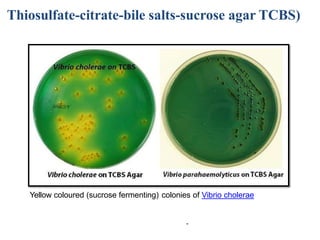
Thiosulfate-citrate-bile salts-sucrose agar TCBS)
Yellow coloured (sucrose fermenting) colonies of Vibrio cholerae
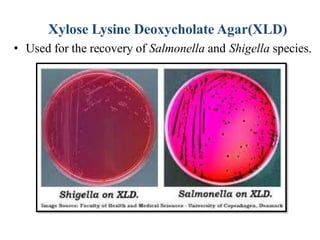
Xylose Lysine Deoxycholate Agar(XLD)
• Used for the recovery of Salmonella and Shigella species.
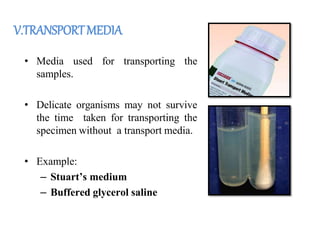
V.TRANSPORTMEDIA
• Media used for transporting the
samples.
• Delicate organisms may not survive
the time taken for transporting the
specimen without a transport media.
• Example:
– Stuart’s medium
– Buffered glycerol saline
III.BasedonOxygenrequirement
a. Anaerobicmedia
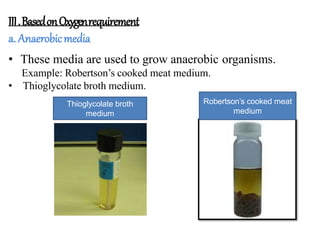
• These media are used to grow anaerobic organisms.
Example: Robertson’s cooked meat medium.
• Thioglycolate broth medium.
Robertson’s cooked meat
medium
Thioglycolate broth
medium
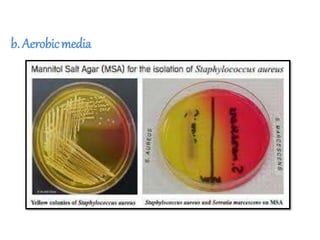
b. Aerobicmedia
CONCLUSION
The preparation of culture media and their underlying
culture technique goes hand in hand and affect each other
in either a good or bad way. When the preparation of a
culture media is already poor that is, it was not sterilized
properly or that the experimenter made some form of
mistake on the culture process, even though the culture
technique is good, the output or the growth of bacteria
would be influenced by the quality of media used.
References
• Textbook of Microbiology by R. Ananatnarayan & C.K.J
Paniker
• Textbook of Microbiology by R. P.Singh
• Textbook of Microbiology by P. Chakraborty
• Textbook of Microbiology Dubey & Maheshwari.
• Google Search
THANK YOU

Culture media

  • 1.
    culture media Dr. RachanaChoudhary Asstt. Prof. Department of Microbiology Shri Shankaracharya Mahavidyalaya Junwani , Bhilai
  • 2.
    What is culturemedium Thefood material or substances required for growing microorganisms in vitro (outside the body) is called Culture Medium.
  • 3.
    Uses of culturemedium Itis important to grow microorganisms outside the body for the following purposes: 1. to identify the cause of infection from the clinical sample, so that proper treatment can be given. 2. to study the characteristics of microorganisms. 3. to prepare biological products like vaccines, toxoides, antigens…etc.
  • 4.
    Composition of culturemedia •Water • Energy source • Carbon source • Nitrogen source • Mineral salts • Special growth factors
  • 5.
    I. Based ontheir consistency/Physical State 1. Solid medium 2. Liquid medium 3. Semi solid medium II. Based on the constituents/ ingredients 1. Simple medium 2. Complex medium 3. Synthetic or defined medium 4. Special media TYPESOF CULTUREMEDIA
  • 6.
    Specialmedia I. Enriched media II.Enrichment media III. Selective media IV. Indicator media V. Differential media VI. Transport media III .Based on Oxygenrequirement a) Anaerobic media b) Aerobic media
  • 7.
    Classificationbasedon physicalstate . 1.Solidmedium agar isthe most commonly used solidifying agent. What is agar • Golden –yellow granular powder • Prepared from seaweeds. • Not affected by the growth of the bacteria • Melts at 98oC & sets at 42oC
  • 8.
    2.Liquidmedia Are sometimes referredas “ broth “.bacteria grow uniformly producing general turbidity. eg. Nutrient broth
  • 9.
    3. Semi-solidmedia Such mediaare soft and are useful in demonstrating bacterial motility and separating motile from non- motile strains .
  • 10.
    Classificationbasedon theingredients 1. SIMPLEMEDIA NutrientBroth, Nutrient Agar - Nutrient Broth consists of peptone, meat extract, NaCl, - Nutrient Broth + 2% agar = Nutrient agar
  • 11.
    2 .Complexmedia Such asblood agar, it has ingredients that exact components are difficult to estimate.
  • 12.
    3.Syntheticor definedmedia Specially preparedmedia from pure chemical substances for research purpose and composition of every component is well known Example: peptone water –1% peptone + 0.5% NaCl in water.
  • 13.
    4. Specialmedia I. Enrichedmedia •Substances like blood, serum, egg are added to the simple medium. • Used to grow bacteria that are exacting in their nutritional needs. Example: Blood agar, Chocolate agar
  • 14.
    II. Enrichment media •Liquid media used to isolate pathogens from a mixed culture. • Media is incorporated with inhibitory substances to suppress the unwanted organism. E.g. Selenite F Broth for the isolation of Salmonella, Shigella Alkaline Peptone Water forVibrio cholerae
  • 15.
    III. Selectivemedia The inhibitorysubstance is added to a solid media to inhibit contaminating bacteria such as :Antibiotics,Dyes,Chemicals Alteration of pH Example. a. Eosin Methylene Blue Agar Medium • Selective for gram negative bacteria • The dye methylene blue in the medium inhibit the growth of gram positive bacteria
  • 16.
    b. Campylobacter agar •Is used for isolation of Campylobacter jejuni from fecal or rectal swab. • Contain Bacteriological charcoal , Cefoperazone & Amphotericin B.
  • 17.
    c. Lowenstein –Jensonmedium • This solid medium used for Mycobacterium tuberculosis. • It contain penicillin, nalidixic acid and malachite green to inhibit growth of gram positive and gram negative bacteria, in order to limit growth to Mycobacteria species only.
  • 18.
    IV. Differentialmedia are designedin such a way that different bacteria can be recognized on the basis of their colony color. Dyes and metabolic substrates are incorporated so that those bacteria that utilize them appear as differently colored colonies. Examples: MacConkey agar CLED agar TCBS agar XLD agar
  • 19.
    Examples of Differentialmedia MacConkey Agar medium • Distinguish between lactose fermenters & non lactose fermenters. • Lactose fermenters – Pink colonies • Non lactose fermenters – colorless colonies
  • 20.
    Cysteine Lactose ElectrolyteDeficient Agar (CLED) • For cultivation of pathogen from urine specimen , inhibit swarming of proteus sp.
  • 21.
    Thiosulfate-citrate-bile salts-sucrose agarTCBS) Yellow coloured (sucrose fermenting) colonies of Vibrio cholerae
  • 22.
    Xylose Lysine DeoxycholateAgar(XLD) • Used for the recovery of Salmonella and Shigella species.
  • 23.
    V.TRANSPORTMEDIA • Media usedfor transporting the samples. • Delicate organisms may not survive the time taken for transporting the specimen without a transport media. • Example: – Stuart’s medium – Buffered glycerol saline
  • 24.
    III.BasedonOxygenrequirement a. Anaerobicmedia • Thesemedia are used to grow anaerobic organisms. Example: Robertson’s cooked meat medium. • Thioglycolate broth medium. Robertson’s cooked meat medium Thioglycolate broth medium
  • 25.
  • 26.
    CONCLUSION The preparation ofculture media and their underlying culture technique goes hand in hand and affect each other in either a good or bad way. When the preparation of a culture media is already poor that is, it was not sterilized properly or that the experimenter made some form of mistake on the culture process, even though the culture technique is good, the output or the growth of bacteria would be influenced by the quality of media used.
  • 27.
    References • Textbook ofMicrobiology by R. Ananatnarayan & C.K.J Paniker • Textbook of Microbiology by R. P.Singh • Textbook of Microbiology by P. Chakraborty • Textbook of Microbiology Dubey & Maheshwari. • Google Search
  • 28.