Dr. Mohit Bhatia
Assistant Professor
Department of Microbiology
AIIMS, Rishikesh
1
culture media
• CULTURE :
Is the term given to microorganisms that
are cultivated in the lab for the purpose of
identifying and studying them.
2
CULTURE AND THE MEDIUM
• MEDIUM:
Is the term given to the combination of
ingredients that will support the growth and
cultivation of microorganisms by providing
all the essential nutrients required for the
growth (i.e. multiplication) in order to
cultivate these microorganisms in large
number to study them.
3
• Microbiological culture: which are
used for growing microorganisms,
such as bacteria or yeast.
• The most common growth media for
microorganisms are nutrient broths and agar
plates
• Specialized media are sometimes required for
microorganism and cell culture growth.
4
CULTURE MEDIA
• Used to grow bacteria
• Can be used to-
 Enrich the numbers of bacteria.
 Select for certain bacteria and suppress others.
 Differentiate among different kinds of bacteria.
5
NEED FOR CULTURE MEDIA
• It is usually essential to obtain a culture by
growing the organism in an artificial medium.
• If more than one species or type of organism are
present each requires to be carefully separated or
isolated in pure culture .
7/25/2022 6
BASIC REQUIREMENTS OF CULTURE MEDIA
• NUTRIENTS :
 Energy source
 Carbon source
 Nitrogen source
• MINERAL SALTS :
 Sulphates, phosphates, chlorides and carbonates
of K, Mg and Ca
 A suitable pH- 7.2- 7.4
7
GROWTH FACTORS
ARGININE E.COLI
GLUTATHIONE GONOCOCCI
CHOLESTEROL MYCOPLASMA
ARYL SULPHATE, AMIDE ATYPICAL MYCOBACTERIA
GLYCEROL MYCOPLASMA HOMINIS
SULFONAMIDES RIKETTSIA
TRYPTOPHAN SALMONELLA TYPHI
L-CYSTEINE LISTERIA MONOCYTOGENS
SODIUM CHLORIDE VIBRIO PARAHAEMOLYTICUS
FACTOR X & V H.INFLUENZAE
7/25/2022 8
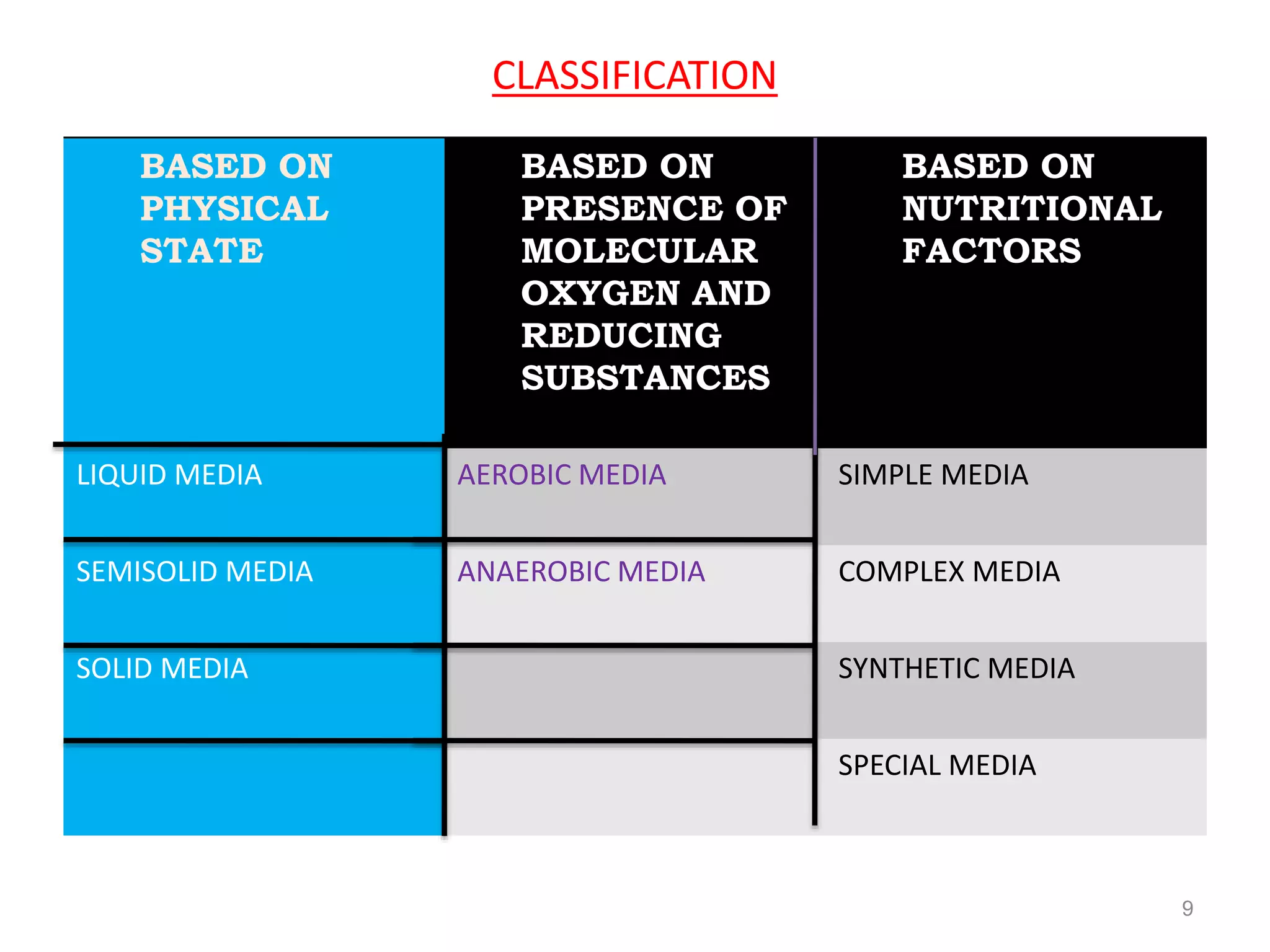
CLASSIFICATION
BASED ON
PHYSICAL
STATE
BASED ON
PRESENCE OF
MOLECULAR
OXYGEN AND
REDUCING
SUBSTANCES
BASED ON
NUTRITIONAL
FACTORS
LIQUID MEDIA AEROBIC MEDIA SIMPLE MEDIA
SEMISOLID MEDIA ANAEROBIC MEDIA COMPLEX MEDIA
SOLID MEDIA SYNTHETIC MEDIA
SPECIAL MEDIA
9
SPECIAL MEDIA
A. ENRICHED MEDIA
B. ENRICHMENT MEDIA
C. SELECTIVE MEDIA
D. DIFFERENTIAL MEDIA
E. INDICATOR MEDIA
F. TRANSPORT MEDIA
G. SUGAR MEDIA
10
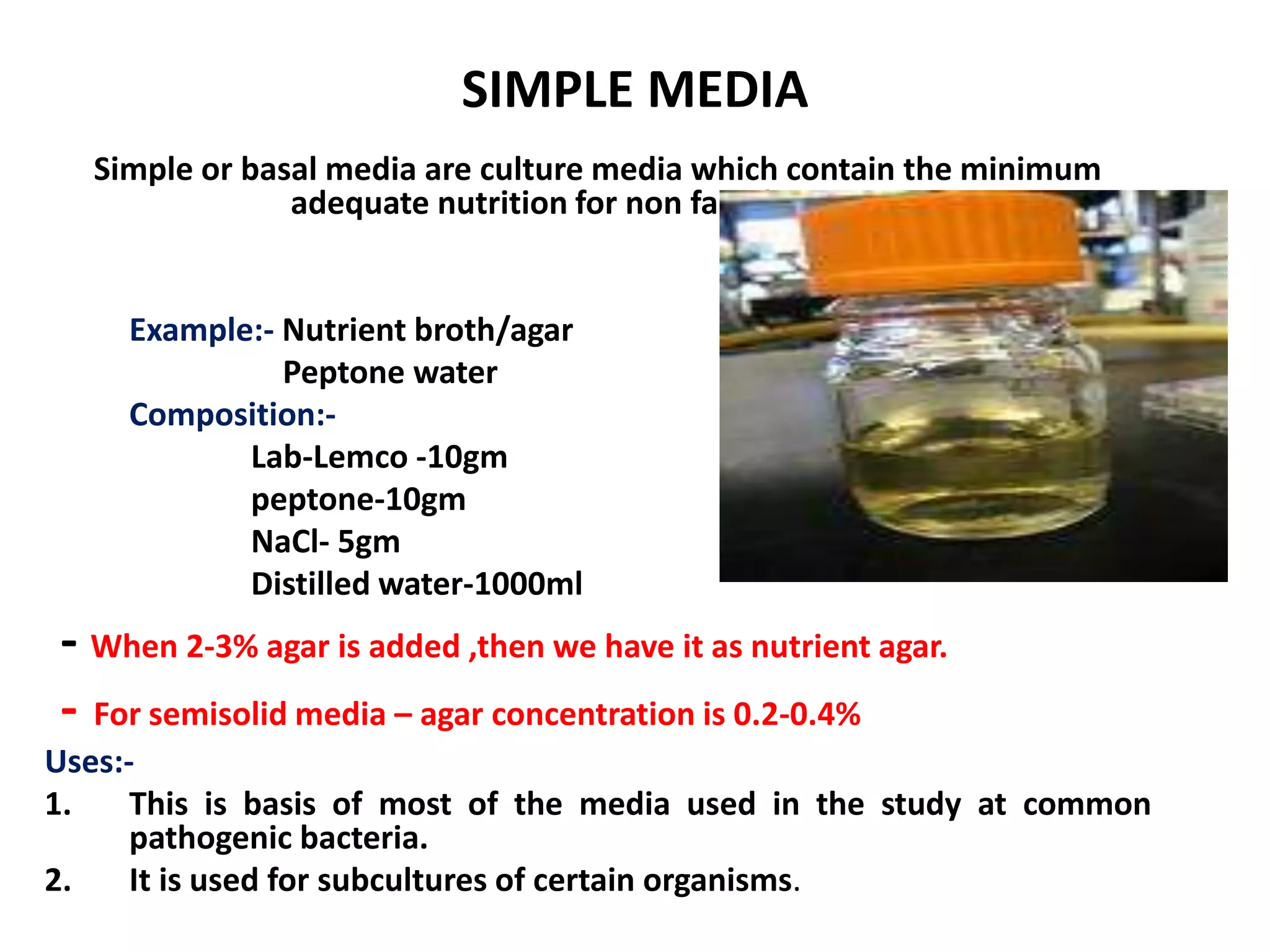
SIMPLE MEDIA
Simple or basal media are culture media which contain the minimum
adequate nutrition for non fastidious organisms
Example:- Nutrient broth/agar
Peptone water
Composition:-
Lab-Lemco -10gm
peptone-10gm
NaCl- 5gm
Distilled water-1000ml
- When 2-3% agar is added ,then we have it as nutrient agar.
- For semisolid media – agar concentration is 0.2-0.4%
Uses:-
1. This is basis of most of the media used in the study at common
pathogenic bacteria.
2. It is used for subcultures of certain organisms.
NUTRIENT BROTH
NUTRIENT AGAR
PEPTONE WATER
• TYPE : Basic liquid media
• APPEARANCE : clear, colorless, watery, usually
in test tube
• Composition :
13
PEPTONE 10 g
SODIUM CHLORIDE, NaCl 5 g
WATER 1 litre
USES OF PEPTONE WATER
The media is used chiefly as the basis for
carbohydrate fermentation media.
Nutrient broths may contain a small amount
of sugar derived from meat and it is essential
that the basal medium to which various
carbohydrates are added for fermentation
tests should be free from natural sugars.
7/25/2022 14
It is also used to test the formation of indole.
Culture of organisms for demonstration of motility
7/25/2022 15
COMPLEX MEDIA
Complex media have added ingredients for bringing out certain properties
for bringing out certain properties or providing special nutrients required
for growth of the bacterium in question.
SYNTHETIC MEDIA
 These are prepared from pure chemicals and the exact compositions of
medium is very well known.
Example :- Dubo’s medium
SEMIDEFINED MEDIA
 In these media the exact chemical composition of the constituents is not
known because substances like meat and peptone are used.
 Most of the culture media used for routine diagnostic work are
semidefined culture media.

SPECIAL MEDIUM
• ENRICHED MEDIA
 When basal medium is added with some nutrients such as blood,
serum or egg is called enriched media.
 They are used to grow bacteria which are more exacting in their
nutritional needs.
Examples:-
Dorset’s Egg Medium.
 It is a creamy coloured opaque
slope kept in screw copped bottle
 Selective medium for isolation
of Mycobacterium tuberculosis.
 Composition: Hen’s egg, Nutrient broth
BLOOD AGAR
• TYPE : Enriched media.
• APPEARANCE : Red color.
• COMPOSITION :
Sterile Nutrient agar + Defibrinated sheep blood
USES :
 Routine culture
 Widely used in medical bacteriology
 It is also an indicator medium showing the haemolytic
properties of bacteria such as Streptococcus pyogenes.
18
CHOCOLATEAGAR
Also called Heated blood agar.
• TYPE : Enriched media.
• APPEARANCE : Chocolate brown color.
PROCEDURE
Melt the desired amount of nutrient agar.
Cool it in a water – bath at 75º C .
Add 10 ml of sterile blood .
Allow the medium to remain at 75º C.
19
Mixing the blood and agar by gentle agitation from
time to time until the blood become chocolate
brown in color, within about 10 min.
Then pour in plates.
USES
 CULTURE OF Neisseria
 CULTURE OF Haemophilus influenzae
 CULTURE OF Pneumococcus
20
ENRICHMENT MEDIA
 In this media, it has a stimulating effect on the bacteria to be grown or inhibits
its competitors.
 This result in an absolute increase in the number of wanted bacteria related to
other bacteria.
 Example:- Selenite F broth
 It is enrichment medium for culture of Salmonella typhi and paratyphi bacilli
from stool sample
 Principle:- at neutral pH solution acid salinity has high toxicity to coli form
group of bacteria and not to most of the salmonella groups.
SELENITE F BROTH Alkaline peptone water
SELECTIVE MEDIA
 It is a medium in which certain substances are present which inhibit all other
bacteria except the desired bacteria.
 It encourages the growth of particular species from a mixed inoculum.
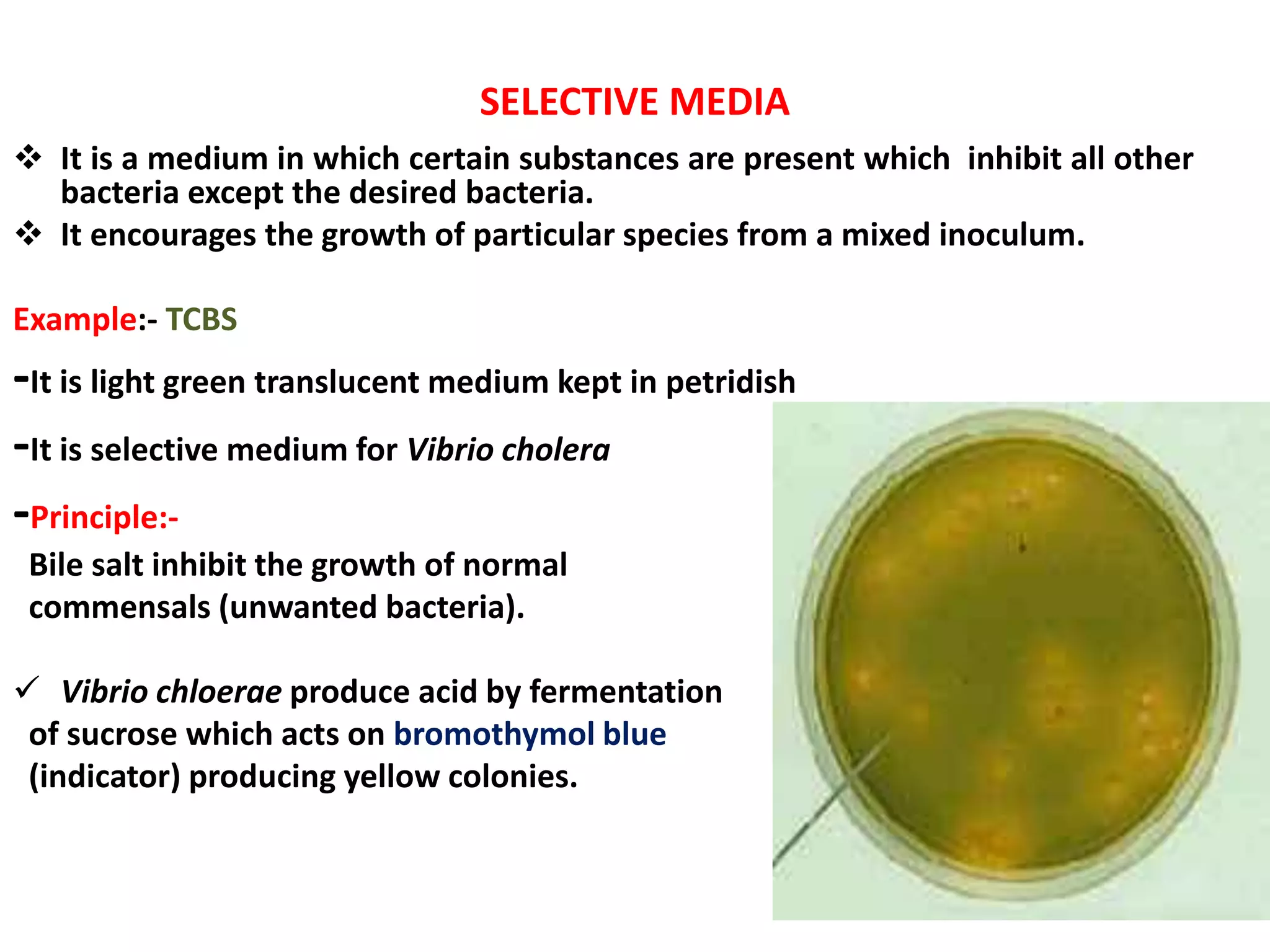
Example:- TCBS
-It is light green translucent medium kept in petridish
-It is selective medium for Vibrio cholera
-Principle:-
Bile salt inhibit the growth of normal
commensals (unwanted bacteria).
 Vibrio chloerae produce acid by fermentation
of sucrose which acts on bromothymol blue
(indicator) producing yellow colonies.
Salmonella-Shigella agar plate (SS)
Salmonella Shigella Agar with DCA
DIFFERENTIAL MEDIA
7/25/2022 25
MAC CONKEY AGAR
• MacConkey agar is a culture medium
designed to grow Gram-negative bacteria. It is
a useful medium for the cultivation of
enterobacteriacea.
26
27
MacConkey agar
showing both
lactose and non-
lactose fermenting
colonies.
Lactose fermenting
colonies are pink
whereas non-
lactose fermenting
ones are colourless
or appear same as
the medium.
• It contains lactose and neutral red to
distinguish the lactose- fermenting coliforms
from the lactose non –fermenting salmonella
and shigella groups.
28
• It contains Bile salts to inhibit non-intestinal
bacteria and most Gram-positive bacteria,
except Enterococcus and some species
of Staphylococcus i.e. Staphylococcus aureus.
• Neutral red dye : which stains microbes
fermenting lactose.
• Crystal violet dye : which also inhibits certain
Gram-positive bacteria).
29
• Gram-negative bacteria growing on the media are
differentiated by their ability to ferment the sugar
lactose.
• Lactose fermenter cause the pH to drop and is
detected by neutral red, (red at pH's below 6.8.) which
appear as bright pink to red colonies on the agar.
30
• Uses
• Acting as a visual pH indicator, the agar
distinguishes those Gram-negative bacteria
that can ferment the sugar lactose (Lac+) from
those that cannot (Lac-).
This medium is also known as an
• "indicator medium"
• "low selective medium".
• Absence of electrolytes serves to inhibit
swarming by Proteus species
31
Lac+
• By utilizing the lactose available in the
medium, Lac+ bacteria such as
Escherichia coli
Enterobacter spp.
Klebsiella spp.
will produce acid, which lowers the pH of the
agar below 6.8 and results in the appearance
of red/pink colonies
32
CLED
(Cystine Lactose Electrolyte Deficient medium)
• It is a valuable non-inhibitory growth medium
used in the isolation and differentiation of
urinary organisms.
• Being electrolyte deficient, it prevents the
swarming of Proteus species
33
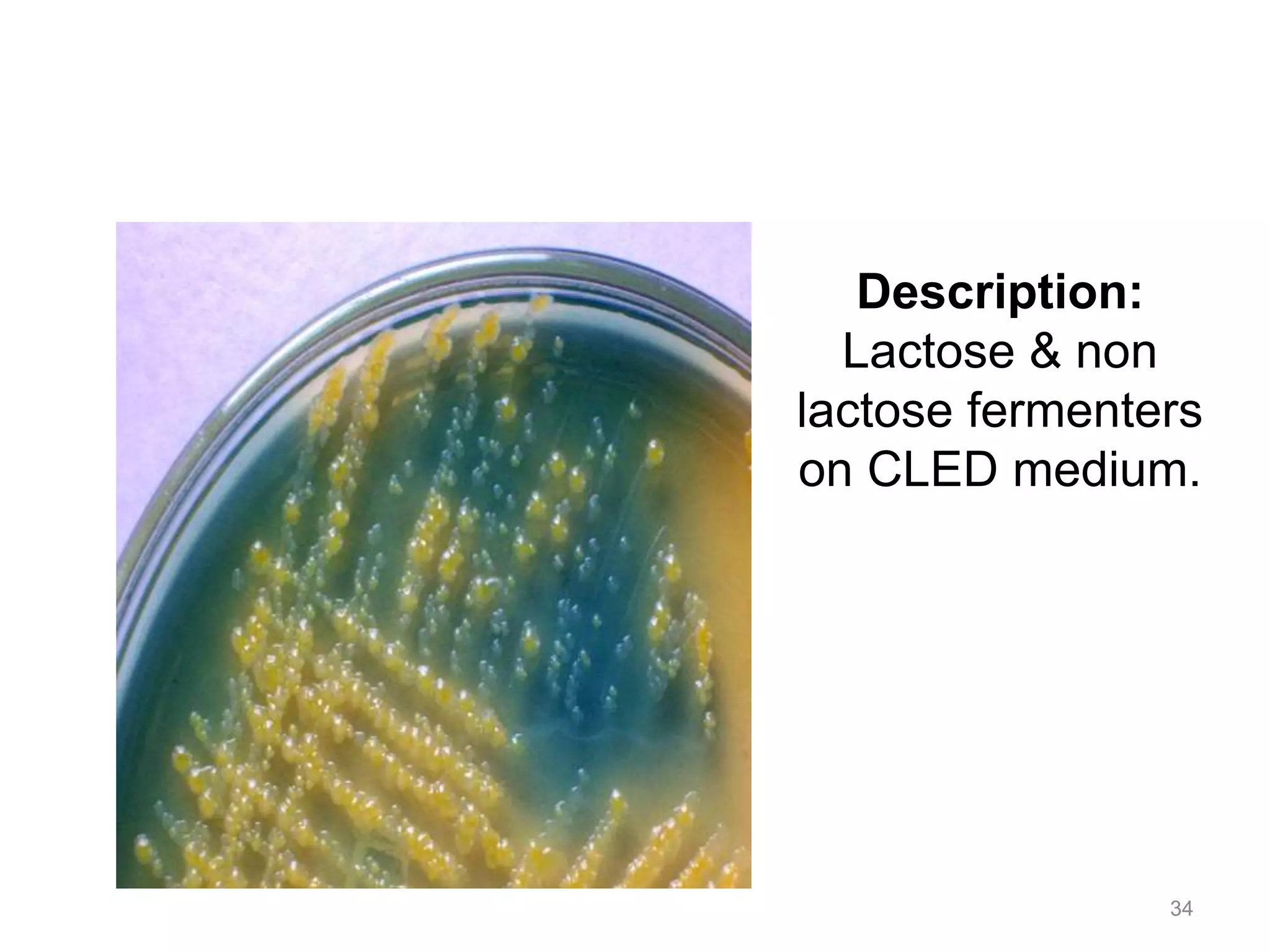
34
Description:
Lactose & non
lactose fermenters
on CLED medium.
INDICATOR MEDIUM
 These media contain an indicator which changes colour when bacteria
grow on them.
 Example:- Wilson and Blair medium
 For isolation of Salmonella typhi and S. paratyphi
 They appear as black colonies
 Principle:- The black colour of colonies is due to the ability of these
organisms to reduce bismuth sulphite to sulphide in the presence of
glucose coliforms are inhibited by brilliant green and bismuth sullphite
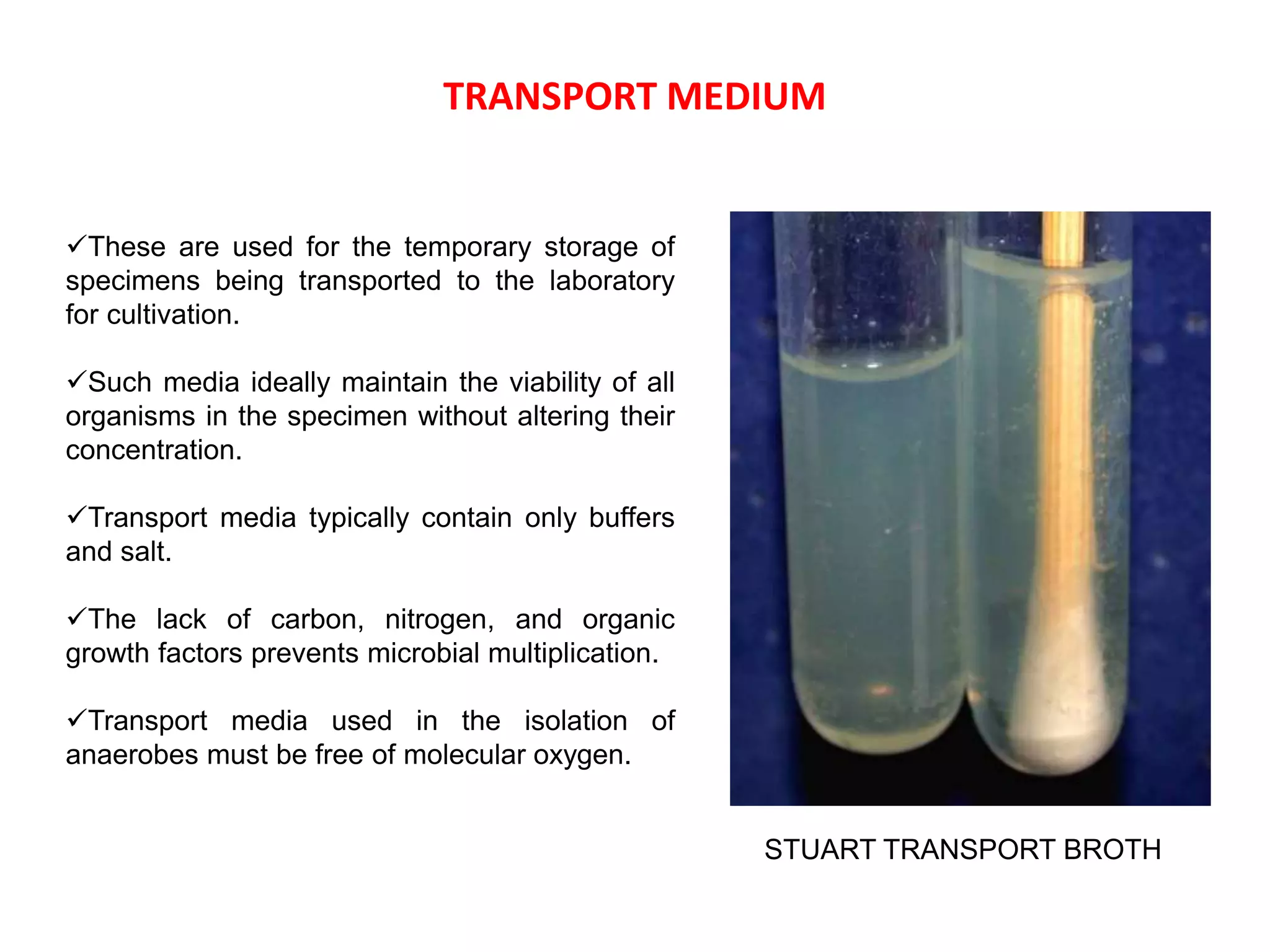
TRANSPORT MEDIUM
These are used for the temporary storage of
specimens being transported to the laboratory
for cultivation.
Such media ideally maintain the viability of all
organisms in the specimen without altering their
concentration.
Transport media typically contain only buffers
and salt.
The lack of carbon, nitrogen, and organic
growth factors prevents microbial multiplication.
Transport media used in the isolation of
anaerobes must be free of molecular oxygen.
STUART TRANSPORT BROTH
CHARACTERISTICS OF TRANSPORT MEDIA:
• It should be non-toxic
• It should not promote or inhibit the bacterial growth
• It should be easy to carry and transport
Examples:
1. Venkatraman Ramakrishnan medium
2. Buffered glycerol saline transport medium
3. Cary and Blair medium
Cary and Blair medium
ANAEROBIC MEDIUM
These media are used to grow anaerobic organisms.
Examples:-
 Thioglycollate broth
 Robertsons Cooked Meat Medium
Mueller-Hinton agar
39
• Mueller-Hinton agar is an microbiological
growth medium that is commonly used for
antibiotic susceptibility testing.
• Originally formulated for isolation of Neisseria
species.
• It is also used to isolate and maintain
Neisseria and Moraxella species.
40
7/25/2022 41
7/25/2022 42

culture_media.ppt

  • 1.
    Dr. Mohit Bhatia AssistantProfessor Department of Microbiology AIIMS, Rishikesh 1 culture media
  • 2.
    • CULTURE : Isthe term given to microorganisms that are cultivated in the lab for the purpose of identifying and studying them. 2 CULTURE AND THE MEDIUM
  • 3.
    • MEDIUM: Is theterm given to the combination of ingredients that will support the growth and cultivation of microorganisms by providing all the essential nutrients required for the growth (i.e. multiplication) in order to cultivate these microorganisms in large number to study them. 3
  • 4.
    • Microbiological culture:which are used for growing microorganisms, such as bacteria or yeast. • The most common growth media for microorganisms are nutrient broths and agar plates • Specialized media are sometimes required for microorganism and cell culture growth. 4
  • 5.
    CULTURE MEDIA • Usedto grow bacteria • Can be used to-  Enrich the numbers of bacteria.  Select for certain bacteria and suppress others.  Differentiate among different kinds of bacteria. 5
  • 6.
    NEED FOR CULTUREMEDIA • It is usually essential to obtain a culture by growing the organism in an artificial medium. • If more than one species or type of organism are present each requires to be carefully separated or isolated in pure culture . 7/25/2022 6
  • 7.
    BASIC REQUIREMENTS OFCULTURE MEDIA • NUTRIENTS :  Energy source  Carbon source  Nitrogen source • MINERAL SALTS :  Sulphates, phosphates, chlorides and carbonates of K, Mg and Ca  A suitable pH- 7.2- 7.4 7
  • 8.
    GROWTH FACTORS ARGININE E.COLI GLUTATHIONEGONOCOCCI CHOLESTEROL MYCOPLASMA ARYL SULPHATE, AMIDE ATYPICAL MYCOBACTERIA GLYCEROL MYCOPLASMA HOMINIS SULFONAMIDES RIKETTSIA TRYPTOPHAN SALMONELLA TYPHI L-CYSTEINE LISTERIA MONOCYTOGENS SODIUM CHLORIDE VIBRIO PARAHAEMOLYTICUS FACTOR X & V H.INFLUENZAE 7/25/2022 8
  • 9.
    CLASSIFICATION BASED ON PHYSICAL STATE BASED ON PRESENCEOF MOLECULAR OXYGEN AND REDUCING SUBSTANCES BASED ON NUTRITIONAL FACTORS LIQUID MEDIA AEROBIC MEDIA SIMPLE MEDIA SEMISOLID MEDIA ANAEROBIC MEDIA COMPLEX MEDIA SOLID MEDIA SYNTHETIC MEDIA SPECIAL MEDIA 9
  • 10.
    SPECIAL MEDIA A. ENRICHEDMEDIA B. ENRICHMENT MEDIA C. SELECTIVE MEDIA D. DIFFERENTIAL MEDIA E. INDICATOR MEDIA F. TRANSPORT MEDIA G. SUGAR MEDIA 10
  • 11.
    SIMPLE MEDIA Simple orbasal media are culture media which contain the minimum adequate nutrition for non fastidious organisms Example:- Nutrient broth/agar Peptone water Composition:- Lab-Lemco -10gm peptone-10gm NaCl- 5gm Distilled water-1000ml - When 2-3% agar is added ,then we have it as nutrient agar. - For semisolid media – agar concentration is 0.2-0.4% Uses:- 1. This is basis of most of the media used in the study at common pathogenic bacteria. 2. It is used for subcultures of certain organisms.
  • 12.
  • 13.
    PEPTONE WATER • TYPE: Basic liquid media • APPEARANCE : clear, colorless, watery, usually in test tube • Composition : 13 PEPTONE 10 g SODIUM CHLORIDE, NaCl 5 g WATER 1 litre
  • 14.
    USES OF PEPTONEWATER The media is used chiefly as the basis for carbohydrate fermentation media. Nutrient broths may contain a small amount of sugar derived from meat and it is essential that the basal medium to which various carbohydrates are added for fermentation tests should be free from natural sugars. 7/25/2022 14
  • 15.
    It is alsoused to test the formation of indole. Culture of organisms for demonstration of motility 7/25/2022 15
  • 16.
    COMPLEX MEDIA Complex mediahave added ingredients for bringing out certain properties for bringing out certain properties or providing special nutrients required for growth of the bacterium in question. SYNTHETIC MEDIA  These are prepared from pure chemicals and the exact compositions of medium is very well known. Example :- Dubo’s medium SEMIDEFINED MEDIA  In these media the exact chemical composition of the constituents is not known because substances like meat and peptone are used.  Most of the culture media used for routine diagnostic work are semidefined culture media.
  • 17.
    SPECIAL MEDIUM • ENRICHEDMEDIA  When basal medium is added with some nutrients such as blood, serum or egg is called enriched media.  They are used to grow bacteria which are more exacting in their nutritional needs. Examples:- Dorset’s Egg Medium.  It is a creamy coloured opaque slope kept in screw copped bottle  Selective medium for isolation of Mycobacterium tuberculosis.  Composition: Hen’s egg, Nutrient broth
  • 18.
    BLOOD AGAR • TYPE: Enriched media. • APPEARANCE : Red color. • COMPOSITION : Sterile Nutrient agar + Defibrinated sheep blood USES :  Routine culture  Widely used in medical bacteriology  It is also an indicator medium showing the haemolytic properties of bacteria such as Streptococcus pyogenes. 18
  • 19.
    CHOCOLATEAGAR Also called Heatedblood agar. • TYPE : Enriched media. • APPEARANCE : Chocolate brown color. PROCEDURE Melt the desired amount of nutrient agar. Cool it in a water – bath at 75º C . Add 10 ml of sterile blood . Allow the medium to remain at 75º C. 19
  • 20.
    Mixing the bloodand agar by gentle agitation from time to time until the blood become chocolate brown in color, within about 10 min. Then pour in plates. USES  CULTURE OF Neisseria  CULTURE OF Haemophilus influenzae  CULTURE OF Pneumococcus 20
  • 21.
    ENRICHMENT MEDIA  Inthis media, it has a stimulating effect on the bacteria to be grown or inhibits its competitors.  This result in an absolute increase in the number of wanted bacteria related to other bacteria.  Example:- Selenite F broth  It is enrichment medium for culture of Salmonella typhi and paratyphi bacilli from stool sample  Principle:- at neutral pH solution acid salinity has high toxicity to coli form group of bacteria and not to most of the salmonella groups.
  • 22.
    SELENITE F BROTHAlkaline peptone water
  • 23.
    SELECTIVE MEDIA  Itis a medium in which certain substances are present which inhibit all other bacteria except the desired bacteria.  It encourages the growth of particular species from a mixed inoculum. Example:- TCBS -It is light green translucent medium kept in petridish -It is selective medium for Vibrio cholera -Principle:- Bile salt inhibit the growth of normal commensals (unwanted bacteria).  Vibrio chloerae produce acid by fermentation of sucrose which acts on bromothymol blue (indicator) producing yellow colonies.
  • 24.
    Salmonella-Shigella agar plate(SS) Salmonella Shigella Agar with DCA
  • 25.
  • 26.
    MAC CONKEY AGAR •MacConkey agar is a culture medium designed to grow Gram-negative bacteria. It is a useful medium for the cultivation of enterobacteriacea. 26
  • 27.
    27 MacConkey agar showing both lactoseand non- lactose fermenting colonies. Lactose fermenting colonies are pink whereas non- lactose fermenting ones are colourless or appear same as the medium.
  • 28.
    • It containslactose and neutral red to distinguish the lactose- fermenting coliforms from the lactose non –fermenting salmonella and shigella groups. 28
  • 29.
    • It containsBile salts to inhibit non-intestinal bacteria and most Gram-positive bacteria, except Enterococcus and some species of Staphylococcus i.e. Staphylococcus aureus. • Neutral red dye : which stains microbes fermenting lactose. • Crystal violet dye : which also inhibits certain Gram-positive bacteria). 29
  • 30.
    • Gram-negative bacteriagrowing on the media are differentiated by their ability to ferment the sugar lactose. • Lactose fermenter cause the pH to drop and is detected by neutral red, (red at pH's below 6.8.) which appear as bright pink to red colonies on the agar. 30
  • 31.
    • Uses • Actingas a visual pH indicator, the agar distinguishes those Gram-negative bacteria that can ferment the sugar lactose (Lac+) from those that cannot (Lac-). This medium is also known as an • "indicator medium" • "low selective medium". • Absence of electrolytes serves to inhibit swarming by Proteus species 31
  • 32.
    Lac+ • By utilizingthe lactose available in the medium, Lac+ bacteria such as Escherichia coli Enterobacter spp. Klebsiella spp. will produce acid, which lowers the pH of the agar below 6.8 and results in the appearance of red/pink colonies 32
  • 33.
    CLED (Cystine Lactose ElectrolyteDeficient medium) • It is a valuable non-inhibitory growth medium used in the isolation and differentiation of urinary organisms. • Being electrolyte deficient, it prevents the swarming of Proteus species 33
  • 34.
    34 Description: Lactose & non lactosefermenters on CLED medium.
  • 35.
    INDICATOR MEDIUM  Thesemedia contain an indicator which changes colour when bacteria grow on them.  Example:- Wilson and Blair medium  For isolation of Salmonella typhi and S. paratyphi  They appear as black colonies  Principle:- The black colour of colonies is due to the ability of these organisms to reduce bismuth sulphite to sulphide in the presence of glucose coliforms are inhibited by brilliant green and bismuth sullphite
  • 36.
    TRANSPORT MEDIUM These areused for the temporary storage of specimens being transported to the laboratory for cultivation. Such media ideally maintain the viability of all organisms in the specimen without altering their concentration. Transport media typically contain only buffers and salt. The lack of carbon, nitrogen, and organic growth factors prevents microbial multiplication. Transport media used in the isolation of anaerobes must be free of molecular oxygen. STUART TRANSPORT BROTH
  • 37.
    CHARACTERISTICS OF TRANSPORTMEDIA: • It should be non-toxic • It should not promote or inhibit the bacterial growth • It should be easy to carry and transport Examples: 1. Venkatraman Ramakrishnan medium 2. Buffered glycerol saline transport medium 3. Cary and Blair medium Cary and Blair medium
  • 38.
    ANAEROBIC MEDIUM These mediaare used to grow anaerobic organisms. Examples:-  Thioglycollate broth  Robertsons Cooked Meat Medium
  • 39.
  • 40.
    • Mueller-Hinton agaris an microbiological growth medium that is commonly used for antibiotic susceptibility testing. • Originally formulated for isolation of Neisseria species. • It is also used to isolate and maintain Neisseria and Moraxella species. 40
  • 41.
  • 42.

Editor's Notes

  • #10 BASED ON PHYSICAL STATE Solid medium Liquid medium Semisolid medium BASED ON PRESENCE OF MOLECULAR OXYGEN & REDUCING SUBSTANCE Aerobic medium Anaerobic medium BASED ON NUTRITIONAL FACTORS Simple medium Complex medium Synthetic or defined medium Semidefined medium Special medium Enriched medium Enrichment medium Selective medium Differential medium Indicator medium Transport medium Sugar medium
  • #14 pH – 7.4 to 7.5 Sterilization : sterilized by autoclaving at 121 degree C for 15 minutes It is an enzymatic hydrolysate of animal tissues used as culture media ingredient in variety of media Also useful for commercial production of enzymes, vaccines, antibiotics and other products.
  • #39 Unsaturated fatty acid present in meat utilise oxygen for autoxidation this reaction is catalysed by haematin in the meat Glutathione and cysteine present in meat also utilize oxygen Sulphydryl compounds (present in cysteine) also contribute for a reduced oxidation – reduction potential Procedure :- Before inoculation the medium is boiled in water bath at 80 degrees for 30 minutes to make oxygen free. For strict anaerobiosis the surface of CMB medium may be converted with a layer of sterile liquid paraffin Interpretation:- Sacchride anaerobes (Clostridium perfinges) turn the colour of meat pieces red while if become black in cases of proteolytic anaerobes (Clostridium tetani)