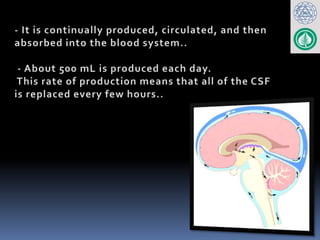
- Is a clear, colorless body fluid ..
- bathes the ..
Formed and Secreted by the choroid
plexus, special tissue that has many blood
vessels and lines the small cavities (ventricles)
in the
brain ..
CIRCULATION OF CSF
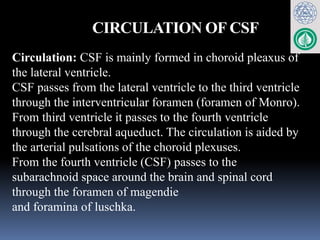
Circulation: CSF is mainly formed in choroid pleaxus of
the lateral ventricle.
CSF passes from the lateral ventricle to the third ventricle
through the interventricular foramen (foramen of Monro).
From third ventricle it passes to the fourth ventricle
through the cerebral aqueduct. The circulation is aided by
the arterial pulsations of the choroid plexuses.
From the fourth ventricle (CSF) passes to the
subarachnoid space around the brain and spinal cord
through the foramen of magendie
and foramina of luschka.
If this protective barrier disrupts may
result in a change in the normal level or
type of constituents of CSF.
Because CSF surrounds the brain and
spinal cord, testing a sample of CSF can
be very valuable in diagnosing a variety
of conditions affecting the central
nervous system (CNS) ..
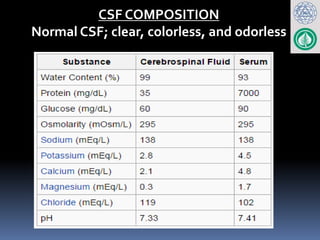
CSF COMPOSITION
Normal CSF; clear, colorless, and odorless
1) Infectious diseases:
such as meningitis and encephalitis and
meningitis.Testing is used to determine if
infection is caused by Bacteria, viruses or,
less commonly, byTuberculosis,
Fungi or Parasites.
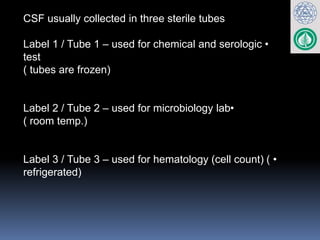
CSF usually collected in three sterile tubes
•
Label 1 / Tube 1 – used for chemical and serologic
test
( tubes are frozen)
•
Label 2 / Tube 2 – used for microbiology lab
( room temp.)
•
Label 3 / Tube 3 – used for hematology (cell count) (
refrigerated)
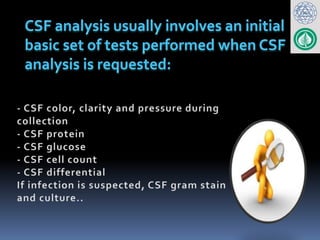
1)CSF glucose– Normal is about 2/3 the
concentration of blood glucose. Glucose levels may decrease
when cells that are not normally present use up (metabolize)
the glucose.These may include bacteria or cells present due
to inflammation (WBCs) or
shed by tumors.
2)CSF protein– only a small amount is normally present in
CSF because proteins are large molecules and do not cross the
blood/brain barrier easily. Decreases in CSF protein are not
generally considered significant. Increases in protein are most
commonly seen with:
Meningitis and brain abscess
Brain or spinal cord tumors
Multiple sclerosis
Guillain-Barre- Syndrome
Syphilis
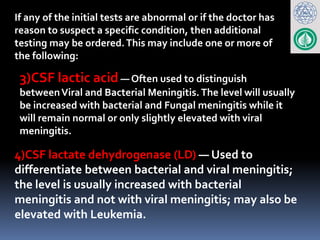
If any of the initial tests are abnormal or if the doctor has
reason to suspect a specific condition, then additional
testing may be ordered.This may include one or more of
the following:
3)CSF lactic acid — Often used to distinguish
betweenViral and Bacterial Meningitis.The level will usually
be increased with bacterial and Fungal meningitis while it
will remain normal or only slightly elevated with viral
meningitis.
4)CSF lactate dehydrogenase (LD) — Used to
differentiate between bacterial and viral meningitis;
the level is usually increased with bacterial
meningitis and not with viral meningitis; may also be
elevated with Leukemia.
5)CSF C-reactive protein (CRP) is
an acute phase protein and is elevated
with inflammation. It is markedly increased
with bacterial meningitis. Since it is very
sensitive even with early bacterial
meningitis, it is often used to distinguish
between bacterial and viral meningitis.
6)CSF Chloride
8)CSF PRESSURE
7) CSF Adenosine Deaminase: ADA testing
is most valuable in ruling out tuberculosis.
reddish color)
LUMBAR PUNCTURE
A lumbar puncture also called a spinal tap is a
procedure where a sample of cerebrospinal fluid is
taken for examination.
CSF is mainly used to diagnose meningitis [an
infection of the meninges].
It is also used to diagnose some other conditions of
the brain and spinal cord.
PRECAUTIONS FOR LUMBAR PUNCTURE
Asked to sign a consent form
Ask about taking any medicines
Are allergic to any medicines
Have / had any bleeding problems

Ask about medications such as aspirin or warfarin
Ask the female patient might be pregnant
Empty the bladder before the procedure
Level of entry
Spinal needle
Collecting the CSF

1. The main anatomical structure which
produces CSF is called the

A. Cerebral Cortex

B. Cerebellum

C Choroid Plexus

D. Foramen of Monroe

2.Which of the following is an
abnormal cerebrospinal fluid (CSF)
finding?

A. Glucose level that is less than 50% of
the plasma glucose level

B. Protein level of less than 0.5 g/l

C. Cell concentration of 0–5 cells/µl

3. Which of the following is true
about CSF analysis in bacterial
meningitis?

A. Raised CSF lactate suggests tuberculous
disease

B. CSF protein increased and Glucose
reduced

C. Antibiotic therapy should be delayed
until after a lumbar puncture to ensure that
bacterial cultures are positive
Thank You

CSF FOR all.pptx

  • 2.
    - Is aclear, colorless body fluid .. - bathes the ..
  • 3.
    Formed and Secretedby the choroid plexus, special tissue that has many blood vessels and lines the small cavities (ventricles) in the brain ..
  • 5.
    CIRCULATION OF CSF Circulation:CSF is mainly formed in choroid pleaxus of the lateral ventricle. CSF passes from the lateral ventricle to the third ventricle through the interventricular foramen (foramen of Monro). From third ventricle it passes to the fourth ventricle through the cerebral aqueduct. The circulation is aided by the arterial pulsations of the choroid plexuses. From the fourth ventricle (CSF) passes to the subarachnoid space around the brain and spinal cord through the foramen of magendie and foramina of luschka.
  • 9.
    If this protectivebarrier disrupts may result in a change in the normal level or type of constituents of CSF. Because CSF surrounds the brain and spinal cord, testing a sample of CSF can be very valuable in diagnosing a variety of conditions affecting the central nervous system (CNS) ..
  • 10.
    CSF COMPOSITION Normal CSF;clear, colorless, and odorless
  • 11.
    1) Infectious diseases: suchas meningitis and encephalitis and meningitis.Testing is used to determine if infection is caused by Bacteria, viruses or, less commonly, byTuberculosis, Fungi or Parasites.
  • 14.
    CSF usually collectedin three sterile tubes • Label 1 / Tube 1 – used for chemical and serologic test ( tubes are frozen) • Label 2 / Tube 2 – used for microbiology lab ( room temp.) • Label 3 / Tube 3 – used for hematology (cell count) ( refrigerated)
  • 18.
    1)CSF glucose– Normalis about 2/3 the concentration of blood glucose. Glucose levels may decrease when cells that are not normally present use up (metabolize) the glucose.These may include bacteria or cells present due to inflammation (WBCs) or shed by tumors. 2)CSF protein– only a small amount is normally present in CSF because proteins are large molecules and do not cross the blood/brain barrier easily. Decreases in CSF protein are not generally considered significant. Increases in protein are most commonly seen with: Meningitis and brain abscess Brain or spinal cord tumors Multiple sclerosis Guillain-Barre- Syndrome Syphilis
  • 19.
    If any ofthe initial tests are abnormal or if the doctor has reason to suspect a specific condition, then additional testing may be ordered.This may include one or more of the following: 3)CSF lactic acid — Often used to distinguish betweenViral and Bacterial Meningitis.The level will usually be increased with bacterial and Fungal meningitis while it will remain normal or only slightly elevated with viral meningitis. 4)CSF lactate dehydrogenase (LD) — Used to differentiate between bacterial and viral meningitis; the level is usually increased with bacterial meningitis and not with viral meningitis; may also be elevated with Leukemia.
  • 20.
    5)CSF C-reactive protein(CRP) is an acute phase protein and is elevated with inflammation. It is markedly increased with bacterial meningitis. Since it is very sensitive even with early bacterial meningitis, it is often used to distinguish between bacterial and viral meningitis. 6)CSF Chloride
  • 21.
    8)CSF PRESSURE 7) CSFAdenosine Deaminase: ADA testing is most valuable in ruling out tuberculosis.
  • 22.
  • 29.
    LUMBAR PUNCTURE A lumbarpuncture also called a spinal tap is a procedure where a sample of cerebrospinal fluid is taken for examination. CSF is mainly used to diagnose meningitis [an infection of the meninges]. It is also used to diagnose some other conditions of the brain and spinal cord.
  • 30.
    PRECAUTIONS FOR LUMBARPUNCTURE Asked to sign a consent form Ask about taking any medicines Are allergic to any medicines Have / had any bleeding problems  Ask about medications such as aspirin or warfarin Ask the female patient might be pregnant Empty the bladder before the procedure
  • 32.
  • 33.
  • 34.
  • 35.
     1. The mainanatomical structure which produces CSF is called the  A. Cerebral Cortex  B. Cerebellum  C Choroid Plexus  D. Foramen of Monroe
  • 36.
     2.Which of thefollowing is an abnormal cerebrospinal fluid (CSF) finding?  A. Glucose level that is less than 50% of the plasma glucose level  B. Protein level of less than 0.5 g/l  C. Cell concentration of 0–5 cells/µl
  • 37.
     3. Which ofthe following is true about CSF analysis in bacterial meningitis?  A. Raised CSF lactate suggests tuberculous disease  B. CSF protein increased and Glucose reduced  C. Antibiotic therapy should be delayed until after a lumbar puncture to ensure that bacterial cultures are positive
  • 38.

Editor's Notes

  • #2 https://www.physio-pedia.com/CSF_Cerebrospinal_Fluid
  • #3 https://teachmephysiology.com/nervous-system/components/cerebrospinal-fluid/