CNIT 141
Cryptography for Computer Networks
8. Authenticated Encryption
MAC v. AE
• Message Authentication Code (MAC)
• Protects a message's authenticity
• With a tag, like a signature
• But doesn't provide confidentiality
• Authenticated Encryption (AE)
• Produces an authentication tag
• And also encrypts the message
• Combining a cipher and a MAC
Topics
• Authenticated Encryption using MACs
• Authenticated Ciphers
• AES-GCM: The Authenticated Cipher Standard
• OCB: An Authenticated Cipher Faster than
GCM
• SIV: The Safest Authenticated Cipher?
• Permutation-Based AEAD
• How Things Can Go Wrong
Authenticated Encryption
using MACs
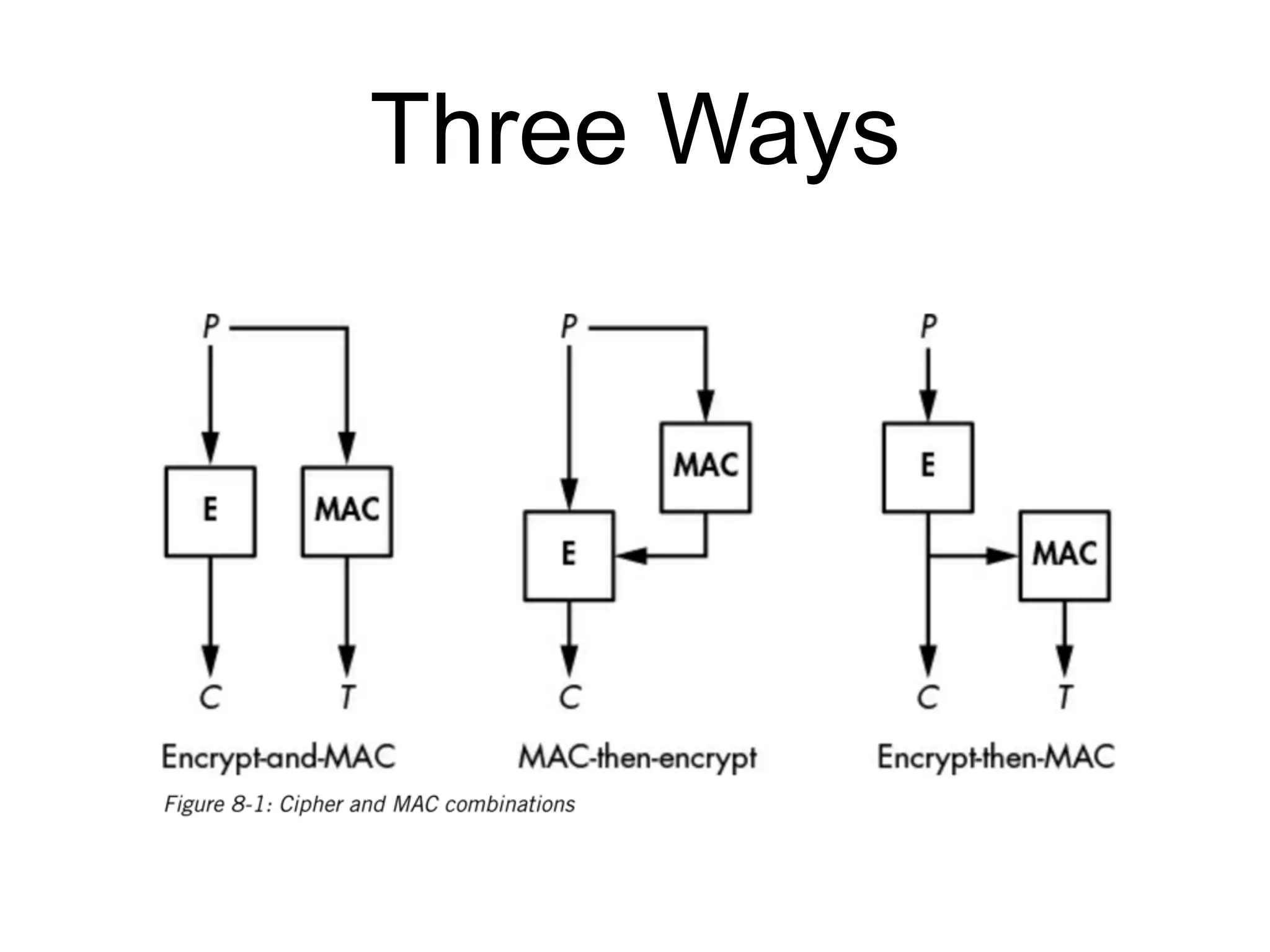
Three Ways
Encrypt-and-MAC
• Least secure system
• MAC might leak information about P
• Because MACs are only required to
be unforgeable, not random
• Used by SSH
SSH
• Each encrypted packet C
• Is followed by the tag
T = MAC(K, N || P)
N is a sequence number
• Secure in practice because the
MAC algorithms are strong and
don't leak information
• Like HMAC-SHA-256
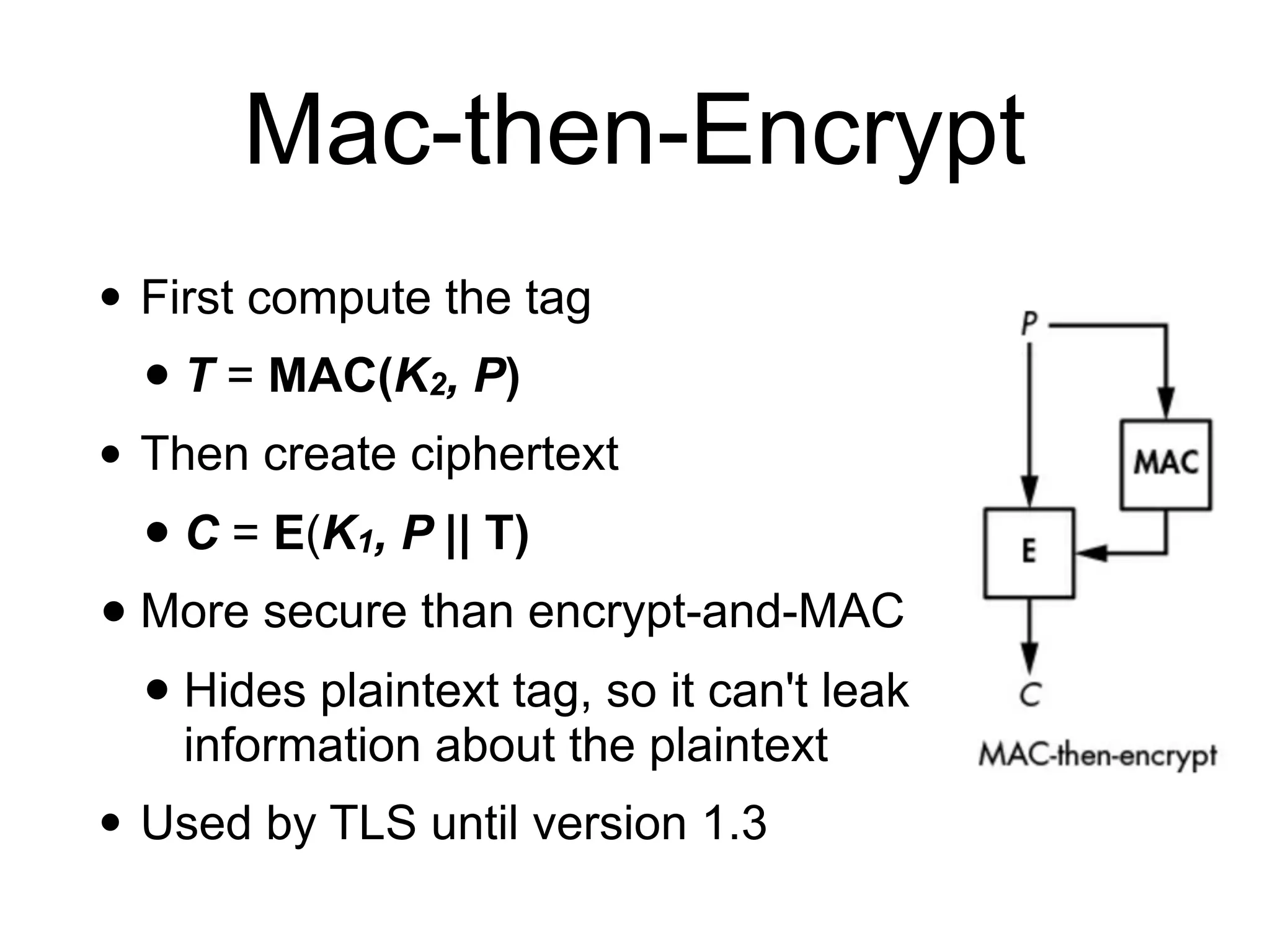
Mac-then-Encrypt
• First compute the tag
• T = MAC(K2, P)
• Then create ciphertext
• C = E(K1, P || T)
• More secure than encrypt-and-MAC
• Hides plaintext tag, so it can't leak
information about the plaintext
• Used by TLS until version 1.3
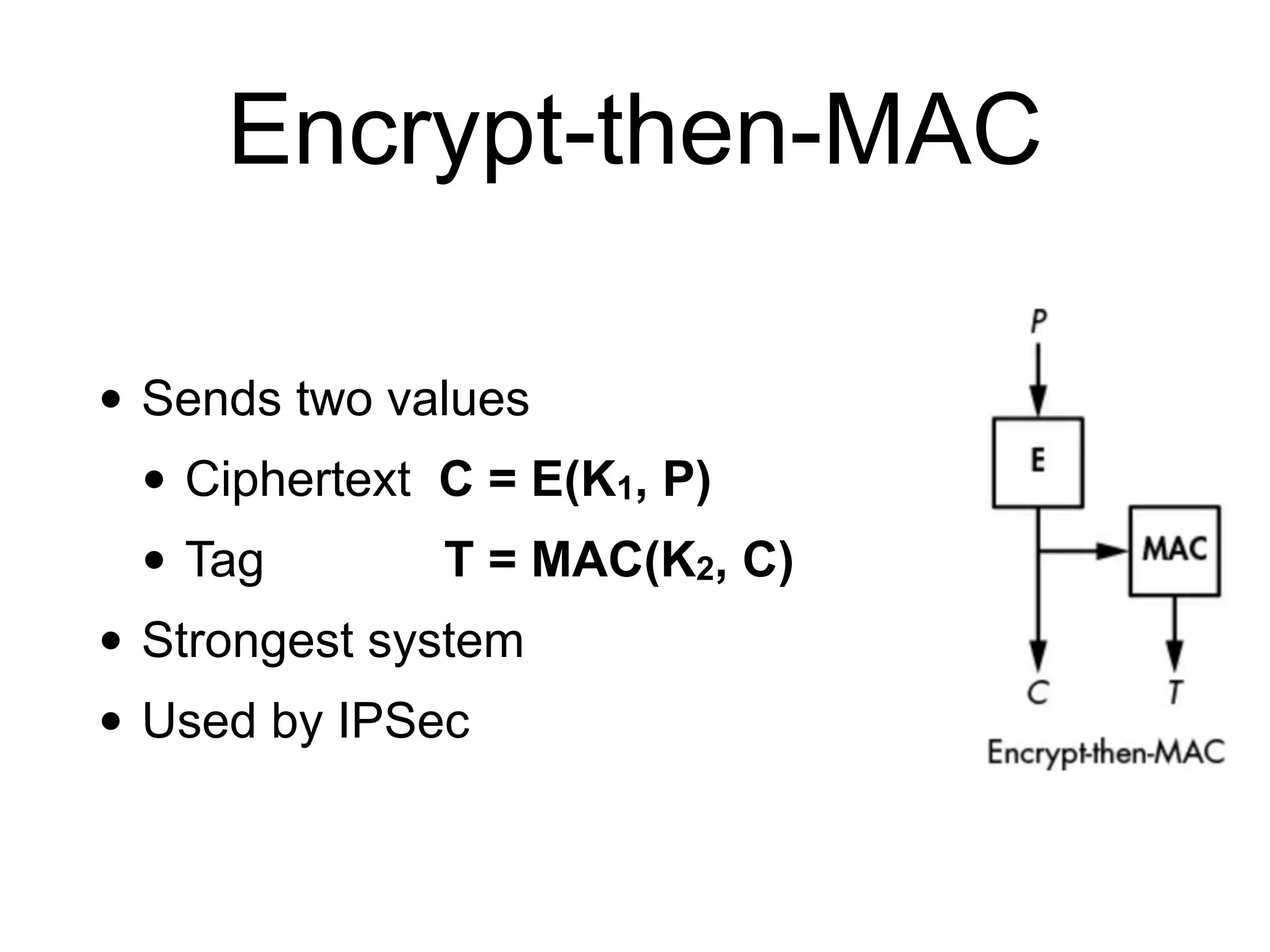
Encrypt-then-MAC
• Sends two values
• Ciphertext C = E(K1, P)
• Tag T = MAC(K2, C)
• Strongest system
• Used by IPSec
Authenticated Ciphers
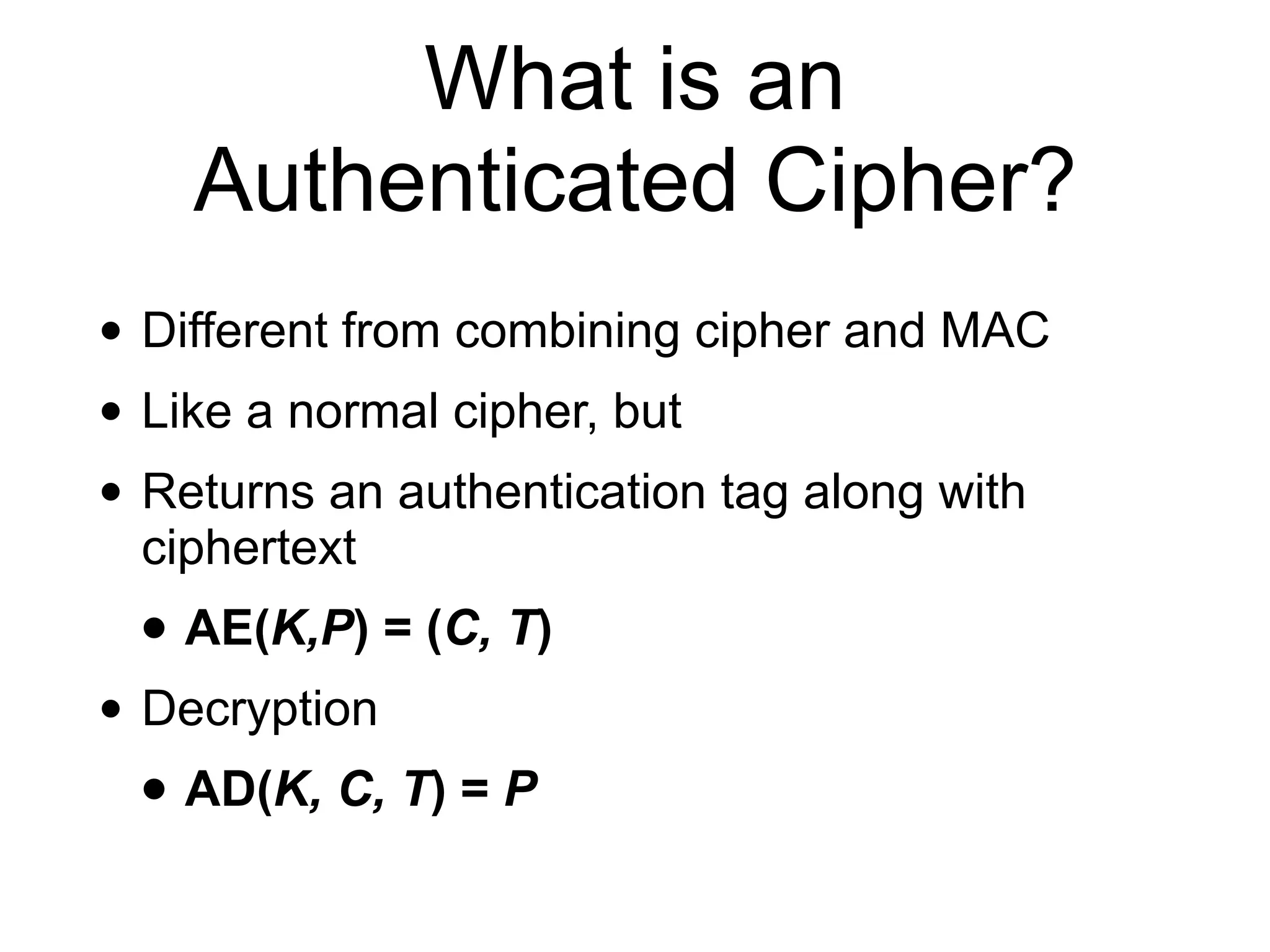
What is an
Authenticated Cipher?
• Different from combining cipher and MAC
• Like a normal cipher, but
• Returns an authentication tag along with
ciphertext
• AE(K,P) = (C, T)
• Decryption
• AD(K, C, T) = P
Security Requirements
• Authentication should be as strong as a MAC
• Impossible to forge a (C,T) pair
• That the AD function will accept and decrypt
• Confidentiality is stronger than a basic cipher
• Decryption will fail unless the tag is valid
• Prevents chosen-ciphertext attacks
Authenticated Encyption with
Associated Data (AEAD)
• Associated data is authenticated by the tag
• But not encrypted
• Example: network header data
• AEAD(K, P, A) = (C, A, T)
• Tag depends on both P and A
• Will be rejected if C or A is modified
• You can leave A or P empty
Authenticated Encyption with
Associated Data (AEAD)
• You can leave A or P empty
• If A is empty, AEAD is AE
• If P is empty, AEAD is MAC
Avoiding Predictability with
Nonces
• Use AE(K, P, A, N)
• N is nonce and must not be re-used with the
same key
What Makes a Good
Authenticated Cipher?
Security Criteria
• Confidentiality must be as strong as the best
cipher
• Authenticity must be as strong as the best
MAC
• Fragility if nonce is repeated (misuse
resistance)
• Parallelizability -- can process multiple blocks
simultaneously
• CTR is parallelizable, CBC is not
Performance Criteria
• Internal structure
• Two-layer, like AES-CGM,
• First layer is encryption of plaintext
• Second layer is authentication
• One-layer may be simpler and faster
Performance Criteria
• Streamable (aka online)
• Can process a message block by block
• Discarding completed blocks
• Reduces RAM requirements
• Nonstreamable ciphers must store the entire
message
• Typically because they must make two
passes over the data
Performance Criteria
• Other features of implementation
• Some AC only allow A to precede P
• Others place it after, or anywhere
• Some systems, like AES-CBC, requre two
algorithms, one for encryption and one for
decryption
• AES-CTR can use the same algorithm for both
• Cost may matter on low-cost dedicated
hardware
Functional Criteria
AES-GCM:
The Authenticated Cipher Standard
AES-GCM
• AES algorithm
• Galois Counter Mode (GCM)
• A tweak of CTR mode
• Uses a small, efficient algorithm to compute
an authentication tag
AES-GCM
• The most widely used authenticated cipher
• The only authenticated cipher that is a NIST
standard
• Part of NSA's Suite B
• Used in IPSec, SSH, and TLS 1.2
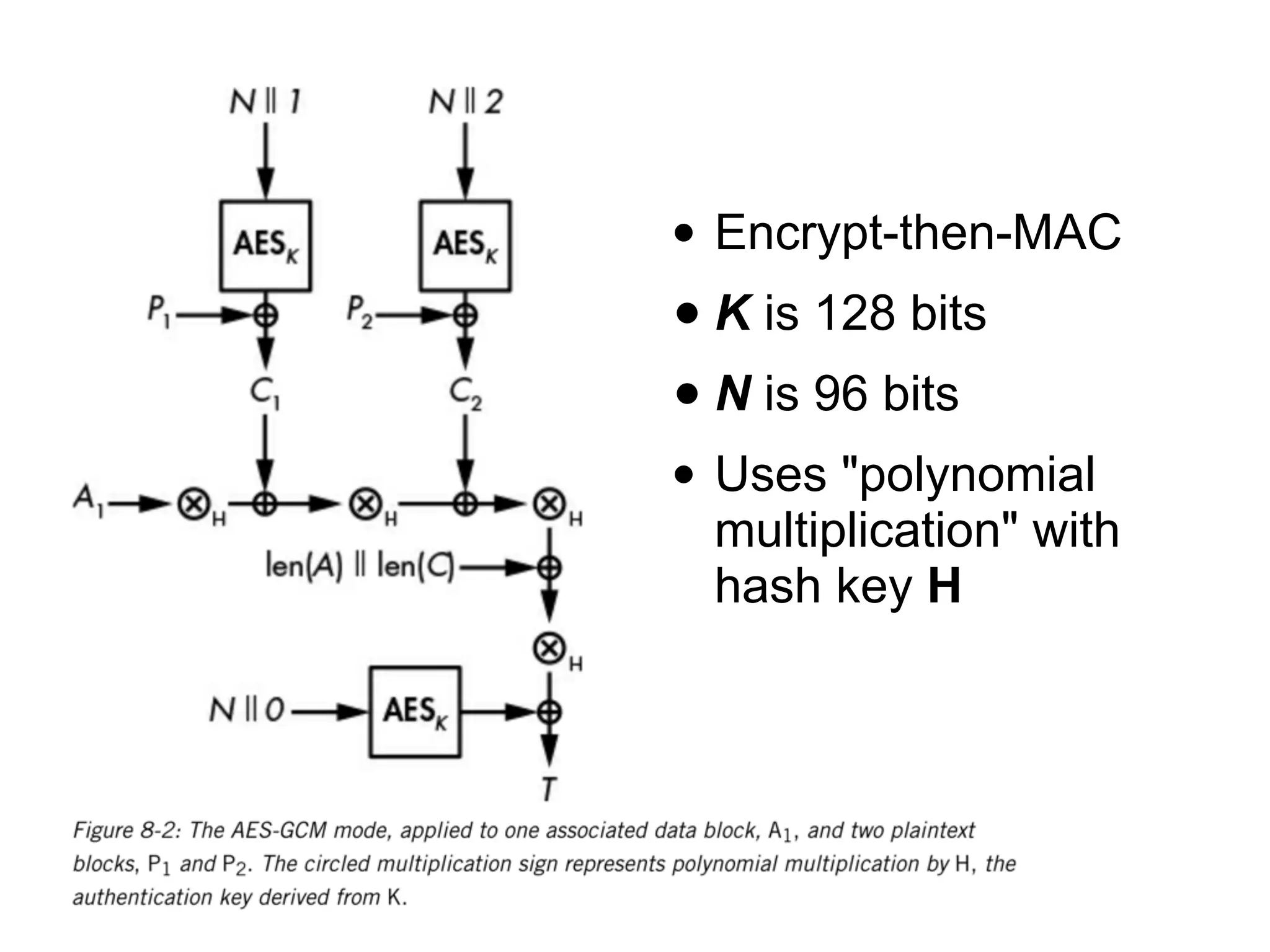
• Encrypt-then-MAC
• K is 128 bits
• N is 96 bits
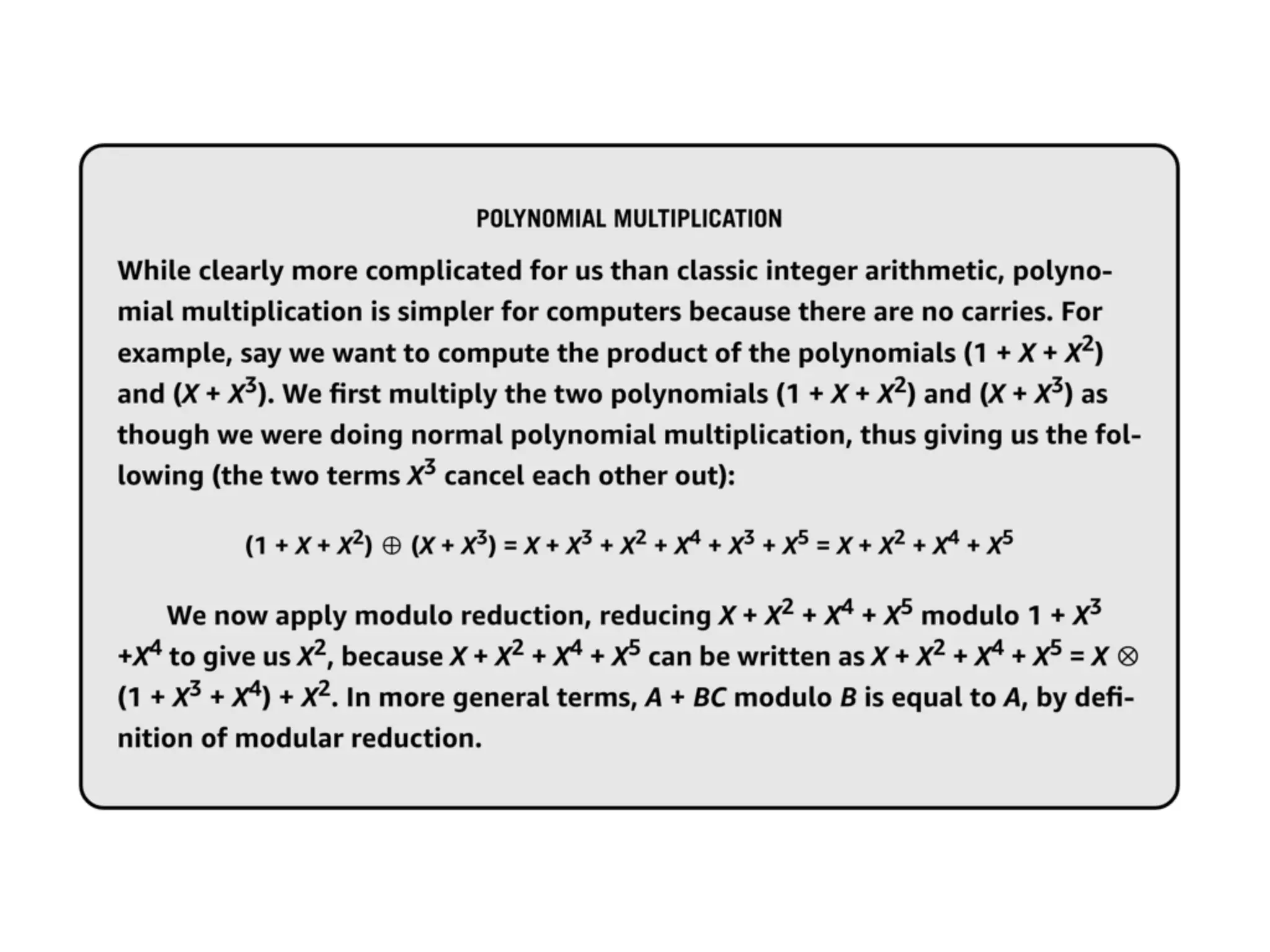
• Uses "polynomial
multiplication" with
hash key H
GCM Security
• Fragile when nonce is repeated
• If nonce is used twice, attacker can get
authentication key H
• And forge tags
• In 2016, 184 HTTPS servers were found with
repeated nonces
• Including 23 using all-zeroes
GCM Efficiency
• GCM encryption and decryption are both
parallelizable
• But the MAC is not
• GCM is streamable
• Because the layers can be pipelined
• Processing blocks one by one
OCB: An Authenticated
Cipher Faster than GCM
Offset Codebook
• Developed in 2001
• Faster and simpler than GCM
• Limited by license until 2013
• Blends encryption and authentication into one
layer
• With only one key
OCB Internals
• Each block of plaintext is encrypted with a
block cipher
• With a key and an Offset computed from the
key and a nonce that increments for each block
OCB Internals
• Tag uses S = P1 ^ P2 ^ P3
• XORs S with an offset computed from the last
block's offset
OCB
• Support associated data also
• With offset values that are different than those
used to encrypt P
OCB Security
• Less fragile than GCM against repeated
nonces
• Attackers will see identical blocks of
ciphertext, like ECB
• But won't be able to find the secret key
OCB Efficiency
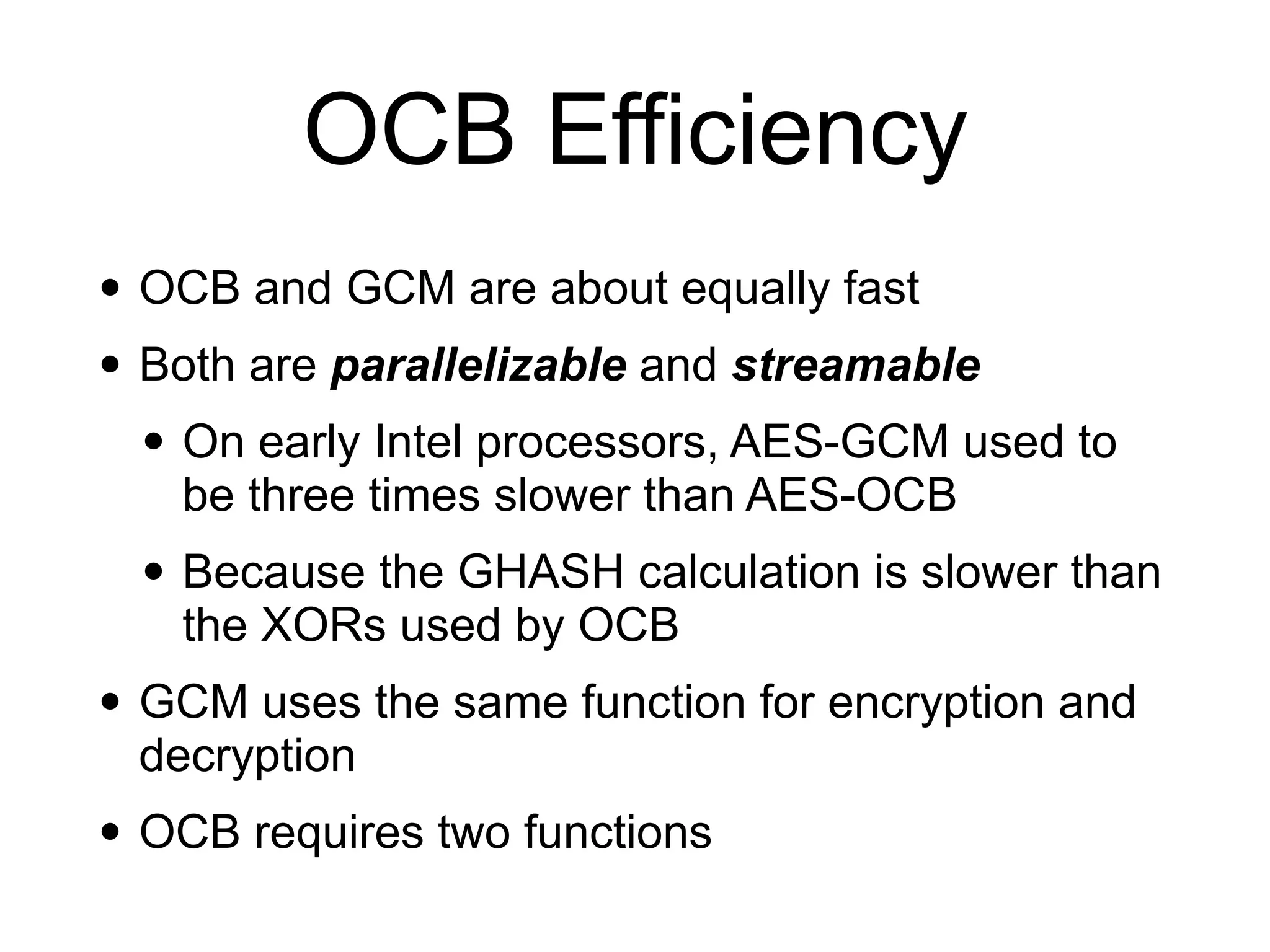
• OCB and GCM are about equally fast
• Both are parallelizable and streamable
• On early Intel processors, AES-GCM used to
be three times slower than AES-OCB
• Because the GHASH calculation is slower than
the XORs used by OCB
• GCM uses the same function for encryption and
decryption
• OCB requires two functions
SIV: The Safest
Authenticated Cipher?
Synthetic IV (SIV)
• An authenticated cipher mode
• Typically used with AES
• Secure even if you use the same nonce twice
• Unlike GCM and OCB
• Attacker will only learn that the same
plaintest was encrypted twice
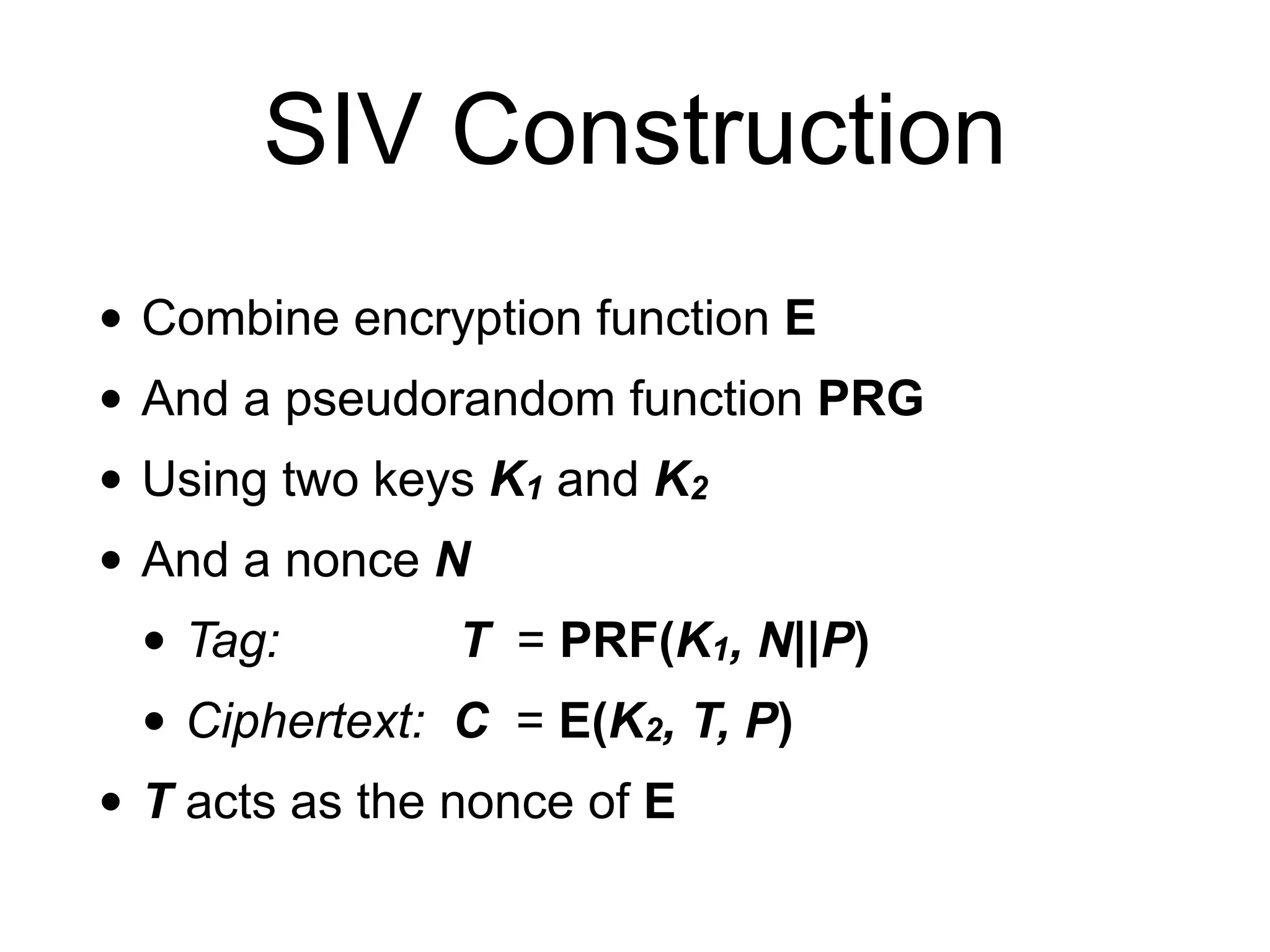
SIV Construction
• Combine encryption function E
• And a pseudorandom function PRG
• Using two keys K1 and K2
• And a nonce N
• Tag: T = PRF(K1, N||P)
• Ciphertext: C = E(K2, T, P)
• T acts as the nonce of E
SIV Performance
• SIV is not streamable
• After computing T, it must keep the entire
plaintext P in memory
• To encrypt 100 GB of plaintext, you must
store 100 GB
Permutation-Based AEAD
Permutation
• Not a block cipher like AES
• Simply transforms input to output of the same
size
• Reversibly, without using a key
• Fast, secure, and more resistant to nonce
reuse than GCM and OCB
Permutation-Based AEAD
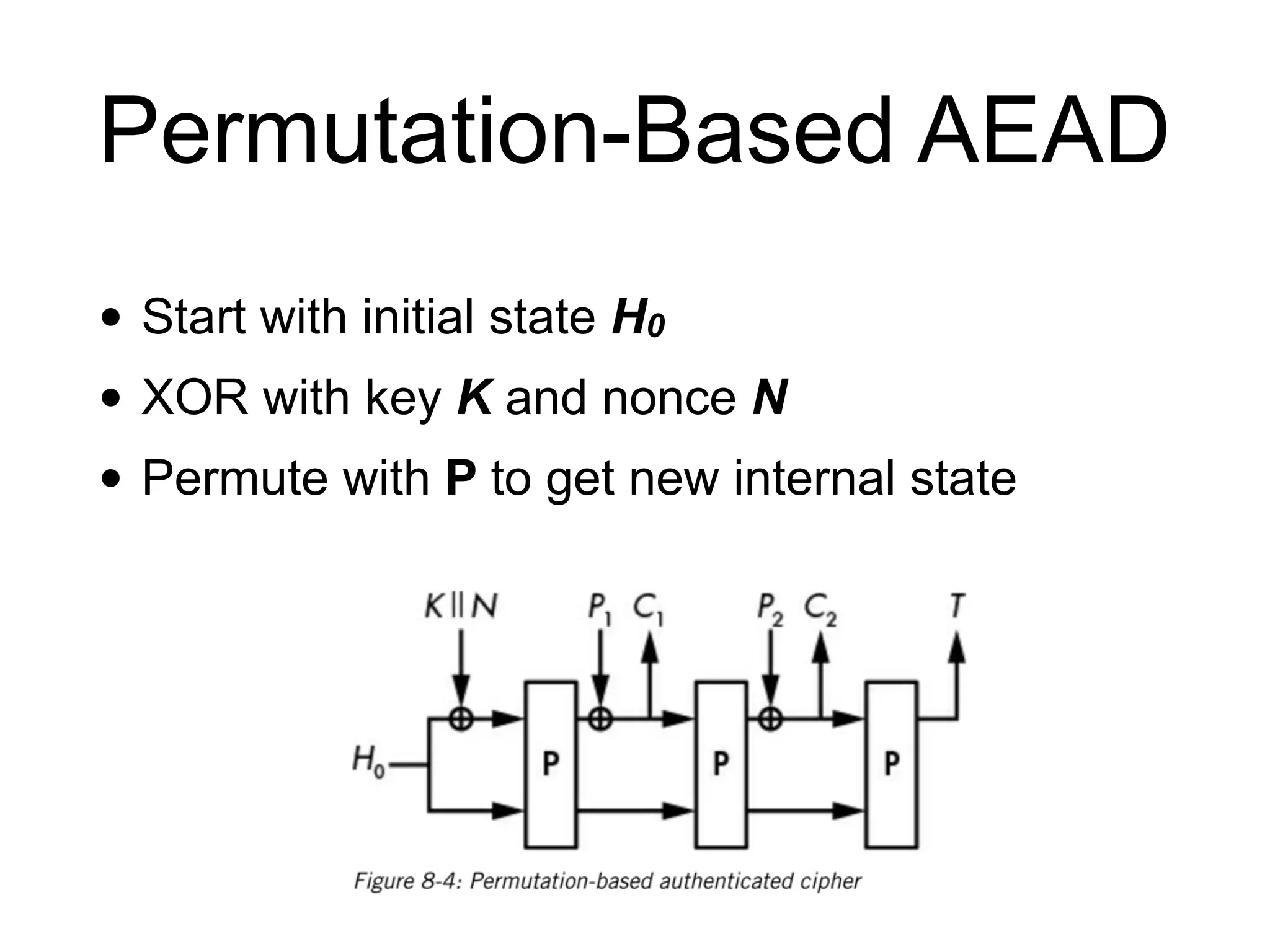
• Start with initial state H0
• XOR with key K and nonce N
• Permute with P to get new internal state
Permutation-Based AEAD
• This produces a series of pseudorandom
blocks
• XOR them with plaintext blocks to form
ciphertext blocks
Permutation-Based AEAD
• Ciphertext is same length as plaintext
• Internal state is larger than block size
• Bits from last internal state form the tag
Permutation-Based AEAD
Security
• Security relies on secrecy of the internal state
• Blocks must be padded carefully
• Nonce re-use is only a small problem
• Attacker can only tell that messages began
with same value
Permutation-Based AEAD
Performance
• A single layer of operations
• Streamable
• A single core algorithm for encryption and
decryption
• But not parallelizable like GCM or OCB
• New calls to P must wait for previous call to
complete
How Things Can Go
Wrong
Attack Surface
• Authenticated ciphers must provide both
confidentiality and authenticity
• Take two values: plaintext P and associated
data A
• Must remain secure for all values of P and A
• Even when one is absent, all zeroes, or very
large
Attack Surface
• Must remain secure against attackers who
collect numerous message/tag pairs
• And against accidental repetition of nonces
AES-GCM and Weak
Hash Keys
• GHASH uses a hash key H over and over for
each block
• Certain values of H make the tag weak
• Because they form a "short cycle" and
repeat every few blocks
Tag Forgery
• If H has a cycle of five
• An attacker could swap the first and sixth
block of ciphertext
• And get the same authentication tag
• Constructing a new valid message without
knowing the key
Consqeuences of Tag
Forgery
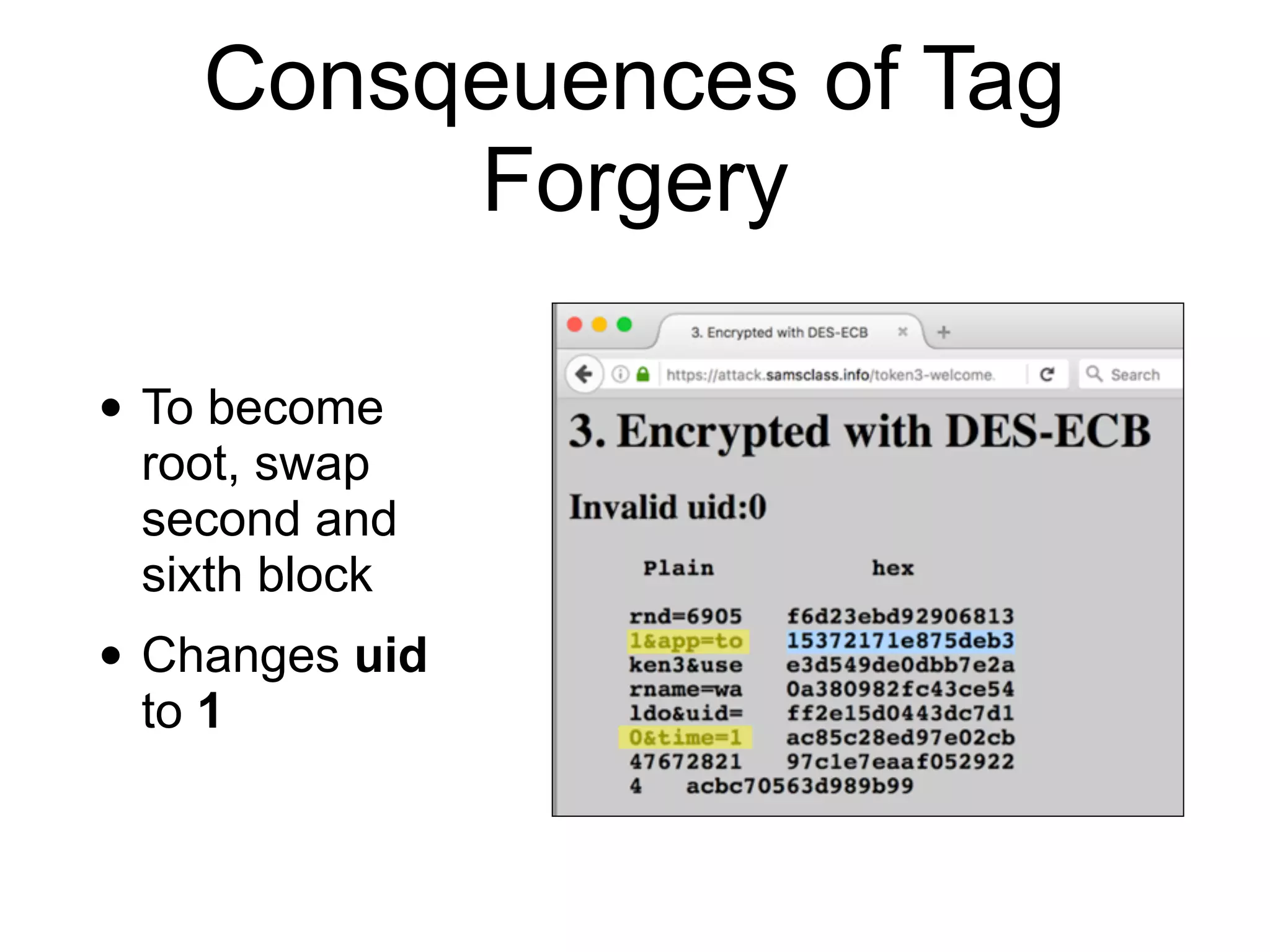
• To become
root, swap
second and
sixth block
• Changes uid
to 1
AES-GCM and Weak
Hash Keys
• Not practical to exploit
• Attacker needs to know H or K to find cycle
length
• But still a defect of AES-GCM
AES-GCM and Small Tags
• Normally returns 128-bit tags
• Those are secure
• But can produce shorter tags, like 32 or 48 bits
• Those are much weaker than they appear, for
long messages
• 48-bit tags for messages 4 GB long
• Have one chance in a million of a forgery
succeeding
CNIT 141: 8. Authenticated Encryption

CNIT 141: 8. Authenticated Encryption

  • 1.
    CNIT 141 Cryptography forComputer Networks 8. Authenticated Encryption
  • 2.
    MAC v. AE •Message Authentication Code (MAC) • Protects a message's authenticity • With a tag, like a signature • But doesn't provide confidentiality • Authenticated Encryption (AE) • Produces an authentication tag • And also encrypts the message • Combining a cipher and a MAC
  • 3.
    Topics • Authenticated Encryptionusing MACs • Authenticated Ciphers • AES-GCM: The Authenticated Cipher Standard • OCB: An Authenticated Cipher Faster than GCM • SIV: The Safest Authenticated Cipher? • Permutation-Based AEAD • How Things Can Go Wrong
  • 4.
  • 5.
  • 6.
    Encrypt-and-MAC • Least securesystem • MAC might leak information about P • Because MACs are only required to be unforgeable, not random • Used by SSH
  • 7.
    SSH • Each encryptedpacket C • Is followed by the tag T = MAC(K, N || P) N is a sequence number • Secure in practice because the MAC algorithms are strong and don't leak information • Like HMAC-SHA-256
  • 8.
    Mac-then-Encrypt • First computethe tag • T = MAC(K2, P) • Then create ciphertext • C = E(K1, P || T) • More secure than encrypt-and-MAC • Hides plaintext tag, so it can't leak information about the plaintext • Used by TLS until version 1.3
  • 9.
    Encrypt-then-MAC • Sends twovalues • Ciphertext C = E(K1, P) • Tag T = MAC(K2, C) • Strongest system • Used by IPSec
  • 10.
  • 11.
    What is an AuthenticatedCipher? • Different from combining cipher and MAC • Like a normal cipher, but • Returns an authentication tag along with ciphertext • AE(K,P) = (C, T) • Decryption • AD(K, C, T) = P
  • 12.
    Security Requirements • Authenticationshould be as strong as a MAC • Impossible to forge a (C,T) pair • That the AD function will accept and decrypt • Confidentiality is stronger than a basic cipher • Decryption will fail unless the tag is valid • Prevents chosen-ciphertext attacks
  • 13.
    Authenticated Encyption with AssociatedData (AEAD) • Associated data is authenticated by the tag • But not encrypted • Example: network header data • AEAD(K, P, A) = (C, A, T) • Tag depends on both P and A • Will be rejected if C or A is modified • You can leave A or P empty
  • 14.
    Authenticated Encyption with AssociatedData (AEAD) • You can leave A or P empty • If A is empty, AEAD is AE • If P is empty, AEAD is MAC
  • 15.
    Avoiding Predictability with Nonces •Use AE(K, P, A, N) • N is nonce and must not be re-used with the same key
  • 16.
    What Makes aGood Authenticated Cipher?
  • 17.
    Security Criteria • Confidentialitymust be as strong as the best cipher • Authenticity must be as strong as the best MAC • Fragility if nonce is repeated (misuse resistance)
  • 18.
    • Parallelizability --can process multiple blocks simultaneously • CTR is parallelizable, CBC is not Performance Criteria
  • 19.
    • Internal structure •Two-layer, like AES-CGM, • First layer is encryption of plaintext • Second layer is authentication • One-layer may be simpler and faster Performance Criteria
  • 20.
    • Streamable (akaonline) • Can process a message block by block • Discarding completed blocks • Reduces RAM requirements • Nonstreamable ciphers must store the entire message • Typically because they must make two passes over the data Performance Criteria
  • 21.
    • Other featuresof implementation • Some AC only allow A to precede P • Others place it after, or anywhere • Some systems, like AES-CBC, requre two algorithms, one for encryption and one for decryption • AES-CTR can use the same algorithm for both • Cost may matter on low-cost dedicated hardware Functional Criteria
  • 22.
  • 23.
    AES-GCM • AES algorithm •Galois Counter Mode (GCM) • A tweak of CTR mode • Uses a small, efficient algorithm to compute an authentication tag
  • 24.
    AES-GCM • The mostwidely used authenticated cipher • The only authenticated cipher that is a NIST standard • Part of NSA's Suite B • Used in IPSec, SSH, and TLS 1.2
  • 25.
    • Encrypt-then-MAC • Kis 128 bits • N is 96 bits • Uses "polynomial multiplication" with hash key H
  • 27.
    GCM Security • Fragilewhen nonce is repeated • If nonce is used twice, attacker can get authentication key H • And forge tags • In 2016, 184 HTTPS servers were found with repeated nonces • Including 23 using all-zeroes
  • 28.
    GCM Efficiency • GCMencryption and decryption are both parallelizable • But the MAC is not • GCM is streamable • Because the layers can be pipelined • Processing blocks one by one
  • 29.
  • 30.
    Offset Codebook • Developedin 2001 • Faster and simpler than GCM • Limited by license until 2013 • Blends encryption and authentication into one layer • With only one key
  • 31.
    OCB Internals • Eachblock of plaintext is encrypted with a block cipher • With a key and an Offset computed from the key and a nonce that increments for each block
  • 32.
    OCB Internals • Taguses S = P1 ^ P2 ^ P3 • XORs S with an offset computed from the last block's offset
  • 33.
    OCB • Support associateddata also • With offset values that are different than those used to encrypt P
  • 34.
    OCB Security • Lessfragile than GCM against repeated nonces • Attackers will see identical blocks of ciphertext, like ECB • But won't be able to find the secret key
  • 35.
    OCB Efficiency • OCBand GCM are about equally fast • Both are parallelizable and streamable • On early Intel processors, AES-GCM used to be three times slower than AES-OCB • Because the GHASH calculation is slower than the XORs used by OCB • GCM uses the same function for encryption and decryption • OCB requires two functions
  • 36.
  • 37.
    Synthetic IV (SIV) •An authenticated cipher mode • Typically used with AES • Secure even if you use the same nonce twice • Unlike GCM and OCB • Attacker will only learn that the same plaintest was encrypted twice
  • 38.
    SIV Construction • Combineencryption function E • And a pseudorandom function PRG • Using two keys K1 and K2 • And a nonce N • Tag: T = PRF(K1, N||P) • Ciphertext: C = E(K2, T, P) • T acts as the nonce of E
  • 39.
    SIV Performance • SIVis not streamable • After computing T, it must keep the entire plaintext P in memory • To encrypt 100 GB of plaintext, you must store 100 GB
  • 40.
  • 41.
    Permutation • Not ablock cipher like AES • Simply transforms input to output of the same size • Reversibly, without using a key • Fast, secure, and more resistant to nonce reuse than GCM and OCB
  • 42.
    Permutation-Based AEAD • Startwith initial state H0 • XOR with key K and nonce N • Permute with P to get new internal state
  • 43.
    Permutation-Based AEAD • Thisproduces a series of pseudorandom blocks • XOR them with plaintext blocks to form ciphertext blocks
  • 44.
    Permutation-Based AEAD • Ciphertextis same length as plaintext • Internal state is larger than block size • Bits from last internal state form the tag
  • 45.
    Permutation-Based AEAD Security • Securityrelies on secrecy of the internal state • Blocks must be padded carefully • Nonce re-use is only a small problem • Attacker can only tell that messages began with same value
  • 46.
    Permutation-Based AEAD Performance • Asingle layer of operations • Streamable • A single core algorithm for encryption and decryption • But not parallelizable like GCM or OCB • New calls to P must wait for previous call to complete
  • 47.
  • 48.
    Attack Surface • Authenticatedciphers must provide both confidentiality and authenticity • Take two values: plaintext P and associated data A • Must remain secure for all values of P and A • Even when one is absent, all zeroes, or very large
  • 49.
    Attack Surface • Mustremain secure against attackers who collect numerous message/tag pairs • And against accidental repetition of nonces
  • 50.
    AES-GCM and Weak HashKeys • GHASH uses a hash key H over and over for each block • Certain values of H make the tag weak • Because they form a "short cycle" and repeat every few blocks
  • 51.
    Tag Forgery • IfH has a cycle of five • An attacker could swap the first and sixth block of ciphertext • And get the same authentication tag • Constructing a new valid message without knowing the key
  • 52.
    Consqeuences of Tag Forgery •To become root, swap second and sixth block • Changes uid to 1
  • 53.
    AES-GCM and Weak HashKeys • Not practical to exploit • Attacker needs to know H or K to find cycle length • But still a defect of AES-GCM
  • 54.
    AES-GCM and SmallTags • Normally returns 128-bit tags • Those are secure • But can produce shorter tags, like 32 or 48 bits • Those are much weaker than they appear, for long messages • 48-bit tags for messages 4 GB long • Have one chance in a million of a forgery succeeding