What is Cryptography?


           Pratik Poddar
       Senior Undergraduate
  Computer Science and Engineering
            IIT Bombay

         23th February 2010
What is Cryptology?
Greek: “krypto” meaning hide

Study of: 1) Hiding data
2) Reading Hidden data
3) Signing data

Goals: 1) Authentication
2) Integrity
3) Non-repudiation
4) Confidentiality
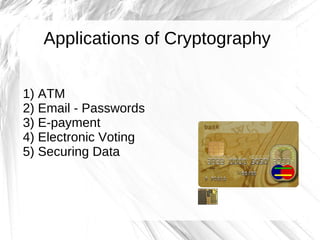
Applications of Cryptography


1) ATM
2) Email - Passwords
3) E-payment
4) Electronic Voting
5) Securing Data
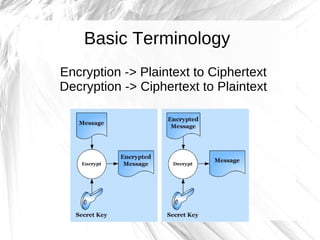
Basic Terminology
Encryption -> Plaintext to Ciphertext
Decryption -> Ciphertext to Plaintext
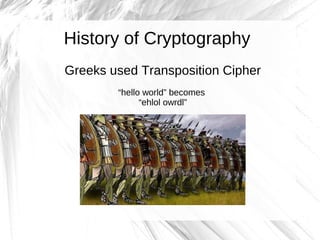
History of Cryptography
Greeks used Transposition Cipher
        “hello world” becomes
              “ehlol owrdl”
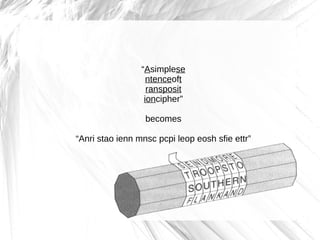
“Asimplese
                   ntenceoft
                   ransposit
                  ioncipher”

                  becomes

“Anri stao ienn mnsc pcpi leop eosh sfie ettr”
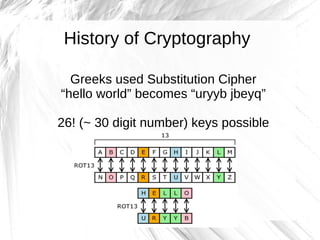
History of Cryptography

  Greeks used Substitution Cipher
“hello world” becomes “uryyb jbeyq”

26! (~ 30 digit number) keys possible
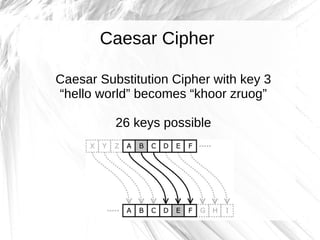
Caesar Cipher

Caesar Substitution Cipher with key 3
“hello world” becomes “khoor zruog”

          26 keys possible
th
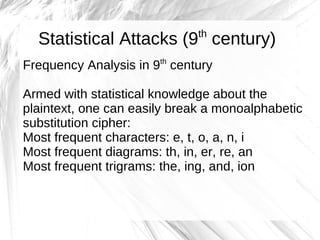
  Statistical Attacks (9 century)
Frequency Analysis in 9th century

Armed with statistical knowledge about the
plaintext, one can easily break a monoalphabetic
substitution cipher:
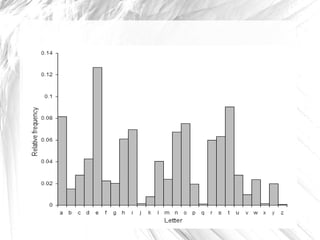
Most frequent characters: e, t, o, a, n, i
Most frequent diagrams: th, in, er, re, an
Most frequent trigrams: the, ing, and, ion
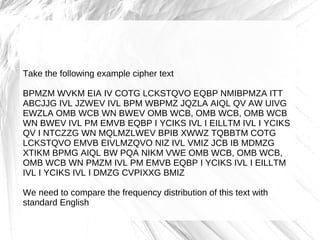
Take the following example cipher text

BPMZM WVKM EIA IV COTG LCKSTQVO EQBP NMIBPMZA ITT
ABCJJG IVL JZWEV IVL BPM WBPMZ JQZLA AIQL QV AW UIVG
EWZLA OMB WCB WN BWEV OMB WCB, OMB WCB, OMB WCB
WN BWEV IVL PM EMVB EQBP I YCIKS IVL I EILLTM IVL I YCIKS
QV I NTCZZG WN MQLMZLWEV BPIB XWWZ TQBBTM COTG
LCKSTQVO EMVB EIVLMZQVO NIZ IVL VMIZ JCB IB MDMZG
XTIKM BPMG AIQL BW PQA NIKM VWE OMB WCB, OMB WCB,
OMB WCB WN PMZM IVL PM EMVB EQBP I YCIKS IVL I EILLTM
IVL I YCIKS IVL I DMZG CVPIXXG BMIZ

We need to compare the frequency distribution of this text with
standard English
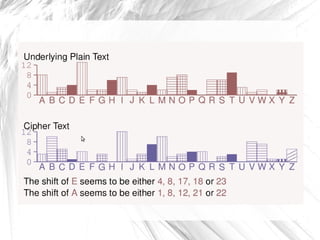
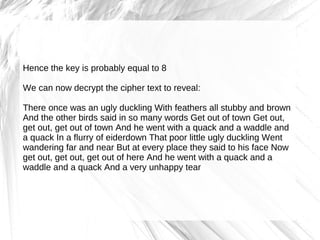
Hence the key is probably equal to 8

We can now decrypt the cipher text to reveal:

There once was an ugly duckling With feathers all stubby and brown
And the other birds said in so many words Get out of town Get out,
get out, get out of town And he went with a quack and a waddle and
a quack In a flurry of eiderdown That poor little ugly duckling Went
wandering far and near But at every place they said to his face Now
get out, get out, get out of here And he went with a quack and a
waddle and a quack And a very unhappy tear
Poly-alphabetic Cipher (1467)

Use different ciphers (i.e., substitution alphabets)
          for various parts of a message

        The first automatic cipher device

             Frequency analysis fails
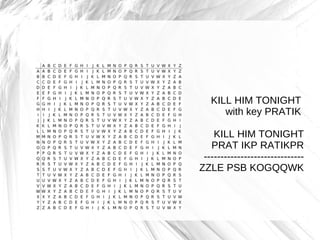
KILL HIM TONIGHT
      with key PRATIK

    KILL HIM TONIGHT
   PRAT IKP RATIKPR
 ------------------------------
ZZLE PSB KOGQQWK
Attack on Poly-Alphabetic Cipher


If period is known, individual frequency analysis
Kerchoff's Principle (1800s)
     Cryptography always involves:
      Transformation and Secret

Security of the key used should alone be
 sufficient for a good cipher to maintain
      confidentiality under an attack

     The enemy knows the system
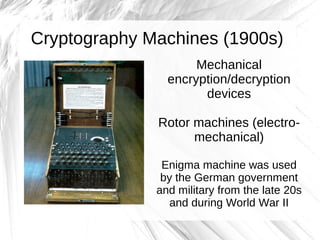
Cryptography Machines (1900s)
                     Mechanical
                encryption/decryption
                      devices

              Rotor machines (electro-
                    mechanical)

               Enigma machine was used
               by the German government
              and military from the late 20s
                 and during World War II
Post WW2 Cryptography
1) Cryptography now on bits instead of letters
2) Academic Research began in 1970s
3) Computers helped Cryptography?
4) No more linguistic and lexicographic patterns,
but aspects of information theory, computational
complexity, statistics, combinatorics, abstract
algebra, number theory, and finite mathematics
“Modern cryptography is a remarkable discipline. It is a cornerstone
 of computer and communications security, with end products that
     are imminently practical. Yet its study touches on branches
  of mathematics that may have been considered esoteric, and it
brings together fields like number theory, computational-complexity
                    theory, and probability theory”
Block vs Stream

                Block Cipher
Message is broken into blocks, each of which is
               then encrypted

              Stream Cipher
Process the message bit by bit ( as a stream )
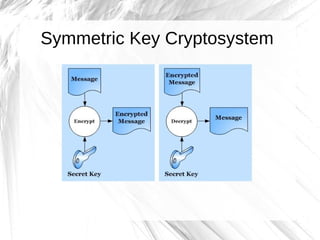
Symmetric Key Cryptosystem
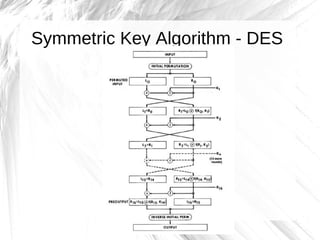
Symmetric Key Algorithm - DES
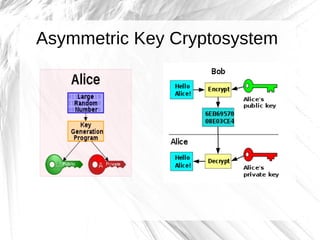
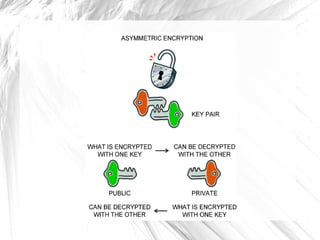
Asymmetric Key Cryptosystem
Asymmetric Key Cryptosystem -
             Idea

Some modern cryptographic techniques can only
  keep their keys secret if certain mathematical
  problems are intractable, such as the integer
 factorization or the discrete logarithm problems
Designing Cipher

-- Little Secrets Hide Bigger Secrets
-- Open Algorithms and value of Peer-Review
-- Mathematical Background
-- Unbroken is Not Necessarily Unbreakable

What is a good encryption scheme?
1) Complexity of encrypting or decrypting
2) Unbreakable
3) Size of cipher-text relative to plaintext
4) Key exchange should be easy
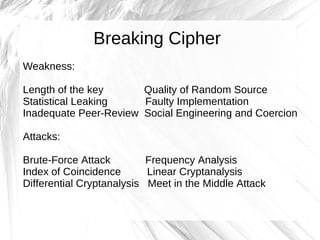
Breaking Cipher
Weakness:

Length of the key      Quality of Random Source
Statistical Leaking    Faulty Implementation
Inadequate Peer-Review Social Engineering and Coercion

Attacks:

Brute-Force Attack         Frequency Analysis
Index of Coincidence       Linear Cryptanalysis
Differential Cryptanalysis Meet in the Middle Attack
Research and Education

-- Encryption Decryption Algorithms
-- Cryptanalysis
-- Mathematics
-- Proofs of cryptosystem
-- Key Exchange Protocols
-- Certificates
Work being done at IIT Bombay
Prof. Bernard Menezes and his 5-6 students

Contact:
Pratik Poddar
pratik.poddar@iitb.ac.in
pratik@cse.iitb.ac.in
(Topic: IBE and Elliptic-Curve Cryptography)
Thank You!

What is Cryptography?

  • 1.
    What is Cryptography? Pratik Poddar Senior Undergraduate Computer Science and Engineering IIT Bombay 23th February 2010
  • 2.
    What is Cryptology? Greek:“krypto” meaning hide Study of: 1) Hiding data 2) Reading Hidden data 3) Signing data Goals: 1) Authentication 2) Integrity 3) Non-repudiation 4) Confidentiality
  • 3.
    Applications of Cryptography 1)ATM 2) Email - Passwords 3) E-payment 4) Electronic Voting 5) Securing Data
  • 4.
    Basic Terminology Encryption ->Plaintext to Ciphertext Decryption -> Ciphertext to Plaintext
  • 5.
    History of Cryptography Greeksused Transposition Cipher “hello world” becomes “ehlol owrdl”
  • 6.
    “Asimplese ntenceoft ransposit ioncipher” becomes “Anri stao ienn mnsc pcpi leop eosh sfie ettr”
  • 7.
    History of Cryptography Greeks used Substitution Cipher “hello world” becomes “uryyb jbeyq” 26! (~ 30 digit number) keys possible
  • 8.
    Caesar Cipher Caesar SubstitutionCipher with key 3 “hello world” becomes “khoor zruog” 26 keys possible
  • 9.
    th StatisticalAttacks (9 century) Frequency Analysis in 9th century Armed with statistical knowledge about the plaintext, one can easily break a monoalphabetic substitution cipher: Most frequent characters: e, t, o, a, n, i Most frequent diagrams: th, in, er, re, an Most frequent trigrams: the, ing, and, ion
  • 11.
    Take the followingexample cipher text BPMZM WVKM EIA IV COTG LCKSTQVO EQBP NMIBPMZA ITT ABCJJG IVL JZWEV IVL BPM WBPMZ JQZLA AIQL QV AW UIVG EWZLA OMB WCB WN BWEV OMB WCB, OMB WCB, OMB WCB WN BWEV IVL PM EMVB EQBP I YCIKS IVL I EILLTM IVL I YCIKS QV I NTCZZG WN MQLMZLWEV BPIB XWWZ TQBBTM COTG LCKSTQVO EMVB EIVLMZQVO NIZ IVL VMIZ JCB IB MDMZG XTIKM BPMG AIQL BW PQA NIKM VWE OMB WCB, OMB WCB, OMB WCB WN PMZM IVL PM EMVB EQBP I YCIKS IVL I EILLTM IVL I YCIKS IVL I DMZG CVPIXXG BMIZ We need to compare the frequency distribution of this text with standard English
  • 13.
    Hence the keyis probably equal to 8 We can now decrypt the cipher text to reveal: There once was an ugly duckling With feathers all stubby and brown And the other birds said in so many words Get out of town Get out, get out, get out of town And he went with a quack and a waddle and a quack In a flurry of eiderdown That poor little ugly duckling Went wandering far and near But at every place they said to his face Now get out, get out, get out of here And he went with a quack and a waddle and a quack And a very unhappy tear
  • 14.
    Poly-alphabetic Cipher (1467) Usedifferent ciphers (i.e., substitution alphabets) for various parts of a message The first automatic cipher device Frequency analysis fails
  • 15.
    KILL HIM TONIGHT with key PRATIK KILL HIM TONIGHT PRAT IKP RATIKPR ------------------------------ ZZLE PSB KOGQQWK
  • 16.
    Attack on Poly-AlphabeticCipher If period is known, individual frequency analysis
  • 17.
    Kerchoff's Principle (1800s) Cryptography always involves: Transformation and Secret Security of the key used should alone be sufficient for a good cipher to maintain confidentiality under an attack The enemy knows the system
  • 18.
    Cryptography Machines (1900s) Mechanical encryption/decryption devices Rotor machines (electro- mechanical) Enigma machine was used by the German government and military from the late 20s and during World War II
  • 19.
    Post WW2 Cryptography 1)Cryptography now on bits instead of letters 2) Academic Research began in 1970s 3) Computers helped Cryptography? 4) No more linguistic and lexicographic patterns, but aspects of information theory, computational complexity, statistics, combinatorics, abstract algebra, number theory, and finite mathematics
  • 20.
    “Modern cryptography isa remarkable discipline. It is a cornerstone of computer and communications security, with end products that are imminently practical. Yet its study touches on branches of mathematics that may have been considered esoteric, and it brings together fields like number theory, computational-complexity theory, and probability theory”
  • 21.
    Block vs Stream Block Cipher Message is broken into blocks, each of which is then encrypted Stream Cipher Process the message bit by bit ( as a stream )
  • 22.
  • 23.
  • 24.
  • 26.
    Asymmetric Key Cryptosystem- Idea Some modern cryptographic techniques can only keep their keys secret if certain mathematical problems are intractable, such as the integer factorization or the discrete logarithm problems
  • 27.
    Designing Cipher -- LittleSecrets Hide Bigger Secrets -- Open Algorithms and value of Peer-Review -- Mathematical Background -- Unbroken is Not Necessarily Unbreakable What is a good encryption scheme?
  • 28.
    1) Complexity ofencrypting or decrypting 2) Unbreakable 3) Size of cipher-text relative to plaintext 4) Key exchange should be easy
  • 29.
    Breaking Cipher Weakness: Length ofthe key Quality of Random Source Statistical Leaking Faulty Implementation Inadequate Peer-Review Social Engineering and Coercion Attacks: Brute-Force Attack Frequency Analysis Index of Coincidence Linear Cryptanalysis Differential Cryptanalysis Meet in the Middle Attack
  • 30.
    Research and Education --Encryption Decryption Algorithms -- Cryptanalysis -- Mathematics -- Proofs of cryptosystem -- Key Exchange Protocols -- Certificates
  • 31.
    Work being doneat IIT Bombay Prof. Bernard Menezes and his 5-6 students Contact: Pratik Poddar pratik.poddar@iitb.ac.in pratik@cse.iitb.ac.in (Topic: IBE and Elliptic-Curve Cryptography)
  • 32.