Catenary Structures
Advanced building construction – II
A case study
Catenary Structures
Course coordinator: Vilas Bakde
Advanced building construction – II
A case study
Museum for Architecture and Photography, Budapest, Hungary
8THSEMESTER
DEPARTMENT OF ARCHITECTURE AND PLANNING, VNIT,
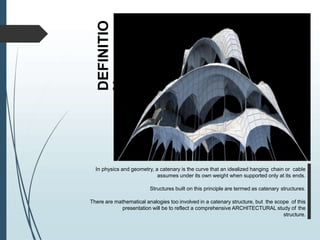
In physics and geometry, a catenary is the curve that an idealized hanging chain or cable
assumes under its own weight when supported only at its ends.
Structures built on this principle are termed as catenary structures.
There are mathematical analogies too involved in a catenary structure, but the scope of this
presentation will be to reflect a comprehensive ARCHITECTURAL study of the
structure.
DEFINITIO
N
scope
1. Understanding the function of the structure/space and use of the technique.
2. Constructional means of achieving the catenary structure.
3. Material detailing done by the designer.
Introduction
the structure
MUSEUMOFARCHITECTUREAND
PHOTOGRAPHY,
Project Name: Museum of Photography and
Hungarian Architectural Museum
Architects: Laboratory for Explorative
Architecture & Design
Location: Budapest, City Park, Hungary
Year: 2014
Photographs: LEAD
Site plan
Development
Concept to built
The following development
process will give us a clearidea of
what and how the structure has
been planned.
All the guiding factors hasbeen
mentioned in these few slides.
The development is followed by the
constructional breakdown of the
structure.
CROSS
AXES
MUSEUMOFARCHITECTUREAND
PHOTOGRAPHY,
Development
Concept to built
MASSIN
G
The following development
process will give us a clearidea of
what and how the structure has
been planned.
All the guiding factors hasbeen
mentioned in these few slides.
The development is followed by the
constructional breakdown of the
structure.
MUSEUMOFARCHITECTUREAND
PHOTOGRAPHY,
Development
Concept to built
OPEN GROUND
FLOOR
The following development
process will give us a clearidea of
what and how the structure has
been planned.
All the guiding factors hasbeen
mentioned in these few slides.
The development is followed by the
constructional breakdown of the
structure.
MUSEUMOFARCHITECTUREAND
PHOTOGRAPHY,
Development
Concept to built
ROOF
CUT
The following development
process will give us a clearidea of
what and how the structure has
been planned.
All the guiding factors hasbeen
mentioned in these few slides.
The development is followed by the
constructional breakdown of the
structure.
MUSEUMOFARCHITECTUREAND
PHOTOGRAPHY,
46m X 92m
Development
concept to built
ASYMMETRIC
MASSING
The following development
process will give us a clearidea of
what and how the structure has
been planned.
All the guiding factors hasbeen
mentioned in these few slides.
The development is followed by the
constructional breakdown of the
structure.
MUSEUMOFARCHITECTUREAND
PHOTOGRAPHY,
Development
Concept to built
SMOOTHENIN
G
The following development
process will give us a clearidea of
what and how the structure has
been planned.
All the guiding factors hasbeen
mentioned in these few slides.
The development is followed by the
constructional breakdown of the
structure.
MUSEUMOFARCHITECTUREAND
PHOTOGRAPHY,
Development
Concept to built
MASSIN
G
The following development
process will give us a clearidea of
what and how the structure has
been planned.
All the guiding factors hasbeen
mentioned in these few slides.
The development is followed by the
constructional breakdown of the
structure.
MUSEUMOFARCHITECTUREAND
PHOTOGRAPHY,
Development
Concept to built
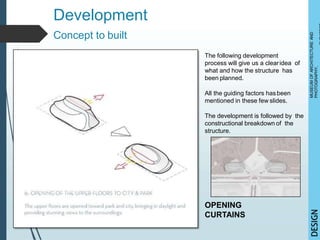
OPENING
CURTAINS
The following development
process will give us a clearidea of
what and how the structure has
been planned.
All the guiding factors hasbeen
mentioned in these few slides.
The development is followed by the
constructional breakdown of the
structure.
MUSEUMOFARCHITECTUREAND
PHOTOGRAPHY,
Spatial Planning
Need for catenary
The basement holds most of the parking spaces
and other services. As discussed earlier public
based commercial activities are kept on the
ground floor to create the amount of openness.
At the same time The entry points from side,
invite people inside the building transitioning from
the bright ground floor to the specifics of
darker the upper floors.
The larger floor plates are taken by the
exhibition and museum spaces and its surfaces
namely 1st and 2nd floors.
The 3rd and 4th floors are kept as utility like
archives and library spaces for general public.
Also the height isolates commotion so thebest
suited configuration thus generated.
Also the top activities have ample views of the
park and adjoining landscapes of serenity.
Blent in the context, flowy column free spaces and
creating a form which is iconic yet contextual,
catenary roofing was best suited for the job.
MUSEUMOFARCHITECTUREAND
PHOTOGRAPHY,
Structure
The master diagram
MUSEUMOFARCHITECTUREAND
PHOTOGRAPHY,
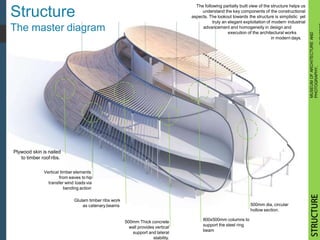
Plywood skin is nailed
to timber roofribs.
Vertical timber elements
from eaves to hip
transfer wind loads via
bending action
Glulam timber ribs work
as catenary beams
500mm Thick concrete
wall provides vertical
support and lateral
stability.
800x500mm columns to
support the steel ring
beam
500mm dia, circular
hollow section.
The following partially built view of the structure helps us
understand the key components of the constructional
aspects. The lookout towards the structure is simplistic yet
truly an elegant exploitation of modern industrial
advancement and homogeneity in design and
execution of the architectural works
in modern days.
Roof/form
The catenary component
MUSEUMOFARCHITECTUREAND
PHOTOGRAPHY,
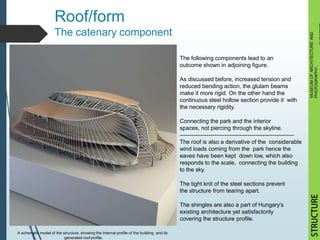
The following components lead to an
outcome shown in adjoining figure.
As discussed before, increased tension and
reduced bending action, the glulam beams
make it more rigid. On the other hand the
continuous steel hollow section provide it with
the necessary rigidity.
Connecting the park and the interior
spaces, not piercing through the skyline.
-----------------------------------------------------------
The roof is also a derivative of the considerable
wind loads coming from the park hence the
eaves have been kept down low, which also
responds to the scale, connecting the building
to the sky.
The tight knit of the steel sections prevent
the structure from tearing apart.
The shingles are also a part of Hungary's
existing architecture yet satisfactorily
covering the structure profile.
A schematic model of the structure, showing the internal profile of the building and its
generated roof profile.
Roof/form
The catenary component
MUSEUMOFARCHITECTUREAND
PHOTOGRAPHY,
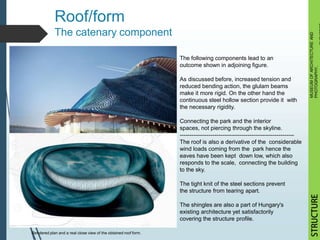
The following components lead to an
outcome shown in adjoining figure.
As discussed before, increased tension and
reduced bending action, the glulam beams
make it more rigid. On the other hand the
continuous steel hollow section provide it with
the necessary rigidity.
Connecting the park and the interior
spaces, not piercing through the skyline.
-----------------------------------------------------------
The roof is also a derivative of the considerable
wind loads coming from the park hence the
eaves have been kept down low, which also
responds to the scale, connecting the building
to the sky.
The tight knit of the steel sections prevent
the structure from tearing apart.
The shingles are also a part of Hungary's
existing architecture yet satisfactorily
covering the structure profile.
Rendered plan and a real close view of the obtained roof form.
Elevations
The profile and scale
MUSEUMOFARCHITECTUREAND
PHOTOGRAPHY,
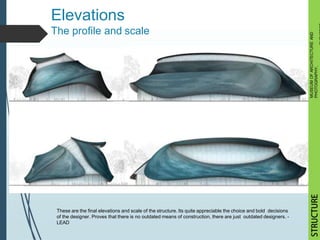
These are the final elevations and scale of the structure. Its quite appreciable the choice and bold decisions
of the designer. Proves that there is no outdated means of construction, there are just outdated designers. -
LEAD
Materials
The construction elements
MUSEUMOFARCHITECTUREAND
PHOTOGRAPHY,
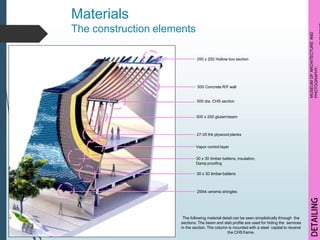
250 x 250 Hollow box section
500 Concrete R/F wall
500 dia. CHS section
500 x 250 glulambeam
27-35 thk plywood planks
Vapor control layer
30 x 30 timber battens, insulation,
Damp proofing
30 x 30 timber battens
25thk ceramic shingles
The following material detail can be seen simplistically through the
sections. The beam and slab profile are used for hiding the services
in the section. The column is mounted with a steel capital to receive
the CHS frame.
Details
Actual construction inside
MUSEUMOFARCHITECTUREAND
PHOTOGRAPHY,
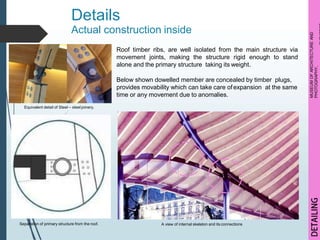
Equivalent detail of Steel – steel joinery.
A view of internal skeleton and its connections
Roof timber ribs, are well isolated from the main structure via
movement joints, making the structure rigid enough to stand
alone and the primary structure taking its weight.
Below shown dowelled member are concealed by timber plugs,
provides movability which can take care ofexpansion at the same
time or any movement due to anomalies.
Separation of primary structure from the roof.
Details
More components
MUSEUMOFARCHITECTUREAND
PHOTOGRAPHY,
Source: Rosboro Glulam Technical Guide.
The demarcated, slab is joined
By a dowel connection.
For acquiring such catenary curves, the fabrication industries need specific data,
which is provided by manufacturers to understand material limitations.
Also, It talks about tolerances that shall be considered, to make the design
flexible at conception stages itself.
FABRICATION
ASPECTS
Interior spaces
Enclosure inside
MUSEUMOFARCHITECTUREAND
PHOTOGRAPHY,
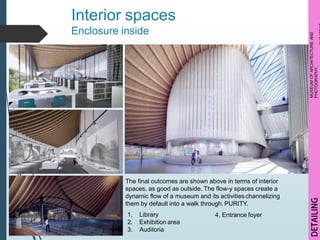
The final outcomes are shown above in terms of interior
spaces, as good as outside. The flow-y spaces create a
dynamic flow of a museum and its activities channelizing
them by default into a walk through. PURITY.
1. Library
2. Exhibition area
3. Auditoria
4. Entrance foyer
Summary
Quick wrap up
MUSEUMOFARCHITECTUREAND
PHOTOGRAPHY,
• Form development.
• Spatial qualities of the
activities.
• Framework and roof forms.
• Material level execution.
• Key details.
• Final outcome.
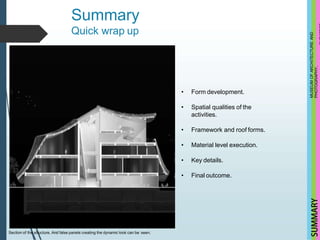
Section of the structure. And false panels creating the dynamic look can be seen.
MUSEUMOFARCHITECTUREAND
PHOTOGRAPHY,
Presented by
Shreya Sable BA13ARC041
Sachi Dongarwar BA13ARC042
Saurabh Deotale BA13ARC043
Shhrruti Jain BA13ARC044
Shivangi Negi BA13ARC045
S.Subhamala BA13ARC046
Swapnil Pudke BA13ARC047
Vrinda Tapadia BA13ARC048
Prasad Thanthratey BA13ARC049
Pawan Tirpude BA13ARC050
Thank you.
Sources:
http://www.Pinterest.com/timber-steel-connectors.html/
http://www.archdaily.com/583675/liget-budapest-awards-third-place-to-lead-s-blue-tiled-museums/
http://www.wikipidia.com/catenary-structures.html/

Case Study: Catenary Structures

  • 1.
    Catenary Structures Advanced buildingconstruction – II A case study
  • 2.
    Catenary Structures Course coordinator:Vilas Bakde Advanced building construction – II A case study Museum for Architecture and Photography, Budapest, Hungary 8THSEMESTER DEPARTMENT OF ARCHITECTURE AND PLANNING, VNIT,
  • 3.
    In physics andgeometry, a catenary is the curve that an idealized hanging chain or cable assumes under its own weight when supported only at its ends. Structures built on this principle are termed as catenary structures. There are mathematical analogies too involved in a catenary structure, but the scope of this presentation will be to reflect a comprehensive ARCHITECTURAL study of the structure. DEFINITIO N
  • 4.
    scope 1. Understanding thefunction of the structure/space and use of the technique. 2. Constructional means of achieving the catenary structure. 3. Material detailing done by the designer.
  • 5.
    Introduction the structure MUSEUMOFARCHITECTUREAND PHOTOGRAPHY, Project Name:Museum of Photography and Hungarian Architectural Museum Architects: Laboratory for Explorative Architecture & Design Location: Budapest, City Park, Hungary Year: 2014 Photographs: LEAD Site plan
  • 6.
    Development Concept to built Thefollowing development process will give us a clearidea of what and how the structure has been planned. All the guiding factors hasbeen mentioned in these few slides. The development is followed by the constructional breakdown of the structure. CROSS AXES MUSEUMOFARCHITECTUREAND PHOTOGRAPHY,
  • 7.
    Development Concept to built MASSIN G Thefollowing development process will give us a clearidea of what and how the structure has been planned. All the guiding factors hasbeen mentioned in these few slides. The development is followed by the constructional breakdown of the structure. MUSEUMOFARCHITECTUREAND PHOTOGRAPHY,
  • 8.
    Development Concept to built OPENGROUND FLOOR The following development process will give us a clearidea of what and how the structure has been planned. All the guiding factors hasbeen mentioned in these few slides. The development is followed by the constructional breakdown of the structure. MUSEUMOFARCHITECTUREAND PHOTOGRAPHY,
  • 9.
    Development Concept to built ROOF CUT Thefollowing development process will give us a clearidea of what and how the structure has been planned. All the guiding factors hasbeen mentioned in these few slides. The development is followed by the constructional breakdown of the structure. MUSEUMOFARCHITECTUREAND PHOTOGRAPHY, 46m X 92m
  • 10.
    Development concept to built ASYMMETRIC MASSING Thefollowing development process will give us a clearidea of what and how the structure has been planned. All the guiding factors hasbeen mentioned in these few slides. The development is followed by the constructional breakdown of the structure. MUSEUMOFARCHITECTUREAND PHOTOGRAPHY,
  • 11.
    Development Concept to built SMOOTHENIN G Thefollowing development process will give us a clearidea of what and how the structure has been planned. All the guiding factors hasbeen mentioned in these few slides. The development is followed by the constructional breakdown of the structure. MUSEUMOFARCHITECTUREAND PHOTOGRAPHY,
  • 12.
    Development Concept to built MASSIN G Thefollowing development process will give us a clearidea of what and how the structure has been planned. All the guiding factors hasbeen mentioned in these few slides. The development is followed by the constructional breakdown of the structure. MUSEUMOFARCHITECTUREAND PHOTOGRAPHY,
  • 13.
    Development Concept to built OPENING CURTAINS Thefollowing development process will give us a clearidea of what and how the structure has been planned. All the guiding factors hasbeen mentioned in these few slides. The development is followed by the constructional breakdown of the structure. MUSEUMOFARCHITECTUREAND PHOTOGRAPHY,
  • 14.
    Spatial Planning Need forcatenary The basement holds most of the parking spaces and other services. As discussed earlier public based commercial activities are kept on the ground floor to create the amount of openness. At the same time The entry points from side, invite people inside the building transitioning from the bright ground floor to the specifics of darker the upper floors. The larger floor plates are taken by the exhibition and museum spaces and its surfaces namely 1st and 2nd floors. The 3rd and 4th floors are kept as utility like archives and library spaces for general public. Also the height isolates commotion so thebest suited configuration thus generated. Also the top activities have ample views of the park and adjoining landscapes of serenity. Blent in the context, flowy column free spaces and creating a form which is iconic yet contextual, catenary roofing was best suited for the job. MUSEUMOFARCHITECTUREAND PHOTOGRAPHY,
  • 15.
    Structure The master diagram MUSEUMOFARCHITECTUREAND PHOTOGRAPHY, Plywoodskin is nailed to timber roofribs. Vertical timber elements from eaves to hip transfer wind loads via bending action Glulam timber ribs work as catenary beams 500mm Thick concrete wall provides vertical support and lateral stability. 800x500mm columns to support the steel ring beam 500mm dia, circular hollow section. The following partially built view of the structure helps us understand the key components of the constructional aspects. The lookout towards the structure is simplistic yet truly an elegant exploitation of modern industrial advancement and homogeneity in design and execution of the architectural works in modern days.
  • 16.
    Roof/form The catenary component MUSEUMOFARCHITECTUREAND PHOTOGRAPHY, Thefollowing components lead to an outcome shown in adjoining figure. As discussed before, increased tension and reduced bending action, the glulam beams make it more rigid. On the other hand the continuous steel hollow section provide it with the necessary rigidity. Connecting the park and the interior spaces, not piercing through the skyline. ----------------------------------------------------------- The roof is also a derivative of the considerable wind loads coming from the park hence the eaves have been kept down low, which also responds to the scale, connecting the building to the sky. The tight knit of the steel sections prevent the structure from tearing apart. The shingles are also a part of Hungary's existing architecture yet satisfactorily covering the structure profile. A schematic model of the structure, showing the internal profile of the building and its generated roof profile.
  • 17.
    Roof/form The catenary component MUSEUMOFARCHITECTUREAND PHOTOGRAPHY, Thefollowing components lead to an outcome shown in adjoining figure. As discussed before, increased tension and reduced bending action, the glulam beams make it more rigid. On the other hand the continuous steel hollow section provide it with the necessary rigidity. Connecting the park and the interior spaces, not piercing through the skyline. ----------------------------------------------------------- The roof is also a derivative of the considerable wind loads coming from the park hence the eaves have been kept down low, which also responds to the scale, connecting the building to the sky. The tight knit of the steel sections prevent the structure from tearing apart. The shingles are also a part of Hungary's existing architecture yet satisfactorily covering the structure profile. Rendered plan and a real close view of the obtained roof form.
  • 18.
    Elevations The profile andscale MUSEUMOFARCHITECTUREAND PHOTOGRAPHY, These are the final elevations and scale of the structure. Its quite appreciable the choice and bold decisions of the designer. Proves that there is no outdated means of construction, there are just outdated designers. - LEAD
  • 19.
    Materials The construction elements MUSEUMOFARCHITECTUREAND PHOTOGRAPHY, 250x 250 Hollow box section 500 Concrete R/F wall 500 dia. CHS section 500 x 250 glulambeam 27-35 thk plywood planks Vapor control layer 30 x 30 timber battens, insulation, Damp proofing 30 x 30 timber battens 25thk ceramic shingles The following material detail can be seen simplistically through the sections. The beam and slab profile are used for hiding the services in the section. The column is mounted with a steel capital to receive the CHS frame.
  • 20.
    Details Actual construction inside MUSEUMOFARCHITECTUREAND PHOTOGRAPHY, Equivalentdetail of Steel – steel joinery. A view of internal skeleton and its connections Roof timber ribs, are well isolated from the main structure via movement joints, making the structure rigid enough to stand alone and the primary structure taking its weight. Below shown dowelled member are concealed by timber plugs, provides movability which can take care ofexpansion at the same time or any movement due to anomalies. Separation of primary structure from the roof.
  • 21.
    Details More components MUSEUMOFARCHITECTUREAND PHOTOGRAPHY, Source: RosboroGlulam Technical Guide. The demarcated, slab is joined By a dowel connection. For acquiring such catenary curves, the fabrication industries need specific data, which is provided by manufacturers to understand material limitations. Also, It talks about tolerances that shall be considered, to make the design flexible at conception stages itself. FABRICATION ASPECTS
  • 22.
    Interior spaces Enclosure inside MUSEUMOFARCHITECTUREAND PHOTOGRAPHY, Thefinal outcomes are shown above in terms of interior spaces, as good as outside. The flow-y spaces create a dynamic flow of a museum and its activities channelizing them by default into a walk through. PURITY. 1. Library 2. Exhibition area 3. Auditoria 4. Entrance foyer
  • 23.
    Summary Quick wrap up MUSEUMOFARCHITECTUREAND PHOTOGRAPHY, •Form development. • Spatial qualities of the activities. • Framework and roof forms. • Material level execution. • Key details. • Final outcome. Section of the structure. And false panels creating the dynamic look can be seen.
  • 24.
    MUSEUMOFARCHITECTUREAND PHOTOGRAPHY, Presented by Shreya SableBA13ARC041 Sachi Dongarwar BA13ARC042 Saurabh Deotale BA13ARC043 Shhrruti Jain BA13ARC044 Shivangi Negi BA13ARC045 S.Subhamala BA13ARC046 Swapnil Pudke BA13ARC047 Vrinda Tapadia BA13ARC048 Prasad Thanthratey BA13ARC049 Pawan Tirpude BA13ARC050 Thank you. Sources: http://www.Pinterest.com/timber-steel-connectors.html/ http://www.archdaily.com/583675/liget-budapest-awards-third-place-to-lead-s-blue-tiled-museums/ http://www.wikipidia.com/catenary-structures.html/