COTM 5204: CONSTRUCTION MANAGEMENT
Chapter 3
Construction Planning and Scheduling
DAGNACHEW ADUGNA
April 2014
School of Civil Engineering
Contents
Construction Planning and Scheduling
1. Construction Planning
2. Construction Scheduling
HU, iOT, Construction Management, Lecture Notes,Marchl 2015, Dagnachew Adugna.
1. Construction Planning
1.1 Planning Studies
 A trial and error approach is no longer valid for the
construction industry and proper planning is now vital.
 The amount of detailing in planning is likely to be the
function of the size of the firm, the complexity of the
project and the expertise of the management.
 Planning is a vital and most difficult part of a
construction project.
HU, iOT, Construction Management, Lecture Notes,Marchl 2015, Dagnachew Adugna.
1. Construction Planning
1.2 Advantages of Planning
 Planning has advantages at all of the following stages of
construction.
A. Before the project is started
 For the client:- to estimate project duration and resources.
 Helps on evaluation of tenders submitted by contractors.
B. During the construction stage
 Ordering of materials.
 For Resource utilization like equipments.
C. After completion of a project
 Serve as a data base for future planning and scheduling.
HU, iOT, Construction Management, Lecture Notes,Marchl 2015, Dagnachew Adugna.
1. Construction Planning
1.3 Construction Planning: Initial Stage
 Before the actual formation of the plan the following
should be considered:
 Planning/scheduling technique to be used;
 Number and type of programs required; and
 Purpose of the program.
 The programs usually developed are:
 Performance based on Financial Schedule;
 Equipment Schedule;
 Material delivery Schedule; and
 Manpower Schedule.
HU, iOT, Construction Management, Lecture Notes,Marchl 2015, Dagnachew Adugna.
1. Construction Planning
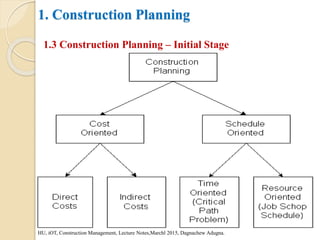
1.3 Construction Planning – Initial Stage
HU, iOT, Construction Management, Lecture Notes,Marchl 2015, Dagnachew Adugna.
1. Construction Planning
1.4 Construction Planning: Steps
 Before the actual formation of the plan the following
should be considered:
 Choice of technology and construction method;
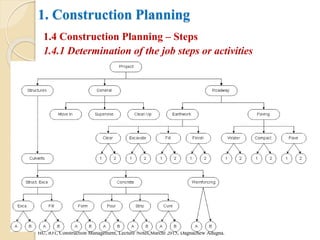
 Determination of the job steps or ‘activities’;
 Developing sequential relationships among these
activities;
 Determination of duration of activities; and
 Preparing the schedule or network.
HU, iOT, Construction Management, Lecture Notes,Marchl 2015, Dagnachew Adugna.
1. Construction Planning
1.4 Construction Planning – Steps
1.4.1 Determination of the job steps or activities
HU, iOT, Construction Management, Lecture Notes,Marchl 2015, Dagnachew Adugna.
1. Construction Planning
1.4 Construction Planning – Steps
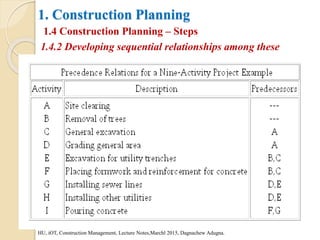
1.4.2 Developing sequential relationships among these
activities
HU, iOT, Construction Management, Lecture Notes,Marchl 2015, Dagnachew Adugna.
1. Construction Planning
1.4 Construction Planning – Steps
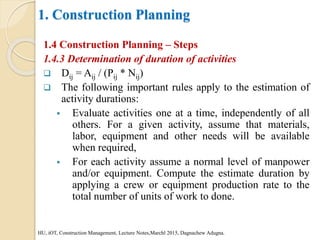
1.4.3 Determination of duration of activities
 Dij = Aij / (Pij * Nij)
 The following important rules apply to the estimation of
activity durations:
 Evaluate activities one at a time, independently of all
others. For a given activity, assume that materials,
labor, equipment and other needs will be available
when required,
 For each activity assume a normal level of manpower
and/or equipment. Compute the estimate duration by
applying a crew or equipment production rate to the
total number of units of work to done.
HU, iOT, Construction Management, Lecture Notes,Marchl 2015, Dagnachew Adugna.
2. Construction Scheduling
 The project program represents the plan for the schedule
of the work. Likewise, the budget is the plan for the cost
aspects of the work.
 In a similar way, the contractor will have plans for the
management of quality, safety and environmental
concerns.
 During project operations, it is essential that actual
performance be compared with planned performance in
all of these areas and action taken to remedy any
indicated deficiencies.
 This responsibility is termed as monitoring and control,
where monitoring refers to methods for comparing
actual with planned performance and control denotes the
actions taken to attempt to bring deficient aspects of the
project into conformance.
HU, iOT, Construction Management, Lecture Notes,Marchl 2015, Dagnachew Adugna.
2. Construction Scheduling
 Scheduling vs. Planning of a construction project.
 Planning must be done before the project can be
intelligently scheduled.
 Scheduling is a mechanical process for formalizing
the planning function, assigning time boundaries for
each part of the work in such a manner that the work
proceeds in logical sequence and in an orderly and
systematic manner.
HU, iOT, Construction Management, Lecture Notes,Marchl 2015, Dagnachew Adugna.
2. Construction Scheduling
2.1 Schedule Updating
 Periodically, perhaps monthly, the contractor will
compare schedule progress with that shown on the
project program.
 The purpose is to determine whether the various activities
that were planned to be active during the previous period
were actually active, the extent of their progress and,
especially, the anticipated project completion date based
on progress to date.
 Another purpose of the update is to incorporate any new
information about already planned activities, to add
information about any new work not previously planned
and to determine their impacts on other activities and on
the overall project completion date.
HU, iOT, Construction Management, Lecture Notes,Marchl 2015, Dagnachew Adugna.
2. Construction Scheduling
2.1 Schedule Updating
 There are various methods to produce a schedule:
 Bar charts,
 CPM, critical path method,
 PERT, program evaluation and review technique,
 Line of balance, and
 Computer Software's:
o Primavera,
o MS Project, etc.
HU, iOT, Construction Management, Lecture Notes,Marchl 2015, Dagnachew Adugna.
2. Construction Scheduling
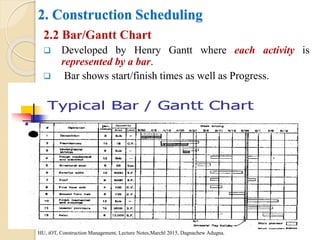
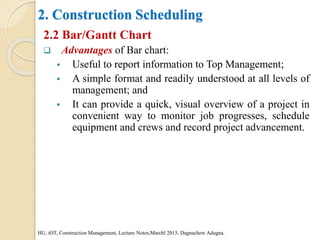
2.2 Bar/Gantt Chart
 Developed by Henry Gantt where each activity is
represented by a bar.
 Bar shows start/finish times as well as Progress.
HU, iOT, Construction Management, Lecture Notes,Marchl 2015, Dagnachew Adugna.
2. Construction Scheduling
2.2 Bar/Gantt Chart
 Advantages of Bar chart:
 Useful to report information to Top Management;
 A simple format and readily understood at all levels of
management; and
 It can provide a quick, visual overview of a project in
convenient way to monitor job progresses, schedule
equipment and crews and record project advancement.
HU, iOT, Construction Management, Lecture Notes,Marchl 2015, Dagnachew Adugna.
2. Construction Scheduling
2.2 Bar/Gantt Chart
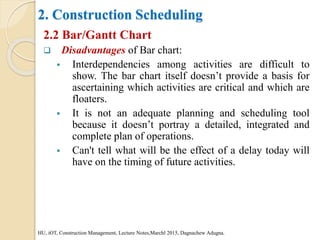
 Disadvantages of Bar chart:
 Interdependencies among activities are difficult to
show. The bar chart itself doesn’t provide a basis for
ascertaining which activities are critical and which are
floaters.
 It is not an adequate planning and scheduling tool
because it doesn’t portray a detailed, integrated and
complete plan of operations.
 Can't tell what will be the effect of a delay today will
have on the timing of future activities.
HU, iOT, Construction Management, Lecture Notes,Marchl 2015, Dagnachew Adugna.
2. Construction Scheduling
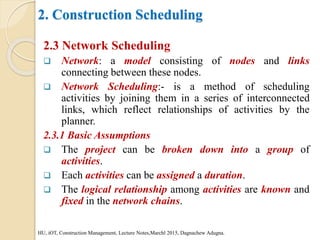
2.3 Network Scheduling
 Network: a model consisting of nodes and links
connecting between these nodes.
 Network Scheduling:- is a method of scheduling
activities by joining them in a series of interconnected
links, which reflect relationships of activities by the
planner.
2.3.1 Basic Assumptions
 The project can be broken down into a group of
activities.
 Each activities can be assigned a duration.
 The logical relationship among activities are known and
fixed in the network chains.
HU, iOT, Construction Management, Lecture Notes,Marchl 2015, Dagnachew Adugna.
2. Construction Scheduling
2.3 Network Scheduling
2.3.2 Rules for Preparing the Network Diagram
 No activity can start before the preceding activity is
finalized.
 There is only one start and finish for an activity.
 No activity leads back and forms a loop.
 The logical precedence, concurrent and subsequent
activities must be clearly developed.
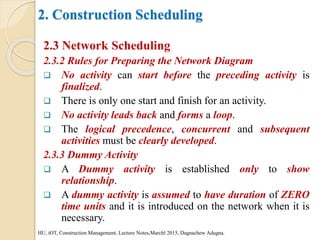
2.3.3 Dummy Activity
 A Dummy activity is established only to show
relationship.
 A dummy activity is assumed to have duration of ZERO
time units and it is introduced on the network when it is
necessary.
HU, iOT, Construction Management, Lecture Notes,Marchl 2015, Dagnachew Adugna.
2. Construction Scheduling
2.3 Network Scheduling
2.3.4 Presentation of Networks
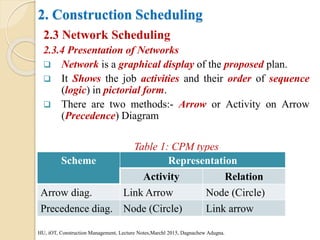
 Network is a graphical display of the proposed plan.
 It Shows the job activities and their order of sequence
(logic) in pictorial form.
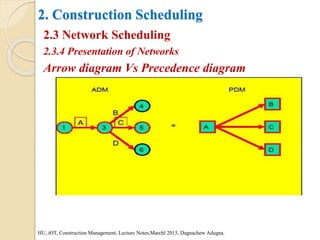
 There are two methods:- Arrow or Activity on Arrow
(Precedence) Diagram
Table 1: CPM types
HU, iOT, Construction Management, Lecture Notes,Marchl 2015, Dagnachew Adugna.
Scheme Representation
Activity Relation
Arrow diag. Link Arrow Node (Circle)
Precedence diag. Node (Circle) Link arrow
2. Construction Scheduling
2.3 Network Scheduling
2.3.4 Presentation of Networks
Arrow diagram Vs Precedence diagram
HU, iOT, Construction Management, Lecture Notes,Marchl 2015, Dagnachew Adugna.
2. Construction Scheduling
2.3 Network Scheduling
2.3.5 Network Logic
 Identifying the preceding activity (PA) and immediately
preceding activity (IPA) is the easiest method to develop
the network logic and draw the network diagram.
2.3.6 Types of Network Schedules
 The two common types of network schedules used in the
construction industry are:
 Critical Path Method (CPM); and
 Program Review and Evaluation Technique (PERT).
HU, iOT, Construction Management, Lecture Notes,Marchl 2015, Dagnachew Adugna.
2. Construction Scheduling
2.4 Critical Path Method, CPM
 The most widely used scheduling technique is the critical
path method (CPM) for scheduling, often referred to as
critical path scheduling.
 This method calculates the minimum completion time
for a project along with the possible start and finish
times for the project activities.
 Computer programs and algorithms for critical path
scheduling are widely available and can efficiently handle
projects with thousands of activities.
HU, iOT, Construction Management, Lecture Notes,Marchl 2015, Dagnachew Adugna.
2. Construction Scheduling
2.4 Critical Path Method, CPM
2.4.1 Duration
 An activity’s “duration“ is the amount of time estimated
to complete that activity.
 An activity’s duration can be expressed in any unit:
minutes, hours, work days, calendar days, weeks, or
months.
 Duration of activities depends on the quantity of work,
the type of work, the type and quantity of available
resources that may be used to conduct the activity.
HU, iOT, Construction Management, Lecture Notes,Marchl 2015, Dagnachew Adugna.
2. Construction Scheduling
2.4 Critical Path Method, CPM
2.4.1 Duration
 Activity durations are estimated based on historical data
and experience considering the following factors:
 Construction method;
 Project time limits;
 Weather and site effects on production;
 Quality of supervision;
 Labor productivity; and
 Complexity of the task.
HU, iOT, Construction Management, Lecture Notes,Marchl 2015, Dagnachew Adugna.
2. Construction Scheduling
2.4 Critical Path Method, CPM
2.4.1 Duration
 The duration is calculated by dividing the quantity of
work by daily production rate.
 For instance, assume a daily production rate of 50m2 in
preparing a flat slab formwork for an 800m2 to
complete the task:
Duration=800m2 /(50m2 /day) = 16 working days.
 After the activities and durations are determined, the next
step in preparing a CPM schedule is to arrange activities
in order in which the activities will be performed.
HU, iOT, Construction Management, Lecture Notes,Marchl 2015, Dagnachew Adugna.
2. Construction Scheduling
2.4 Critical Path Method, CPM
2.4.2 Calculation of Critical Path
 Assuming an activity on branch project network and all
precedence are of finish-to-start nature, so that the
succeeding activity can not start until the completion of
preceding activity.
HU, iOT, Construction Management, Lecture Notes,Marchl 2015, Dagnachew Adugna.
2. Construction Scheduling
2.4 Critical Path Method, CPM
2.4.2 Calculation of Critical Path
Critical Path Scheduling Algorithms
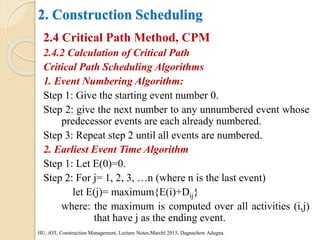
1. Event Numbering Algorithm:
Step 1: Give the starting event number 0.
Step 2: give the next number to any unnumbered event whose
predecessor events are each already numbered.
Step 3: Repeat step 2 until all events are numbered.
2. Earliest Event Time Algorithm
Step 1: Let E(0)=0.
Step 2: For j= 1, 2, 3, …n (where n is the last event)
let E(j)= maximum{E(i)+Dij}
where: the maximum is computed over all activities (i,j)
that have j as the ending event.
HU, iOT, Construction Management, Lecture Notes,Marchl 2015, Dagnachew Adugna.
2. Construction Scheduling
2.4 Critical Path Method, CPM
2.4.2 Calculation of Critical Path
Critical Path Scheduling Algorithms
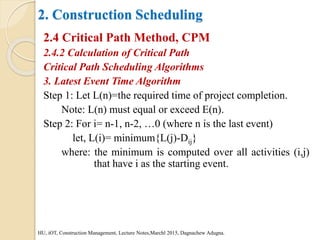
3. Latest Event Time Algorithm
Step 1: Let L(n)=the required time of project completion.
Note: L(n) must equal or exceed E(n).
Step 2: For i= n-1, n-2, …0 (where n is the last event)
let, L(i)= minimum{L(j)-Dij}
where: the minimum is computed over all activities (i,j)
that have i as the starting event.
HU, iOT, Construction Management, Lecture Notes,Marchl 2015, Dagnachew Adugna.
2. Construction Scheduling
2.4 Critical Path Method, CPM
2.4.3 Earliest Time Calculations
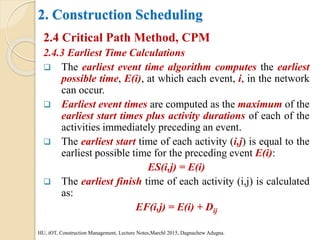
 The earliest event time algorithm computes the earliest
possible time, E(i), at which each event, i, in the network
can occur.
 Earliest event times are computed as the maximum of the
earliest start times plus activity durations of each of the
activities immediately preceding an event.
 The earliest start time of each activity (i,j) is equal to the
earliest possible time for the preceding event E(i):
ES(i,j) = E(i)
 The earliest finish time of each activity (i,j) is calculated
as:
EF(i,j) = E(i) + Dij
HU, iOT, Construction Management, Lecture Notes,Marchl 2015, Dagnachew Adugna.
2. Construction Scheduling
2.4 Critical Path Method, CPM
2.4.4 Latest Time Calculations
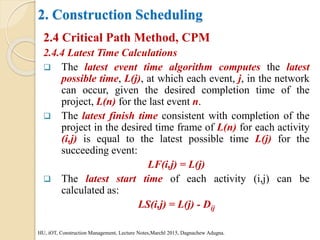
 The latest event time algorithm computes the latest
possible time, L(j), at which each event, j, in the network
can occur, given the desired completion time of the
project, L(n) for the last event n.
 The latest finish time consistent with completion of the
project in the desired time frame of L(n) for each activity
(i,j) is equal to the latest possible time L(j) for the
succeeding event:
LF(i,j) = L(j)
 The latest start time of each activity (i,j) can be
calculated as:
LS(i,j) = L(j) - Dij
HU, iOT, Construction Management, Lecture Notes,Marchl 2015, Dagnachew Adugna.
2. Construction Scheduling
2.4 Critical Path Method, CPM
2.4.5 Critical Path
 The critical path itself represents the set or sequence of
predecessor/successor activities which will take the
longest time to complete.
 The duration of the critical path represents the
minimum time required to complete a project.
 Any delays along the critical path would imply that
additional time would be required to complete the
project.
 CPM assumes deterministic durations.
 CPM does not consider resource constraints.
HU, iOT, Construction Management, Lecture Notes,Marchl 2015, Dagnachew Adugna.
2. Construction Scheduling
2.4 Critical Path Method, CPM
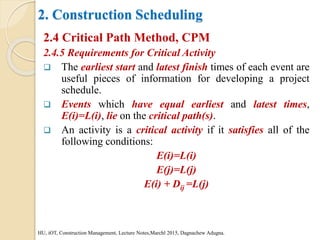
2.4.5 Requirements for Critical Activity
 The earliest start and latest finish times of each event are
useful pieces of information for developing a project
schedule.
 Events which have equal earliest and latest times,
E(i)=L(i), lie on the critical path(s).
 An activity is a critical activity if it satisfies all of the
following conditions:
E(i)=L(i)
E(j)=L(j)
E(i) + Dij =L(j)
HU, iOT, Construction Management, Lecture Notes,Marchl 2015, Dagnachew Adugna.
2. Construction Scheduling
2.4 Critical Path Method, CPM
2.4.6 Activity float and schedules
 The concept of float is to use part or all of allowable
range to schedule an activity without delaying the
completion of the project.
 An activity that has the earliest time for its predecessor
and successor nodes differing by more than its duration
possesses a window in which it can be scheduled late.
 Float is a very valuable concept since it represents the
scheduling flexibility or "maneuvering room" available
to complete particular tasks.
HU, iOT, Construction Management, Lecture Notes,Marchl 2015, Dagnachew Adugna.
2. Construction Scheduling
2.4 Critical Path Method, CPM
2.4.6 Activity float and schedules
 Activities on the critical path do not provide any
flexibility for scheduling nor leeway in case of problems.
 For activities with some float, the actual starting time
might be chosen to: balance work loads over time,
correspond with material deliveries, and improve the
project's cash flow.
 There are three types of activity floats:
 Free float,
 Independent float, and
 Total float
HU, iOT, Construction Management, Lecture Notes,Marchl 2015, Dagnachew Adugna.
2. Construction Scheduling
2.4 Critical Path Method, CPM
2.4.6 Activity float and schedules
 Free float is the amount of delay which can be assigned
to any one activity without delaying subsequent activities.
 Independent float is the amount of delay which can be
assigned to any one activity without delaying subsequent
activities or restricting the scheduling of preceding
activities.
 Total float is the maximum amount of delay which can be
assigned to any activity without delaying the entire
project.
HU, iOT, Construction Management, Lecture Notes,Marchl 2015, Dagnachew Adugna.
2. Construction Scheduling
2.4 Critical Path Method, CPM
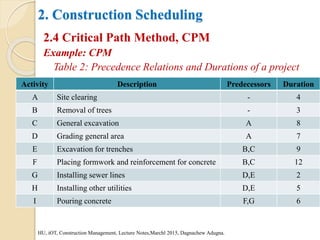
Example: CPM
Table 2: Precedence Relations and Durations of a project
HU, iOT, Construction Management, Lecture Notes,Marchl 2015, Dagnachew Adugna.
Activity Description Predecessors Duration
A Site clearing - 4
B Removal of trees - 3
C General excavation A 8
D Grading general area A 7
E Excavation for trenches B,C 9
F Placing formwork and reinforcement for concrete B,C 12
G Installing sewer lines D,E 2
H Installing other utilities D,E 5
I Pouring concrete F,G 6
2. Construction Scheduling
2.4 Critical Path Method, CPM
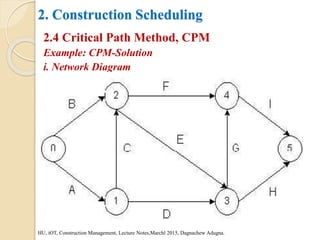
Example: CPM-Solution
i. Network Diagram
HU, iOT, Construction Management, Lecture Notes,Marchl 2015, Dagnachew Adugna.
2. Construction Scheduling
2.4 Critical Path Method, CPM
Example: CPM-Solution
ii. Earliest Time Determination
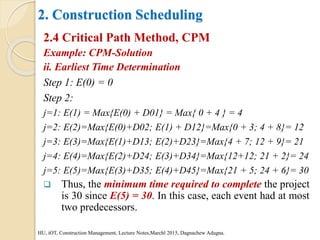
Step 1: E(0) = 0
Step 2:
j=1: E(1) = Max{E(0) + D01} = Max{ 0 + 4 } = 4
j=2: E(2)=Max{E(0)+D02; E(1) + D12}=Max{0 + 3; 4 + 8}= 12
j=3: E(3)=Max{E(1)+D13; E(2)+D23}=Max{4 + 7; 12 + 9}= 21
j=4: E(4)=Max{E(2)+D24; E(3)+D34}=Max{12+12; 21 + 2}= 24
j=5: E(5)=Max{E(3)+D35; E(4)+D45}=Max{21 + 5; 24 + 6}= 30
 Thus, the minimum time required to complete the project
is 30 since E(5) = 30. In this case, each event had at most
two predecessors.
HU, iOT, Construction Management, Lecture Notes,Marchl 2015, Dagnachew Adugna.
2. Construction Scheduling
2.4 Critical Path Method, CPM
Example: CPM-Solution
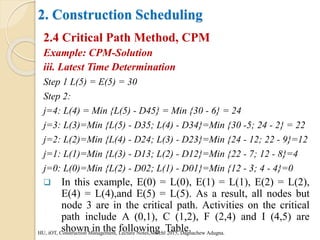
iii. Latest Time Determination
Step 1 L(5) = E(5) = 30
Step 2:
j=4: L(4) = Min {L(5) - D45} = Min {30 - 6} = 24
j=3: L(3)=Min {L(5) - D35; L(4) - D34}=Min {30 -5; 24 - 2} = 22
j=2: L(2)=Min {L(4) - D24; L(3) - D23}=Min {24 - 12; 22 - 9}=12
j=1: L(1)=Min {L(3) - D13; L(2) - D12}=Min {22 - 7; 12 - 8}=4
j=0: L(0)=Min {L(2) - D02; L(1) - D01}=Min {12 - 3; 4 - 4}=0
 In this example, E(0) = L(0), E(1) = L(1), E(2) = L(2),
E(4) = L(4),and E(5) = L(5). As a result, all nodes but
node 3 are in the critical path. Activities on the critical
path include A (0,1), C (1,2), F (2,4) and I (4,5) are
shown in the following Table.
HU, iOT, Construction Management, Lecture Notes,Marchl 2015, Dagnachew Adugna.
2. Construction Scheduling
2.4 Critical Path Method, CPM
Example: CPM-Solution
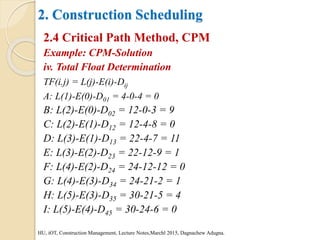
iv. Total Float Determination
TF(i.j) = L(j)-E(i)-Dij
A: L(1)-E(0)-D01 = 4-0-4 = 0
B: L(2)-E(0)-D02 = 12-0-3 = 9
C: L(2)-E(1)-D12 = 12-4-8 = 0
D: L(3)-E(1)-D13 = 22-4-7 = 11
E: L(3)-E(2)-D23 = 22-12-9 = 1
F: L(4)-E(2)-D24 = 24-12-12 = 0
G: L(4)-E(3)-D34 = 24-21-2 = 1
H: L(5)-E(3)-D35 = 30-21-5 = 4
I: L(5)-E(4)-D45 = 30-24-6 = 0
HU, iOT, Construction Management, Lecture Notes,Marchl 2015, Dagnachew Adugna.
2. Construction Scheduling
2.4 Critical Path Method, CPM
Example: CPM-Solution
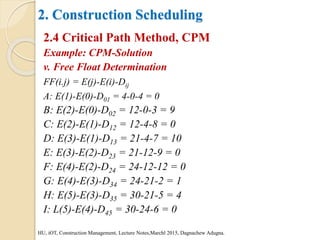
v. Free Float Determination
FF(i.j) = E(j)-E(i)-Dij
A: E(1)-E(0)-D01 = 4-0-4 = 0
B: E(2)-E(0)-D02 = 12-0-3 = 9
C: E(2)-E(1)-D12 = 12-4-8 = 0
D: E(3)-E(1)-D13 = 21-4-7 = 10
E: E(3)-E(2)-D23 = 21-12-9 = 0
F: E(4)-E(2)-D24 = 24-12-12 = 0
G: E(4)-E(3)-D34 = 24-21-2 = 1
H: E(5)-E(3)-D35 = 30-21-5 = 4
I: L(5)-E(4)-D45 = 30-24-6 = 0
HU, iOT, Construction Management, Lecture Notes,Marchl 2015, Dagnachew Adugna.
2. Construction Scheduling
2.4 Critical Path Method, CPM
Example: CPM-Solution
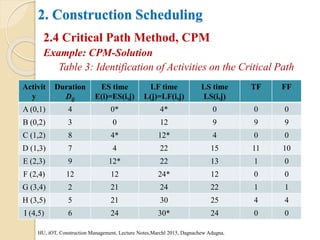
Table 3: Identification of Activities on the Critical Path
HU, iOT, Construction Management, Lecture Notes,Marchl 2015, Dagnachew Adugna.
Activit
y
Duration
Dij
ES time
E(i)=ES(i,j)
LF time
L(j)=LF(i,j)
LS time
LS(i,j)
TF FF
A (0,1) 4 0* 4* 0 0 0
B (0,2) 3 0 12 9 9 9
C (1,2) 8 4* 12* 4 0 0
D (1,3) 7 4 22 15 11 10
E (2,3) 9 12* 22 13 1 0
F (2,4) 12 12 24* 12 0 0
G (3,4) 2 21 24 22 1 1
H (3,5) 5 21 30 25 4 4
I (4,5) 6 24 30* 24 0 0
2. Construction Scheduling
2.4 Critical Path Method, CPM
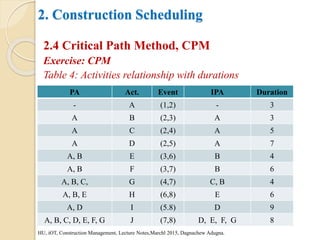
Exercise: CPM
 The data in Table 4 shows the activity relationship and
duration of a minor construction maintenance work.
Develop the network diagram and determine ES, EF, LS,
LF, TF and FF. Find also the critical path(s).
HU, iOT, Construction Management, Lecture Notes,Marchl 2015, Dagnachew Adugna.
2. Construction Scheduling
2.4 Critical Path Method, CPM
Exercise: CPM
Table 4: Activities relationship with durations
HU, iOT, Construction Management, Lecture Notes,Marchl 2015, Dagnachew Adugna.
PA Act. Event IPA Duration
- A (1,2) - 3
A B (2,3) A 3
A C (2,4) A 5
A D (2,5) A 7
A, B E (3,6) B 4
A, B F (3,7) B 6
A, B, C, G (4,7) C, B 4
A, B, E H (6,8) E 6
A, D I (5.8) D 9
A, B, C, D, E, F, G J (7,8) D, E, F, G 8
2. Construction Scheduling
2.5 Program Evaluation and Review Technique,
PERT
 Construction works are uploaded with uncertainties
ranging from adverse weather, machinery breakdown and
material shortage etc. which affect the activity progress
and schedule.
 However; the probability of an activity being completed
as planned can be assessed.
 PERT is one of the most widely used project
management tools which entertains uncertainty in
planning.
 PERT is developed in 1958 for the POLARIS missile
program by the Program Evaluation branch of the Special
Projects office of the U.S. Navy along with the lockheed
Missile systems and Booz-Allen & Hamilton.
HU, iOT, Construction Management, Lecture Notes,Marchl 2015, Dagnachew Adugna.
2. Construction Scheduling
2.5 Program Evaluation and Review Technique,
PERT
 Even though the rules for network manipulation of PERT
are similar to CPM, it were developed independently.
 Basically the only difference between the two is that
CPM uses deterministic/fixed duration for each activity
while PERT uses probabilistic duration.
 The probability distribution appropriate for most projects
is Beta distribution.
 Beta distribution is chosen for the following reasons:
 There is only a small probability of completing the
project in the most optimistic time;
 Probability of completing the project in the most
pessimistic time is small; and
 There is only one most likely time.
HU, iOT, Construction Management, Lecture Notes,Marchl 2015, Dagnachew Adugna.
2. Construction Scheduling
2.5 Program Evaluation and Review Technique,
PERT
2.5.1 PERT Activity Durations
 PERT differs from CPM in that it bases the duration of an
activity on three estimates:
 Optimistic time, a, which occurs when execution goes
extremely well.
 Most likely time, m, which occurs when execution is
done under normal conditions.
 Pessimistic time, b, which occurs when execution goes
extremely poorly.
 The range (a, b) encloses all possible estimates of the
duration of an activity. The estimate m lies somewhere in
the range (a, b).
HU, iOT, Construction Management, Lecture Notes,Marchl 2015, Dagnachew Adugna.
2. Construction Scheduling
2.5 Program Evaluation and Review Technique,
PERT
2.5.1 PERT Activity Durations
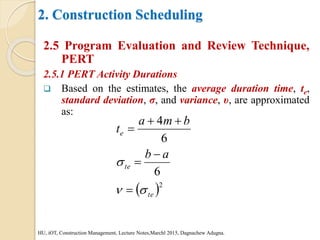
 Based on the estimates, the average duration time, te,
standard deviation, σ, and variance, υ, are approximated
as:
HU, iOT, Construction Management, Lecture Notes,Marchl 2015, Dagnachew Adugna.
 2
6
6
4
te
te
e
a
b
b
m
a
t









2. Construction Scheduling
2.5 Program Evaluation and Review Technique,
PERT
2.5.2 Sequence of events in PERT
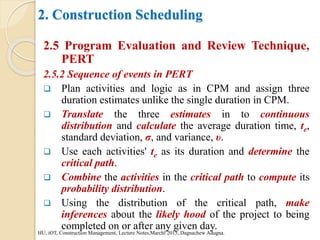
 Plan activities and logic as in CPM and assign three
duration estimates unlike the single duration in CPM.
 Translate the three estimates in to continuous
distribution and calculate the average duration time, te,
standard deviation, σ, and variance, υ.
 Use each activities' te as its duration and determine the
critical path.
 Combine the activities in the critical path to compute its
probability distribution.
 Using the distribution of the critical path, make
inferences about the likely hood of the project to being
completed on or after any given day.
HU, iOT, Construction Management, Lecture Notes,Marchl 2015, Dagnachew Adugna.
2. Construction Scheduling
2.5 Program Evaluation and Review Technique,
PERT
2.5.3 Calculations in PERT
 Once the activity duration is plotted on the normal
distribution, and standard deviation, σ, and variance, υ
can be determined.
 The value of the most likely time, m, does not affect the
calculation of standard deviation. It is only affected by
the range from optimistic to pessimistic estimates.
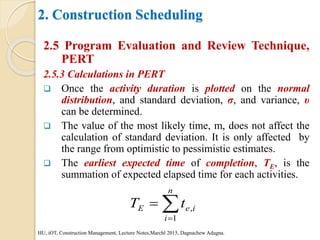
 The earliest expected time of completion, TE, is the
summation of expected elapsed time for each activities.
HU, iOT, Construction Management, Lecture Notes,Marchl 2015, Dagnachew Adugna.



n
i
i
e
E t
T
1
,
2. Construction Scheduling
2.5 Program Evaluation and Review Technique,
PERT
2.5.3 Calculations in PERT
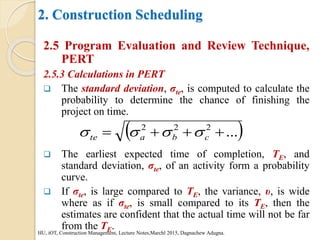
 The standard deviation, σte, is computed to calculate the
probability to determine the chance of finishing the
project on time.
 The earliest expected time of completion, TE, and
standard deviation, σte, of an activity form a probability
curve.
 If σte, is large compared to TE, the variance, υ, is wide
where as if σte, is small compared to its TE, then the
estimates are confident that the actual time will not be far
from the TE.
HU, iOT, Construction Management, Lecture Notes,Marchl 2015, Dagnachew Adugna.
 
...
2
2
2



 c
b
a
te 



2. Construction Scheduling
2.5 Program Evaluation and Review Technique,
PERT
2.5.3 Calculations in PERT
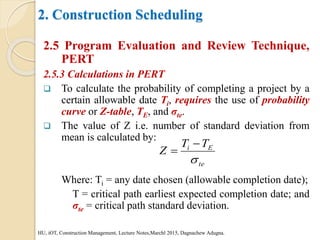
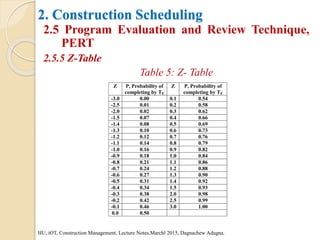
 To calculate the probability of completing a project by a
certain allowable date Ti, requires the use of probability
curve or Z-table, TE, and σte.
 The value of Z i.e. number of standard deviation from
mean is calculated by:
Where: Ti = any date chosen (allowable completion date);
T = critical path earliest expected completion date; and
σte = critical path standard deviation.
HU, iOT, Construction Management, Lecture Notes,Marchl 2015, Dagnachew Adugna.
te
E
i T
T
Z



2. Construction Scheduling
2.5 Program Evaluation and Review Technique,
PERT
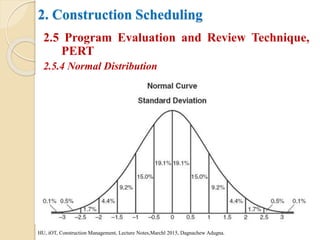
2.5.4 Normal Distribution
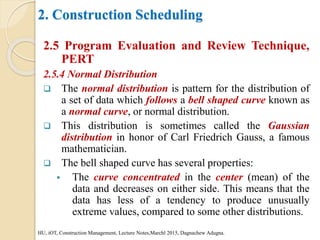
 The normal distribution is pattern for the distribution of
a set of data which follows a bell shaped curve known as
a normal curve, or normal distribution.
 This distribution is sometimes called the Gaussian
distribution in honor of Carl Friedrich Gauss, a famous
mathematician.
 The bell shaped curve has several properties:
 The curve concentrated in the center (mean) of the
data and decreases on either side. This means that the
data has less of a tendency to produce unusually
extreme values, compared to some other distributions.
HU, iOT, Construction Management, Lecture Notes,Marchl 2015, Dagnachew Adugna.
2. Construction Scheduling
2.5 Program Evaluation and Review Technique,
PERT
2.5.4 Normal Distribution
 The bell shaped curve has several properties:
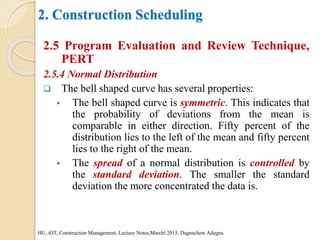
 The bell shaped curve is symmetric. This indicates that
the probability of deviations from the mean is
comparable in either direction. Fifty percent of the
distribution lies to the left of the mean and fifty percent
lies to the right of the mean.
 The spread of a normal distribution is controlled by
the standard deviation. The smaller the standard
deviation the more concentrated the data is.
HU, iOT, Construction Management, Lecture Notes,Marchl 2015, Dagnachew Adugna.
2. Construction Scheduling
2.5 Program Evaluation and Review Technique,
PERT
2.5.4 Normal Distribution
HU, iOT, Construction Management, Lecture Notes,Marchl 2015, Dagnachew Adugna.
2. Construction Scheduling
2.5 Program Evaluation and Review Technique,
PERT
2.5.5 Z-Table
Table 5: Z- Table
HU, iOT, Construction Management, Lecture Notes,Marchl 2015, Dagnachew Adugna.
Z P, Probability of
completing by TE
Z P, Probability of
completing by TE
-3.0 0.00 0.1 0.54
-2.5 0.01 0.2 0.58
-2.0 0.02 0.3 0.62
-1.5 0.07 0.4 0.66
-1.4 0.08 0.5 0.69
-1.3 0.10 0.6 0.73
-1.2 0.12 0.7 0.76
-1.1 0.14 0.8 0.79
-1.0 0.16 0.9 0.82
-0.9 0.18 1.0 0.84
-0.8 0.21 1.1 0.86
-0.7 0.24 1.2 0.88
-0.6 0.27 1.3 0.90
-0.5 0.31 1.4 0.92
-0.4 0.34 1.5 0.93
-0.3 0.38 2.0 0.98
-0.2 0.42 2.5 0.99
-0.1 0.46 3.0 1.00
0.0 0.50
2. Construction Scheduling
2.5 Program Evaluation and Review Technique,
PERT
Exercise: PERT
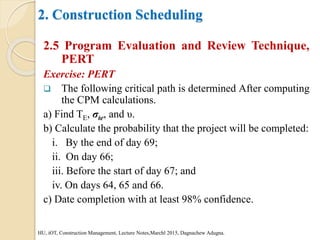
 The following critical path is determined After computing
the CPM calculations.
a) Find TE, σte, and υ.
b) Calculate the probability that the project will be completed:
i. By the end of day 69;
ii. On day 66;
iii. Before the start of day 67; and
iv. On days 64, 65 and 66.
c) Date completion with at least 98% confidence.
HU, iOT, Construction Management, Lecture Notes,Marchl 2015, Dagnachew Adugna.
2. Construction Scheduling
2.5 Program Evaluation and Review Technique,
PERT
Exercise: PERT
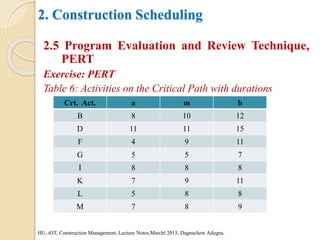
Table 6: Activities on the Critical Path with durations
HU, iOT, Construction Management, Lecture Notes,Marchl 2015, Dagnachew Adugna.
Crt. Act. a m b
B 8 10 12
D 11 11 15
F 4 9 11
G 5 5 7
I 8 8 8
K 7 9 11
L 5 8 8
M 7 8 9
THANK YOU!
HU, iOT, Construction Management, Lecture Notes,Marchl 2015, Dagnachew Adugna.

Chapter 3 Construction Planning and Scheduling lect. 3.ppt

  • 1.
    COTM 5204: CONSTRUCTIONMANAGEMENT Chapter 3 Construction Planning and Scheduling DAGNACHEW ADUGNA April 2014 School of Civil Engineering
  • 2.
    Contents Construction Planning andScheduling 1. Construction Planning 2. Construction Scheduling HU, iOT, Construction Management, Lecture Notes,Marchl 2015, Dagnachew Adugna.
  • 3.
    1. Construction Planning 1.1Planning Studies  A trial and error approach is no longer valid for the construction industry and proper planning is now vital.  The amount of detailing in planning is likely to be the function of the size of the firm, the complexity of the project and the expertise of the management.  Planning is a vital and most difficult part of a construction project. HU, iOT, Construction Management, Lecture Notes,Marchl 2015, Dagnachew Adugna.
  • 4.
    1. Construction Planning 1.2Advantages of Planning  Planning has advantages at all of the following stages of construction. A. Before the project is started  For the client:- to estimate project duration and resources.  Helps on evaluation of tenders submitted by contractors. B. During the construction stage  Ordering of materials.  For Resource utilization like equipments. C. After completion of a project  Serve as a data base for future planning and scheduling. HU, iOT, Construction Management, Lecture Notes,Marchl 2015, Dagnachew Adugna.
  • 5.
    1. Construction Planning 1.3Construction Planning: Initial Stage  Before the actual formation of the plan the following should be considered:  Planning/scheduling technique to be used;  Number and type of programs required; and  Purpose of the program.  The programs usually developed are:  Performance based on Financial Schedule;  Equipment Schedule;  Material delivery Schedule; and  Manpower Schedule. HU, iOT, Construction Management, Lecture Notes,Marchl 2015, Dagnachew Adugna.
  • 6.
    1. Construction Planning 1.3Construction Planning – Initial Stage HU, iOT, Construction Management, Lecture Notes,Marchl 2015, Dagnachew Adugna.
  • 7.
    1. Construction Planning 1.4Construction Planning: Steps  Before the actual formation of the plan the following should be considered:  Choice of technology and construction method;  Determination of the job steps or ‘activities’;  Developing sequential relationships among these activities;  Determination of duration of activities; and  Preparing the schedule or network. HU, iOT, Construction Management, Lecture Notes,Marchl 2015, Dagnachew Adugna.
  • 8.
    1. Construction Planning 1.4Construction Planning – Steps 1.4.1 Determination of the job steps or activities HU, iOT, Construction Management, Lecture Notes,Marchl 2015, Dagnachew Adugna.
  • 9.
    1. Construction Planning 1.4Construction Planning – Steps 1.4.2 Developing sequential relationships among these activities HU, iOT, Construction Management, Lecture Notes,Marchl 2015, Dagnachew Adugna.
  • 10.
    1. Construction Planning 1.4Construction Planning – Steps 1.4.3 Determination of duration of activities  Dij = Aij / (Pij * Nij)  The following important rules apply to the estimation of activity durations:  Evaluate activities one at a time, independently of all others. For a given activity, assume that materials, labor, equipment and other needs will be available when required,  For each activity assume a normal level of manpower and/or equipment. Compute the estimate duration by applying a crew or equipment production rate to the total number of units of work to done. HU, iOT, Construction Management, Lecture Notes,Marchl 2015, Dagnachew Adugna.
  • 11.
    2. Construction Scheduling The project program represents the plan for the schedule of the work. Likewise, the budget is the plan for the cost aspects of the work.  In a similar way, the contractor will have plans for the management of quality, safety and environmental concerns.  During project operations, it is essential that actual performance be compared with planned performance in all of these areas and action taken to remedy any indicated deficiencies.  This responsibility is termed as monitoring and control, where monitoring refers to methods for comparing actual with planned performance and control denotes the actions taken to attempt to bring deficient aspects of the project into conformance. HU, iOT, Construction Management, Lecture Notes,Marchl 2015, Dagnachew Adugna.
  • 12.
    2. Construction Scheduling Scheduling vs. Planning of a construction project.  Planning must be done before the project can be intelligently scheduled.  Scheduling is a mechanical process for formalizing the planning function, assigning time boundaries for each part of the work in such a manner that the work proceeds in logical sequence and in an orderly and systematic manner. HU, iOT, Construction Management, Lecture Notes,Marchl 2015, Dagnachew Adugna.
  • 13.
    2. Construction Scheduling 2.1Schedule Updating  Periodically, perhaps monthly, the contractor will compare schedule progress with that shown on the project program.  The purpose is to determine whether the various activities that were planned to be active during the previous period were actually active, the extent of their progress and, especially, the anticipated project completion date based on progress to date.  Another purpose of the update is to incorporate any new information about already planned activities, to add information about any new work not previously planned and to determine their impacts on other activities and on the overall project completion date. HU, iOT, Construction Management, Lecture Notes,Marchl 2015, Dagnachew Adugna.
  • 14.
    2. Construction Scheduling 2.1Schedule Updating  There are various methods to produce a schedule:  Bar charts,  CPM, critical path method,  PERT, program evaluation and review technique,  Line of balance, and  Computer Software's: o Primavera, o MS Project, etc. HU, iOT, Construction Management, Lecture Notes,Marchl 2015, Dagnachew Adugna.
  • 15.
    2. Construction Scheduling 2.2Bar/Gantt Chart  Developed by Henry Gantt where each activity is represented by a bar.  Bar shows start/finish times as well as Progress. HU, iOT, Construction Management, Lecture Notes,Marchl 2015, Dagnachew Adugna.
  • 16.
    2. Construction Scheduling 2.2Bar/Gantt Chart  Advantages of Bar chart:  Useful to report information to Top Management;  A simple format and readily understood at all levels of management; and  It can provide a quick, visual overview of a project in convenient way to monitor job progresses, schedule equipment and crews and record project advancement. HU, iOT, Construction Management, Lecture Notes,Marchl 2015, Dagnachew Adugna.
  • 17.
    2. Construction Scheduling 2.2Bar/Gantt Chart  Disadvantages of Bar chart:  Interdependencies among activities are difficult to show. The bar chart itself doesn’t provide a basis for ascertaining which activities are critical and which are floaters.  It is not an adequate planning and scheduling tool because it doesn’t portray a detailed, integrated and complete plan of operations.  Can't tell what will be the effect of a delay today will have on the timing of future activities. HU, iOT, Construction Management, Lecture Notes,Marchl 2015, Dagnachew Adugna.
  • 18.
    2. Construction Scheduling 2.3Network Scheduling  Network: a model consisting of nodes and links connecting between these nodes.  Network Scheduling:- is a method of scheduling activities by joining them in a series of interconnected links, which reflect relationships of activities by the planner. 2.3.1 Basic Assumptions  The project can be broken down into a group of activities.  Each activities can be assigned a duration.  The logical relationship among activities are known and fixed in the network chains. HU, iOT, Construction Management, Lecture Notes,Marchl 2015, Dagnachew Adugna.
  • 19.
    2. Construction Scheduling 2.3Network Scheduling 2.3.2 Rules for Preparing the Network Diagram  No activity can start before the preceding activity is finalized.  There is only one start and finish for an activity.  No activity leads back and forms a loop.  The logical precedence, concurrent and subsequent activities must be clearly developed. 2.3.3 Dummy Activity  A Dummy activity is established only to show relationship.  A dummy activity is assumed to have duration of ZERO time units and it is introduced on the network when it is necessary. HU, iOT, Construction Management, Lecture Notes,Marchl 2015, Dagnachew Adugna.
  • 20.
    2. Construction Scheduling 2.3Network Scheduling 2.3.4 Presentation of Networks  Network is a graphical display of the proposed plan.  It Shows the job activities and their order of sequence (logic) in pictorial form.  There are two methods:- Arrow or Activity on Arrow (Precedence) Diagram Table 1: CPM types HU, iOT, Construction Management, Lecture Notes,Marchl 2015, Dagnachew Adugna. Scheme Representation Activity Relation Arrow diag. Link Arrow Node (Circle) Precedence diag. Node (Circle) Link arrow
  • 21.
    2. Construction Scheduling 2.3Network Scheduling 2.3.4 Presentation of Networks Arrow diagram Vs Precedence diagram HU, iOT, Construction Management, Lecture Notes,Marchl 2015, Dagnachew Adugna.
  • 22.
    2. Construction Scheduling 2.3Network Scheduling 2.3.5 Network Logic  Identifying the preceding activity (PA) and immediately preceding activity (IPA) is the easiest method to develop the network logic and draw the network diagram. 2.3.6 Types of Network Schedules  The two common types of network schedules used in the construction industry are:  Critical Path Method (CPM); and  Program Review and Evaluation Technique (PERT). HU, iOT, Construction Management, Lecture Notes,Marchl 2015, Dagnachew Adugna.
  • 23.
    2. Construction Scheduling 2.4Critical Path Method, CPM  The most widely used scheduling technique is the critical path method (CPM) for scheduling, often referred to as critical path scheduling.  This method calculates the minimum completion time for a project along with the possible start and finish times for the project activities.  Computer programs and algorithms for critical path scheduling are widely available and can efficiently handle projects with thousands of activities. HU, iOT, Construction Management, Lecture Notes,Marchl 2015, Dagnachew Adugna.
  • 24.
    2. Construction Scheduling 2.4Critical Path Method, CPM 2.4.1 Duration  An activity’s “duration“ is the amount of time estimated to complete that activity.  An activity’s duration can be expressed in any unit: minutes, hours, work days, calendar days, weeks, or months.  Duration of activities depends on the quantity of work, the type of work, the type and quantity of available resources that may be used to conduct the activity. HU, iOT, Construction Management, Lecture Notes,Marchl 2015, Dagnachew Adugna.
  • 25.
    2. Construction Scheduling 2.4Critical Path Method, CPM 2.4.1 Duration  Activity durations are estimated based on historical data and experience considering the following factors:  Construction method;  Project time limits;  Weather and site effects on production;  Quality of supervision;  Labor productivity; and  Complexity of the task. HU, iOT, Construction Management, Lecture Notes,Marchl 2015, Dagnachew Adugna.
  • 26.
    2. Construction Scheduling 2.4Critical Path Method, CPM 2.4.1 Duration  The duration is calculated by dividing the quantity of work by daily production rate.  For instance, assume a daily production rate of 50m2 in preparing a flat slab formwork for an 800m2 to complete the task: Duration=800m2 /(50m2 /day) = 16 working days.  After the activities and durations are determined, the next step in preparing a CPM schedule is to arrange activities in order in which the activities will be performed. HU, iOT, Construction Management, Lecture Notes,Marchl 2015, Dagnachew Adugna.
  • 27.
    2. Construction Scheduling 2.4Critical Path Method, CPM 2.4.2 Calculation of Critical Path  Assuming an activity on branch project network and all precedence are of finish-to-start nature, so that the succeeding activity can not start until the completion of preceding activity. HU, iOT, Construction Management, Lecture Notes,Marchl 2015, Dagnachew Adugna.
  • 28.
    2. Construction Scheduling 2.4Critical Path Method, CPM 2.4.2 Calculation of Critical Path Critical Path Scheduling Algorithms 1. Event Numbering Algorithm: Step 1: Give the starting event number 0. Step 2: give the next number to any unnumbered event whose predecessor events are each already numbered. Step 3: Repeat step 2 until all events are numbered. 2. Earliest Event Time Algorithm Step 1: Let E(0)=0. Step 2: For j= 1, 2, 3, …n (where n is the last event) let E(j)= maximum{E(i)+Dij} where: the maximum is computed over all activities (i,j) that have j as the ending event. HU, iOT, Construction Management, Lecture Notes,Marchl 2015, Dagnachew Adugna.
  • 29.
    2. Construction Scheduling 2.4Critical Path Method, CPM 2.4.2 Calculation of Critical Path Critical Path Scheduling Algorithms 3. Latest Event Time Algorithm Step 1: Let L(n)=the required time of project completion. Note: L(n) must equal or exceed E(n). Step 2: For i= n-1, n-2, …0 (where n is the last event) let, L(i)= minimum{L(j)-Dij} where: the minimum is computed over all activities (i,j) that have i as the starting event. HU, iOT, Construction Management, Lecture Notes,Marchl 2015, Dagnachew Adugna.
  • 30.
    2. Construction Scheduling 2.4Critical Path Method, CPM 2.4.3 Earliest Time Calculations  The earliest event time algorithm computes the earliest possible time, E(i), at which each event, i, in the network can occur.  Earliest event times are computed as the maximum of the earliest start times plus activity durations of each of the activities immediately preceding an event.  The earliest start time of each activity (i,j) is equal to the earliest possible time for the preceding event E(i): ES(i,j) = E(i)  The earliest finish time of each activity (i,j) is calculated as: EF(i,j) = E(i) + Dij HU, iOT, Construction Management, Lecture Notes,Marchl 2015, Dagnachew Adugna.
  • 31.
    2. Construction Scheduling 2.4Critical Path Method, CPM 2.4.4 Latest Time Calculations  The latest event time algorithm computes the latest possible time, L(j), at which each event, j, in the network can occur, given the desired completion time of the project, L(n) for the last event n.  The latest finish time consistent with completion of the project in the desired time frame of L(n) for each activity (i,j) is equal to the latest possible time L(j) for the succeeding event: LF(i,j) = L(j)  The latest start time of each activity (i,j) can be calculated as: LS(i,j) = L(j) - Dij HU, iOT, Construction Management, Lecture Notes,Marchl 2015, Dagnachew Adugna.
  • 32.
    2. Construction Scheduling 2.4Critical Path Method, CPM 2.4.5 Critical Path  The critical path itself represents the set or sequence of predecessor/successor activities which will take the longest time to complete.  The duration of the critical path represents the minimum time required to complete a project.  Any delays along the critical path would imply that additional time would be required to complete the project.  CPM assumes deterministic durations.  CPM does not consider resource constraints. HU, iOT, Construction Management, Lecture Notes,Marchl 2015, Dagnachew Adugna.
  • 33.
    2. Construction Scheduling 2.4Critical Path Method, CPM 2.4.5 Requirements for Critical Activity  The earliest start and latest finish times of each event are useful pieces of information for developing a project schedule.  Events which have equal earliest and latest times, E(i)=L(i), lie on the critical path(s).  An activity is a critical activity if it satisfies all of the following conditions: E(i)=L(i) E(j)=L(j) E(i) + Dij =L(j) HU, iOT, Construction Management, Lecture Notes,Marchl 2015, Dagnachew Adugna.
  • 34.
    2. Construction Scheduling 2.4Critical Path Method, CPM 2.4.6 Activity float and schedules  The concept of float is to use part or all of allowable range to schedule an activity without delaying the completion of the project.  An activity that has the earliest time for its predecessor and successor nodes differing by more than its duration possesses a window in which it can be scheduled late.  Float is a very valuable concept since it represents the scheduling flexibility or "maneuvering room" available to complete particular tasks. HU, iOT, Construction Management, Lecture Notes,Marchl 2015, Dagnachew Adugna.
  • 35.
    2. Construction Scheduling 2.4Critical Path Method, CPM 2.4.6 Activity float and schedules  Activities on the critical path do not provide any flexibility for scheduling nor leeway in case of problems.  For activities with some float, the actual starting time might be chosen to: balance work loads over time, correspond with material deliveries, and improve the project's cash flow.  There are three types of activity floats:  Free float,  Independent float, and  Total float HU, iOT, Construction Management, Lecture Notes,Marchl 2015, Dagnachew Adugna.
  • 36.
    2. Construction Scheduling 2.4Critical Path Method, CPM 2.4.6 Activity float and schedules  Free float is the amount of delay which can be assigned to any one activity without delaying subsequent activities.  Independent float is the amount of delay which can be assigned to any one activity without delaying subsequent activities or restricting the scheduling of preceding activities.  Total float is the maximum amount of delay which can be assigned to any activity without delaying the entire project. HU, iOT, Construction Management, Lecture Notes,Marchl 2015, Dagnachew Adugna.
  • 37.
    2. Construction Scheduling 2.4Critical Path Method, CPM Example: CPM Table 2: Precedence Relations and Durations of a project HU, iOT, Construction Management, Lecture Notes,Marchl 2015, Dagnachew Adugna. Activity Description Predecessors Duration A Site clearing - 4 B Removal of trees - 3 C General excavation A 8 D Grading general area A 7 E Excavation for trenches B,C 9 F Placing formwork and reinforcement for concrete B,C 12 G Installing sewer lines D,E 2 H Installing other utilities D,E 5 I Pouring concrete F,G 6
  • 38.
    2. Construction Scheduling 2.4Critical Path Method, CPM Example: CPM-Solution i. Network Diagram HU, iOT, Construction Management, Lecture Notes,Marchl 2015, Dagnachew Adugna.
  • 39.
    2. Construction Scheduling 2.4Critical Path Method, CPM Example: CPM-Solution ii. Earliest Time Determination Step 1: E(0) = 0 Step 2: j=1: E(1) = Max{E(0) + D01} = Max{ 0 + 4 } = 4 j=2: E(2)=Max{E(0)+D02; E(1) + D12}=Max{0 + 3; 4 + 8}= 12 j=3: E(3)=Max{E(1)+D13; E(2)+D23}=Max{4 + 7; 12 + 9}= 21 j=4: E(4)=Max{E(2)+D24; E(3)+D34}=Max{12+12; 21 + 2}= 24 j=5: E(5)=Max{E(3)+D35; E(4)+D45}=Max{21 + 5; 24 + 6}= 30  Thus, the minimum time required to complete the project is 30 since E(5) = 30. In this case, each event had at most two predecessors. HU, iOT, Construction Management, Lecture Notes,Marchl 2015, Dagnachew Adugna.
  • 40.
    2. Construction Scheduling 2.4Critical Path Method, CPM Example: CPM-Solution iii. Latest Time Determination Step 1 L(5) = E(5) = 30 Step 2: j=4: L(4) = Min {L(5) - D45} = Min {30 - 6} = 24 j=3: L(3)=Min {L(5) - D35; L(4) - D34}=Min {30 -5; 24 - 2} = 22 j=2: L(2)=Min {L(4) - D24; L(3) - D23}=Min {24 - 12; 22 - 9}=12 j=1: L(1)=Min {L(3) - D13; L(2) - D12}=Min {22 - 7; 12 - 8}=4 j=0: L(0)=Min {L(2) - D02; L(1) - D01}=Min {12 - 3; 4 - 4}=0  In this example, E(0) = L(0), E(1) = L(1), E(2) = L(2), E(4) = L(4),and E(5) = L(5). As a result, all nodes but node 3 are in the critical path. Activities on the critical path include A (0,1), C (1,2), F (2,4) and I (4,5) are shown in the following Table. HU, iOT, Construction Management, Lecture Notes,Marchl 2015, Dagnachew Adugna.
  • 41.
    2. Construction Scheduling 2.4Critical Path Method, CPM Example: CPM-Solution iv. Total Float Determination TF(i.j) = L(j)-E(i)-Dij A: L(1)-E(0)-D01 = 4-0-4 = 0 B: L(2)-E(0)-D02 = 12-0-3 = 9 C: L(2)-E(1)-D12 = 12-4-8 = 0 D: L(3)-E(1)-D13 = 22-4-7 = 11 E: L(3)-E(2)-D23 = 22-12-9 = 1 F: L(4)-E(2)-D24 = 24-12-12 = 0 G: L(4)-E(3)-D34 = 24-21-2 = 1 H: L(5)-E(3)-D35 = 30-21-5 = 4 I: L(5)-E(4)-D45 = 30-24-6 = 0 HU, iOT, Construction Management, Lecture Notes,Marchl 2015, Dagnachew Adugna.
  • 42.
    2. Construction Scheduling 2.4Critical Path Method, CPM Example: CPM-Solution v. Free Float Determination FF(i.j) = E(j)-E(i)-Dij A: E(1)-E(0)-D01 = 4-0-4 = 0 B: E(2)-E(0)-D02 = 12-0-3 = 9 C: E(2)-E(1)-D12 = 12-4-8 = 0 D: E(3)-E(1)-D13 = 21-4-7 = 10 E: E(3)-E(2)-D23 = 21-12-9 = 0 F: E(4)-E(2)-D24 = 24-12-12 = 0 G: E(4)-E(3)-D34 = 24-21-2 = 1 H: E(5)-E(3)-D35 = 30-21-5 = 4 I: L(5)-E(4)-D45 = 30-24-6 = 0 HU, iOT, Construction Management, Lecture Notes,Marchl 2015, Dagnachew Adugna.
  • 43.
    2. Construction Scheduling 2.4Critical Path Method, CPM Example: CPM-Solution Table 3: Identification of Activities on the Critical Path HU, iOT, Construction Management, Lecture Notes,Marchl 2015, Dagnachew Adugna. Activit y Duration Dij ES time E(i)=ES(i,j) LF time L(j)=LF(i,j) LS time LS(i,j) TF FF A (0,1) 4 0* 4* 0 0 0 B (0,2) 3 0 12 9 9 9 C (1,2) 8 4* 12* 4 0 0 D (1,3) 7 4 22 15 11 10 E (2,3) 9 12* 22 13 1 0 F (2,4) 12 12 24* 12 0 0 G (3,4) 2 21 24 22 1 1 H (3,5) 5 21 30 25 4 4 I (4,5) 6 24 30* 24 0 0
  • 44.
    2. Construction Scheduling 2.4Critical Path Method, CPM Exercise: CPM  The data in Table 4 shows the activity relationship and duration of a minor construction maintenance work. Develop the network diagram and determine ES, EF, LS, LF, TF and FF. Find also the critical path(s). HU, iOT, Construction Management, Lecture Notes,Marchl 2015, Dagnachew Adugna.
  • 45.
    2. Construction Scheduling 2.4Critical Path Method, CPM Exercise: CPM Table 4: Activities relationship with durations HU, iOT, Construction Management, Lecture Notes,Marchl 2015, Dagnachew Adugna. PA Act. Event IPA Duration - A (1,2) - 3 A B (2,3) A 3 A C (2,4) A 5 A D (2,5) A 7 A, B E (3,6) B 4 A, B F (3,7) B 6 A, B, C, G (4,7) C, B 4 A, B, E H (6,8) E 6 A, D I (5.8) D 9 A, B, C, D, E, F, G J (7,8) D, E, F, G 8
  • 46.
    2. Construction Scheduling 2.5Program Evaluation and Review Technique, PERT  Construction works are uploaded with uncertainties ranging from adverse weather, machinery breakdown and material shortage etc. which affect the activity progress and schedule.  However; the probability of an activity being completed as planned can be assessed.  PERT is one of the most widely used project management tools which entertains uncertainty in planning.  PERT is developed in 1958 for the POLARIS missile program by the Program Evaluation branch of the Special Projects office of the U.S. Navy along with the lockheed Missile systems and Booz-Allen & Hamilton. HU, iOT, Construction Management, Lecture Notes,Marchl 2015, Dagnachew Adugna.
  • 47.
    2. Construction Scheduling 2.5Program Evaluation and Review Technique, PERT  Even though the rules for network manipulation of PERT are similar to CPM, it were developed independently.  Basically the only difference between the two is that CPM uses deterministic/fixed duration for each activity while PERT uses probabilistic duration.  The probability distribution appropriate for most projects is Beta distribution.  Beta distribution is chosen for the following reasons:  There is only a small probability of completing the project in the most optimistic time;  Probability of completing the project in the most pessimistic time is small; and  There is only one most likely time. HU, iOT, Construction Management, Lecture Notes,Marchl 2015, Dagnachew Adugna.
  • 48.
    2. Construction Scheduling 2.5Program Evaluation and Review Technique, PERT 2.5.1 PERT Activity Durations  PERT differs from CPM in that it bases the duration of an activity on three estimates:  Optimistic time, a, which occurs when execution goes extremely well.  Most likely time, m, which occurs when execution is done under normal conditions.  Pessimistic time, b, which occurs when execution goes extremely poorly.  The range (a, b) encloses all possible estimates of the duration of an activity. The estimate m lies somewhere in the range (a, b). HU, iOT, Construction Management, Lecture Notes,Marchl 2015, Dagnachew Adugna.
  • 49.
    2. Construction Scheduling 2.5Program Evaluation and Review Technique, PERT 2.5.1 PERT Activity Durations  Based on the estimates, the average duration time, te, standard deviation, σ, and variance, υ, are approximated as: HU, iOT, Construction Management, Lecture Notes,Marchl 2015, Dagnachew Adugna.  2 6 6 4 te te e a b b m a t         
  • 50.
    2. Construction Scheduling 2.5Program Evaluation and Review Technique, PERT 2.5.2 Sequence of events in PERT  Plan activities and logic as in CPM and assign three duration estimates unlike the single duration in CPM.  Translate the three estimates in to continuous distribution and calculate the average duration time, te, standard deviation, σ, and variance, υ.  Use each activities' te as its duration and determine the critical path.  Combine the activities in the critical path to compute its probability distribution.  Using the distribution of the critical path, make inferences about the likely hood of the project to being completed on or after any given day. HU, iOT, Construction Management, Lecture Notes,Marchl 2015, Dagnachew Adugna.
  • 51.
    2. Construction Scheduling 2.5Program Evaluation and Review Technique, PERT 2.5.3 Calculations in PERT  Once the activity duration is plotted on the normal distribution, and standard deviation, σ, and variance, υ can be determined.  The value of the most likely time, m, does not affect the calculation of standard deviation. It is only affected by the range from optimistic to pessimistic estimates.  The earliest expected time of completion, TE, is the summation of expected elapsed time for each activities. HU, iOT, Construction Management, Lecture Notes,Marchl 2015, Dagnachew Adugna.    n i i e E t T 1 ,
  • 52.
    2. Construction Scheduling 2.5Program Evaluation and Review Technique, PERT 2.5.3 Calculations in PERT  The standard deviation, σte, is computed to calculate the probability to determine the chance of finishing the project on time.  The earliest expected time of completion, TE, and standard deviation, σte, of an activity form a probability curve.  If σte, is large compared to TE, the variance, υ, is wide where as if σte, is small compared to its TE, then the estimates are confident that the actual time will not be far from the TE. HU, iOT, Construction Management, Lecture Notes,Marchl 2015, Dagnachew Adugna.   ... 2 2 2     c b a te    
  • 53.
    2. Construction Scheduling 2.5Program Evaluation and Review Technique, PERT 2.5.3 Calculations in PERT  To calculate the probability of completing a project by a certain allowable date Ti, requires the use of probability curve or Z-table, TE, and σte.  The value of Z i.e. number of standard deviation from mean is calculated by: Where: Ti = any date chosen (allowable completion date); T = critical path earliest expected completion date; and σte = critical path standard deviation. HU, iOT, Construction Management, Lecture Notes,Marchl 2015, Dagnachew Adugna. te E i T T Z   
  • 54.
    2. Construction Scheduling 2.5Program Evaluation and Review Technique, PERT 2.5.4 Normal Distribution  The normal distribution is pattern for the distribution of a set of data which follows a bell shaped curve known as a normal curve, or normal distribution.  This distribution is sometimes called the Gaussian distribution in honor of Carl Friedrich Gauss, a famous mathematician.  The bell shaped curve has several properties:  The curve concentrated in the center (mean) of the data and decreases on either side. This means that the data has less of a tendency to produce unusually extreme values, compared to some other distributions. HU, iOT, Construction Management, Lecture Notes,Marchl 2015, Dagnachew Adugna.
  • 55.
    2. Construction Scheduling 2.5Program Evaluation and Review Technique, PERT 2.5.4 Normal Distribution  The bell shaped curve has several properties:  The bell shaped curve is symmetric. This indicates that the probability of deviations from the mean is comparable in either direction. Fifty percent of the distribution lies to the left of the mean and fifty percent lies to the right of the mean.  The spread of a normal distribution is controlled by the standard deviation. The smaller the standard deviation the more concentrated the data is. HU, iOT, Construction Management, Lecture Notes,Marchl 2015, Dagnachew Adugna.
  • 56.
    2. Construction Scheduling 2.5Program Evaluation and Review Technique, PERT 2.5.4 Normal Distribution HU, iOT, Construction Management, Lecture Notes,Marchl 2015, Dagnachew Adugna.
  • 57.
    2. Construction Scheduling 2.5Program Evaluation and Review Technique, PERT 2.5.5 Z-Table Table 5: Z- Table HU, iOT, Construction Management, Lecture Notes,Marchl 2015, Dagnachew Adugna. Z P, Probability of completing by TE Z P, Probability of completing by TE -3.0 0.00 0.1 0.54 -2.5 0.01 0.2 0.58 -2.0 0.02 0.3 0.62 -1.5 0.07 0.4 0.66 -1.4 0.08 0.5 0.69 -1.3 0.10 0.6 0.73 -1.2 0.12 0.7 0.76 -1.1 0.14 0.8 0.79 -1.0 0.16 0.9 0.82 -0.9 0.18 1.0 0.84 -0.8 0.21 1.1 0.86 -0.7 0.24 1.2 0.88 -0.6 0.27 1.3 0.90 -0.5 0.31 1.4 0.92 -0.4 0.34 1.5 0.93 -0.3 0.38 2.0 0.98 -0.2 0.42 2.5 0.99 -0.1 0.46 3.0 1.00 0.0 0.50
  • 58.
    2. Construction Scheduling 2.5Program Evaluation and Review Technique, PERT Exercise: PERT  The following critical path is determined After computing the CPM calculations. a) Find TE, σte, and υ. b) Calculate the probability that the project will be completed: i. By the end of day 69; ii. On day 66; iii. Before the start of day 67; and iv. On days 64, 65 and 66. c) Date completion with at least 98% confidence. HU, iOT, Construction Management, Lecture Notes,Marchl 2015, Dagnachew Adugna.
  • 59.
    2. Construction Scheduling 2.5Program Evaluation and Review Technique, PERT Exercise: PERT Table 6: Activities on the Critical Path with durations HU, iOT, Construction Management, Lecture Notes,Marchl 2015, Dagnachew Adugna. Crt. Act. a m b B 8 10 12 D 11 11 15 F 4 9 11 G 5 5 7 I 8 8 8 K 7 9 11 L 5 8 8 M 7 8 9
  • 60.
    THANK YOU! HU, iOT,Construction Management, Lecture Notes,Marchl 2015, Dagnachew Adugna.