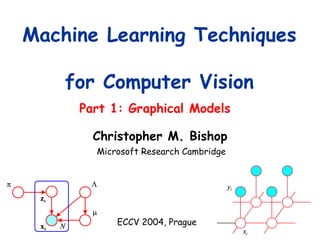
Part 1: Graphical Models Machine Learning Techniques  for Computer Vision Microsoft Research Cambridge ECCV 2004, Prague Christopher M. Bishop
About this Tutorial Learning is the new frontier in computer vision  Focus on concepts  not lists of algorithms not technical details Graduate level Please ask questions!
Overview Part 1:  Graphical models directed and undirected graphs inference and learning   Part 2:  Unsupervised learning mixture models, EM variational inference, model complexity continuous latent variables Part 3:  Supervised learning decision theory linear models, neural networks,  boosting, sparse kernel machines
Probability Theory Sum rule Product rule From these we have Bayes’ theorem with normalization
Role of the Graphs New insights into existing models Motivation for new models Graph based algorithms for calculation and computation c.f. Feynman diagrams in physics
Decomposition Consider an arbitrary joint distribution By successive application of the product rule
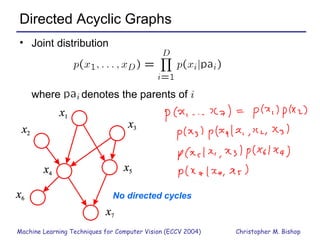
Directed Acyclic Graphs Joint distribution where  denotes the parents of  i No directed cycles
Undirected Graphs Provided  then joint distribution is product of non-negative functions over the  cliques  of the graph where  are the  clique potentials,  and  Z  is a normalization constant
Conditioning on Evidence Variables may be hidden (latent) or visible (observed) Latent variables may have a specific interpretation, or may be introduced to permit a richer class of distribution
Conditional Independences x  independent of  y  given  z  if, for all values of  z , For undirected graphs this is given by graph separation!
“Explaining Away” C.I. for directed graphs similar, but with one subtlety Illustration: pixel colour in an image image colour surface colour lighting colour
Directed versus Undirected
Example: State Space Models Hidden Markov model Kalman filter
Example: Bayesian SSM
Example: Factorial SSM Multiple hidden sequences Avoid exponentially large hidden space
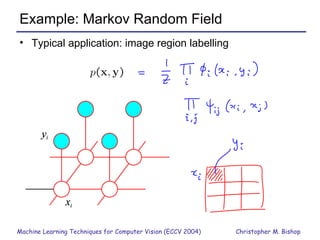
Example: Markov Random Field Typical application: image region labelling
Example: Conditional Random Field
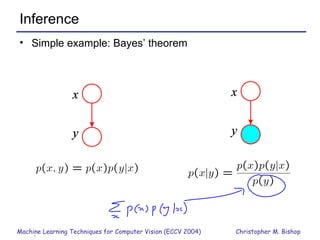
Inference Simple example: Bayes’ theorem
Message Passing Example Find marginal for a particular node for  M -state nodes, cost is  exponential in length of chain but, we can exploit the graphical structure (conditional independences)
Message Passing Joint distribution Exchange sums and products
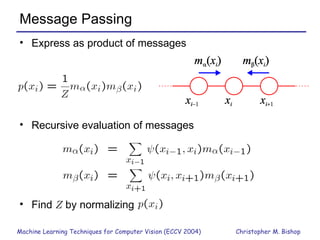
Message Passing Express as product of messages Recursive evaluation of messages Find  Z  by normalizing
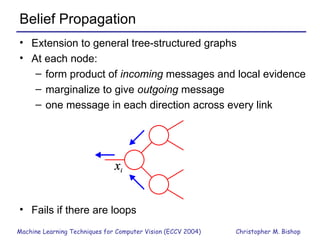
Belief Propagation Extension to general tree-structured graphs At each node: form product of  incoming  messages and local evidence marginalize to give  outgoing  message one message in each direction across every link Fails if there are loops
Junction Tree Algorithm An efficient exact algorithm for a general graph applies to both directed and undirected graphs compile original graph into a tree of cliques then perform message passing on this tree Problem:  cost is exponential in size of largest clique many vision models have intractably large cliques
Loopy Belief Propagation Apply belief propagation directly to general graph need to keep iterating might not converge State-of-the-art performance in error-correcting codes
Max-product Algorithm Goal: find define then Message passing algorithm with “sum” replaced by “max” Example:  Viterbi algorithm for HMMs
Inference and Learning Data set Likelihood function (independent observations) Maximize (log) likelihood Predictive distribution
Regularized Maximum Likelihood Prior  , posterior MAP (maximum posterior) Predictive distribution Not really Bayesian
Bayesian Learning Key idea is to  marginalize  over unknown parameters, rather than make point estimates avoids severe over-fitting of ML and MAP allows direct model comparison Parameters are now latent variables Bayesian learning is an inference problem!
Bayesian Learning
Bayesian Learning
And Finally … the Exponential Family Many distributions can be written in the form Includes:  Gaussian Dirichlet Gamma Multi-nomial Wishart Bernoulli … Building blocks in graphs to give rich probabilistic models
Illustration: the Gaussian Use precision (inverse variance) In standard form
Maximum Likelihood Likelihood function (independent observations) Depends on data via  sufficient statistics  of fixed dimension
Conjugate Priors Prior has same functional form as likelihood Hence posterior is of the form Can interpret prior as  effective observations of value Examples:  Gaussian for the mean of a Gaussian Gaussian-Wishart for mean and precision of Gaussian Dirichlet for the parameters of a discrete distribution
Summary of Part 1 Directed graphs Undirected graphs Inference by message passing: belief propagation

Cristopher M. Bishop's tutorial on graphical models

  • 1.
    Part 1: GraphicalModels Machine Learning Techniques for Computer Vision Microsoft Research Cambridge ECCV 2004, Prague Christopher M. Bishop
  • 2.
    About this TutorialLearning is the new frontier in computer vision Focus on concepts not lists of algorithms not technical details Graduate level Please ask questions!
  • 3.
    Overview Part 1: Graphical models directed and undirected graphs inference and learning Part 2: Unsupervised learning mixture models, EM variational inference, model complexity continuous latent variables Part 3: Supervised learning decision theory linear models, neural networks, boosting, sparse kernel machines
  • 4.
    Probability Theory Sumrule Product rule From these we have Bayes’ theorem with normalization
  • 5.
    Role of theGraphs New insights into existing models Motivation for new models Graph based algorithms for calculation and computation c.f. Feynman diagrams in physics
  • 6.
    Decomposition Consider anarbitrary joint distribution By successive application of the product rule
  • 7.
    Directed Acyclic GraphsJoint distribution where denotes the parents of i No directed cycles
  • 8.
    Undirected Graphs Provided then joint distribution is product of non-negative functions over the cliques of the graph where are the clique potentials, and Z is a normalization constant
  • 9.
    Conditioning on EvidenceVariables may be hidden (latent) or visible (observed) Latent variables may have a specific interpretation, or may be introduced to permit a richer class of distribution
  • 10.
    Conditional Independences x independent of y given z if, for all values of z , For undirected graphs this is given by graph separation!
  • 11.
    “Explaining Away” C.I.for directed graphs similar, but with one subtlety Illustration: pixel colour in an image image colour surface colour lighting colour
  • 12.
  • 13.
    Example: State SpaceModels Hidden Markov model Kalman filter
  • 14.
  • 15.
    Example: Factorial SSMMultiple hidden sequences Avoid exponentially large hidden space
  • 16.
    Example: Markov RandomField Typical application: image region labelling
  • 17.
  • 18.
    Inference Simple example:Bayes’ theorem
  • 19.
    Message Passing ExampleFind marginal for a particular node for M -state nodes, cost is exponential in length of chain but, we can exploit the graphical structure (conditional independences)
  • 20.
    Message Passing Jointdistribution Exchange sums and products
  • 21.
    Message Passing Expressas product of messages Recursive evaluation of messages Find Z by normalizing
  • 22.
    Belief Propagation Extensionto general tree-structured graphs At each node: form product of incoming messages and local evidence marginalize to give outgoing message one message in each direction across every link Fails if there are loops
  • 23.
    Junction Tree AlgorithmAn efficient exact algorithm for a general graph applies to both directed and undirected graphs compile original graph into a tree of cliques then perform message passing on this tree Problem: cost is exponential in size of largest clique many vision models have intractably large cliques
  • 24.
    Loopy Belief PropagationApply belief propagation directly to general graph need to keep iterating might not converge State-of-the-art performance in error-correcting codes
  • 25.
    Max-product Algorithm Goal:find define then Message passing algorithm with “sum” replaced by “max” Example: Viterbi algorithm for HMMs
  • 26.
    Inference and LearningData set Likelihood function (independent observations) Maximize (log) likelihood Predictive distribution
  • 27.
    Regularized Maximum LikelihoodPrior , posterior MAP (maximum posterior) Predictive distribution Not really Bayesian
  • 28.
    Bayesian Learning Keyidea is to marginalize over unknown parameters, rather than make point estimates avoids severe over-fitting of ML and MAP allows direct model comparison Parameters are now latent variables Bayesian learning is an inference problem!
  • 29.
  • 30.
  • 31.
    And Finally …the Exponential Family Many distributions can be written in the form Includes: Gaussian Dirichlet Gamma Multi-nomial Wishart Bernoulli … Building blocks in graphs to give rich probabilistic models
  • 32.
    Illustration: the GaussianUse precision (inverse variance) In standard form
  • 33.
    Maximum Likelihood Likelihoodfunction (independent observations) Depends on data via sufficient statistics of fixed dimension
  • 34.
    Conjugate Priors Priorhas same functional form as likelihood Hence posterior is of the form Can interpret prior as effective observations of value Examples: Gaussian for the mean of a Gaussian Gaussian-Wishart for mean and precision of Gaussian Dirichlet for the parameters of a discrete distribution
  • 35.
    Summary of Part1 Directed graphs Undirected graphs Inference by message passing: belief propagation