
ML Algorithms
Part 2 Draft
Do you really understand more...
Outline
Learning Theory: Model, Evaluation Metrics
Algorithems: Naïve Bayesian, Clustering Methods (K-means)
Ensemble Learning, EM Algorithm
Restricted Boltzman Machines
Neural Networks: BP, Word2Vec, GloVe, CNN, RNN
Other: Singular Vector Decompostion, Matrix Factorization
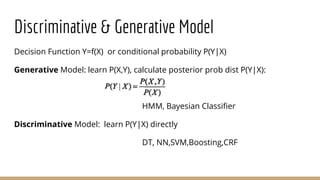
Discriminative & Generative Model
Decision Function Y=f(X) or conditional probability P(Y|X)
Generative Model: learn P(X,Y), calculate posterior prob dist P(Y|X):
HMM, Bayesian Classifier
Discriminative Model: learn P(Y|X) directly
DT, NN,SVM,Boosting,CRF
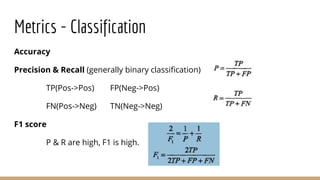
Metrics - Classification
Accuracy
Precision & Recall (generally binary classification)
TP(Pos->Pos) FP(Neg->Pos)
FN(Pos->Neg) TN(Neg->Neg)
F1 score
P & R are high, F1 is high.
Metrics - Regression
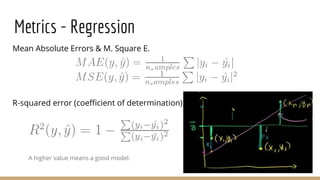
Mean Absolute Errors & M. Square E.
R-squared error (coefficient of determination):
A higher value means a good model.
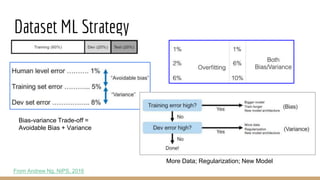
Dataset ML Strategy
From Andrew Ng, NIPS, 2016
Bias-variance Trade-off =
Avoidable Bias + Variance
More Data; Regularization; New Model
Naive Bayesian Classifier
Two Assumptions
Bayes’ Theorem
Features are conditionally independent
How to do?
Learn Joint probability distribution p(x,y)
Learn p(x)
Calculate p(y)
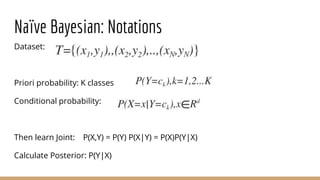
Naïve Bayesian: Notations
Dataset:
Priori probability: K classes
Conditional probability:
Then learn Joint: P(X,Y) = P(Y) P(X|Y) = P(X)P(Y|X)
Calculate Posterior: P(Y|X)
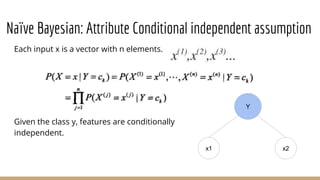
Naïve Bayesian: Attribute Conditional independent assumption
Each input x is a vector with n elements.
Given the class y, features are conditionally
independent.
Y
x1 x2
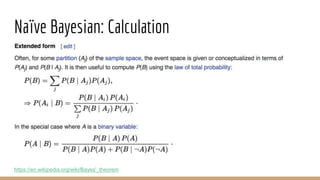
Naïve Bayesian: Calculation
https://en.wikipedia.org/wiki/Bayes'_theorem
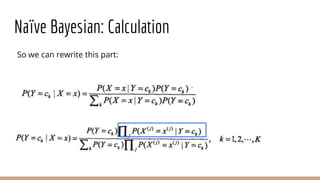
Naïve Bayesian: Calculation
So we can rewrite this part:
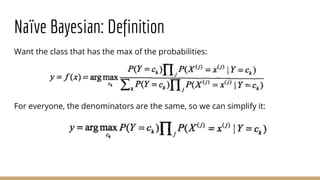
Naïve Bayesian: Definition
Want the class that has the max of the probabilities:
For everyone, the denominators are the same, so we can simplify it:
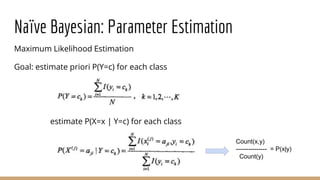
Naïve Bayesian: Parameter Estimation
Maximum Likelihood Estimation
Goal: estimate priori P(Y=c) for each class
estimate P(X=x | Y=c) for each class
Count(x,y)
--------------- = P(x|y)
Count(y)
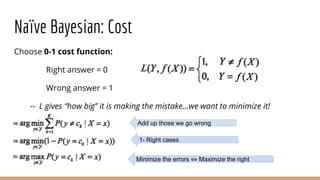
Naïve Bayesian: Cost
Choose 0-1 cost function:
Right answer = 0
Wrong answer = 1
-- L gives “how big” it is making the mistake...we want to minimize it!
Add up those we go wrong
1- Right cases
Minimize the errors ⇔ Maximize the right
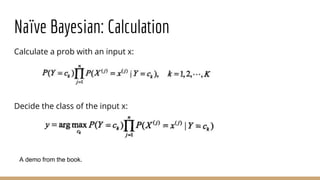
Naïve Bayesian: Calculation
Calculate a prob with an input x:
Decide the class of the input x:
A demo from the book.
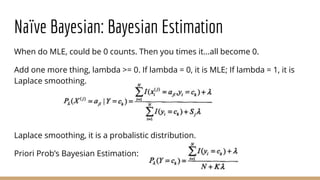
Naïve Bayesian: Bayesian Estimation
When do MLE, could be 0 counts. Then you times it...all become 0.
Add one more thing, lambda >= 0. If lambda = 0, it is MLE; If lambda = 1, it is
Laplace smoothing.
Laplace smoothing, it is a probalistic distribution.
Priori Prob’s Bayesian Estimation:
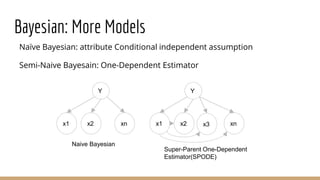
Bayesian: More Models
Naïve Bayesian: attribute Conditional independent assumption
Semi-Naive Bayesain: One-Dependent Estimator
Y
x1 x2 xn
Naive Bayesian
Y
x1 x2 xn
Super-Parent One-Dependent
Estimator(SPODE)
x3
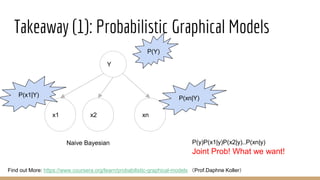
Takeaway (1): Probabilistic Graphical Models
Y
x1 x2 xn
Naive Bayesian
P(Y)
P(xn|Y)
P(y)P(x1|y)P(x2|y)..P(xn|y)
Joint Prob! What we want!
P(x1|Y)
Find out More: https://www.coursera.org/learn/probabilistic-graphical-models (Prof.Daphne Koller)
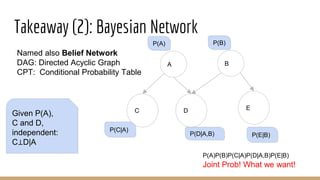
Takeaway (2): Bayesian Network
A
C D E
P(A)P(B)P(C|A)P(D|A,B)P(E|B)
Joint Prob! What we want!
Named also Belief Network
DAG: Directed Acyclic Graph
CPT: Conditional Probability Table
B
P(A) P(B)
P(C|A)
P(E|B)P(D|A,B)
Given P(A),
C and D,
independent:
C⊥D|A
Clustering: Unsupervised Learning
Similarty Methods: Eculidean Distance, etc.
In-group: high similarity
Out-group: high distance
Methods
Prototype-based Clustering: K-means, LVQ, MoG
Density-based Clustering: DBSCAN
Hierarchical Clustering: AGNES,DIANA
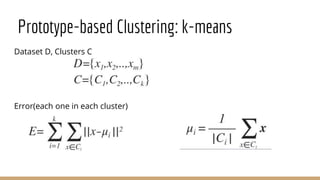
Prototype-based Clustering: k-means
Dataset D, Clusters C
Error(each one in each cluster)
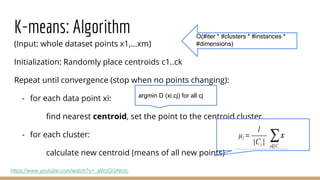
K-means: Algorithm
(Input: whole dataset points x1,...xm)
Initialization: Randomly place centroids c1..ck
Repeat until convergence (stop when no points changing):
- for each data point xi:
find nearest centroid, set the point to the centroid cluster
- for each cluster:
calculate new centroid (means of all new points)
https://www.youtube.com/watch?v=_aWzGGNrcic
argmin D (xi,cj) for all cj
O(#iter * #clusters * #instances *
#dimensions)
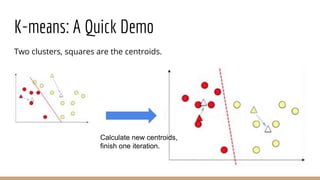
K-means: A Quick Demo
Two clusters, squares are the centroids.
Calculate new centroids,
finish one iteration.
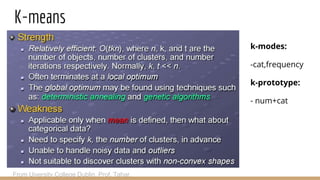
K-means
k-modes:
-cat,frequency
k-prototype:
- num+cat
From Uiversity College Dublin, Prof. Tahar.
Clustering: Other Methods(1)
Prototype-based Clustering
LVQ: Find out a group of vectors to describe the clusters, with labels
MoG: describe the model by a probabilistic model.
Density-based Clustering
DBSCAN
Clustering: Other Methods(2)
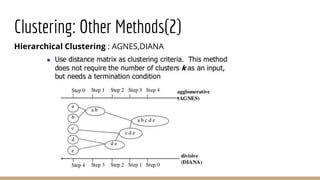
Hierarchical Clustering : AGNES,DIANA
Ensemble Learning
Strong learning method: learns model with good performance;
Week learning method: learns model slightly better than random.
Ensemble learning methods:
Iterative method: Boosting
Parallel method: Bagging
Boosting: Algorithm
Boosting: gather/ensemble week learners to become a strong one.
Through majority voting on classification; average on regression.
Algo:
1) Feed N data to train a week learner/ model: h1.
2) Feed N data to train another one: h2; N pieces of data including: h1 errors and new
data never trained before.
3) Repeat to train hn, N includes previous errors and new data.
4) Get final model: h_final=Majority Vote(h1,h2,..,hn)
Bagging: Bootstrap AGGregatING
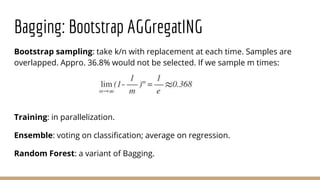
Bootstrap sampling: take k/n with replacement at each time. Samples are
overlapped. Appro. 36.8% would not be selected. If we sample m times:
Training: in parallelization.
Ensemble: voting on classification; average on regression.
Random Forest: a variant of Bagging.
Random Forest: Random Attribute Selection
Bagging: select a number of data to train each DT.
Random Attribute Selection
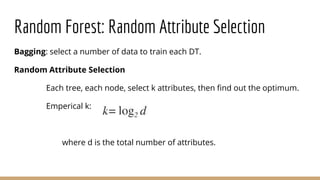
Each tree, each node, select k attributes, then find out the optimum.
Emperical k:
where d is the total number of attributes.
Expectation Maximization: Motivation
Expectation Maximization:
- An iterative method to maximum the likelihood function.
- Always used for estimate parameters in statistical models.
Example:
Three coins: A, B and C. For each throw step, first throw coin A. If positive,
throw B, otherwise, throw C. Repeat those steps n times independently.
The face up probability of A, B and C is 𝝅, 𝘱 and 𝘲.
If we only can observe the results not the process, how can we get the
face up probability of those coins?
Expectation Maximization
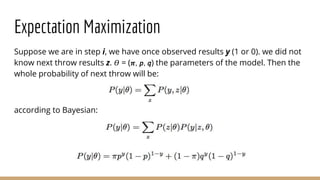
Suppose we are in step i, we have once observed results y (1 or 0). we did not
know next throw results z. 𝛳 = ( 𝝅, 𝘱, 𝘲) the parameters of the model. Then the
whole probability of next throw will be:
according to Bayesian:
Expectation Maximization
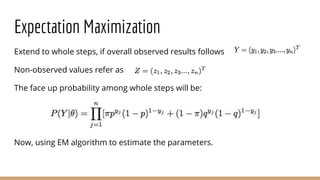
Extend to whole steps, if overall observed results follows
Non-observed values refer as
The face up probability among whole steps will be:
Now, using EM algorithm to estimate the parameters.
Expectation Maximization: Expectation(1)
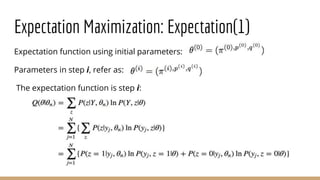
Expectation function using initial parameters:
Parameters in step i, refer as:
The expectation function is step i:
Expectation Maximization: Expectation(2)
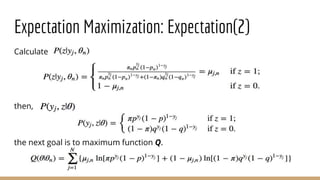
Calculate
then,
the next goal is to maximum function Q.
Expectation Maximization: Maximization
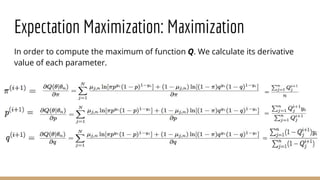
In order to compute the maximum of function Q. We calculate its derivative
value of each parameter.
Expectation Maximization
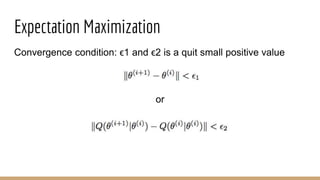
Convergence condition: ϵ1 and ϵ2 is a quit small positive value
or
Restricted Boltzmann Machine
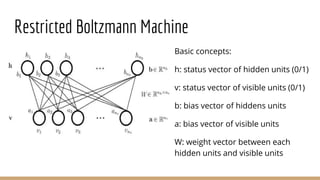
Basic concepts:
h: status vector of hidden units (0/1)
v: status vector of visible units (0/1)
b: bias vector of hiddens units
a: bias vector of visible units
W: weight vector between each
hidden units and visible units
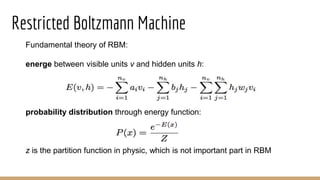
Fundamental theory of RBM:
energe between visible units v and hidden units h:
probability distribution through energy function:
z is the partition function in physic, which is not important part in RBM
Restricted Boltzmann Machine
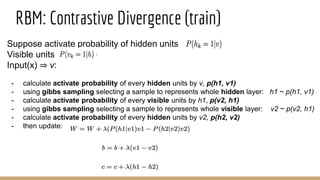
Suppose activate probability of hidden units
Visible units
Input(x) ⇒ v:
- calculate activate probability of every hidden units by v, p(h1, v1)
- using gibbs sampling selecting a sample to represents whole hidden layer: h1 ~ p(h1, v1)
- calculate activate probability of every visible units by h1, p(v2, h1)
- using gibbs sampling selecting a sample to represents whole visible layer: v2 ~ p(v2, h1)
- calculate activate probability of every hidden units by v2, p(h2, v2)
- then update:
RBM: Contrastive Divergence (train)
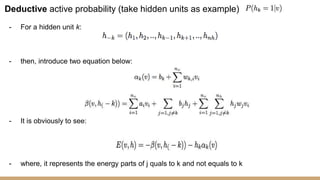
Deductive active probability (take hidden units as example)
- For a hidden unit k:
- then, introduce two equation below:
- It is obviously to see:
- where, it represents the energy parts of j quals to k and not equals to k
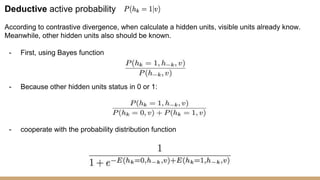
Deductive active probability
According to contrastive divergence, when calculate a hidden units, visible units already know.
Meanwhile, other hidden units also should be known.
- First, using Bayes function
- Because other hidden units status in 0 or 1:
- cooperate with the probability distribution function
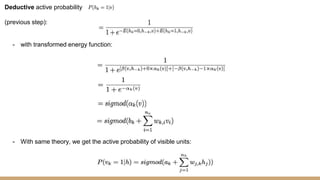
Deductive active probability
(previous step):
- with transformed energy function:
- With same theory, we get the active probability of visible units:
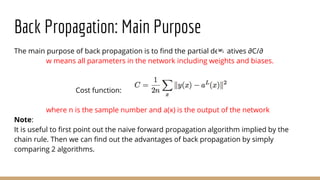
Back Propagation: Main Purpose
The main purpose of back propagation is to find the partial derivatives ∂C/∂
w means all parameters in the network including weights and biases.
Cost function:
where n is the sample number and a(x) is the output of the network
Note:
It is useful to first point out the naive forward propagation algorithm implied by the
chain rule. Then we can find out the advantages of back propagation by simply
comparing 2 algorithms.
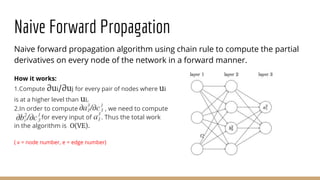
Naive Forward Propagation
Naive forward propagation algorithm using chain rule to compute the partial
derivatives on every node of the network in a forward manner.
How it works:
1.Compute ∂ui/∂uj for every pair of nodes where ui
is at a higher level than uj.
2.In order to compute , , we need to compute
for every input of ,. Thus the total work
in the algorithm is O(VE).
( v = node number, e = edge number)
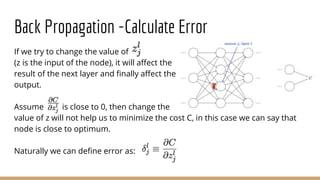
Back Propagation -Calculate Error
If we try to change the value of
(z is the input of the node), it will affect the
result of the next layer and finally affect the
output.
Assume is close to 0, then change the
value of z will not help us to minimize the cost C, in this case we can say that
node is close to optimum.
Naturally we can define error as:
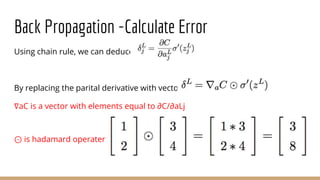
Back Propagation -Calculate Error
Using chain rule, we can deduce
By replacing the parital derivative with vector:
∇aC is a vector with elements equal to ∂C/∂aLj
⊙ is hadamard operater
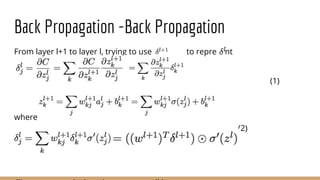
Back Propagation -Back Propagation
From layer l+1 to layer l, trying to use to represent
(1)
where
(2)
By combine (1) and (2):
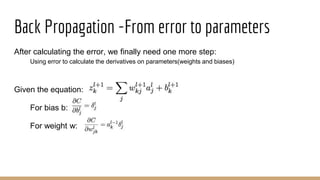
Back Propagation -From error to parameters
After calculating the error, we finally need one more step:
Using error to calculate the derivatives on parameters(weights and biases)
Given the equation:
For bias b:
For weight w:
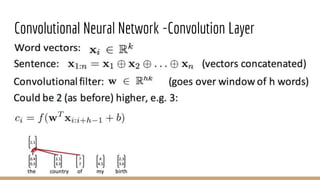
Convolutional Neural Network -Convolution Layer
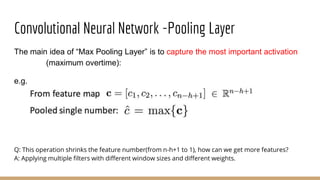
Convolutional Neural Network -Pooling Layer
The main idea of “Max Pooling Layer” is to capture the most important activation
(maximum overtime):
e.g.
Q: This operation shrinks the feature number(from n-h+1 to 1), how can we get more features?
A: Applying multiple filters with different window sizes and different weights.
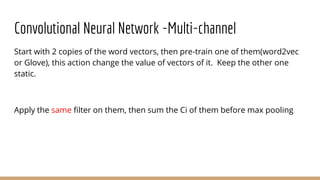
Convolutional Neural Network -Multi-channel
Start with 2 copies of the word vectors, then pre-train one of them(word2vec
or Glove), this action change the value of vectors of it. Keep the other one
static.
Apply the same filter on them, then sum the Ci of them before max pooling
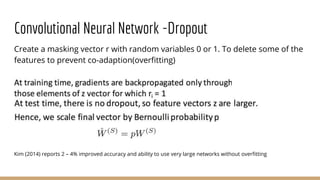
Convolutional Neural Network -Dropout
Create a masking vector r with random variables 0 or 1. To delete some of the
features to prevent co-adaption(overfitting)
Kim (2014) reports 2 – 4% improved accuracy and ability to use very large networks without overfitting
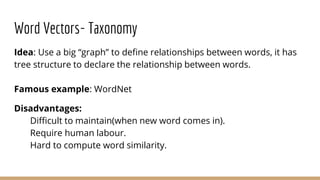
Word Vectors- Taxonomy
Idea: Use a big “graph” to define relationships between words, it has
tree structure to declare the relationship between words.
Famous example: WordNet
Disadvantages:
Difficult to maintain(when new word comes in).
Require human labour.
Hard to compute word similarity.
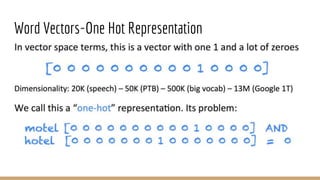
Word Vectors-One Hot Representation
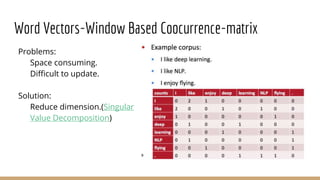
Word Vectors-Window Based Coocurrence-matrix
Problems:
Space consuming.
Difficult to update.
Solution:
Reduce dimension.(Singular
Value Decomposition)
Word Vectors-Word2vec
Word2vec: Predicts neighbor words.
Previous approach: capturing co-occurrence statistics.
Advantage:
Faster and can easily incorporate a new sentence/ document or add a
word to the vocabulary.
Good representation. (Solve analogy by vector subtraction)
Word Vectors-Word2vec
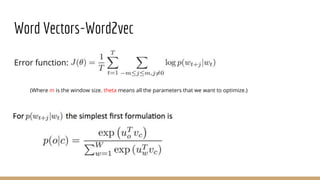
Error function:
(Where m is the window size. theta means all the parameters that we want to optimize.)
Word Vectors-Word2vec
Problem:
With large vocabularies this objective function is not scalable and
would train too slow.(use glove instead)
Solution:
Negative sampling.
Word Vectors-Word2vec
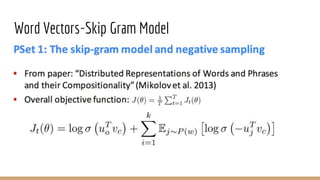
Word Vectors-Skip Gram Model
big window size may damage the syntactic accuracy.
Word Vectors-Continuous Bag of Words
Differ from word2vec, this model trying to predict the center word from the
surrounding words.
The result will be slightly different from skip-gram model, by average them we
can get a better result.
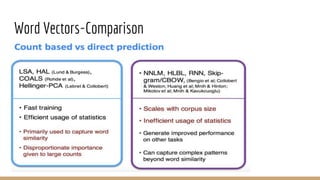
Word Vectors-Comparison
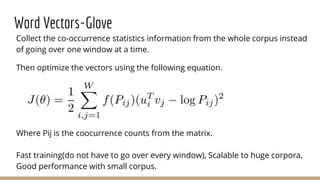
Word Vectors-Glove
Collect the co-occurrence statistics information from the whole corpus instead
of going over one window at a time.
Then optimize the vectors using the following equation.
Where Pij is the coocurrence counts from the matrix.
Fast training(do not have to go over every window), Scalable to huge corpora,
Good performance with small corpus.
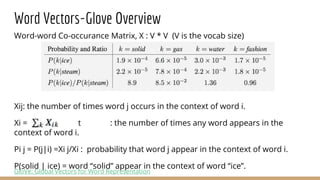
Word Vectors-Glove Overview
Word-word Co-occurance Matrix, X : V * V (V is the vocab size)
Xij: the number of times word j occurs in the context of word i.
Xi = t : the number of times any word appears in the
context of word i.
Pi j = P(j|i) =Xi j/Xi : probability that word j appear in the context of word i.
P(solid | ice) = word “solid” appear in the context of word “ice”.
GloVe: Global Vectors for Word Representation
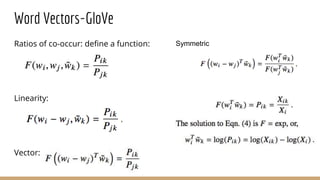
Symmetric
Word Vectors-GloVe
Ratios of co-occur: define a function:
Linearity:
Vector:
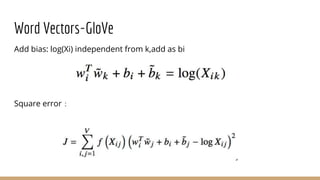
Word Vectors-GloVe
Add bias: log(Xi) independent from k,add as bi
Square error:
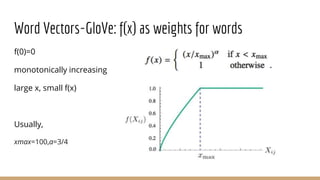
Word Vectors-GloVe: f(x) as weights for words
f(0)=0
monotonically increasing
large x, small f(x)
Usually,
xmax=100,α=3/4
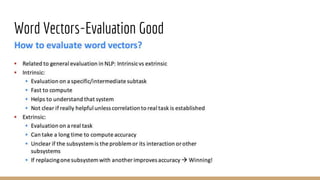
Word Vectors-Evaluation Good
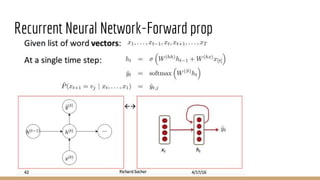
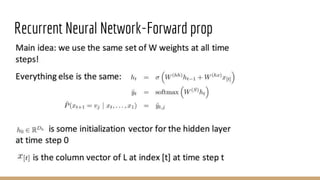
Recurrent Neural Network-Forward prop
Recurrent Neural Network-Loss Function
The cross-entropy in one single time step:
Overall cross-entrophy cost:
Where V is the vocabulary and T means the text.
Exp:
yt = [0.3,0.6,0.1] the, a, movie
y1 = [0.001,0.009,0.9]
y2 = [0.001,0.299,0.7]
y3 = [0.001,0.9,0.009]
J1= yt*logJ1
J2= yt*logJ2
J3 = yt*logJ3
J3>J2>J1 because y3 is more close to
yt than others.
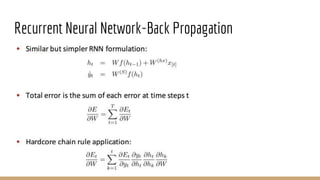
Recurrent Neural Network-Back Propagation
eg:
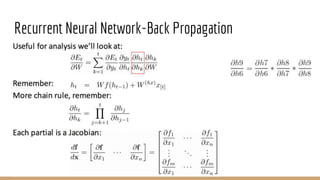
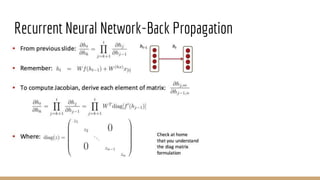
Recurrent Neural Network-Back Propagation
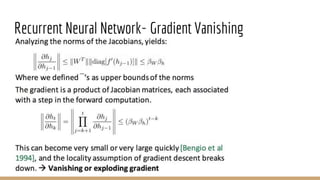
Recurrent Neural Network- Gradient Vanishing
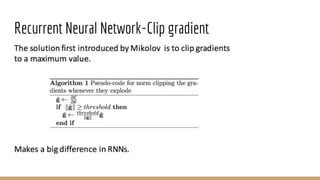
Recurrent Neural Network-Clip gradient
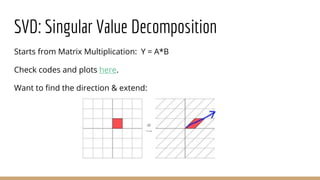
SVD: Singular Value Decomposition
Starts from Matrix Multiplication: Y = A*B
Check codes and plots here.
Want to find the direction & extend:
SVD: Singular Value Decomposition
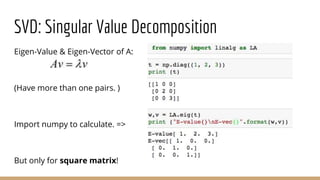
Eigen-Value & Eigen-Vector of A:
(Have more than one pairs. )
Import numpy to calculate. =>
But only for square matrix!
SVD: Singular Value Decomposition
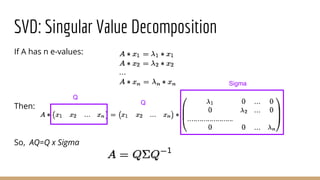
If A has n e-values:
Then:
So, AQ=Q x Sigma
Q
Sigma
Q
SVD: Singular Value Decomposition
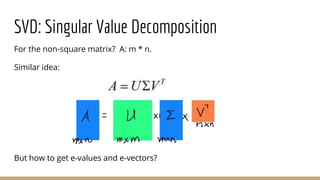
For the non-square matrix? A: m * n.
Similar idea:
But how to get e-values and e-vectors?
SVD: Singular Value Decomposition
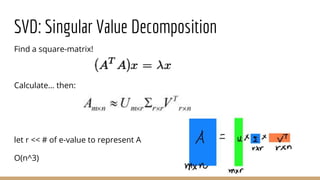
Find a square-matrix!
Calculate… then:
let r << # of e-value to represent A
O(n^3)
SVD: Application
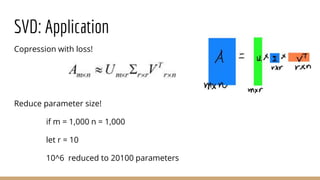
Copression with loss!
Reduce parameter size!
if m = 1,000 n = 1,000
let r = 10
10^6 reduced to 20100 parameters
MF: Matrix Factorization in RecSys
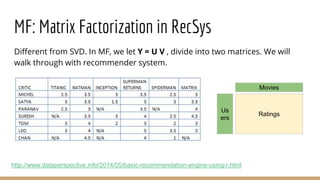
Different from SVD. In MF, we let Y = U V , divide into two matrices. We will
walk through with recommender system.
http://www.dataperspective.info/2014/05/basic-recommendation-engine-using-r.html
Movies
Ratings
Us
ers
MF: Matrix Factorization in RecSys
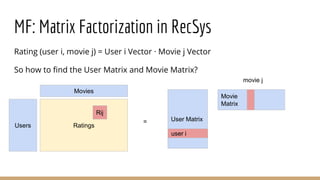
Rating (user i, movie j) = User i Vector · Movie j Vector
So how to find the User Matrix and Movie Matrix?
Movies
RatingsUsers
= User Matrix
Movie
Matrix
user i
movie j
Rij
MF: Matrix Factorization in RecSys
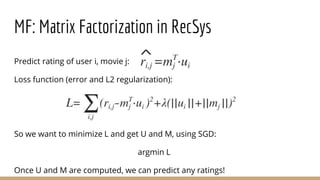
Predict rating of user i, movie j:
Loss function (error and L2 regularization):
So we want to minimize L and get U and M, using SGD:
argmin L
Once U and M are computed, we can predict any ratings!
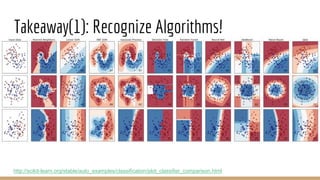
Takeaway(1): Recognize Algorithms!
http://scikit-learn.org/stable/auto_examples/classification/plot_classifier_comparison.html
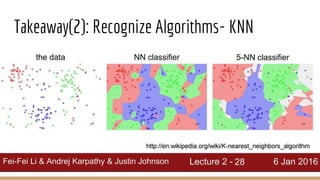
Takeaway(2): Recognize Algorithms- KNN
Useful Links
Stanford CS224d: Deep Learning for Natural Language Processing
Stanford CS231n: Convolutional Neural Networks for Visual Recognition
SVM Notes :http://www.robots.ox.ac.uk/~az/lectures/ml/lect2.pdf
Nuts and Bolts of Applying Deep Learning (Andrew Ng) - YouTube

Machine Learning Algorithms Review(Part 2)

  • 1.
    ML Algorithms Part 2Draft Do you really understand more...
  • 2.
    Outline Learning Theory: Model,Evaluation Metrics Algorithems: Naïve Bayesian, Clustering Methods (K-means) Ensemble Learning, EM Algorithm Restricted Boltzman Machines Neural Networks: BP, Word2Vec, GloVe, CNN, RNN Other: Singular Vector Decompostion, Matrix Factorization
  • 3.
    Discriminative & GenerativeModel Decision Function Y=f(X) or conditional probability P(Y|X) Generative Model: learn P(X,Y), calculate posterior prob dist P(Y|X): HMM, Bayesian Classifier Discriminative Model: learn P(Y|X) directly DT, NN,SVM,Boosting,CRF
  • 4.
    Metrics - Classification Accuracy Precision& Recall (generally binary classification) TP(Pos->Pos) FP(Neg->Pos) FN(Pos->Neg) TN(Neg->Neg) F1 score P & R are high, F1 is high.
  • 5.
    Metrics - Regression MeanAbsolute Errors & M. Square E. R-squared error (coefficient of determination): A higher value means a good model.
  • 6.
    Dataset ML Strategy FromAndrew Ng, NIPS, 2016 Bias-variance Trade-off = Avoidable Bias + Variance More Data; Regularization; New Model
  • 7.
    Naive Bayesian Classifier TwoAssumptions Bayes’ Theorem Features are conditionally independent How to do? Learn Joint probability distribution p(x,y) Learn p(x) Calculate p(y)
  • 8.
    Naïve Bayesian: Notations Dataset: Prioriprobability: K classes Conditional probability: Then learn Joint: P(X,Y) = P(Y) P(X|Y) = P(X)P(Y|X) Calculate Posterior: P(Y|X)
  • 9.
    Naïve Bayesian: AttributeConditional independent assumption Each input x is a vector with n elements. Given the class y, features are conditionally independent. Y x1 x2
  • 10.
  • 11.
    Naïve Bayesian: Calculation Sowe can rewrite this part:
  • 12.
    Naïve Bayesian: Definition Wantthe class that has the max of the probabilities: For everyone, the denominators are the same, so we can simplify it:
  • 13.
    Naïve Bayesian: ParameterEstimation Maximum Likelihood Estimation Goal: estimate priori P(Y=c) for each class estimate P(X=x | Y=c) for each class Count(x,y) --------------- = P(x|y) Count(y)
  • 14.
    Naïve Bayesian: Cost Choose0-1 cost function: Right answer = 0 Wrong answer = 1 -- L gives “how big” it is making the mistake...we want to minimize it! Add up those we go wrong 1- Right cases Minimize the errors ⇔ Maximize the right
  • 15.
    Naïve Bayesian: Calculation Calculatea prob with an input x: Decide the class of the input x: A demo from the book.
  • 16.
    Naïve Bayesian: BayesianEstimation When do MLE, could be 0 counts. Then you times it...all become 0. Add one more thing, lambda >= 0. If lambda = 0, it is MLE; If lambda = 1, it is Laplace smoothing. Laplace smoothing, it is a probalistic distribution. Priori Prob’s Bayesian Estimation:
  • 17.
    Bayesian: More Models NaïveBayesian: attribute Conditional independent assumption Semi-Naive Bayesain: One-Dependent Estimator Y x1 x2 xn Naive Bayesian Y x1 x2 xn Super-Parent One-Dependent Estimator(SPODE) x3
  • 18.
    Takeaway (1): ProbabilisticGraphical Models Y x1 x2 xn Naive Bayesian P(Y) P(xn|Y) P(y)P(x1|y)P(x2|y)..P(xn|y) Joint Prob! What we want! P(x1|Y) Find out More: https://www.coursera.org/learn/probabilistic-graphical-models (Prof.Daphne Koller)
  • 19.
    Takeaway (2): BayesianNetwork A C D E P(A)P(B)P(C|A)P(D|A,B)P(E|B) Joint Prob! What we want! Named also Belief Network DAG: Directed Acyclic Graph CPT: Conditional Probability Table B P(A) P(B) P(C|A) P(E|B)P(D|A,B) Given P(A), C and D, independent: C⊥D|A
  • 20.
    Clustering: Unsupervised Learning SimilartyMethods: Eculidean Distance, etc. In-group: high similarity Out-group: high distance Methods Prototype-based Clustering: K-means, LVQ, MoG Density-based Clustering: DBSCAN Hierarchical Clustering: AGNES,DIANA
  • 21.
    Prototype-based Clustering: k-means DatasetD, Clusters C Error(each one in each cluster)
  • 22.
    K-means: Algorithm (Input: wholedataset points x1,...xm) Initialization: Randomly place centroids c1..ck Repeat until convergence (stop when no points changing): - for each data point xi: find nearest centroid, set the point to the centroid cluster - for each cluster: calculate new centroid (means of all new points) https://www.youtube.com/watch?v=_aWzGGNrcic argmin D (xi,cj) for all cj O(#iter * #clusters * #instances * #dimensions)
  • 23.
    K-means: A QuickDemo Two clusters, squares are the centroids. Calculate new centroids, finish one iteration.
  • 24.
  • 25.
    Clustering: Other Methods(1) Prototype-basedClustering LVQ: Find out a group of vectors to describe the clusters, with labels MoG: describe the model by a probabilistic model. Density-based Clustering DBSCAN
  • 26.
  • 27.
    Ensemble Learning Strong learningmethod: learns model with good performance; Week learning method: learns model slightly better than random. Ensemble learning methods: Iterative method: Boosting Parallel method: Bagging
  • 28.
    Boosting: Algorithm Boosting: gather/ensembleweek learners to become a strong one. Through majority voting on classification; average on regression. Algo: 1) Feed N data to train a week learner/ model: h1. 2) Feed N data to train another one: h2; N pieces of data including: h1 errors and new data never trained before. 3) Repeat to train hn, N includes previous errors and new data. 4) Get final model: h_final=Majority Vote(h1,h2,..,hn)
  • 29.
    Bagging: Bootstrap AGGregatING Bootstrapsampling: take k/n with replacement at each time. Samples are overlapped. Appro. 36.8% would not be selected. If we sample m times: Training: in parallelization. Ensemble: voting on classification; average on regression. Random Forest: a variant of Bagging.
  • 30.
    Random Forest: RandomAttribute Selection Bagging: select a number of data to train each DT. Random Attribute Selection Each tree, each node, select k attributes, then find out the optimum. Emperical k: where d is the total number of attributes.
  • 31.
    Expectation Maximization: Motivation ExpectationMaximization: - An iterative method to maximum the likelihood function. - Always used for estimate parameters in statistical models. Example: Three coins: A, B and C. For each throw step, first throw coin A. If positive, throw B, otherwise, throw C. Repeat those steps n times independently. The face up probability of A, B and C is 𝝅, 𝘱 and 𝘲. If we only can observe the results not the process, how can we get the face up probability of those coins?
  • 32.
    Expectation Maximization Suppose weare in step i, we have once observed results y (1 or 0). we did not know next throw results z. 𝛳 = ( 𝝅, 𝘱, 𝘲) the parameters of the model. Then the whole probability of next throw will be: according to Bayesian:
  • 33.
    Expectation Maximization Extend towhole steps, if overall observed results follows Non-observed values refer as The face up probability among whole steps will be: Now, using EM algorithm to estimate the parameters.
  • 34.
    Expectation Maximization: Expectation(1) Expectationfunction using initial parameters: Parameters in step i, refer as: The expectation function is step i:
  • 35.
  • 36.
    Expectation Maximization: Maximization Inorder to compute the maximum of function Q. We calculate its derivative value of each parameter.
  • 37.
    Expectation Maximization Convergence condition:ϵ1 and ϵ2 is a quit small positive value or
  • 38.
    Restricted Boltzmann Machine Basicconcepts: h: status vector of hidden units (0/1) v: status vector of visible units (0/1) b: bias vector of hiddens units a: bias vector of visible units W: weight vector between each hidden units and visible units
  • 39.
    Fundamental theory ofRBM: energe between visible units v and hidden units h: probability distribution through energy function: z is the partition function in physic, which is not important part in RBM Restricted Boltzmann Machine
  • 40.
    Suppose activate probabilityof hidden units Visible units Input(x) ⇒ v: - calculate activate probability of every hidden units by v, p(h1, v1) - using gibbs sampling selecting a sample to represents whole hidden layer: h1 ~ p(h1, v1) - calculate activate probability of every visible units by h1, p(v2, h1) - using gibbs sampling selecting a sample to represents whole visible layer: v2 ~ p(v2, h1) - calculate activate probability of every hidden units by v2, p(h2, v2) - then update: RBM: Contrastive Divergence (train)
  • 41.
    Deductive active probability(take hidden units as example) - For a hidden unit k: - then, introduce two equation below: - It is obviously to see: - where, it represents the energy parts of j quals to k and not equals to k
  • 42.
    Deductive active probability Accordingto contrastive divergence, when calculate a hidden units, visible units already know. Meanwhile, other hidden units also should be known. - First, using Bayes function - Because other hidden units status in 0 or 1: - cooperate with the probability distribution function
  • 43.
    Deductive active probability (previousstep): - with transformed energy function: - With same theory, we get the active probability of visible units:
  • 44.
    Back Propagation: MainPurpose The main purpose of back propagation is to find the partial derivatives ∂C/∂ w means all parameters in the network including weights and biases. Cost function: where n is the sample number and a(x) is the output of the network Note: It is useful to first point out the naive forward propagation algorithm implied by the chain rule. Then we can find out the advantages of back propagation by simply comparing 2 algorithms.
  • 45.
    Naive Forward Propagation Naiveforward propagation algorithm using chain rule to compute the partial derivatives on every node of the network in a forward manner. How it works: 1.Compute ∂ui/∂uj for every pair of nodes where ui is at a higher level than uj. 2.In order to compute , , we need to compute for every input of ,. Thus the total work in the algorithm is O(VE). ( v = node number, e = edge number)
  • 46.
    Back Propagation -CalculateError If we try to change the value of (z is the input of the node), it will affect the result of the next layer and finally affect the output. Assume is close to 0, then change the value of z will not help us to minimize the cost C, in this case we can say that node is close to optimum. Naturally we can define error as:
  • 47.
    Back Propagation -CalculateError Using chain rule, we can deduce By replacing the parital derivative with vector: ∇aC is a vector with elements equal to ∂C/∂aLj ⊙ is hadamard operater
  • 48.
    Back Propagation -BackPropagation From layer l+1 to layer l, trying to use to represent (1) where (2) By combine (1) and (2):
  • 49.
    Back Propagation -Fromerror to parameters After calculating the error, we finally need one more step: Using error to calculate the derivatives on parameters(weights and biases) Given the equation: For bias b: For weight w:
  • 50.
    Convolutional Neural Network-Convolution Layer
  • 51.
    Convolutional Neural Network-Pooling Layer The main idea of “Max Pooling Layer” is to capture the most important activation (maximum overtime): e.g. Q: This operation shrinks the feature number(from n-h+1 to 1), how can we get more features? A: Applying multiple filters with different window sizes and different weights.
  • 52.
    Convolutional Neural Network-Multi-channel Start with 2 copies of the word vectors, then pre-train one of them(word2vec or Glove), this action change the value of vectors of it. Keep the other one static. Apply the same filter on them, then sum the Ci of them before max pooling
  • 53.
    Convolutional Neural Network-Dropout Create a masking vector r with random variables 0 or 1. To delete some of the features to prevent co-adaption(overfitting) Kim (2014) reports 2 – 4% improved accuracy and ability to use very large networks without overfitting
  • 54.
    Word Vectors- Taxonomy Idea:Use a big “graph” to define relationships between words, it has tree structure to declare the relationship between words. Famous example: WordNet Disadvantages: Difficult to maintain(when new word comes in). Require human labour. Hard to compute word similarity.
  • 55.
    Word Vectors-One HotRepresentation
  • 56.
    Word Vectors-Window BasedCoocurrence-matrix Problems: Space consuming. Difficult to update. Solution: Reduce dimension.(Singular Value Decomposition)
  • 57.
    Word Vectors-Word2vec Word2vec: Predictsneighbor words. Previous approach: capturing co-occurrence statistics. Advantage: Faster and can easily incorporate a new sentence/ document or add a word to the vocabulary. Good representation. (Solve analogy by vector subtraction)
  • 58.
    Word Vectors-Word2vec Error function: (Wherem is the window size. theta means all the parameters that we want to optimize.)
  • 59.
    Word Vectors-Word2vec Problem: With largevocabularies this objective function is not scalable and would train too slow.(use glove instead) Solution: Negative sampling.
  • 60.
  • 61.
    Word Vectors-Skip GramModel big window size may damage the syntactic accuracy.
  • 62.
    Word Vectors-Continuous Bagof Words Differ from word2vec, this model trying to predict the center word from the surrounding words. The result will be slightly different from skip-gram model, by average them we can get a better result.
  • 63.
  • 64.
    Word Vectors-Glove Collect theco-occurrence statistics information from the whole corpus instead of going over one window at a time. Then optimize the vectors using the following equation. Where Pij is the coocurrence counts from the matrix. Fast training(do not have to go over every window), Scalable to huge corpora, Good performance with small corpus.
  • 65.
    Word Vectors-Glove Overview Word-wordCo-occurance Matrix, X : V * V (V is the vocab size) Xij: the number of times word j occurs in the context of word i. Xi = t : the number of times any word appears in the context of word i. Pi j = P(j|i) =Xi j/Xi : probability that word j appear in the context of word i. P(solid | ice) = word “solid” appear in the context of word “ice”. GloVe: Global Vectors for Word Representation
  • 66.
    Symmetric Word Vectors-GloVe Ratios ofco-occur: define a function: Linearity: Vector:
  • 67.
    Word Vectors-GloVe Add bias:log(Xi) independent from k,add as bi Square error:
  • 68.
    Word Vectors-GloVe: f(x)as weights for words f(0)=0 monotonically increasing large x, small f(x) Usually, xmax=100,α=3/4
  • 69.
  • 70.
  • 71.
  • 72.
    Recurrent Neural Network-LossFunction The cross-entropy in one single time step: Overall cross-entrophy cost: Where V is the vocabulary and T means the text. Exp: yt = [0.3,0.6,0.1] the, a, movie y1 = [0.001,0.009,0.9] y2 = [0.001,0.299,0.7] y3 = [0.001,0.9,0.009] J1= yt*logJ1 J2= yt*logJ2 J3 = yt*logJ3 J3>J2>J1 because y3 is more close to yt than others.
  • 73.
  • 74.
  • 75.
  • 76.
    Recurrent Neural Network-Gradient Vanishing
  • 77.
  • 78.
    SVD: Singular ValueDecomposition Starts from Matrix Multiplication: Y = A*B Check codes and plots here. Want to find the direction & extend:
  • 79.
    SVD: Singular ValueDecomposition Eigen-Value & Eigen-Vector of A: (Have more than one pairs. ) Import numpy to calculate. => But only for square matrix!
  • 80.
    SVD: Singular ValueDecomposition If A has n e-values: Then: So, AQ=Q x Sigma Q Sigma Q
  • 81.
    SVD: Singular ValueDecomposition For the non-square matrix? A: m * n. Similar idea: But how to get e-values and e-vectors?
  • 82.
    SVD: Singular ValueDecomposition Find a square-matrix! Calculate… then: let r << # of e-value to represent A O(n^3)
  • 83.
    SVD: Application Copression withloss! Reduce parameter size! if m = 1,000 n = 1,000 let r = 10 10^6 reduced to 20100 parameters
  • 84.
    MF: Matrix Factorizationin RecSys Different from SVD. In MF, we let Y = U V , divide into two matrices. We will walk through with recommender system. http://www.dataperspective.info/2014/05/basic-recommendation-engine-using-r.html Movies Ratings Us ers
  • 85.
    MF: Matrix Factorizationin RecSys Rating (user i, movie j) = User i Vector · Movie j Vector So how to find the User Matrix and Movie Matrix? Movies RatingsUsers = User Matrix Movie Matrix user i movie j Rij
  • 86.
    MF: Matrix Factorizationin RecSys Predict rating of user i, movie j: Loss function (error and L2 regularization): So we want to minimize L and get U and M, using SGD: argmin L Once U and M are computed, we can predict any ratings!
  • 87.
  • 88.
  • 89.
    Useful Links Stanford CS224d:Deep Learning for Natural Language Processing Stanford CS231n: Convolutional Neural Networks for Visual Recognition SVM Notes :http://www.robots.ox.ac.uk/~az/lectures/ml/lect2.pdf Nuts and Bolts of Applying Deep Learning (Andrew Ng) - YouTube

Editor's Notes

  • #2 http://s1.daumcdn.net/editor/fp/service_nc/pencil/Pencil_chromestore.html
  • #3 TODO: 整理顺序和分类
  • #7 偏差-方差权衡
  • #8 李航《统计学习方法》
  • #20 根据已知变量,推断出未知变量的分布的过程,Inference。 Hidden Markov Model:动态的BN
  • #21 LVQ: learning vector quantizaion 学习向量量化 MoG: mixture of Gaussian 高斯混合聚类 DBSCAN: Density-based spatial clustering of applications with noise AGNES: AGglomerative NESting DIANA: Divisive Analysis
  • #26 LVQ: learning vector quantizaion 学习向量量化 MoG: mixture of Gaussian 高斯混合聚类 DBSCAN: Density-based spatial clustering of applications with noise AGNES: AGglomerative NESting DIANA: Divisive Analysis
  • #41 对比散度 x = [ [0 1 0 0 0] [0 0 0 0 0] [0 0 1 0 0] ] after loop 100: a, b, W query(u1, i2): =>a2
  • #46 Basic assumption: If u is a node at level t+1 and z is any node at level ≤t whose output is an input to u, then computing ∂u/∂z takes unit time on our computer.
  • #67 https://zhuanlan.zhihu.com/p/21242347
  • #75 \frac{ \partial h9}{ \partial h6} = \frac{ \partial h7}{ \partial h6}*\frac{ \partial h8}{ \partial h7}*\frac{ \partial h9}{ \partial h8}
  • #77 This could happen when t is a large number(layer of the neural network)
  • #79 http://xiahouzuoxin.github.io/notes/html/%E7%9F%A9%E9%98%B5%E7%89%B9%E5%BE%81%E5%80%BC%E5%88%86%E8%A7%A3%E4%B8%8E%E5%A5%87%E5%BC%82%E5%80%BC%E5%88%86%E8%A7%A3%E5%90%AB%E4%B9%89%E8%A7%A3%E6%9E%90%E5%8F%8A%E5%BA%94%E7%94%A8.html
  • #87 \widehat { r_{ i,j } } =m_{ j }^{ T }\cdot u_{ i }\\ \sum_{i,j} { ( r_{ i,j } -m_{ j }^{ T }\cdot u_{ i } )^2 + \lambda(||u_i||+||m_j|| )^2 } \\