- An introduction to machine learning and neural networks
Ankur Nair
Before we start,
let’s familiarize
with these…
• Neuron – Neurons (Artificial) are elementary units in a
neural network. A neuron receives one or more inputs and
sums them to produce an output. These are designed to
mimic their biological counterparts.
• Non-linear system – Its a set of simultaneous equations in
which the unknowns (differential equations) appear as
variables of a polynomial of degree higher than one or in
the argument of a function which is not a polynomial of
degree one. Or in simpler terms the output is not
proportional to the input provided.
• Convolutional Neural Network – A network consisting of
many identical copies of the same neuron that uses a
weight tying.
• Tensor – N dimensional array.
• 1 Dimension – Vector
• 2 Dimension – Matrix
• N Dimension – Tensor
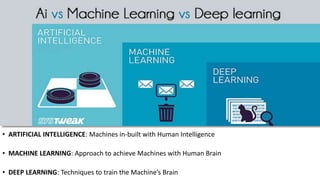
• ARTIFICIAL INTELLIGENCE: Machines in-built with Human Intelligence
• MACHINE LEARNING: Approach to achieve Machines with Human Brain
• DEEP LEARNING: Techniques to train the Machine’s Brain
TensorFlow is an open source software library for numerical computation using data
flow graphs. Nodes in the graph represent mathematical operations, while the graph
edges represent the multidimensional data arrays (tensors) communicated between
them.
How does it work?
The inspiration comes from the idea that you need to
make a decision as to what type of convolution you
want to make at each layer: Do you want a 3×3? Or a
5×5? And this can go on for quite a while.
Each convolution is executed in parallel and
concatenating the resulting feature maps before going
to the next layer.
The next layer is also an Inception module. Then each
of the convolution’s feature maps will be passed
through the mixture of convolutions of the current
layer. The idea is that you don’t need to know ahead of
time if it was better to do, for example, a 3×3 then a
5×5. Instead, just do all the convolutions and let the
model pick what’s best.
Inception V3
Model – In
simpler
terms
A Quick Demo
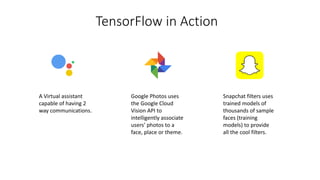
TensorFlow in Action
A Virtual assistant
capable of having 2
way communications.
Google Photos uses
the Google Cloud
Vision API to
intelligently associate
users’ photos to a
face, place or theme.
Snapchat filters uses
trained models of
thousands of sample
faces (training
models) to provide
all the cool filters.
Thank you!

Introduction to Machine learning & Neural Networks

  • 1.
    - An introductionto machine learning and neural networks Ankur Nair
  • 2.
    Before we start, let’sfamiliarize with these… • Neuron – Neurons (Artificial) are elementary units in a neural network. A neuron receives one or more inputs and sums them to produce an output. These are designed to mimic their biological counterparts. • Non-linear system – Its a set of simultaneous equations in which the unknowns (differential equations) appear as variables of a polynomial of degree higher than one or in the argument of a function which is not a polynomial of degree one. Or in simpler terms the output is not proportional to the input provided. • Convolutional Neural Network – A network consisting of many identical copies of the same neuron that uses a weight tying. • Tensor – N dimensional array. • 1 Dimension – Vector • 2 Dimension – Matrix • N Dimension – Tensor
  • 3.
    • ARTIFICIAL INTELLIGENCE:Machines in-built with Human Intelligence • MACHINE LEARNING: Approach to achieve Machines with Human Brain • DEEP LEARNING: Techniques to train the Machine’s Brain
  • 4.
    TensorFlow is anopen source software library for numerical computation using data flow graphs. Nodes in the graph represent mathematical operations, while the graph edges represent the multidimensional data arrays (tensors) communicated between them.
  • 6.
    How does itwork? The inspiration comes from the idea that you need to make a decision as to what type of convolution you want to make at each layer: Do you want a 3×3? Or a 5×5? And this can go on for quite a while. Each convolution is executed in parallel and concatenating the resulting feature maps before going to the next layer. The next layer is also an Inception module. Then each of the convolution’s feature maps will be passed through the mixture of convolutions of the current layer. The idea is that you don’t need to know ahead of time if it was better to do, for example, a 3×3 then a 5×5. Instead, just do all the convolutions and let the model pick what’s best.
  • 7.
    Inception V3 Model –In simpler terms
  • 8.
  • 9.
    TensorFlow in Action AVirtual assistant capable of having 2 way communications. Google Photos uses the Google Cloud Vision API to intelligently associate users’ photos to a face, place or theme. Snapchat filters uses trained models of thousands of sample faces (training models) to provide all the cool filters.
  • 10.

Editor's Notes