


Steganography Using Reversible Texture Synthesis
ABSTRACT
 We propose a novel approach for steganography using a
reversible texture synthesis. A texture synthesis process re-samples
a smaller texture image which synthesizes a new texture image
with a similar local appearance and arbitrary size.
 We weave the texture synthesis process into steganography to
conceal secret messages. In contrast to using an existing cover
image to hide messages, our algorithm conceals the source texture
image and embeds secret messages through the process of texture
synthesis. This allows us to extract secret messages and the source
texture from a stego synthetic texture.
 Our approach offers three distinct advantages. First, our scheme
offers the embedding capacity that is proportional to the size of the
stego texture image. Second, a steganalytic algorithm is not likely
to defeat our steganographic approach. Third, the reversible
capability inherited from our scheme provides functionality which
allows recovery of the source texture.
Head office: 3nd
floor, Krishna Reddy Buildings, OPP: ICICI ATM, Ramalingapuram, Nellore
www.pvrtechnology.com, E-Mail: pvrieeeprojects@gmail.com, Ph: 81432 71457
 Experimental results have verified that our proposed algorithm
can provide various numbers of embedding capacities, produce a
visually plausible texture images, and recover the source texture.
 EXISTING SYSTEM
• In contrast to using an existing cover image to hide messages, our
algorithm conceals the source texture image and embeds secret
messages through the process of texture synthesis.
• A typical steganographic application includes covert
communications between two parties whose existence is unknown
to a possible attacker and whose success depends on detecting the
existence of this communication
• Most image steganographic algorithms adopt an existing image as a
cover medium. The expense of embedding secret messages into this
cover image is the image distortion encountered in the stego image.
• No significant visual difference exists between the two stego
synthetic textures and the pure synthetic texture.
Head office: 3nd
floor, Krishna Reddy Buildings, OPP: ICICI ATM, Ramalingapuram, Nellore
www.pvrtechnology.com, E-Mail: pvrieeeprojects@gmail.com, Ph: 81432 71457
PROPOSED SYSTEM
• Experimental results have verified that our proposed algorithm can
provide various numbers of embedding capacities, produce a visually
plausible texture images, and recover the source texture.
• proposed an image reversible data hiding algorithm which can recover the
cover image without any distortion from the stego image after the hidden
data have been extracted.
• We illustrate our proposed method in this section. First, we will define
some basic terminology to be used in our algorithm. The basic unit used
for our steganographic texture synthesis is referred to as a “patch.”
• The three fundamental differences between our proposed message-
oriented texture synthesis and the conventional patch-based texture
synthesis are described in Table I. The first difference is the shape of the
overlapped area.
Head office: 3nd
floor, Krishna Reddy Buildings, OPP: ICICI ATM, Ramalingapuram, Nellore
www.pvrtechnology.com, E-Mail: pvrieeeprojects@gmail.com, Ph: 81432 71457
• We believe our proposed scheme offers substantial benefits and provides
an opportunity to extend steganographic applications.
PROPOSED SYSTEM ALGORITHMS
 A large number of image steganographic algorithms have been
investigated with the increasing popularity and use of digital images
ADVANTAGES
Our approach offers three distinct advantages. First, our scheme
offers the embedding capacity that is proportional to the size of the
stego texture image. Second, a steganalytic algorithm is not likely to
defeat our steganographic approach. Third, the reversible capability
Head office: 3nd
floor, Krishna Reddy Buildings, OPP: ICICI ATM, Ramalingapuram, Nellore
www.pvrtechnology.com, E-Mail: pvrieeeprojects@gmail.com, Ph: 81432 71457
inherited from our scheme provides functionality which allows recovery
of the source texture.
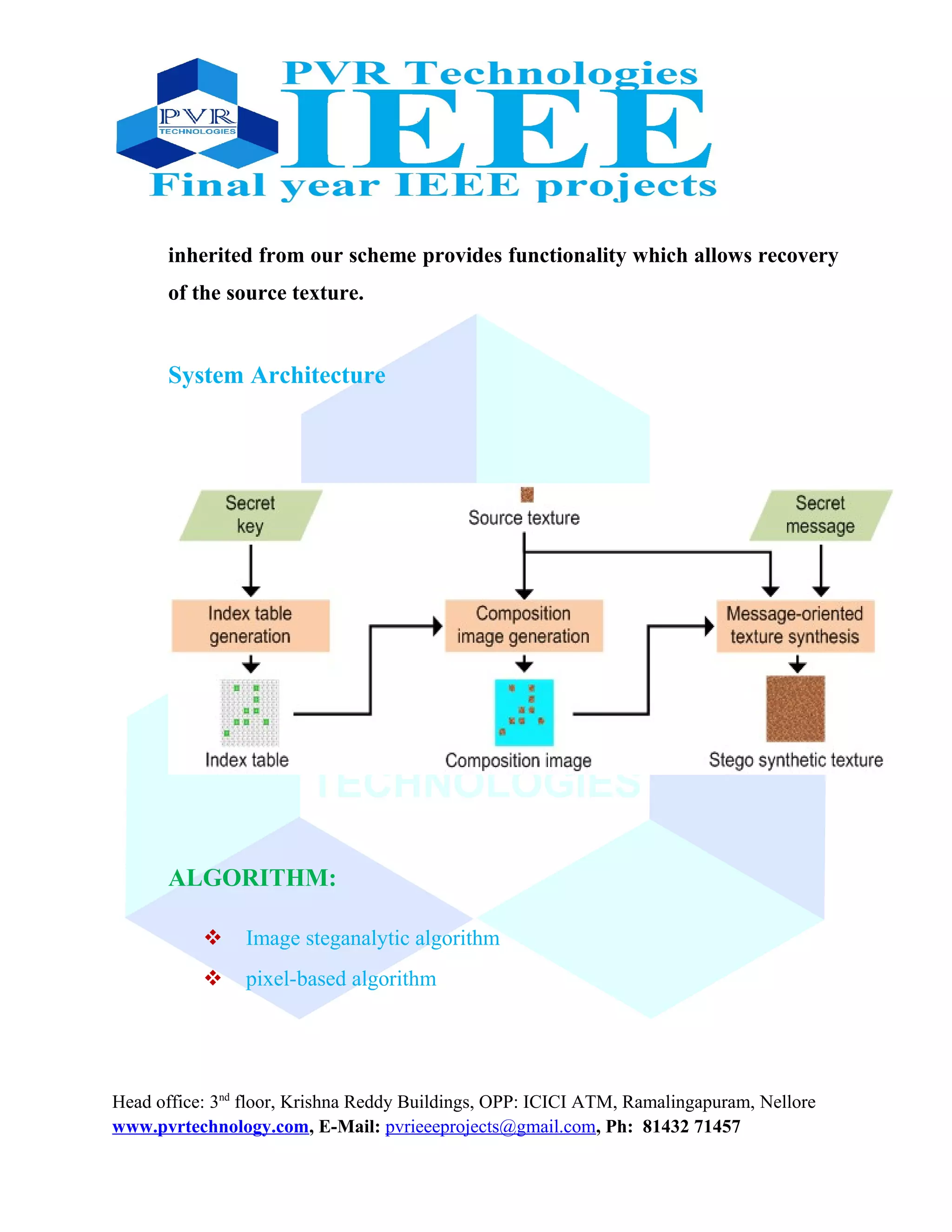
System Architecture
ALGORITHM:
 Image steganalytic algorithm
 pixel-based algorithm
Head office: 3nd
floor, Krishna Reddy Buildings, OPP: ICICI ATM, Ramalingapuram, Nellore
www.pvrtechnology.com, E-Mail: pvrieeeprojects@gmail.com, Ph: 81432 71457
MODULE DESCRIPTION
 Steganography Process,
 Encoding,
 Decoding Steps,
 Transaction Online Shopping,
 Customer Authentication,
 Certification Authority Access,
 Final Authenticated Information Results.
Stegnography Process:
In this module, Steganography uses characteristics of English
language such as inflexion, fixed word order and use of periphrases for
hiding data rather than using properties of a sentence. This gives
Head office: 3nd
floor, Krishna Reddy Buildings, OPP: ICICI ATM, Ramalingapuram, Nellore
www.pvrtechnology.com, E-Mail: pvrieeeprojects@gmail.com, Ph: 81432 71457
flexibility and freedom from the point view of sentence construction but
it increases computational complexity.
Encoding:
• Representation of each letter in secret message by its equivalent ASCII
code.
• Conversion of ASCII code to equivalent 8 bit binary number.
• Division of 8 bit binary number into two 4 bit parts.
• Choosing of suitable letters from table 1 corresponding to the 4 bit
parts.
• Meaningful sentence construction by using letters obtained as the first
letters of suitable words.
• Encoding is not case sensitive.
Decoding Steps:
Head office: 3nd
floor, Krishna Reddy Buildings, OPP: ICICI ATM, Ramalingapuram, Nellore
www.pvrtechnology.com, E-Mail: pvrieeeprojects@gmail.com, Ph: 81432 71457
• First letter in each word of cover message is taken and represented by
corresponding 4 bit number.
• 4 bit binary numbers of combined to obtain 8 bit number.
• ASCII codes are obtained from 8 bit numbers.
• Finally secret message is recovered from ASCII codes.
Transaction Online Shopping:
In this module traditional online shopping consumer selects items from
online shopping portal and then is directed to the payment page. Online
merchant may have its own payment system or can take advantage of third
party payment systems such as PayPal, pay online system, Web Money and
others. In the payment portal consumer submit his or her credit or debit card
details such as credit or debit card number, name on the card, expiry date of
the card.
Customer Authentication:
Head office: 3nd
floor, Krishna Reddy Buildings, OPP: ICICI ATM, Ramalingapuram, Nellore
www.pvrtechnology.com, E-Mail: pvrieeeprojects@gmail.com, Ph: 81432 71457
Customer unique authentication password in connection to the bank is
hidden inside a cover text using the text based Steganography method.
Customer authentication information (account no) in connection with
merchant is placed above the cover text in its original form. Now a snapshot
of two texts is taken. From the snapshot image, two shares are generated using
visual cryptography. Now one share is kept by the customer and the other
share is kept in the database of the certified authority.
Certification Authority Access:
During shopping online, after selection of desired item and adding it to
the cart, preferred payment system of the merchant directs the customer to
the Certified Authority portal. In the portal, shopper submits its own share
and merchant submits its own account details. Now the CA combines its own
share with shopper’s share and obtains the original image. From CA now,
merchant account details, cover text are sent to the bank where customer
authentication password is recovered from the cover text.
Final Authenticated Information Results:
Customer authentication information is sent to the merchant by CA.
Upon receiving customer authentication password, bank matches it with its
own database and after verifying legitimate customer, transfers fund from the
customer account to the submitted merchant account. After receiving the
Head office: 3nd
floor, Krishna Reddy Buildings, OPP: ICICI ATM, Ramalingapuram, Nellore
www.pvrtechnology.com, E-Mail: pvrieeeprojects@gmail.com, Ph: 81432 71457
fund, merchant’s payment system validates receipt of payment using
customer authentication information.
New Technology
Ajax toolkit
Stored procedures
javascript
Jquery
Css
Telerik
SYSTEM SPECIFICATION
Hardware Requirements:
 System : Pentium IV 2.4 GHz.
 Hard Disk : 40 GB.
 Floppy Drive : 1.44 Mb.
 Monitor : 14’ Colour Monitor.
 Mouse : Optical Mouse.
 Ram : 512 Mb.
Head office: 3nd
floor, Krishna Reddy Buildings, OPP: ICICI ATM, Ramalingapuram, Nellore
www.pvrtechnology.com, E-Mail: pvrieeeprojects@gmail.com, Ph: 81432 71457
Software Requirements:
 Operating system : Windows 7 Ultimate.
 Coding Language : ASP.Net with C#
 Front-End : Visual Studio 2010 Professional.
 Data Base : SQL Server 2008.
Head office: 3nd
floor, Krishna Reddy Buildings, OPP: ICICI ATM, Ramalingapuram, Nellore
www.pvrtechnology.com, E-Mail: pvrieeeprojects@gmail.com, Ph: 81432 71457

Steganography using reversible texture synthesis

  • 1.
    Steganography Using ReversibleTexture Synthesis ABSTRACT  We propose a novel approach for steganography using a reversible texture synthesis. A texture synthesis process re-samples a smaller texture image which synthesizes a new texture image with a similar local appearance and arbitrary size.  We weave the texture synthesis process into steganography to conceal secret messages. In contrast to using an existing cover image to hide messages, our algorithm conceals the source texture image and embeds secret messages through the process of texture synthesis. This allows us to extract secret messages and the source texture from a stego synthetic texture.  Our approach offers three distinct advantages. First, our scheme offers the embedding capacity that is proportional to the size of the stego texture image. Second, a steganalytic algorithm is not likely to defeat our steganographic approach. Third, the reversible capability inherited from our scheme provides functionality which allows recovery of the source texture. Head office: 3nd floor, Krishna Reddy Buildings, OPP: ICICI ATM, Ramalingapuram, Nellore www.pvrtechnology.com, E-Mail: pvrieeeprojects@gmail.com, Ph: 81432 71457
  • 2.
     Experimental resultshave verified that our proposed algorithm can provide various numbers of embedding capacities, produce a visually plausible texture images, and recover the source texture.  EXISTING SYSTEM • In contrast to using an existing cover image to hide messages, our algorithm conceals the source texture image and embeds secret messages through the process of texture synthesis. • A typical steganographic application includes covert communications between two parties whose existence is unknown to a possible attacker and whose success depends on detecting the existence of this communication • Most image steganographic algorithms adopt an existing image as a cover medium. The expense of embedding secret messages into this cover image is the image distortion encountered in the stego image. • No significant visual difference exists between the two stego synthetic textures and the pure synthetic texture. Head office: 3nd floor, Krishna Reddy Buildings, OPP: ICICI ATM, Ramalingapuram, Nellore www.pvrtechnology.com, E-Mail: pvrieeeprojects@gmail.com, Ph: 81432 71457
  • 3.
    PROPOSED SYSTEM • Experimentalresults have verified that our proposed algorithm can provide various numbers of embedding capacities, produce a visually plausible texture images, and recover the source texture. • proposed an image reversible data hiding algorithm which can recover the cover image without any distortion from the stego image after the hidden data have been extracted. • We illustrate our proposed method in this section. First, we will define some basic terminology to be used in our algorithm. The basic unit used for our steganographic texture synthesis is referred to as a “patch.” • The three fundamental differences between our proposed message- oriented texture synthesis and the conventional patch-based texture synthesis are described in Table I. The first difference is the shape of the overlapped area. Head office: 3nd floor, Krishna Reddy Buildings, OPP: ICICI ATM, Ramalingapuram, Nellore www.pvrtechnology.com, E-Mail: pvrieeeprojects@gmail.com, Ph: 81432 71457
  • 4.
    • We believeour proposed scheme offers substantial benefits and provides an opportunity to extend steganographic applications. PROPOSED SYSTEM ALGORITHMS  A large number of image steganographic algorithms have been investigated with the increasing popularity and use of digital images ADVANTAGES Our approach offers three distinct advantages. First, our scheme offers the embedding capacity that is proportional to the size of the stego texture image. Second, a steganalytic algorithm is not likely to defeat our steganographic approach. Third, the reversible capability Head office: 3nd floor, Krishna Reddy Buildings, OPP: ICICI ATM, Ramalingapuram, Nellore www.pvrtechnology.com, E-Mail: pvrieeeprojects@gmail.com, Ph: 81432 71457
  • 5.
    inherited from ourscheme provides functionality which allows recovery of the source texture. System Architecture ALGORITHM:  Image steganalytic algorithm  pixel-based algorithm Head office: 3nd floor, Krishna Reddy Buildings, OPP: ICICI ATM, Ramalingapuram, Nellore www.pvrtechnology.com, E-Mail: pvrieeeprojects@gmail.com, Ph: 81432 71457
  • 6.
    MODULE DESCRIPTION  SteganographyProcess,  Encoding,  Decoding Steps,  Transaction Online Shopping,  Customer Authentication,  Certification Authority Access,  Final Authenticated Information Results. Stegnography Process: In this module, Steganography uses characteristics of English language such as inflexion, fixed word order and use of periphrases for hiding data rather than using properties of a sentence. This gives Head office: 3nd floor, Krishna Reddy Buildings, OPP: ICICI ATM, Ramalingapuram, Nellore www.pvrtechnology.com, E-Mail: pvrieeeprojects@gmail.com, Ph: 81432 71457
  • 7.
    flexibility and freedomfrom the point view of sentence construction but it increases computational complexity. Encoding: • Representation of each letter in secret message by its equivalent ASCII code. • Conversion of ASCII code to equivalent 8 bit binary number. • Division of 8 bit binary number into two 4 bit parts. • Choosing of suitable letters from table 1 corresponding to the 4 bit parts. • Meaningful sentence construction by using letters obtained as the first letters of suitable words. • Encoding is not case sensitive. Decoding Steps: Head office: 3nd floor, Krishna Reddy Buildings, OPP: ICICI ATM, Ramalingapuram, Nellore www.pvrtechnology.com, E-Mail: pvrieeeprojects@gmail.com, Ph: 81432 71457
  • 8.
    • First letterin each word of cover message is taken and represented by corresponding 4 bit number. • 4 bit binary numbers of combined to obtain 8 bit number. • ASCII codes are obtained from 8 bit numbers. • Finally secret message is recovered from ASCII codes. Transaction Online Shopping: In this module traditional online shopping consumer selects items from online shopping portal and then is directed to the payment page. Online merchant may have its own payment system or can take advantage of third party payment systems such as PayPal, pay online system, Web Money and others. In the payment portal consumer submit his or her credit or debit card details such as credit or debit card number, name on the card, expiry date of the card. Customer Authentication: Head office: 3nd floor, Krishna Reddy Buildings, OPP: ICICI ATM, Ramalingapuram, Nellore www.pvrtechnology.com, E-Mail: pvrieeeprojects@gmail.com, Ph: 81432 71457
  • 9.
    Customer unique authenticationpassword in connection to the bank is hidden inside a cover text using the text based Steganography method. Customer authentication information (account no) in connection with merchant is placed above the cover text in its original form. Now a snapshot of two texts is taken. From the snapshot image, two shares are generated using visual cryptography. Now one share is kept by the customer and the other share is kept in the database of the certified authority. Certification Authority Access: During shopping online, after selection of desired item and adding it to the cart, preferred payment system of the merchant directs the customer to the Certified Authority portal. In the portal, shopper submits its own share and merchant submits its own account details. Now the CA combines its own share with shopper’s share and obtains the original image. From CA now, merchant account details, cover text are sent to the bank where customer authentication password is recovered from the cover text. Final Authenticated Information Results: Customer authentication information is sent to the merchant by CA. Upon receiving customer authentication password, bank matches it with its own database and after verifying legitimate customer, transfers fund from the customer account to the submitted merchant account. After receiving the Head office: 3nd floor, Krishna Reddy Buildings, OPP: ICICI ATM, Ramalingapuram, Nellore www.pvrtechnology.com, E-Mail: pvrieeeprojects@gmail.com, Ph: 81432 71457
  • 10.
    fund, merchant’s paymentsystem validates receipt of payment using customer authentication information. New Technology Ajax toolkit Stored procedures javascript Jquery Css Telerik SYSTEM SPECIFICATION Hardware Requirements:  System : Pentium IV 2.4 GHz.  Hard Disk : 40 GB.  Floppy Drive : 1.44 Mb.  Monitor : 14’ Colour Monitor.  Mouse : Optical Mouse.  Ram : 512 Mb. Head office: 3nd floor, Krishna Reddy Buildings, OPP: ICICI ATM, Ramalingapuram, Nellore www.pvrtechnology.com, E-Mail: pvrieeeprojects@gmail.com, Ph: 81432 71457
  • 11.
    Software Requirements:  Operatingsystem : Windows 7 Ultimate.  Coding Language : ASP.Net with C#  Front-End : Visual Studio 2010 Professional.  Data Base : SQL Server 2008. Head office: 3nd floor, Krishna Reddy Buildings, OPP: ICICI ATM, Ramalingapuram, Nellore www.pvrtechnology.com, E-Mail: pvrieeeprojects@gmail.com, Ph: 81432 71457