7.8 Cramer’s Rule
Chapter 7 Systems of Equations and Inequalities
Concepts and Objectives
⚫ The objectives for this section are
⚫ Evaluate 22 determinants.
⚫ Use Cramer’s Rule to solve a system of equations in
two variables.
⚫ Evaluate 33 determinants.
⚫ Use Cramer’s Rule to solve a system of three
equations in three variables.
⚫ Know the properties of determinants.
Determinants
⚫ Every n  n matrix A is associated with a real number
called the determinant of A, written  A .
⚫ The determinant is the sum of the diagonals in one
direction minus the sum of the diagonals in the other
direction.
⚫ Example:
−3 4
6 8
= − − = −
24 24 48
( )( ) ( )( )
= − −
3 8 6 4
a b
c d
ad cb
= −
Determinants
⚫ Example: Find the determinant of
−
 
 
 
2 2
3 1
Determinants
⚫ Example: Find the determinant of
−
 
 
 
2 2
3 1
( )( ) ( )( )
−
= − −
2 2
2 1 3 2
3 1
= + =
2 6 8
Determinants
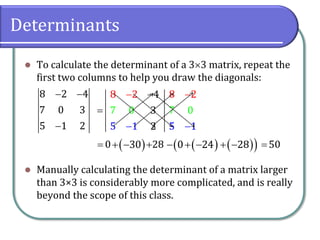
⚫ To calculate the determinant of a 33 matrix, repeat the
first two columns to help you draw the diagonals:
⚫ Manually calculating the determinant of a matrix larger
than 3×3 is considerably more complicated, and is really
beyond the scope of this class.
− −
−
8 2 4
7 0 3
5 1 2
−
−
−
−
−
= 7 0
5
8 2
1
4
3
8 2
7
2 5
0
1
=50
0
= ( )
30
+ − 28
+ (0
− ( )
24
+ − ( ))
28
+ −
Determinants (cont.)
⚫ Desmos.com/matrix calculator can also calculate the
determinant of a matrix you have entered.
Determinants (cont.)
⚫ Desmos.com/matrix calculator can also calculate the
determinant of a matrix you have entered.
Cramer’s Rule
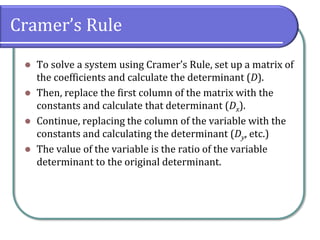
⚫ To solve a system using Cramer’s Rule, set up a matrix of
the coefficients and calculate the determinant (D).
⚫ Then, replace the first column of the matrix with the
constants and calculate that determinant (Dx).
⚫ Continue, replacing the column of the variable with the
constants and calculating the determinant (Dy, etc.)
⚫ The value of the variable is the ratio of the variable
determinant to the original determinant.
Cramer’s Rule
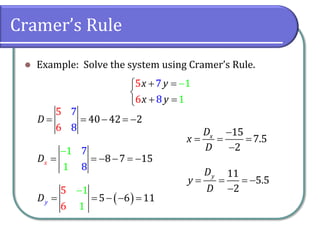
⚫ Example: Solve the system using Cramer’s Rule.
+ = −


+ =

5 7 1
6 8 1
x y
x y
Cramer’s Rule
⚫ Example: Solve the system using Cramer’s Rule.
5
6 1
7 1
8
x y
x y
+ =


+ =
−

40 4
7
6 8
2 2
5
D = = − = −
7
1
1
8 7 15
8
x
D = = − − = −
−
( )
1
5
6
5 6 11
1
y
D = = − − =
−
−
= = =
−
15
7.5
2
x
D
x
D
= = = −
−
11
5.5
2
y
D
y
D
Classwork
⚫ College Algebra 2e
⚫ 7.8: 8-20 (4); 7.6: 16-28 (even); 7.5: 42-48 (even)
⚫ 7.8 Classwork Check
⚫ Quiz 7.6

7.8 Cramer's Rule

  • 1.
    7.8 Cramer’s Rule Chapter7 Systems of Equations and Inequalities
  • 2.
    Concepts and Objectives ⚫The objectives for this section are ⚫ Evaluate 22 determinants. ⚫ Use Cramer’s Rule to solve a system of equations in two variables. ⚫ Evaluate 33 determinants. ⚫ Use Cramer’s Rule to solve a system of three equations in three variables. ⚫ Know the properties of determinants.
  • 3.
    Determinants ⚫ Every n n matrix A is associated with a real number called the determinant of A, written  A . ⚫ The determinant is the sum of the diagonals in one direction minus the sum of the diagonals in the other direction. ⚫ Example: −3 4 6 8 = − − = − 24 24 48 ( )( ) ( )( ) = − − 3 8 6 4 a b c d ad cb = −
  • 4.
    Determinants ⚫ Example: Findthe determinant of −       2 2 3 1
  • 5.
    Determinants ⚫ Example: Findthe determinant of −       2 2 3 1 ( )( ) ( )( ) − = − − 2 2 2 1 3 2 3 1 = + = 2 6 8
  • 6.
    Determinants ⚫ To calculatethe determinant of a 33 matrix, repeat the first two columns to help you draw the diagonals: ⚫ Manually calculating the determinant of a matrix larger than 3×3 is considerably more complicated, and is really beyond the scope of this class. − − − 8 2 4 7 0 3 5 1 2 − − − − − = 7 0 5 8 2 1 4 3 8 2 7 2 5 0 1 =50 0 = ( ) 30 + − 28 + (0 − ( ) 24 + − ( )) 28 + −
  • 7.
    Determinants (cont.) ⚫ Desmos.com/matrixcalculator can also calculate the determinant of a matrix you have entered.
  • 8.
    Determinants (cont.) ⚫ Desmos.com/matrixcalculator can also calculate the determinant of a matrix you have entered.
  • 9.
    Cramer’s Rule ⚫ Tosolve a system using Cramer’s Rule, set up a matrix of the coefficients and calculate the determinant (D). ⚫ Then, replace the first column of the matrix with the constants and calculate that determinant (Dx). ⚫ Continue, replacing the column of the variable with the constants and calculating the determinant (Dy, etc.) ⚫ The value of the variable is the ratio of the variable determinant to the original determinant.
  • 10.
    Cramer’s Rule ⚫ Example:Solve the system using Cramer’s Rule. + = −   + =  5 7 1 6 8 1 x y x y
  • 11.
    Cramer’s Rule ⚫ Example:Solve the system using Cramer’s Rule. 5 6 1 7 1 8 x y x y + =   + = −  40 4 7 6 8 2 2 5 D = = − = − 7 1 1 8 7 15 8 x D = = − − = − − ( ) 1 5 6 5 6 11 1 y D = = − − = − − = = = − 15 7.5 2 x D x D = = = − − 11 5.5 2 y D y D
  • 12.
    Classwork ⚫ College Algebra2e ⚫ 7.8: 8-20 (4); 7.6: 16-28 (even); 7.5: 42-48 (even) ⚫ 7.8 Classwork Check ⚫ Quiz 7.6