2018
Lecture №1
DETERMINANTS
Dobroshtan Оlena
If a matrix is square (that is, if it has the
same number of rows as columns), then we
can assign to it a number called its
determinant.
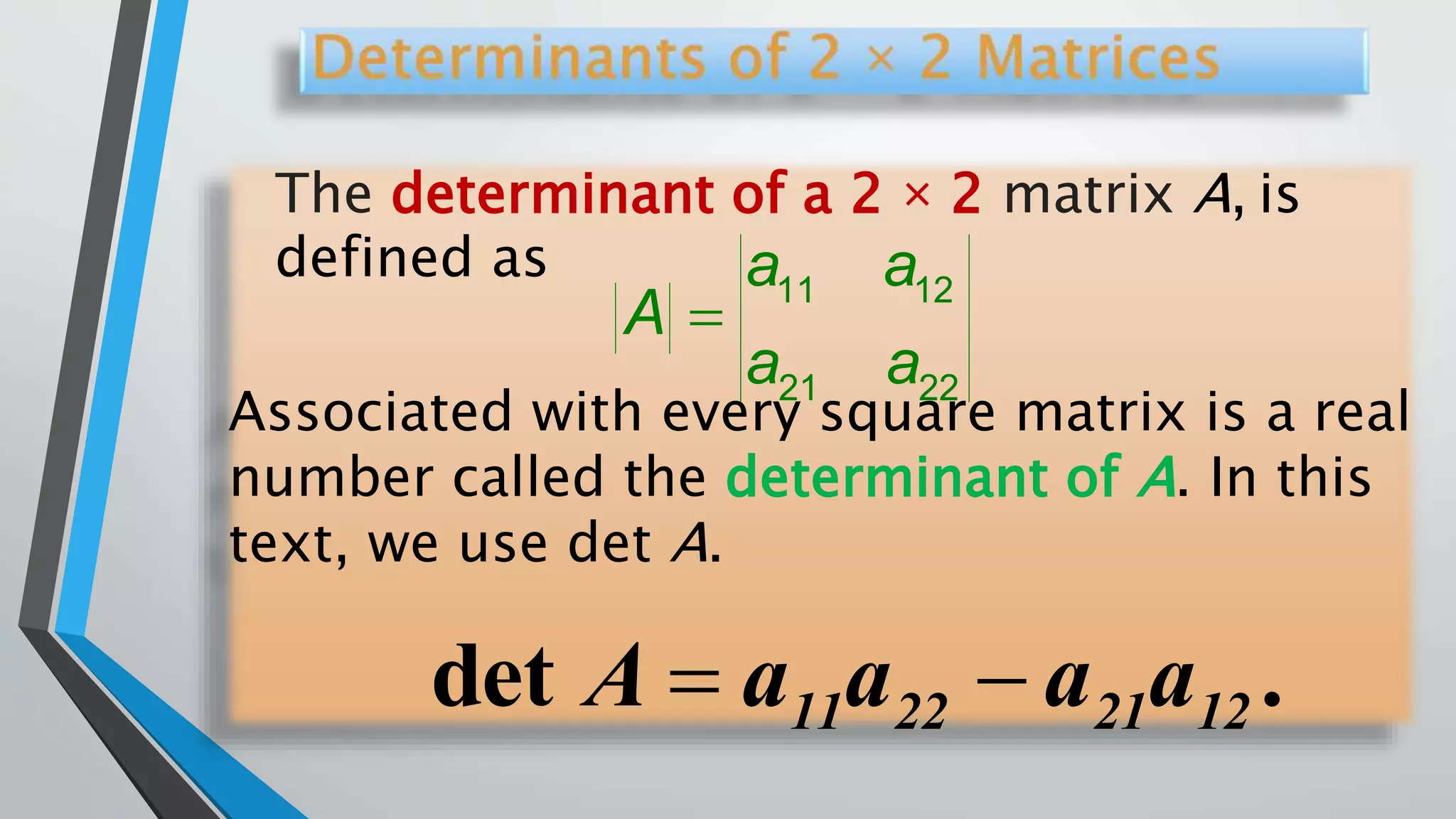
Associated with every square matrix is a real
number called the determinant of A. In this
text, we use det A.
.aaaaA 12212211 det
The determinant of a 2 × 2 matrix A, is
defined as

11 12
21 22
a a
A
a a
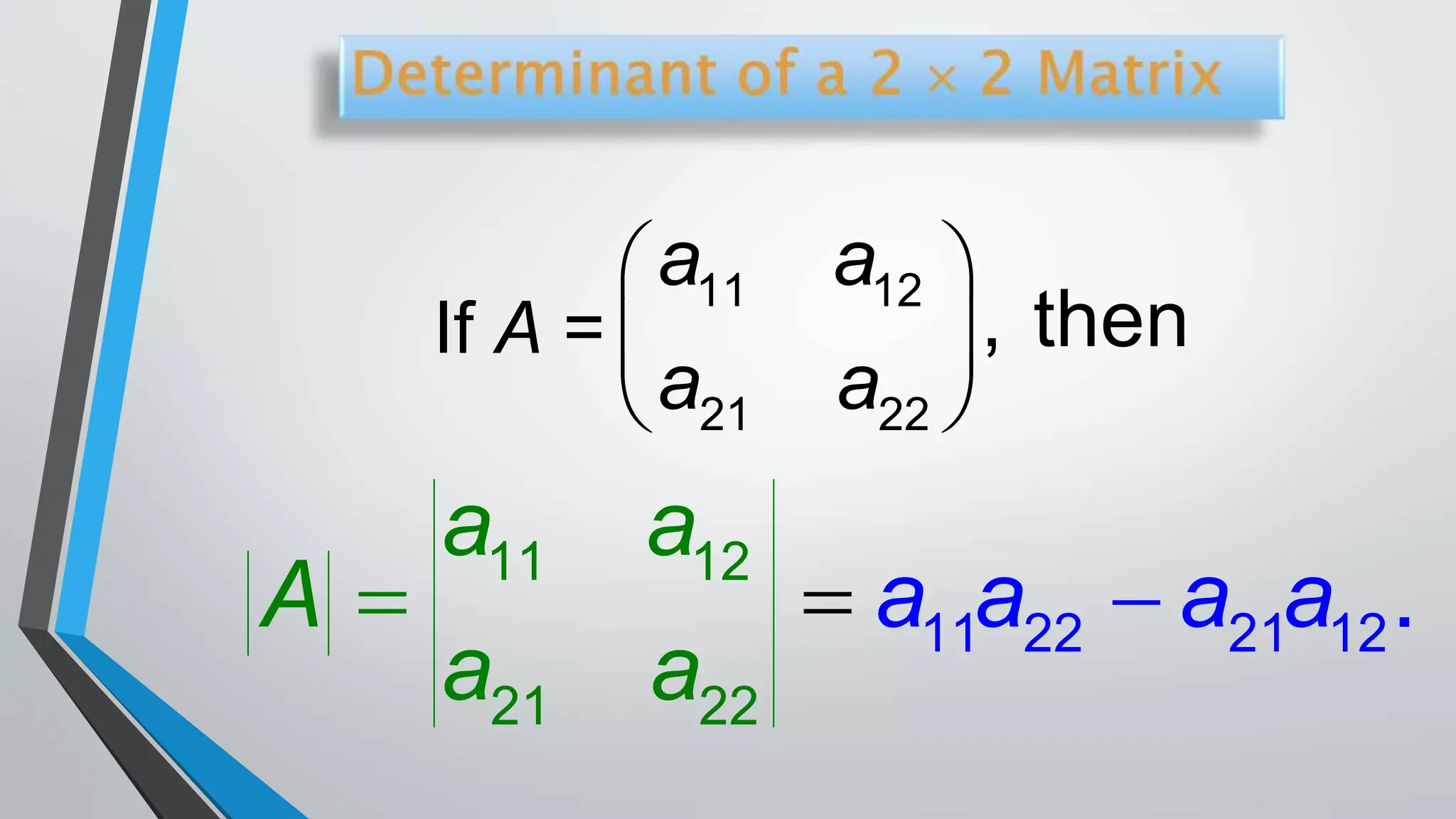
If A =
 
 
 
11 12
21 22
, then
a a
a a
 11 12
21
11 22 2 12
22
1 .a a aA
a
a
a a
a
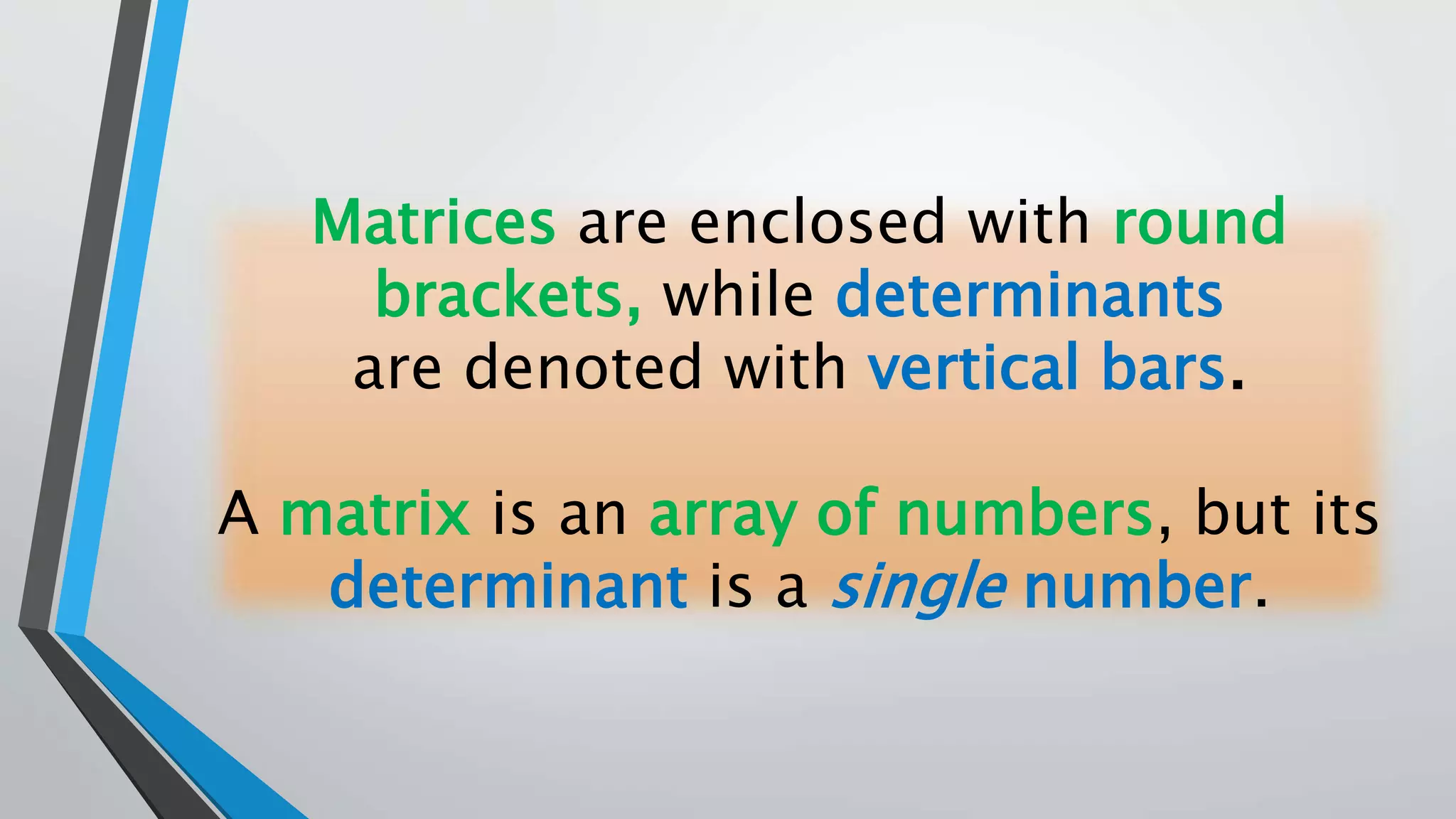
Matrices are enclosed with round
brackets, while determinants
are denoted with vertical bars.
A matrix is an array of numbers, but its
determinant is a single number.
The arrows in the following diagram will remind
you which products to find when evaluating a 2  2
determinant.
11 12
21 22
a a
a a
Example 1 EVALUATING A 2  2 DETERMINANT
Let A =
3 4
.
6 8
 
 
 
Find A.
Solution
Use the definition with
    22212 111 , ,43 6, .8aaa a
  8 463A
a11 a22 a21 a12
  24 24  48
Determinant of a 2 x 2 Matrix


6 3
2 3
 
  
 
6 3
2 3
A
Evaluate | A | for
   6 3 ( 3)2   18 ( 6) 24
If A =
11 12 13
21 22 23
31 32 33
, then
a a a
a a a
a a a
 
 
 
  
11 12 13
21 22 23 11 22 33 12 23 31 13 21 32
31 32 33
( )
a a a
A a a a a a a a a a a a a
a a a
   
31 22 13 32 23 11 33 21 12( ).a a a a a a a a a  
The determinant of each 2  2 matrix above is
called the of the associated element in the
3  3 matrix.
The symbol represents ,the minor that results
when row i and column j are eliminated.
22 23
11
32 33
a a
M
a a
 
  
 
12 13
21
32 33
a a
M
a a
 
  
 
12 13
31
22 23
a a
M
a a
 
  
 
11 13
22
31 33
a a
M
a a
 
  
 
11 12
23
31 32
a a
M
a a
 
  
 
11 12
33
21 22
a a
M
a a
 
  
 
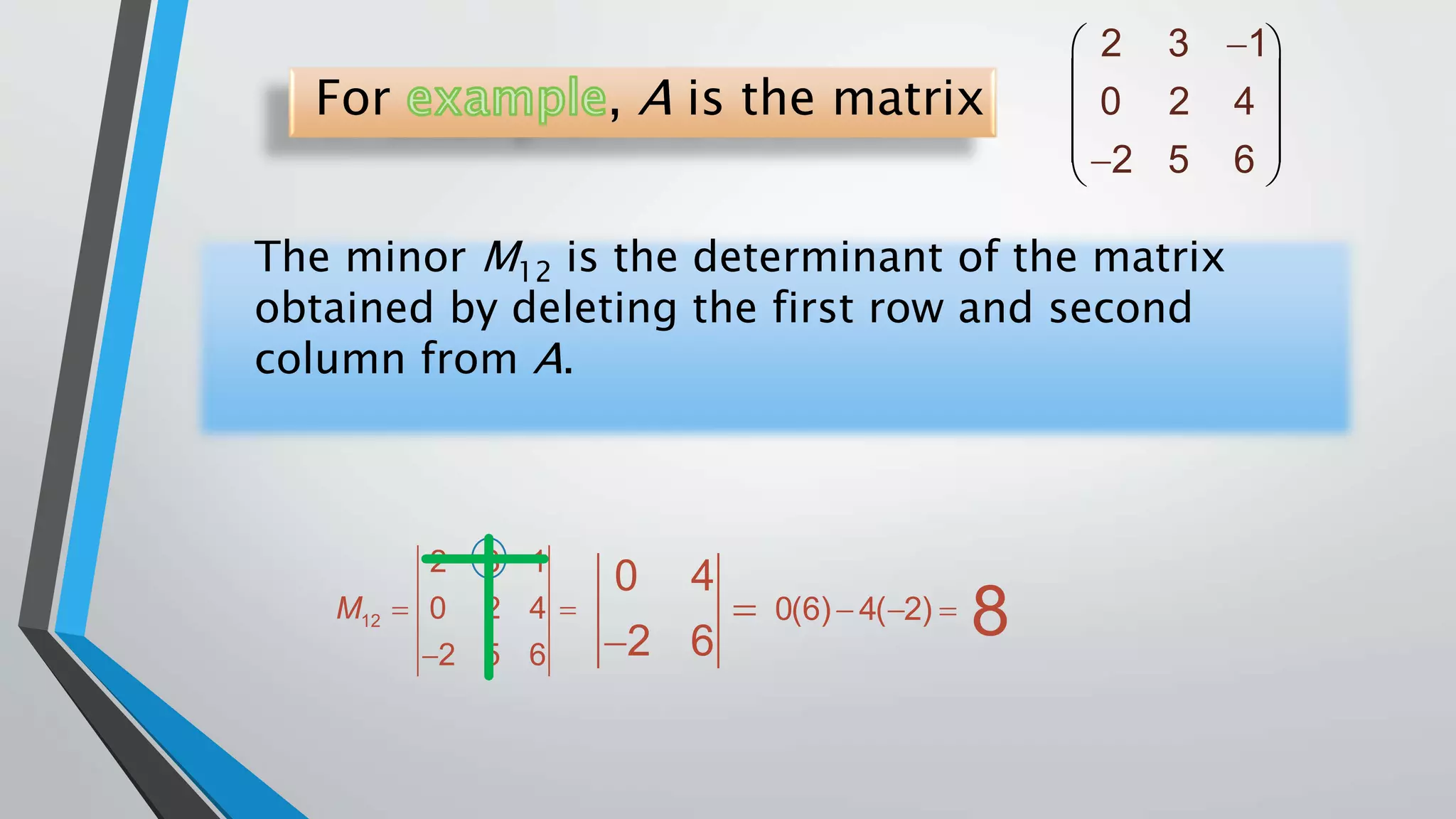
The minor M12 is the determinant of the matrix
obtained by deleting the first row and second
column from A.
 

12
2 3 1
0 2 4
2 5 6
M 

0 4
2 6
  0(6) 4( 2) 8
For , A is the matrix
 
 
 
 
 
2 3 1
0 2 4
2 5 6
Let Mij be the for element aij in an n  n
matrix.
The of aij, written as Aij, is

 ( 1) .i j
ij ijA M
Find the cofactor of each of the following elements
of the matrix  
 
 
 
 
3
1 2 0
6 2
98
4
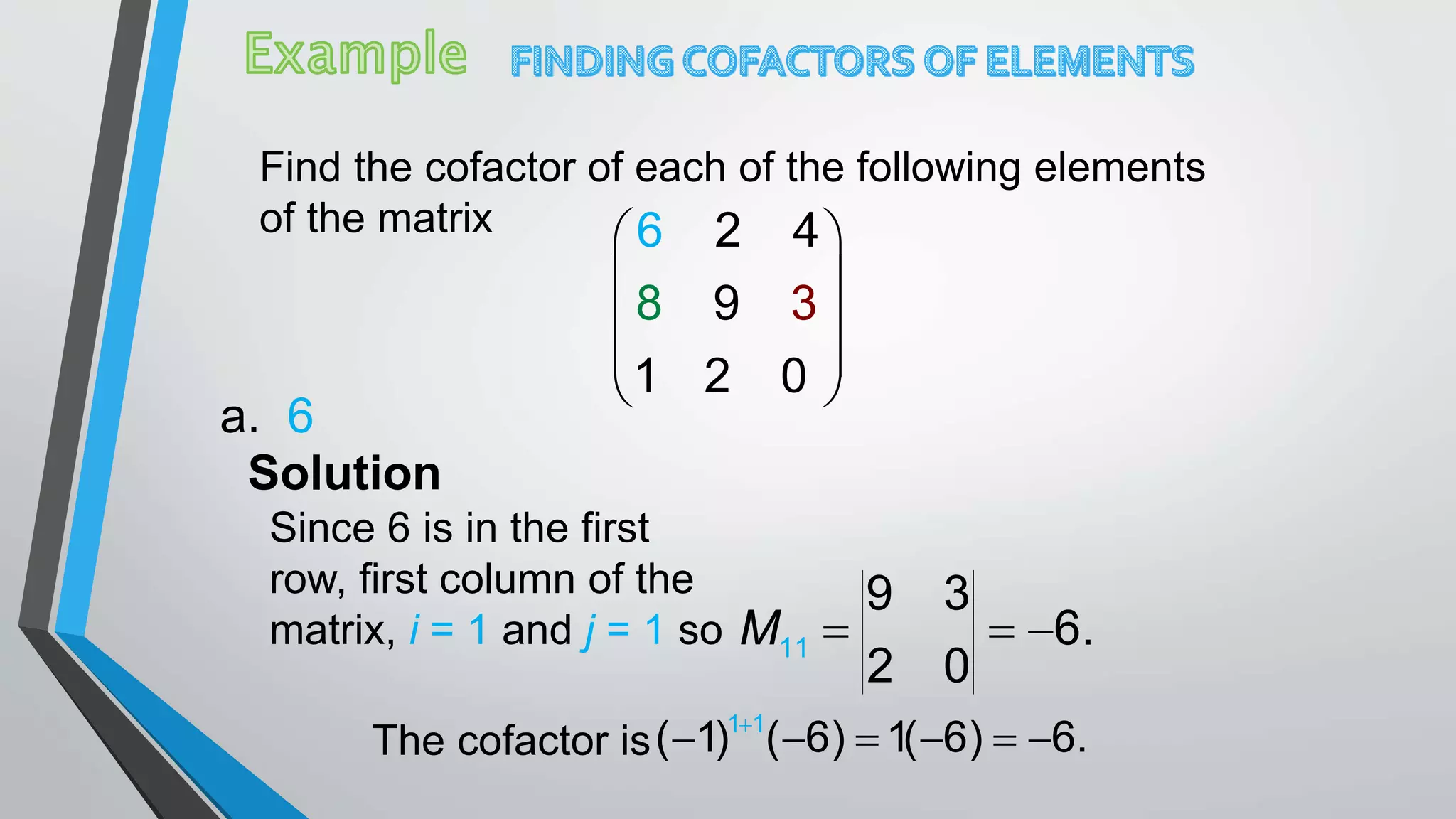
a. 6
Solution
Since 6 is in the first
row, first column of the
matrix, i = 1 and j = 1 so 11
9 3
6.
2 0
M   
The cofactor is
1 1
( 1) ( 6) 1( 6) 6.
     
Find the cofactor of each of the following elements
of the matrix  
 
 
 
 
3
1 2 0
6 2
98
4
Solution
The cofactor is
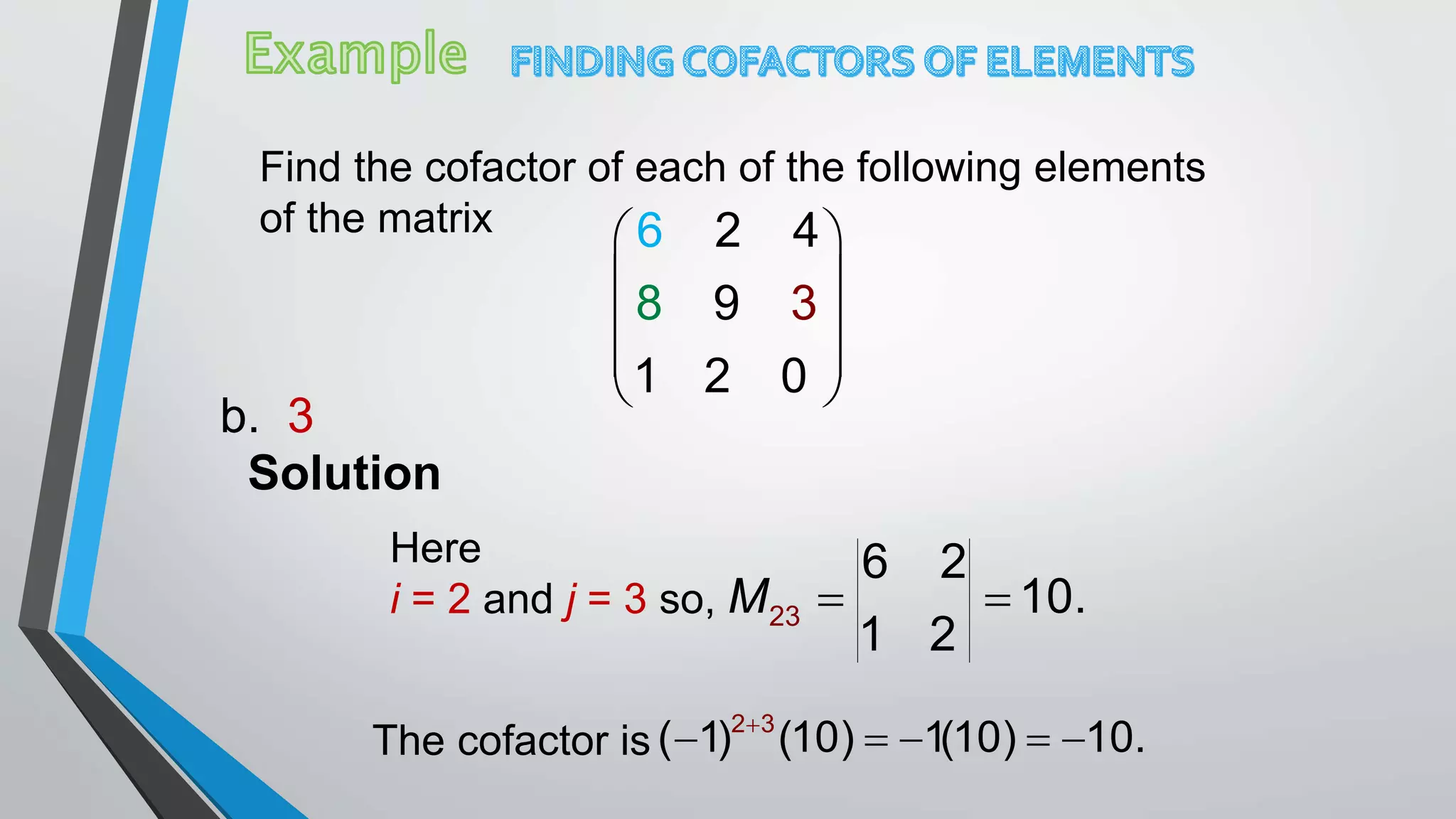
b. 3
Here
i = 2 and j = 3 so, 23
6 2
10.
1 2
M  
2 3
( 1) (10) 1(10) 10.
    
Find the cofactor of each of the following elements
of the matrix  
 
 
 
 
3
1 2 0
6 2
98
4
Solution
The cofactor is
c. 8
We have,
i = 2 and j = 1 so, 21
2 4
8.
2 0
M   
2 1
( 1) ( 8) 1( 8) 8.
     
•Similarly,
•
• So, A33 = (–1)3+3 M33 = 4
33
2 3 1
2 3
0 2 4 2 2 3 0 4
0 2
2 5 6
M

      

Multiply each element in any row or column of
the matrix by its cofactor.
The sum of these products gives the value of the
determinant.
11 12 1
21 22 2
1 2
11 11 12 12 1 1
det( )
...
n
n
n n nn
n n
a a a
a a a
A A
a a a
a A a A a A
 
   
Evaluate
  
   
 
  
2 3 2
1 4 3 ,
1 0 2
by the
.
Solution
12
1 3
1(2) ( 1) 3)
1 2
5(M
 
       

22
2 2
2(2) ( 1)( 2)
1 2
2M

     

32
2 2
2( 3) ( 1)( 2)
1 3
8M

      



Use
parentheses, &
keep track of
all negative
signs to avoid
errors.
Evaluate
  
   
 
  
2 3 2
1 4 3 ,
1 0 2
by the
.
Solution
Now find the cofactor of each element of
these minors.
12
1 2
12
3
( 1) ( 1) ( 5) ( 5) 51MA 
        
2
22
42
22 ( 1) ( 1) (2) 1 2 2MA 
     
32
3 2
32
5
( 1) ( 1) ( 8) ( 8) 81MA 
        
Evaluate
  
   
 
  
2 3 2
1 4 3 ,
1 0 2
by the
.
Solution
Find the determinant by multiplying each cofactor by its
corresponding element in the matrix and finding the sum of these
products.
12 12 2 32 2 222 3
2 2
1
1 2
4 3
3
0
a A aA Aa
 
    

(5) ( )2 (8043 )  
15 ( 8) 0 23      
 
 
  
  
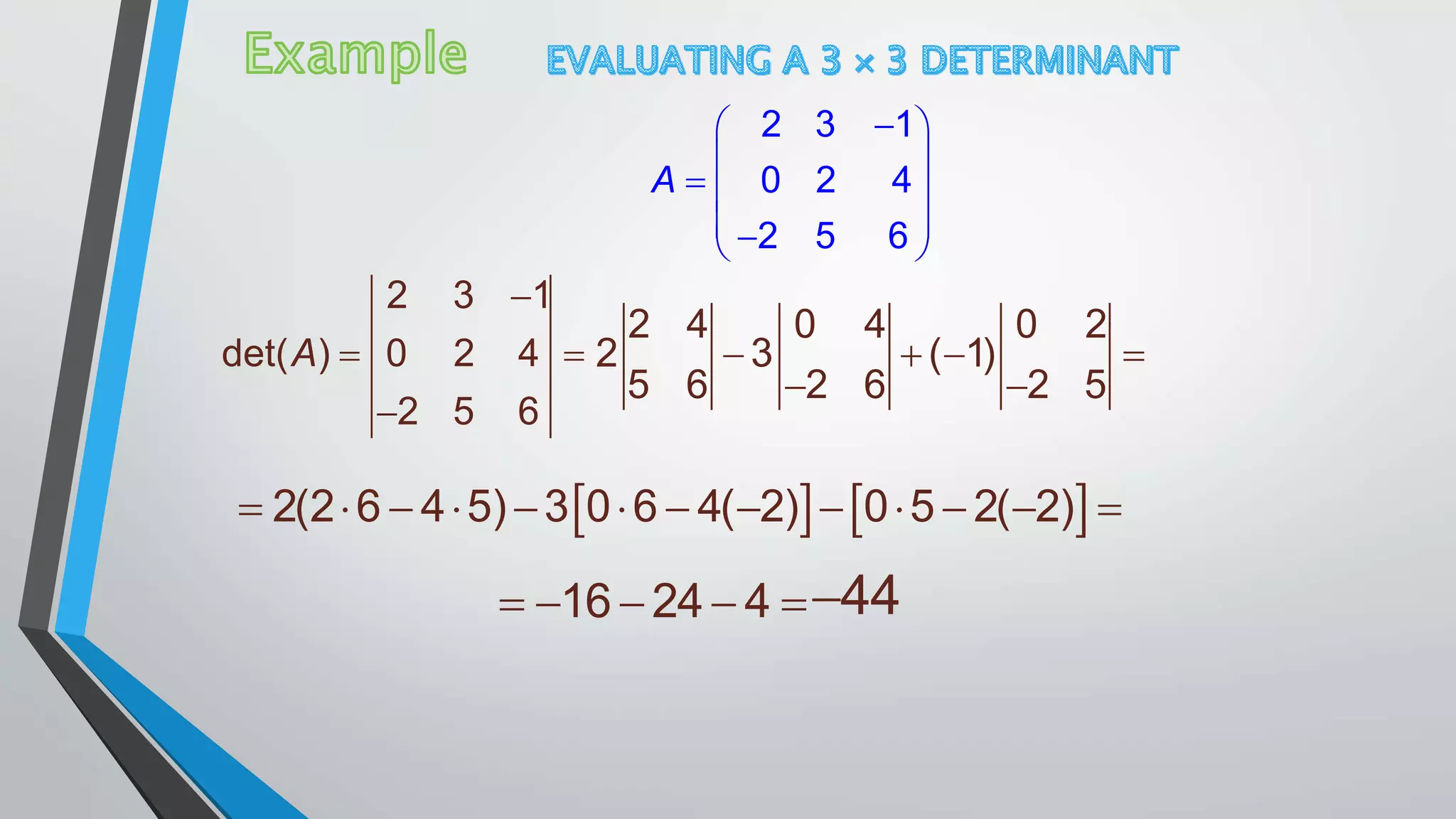
2 3 1
0 2 4
2 5 6
A

 

2 3 1
det( ) 0 2 4
2 5 6
A    
 
2 4 0 4 0 2
2 3 ( 1)
5 6 2 6 2 5
               2(2 6 4 5) 3 0 6 4( 2) 0 5 2( 2)
    16 24 4 44
 
 
  
  
2 3 1
0 2 4
2 5 6
A
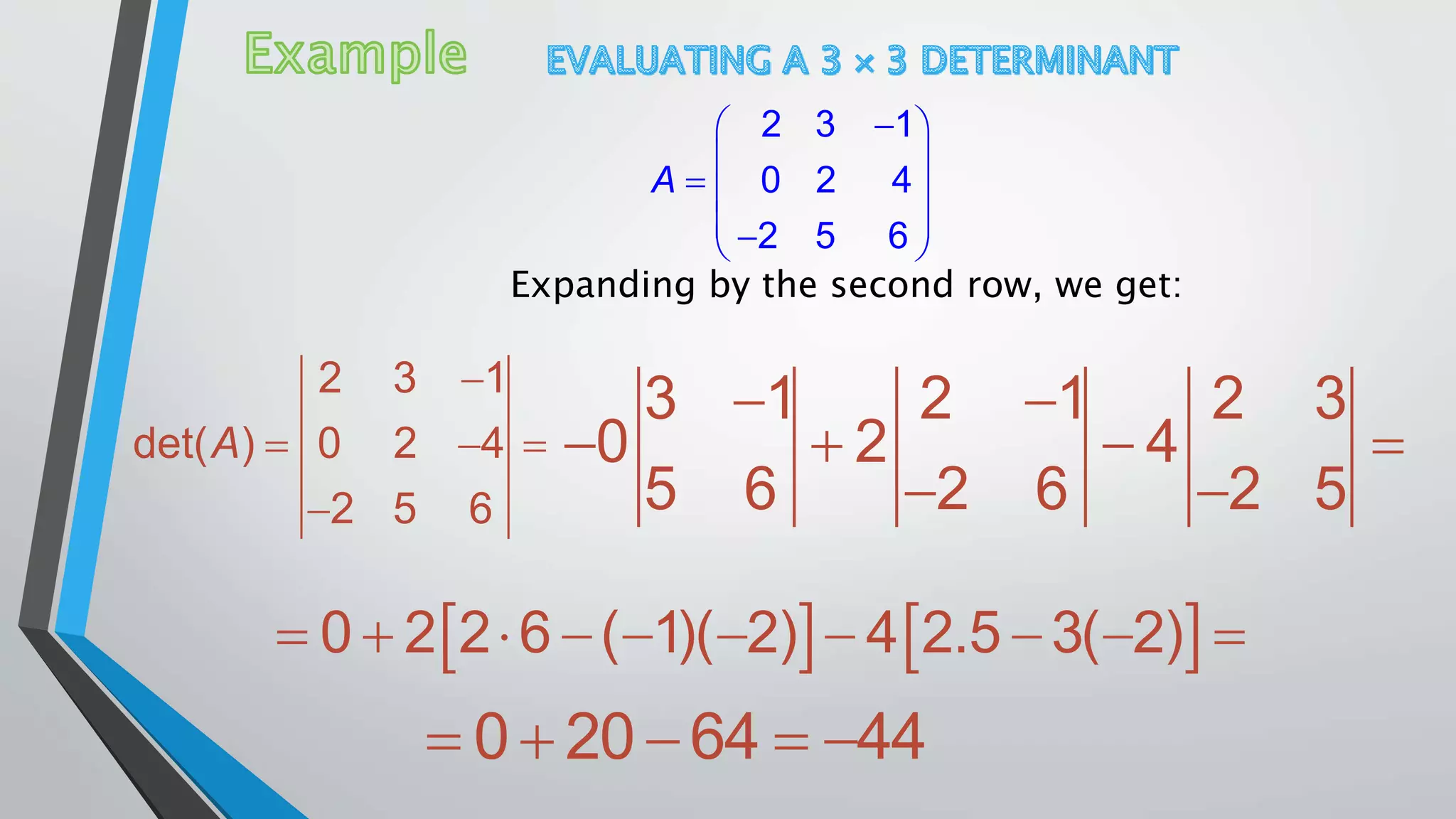
Expanding by the second row, we get:

  

2 3 1
det( ) 0 2 4
2 5 6
A
 
   
 
3 1 2 1 2 3
0 2 4
5 6 2 6 2 5
            0 2 2 6 ( 1)( 2) 4 2.5 3( 2)
    0 20 64 44
 
 
  
  
2 3 1
0 2 4
2 5 6
A
Expanding by the third column, we get:

  

2 3 1
det( ) 0 2 4
2 5 6
A    
 
0 2 2 3 2 3
1 4 6
2 5 2 5 0 2
                 0 5 2( 2) 4 2 5 3( 2) 6 2.2 3 0
     4 64 24 44
The solutions of linear equations can sometimes be
expressed using determinants.
To illustrate, let’s solve the following pair of linear
equations for the variable x.
ax by r
cx dy s
 

 
•    x y
a b r b a r
c d s d c s
 and
yx
x y
Using the notation
the solution of the system can be written as:
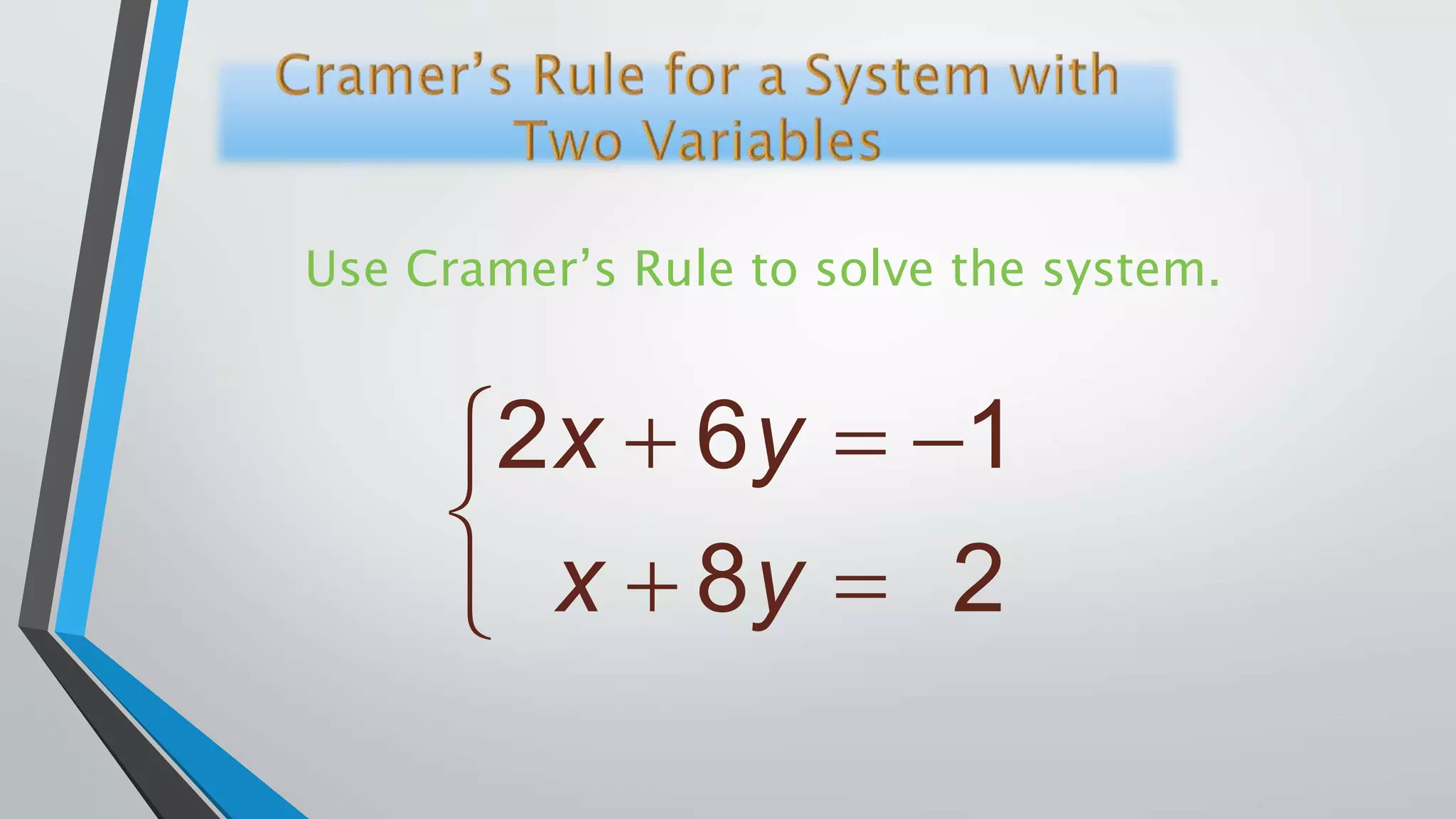
2 6 1
8 2
x y
x y
  

 
Use Cramer’s Rule to solve the system.
For this system, we have:
     
2 6
2 8 6 1 10
1 8

      
1 6
( 1)8 6 2 20
2 8
x

     
2 1
2 2 ( 1)1 5
1 2
y
 
   
20
2
10
x
x

  
5 1
10 2
y
y
The solution is:
Cramer’s Rule can be extended
to apply to any system of n linear
equations in n variables in which
the determinant of the
coefficient matrix is not zero.
     
     
     
     
     
          
11 12 1 1 1
21 22 2 2 2
1 2
n
n
n n nn n n
a a a x b
a a a x b
a a a x b
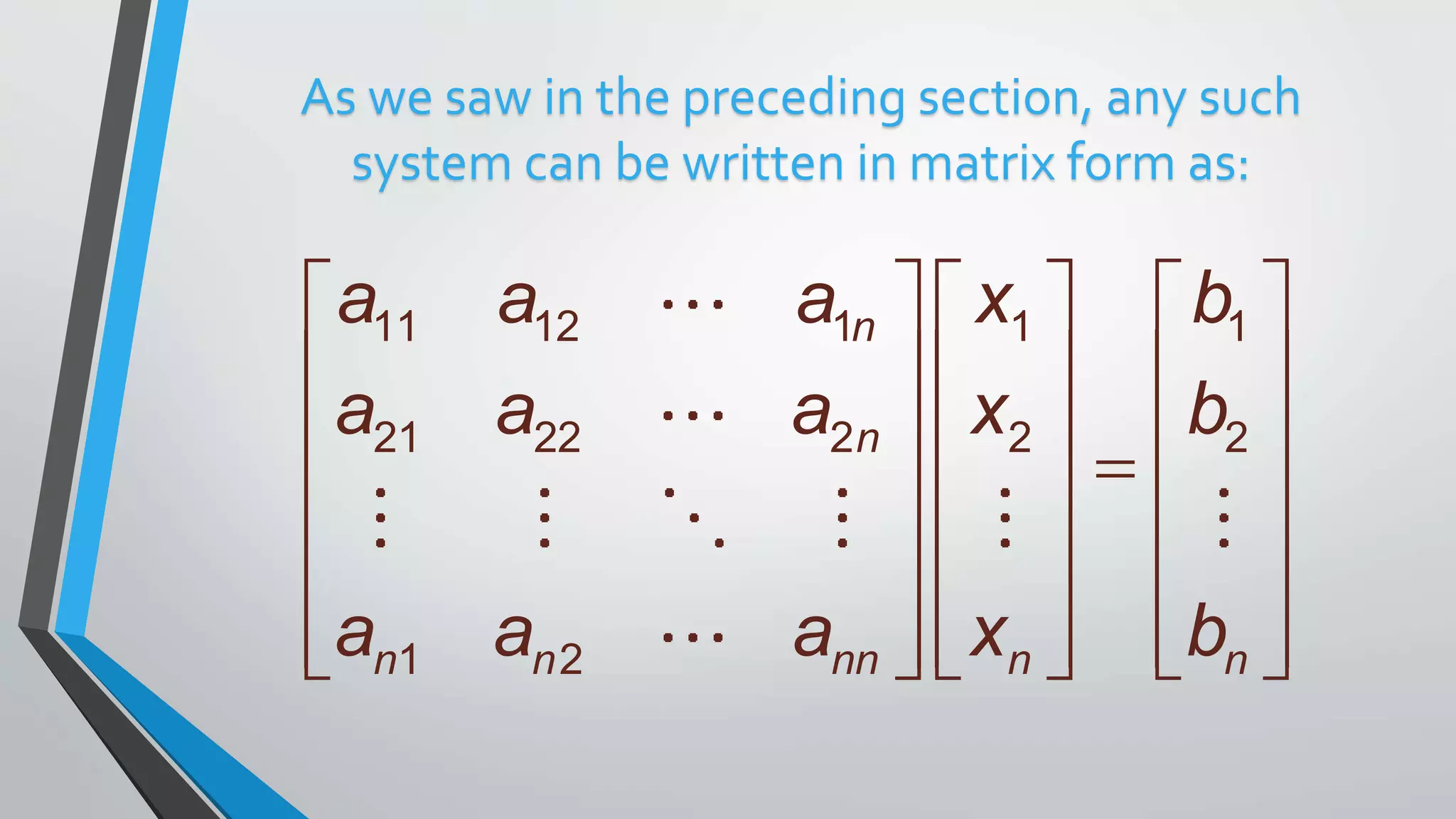
As we saw in the preceding section, any such
system can be written in matrix form as:
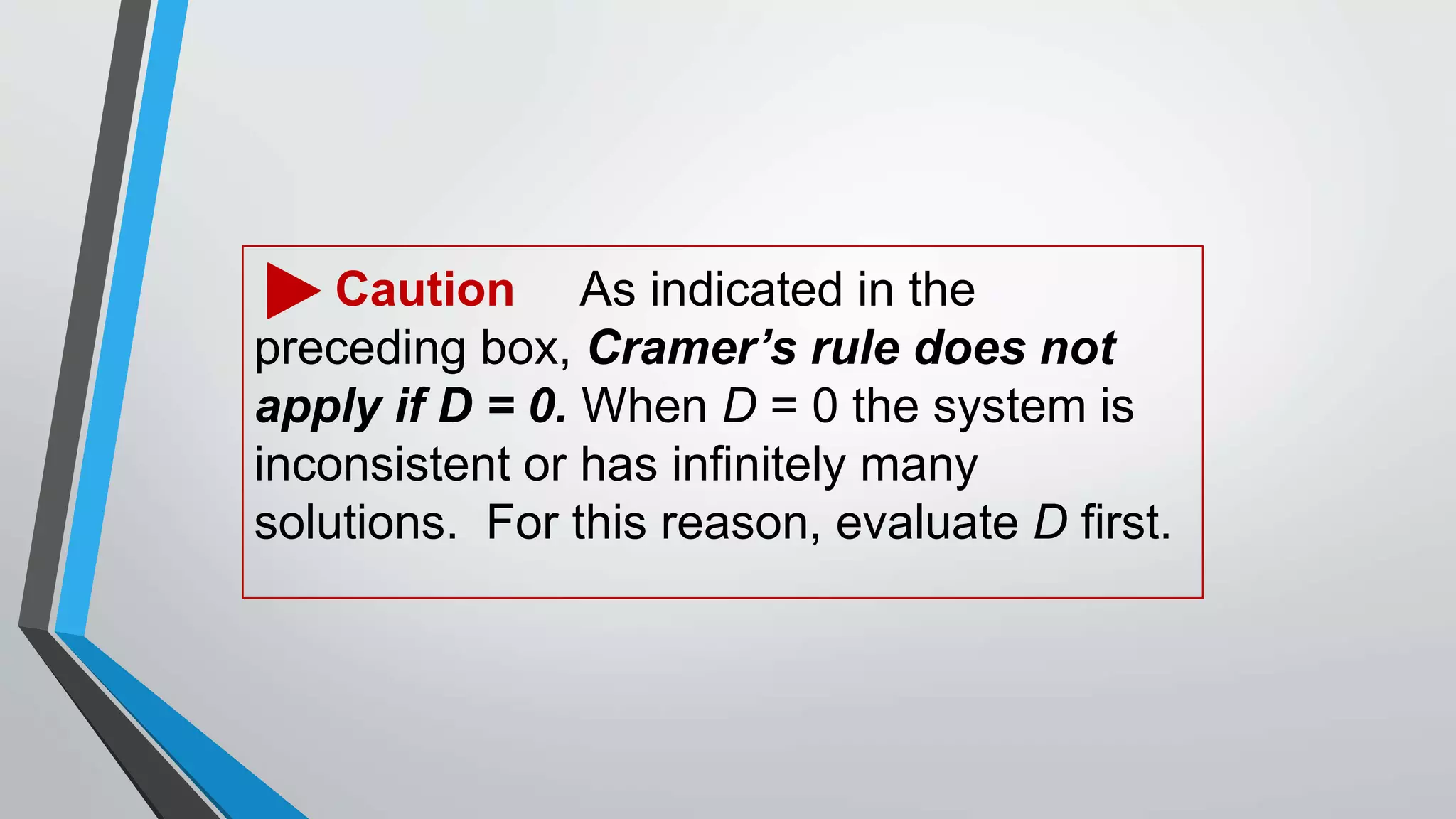
Caution As indicated in the
preceding box, Cramer’s rule does not
apply if D = 0. When D = 0 the system is
inconsistent or has infinitely many
solutions. For this reason, evaluate D first.
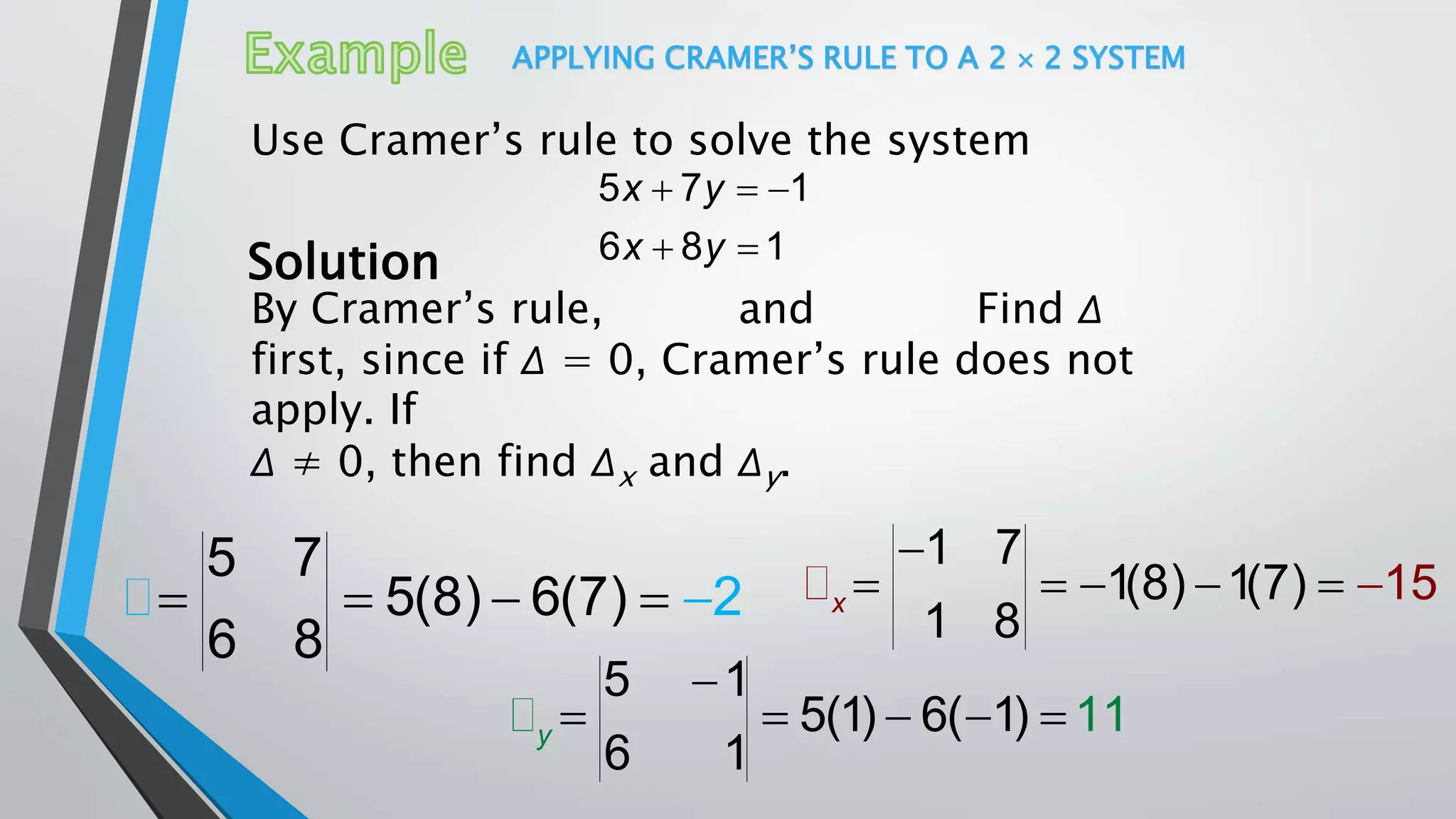
APPLYING CRAMER’S RULE TO A 2  2 SYSTEM
Use Cramer’s rule to solve the system
5 7 1
6 8 1
x y
x y
  
 Solution
By Cramer’s rule, and Find Δ
first, since if Δ = 0, Cramer’s rule does not
apply. If
Δ ≠ 0, then find Δx and Δy.
    
5 7
5(8) 6(7)
6 8
2  

   
1 7
1(8) 1(7)
1 8
15x

    
5 1
5(1) 6( 1)
6 1
11y
APPLYING CRAMER’S RULE TO A 2  2 SYSTEM
By Cramer’s rule,
     




15 11
and
2 2
1
.
11
2 2
5 yx
x y
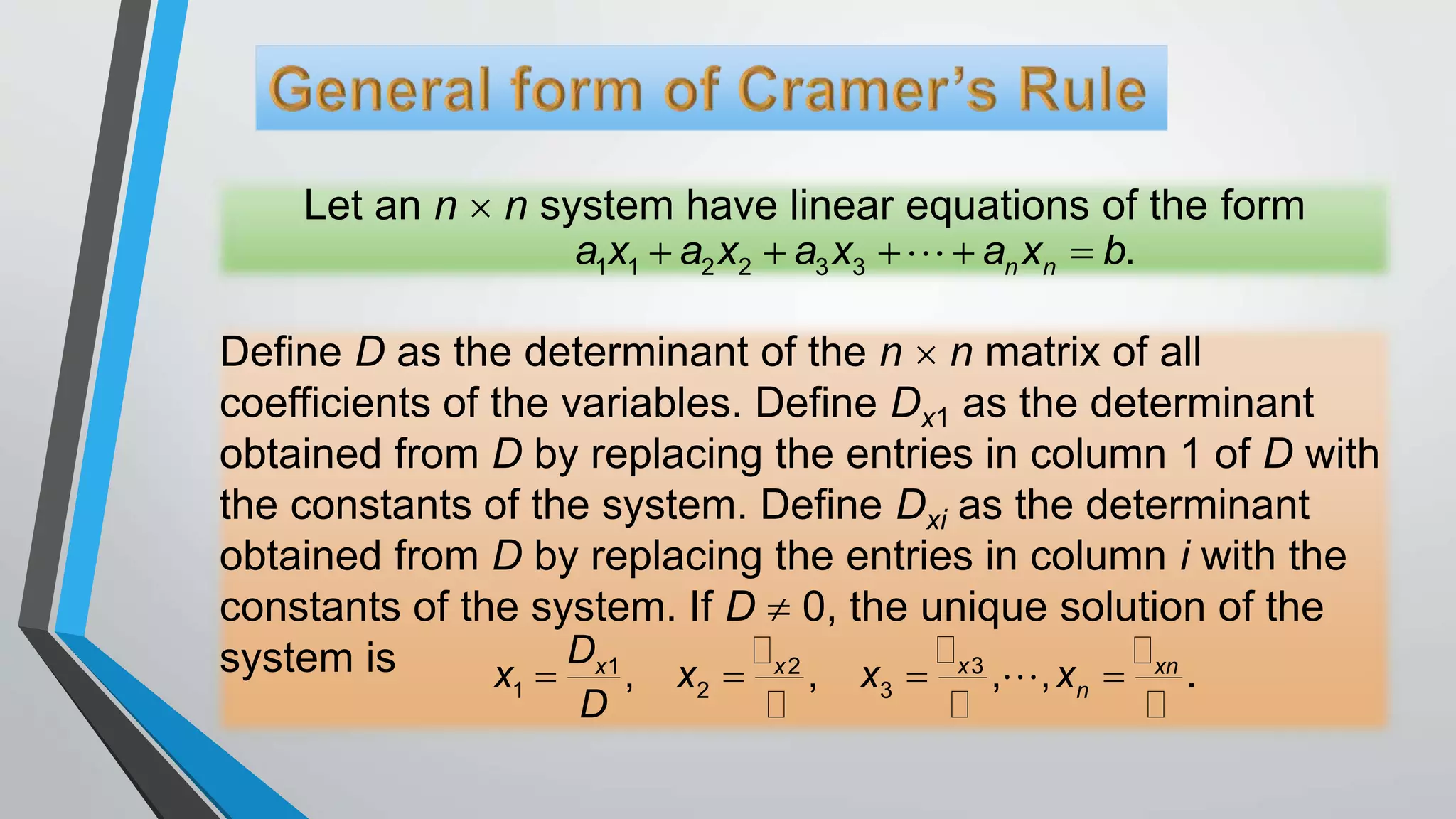
Let an n  n system have linear equations of the form
1 1 2 2 3 3 .n na x a x a x a x b    
Define D as the determinant of the n  n matrix of all
coefficients of the variables. Define Dx1 as the determinant
obtained from D by replacing the entries in column 1 of D with
the constants of the system. Define Dxi as the determinant
obtained from D by replacing the entries in column i with the
constants of the system. If D  0, the unique solution of the
system is    31 2
1 2 3, , , , .xx x xn
n
D
x x x x
D
APPLYING CRAMER’S RULETO A 3  3 SYSTEM
Use Cramer’s rule to solve the system.
   

   
    
2 0
2 5 0
2 3 4 0
x y z
x y z
x y z
Solution Rewrite each
equation in the form
ax + by + cz + = k.
APPLYING CRAMER’S RULETO A 3  3 SYSTEM
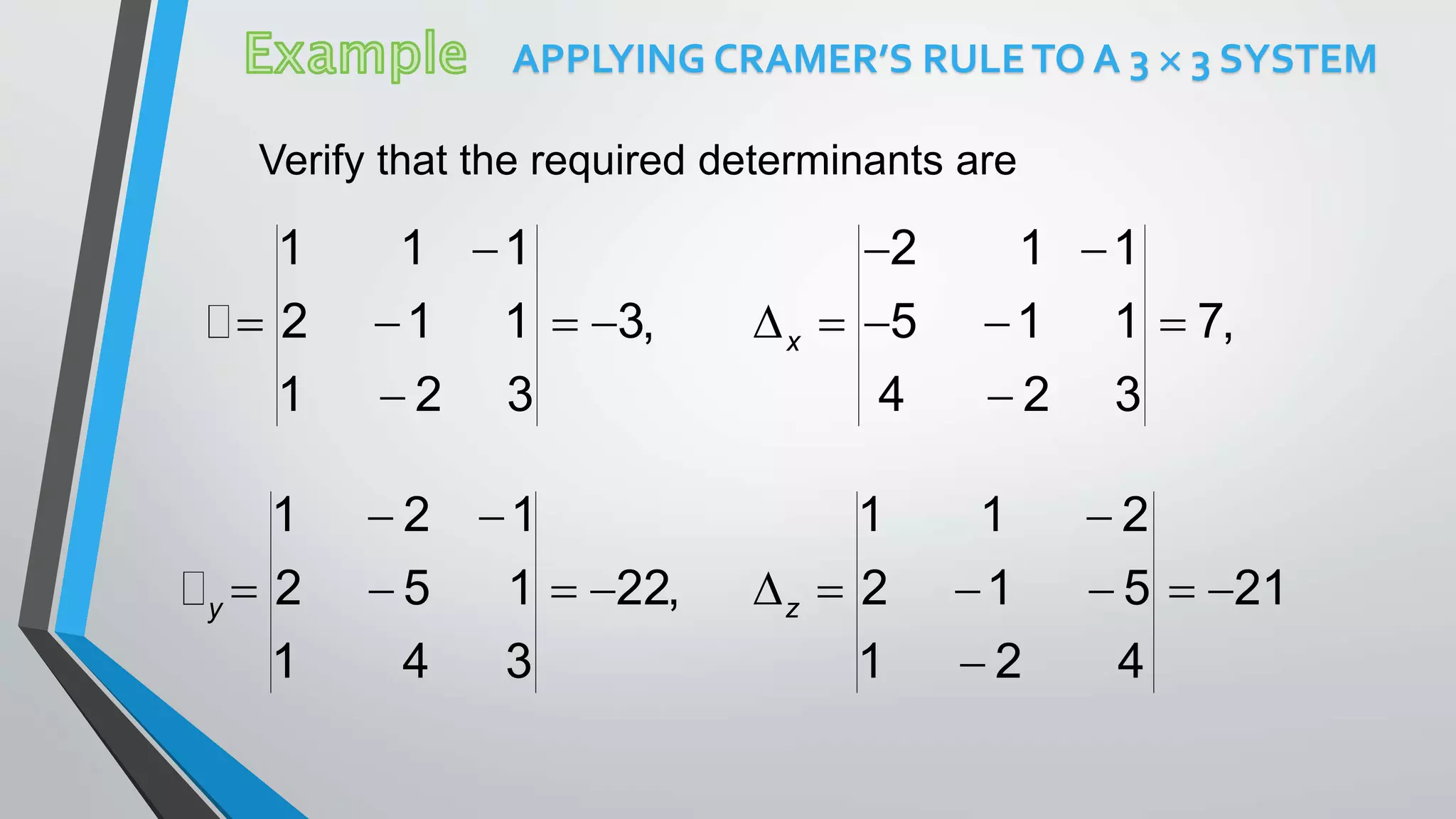
Verify that the required determinants are

   

1 1 1
2 1 1 3,
1 2 3
 
    

2 1 1
5 1 1 7,
4 2 3
x
 
   
1 2 1
2 5 1 22,
1 4 3
y

     

1 1 2
2 1 5 21
1 2 4
z
APPLYING CRAMER’S RULETO A 3  3 SYSTEM
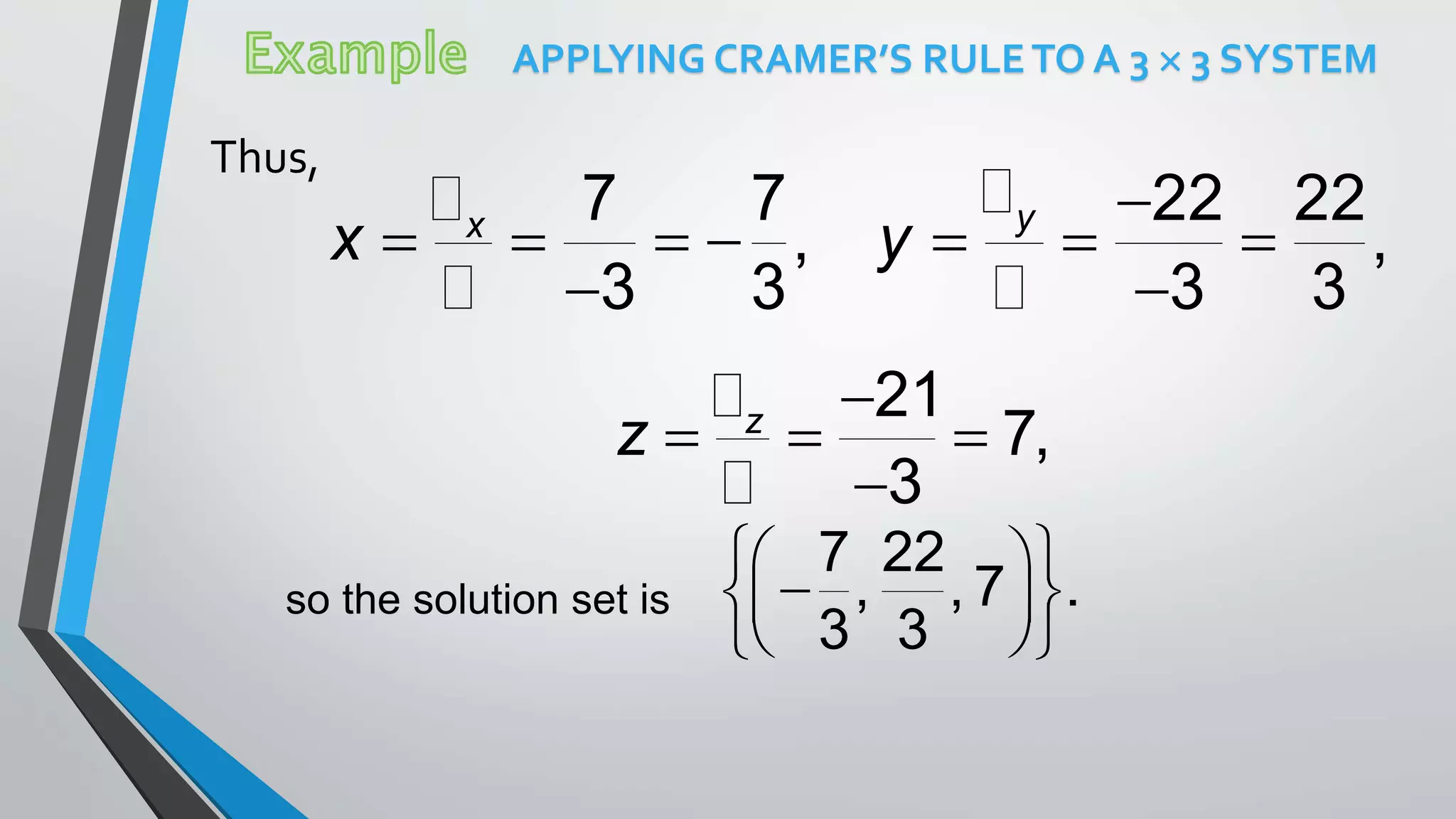
Thus,

      
 
7 7 22 22
, ,
3 3 3 3
yx
x y

  

21
7,
3
z
z
so the solution set is
7 22
, , 7 .
3 3
  
  
  
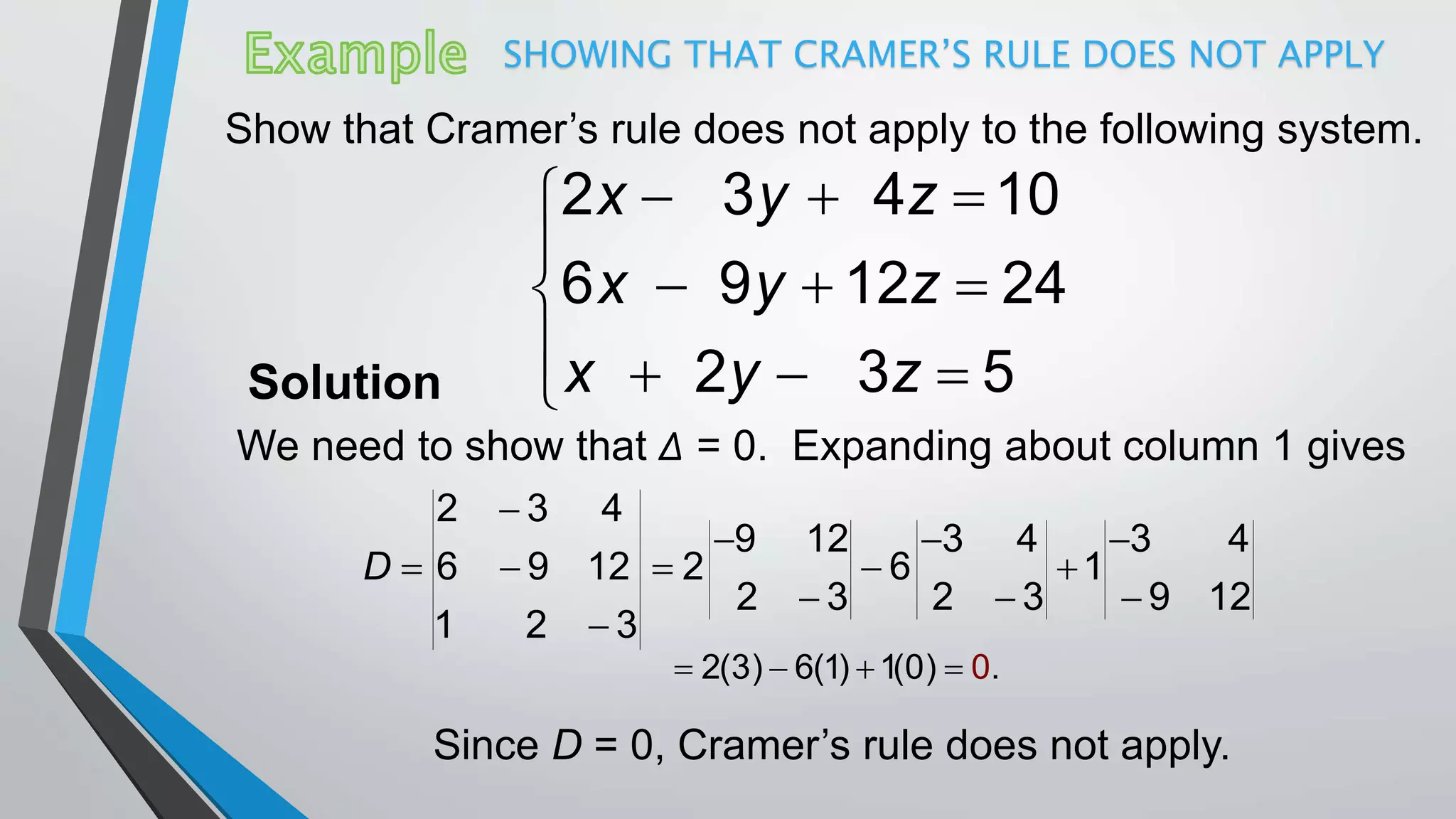
SHOWING THAT CRAMER’S RULE DOES NOT APPLY
Show that Cramer’s rule does not apply to the following system.
  

  
   
2 3 4 10
6 9 12 24
2 3 5
x y z
x y z
x y zSolution
We need to show that Δ = 0. Expanding about column 1 gives
2 3 4
9 12 3 4 3 4
6 9 12 2 6 1
2 3 2 3 9 12
1 2 3
D

  
    
  

2(3) 6(1) 1(0 0) .   
Since D = 0, Cramer’s rule does not apply.
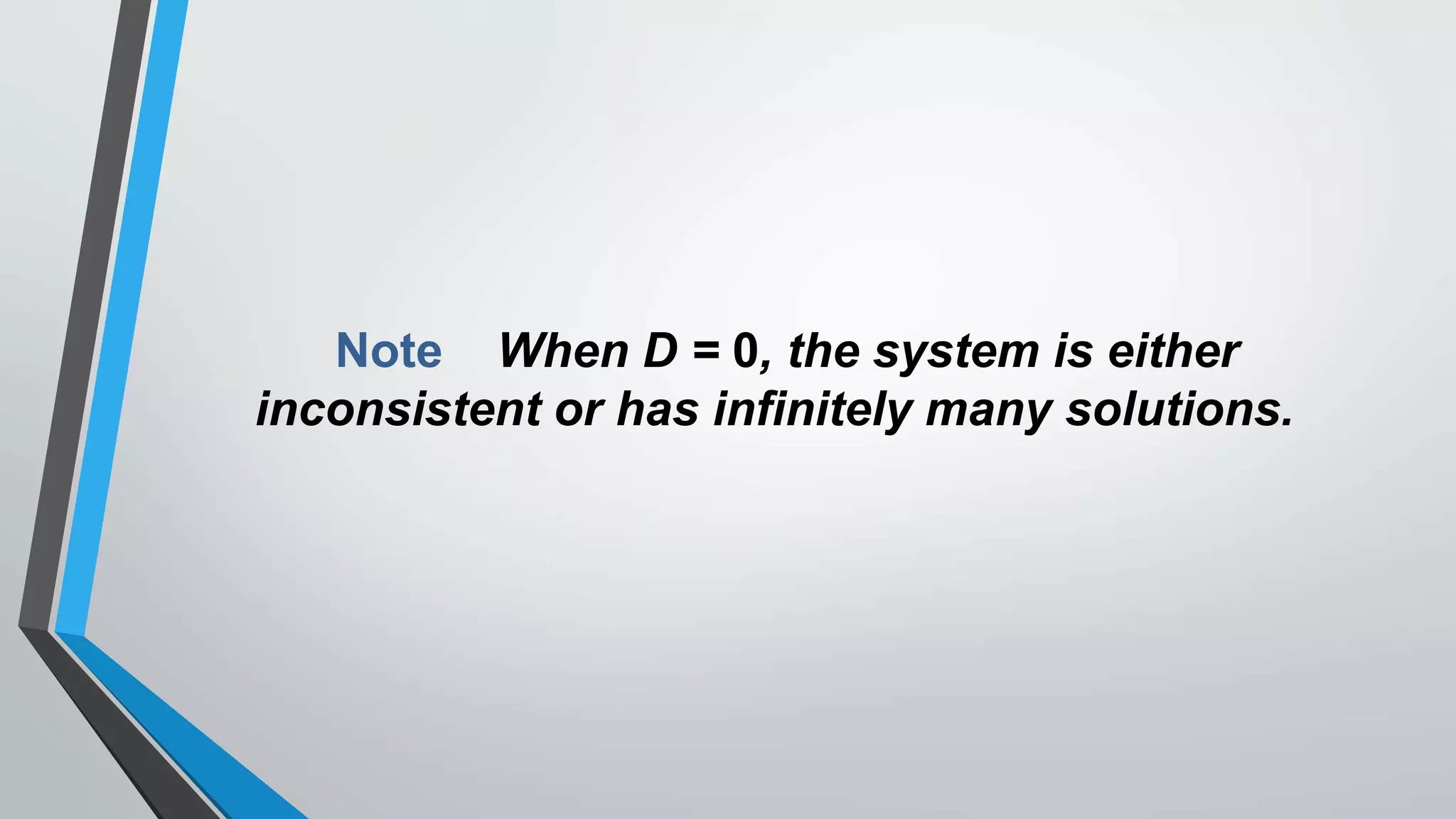
Note When D = 0, the system is either
inconsistent or has infinitely many solutions.
Use Cramer’s Rule to solve the system.
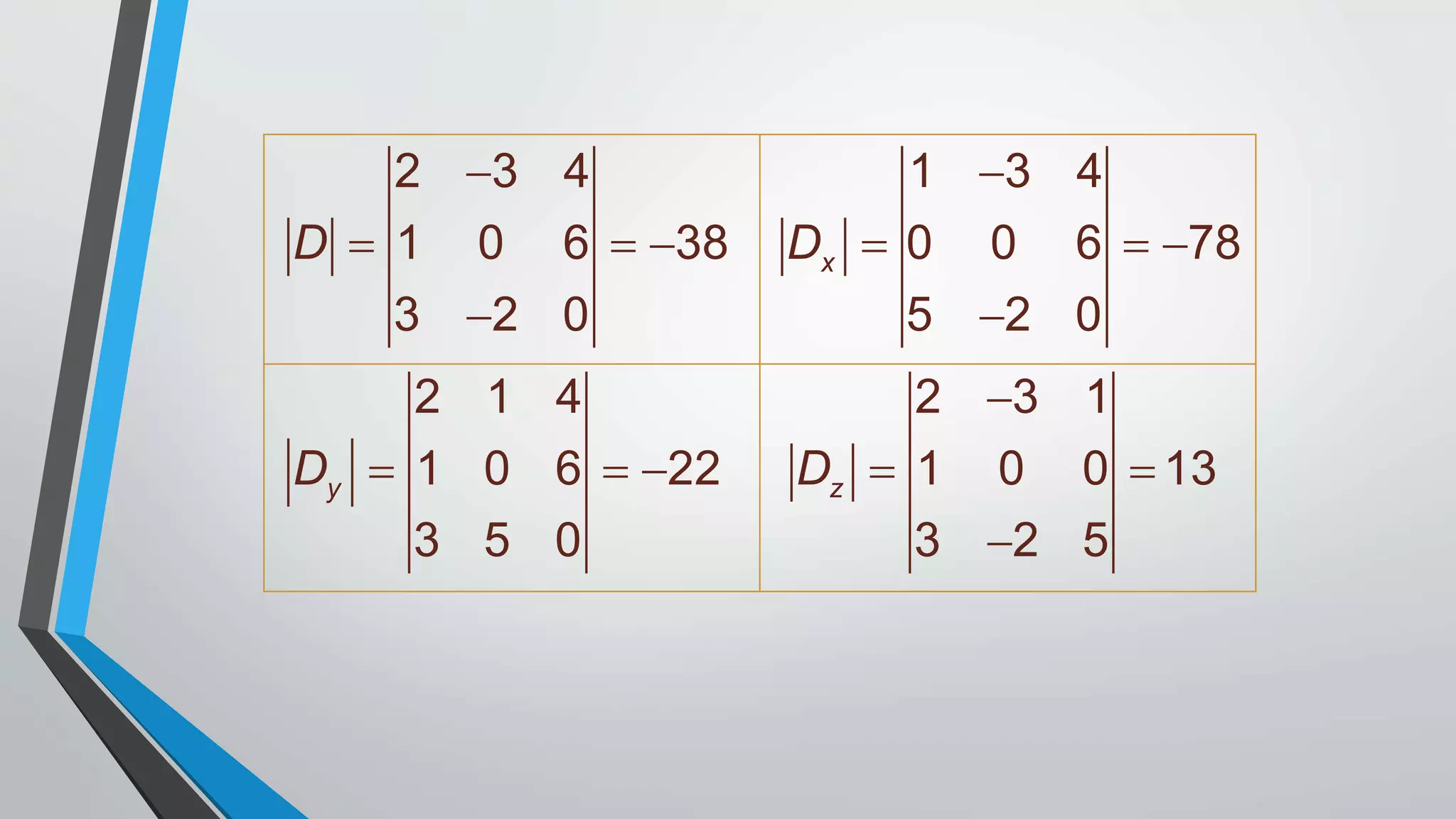
First, we evaluate the determinants that appear in Cramer’s
Rule.
2 3 4 1
6 0
3 2 5
x y z
x z
x y
  

 
  
2 3 4 1 3 4
1 0 6 38 0 0 6 78
3 2 0 5 2 0
2 1 4 2 3 1
1 0 6 22 1 0 0 13
3 5 0 3 2 5
x
y z
D D
D D
 
     
 

    

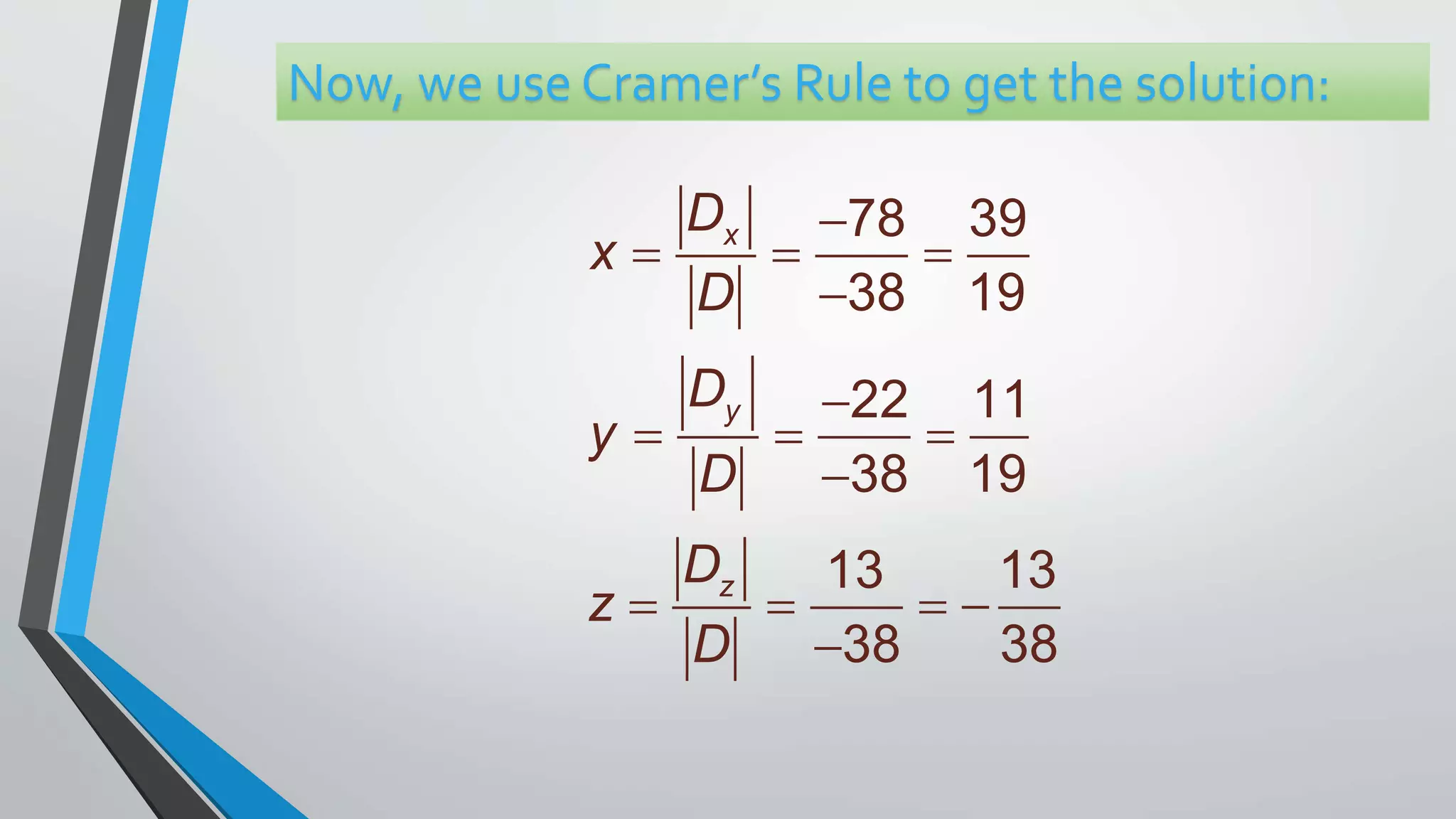
78 39
38 19
22 11
38 19
13 13
38 38
x
y
z
D
x
D
D
y
D
D
z
D

  


  

   

Now, we use Cramer’s Rule to get the solution:
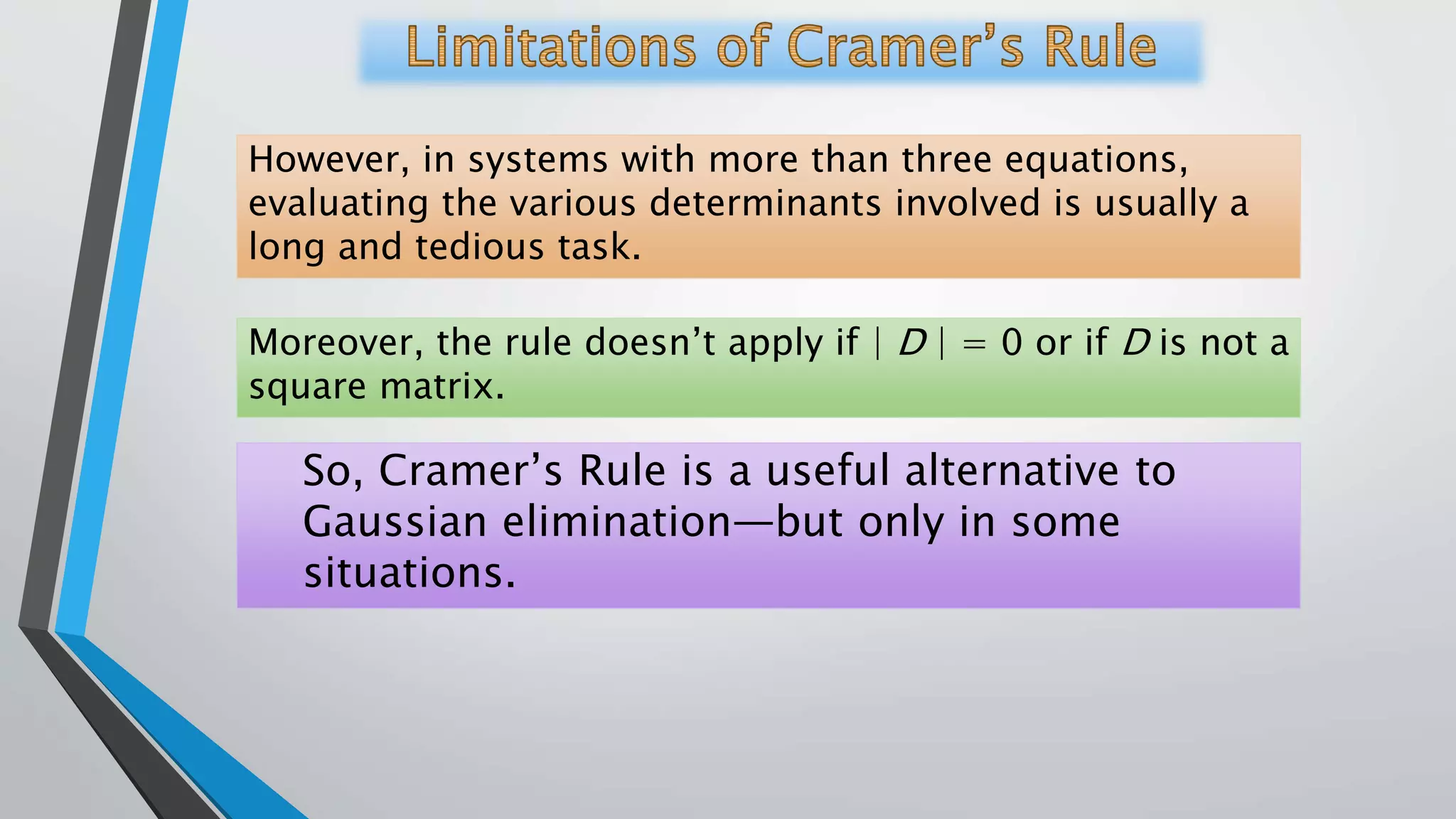
However, in systems with more than three equations,
evaluating the various determinants involved is usually a
long and tedious task.
Moreover, the rule doesn’t apply if | D | = 0 or if D is not a
square matrix.
So, Cramer’s Rule is a useful alternative to
Gaussian elimination—but only in some
situations.

Determinants. Cramer’s Rule

  • 1.
  • 3.
    If a matrixis square (that is, if it has the same number of rows as columns), then we can assign to it a number called its determinant.
  • 4.
    Associated with everysquare matrix is a real number called the determinant of A. In this text, we use det A. .aaaaA 12212211 det The determinant of a 2 × 2 matrix A, is defined as  11 12 21 22 a a A a a
  • 6.
    If A =      11 12 21 22 , then a a a a  11 12 21 11 22 2 12 22 1 .a a aA a a a a a
  • 7.
    Matrices are enclosedwith round brackets, while determinants are denoted with vertical bars. A matrix is an array of numbers, but its determinant is a single number.
  • 8.
    The arrows inthe following diagram will remind you which products to find when evaluating a 2  2 determinant. 11 12 21 22 a a a a
  • 9.
    Example 1 EVALUATINGA 2  2 DETERMINANT Let A = 3 4 . 6 8       Find A. Solution Use the definition with     22212 111 , ,43 6, .8aaa a   8 463A a11 a22 a21 a12   24 24  48
  • 10.
    Determinant of a2 x 2 Matrix   6 3 2 3        6 3 2 3 A Evaluate | A | for    6 3 ( 3)2   18 ( 6) 24
  • 11.
    If A = 1112 13 21 22 23 31 32 33 , then a a a a a a a a a          11 12 13 21 22 23 11 22 33 12 23 31 13 21 32 31 32 33 ( ) a a a A a a a a a a a a a a a a a a a     31 22 13 32 23 11 33 21 12( ).a a a a a a a a a  
  • 13.
    The determinant ofeach 2  2 matrix above is called the of the associated element in the 3  3 matrix. The symbol represents ,the minor that results when row i and column j are eliminated.
  • 14.
    22 23 11 32 33 aa M a a        12 13 21 32 33 a a M a a        12 13 31 22 23 a a M a a        11 13 22 31 33 a a M a a        11 12 23 31 32 a a M a a        11 12 33 21 22 a a M a a       
  • 15.
    The minor M12is the determinant of the matrix obtained by deleting the first row and second column from A.    12 2 3 1 0 2 4 2 5 6 M   0 4 2 6   0(6) 4( 2) 8 For , A is the matrix           2 3 1 0 2 4 2 5 6
  • 16.
    Let Mij bethe for element aij in an n  n matrix. The of aij, written as Aij, is   ( 1) .i j ij ijA M
  • 17.
    Find the cofactorof each of the following elements of the matrix           3 1 2 0 6 2 98 4 a. 6 Solution Since 6 is in the first row, first column of the matrix, i = 1 and j = 1 so 11 9 3 6. 2 0 M    The cofactor is 1 1 ( 1) ( 6) 1( 6) 6.      
  • 18.
    Find the cofactorof each of the following elements of the matrix           3 1 2 0 6 2 98 4 Solution The cofactor is b. 3 Here i = 2 and j = 3 so, 23 6 2 10. 1 2 M   2 3 ( 1) (10) 1(10) 10.     
  • 19.
    Find the cofactorof each of the following elements of the matrix           3 1 2 0 6 2 98 4 Solution The cofactor is c. 8 We have, i = 2 and j = 1 so, 21 2 4 8. 2 0 M    2 1 ( 1) ( 8) 1( 8) 8.      
  • 20.
    •Similarly, • • So, A33= (–1)3+3 M33 = 4 33 2 3 1 2 3 0 2 4 2 2 3 0 4 0 2 2 5 6 M         
  • 21.
    Multiply each elementin any row or column of the matrix by its cofactor. The sum of these products gives the value of the determinant. 11 12 1 21 22 2 1 2 11 11 12 12 1 1 det( ) ... n n n n nn n n a a a a a a A A a a a a A a A a A      
  • 22.
    Evaluate            2 3 2 1 4 3 , 1 0 2 by the . Solution 12 1 3 1(2) ( 1) 3) 1 2 5(M            22 2 2 2(2) ( 1)( 2) 1 2 2M         32 2 2 2( 3) ( 1)( 2) 1 3 8M            Use parentheses, & keep track of all negative signs to avoid errors.
  • 23.
    Evaluate            2 3 2 1 4 3 , 1 0 2 by the . Solution Now find the cofactor of each element of these minors. 12 1 2 12 3 ( 1) ( 1) ( 5) ( 5) 51MA           2 22 42 22 ( 1) ( 1) (2) 1 2 2MA        32 3 2 32 5 ( 1) ( 1) ( 8) ( 8) 81MA          
  • 24.
    Evaluate            2 3 2 1 4 3 , 1 0 2 by the . Solution Find the determinant by multiplying each cofactor by its corresponding element in the matrix and finding the sum of these products. 12 12 2 32 2 222 3 2 2 1 1 2 4 3 3 0 a A aA Aa         (5) ( )2 (8043 )   15 ( 8) 0 23      
  • 25.
             2 3 1 0 2 4 2 5 6 A     2 3 1 det( ) 0 2 4 2 5 6 A       2 4 0 4 0 2 2 3 ( 1) 5 6 2 6 2 5                2(2 6 4 5) 3 0 6 4( 2) 0 5 2( 2)     16 24 4 44
  • 26.
             2 3 1 0 2 4 2 5 6 A Expanding by the second row, we get:      2 3 1 det( ) 0 2 4 2 5 6 A         3 1 2 1 2 3 0 2 4 5 6 2 6 2 5             0 2 2 6 ( 1)( 2) 4 2.5 3( 2)     0 20 64 44
  • 27.
             2 3 1 0 2 4 2 5 6 A Expanding by the third column, we get:      2 3 1 det( ) 0 2 4 2 5 6 A       0 2 2 3 2 3 1 4 6 2 5 2 5 0 2                  0 5 2( 2) 4 2 5 3( 2) 6 2.2 3 0      4 64 24 44
  • 29.
    The solutions oflinear equations can sometimes be expressed using determinants. To illustrate, let’s solve the following pair of linear equations for the variable x. ax by r cx dy s     
  • 30.
    •   x y a b r b a r c d s d c s  and yx x y Using the notation the solution of the system can be written as:
  • 31.
    2 6 1 82 x y x y       Use Cramer’s Rule to solve the system.
  • 32.
    For this system,we have:       2 6 2 8 6 1 10 1 8         1 6 ( 1)8 6 2 20 2 8 x        2 1 2 2 ( 1)1 5 1 2 y
  • 33.
         20 2 10 x x     5 1 10 2 y y The solution is:
  • 34.
    Cramer’s Rule canbe extended to apply to any system of n linear equations in n variables in which the determinant of the coefficient matrix is not zero.
  • 35.
                                            11 12 1 1 1 21 22 2 2 2 1 2 n n n n nn n n a a a x b a a a x b a a a x b As we saw in the preceding section, any such system can be written in matrix form as:
  • 36.
    Caution As indicatedin the preceding box, Cramer’s rule does not apply if D = 0. When D = 0 the system is inconsistent or has infinitely many solutions. For this reason, evaluate D first.
  • 37.
    APPLYING CRAMER’S RULETO A 2  2 SYSTEM Use Cramer’s rule to solve the system 5 7 1 6 8 1 x y x y     Solution By Cramer’s rule, and Find Δ first, since if Δ = 0, Cramer’s rule does not apply. If Δ ≠ 0, then find Δx and Δy.      5 7 5(8) 6(7) 6 8 2        1 7 1(8) 1(7) 1 8 15x       5 1 5(1) 6( 1) 6 1 11y
  • 38.
    APPLYING CRAMER’S RULETO A 2  2 SYSTEM By Cramer’s rule,           15 11 and 2 2 1 . 11 2 2 5 yx x y
  • 39.
    Let an n n system have linear equations of the form 1 1 2 2 3 3 .n na x a x a x a x b     Define D as the determinant of the n  n matrix of all coefficients of the variables. Define Dx1 as the determinant obtained from D by replacing the entries in column 1 of D with the constants of the system. Define Dxi as the determinant obtained from D by replacing the entries in column i with the constants of the system. If D  0, the unique solution of the system is    31 2 1 2 3, , , , .xx x xn n D x x x x D
  • 40.
    APPLYING CRAMER’S RULETOA 3  3 SYSTEM Use Cramer’s rule to solve the system.               2 0 2 5 0 2 3 4 0 x y z x y z x y z Solution Rewrite each equation in the form ax + by + cz + = k.
  • 41.
    APPLYING CRAMER’S RULETOA 3  3 SYSTEM Verify that the required determinants are       1 1 1 2 1 1 3, 1 2 3         2 1 1 5 1 1 7, 4 2 3 x       1 2 1 2 5 1 22, 1 4 3 y         1 1 2 2 1 5 21 1 2 4 z
  • 42.
    APPLYING CRAMER’S RULETOA 3  3 SYSTEM Thus,           7 7 22 22 , , 3 3 3 3 yx x y      21 7, 3 z z so the solution set is 7 22 , , 7 . 3 3         
  • 43.
    SHOWING THAT CRAMER’SRULE DOES NOT APPLY Show that Cramer’s rule does not apply to the following system.            2 3 4 10 6 9 12 24 2 3 5 x y z x y z x y zSolution We need to show that Δ = 0. Expanding about column 1 gives 2 3 4 9 12 3 4 3 4 6 9 12 2 6 1 2 3 2 3 9 12 1 2 3 D              2(3) 6(1) 1(0 0) .    Since D = 0, Cramer’s rule does not apply.
  • 44.
    Note When D= 0, the system is either inconsistent or has infinitely many solutions.
  • 45.
    Use Cramer’s Ruleto solve the system. First, we evaluate the determinants that appear in Cramer’s Rule. 2 3 4 1 6 0 3 2 5 x y z x z x y         
  • 46.
    2 3 41 3 4 1 0 6 38 0 0 6 78 3 2 0 5 2 0 2 1 4 2 3 1 1 0 6 22 1 0 0 13 3 5 0 3 2 5 x y z D D D D                 
  • 47.
    78 39 38 19 2211 38 19 13 13 38 38 x y z D x D D y D D z D                Now, we use Cramer’s Rule to get the solution:
  • 48.
    However, in systemswith more than three equations, evaluating the various determinants involved is usually a long and tedious task. Moreover, the rule doesn’t apply if | D | = 0 or if D is not a square matrix. So, Cramer’s Rule is a useful alternative to Gaussian elimination—but only in some situations.