COUNSELLING
Prepared By : Ms. Leena Ghag Sakpal.
RN, P.B.B.Sc.Nursing.
INTRODUCTION
• Counselling is a two way interaction between a client and counsellor.
• It is an interpersonal, dynamic communication process that involves a
kind of contractual agreement between a client and counsellor.
• It aims to encourage healthy living and requires the client to explore
important personal issues and identify ways of living with prevailing
situation.
DEFINITION
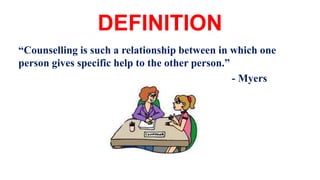
“Counselling is such a relationship between in which one
person gives specific help to the other person.”
- Myers
STEPS AND TECHNIQUES
1. Establishing rapport
• By winning the confidence of the
client and establishing close
relationship with him,
counselling becomes easy and
meaningful.
2. Cultivating self-understanding
• Client may have a clear understanding of his own
abilities, capacities and responsibilities.
• In this situation, the counsellor should improve
his understanding by pretesting and interpretation.
• Having full knowledge of clients problem and
capacity help to effective counselling.
3. Advising and planning of action
• The counsellor should be able to
say the positive and negative
sides of the problems of client
and should be able to give clear
advice.
• Advice should be given frankly.
• Counsellor should help the client
to make the plans.
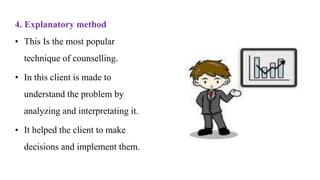
4. Explanatory method
• This Is the most popular
technique of counselling.
• In this client is made to
understand the problem by
analyzing and interpretating it.
• It helped the client to make
decisions and implement them.
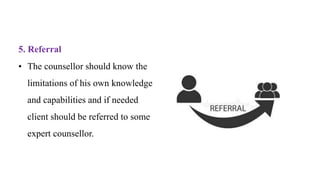
5. Referral
• The counsellor should know the
limitations of his own knowledge
and capabilities and if needed
client should be referred to some
expert counsellor.
6. Other techniques
• Silence
• Acceptance
• Explanation
• Analysis
• Express regret
• Humor
• Ask question
• Short classification
• Repetition
Etc.
PRINCIPLES
1.Principle of respecting the person
• In this counsellor should respect the
individual's feeling’s, beliefs and values.
• Counsellor should be careful towards
feelings and emotions of the client.
2.Principle of acceptance
• Counsellor should be accepted
the client along with his good and
bad qualities.
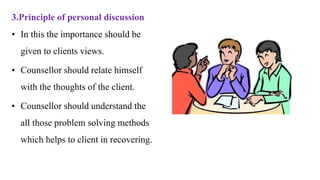
3.Principle of personal discussion
• In this the importance should be
given to clients views.
• Counsellor should relate himself
with the thoughts of the client.
• Counsellor should understand the
all those problem solving methods
which helps to client in recovering.
4. Principle of learning
• Counselling can be though successful only
when the client learns or accept the counselling
given to him.
• In counselling all elements of learning are
found e.g, knowledge, skills, attitudes, actions
etc.
5. Principle of respect of
democratic values
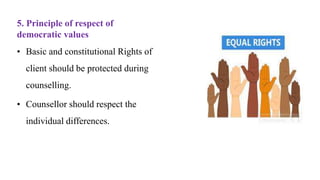
• Basic and constitutional Rights of
client should be protected during
counselling.
• Counsellor should respect the
individual differences.
6. Principle of permissiveness
• Counseling is such a relationship which develops optimism and the
environment shapes according to the person, which helps to give new
hope and efforts are made to make them according to the situation.
• All the thoughts accept the relative relationship in the process
counseling.
QUALITIES OF GOOD
COUNSELLOR
• Able to understand the interest and capacities of patient.
• Understand the desires of the patients.
• Sympathetic behavior.
• Good conversationalist.
• Truthfulness and clarity.
• Friendly behavior.
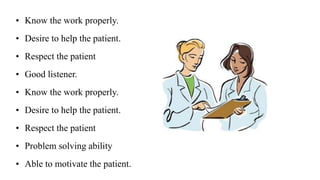
• Good listener.
• Know the work properly.
• Desire to help the patient.
• Respect the patient
• Good listener.
• Know the work properly.
• Desire to help the patient.
• Respect the patient
• Problem solving ability
• Able to motivate the patient.
Things to avoided by counsellor :
• Ignoring the patient
• Not accepting the feelings of patient.
• Aggressive way of asking questions.
• Giving unwanted reassurance and promises.
• Judging and evaluating the patients
• Moralizing and preaching
• Advising rather than helping the patient.
• Directing and leading the unwanted ideas of the patient.
ROLE OF NURSE IN
COUNSELLING
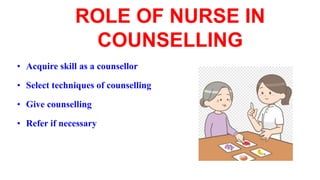
• Acquire skill as a counsellor
• Select techniques of counselling
• Give counselling
• Refer if necessary
1. Acquire skills as a counsellor
• Keep up to date knowledge about subject of counselling.
• Keep knowledge about patient and their problems.
• Identify the various methods of problem solving.
• Develop capacity to evaluate the results of counsellor.
• Select suitable venue and prepare a positive environment.
2. Select the techniques of counselling
• Acquire knowledge about different techniques of counselling.
• Select suitable technique according problem of patients and their
nature.
• Follow code of ethics during counselling e.g, confidentiality,
tolerance.
3. Give counselling
• Use GATHER technique.
• Use suitable facial expressions.
• Maintain right body image.
• Use simple and clear language.
• Listen carefully the problems and issues of patient.
• Min d your dress.
• Use empathy[ keep yourself in the place of the patient].
4. Refer if necessary
If you may come across very
complicated cases or if you feel you
cannot counsel such a person, the
patient should be sent to much more
expert counsellor.
D/B HEALTH EDUCATION AND
COUNSELLING
Health Education
• Aim : to make the patient better
informed so that they make an
informed choice.
• Nature of process :
 It is more preventive in nature.
 Its prepare the learner to find
out the possible situations and
solutions of their problems.
Counselling
• Aim : to encourage the person
to explore their important health
issues and to identify the correct
solutions or ways of living.
• Nature of process :
 It is more curative in nature.
 It helps to client to make
changes in their negative
situations.
• Setting :
 It does not require lot of
privacy.
 Given in a formal setting
among group and
individuals.
• Subject and time :
 It is a temporary and one
time thing.
 It focuses on one health
problem or risk.
• Setting :
 It requires privacy and
confidentiality.
 Setting is selected on an
individual basis.
• Subject and time :
 It is long term and ongoing
process.
 Discussion of feelings,
problems are needed.
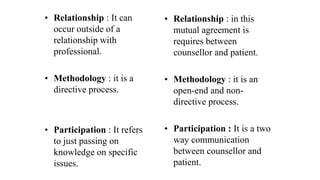
• Relationship : It can
occur outside of a
relationship with
professional.
• Methodology : it is a
directive process.
• Participation : It refers
to just passing on
knowledge on specific
issues.
• Relationship : in this
mutual agreement is
requires between
counsellor and patient.
• Methodology : it is an
open-end and non-
directive process.
• Participation : It is a two
way communication
between counsellor and
patient.
Counselling

Counselling

  • 1.
    COUNSELLING Prepared By :Ms. Leena Ghag Sakpal. RN, P.B.B.Sc.Nursing.
  • 2.
    INTRODUCTION • Counselling isa two way interaction between a client and counsellor. • It is an interpersonal, dynamic communication process that involves a kind of contractual agreement between a client and counsellor. • It aims to encourage healthy living and requires the client to explore important personal issues and identify ways of living with prevailing situation.
  • 3.
    DEFINITION “Counselling is sucha relationship between in which one person gives specific help to the other person.” - Myers
  • 4.
    STEPS AND TECHNIQUES 1.Establishing rapport • By winning the confidence of the client and establishing close relationship with him, counselling becomes easy and meaningful.
  • 5.
    2. Cultivating self-understanding •Client may have a clear understanding of his own abilities, capacities and responsibilities. • In this situation, the counsellor should improve his understanding by pretesting and interpretation. • Having full knowledge of clients problem and capacity help to effective counselling.
  • 6.
    3. Advising andplanning of action • The counsellor should be able to say the positive and negative sides of the problems of client and should be able to give clear advice. • Advice should be given frankly. • Counsellor should help the client to make the plans.
  • 7.
    4. Explanatory method •This Is the most popular technique of counselling. • In this client is made to understand the problem by analyzing and interpretating it. • It helped the client to make decisions and implement them.
  • 8.
    5. Referral • Thecounsellor should know the limitations of his own knowledge and capabilities and if needed client should be referred to some expert counsellor.
  • 9.
    6. Other techniques •Silence • Acceptance • Explanation • Analysis • Express regret • Humor • Ask question • Short classification • Repetition Etc.
  • 10.
    PRINCIPLES 1.Principle of respectingthe person • In this counsellor should respect the individual's feeling’s, beliefs and values. • Counsellor should be careful towards feelings and emotions of the client.
  • 11.
    2.Principle of acceptance •Counsellor should be accepted the client along with his good and bad qualities.
  • 12.
    3.Principle of personaldiscussion • In this the importance should be given to clients views. • Counsellor should relate himself with the thoughts of the client. • Counsellor should understand the all those problem solving methods which helps to client in recovering.
  • 13.
    4. Principle oflearning • Counselling can be though successful only when the client learns or accept the counselling given to him. • In counselling all elements of learning are found e.g, knowledge, skills, attitudes, actions etc.
  • 14.
    5. Principle ofrespect of democratic values • Basic and constitutional Rights of client should be protected during counselling. • Counsellor should respect the individual differences.
  • 15.
    6. Principle ofpermissiveness • Counseling is such a relationship which develops optimism and the environment shapes according to the person, which helps to give new hope and efforts are made to make them according to the situation. • All the thoughts accept the relative relationship in the process counseling.
  • 16.
    QUALITIES OF GOOD COUNSELLOR •Able to understand the interest and capacities of patient. • Understand the desires of the patients. • Sympathetic behavior. • Good conversationalist. • Truthfulness and clarity. • Friendly behavior. • Good listener.
  • 17.
    • Know thework properly. • Desire to help the patient. • Respect the patient • Good listener. • Know the work properly. • Desire to help the patient. • Respect the patient • Problem solving ability • Able to motivate the patient.
  • 18.
    Things to avoidedby counsellor : • Ignoring the patient • Not accepting the feelings of patient. • Aggressive way of asking questions. • Giving unwanted reassurance and promises. • Judging and evaluating the patients • Moralizing and preaching • Advising rather than helping the patient. • Directing and leading the unwanted ideas of the patient.
  • 19.
    ROLE OF NURSEIN COUNSELLING • Acquire skill as a counsellor • Select techniques of counselling • Give counselling • Refer if necessary
  • 20.
    1. Acquire skillsas a counsellor • Keep up to date knowledge about subject of counselling. • Keep knowledge about patient and their problems. • Identify the various methods of problem solving. • Develop capacity to evaluate the results of counsellor. • Select suitable venue and prepare a positive environment.
  • 21.
    2. Select thetechniques of counselling • Acquire knowledge about different techniques of counselling. • Select suitable technique according problem of patients and their nature. • Follow code of ethics during counselling e.g, confidentiality, tolerance.
  • 22.
    3. Give counselling •Use GATHER technique. • Use suitable facial expressions. • Maintain right body image. • Use simple and clear language. • Listen carefully the problems and issues of patient. • Min d your dress. • Use empathy[ keep yourself in the place of the patient].
  • 23.
    4. Refer ifnecessary If you may come across very complicated cases or if you feel you cannot counsel such a person, the patient should be sent to much more expert counsellor.
  • 24.
    D/B HEALTH EDUCATIONAND COUNSELLING Health Education • Aim : to make the patient better informed so that they make an informed choice. • Nature of process :  It is more preventive in nature.  Its prepare the learner to find out the possible situations and solutions of their problems. Counselling • Aim : to encourage the person to explore their important health issues and to identify the correct solutions or ways of living. • Nature of process :  It is more curative in nature.  It helps to client to make changes in their negative situations.
  • 25.
    • Setting : It does not require lot of privacy.  Given in a formal setting among group and individuals. • Subject and time :  It is a temporary and one time thing.  It focuses on one health problem or risk. • Setting :  It requires privacy and confidentiality.  Setting is selected on an individual basis. • Subject and time :  It is long term and ongoing process.  Discussion of feelings, problems are needed.
  • 26.
    • Relationship :It can occur outside of a relationship with professional. • Methodology : it is a directive process. • Participation : It refers to just passing on knowledge on specific issues. • Relationship : in this mutual agreement is requires between counsellor and patient. • Methodology : it is an open-end and non- directive process. • Participation : It is a two way communication between counsellor and patient.