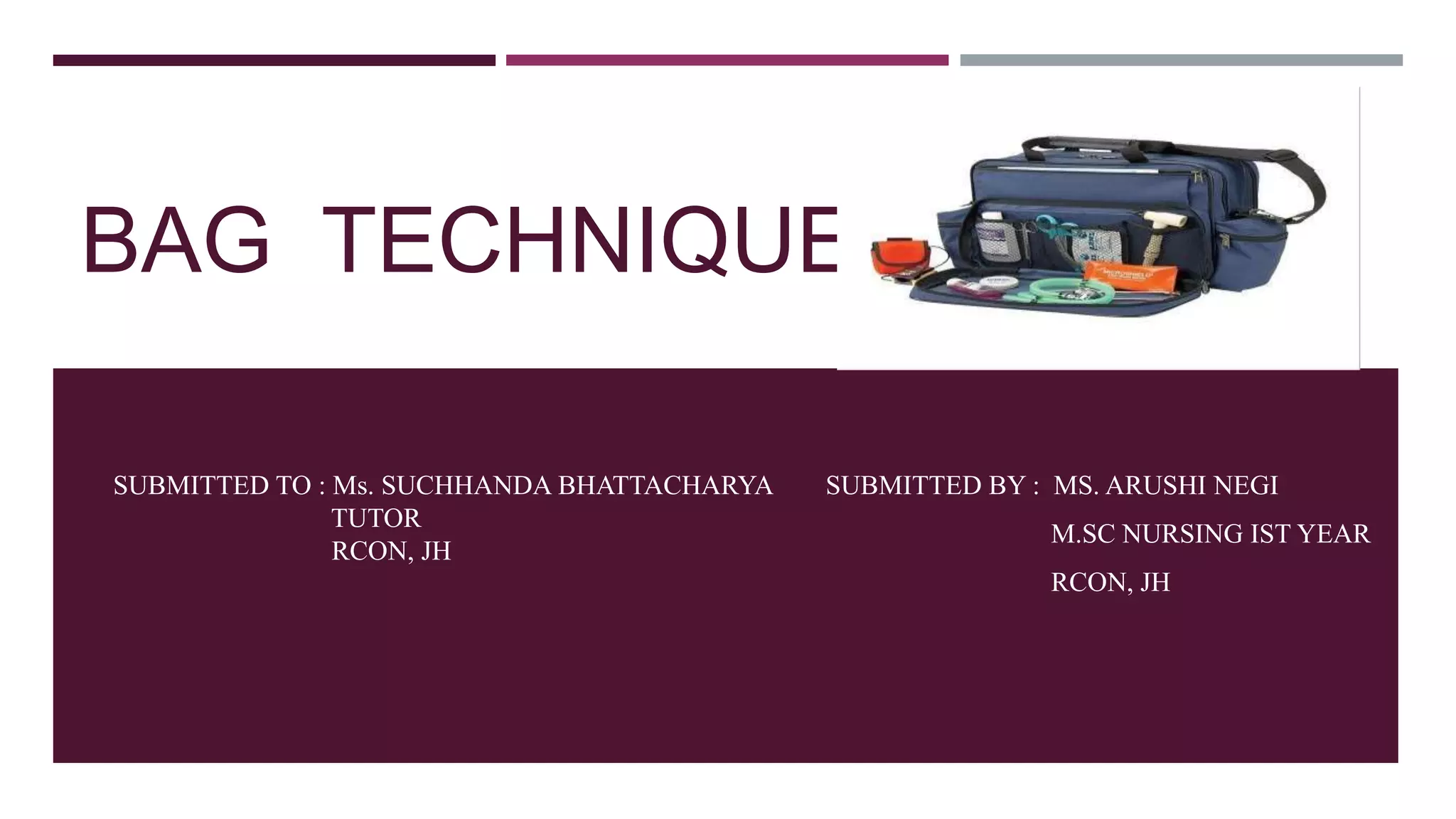
BAG TECHNIQUE
SUBMITTED BY : MS. ARUSHI NEGI
M.SC NURSING IST YEAR
RCON, JH
SUBMITTED TO : Ms. SUCHHANDA BHATTACHARYA
TUTOR
RCON, JH
INTRODUCTION
 The major aim of the health care services in the home is to help people
with their health problems
 When performing home visit the community health nurses should carry
the community health bag .
 Home visiting is very essential and important aspect to the community.
 The services in the home requires technical skills, knowledge of
preventive and therapeutic measures, teaching ability, judgement and a
full understanding of human relations.
DEFINITION
COMMUNITY:
• A group of species who reside in a designated geographical area and who share
common interest or bonds.
BAG:
• It is a flexible, or dilated sac or pouch designed to contain needed article to carry
from one place to other place to do the health related services to the people.
BAG TECHNIQUE:
• The bag technique is a tool by which the nurse, during her visit will enable her to
perform a nursing procedure with ease and to save time and effort with the end
view of rendering effective nursing care to clients
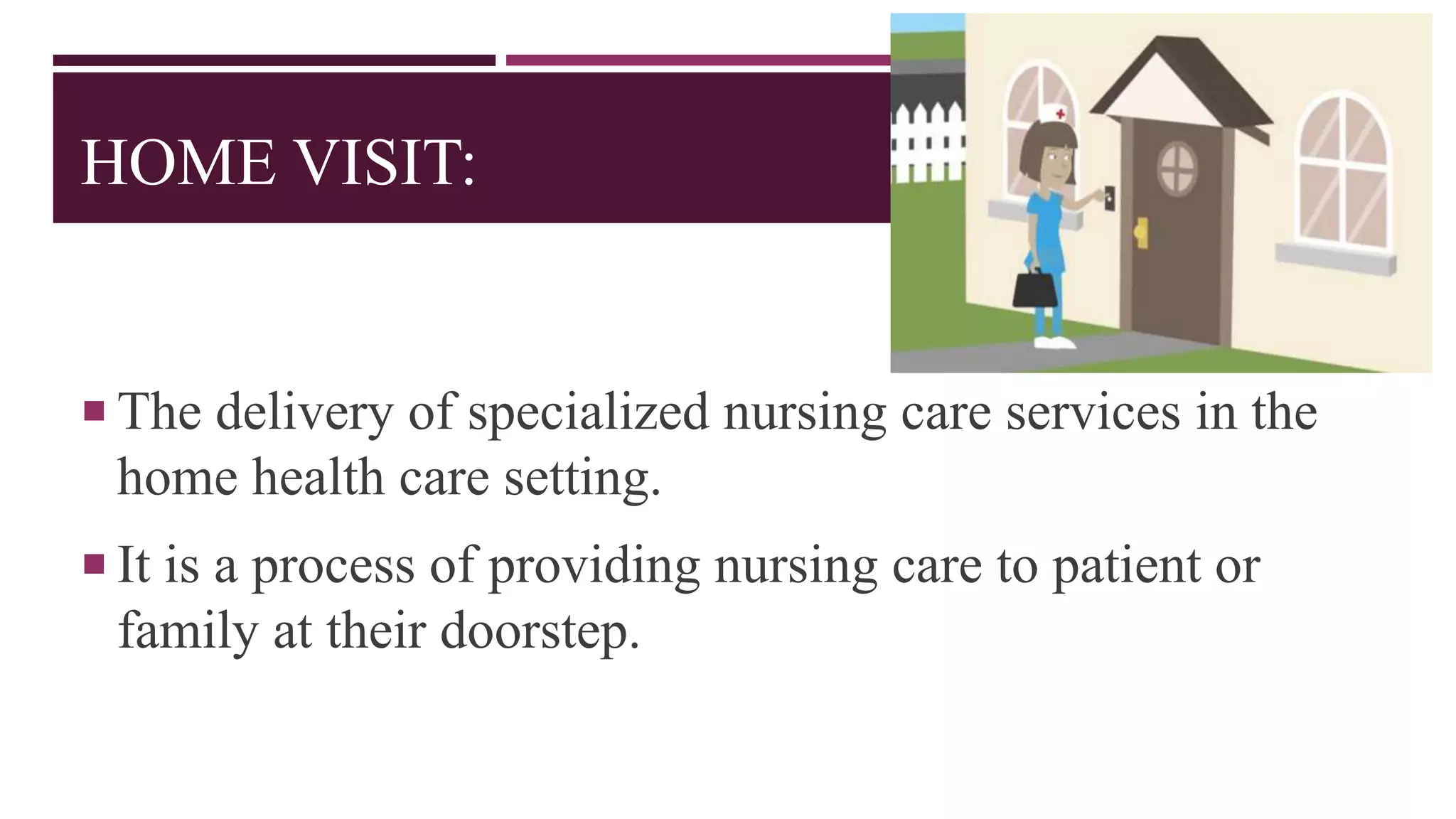
HOME VISIT:
 The delivery of specialized nursing care services in the
home health care setting.
 It is a process of providing nursing care to patient or
family at their doorstep.
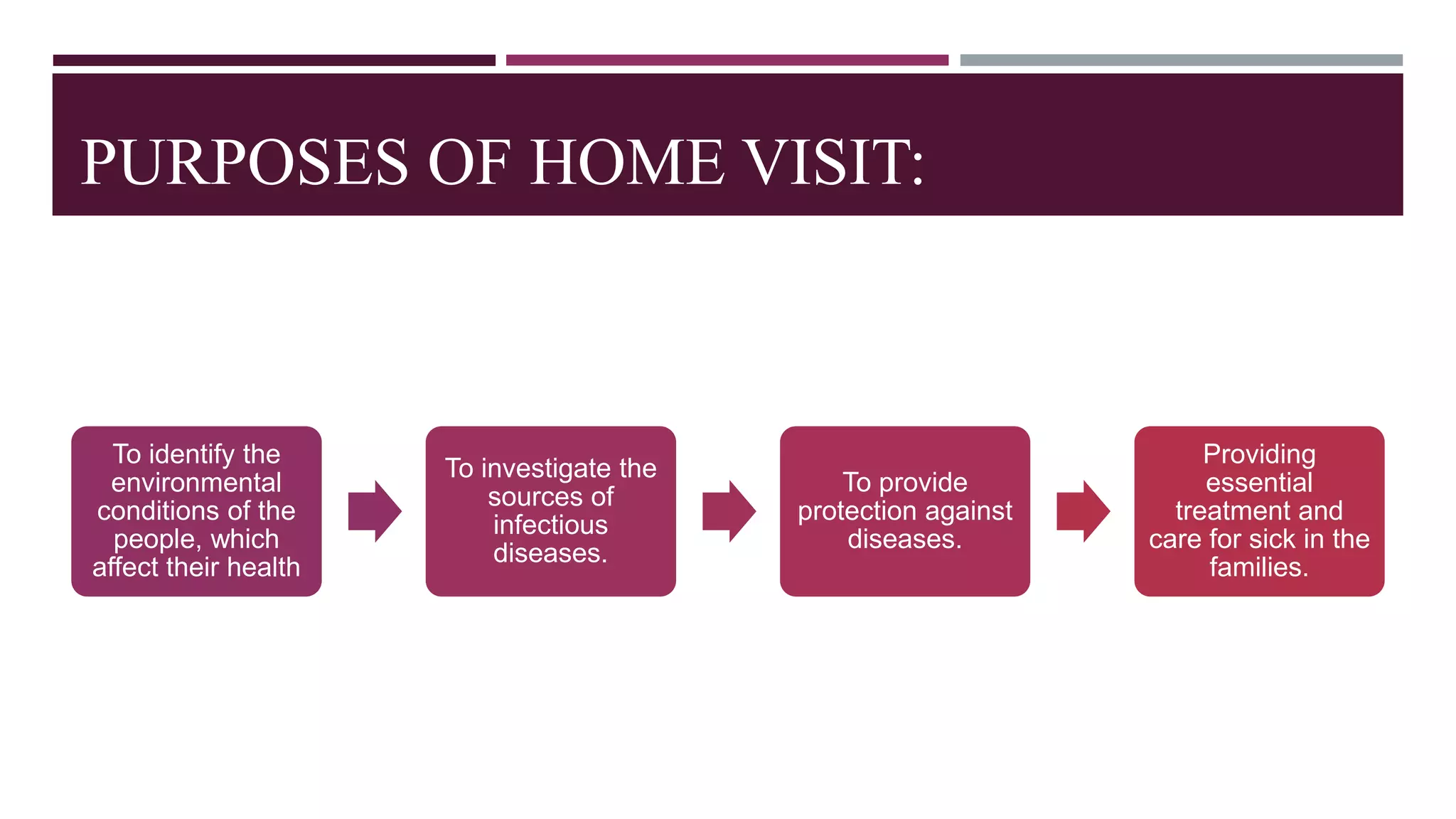
PURPOSES OF HOME VISIT:
To identify the
environmental
conditions of the
people, which
affect their health
To investigate the
sources of
infectious
diseases.
To provide
protection against
diseases.
Providing
essential
treatment and
care for sick in the
families.
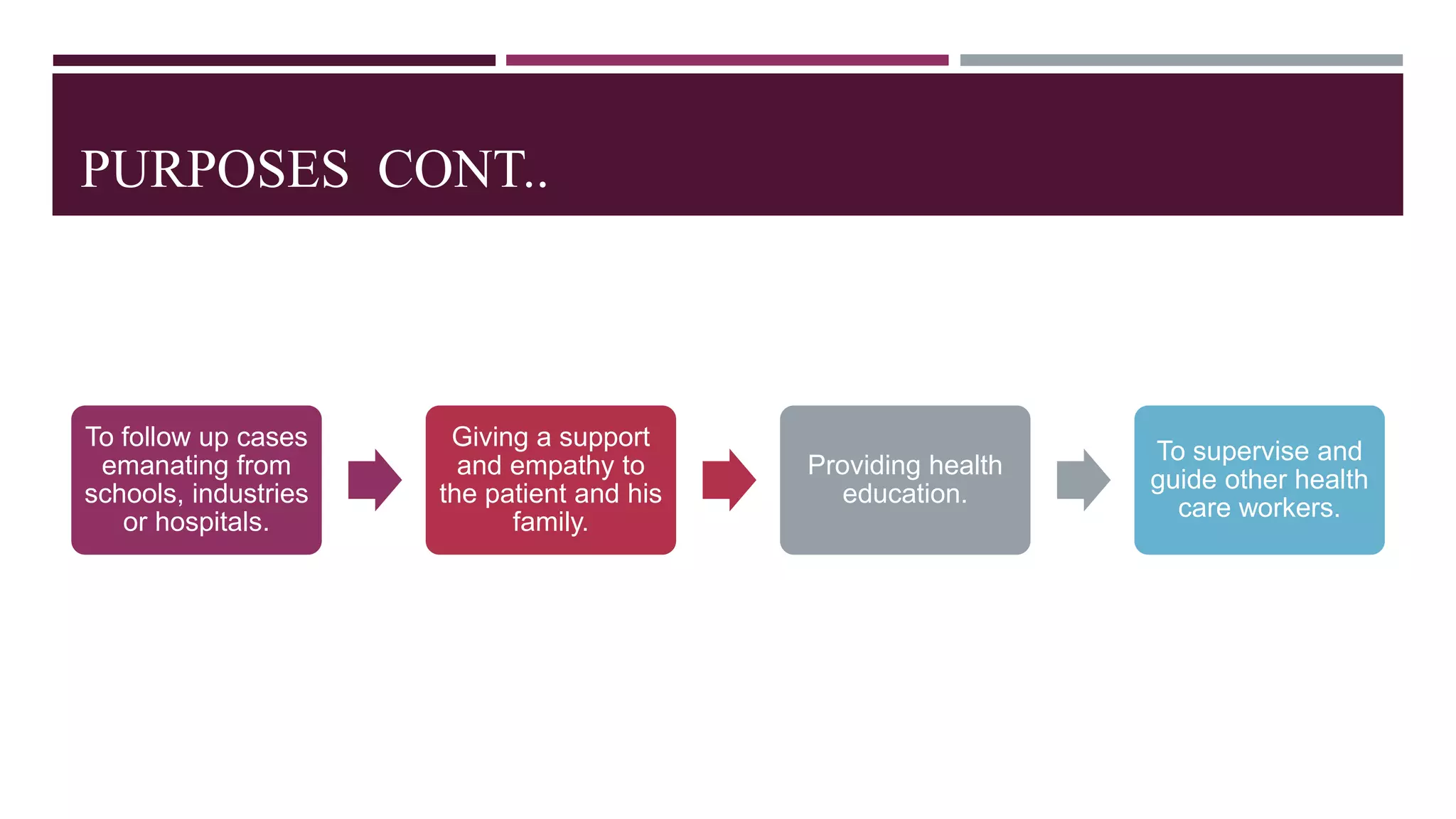
PURPOSES CONT..
To follow up cases
emanating from
schools, industries
or hospitals.
Giving a support
and empathy to
the patient and his
family.
Providing health
education.
To supervise and
guide other health
care workers.
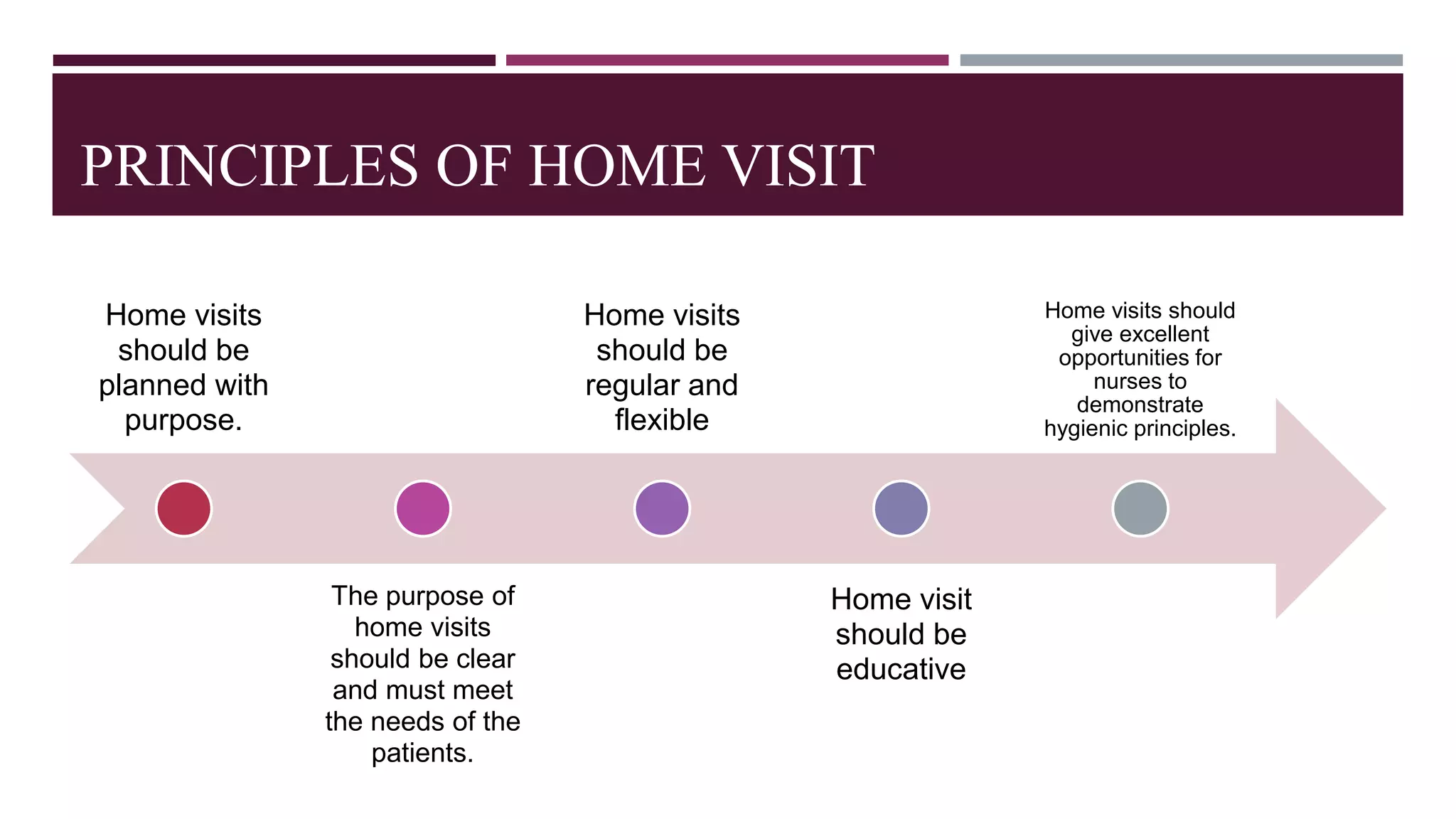
PRINCIPLES OF HOME VISIT
Home visits
should be
planned with
purpose.
The purpose of
home visits
should be clear
and must meet
the needs of the
patients.
Home visits
should be
regular and
flexible
Home visit
should be
educative
Home visits should
give excellent
opportunities for
nurses to
demonstrate
hygienic principles.
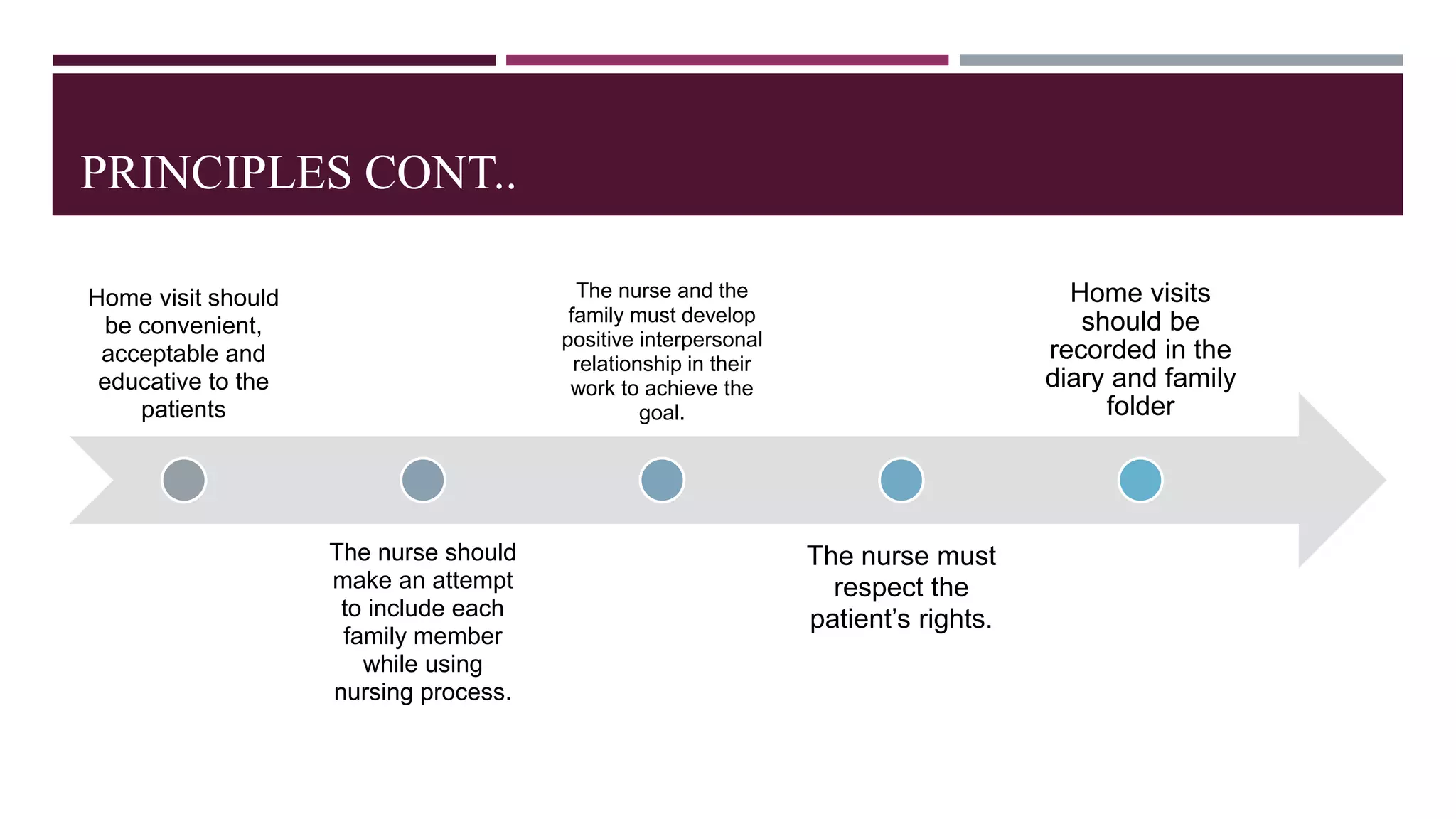
PRINCIPLES CONT..
Home visit should
be convenient,
acceptable and
educative to the
patients
The nurse should
make an attempt
to include each
family member
while using
nursing process.
The nurse and the
family must develop
positive interpersonal
relationship in their
work to achieve the
goal.
The nurse must
respect the
patient’s rights.
Home visits
should be
recorded in the
diary and family
folder
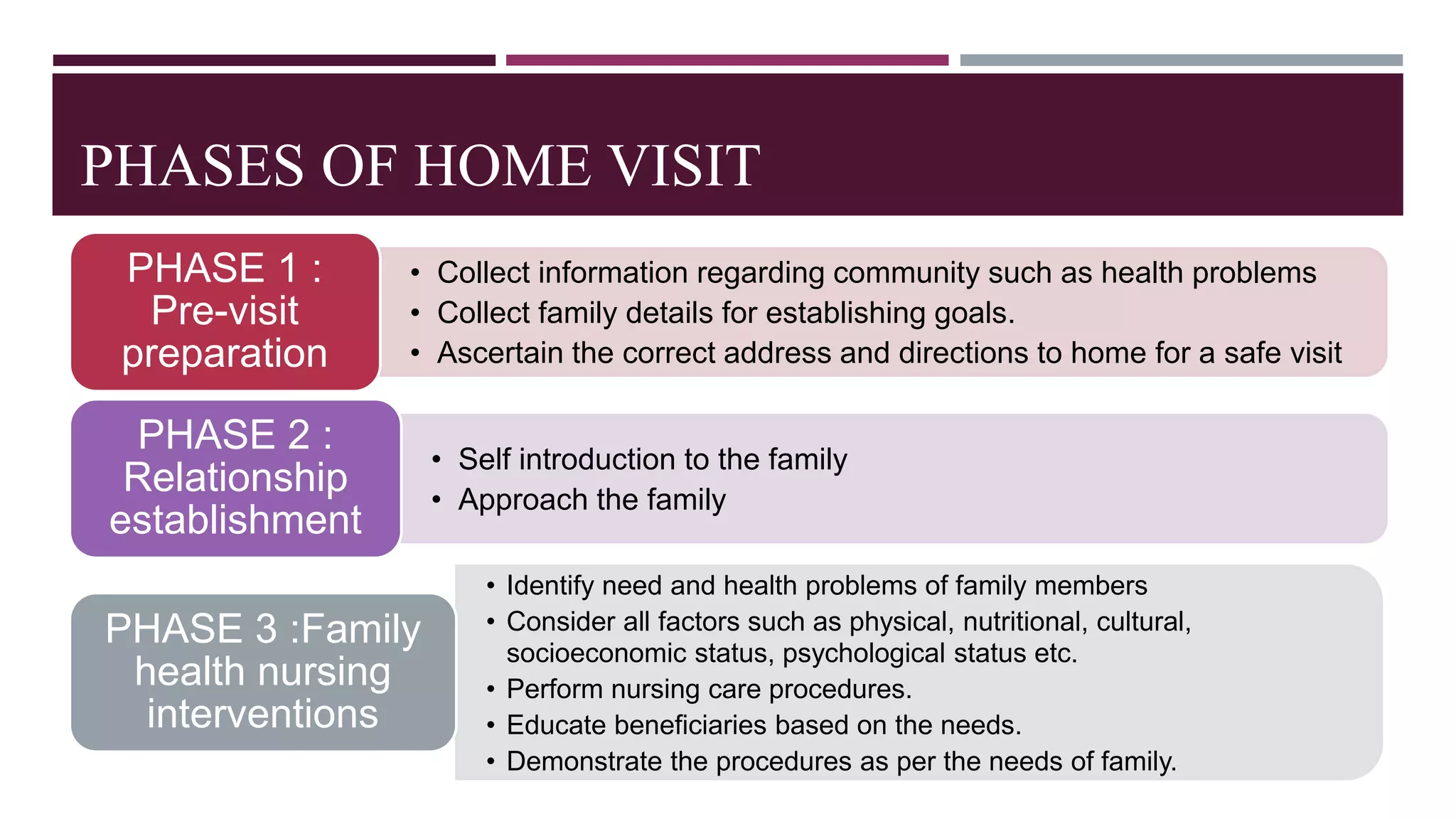
PHASES OF HOME VISIT
• Collect information regarding community such as health problems
• Collect family details for establishing goals.
• Ascertain the correct address and directions to home for a safe visit
PHASE 1 :
Pre-visit
preparation
• Self introduction to the family
• Approach the family
PHASE 2 :
Relationship
establishment
• Identify need and health problems of family members
• Consider all factors such as physical, nutritional, cultural,
socioeconomic status, psychological status etc.
• Perform nursing care procedures.
• Educate beneficiaries based on the needs.
• Demonstrate the procedures as per the needs of family.
PHASE 3 :Family
health nursing
interventions
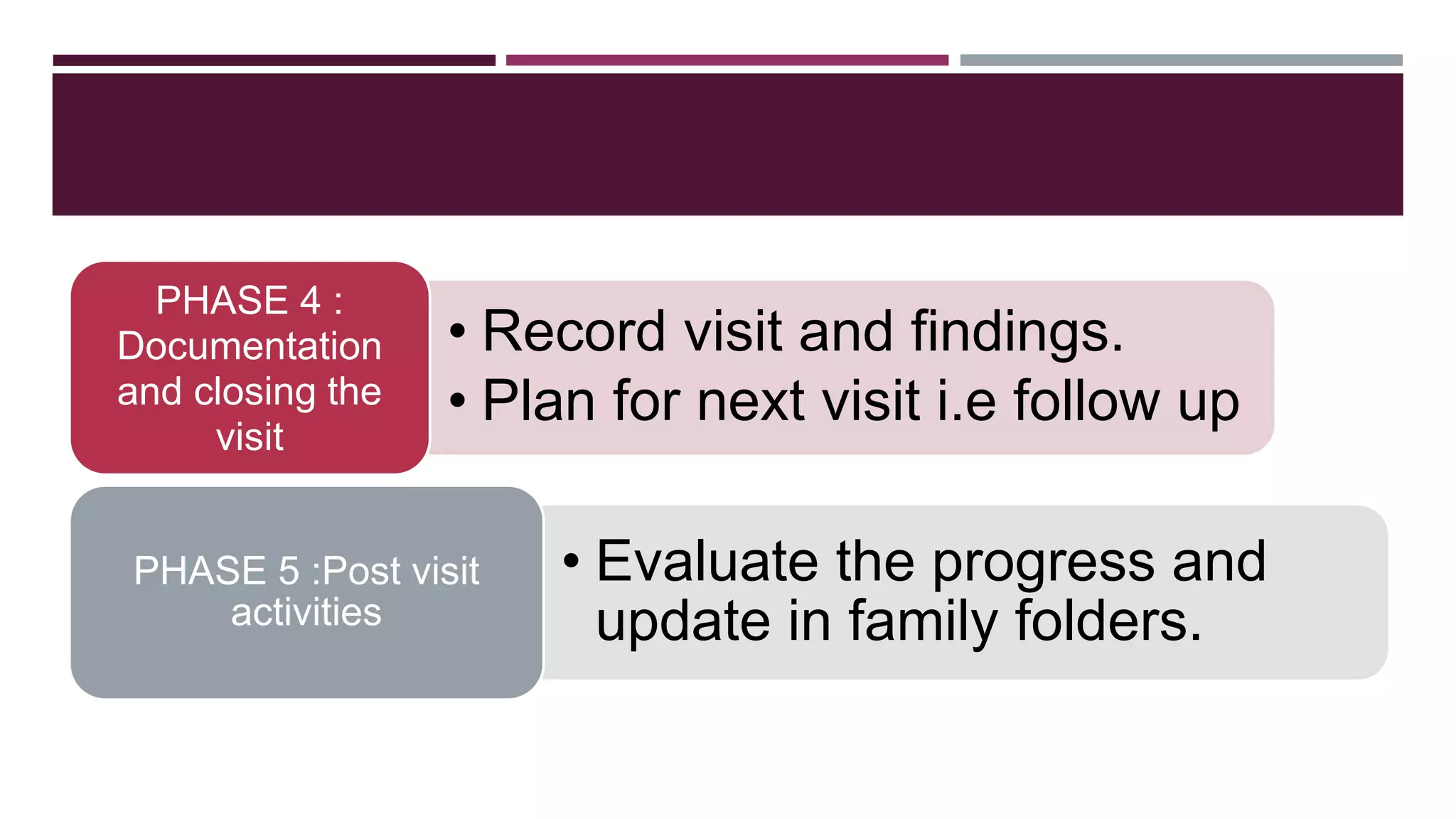
• Record visit and findings.
• Plan for next visit i.e follow up
PHASE 4 :
Documentation
and closing the
visit
• Evaluate the progress and
update in family folders.
PHASE 5 :Post visit
activities
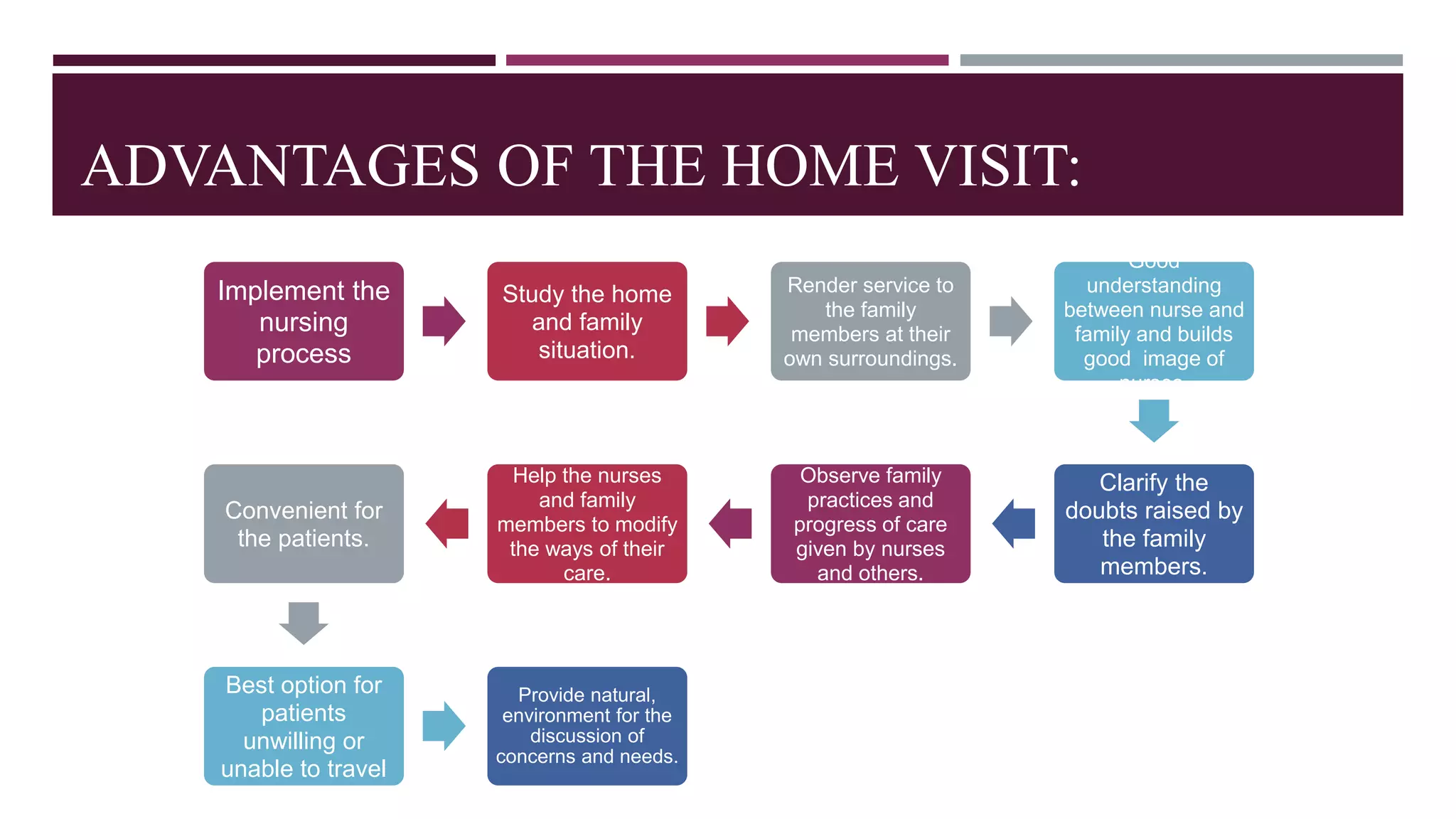
ADVANTAGES OF THE HOME VISIT:
Implement the
nursing
process
Study the home
and family
situation.
Render service to
the family
members at their
own surroundings.
Good
understanding
between nurse and
family and builds
good image of
nurses.
Clarify the
doubts raised by
the family
members.
Observe family
practices and
progress of care
given by nurses
and others.
Help the nurses
and family
members to modify
the ways of their
care.
Convenient for
the patients.
Best option for
patients
unwilling or
unable to travel
Provide natural,
environment for the
discussion of
concerns and needs.
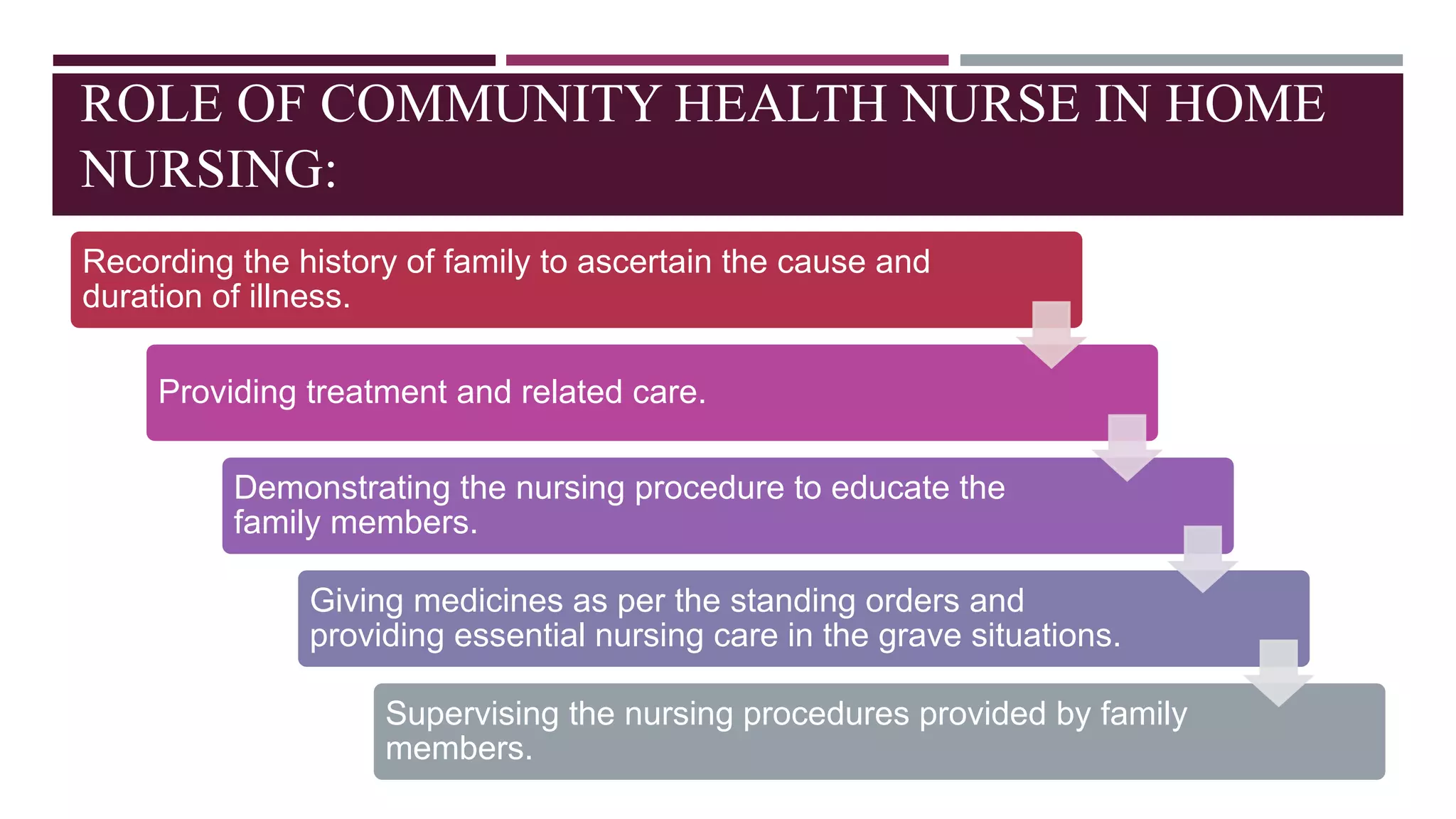
ROLE OF COMMUNITY HEALTH NURSE IN HOME
NURSING:
Recording the history of family to ascertain the cause and
duration of illness.
Providing treatment and related care.
Demonstrating the nursing procedure to educate the
family members.
Giving medicines as per the standing orders and
providing essential nursing care in the grave situations.
Supervising the nursing procedures provided by family
members.
BAG TECHNIQUES
 INTRODUCTION:
 Bag is a vehicle for carrying the materials and equipments needed during home visit
to attend family ,school and factory health care needs.The bag should be made of
strong but light weight materials.
 BAG TECHNIQUE:
 The bag technique is a tool by which the nurse, during her visit will enable her to
perform a nursing procedure with ease and deftness, to save time and effort with the
end view of rendering effective nursing care to clients
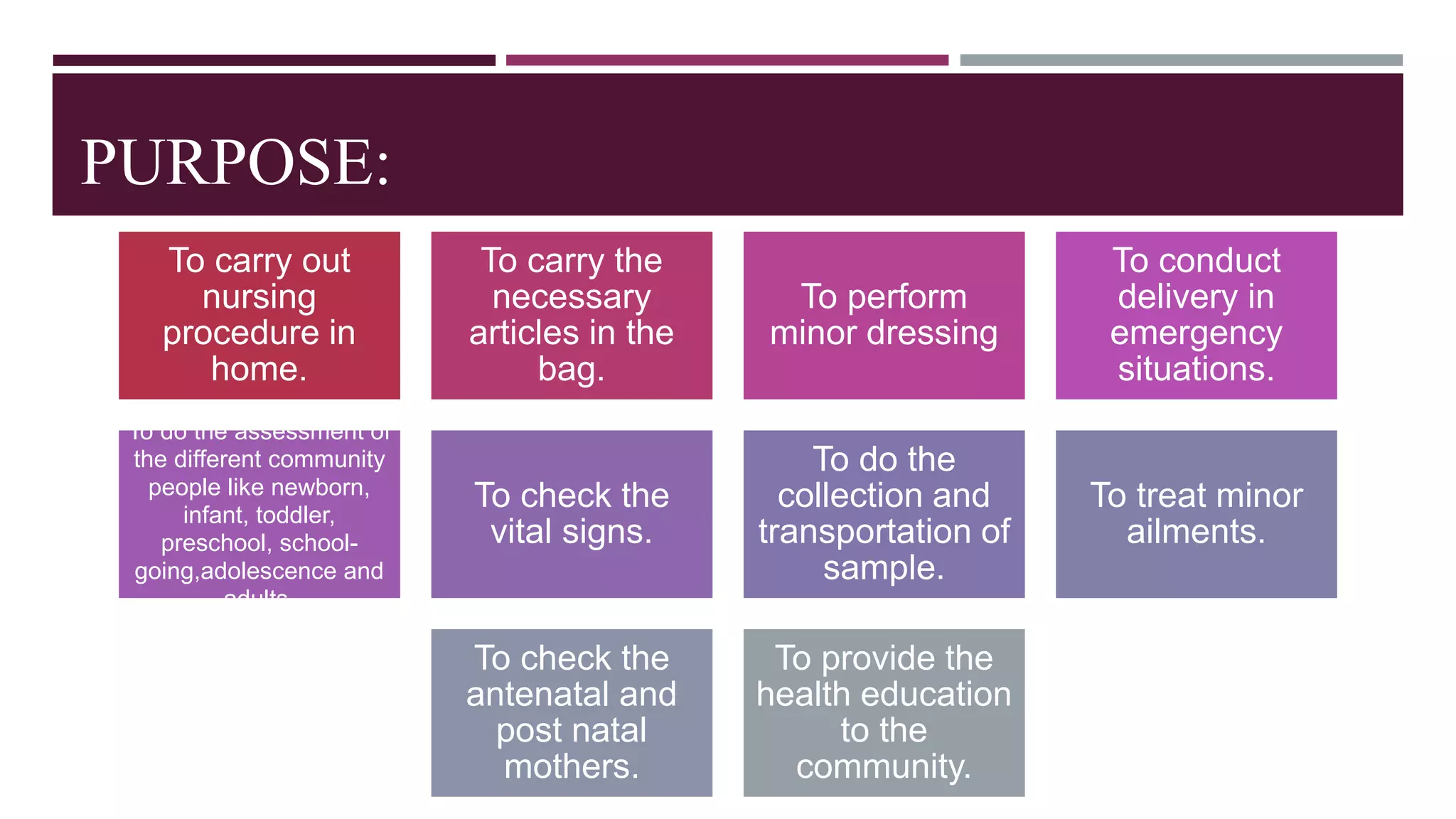
PURPOSE:
To carry out
nursing
procedure in
home.
To carry the
necessary
articles in the
bag.
To perform
minor dressing
To conduct
delivery in
emergency
situations.
To do the assessment of
the different community
people like newborn,
infant, toddler,
preschool, school-
going,adolescence and
adults.
To check the
vital signs.
To do the
collection and
transportation of
sample.
To treat minor
ailments.
To check the
antenatal and
post natal
mothers.
To provide the
health education
to the
community.
PRINCIPLES OF COMMUNITY HEALTH BAG
 Keep bag away from children and pet animals
 Keep the bag on the flat and raised surface
 Keep community bag always clean and equip economically
 Sterilize/ boil contaminated articles before keeping them again into bag.
 Provide privacy to the clients and maintain the standards of community
procedures.
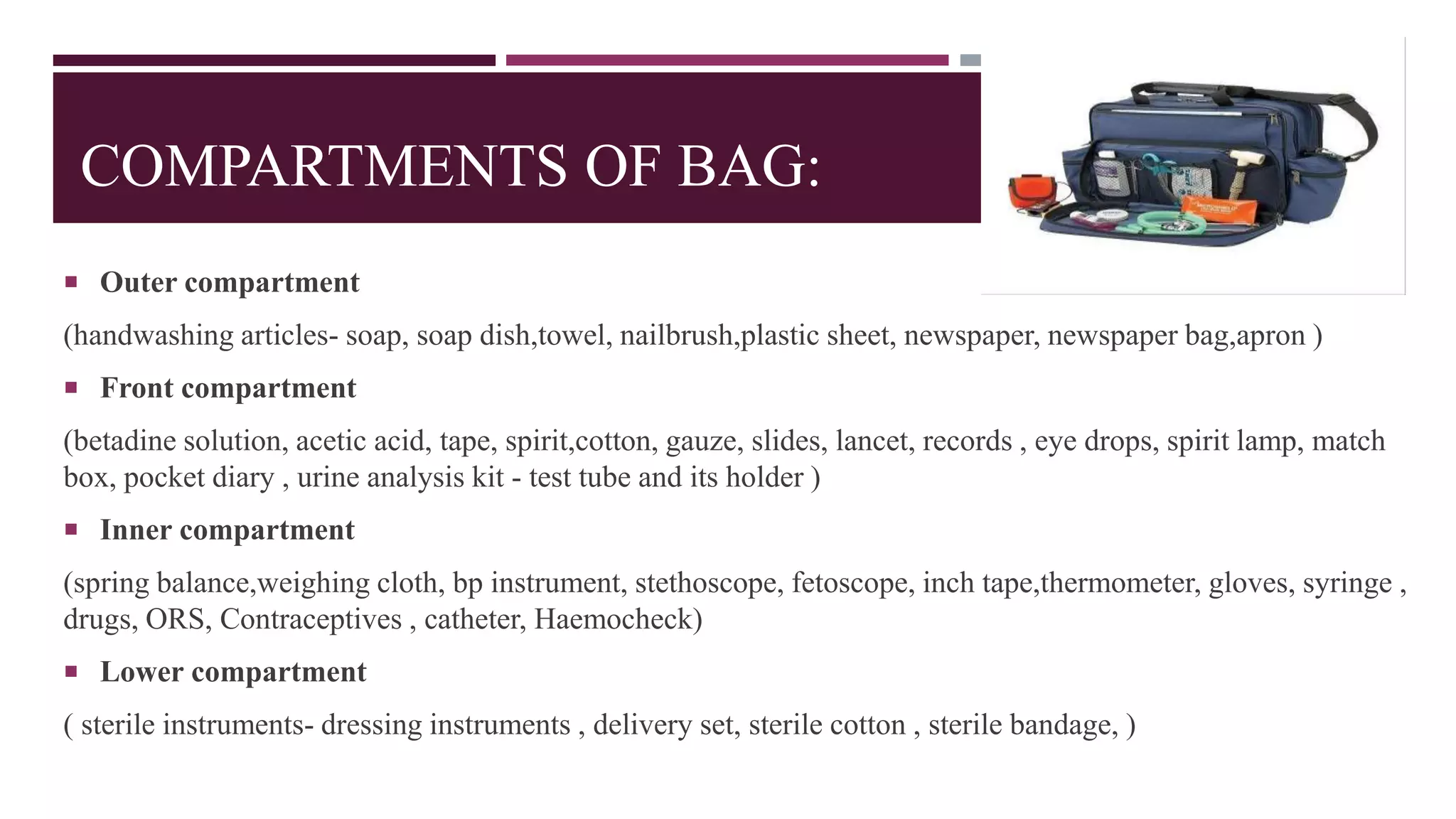
COMPARTMENTS OF BAG:
 Outer compartment
(handwashing articles- soap, soap dish,towel, nailbrush,plastic sheet, newspaper, newspaper bag,apron )
 Front compartment
(betadine solution, acetic acid, tape, spirit,cotton, gauze, slides, lancet, records , eye drops, spirit lamp, match
box, pocket diary , urine analysis kit - test tube and its holder )
 Inner compartment
(spring balance,weighing cloth, bp instrument, stethoscope, fetoscope, inch tape,thermometer, gloves, syringe ,
drugs, ORS, Contraceptives , catheter, Haemocheck)
 Lower compartment
( sterile instruments- dressing instruments , delivery set, sterile cotton , sterile bandage, )
PROCEDURE:
 Select the a work area where the bag may be set without danger being contaminated.e.g. verandah.
 Place the bag on a piece of news paper or plastic sheet.
 After spreading the newspaper, keep the bag at the corner of the paper.
 Remove the inner compartment half-way fold backside.
 To keep it ready to touch the inner compartment after hand washing procedure.
 Remove the necessary article form front compartment.
 Remove the hand washing articles from lower compartment for hand washing procedure.
 Before going to do hand washing check the bag technique area arranged according to the sequence way of procedure.
 Take the hand washing articles go to hand washing place. Wash the hands under poured water or tap water. Wash the
hands with bacteriostatic soap if available.
 After hands washing , open the bag and take only needed articles from the bag and close the bag in half –way.
 Don’t the display the bag fully to outer environment because it cross infection from the home.
 Don’t open the bag inner compartment unnecessary.
 Give the nursing procedure as indicated according to the need that is shown during a visit and by records.
 When the procedure is over, placing the soiled swabs inside the paper bag for disposable by burning or any other suitable method.
 After the procedure, wash hands with soap and water.
 Return articles to the bag- use a cotton swab moistened with spirit and wipe outside of used bottles and other articles taken from the
inner compartment.
 Other instrument like dressing kit, delivery kit etc. wash and boil all the instruments if possible collect it and take back to health centre
for disinfection.
 Check all the articles from inner compartment replaced with clean technique or not.
 Close the bag(inner compartment)
 Go to hand washing area. Wash the hands .
 Bring the hands washing articles near to the bag and replace it.
 Close the bag ( lower compartment)
 Replace the articles from front compartment.
 Record the procedure.
 Fold the used newspaper or plastic sheet with exposed side innermost and keep it in the outside pocket of the bag.
CARE OF EQUIPMENTS
Bag: Leather bag to be washed with soap and water. Canvas bag to be washed and dried in sun.
Rubber goods: sterilized by boiling for 10 minutes; but disposable gloves are disposed by sanitary method.
Thermometer: Soked in antiseptic lotion.
Glass bottles: Sterilized in boiled water.
Enamel or steel items: 20 minutes boiling required.
Cord ligature: Pre-sterilized pack is available; otherwise thread is boiled for 20minutes; it is handled with sterile forceps and scrubbed hands.
Eye drop: Opened ones are used within 10 days; later to be discarded and a new one is to be procured.
Dry dressing and swabs: Autoclaved material is carried and used ones are disposed by burning.
Instruments: Sterilization process is followed.
Weighing machine: check regularly functioning or not.
Other instrument: B.P apparatus foetoscope and stethoscope is handled properly.
A-V aids materials: Cover with plastic sheet or polythene cover.
SUMMARY
 Through this content we came to know about home visit, its
purposes , its principles, its phases , advantages and role of
community health nurse in home visiting.
 Also, bag technique, its purpose, principles , compartments of
bag, procedure and care of equipments.
CONCLUSION
 When performing home visit the community health nurses should carry
the community health bag i.e., general nursing kit bag
 Home visiting is very essential and important aspect to the community.
 The services in the home requires technical skills, knowledge of
preventive and therapeutic measures, teaching ability, judgement and a
full understanding of human relations.
BIBLIOGRAPHY
 Dash B., A comprehensive textbook of community health nursing, First
edition, 2017, the health sciences publisher, pg no-28-30
 Gowri N, Grace G, Procedure manual for community health
nursing,2020-2021, CBS publishers and distributors , pg no- 3-9.
bag technique.pptx

bag technique.pptx

  • 1.
    BAG TECHNIQUE SUBMITTED BY: MS. ARUSHI NEGI M.SC NURSING IST YEAR RCON, JH SUBMITTED TO : Ms. SUCHHANDA BHATTACHARYA TUTOR RCON, JH
  • 2.
    INTRODUCTION  The majoraim of the health care services in the home is to help people with their health problems  When performing home visit the community health nurses should carry the community health bag .  Home visiting is very essential and important aspect to the community.  The services in the home requires technical skills, knowledge of preventive and therapeutic measures, teaching ability, judgement and a full understanding of human relations.
  • 3.
    DEFINITION COMMUNITY: • A groupof species who reside in a designated geographical area and who share common interest or bonds. BAG: • It is a flexible, or dilated sac or pouch designed to contain needed article to carry from one place to other place to do the health related services to the people. BAG TECHNIQUE: • The bag technique is a tool by which the nurse, during her visit will enable her to perform a nursing procedure with ease and to save time and effort with the end view of rendering effective nursing care to clients
  • 4.
    HOME VISIT:  Thedelivery of specialized nursing care services in the home health care setting.  It is a process of providing nursing care to patient or family at their doorstep.
  • 5.
    PURPOSES OF HOMEVISIT: To identify the environmental conditions of the people, which affect their health To investigate the sources of infectious diseases. To provide protection against diseases. Providing essential treatment and care for sick in the families.
  • 6.
    PURPOSES CONT.. To followup cases emanating from schools, industries or hospitals. Giving a support and empathy to the patient and his family. Providing health education. To supervise and guide other health care workers.
  • 7.
    PRINCIPLES OF HOMEVISIT Home visits should be planned with purpose. The purpose of home visits should be clear and must meet the needs of the patients. Home visits should be regular and flexible Home visit should be educative Home visits should give excellent opportunities for nurses to demonstrate hygienic principles.
  • 8.
    PRINCIPLES CONT.. Home visitshould be convenient, acceptable and educative to the patients The nurse should make an attempt to include each family member while using nursing process. The nurse and the family must develop positive interpersonal relationship in their work to achieve the goal. The nurse must respect the patient’s rights. Home visits should be recorded in the diary and family folder
  • 9.
    PHASES OF HOMEVISIT • Collect information regarding community such as health problems • Collect family details for establishing goals. • Ascertain the correct address and directions to home for a safe visit PHASE 1 : Pre-visit preparation • Self introduction to the family • Approach the family PHASE 2 : Relationship establishment • Identify need and health problems of family members • Consider all factors such as physical, nutritional, cultural, socioeconomic status, psychological status etc. • Perform nursing care procedures. • Educate beneficiaries based on the needs. • Demonstrate the procedures as per the needs of family. PHASE 3 :Family health nursing interventions
  • 10.
    • Record visitand findings. • Plan for next visit i.e follow up PHASE 4 : Documentation and closing the visit • Evaluate the progress and update in family folders. PHASE 5 :Post visit activities
  • 11.
    ADVANTAGES OF THEHOME VISIT: Implement the nursing process Study the home and family situation. Render service to the family members at their own surroundings. Good understanding between nurse and family and builds good image of nurses. Clarify the doubts raised by the family members. Observe family practices and progress of care given by nurses and others. Help the nurses and family members to modify the ways of their care. Convenient for the patients. Best option for patients unwilling or unable to travel Provide natural, environment for the discussion of concerns and needs.
  • 12.
    ROLE OF COMMUNITYHEALTH NURSE IN HOME NURSING: Recording the history of family to ascertain the cause and duration of illness. Providing treatment and related care. Demonstrating the nursing procedure to educate the family members. Giving medicines as per the standing orders and providing essential nursing care in the grave situations. Supervising the nursing procedures provided by family members.
  • 13.
    BAG TECHNIQUES  INTRODUCTION: Bag is a vehicle for carrying the materials and equipments needed during home visit to attend family ,school and factory health care needs.The bag should be made of strong but light weight materials.  BAG TECHNIQUE:  The bag technique is a tool by which the nurse, during her visit will enable her to perform a nursing procedure with ease and deftness, to save time and effort with the end view of rendering effective nursing care to clients
  • 14.
    PURPOSE: To carry out nursing procedurein home. To carry the necessary articles in the bag. To perform minor dressing To conduct delivery in emergency situations. To do the assessment of the different community people like newborn, infant, toddler, preschool, school- going,adolescence and adults. To check the vital signs. To do the collection and transportation of sample. To treat minor ailments. To check the antenatal and post natal mothers. To provide the health education to the community.
  • 15.
    PRINCIPLES OF COMMUNITYHEALTH BAG  Keep bag away from children and pet animals  Keep the bag on the flat and raised surface  Keep community bag always clean and equip economically  Sterilize/ boil contaminated articles before keeping them again into bag.  Provide privacy to the clients and maintain the standards of community procedures.
  • 16.
    COMPARTMENTS OF BAG: Outer compartment (handwashing articles- soap, soap dish,towel, nailbrush,plastic sheet, newspaper, newspaper bag,apron )  Front compartment (betadine solution, acetic acid, tape, spirit,cotton, gauze, slides, lancet, records , eye drops, spirit lamp, match box, pocket diary , urine analysis kit - test tube and its holder )  Inner compartment (spring balance,weighing cloth, bp instrument, stethoscope, fetoscope, inch tape,thermometer, gloves, syringe , drugs, ORS, Contraceptives , catheter, Haemocheck)  Lower compartment ( sterile instruments- dressing instruments , delivery set, sterile cotton , sterile bandage, )
  • 17.
    PROCEDURE:  Select thea work area where the bag may be set without danger being contaminated.e.g. verandah.  Place the bag on a piece of news paper or plastic sheet.  After spreading the newspaper, keep the bag at the corner of the paper.  Remove the inner compartment half-way fold backside.  To keep it ready to touch the inner compartment after hand washing procedure.  Remove the necessary article form front compartment.  Remove the hand washing articles from lower compartment for hand washing procedure.  Before going to do hand washing check the bag technique area arranged according to the sequence way of procedure.  Take the hand washing articles go to hand washing place. Wash the hands under poured water or tap water. Wash the hands with bacteriostatic soap if available.  After hands washing , open the bag and take only needed articles from the bag and close the bag in half –way.
  • 18.
     Don’t thedisplay the bag fully to outer environment because it cross infection from the home.  Don’t open the bag inner compartment unnecessary.  Give the nursing procedure as indicated according to the need that is shown during a visit and by records.  When the procedure is over, placing the soiled swabs inside the paper bag for disposable by burning or any other suitable method.  After the procedure, wash hands with soap and water.  Return articles to the bag- use a cotton swab moistened with spirit and wipe outside of used bottles and other articles taken from the inner compartment.  Other instrument like dressing kit, delivery kit etc. wash and boil all the instruments if possible collect it and take back to health centre for disinfection.  Check all the articles from inner compartment replaced with clean technique or not.  Close the bag(inner compartment)  Go to hand washing area. Wash the hands .  Bring the hands washing articles near to the bag and replace it.  Close the bag ( lower compartment)  Replace the articles from front compartment.  Record the procedure.  Fold the used newspaper or plastic sheet with exposed side innermost and keep it in the outside pocket of the bag.
  • 19.
    CARE OF EQUIPMENTS Bag:Leather bag to be washed with soap and water. Canvas bag to be washed and dried in sun. Rubber goods: sterilized by boiling for 10 minutes; but disposable gloves are disposed by sanitary method. Thermometer: Soked in antiseptic lotion. Glass bottles: Sterilized in boiled water. Enamel or steel items: 20 minutes boiling required. Cord ligature: Pre-sterilized pack is available; otherwise thread is boiled for 20minutes; it is handled with sterile forceps and scrubbed hands. Eye drop: Opened ones are used within 10 days; later to be discarded and a new one is to be procured. Dry dressing and swabs: Autoclaved material is carried and used ones are disposed by burning. Instruments: Sterilization process is followed. Weighing machine: check regularly functioning or not. Other instrument: B.P apparatus foetoscope and stethoscope is handled properly. A-V aids materials: Cover with plastic sheet or polythene cover.
  • 20.
    SUMMARY  Through thiscontent we came to know about home visit, its purposes , its principles, its phases , advantages and role of community health nurse in home visiting.  Also, bag technique, its purpose, principles , compartments of bag, procedure and care of equipments.
  • 21.
    CONCLUSION  When performinghome visit the community health nurses should carry the community health bag i.e., general nursing kit bag  Home visiting is very essential and important aspect to the community.  The services in the home requires technical skills, knowledge of preventive and therapeutic measures, teaching ability, judgement and a full understanding of human relations.
  • 22.
    BIBLIOGRAPHY  Dash B.,A comprehensive textbook of community health nursing, First edition, 2017, the health sciences publisher, pg no-28-30  Gowri N, Grace G, Procedure manual for community health nursing,2020-2021, CBS publishers and distributors , pg no- 3-9.