
PRINCIPLES
and
Techniques of Counselling
Mr. Veeresh Demashetti
MSc (N) Community Health Nursing
LEARNING OBJECTIVES
• DEFINITIONS
• CONCEPT OF COUNSELING
• PURPOSES OF COUNSELLING
• CHARACTERISTICS OF COUNSELING
• SCOPE OF COUNSELING
• NEED OF COUNSELLING
• AIMS OF COUNSELLING
• PRINCIPLES
• TECHNIQUES
• TYPES
• BASIC COMPONENTS
• TOOLS FOR COUNSELLING SERVICES
• ROLL OF COUNSELLING
• QUALITYIES OF GOOD COUNSELOR
• COUNSELLING PROCESS
• ISSUES OF COUNSELLING
• CONCLUSION
INTRODUCTION
• “What is counseling – Just tea and
sympathy?”
• Counseling denotes, “giving of advice.” It
is a wider procedure concerned with
emotion as well as giving information.
DEFINITIONS
• According to Cornier and Hackney, “Counselling is the
helping relationship that includes someone seeking help,
someone willing to give help who is capable or trained to
help, in a setting that patterns help to be giving and
received”.
• According to Wren (1962), “Counselling is a dynamic
and purposeful relationship between two people who
approach a mutually defined problem with mutual
consideration of each other to the end that the younger
or less mature, or more troubled of the two is aided to a
self determined resolution of his problem.”
CONCEPT OF COUNSELING
• Counseling is the relationship between two persons in which, one of
them attempts to assist the other in organizing him to attain a form
of happiness, adjustment to a life situation, i.e., self-actualization.
• An accepted, trusting and safe relationship will be formulated in
which clients will learn to discuss openly their problems, acquires
the social skills, courage, self-confidence to implement desired new
behaviours.
• The relationship between two persons or the interaction between the
counselor, i.e., one a professionally trained worker and the
counselee, i.e., the person who seeks the services or who cannot
his problems by finding new ways.
• Helps the individual to become aware of himself and the ways in
which he is reacting to the behavioral influences of his environment.
• To develop a set of goals for future a behaviour of an individual.
PURPOSES OF COUNSELLING
• Providing the needed information & assistance
• Helping in individual to make wise choices
• Improve the understanding of self
• Facilitate the adjustment
• Helps in adapting to the changes or new environment
• Making self-sufficient & independent
• Efficient use of capabilities & talent
• Promote the optimal personal & professional
development
• Balanced physical, psychological, emotional, social &
spiritual growth
• Helps in overall development & to live productive life
CHARACTERISTICS OF
COUNSELING
1. It is purposeful learning experience for the counselee.
2. It is the purposeful oriented and private interview between the
counselor and counselee.
3. Based on mutual confidence satisfactory relationship will be
established.
4. Counseling process is structured around the felt needs of the
counselee.
5. Main emphasis in the counseling process is on the counselee’s self-
direction and self-acceptance.
6. Client-centered counseling is therapeutic.
7. It stresses the emotional element, the feeling aspect of the situation
rather than the intellectual aspect.
8. It stresses the “immediate situation” rather than the individual’s past.
9. Counselling leads to a voluntary choice of goals and actions.
SCOPE OF COUNSELING
Evidence and counseling services are aimed
• To meet the student needs.
• To aid the student in identification of his
abilities, aptitudes, interests and attitudes,
• To help him to understand, accepts and
utilize his traits.
• To assist him in developing his potential to
the optimum so that he will become self-
directive.
NEED OF COUNSELLING
I. Need s for personal & social domain
Personal & social development of individual
To adapt in different stages of development
Offering art of better living
Proper use of leisure time
Holistic personality development
Best use of available opportunities
Motivates for effective utilization & development
of self
NEED OF COUNSELLING
II. Needs for educational/professional
domain
 Helps in academic growth & development
 Helps in vocational & professional maturity
 Facilitates an individual in the right education & profession
 Offer help to handle educational & professional situations
 Helps in the proper utilization of human resources
 Helps in adapting to the changing concept of education
 Prepares to adapt in changing professional situations & emerging
challenges
 Helps in making proper career choice
 Helps to minimize indiscipline
NEED OF COUNSELLING
III. Need of Counselling in Nursing
Education…
 To help students adjusting with the new environment of the nursing
institute.
 To help in developing qualities required for a successful for a
nursing practice.
 To help students in getting adjusted with the clinical environment.
 To help students keeping in touch with the latest trends in nursing
 To help students in developing positive learning habits, especially
skill learning
 To help in the development of appropriate coping straggles in order
to deal with stress in a productive manner
 To help nursing students in establishing proper identity.
 To help them to develop a positive attitude towards life.
NEED OF COUNSELLING
III. Need of Counselling in Nursing
Education…conti…
 To help to overcome periods of turmoil & confusion.
 To help students in developing their leadership qualities.
 To motivate them for taking membership in professional
organizations after competing their studies.
 Helps them to make advantages of technological advancement in a
patient care.
 Helps them to readiness for changes & face challenges
 To carryout responsibilities as a health team member
 Helps them to proper selection of career
 Motivate them for higher studies.
PRINCIPLES OF COUNSELING
Tailor-made to the requirement of an individual’s problem.
1. Emphasizes thinking with individual.
2. Maintains relationship of trust and confidence with the client.
3. Client’s need is to be put first.
4. Everyone participating in the counseling process must feel comfortable.
5. The client’s family members and significant influencing personnel must
be included in counseling process.
6. Skills of warmth, friendliness, openness and empathy are ingredients of
successful counseling.
7. Counseling has to listen attentively, answer questions objectively, and
reinforce important information.
8. Let the client make voluntary informed decision.
9. Maintain dignity of individual as individual is primary concern in
counseling.
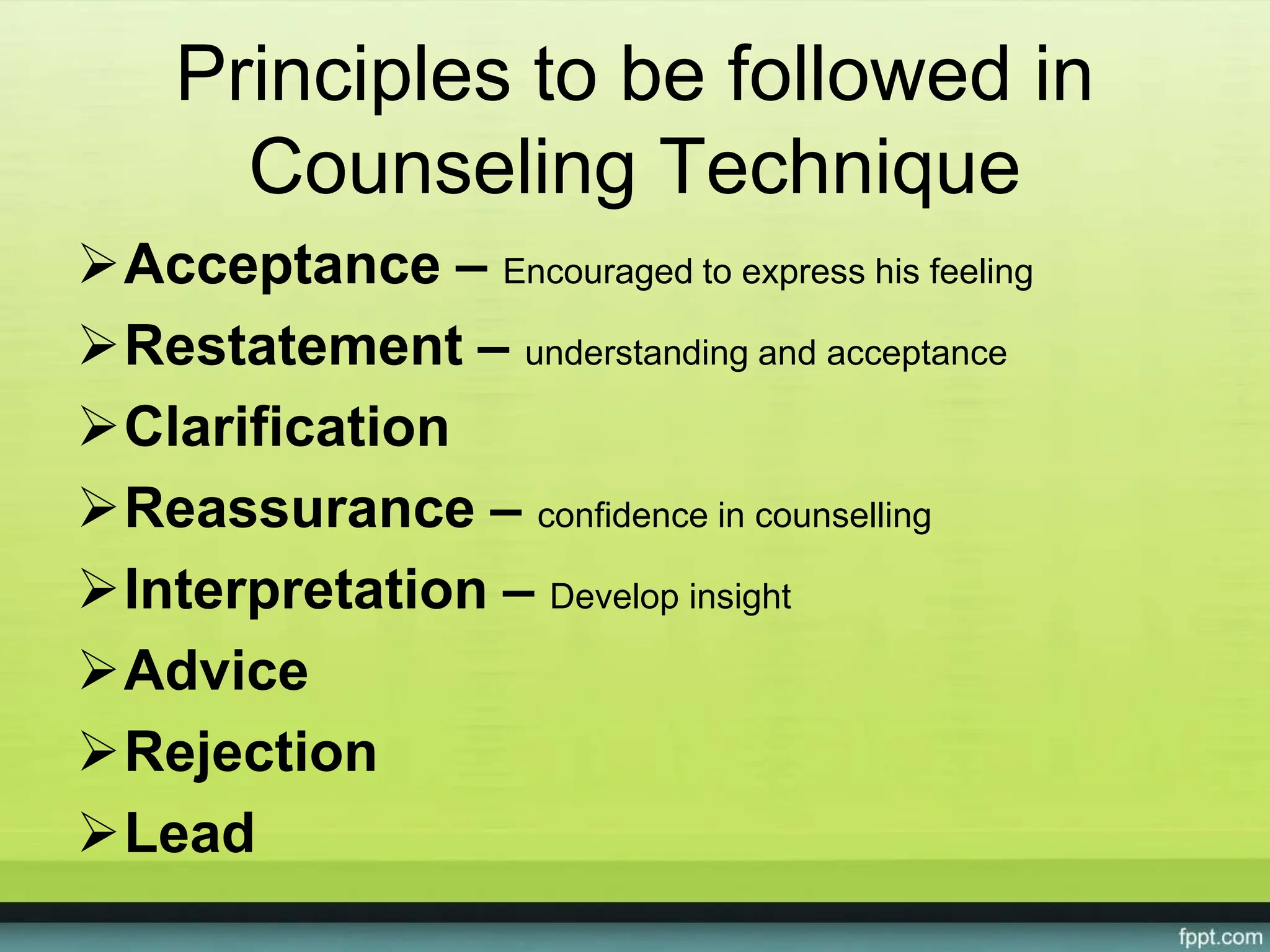
Principles to be followed in
Counseling Technique
Acceptance – Encouraged to express his feeling
Restatement – understanding and acceptance
Clarification
Reassurance – confidence in counselling
Interpretation – Develop insight
Advice
Rejection
Lead
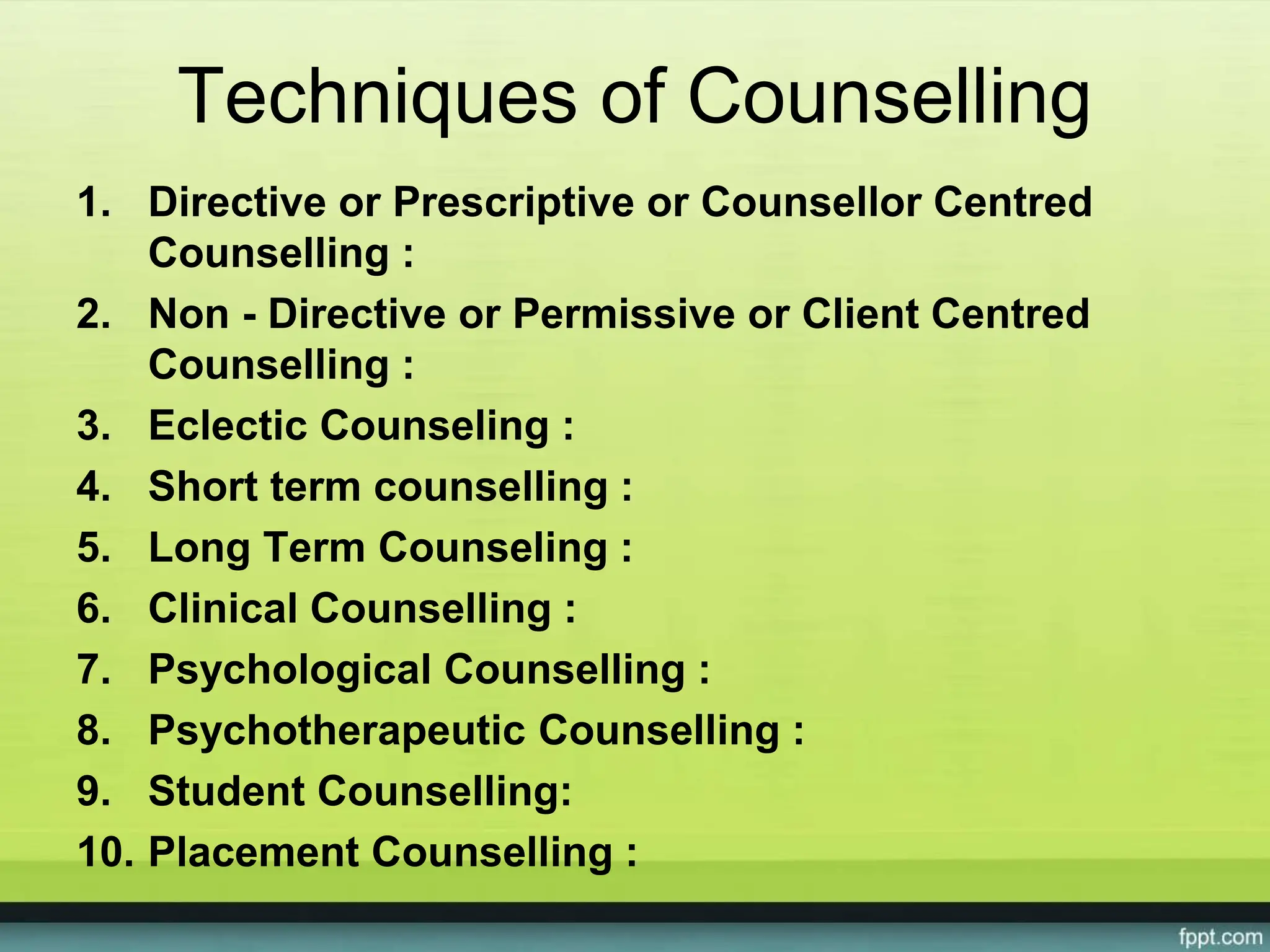
Techniques of Counselling
1. Directive or Prescriptive or Counsellor Centred
Counselling :
2. Non - Directive or Permissive or Client Centred
Counselling :
3. Eclectic Counseling :
4. Short term counselling :
5. Long Term Counseling :
6. Clinical Counselling :
7. Psychological Counselling :
8. Psychotherapeutic Counselling :
9. Student Counselling:
10. Placement Counselling :
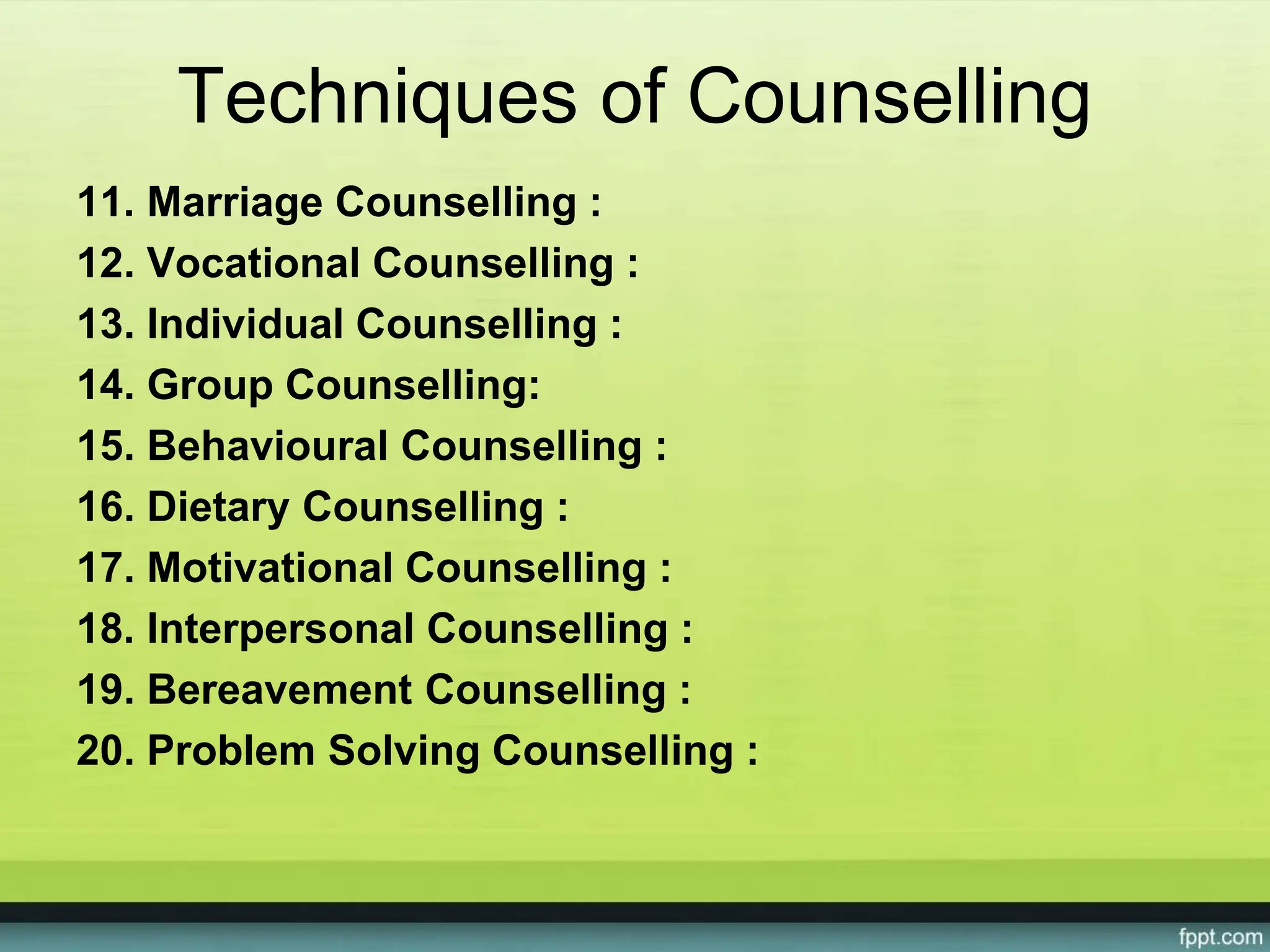
Techniques of Counselling
11. Marriage Counselling :
12. Vocational Counselling :
13. Individual Counselling :
14. Group Counselling:
15. Behavioural Counselling :
16. Dietary Counselling :
17. Motivational Counselling :
18. Interpersonal Counselling :
19. Bereavement Counselling :
20. Problem Solving Counselling :
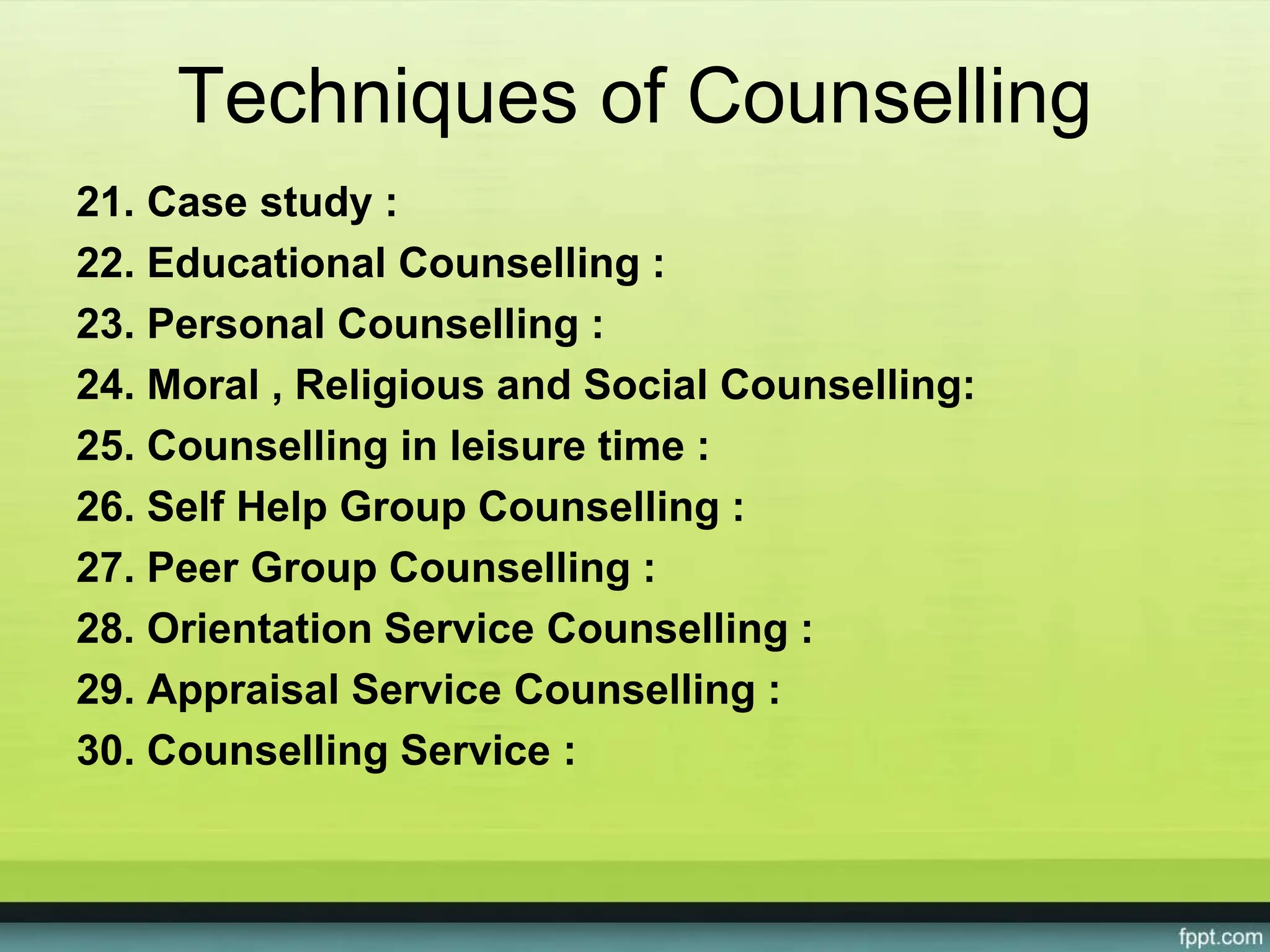
Techniques of Counselling
21. Case study :
22. Educational Counselling :
23. Personal Counselling :
24. Moral , Religious and Social Counselling:
25. Counselling in leisure time :
26. Self Help Group Counselling :
27. Peer Group Counselling :
28. Orientation Service Counselling :
29. Appraisal Service Counselling :
30. Counselling Service :
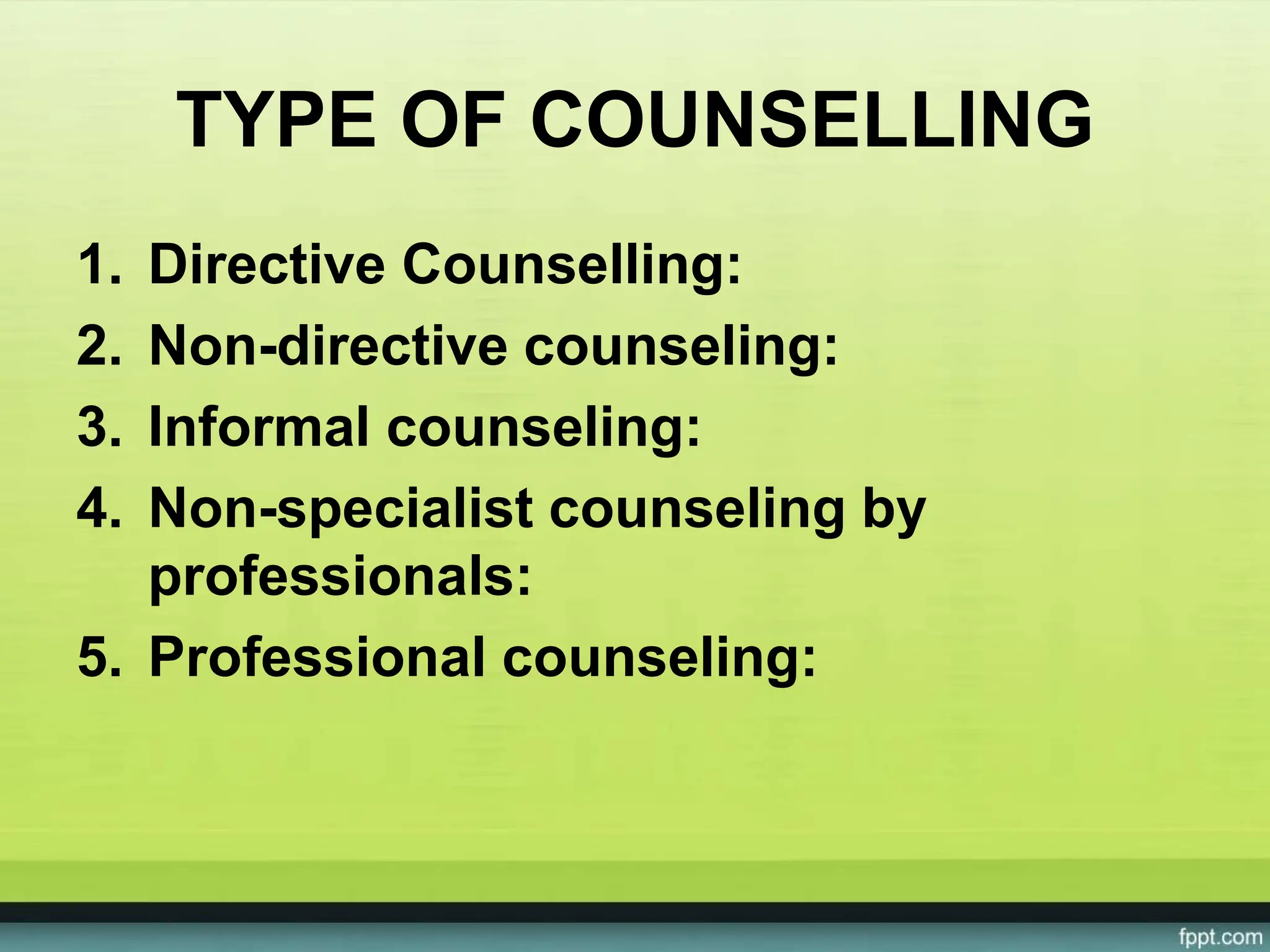
TYPE OF COUNSELLING
1. Directive Counselling:
2. Non-directive counseling:
3. Informal counseling:
4. Non-specialist counseling by
professionals:
5. Professional counseling:
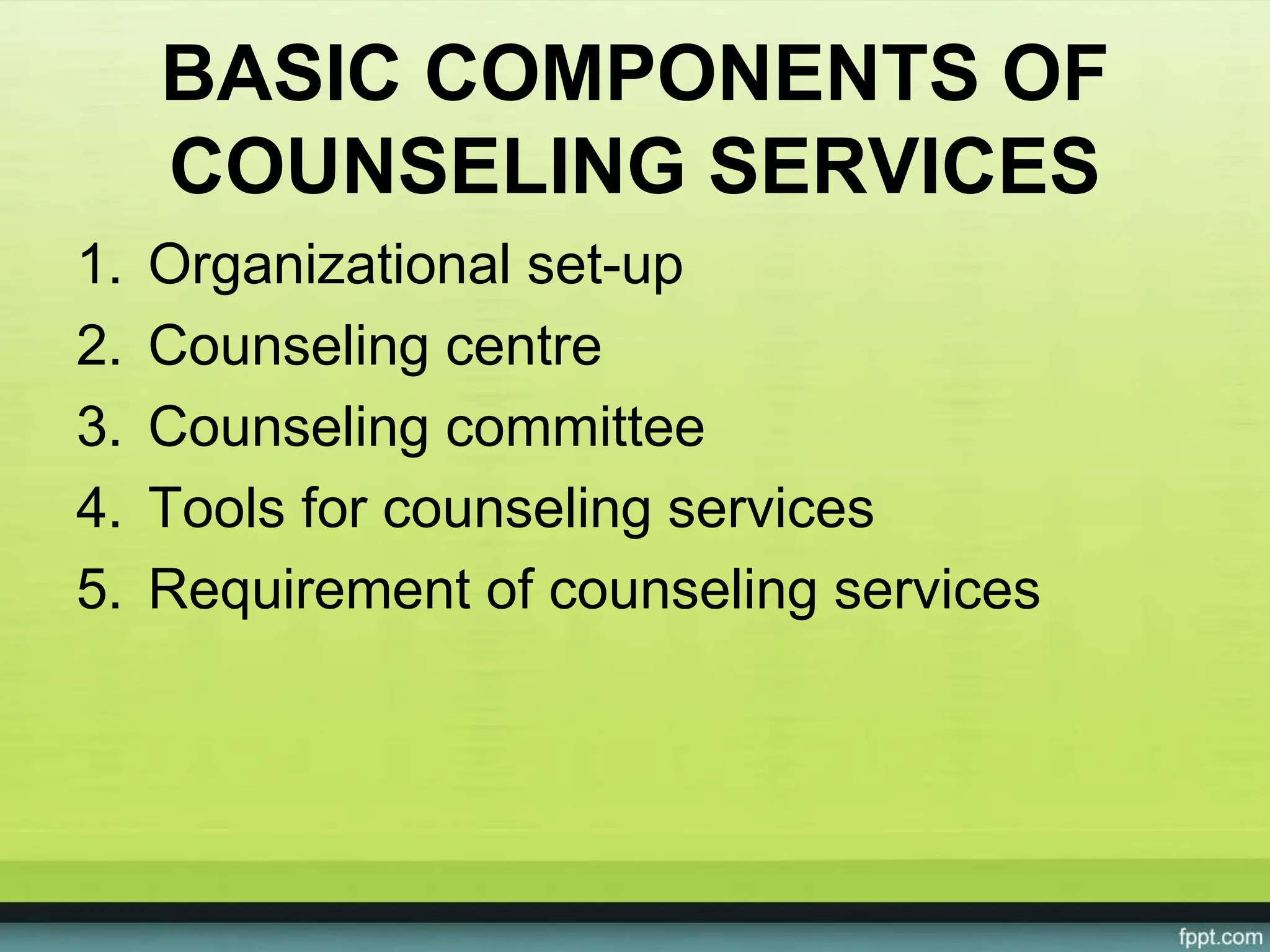
BASIC COMPONENTS OF
COUNSELING SERVICES
1. Organizational set-up
2. Counseling centre
3. Counseling committee
4. Tools for counseling services
5. Requirement of counseling services
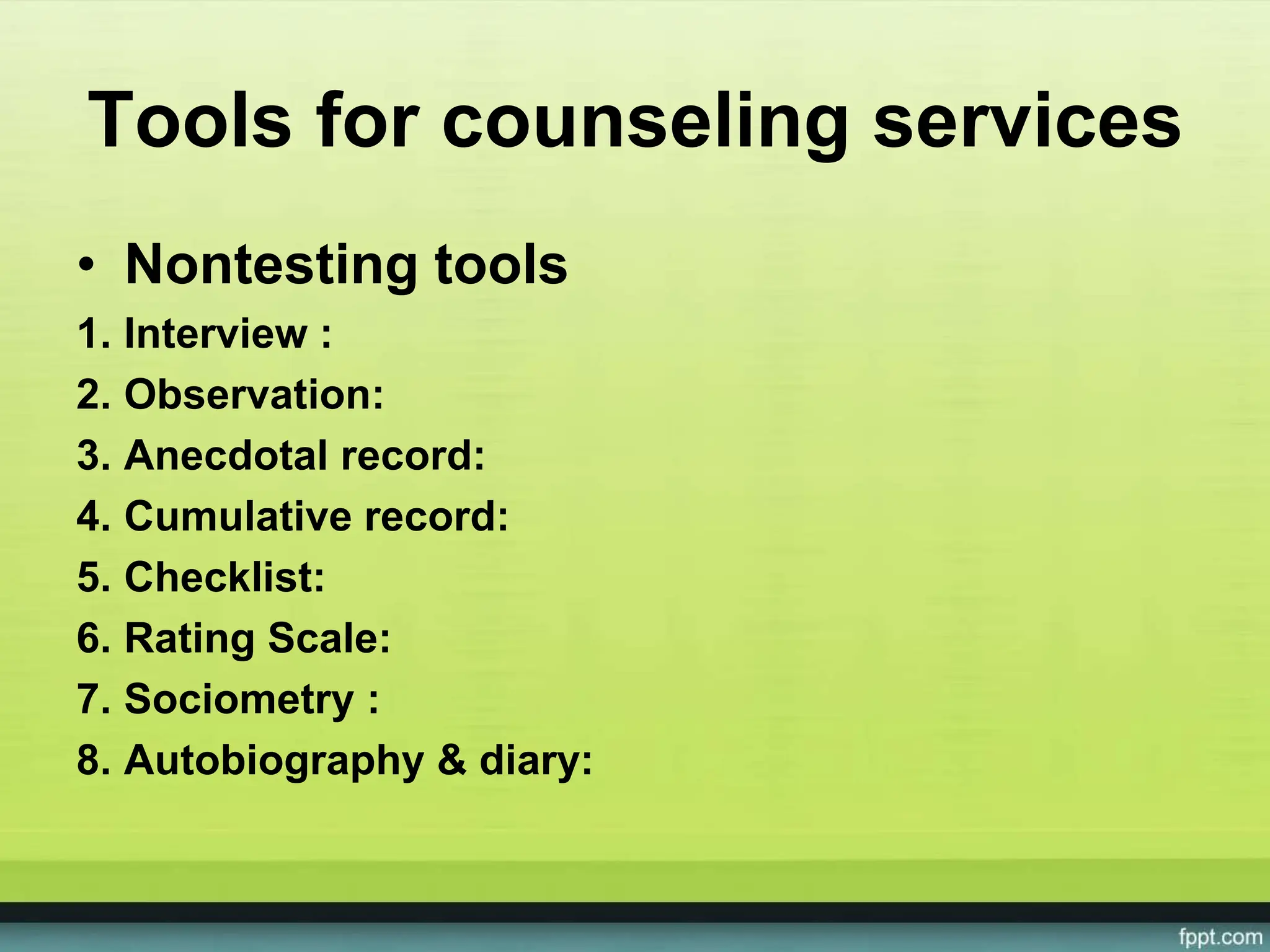
Tools for counseling services
• Nontesting tools
1. Interview :
2. Observation:
3. Anecdotal record:
4. Cumulative record:
5. Checklist:
6. Rating Scale:
7. Sociometry :
8. Autobiography & diary:
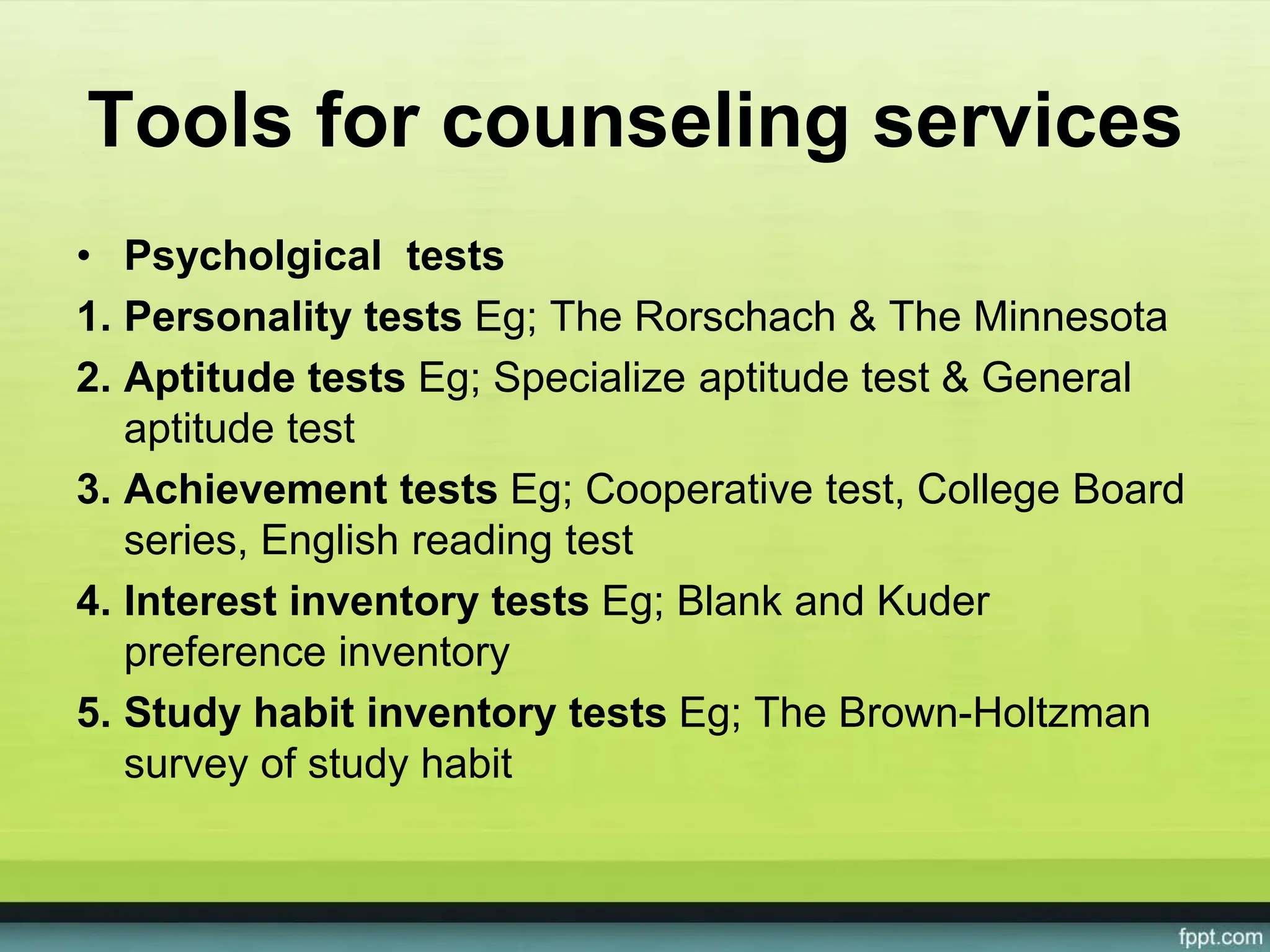
Tools for counseling services
• Psycholgical tests
1. Personality tests Eg; The Rorschach & The Minnesota
2. Aptitude tests Eg; Specialize aptitude test & General
aptitude test
3. Achievement tests Eg; Cooperative test, College Board
series, English reading test
4. Interest inventory tests Eg; Blank and Kuder
preference inventory
5. Study habit inventory tests Eg; The Brown-Holtzman
survey of study habit
ROLE OF THE COUNSELLOR
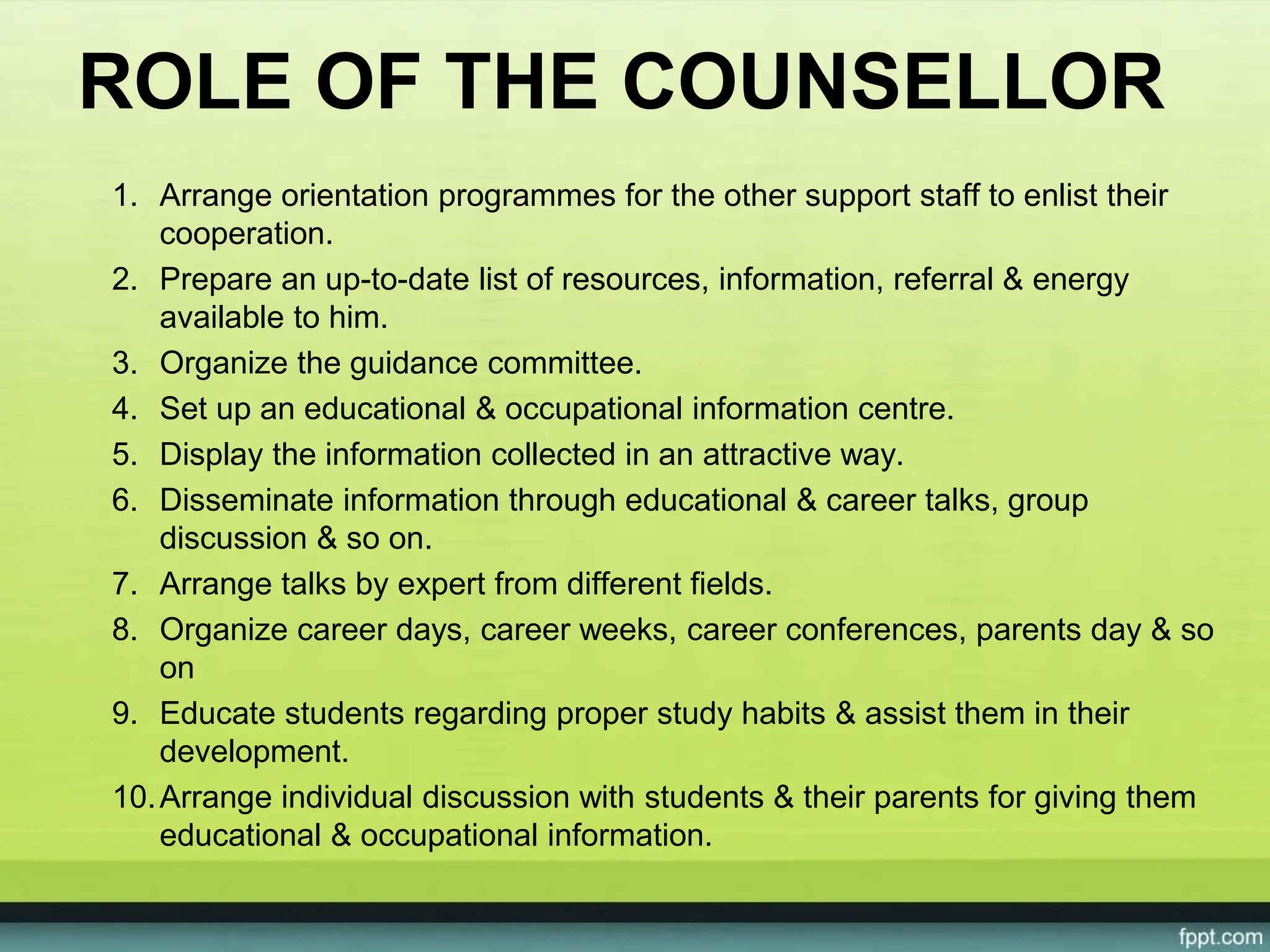
1. Arrange orientation programmes for the other support staff to enlist their
cooperation.
2. Prepare an up-to-date list of resources, information, referral & energy
available to him.
3. Organize the guidance committee.
4. Set up an educational & occupational information centre.
5. Display the information collected in an attractive way.
6. Disseminate information through educational & career talks, group
discussion & so on.
7. Arrange talks by expert from different fields.
8. Organize career days, career weeks, career conferences, parents day & so
on
9. Educate students regarding proper study habits & assist them in their
development.
10.Arrange individual discussion with students & their parents for giving them
educational & occupational information.
ROLE OF THE COUNSELLOR
11. Arrange visits to place of work like industries, business,
establishments, offices, higher education institutions & other
important educational places.
12. Maintain an active relationship with schools, colleges, universities.
13. Maintain an active liaison with club like Lions Club & Rotary Club.
14. Refer serious mental cases to clinical psychologist or psychiatrists.
15. Maintain complete secrecy of the discussion between him & the
patient.
16. Administer psychological tests.
17. Provide counseling services to students.
18. Help in the student placements.
19. Take up research projecting relating to the fields of educational,
vocational, personal & social guidance in colleges.
Qualities of a Good Counselor
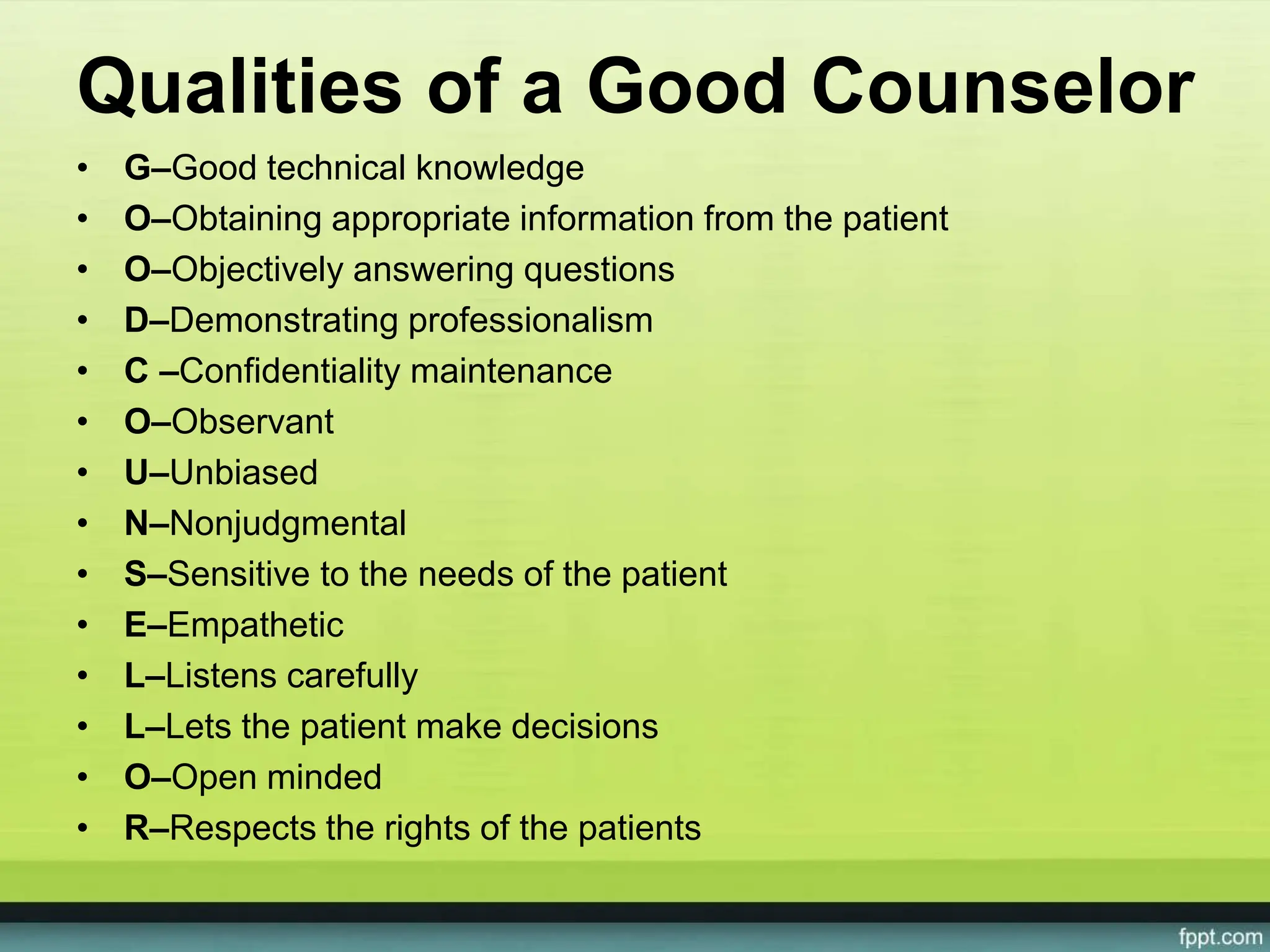
• G–Good technical knowledge
• O–Obtaining appropriate information from the patient
• O–Objectively answering questions
• D–Demonstrating professionalism
• C –Confidentiality maintenance
• O–Observant
• U–Unbiased
• N–Nonjudgmental
• S–Sensitive to the needs of the patient
• E–Empathetic
• L–Listens carefully
• L–Lets the patient make decisions
• O–Open minded
• R–Respects the rights of the patients
COUNSELING PROCESS
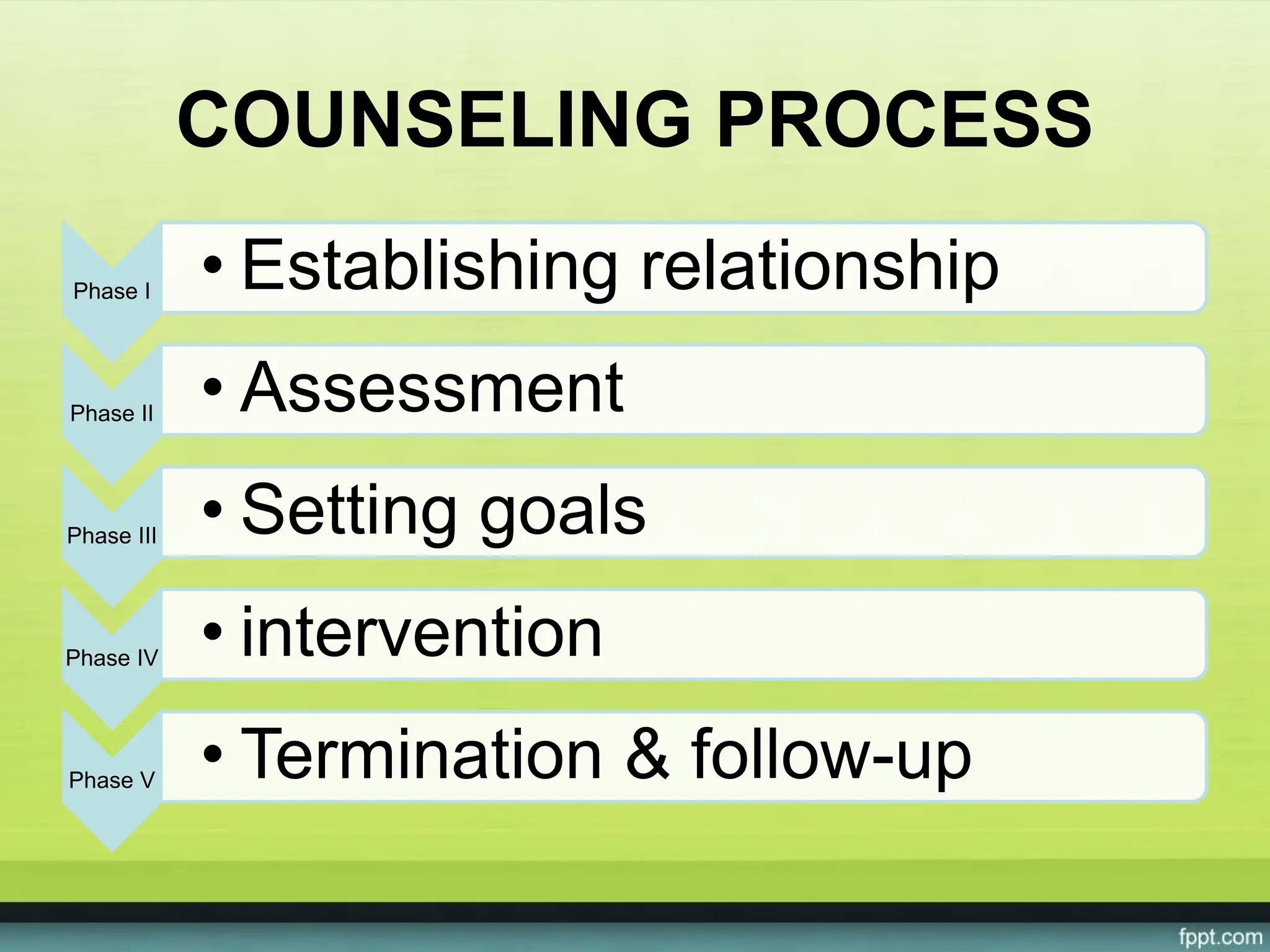
Phase I • Establishing relationship
Phase II • Assessment
Phase III • Setting goals
Phase IV • intervention
Phase V • Termination & follow-up
ISSUES OF COUNSELLING IN
NURSING
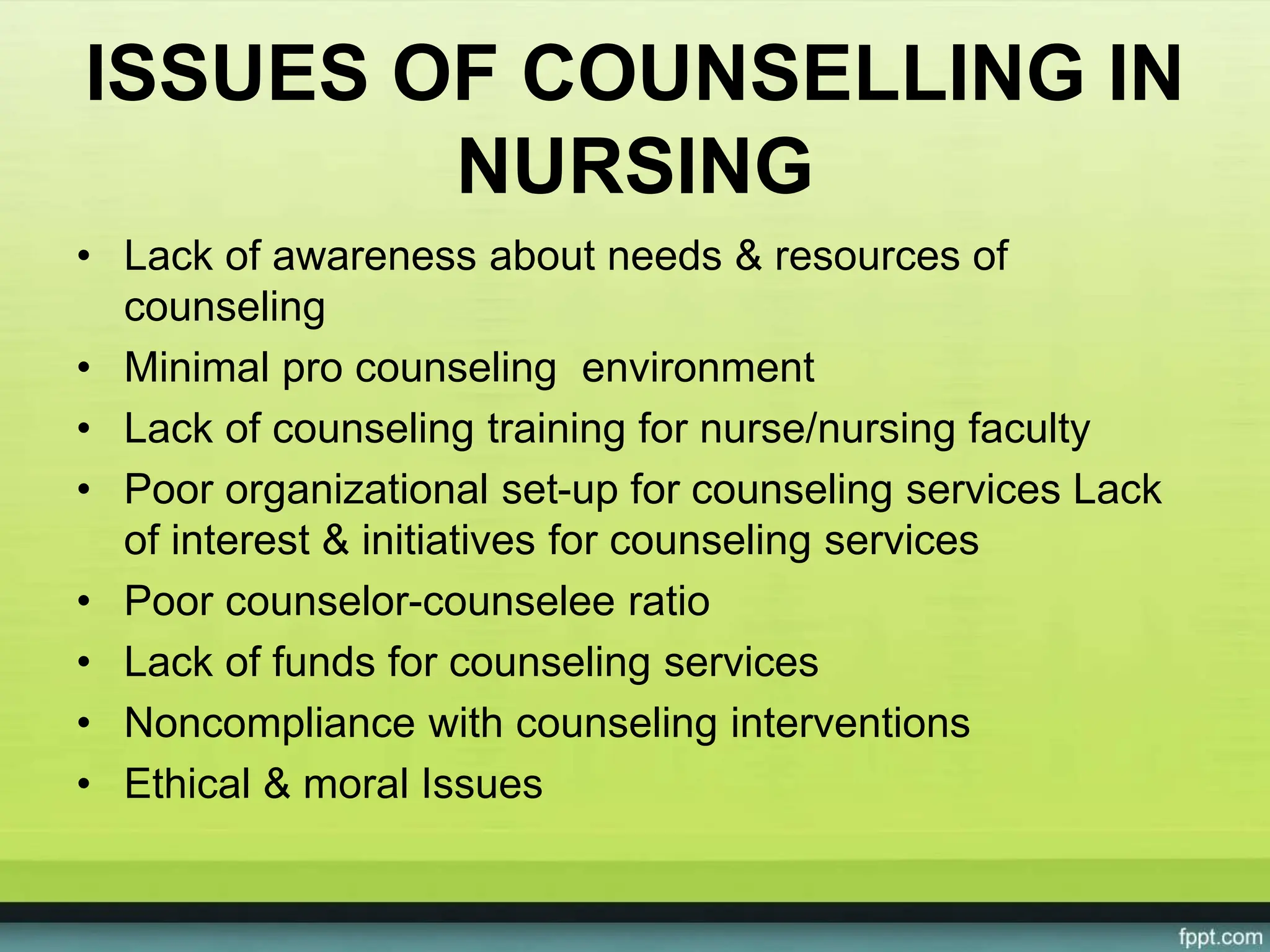
• Lack of awareness about needs & resources of
counseling
• Minimal pro counseling environment
• Lack of counseling training for nurse/nursing faculty
• Poor organizational set-up for counseling services Lack
of interest & initiatives for counseling services
• Poor counselor-counselee ratio
• Lack of funds for counseling services
• Noncompliance with counseling interventions
• Ethical & moral Issues
CONCLUSION
Counselling enjoys a predominant role
in the present day life. Counselling
services are aimed at enabling peoples to
acquire ability which promote self-direction
and self-realization. So counseling is very
important in the day to day life.
Thank You

Principles and Techniques of Counselling ppt.ppt

  • 1.
    PRINCIPLES and Techniques of Counselling Mr.Veeresh Demashetti MSc (N) Community Health Nursing
  • 2.
    LEARNING OBJECTIVES • DEFINITIONS •CONCEPT OF COUNSELING • PURPOSES OF COUNSELLING • CHARACTERISTICS OF COUNSELING • SCOPE OF COUNSELING • NEED OF COUNSELLING • AIMS OF COUNSELLING • PRINCIPLES • TECHNIQUES • TYPES • BASIC COMPONENTS • TOOLS FOR COUNSELLING SERVICES • ROLL OF COUNSELLING • QUALITYIES OF GOOD COUNSELOR • COUNSELLING PROCESS • ISSUES OF COUNSELLING • CONCLUSION
  • 3.
    INTRODUCTION • “What iscounseling – Just tea and sympathy?” • Counseling denotes, “giving of advice.” It is a wider procedure concerned with emotion as well as giving information.
  • 4.
    DEFINITIONS • According toCornier and Hackney, “Counselling is the helping relationship that includes someone seeking help, someone willing to give help who is capable or trained to help, in a setting that patterns help to be giving and received”. • According to Wren (1962), “Counselling is a dynamic and purposeful relationship between two people who approach a mutually defined problem with mutual consideration of each other to the end that the younger or less mature, or more troubled of the two is aided to a self determined resolution of his problem.”
  • 5.
    CONCEPT OF COUNSELING •Counseling is the relationship between two persons in which, one of them attempts to assist the other in organizing him to attain a form of happiness, adjustment to a life situation, i.e., self-actualization. • An accepted, trusting and safe relationship will be formulated in which clients will learn to discuss openly their problems, acquires the social skills, courage, self-confidence to implement desired new behaviours. • The relationship between two persons or the interaction between the counselor, i.e., one a professionally trained worker and the counselee, i.e., the person who seeks the services or who cannot his problems by finding new ways. • Helps the individual to become aware of himself and the ways in which he is reacting to the behavioral influences of his environment. • To develop a set of goals for future a behaviour of an individual.
  • 6.
    PURPOSES OF COUNSELLING •Providing the needed information & assistance • Helping in individual to make wise choices • Improve the understanding of self • Facilitate the adjustment • Helps in adapting to the changes or new environment • Making self-sufficient & independent • Efficient use of capabilities & talent • Promote the optimal personal & professional development • Balanced physical, psychological, emotional, social & spiritual growth • Helps in overall development & to live productive life
  • 7.
    CHARACTERISTICS OF COUNSELING 1. Itis purposeful learning experience for the counselee. 2. It is the purposeful oriented and private interview between the counselor and counselee. 3. Based on mutual confidence satisfactory relationship will be established. 4. Counseling process is structured around the felt needs of the counselee. 5. Main emphasis in the counseling process is on the counselee’s self- direction and self-acceptance. 6. Client-centered counseling is therapeutic. 7. It stresses the emotional element, the feeling aspect of the situation rather than the intellectual aspect. 8. It stresses the “immediate situation” rather than the individual’s past. 9. Counselling leads to a voluntary choice of goals and actions.
  • 8.
    SCOPE OF COUNSELING Evidenceand counseling services are aimed • To meet the student needs. • To aid the student in identification of his abilities, aptitudes, interests and attitudes, • To help him to understand, accepts and utilize his traits. • To assist him in developing his potential to the optimum so that he will become self- directive.
  • 9.
    NEED OF COUNSELLING I.Need s for personal & social domain Personal & social development of individual To adapt in different stages of development Offering art of better living Proper use of leisure time Holistic personality development Best use of available opportunities Motivates for effective utilization & development of self
  • 10.
    NEED OF COUNSELLING II.Needs for educational/professional domain  Helps in academic growth & development  Helps in vocational & professional maturity  Facilitates an individual in the right education & profession  Offer help to handle educational & professional situations  Helps in the proper utilization of human resources  Helps in adapting to the changing concept of education  Prepares to adapt in changing professional situations & emerging challenges  Helps in making proper career choice  Helps to minimize indiscipline
  • 11.
    NEED OF COUNSELLING III.Need of Counselling in Nursing Education…  To help students adjusting with the new environment of the nursing institute.  To help in developing qualities required for a successful for a nursing practice.  To help students in getting adjusted with the clinical environment.  To help students keeping in touch with the latest trends in nursing  To help students in developing positive learning habits, especially skill learning  To help in the development of appropriate coping straggles in order to deal with stress in a productive manner  To help nursing students in establishing proper identity.  To help them to develop a positive attitude towards life.
  • 12.
    NEED OF COUNSELLING III.Need of Counselling in Nursing Education…conti…  To help to overcome periods of turmoil & confusion.  To help students in developing their leadership qualities.  To motivate them for taking membership in professional organizations after competing their studies.  Helps them to make advantages of technological advancement in a patient care.  Helps them to readiness for changes & face challenges  To carryout responsibilities as a health team member  Helps them to proper selection of career  Motivate them for higher studies.
  • 13.
    PRINCIPLES OF COUNSELING Tailor-madeto the requirement of an individual’s problem. 1. Emphasizes thinking with individual. 2. Maintains relationship of trust and confidence with the client. 3. Client’s need is to be put first. 4. Everyone participating in the counseling process must feel comfortable. 5. The client’s family members and significant influencing personnel must be included in counseling process. 6. Skills of warmth, friendliness, openness and empathy are ingredients of successful counseling. 7. Counseling has to listen attentively, answer questions objectively, and reinforce important information. 8. Let the client make voluntary informed decision. 9. Maintain dignity of individual as individual is primary concern in counseling.
  • 14.
    Principles to befollowed in Counseling Technique Acceptance – Encouraged to express his feeling Restatement – understanding and acceptance Clarification Reassurance – confidence in counselling Interpretation – Develop insight Advice Rejection Lead
  • 15.
    Techniques of Counselling 1.Directive or Prescriptive or Counsellor Centred Counselling : 2. Non - Directive or Permissive or Client Centred Counselling : 3. Eclectic Counseling : 4. Short term counselling : 5. Long Term Counseling : 6. Clinical Counselling : 7. Psychological Counselling : 8. Psychotherapeutic Counselling : 9. Student Counselling: 10. Placement Counselling :
  • 16.
    Techniques of Counselling 11.Marriage Counselling : 12. Vocational Counselling : 13. Individual Counselling : 14. Group Counselling: 15. Behavioural Counselling : 16. Dietary Counselling : 17. Motivational Counselling : 18. Interpersonal Counselling : 19. Bereavement Counselling : 20. Problem Solving Counselling :
  • 17.
    Techniques of Counselling 21.Case study : 22. Educational Counselling : 23. Personal Counselling : 24. Moral , Religious and Social Counselling: 25. Counselling in leisure time : 26. Self Help Group Counselling : 27. Peer Group Counselling : 28. Orientation Service Counselling : 29. Appraisal Service Counselling : 30. Counselling Service :
  • 18.
    TYPE OF COUNSELLING 1.Directive Counselling: 2. Non-directive counseling: 3. Informal counseling: 4. Non-specialist counseling by professionals: 5. Professional counseling:
  • 19.
    BASIC COMPONENTS OF COUNSELINGSERVICES 1. Organizational set-up 2. Counseling centre 3. Counseling committee 4. Tools for counseling services 5. Requirement of counseling services
  • 20.
    Tools for counselingservices • Nontesting tools 1. Interview : 2. Observation: 3. Anecdotal record: 4. Cumulative record: 5. Checklist: 6. Rating Scale: 7. Sociometry : 8. Autobiography & diary:
  • 21.
    Tools for counselingservices • Psycholgical tests 1. Personality tests Eg; The Rorschach & The Minnesota 2. Aptitude tests Eg; Specialize aptitude test & General aptitude test 3. Achievement tests Eg; Cooperative test, College Board series, English reading test 4. Interest inventory tests Eg; Blank and Kuder preference inventory 5. Study habit inventory tests Eg; The Brown-Holtzman survey of study habit
  • 22.
    ROLE OF THECOUNSELLOR 1. Arrange orientation programmes for the other support staff to enlist their cooperation. 2. Prepare an up-to-date list of resources, information, referral & energy available to him. 3. Organize the guidance committee. 4. Set up an educational & occupational information centre. 5. Display the information collected in an attractive way. 6. Disseminate information through educational & career talks, group discussion & so on. 7. Arrange talks by expert from different fields. 8. Organize career days, career weeks, career conferences, parents day & so on 9. Educate students regarding proper study habits & assist them in their development. 10.Arrange individual discussion with students & their parents for giving them educational & occupational information.
  • 23.
    ROLE OF THECOUNSELLOR 11. Arrange visits to place of work like industries, business, establishments, offices, higher education institutions & other important educational places. 12. Maintain an active relationship with schools, colleges, universities. 13. Maintain an active liaison with club like Lions Club & Rotary Club. 14. Refer serious mental cases to clinical psychologist or psychiatrists. 15. Maintain complete secrecy of the discussion between him & the patient. 16. Administer psychological tests. 17. Provide counseling services to students. 18. Help in the student placements. 19. Take up research projecting relating to the fields of educational, vocational, personal & social guidance in colleges.
  • 24.
    Qualities of aGood Counselor • G–Good technical knowledge • O–Obtaining appropriate information from the patient • O–Objectively answering questions • D–Demonstrating professionalism • C –Confidentiality maintenance • O–Observant • U–Unbiased • N–Nonjudgmental • S–Sensitive to the needs of the patient • E–Empathetic • L–Listens carefully • L–Lets the patient make decisions • O–Open minded • R–Respects the rights of the patients
  • 25.
    COUNSELING PROCESS Phase I• Establishing relationship Phase II • Assessment Phase III • Setting goals Phase IV • intervention Phase V • Termination & follow-up
  • 26.
    ISSUES OF COUNSELLINGIN NURSING • Lack of awareness about needs & resources of counseling • Minimal pro counseling environment • Lack of counseling training for nurse/nursing faculty • Poor organizational set-up for counseling services Lack of interest & initiatives for counseling services • Poor counselor-counselee ratio • Lack of funds for counseling services • Noncompliance with counseling interventions • Ethical & moral Issues
  • 27.
    CONCLUSION Counselling enjoys apredominant role in the present day life. Counselling services are aimed at enabling peoples to acquire ability which promote self-direction and self-realization. So counseling is very important in the day to day life.
  • 28.