GROUP 7 MEMBERS
•clinical Counselling
OBJECTIVES
1. Define clinical Counselling
2. Outline the 7 principles of counselling
3. State and explain the 7 major skills of counselling
4. Describe 7 types of counselling , family counselling included
5. Describe the counselling process
6. What are the six major qualities of a good counsellor
7. As a health counsellor briefly explain how you wound conduct crisis
counselling to relatives who have recently lost their loved one
INTRODUCTION TO COUNSELLING
• Clinical counselling is a branch of clinical psychology that helps people as
they navigate emotional or mental health difficulties, clinical counselling
can also be considered part of the professional counselling and social work
fields.
• The aim is to help the client find their own solutions to problems, while
being supported and being guided by appropriate advice.
PRINCIPLES OF COUNSELLING
• Principle of acceptance - Accept the patient with his /her
physical, psychological, social, economical and cultural
conditions.
• Principle of non-judge - Mental attitude-do npt criticize or
comment negatively regarding the patients complaints.
• Principle of communication - Communication should be
verbalas well as non-verbal and should be skillful.
• Principle of empathy - Instead of showing sympathy put yourself
in patients shoes and then give reflections accordingly, Empathy
is ability to identify with a person.
• Principle of confidentiality- Always keep the patients name, and
the problem strictly secrete and assure the patients about assure
the patients about the same.
• Principle of individuality- Treat each and every patient as
unique and respect his/ her problem as well.
• Principle of non emotional involvement- Not getting
emotionally involved with the patient and avoid getting away with
his /her feelings.
7 MAJOR SKILLS OF COUNSELLIG
• Counseling Skills are interpersonal and technical attributes that a counselor
puts to use in order to help their clients. Mastering particular counseling
skills could make a big difference in whether or not help is provided to the
client. Examples of Major Counseling skills include:
• Active listening skill
• Questioning skill
• Empathy
• Interpretation skill
• Challenging skill
• Note taking
• Reflecting skill
• Active Listening Skill: This type of listening can be defined as the
use of eye contact, facial expressions and gestures to imply that
you are engaged and focused on the information the other person
is saying.
• Questioning Skills: A good counselor should be able to ask open
questions that are directed to gathering more detailed and complex
information as opposed to close ended questions with specific
answers.
• Empathy: The counselor must be able to develop the ability to
discern another persons experience and then communicate that
perception back to clarify what they have said.
• Interpretation: This is any statement outside of what the patient
has actually said or may even be aware of. When interpreting the
counselor is able to provide a new perspective, provoke thoughts
or feelings or present explanations, may help patients connect
things they have compartmentalized.
• Note Taking Skills: The ability to take notes in an organized
manner can help record important points during the counseling
session. A counselor can always refer to these notes for in-depth
analyses of the client’s situation or problem.
• Reflection: Reflection is used in counseling process to
accurately describe the client’s state from their verbal and
non verbal cues
• Challenging: A challenge is an invitation to examine internal
and external behaviour that seem to be self-defeating, harmful to
others or both.
• It is aimed at helping the client develop new perspectives to his
situation.
Types of counselling
1. Client centered
2. Directive counseling
3. Problem solving
4. Cognitive behavioral counseling
5. Psychodynamic counseling
6. Crisis counseling
7. Family counselling
Client centred counselling
• This approach is widely used.
• It was first used by Carl Rodgers in 1951.
• Carl Rodgers noted that the client him/herself is better placed to decide to find
solutions for him/herself.
• It is a non-directive approach to talk therapy, it requires the client to actively
take the reins during each therapy session while the therapist acts mainly as a
guide or source of support the client.
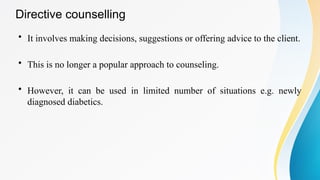
Directive counselling
• It involves making decisions, suggestions or offering advice to the client.
• This is no longer a popular approach to counseling.
• However, it can be used in limited number of situations e.g. newly
diagnosed diabetics.
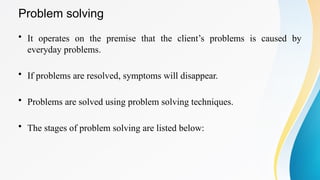
Problem solving
• It operates on the premise that the client’s problems is caused by
everyday problems.
• If problems are resolved, symptoms will disappear.
• Problems are solved using problem solving techniques.
• The stages of problem solving are listed below:
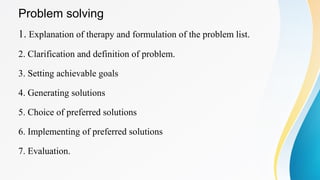
Problem solving
1. Explanation of therapy and formulation of the problem list.
2. Clarification and definition of problem.
3. Setting achievable goals
4. Generating solutions
5. Choice of preferred solutions
6. Implementing of preferred solutions
7. Evaluation.
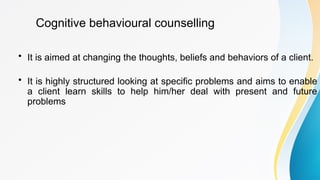
Cognitive behavioural counselling
• It is aimed at changing the thoughts, beliefs and behaviors of a client.
• It is highly structured looking at specific problems and aims to enable
a client learn skills to help him/her deal with present and future
problems
Psychodynamic counselling
• It emphasizes social development associated with individuation
and the family life cycle.
• The task of the counselor in this approach is to encourage the
client to talk about his difficulties and reflect on them as they
may have come from childhood traumatic experiences.
• Psychodynamic counseling may also in cooperate problem
solving and behavioral experiments.
Crisis counselling
• This is a short and active intervention.
• It is based on sound assessment of the situation which include
family, patient, social network, nature of the stressor, severity
of the response of risk and available coping resources including
external support.
• The task is directed at helping the client redefine the challenges
and mobilize resources for its resolution.
Family counselling
• Family counselling is the type of psychological counselling that
can help family members improve communication and resolve
conflicts.
• Family therapy is often short term, it may include all family
members or just those able or willing to participate.
• Family therapy sessions can teach you skills to deepen family
connections and get through stressful times , even after you are
done going to therapy sessions.
• Greet the client.
• Establish rapport and structure.
• Find out their name, what they do, and where they come from.
• Initiate a conversation on neutral topics before asking them to
tell you why they have come to see you
• Introduce your service e.g. tell them you are a clinical
counselor/ HIV counselor
• Gather data about client and identify their problems – what is
the client’s problem of concern and what is his strength and
weakness.
Counselling process
Counselling process
• Determine outcome (what do we want to happen)
• Generate solutions (what shall we do to bring an end to the presenting
problems?)
• The outcome of this stage is aimed at allowing the client to identify as
many solutions as possible, protect the consequences of each solution
and finally set priorities of these solutions.
• Solution application and termination.
Counselling process
• In this final stage, the client has the responsibility for applying the
determined solution.
• The counselor must encourage the client to implement the agreed
solution to the problem.
• While the client is actively engaged in applying the problem
solution, the counselor will often maintain contact as a source of
follow up support encouragement.
Qualities of a good counsellor
1. Responsibility
2. Reliability
3. Humanity
4. Intelligent
5. Confidentiality
6. professionalism
Responsibility
• Counseling is an enormous task.
• For a counselor to function well and effectively, a high sense of
commitment and responsibility is essential.
Reliability
• A counselor must be truthful and honest. She should be able to hold
reasonable control over her emotions.
• She should be someone who is dependable and be considered as such by
the client and the community at large.
Humility
• The counselor must be in a position to acknowledge her own limitations.
It is not possible for a counselor to handle competently all the problems
that may be presented to her. She should be ready and willing to handle
over the clients that she cannot competently handle.
Intelligent
• A good counselor uses her intellectual capacity to the fullest.
• The counselor must be eager to learn and acquire different skills.
• This will enable her to see problems in their right perspective and help out
to give appropriate advice.
Confidentiality
• The counselor should not divulge information about the client without
permission.
• Information should be kept strictly confidential.
• This will help the client to have trust in the counselor and be ready to
share sensitive information that may be helpful in solving the client’s
problems.
Professionalism
• Counseling carries with it professional responsibilities.
• Good conduct and appearance is important for the counselor’s
own physical and mental health. This will cause the counselor to
be respected and valued by the clients.
HOW TO CONDUCT CRISIS COUNSELLING TO RELATIVES
WHO HAVE RECENTLY LOST THEIR LOVED ONE
• A Crisis refers not only to a traumatic even or experience but to an
individuals response to a situation.
• Crisis counseling is therefore a type of counseling that helps
individuals deal with the crisis by offering support and assistance
• The first part of crisis counseling involves assessing the situation. This
largely involves listening to the clients current situation, asking
questions to determine what the relatives need to cope effectively with
the crisis.
• In this case, this will involve listening to the relatives talk about the loved
one they have lost.
• Listening to the type of relationship the loved one had with the
relatives
• What type of person he or she was etc...
COPING STRATEGIES
• The second part of crisis counseling involves finding coping
strategies to help the relatives deal with the loss.
• The aim of counseling is for the relatives to;
1.accept the reality of the loss
2.Adjust to life without the deceased
3.And maintain a connection with the deceased.
• Therefore according to the initial assessment the right coping skills
should be advised to the relatives
EXAMPLE OF COPING STRATEGIES
• Positive reframing. This is looking at the “Bright side” of the
situation. Of course there is no bright side of losing a loved one
but instead the relatives can be advised to focus on the good
memories of the loved one. This may reframe the grieving
emotions and give temporary relief.
• Acceptance is another strategy that can help. It is focusing on
what comes next and how to learn to adjust to life without the lost
loved one
THE END

COUNSELLING ..pptx. .

  • 1.
  • 2.
  • 3.
    OBJECTIVES 1. Define clinicalCounselling 2. Outline the 7 principles of counselling 3. State and explain the 7 major skills of counselling 4. Describe 7 types of counselling , family counselling included 5. Describe the counselling process 6. What are the six major qualities of a good counsellor 7. As a health counsellor briefly explain how you wound conduct crisis counselling to relatives who have recently lost their loved one
  • 4.
    INTRODUCTION TO COUNSELLING •Clinical counselling is a branch of clinical psychology that helps people as they navigate emotional or mental health difficulties, clinical counselling can also be considered part of the professional counselling and social work fields. • The aim is to help the client find their own solutions to problems, while being supported and being guided by appropriate advice.
  • 5.
    PRINCIPLES OF COUNSELLING •Principle of acceptance - Accept the patient with his /her physical, psychological, social, economical and cultural conditions. • Principle of non-judge - Mental attitude-do npt criticize or comment negatively regarding the patients complaints.
  • 6.
    • Principle ofcommunication - Communication should be verbalas well as non-verbal and should be skillful. • Principle of empathy - Instead of showing sympathy put yourself in patients shoes and then give reflections accordingly, Empathy is ability to identify with a person.
  • 7.
    • Principle ofconfidentiality- Always keep the patients name, and the problem strictly secrete and assure the patients about assure the patients about the same. • Principle of individuality- Treat each and every patient as unique and respect his/ her problem as well. • Principle of non emotional involvement- Not getting emotionally involved with the patient and avoid getting away with his /her feelings.
  • 8.
    7 MAJOR SKILLSOF COUNSELLIG • Counseling Skills are interpersonal and technical attributes that a counselor puts to use in order to help their clients. Mastering particular counseling skills could make a big difference in whether or not help is provided to the client. Examples of Major Counseling skills include: • Active listening skill • Questioning skill • Empathy • Interpretation skill • Challenging skill • Note taking • Reflecting skill
  • 9.
    • Active ListeningSkill: This type of listening can be defined as the use of eye contact, facial expressions and gestures to imply that you are engaged and focused on the information the other person is saying. • Questioning Skills: A good counselor should be able to ask open questions that are directed to gathering more detailed and complex information as opposed to close ended questions with specific answers. • Empathy: The counselor must be able to develop the ability to discern another persons experience and then communicate that perception back to clarify what they have said.
  • 10.
    • Interpretation: Thisis any statement outside of what the patient has actually said or may even be aware of. When interpreting the counselor is able to provide a new perspective, provoke thoughts or feelings or present explanations, may help patients connect things they have compartmentalized. • Note Taking Skills: The ability to take notes in an organized manner can help record important points during the counseling session. A counselor can always refer to these notes for in-depth analyses of the client’s situation or problem.
  • 11.
    • Reflection: Reflectionis used in counseling process to accurately describe the client’s state from their verbal and non verbal cues • Challenging: A challenge is an invitation to examine internal and external behaviour that seem to be self-defeating, harmful to others or both. • It is aimed at helping the client develop new perspectives to his situation.
  • 12.
    Types of counselling 1.Client centered 2. Directive counseling 3. Problem solving 4. Cognitive behavioral counseling 5. Psychodynamic counseling 6. Crisis counseling 7. Family counselling
  • 13.
    Client centred counselling •This approach is widely used. • It was first used by Carl Rodgers in 1951. • Carl Rodgers noted that the client him/herself is better placed to decide to find solutions for him/herself. • It is a non-directive approach to talk therapy, it requires the client to actively take the reins during each therapy session while the therapist acts mainly as a guide or source of support the client.
  • 14.
    Directive counselling • Itinvolves making decisions, suggestions or offering advice to the client. • This is no longer a popular approach to counseling. • However, it can be used in limited number of situations e.g. newly diagnosed diabetics.
  • 15.
    Problem solving • Itoperates on the premise that the client’s problems is caused by everyday problems. • If problems are resolved, symptoms will disappear. • Problems are solved using problem solving techniques. • The stages of problem solving are listed below:
  • 16.
    Problem solving 1. Explanationof therapy and formulation of the problem list. 2. Clarification and definition of problem. 3. Setting achievable goals 4. Generating solutions 5. Choice of preferred solutions 6. Implementing of preferred solutions 7. Evaluation.
  • 17.
    Cognitive behavioural counselling •It is aimed at changing the thoughts, beliefs and behaviors of a client. • It is highly structured looking at specific problems and aims to enable a client learn skills to help him/her deal with present and future problems
  • 18.
    Psychodynamic counselling • Itemphasizes social development associated with individuation and the family life cycle. • The task of the counselor in this approach is to encourage the client to talk about his difficulties and reflect on them as they may have come from childhood traumatic experiences. • Psychodynamic counseling may also in cooperate problem solving and behavioral experiments.
  • 19.
    Crisis counselling • Thisis a short and active intervention. • It is based on sound assessment of the situation which include family, patient, social network, nature of the stressor, severity of the response of risk and available coping resources including external support. • The task is directed at helping the client redefine the challenges and mobilize resources for its resolution.
  • 20.
    Family counselling • Familycounselling is the type of psychological counselling that can help family members improve communication and resolve conflicts. • Family therapy is often short term, it may include all family members or just those able or willing to participate. • Family therapy sessions can teach you skills to deepen family connections and get through stressful times , even after you are done going to therapy sessions.
  • 21.
    • Greet theclient. • Establish rapport and structure. • Find out their name, what they do, and where they come from. • Initiate a conversation on neutral topics before asking them to tell you why they have come to see you • Introduce your service e.g. tell them you are a clinical counselor/ HIV counselor • Gather data about client and identify their problems – what is the client’s problem of concern and what is his strength and weakness. Counselling process
  • 22.
    Counselling process • Determineoutcome (what do we want to happen) • Generate solutions (what shall we do to bring an end to the presenting problems?) • The outcome of this stage is aimed at allowing the client to identify as many solutions as possible, protect the consequences of each solution and finally set priorities of these solutions. • Solution application and termination.
  • 23.
    Counselling process • Inthis final stage, the client has the responsibility for applying the determined solution. • The counselor must encourage the client to implement the agreed solution to the problem. • While the client is actively engaged in applying the problem solution, the counselor will often maintain contact as a source of follow up support encouragement.
  • 24.
    Qualities of agood counsellor 1. Responsibility 2. Reliability 3. Humanity 4. Intelligent 5. Confidentiality 6. professionalism
  • 25.
    Responsibility • Counseling isan enormous task. • For a counselor to function well and effectively, a high sense of commitment and responsibility is essential.
  • 26.
    Reliability • A counselormust be truthful and honest. She should be able to hold reasonable control over her emotions. • She should be someone who is dependable and be considered as such by the client and the community at large.
  • 27.
    Humility • The counselormust be in a position to acknowledge her own limitations. It is not possible for a counselor to handle competently all the problems that may be presented to her. She should be ready and willing to handle over the clients that she cannot competently handle.
  • 28.
    Intelligent • A goodcounselor uses her intellectual capacity to the fullest. • The counselor must be eager to learn and acquire different skills. • This will enable her to see problems in their right perspective and help out to give appropriate advice.
  • 29.
    Confidentiality • The counselorshould not divulge information about the client without permission. • Information should be kept strictly confidential. • This will help the client to have trust in the counselor and be ready to share sensitive information that may be helpful in solving the client’s problems.
  • 30.
    Professionalism • Counseling carrieswith it professional responsibilities. • Good conduct and appearance is important for the counselor’s own physical and mental health. This will cause the counselor to be respected and valued by the clients.
  • 31.
    HOW TO CONDUCTCRISIS COUNSELLING TO RELATIVES WHO HAVE RECENTLY LOST THEIR LOVED ONE • A Crisis refers not only to a traumatic even or experience but to an individuals response to a situation. • Crisis counseling is therefore a type of counseling that helps individuals deal with the crisis by offering support and assistance • The first part of crisis counseling involves assessing the situation. This largely involves listening to the clients current situation, asking questions to determine what the relatives need to cope effectively with the crisis. • In this case, this will involve listening to the relatives talk about the loved one they have lost.
  • 32.
    • Listening tothe type of relationship the loved one had with the relatives • What type of person he or she was etc...
  • 33.
    COPING STRATEGIES • Thesecond part of crisis counseling involves finding coping strategies to help the relatives deal with the loss. • The aim of counseling is for the relatives to; 1.accept the reality of the loss 2.Adjust to life without the deceased 3.And maintain a connection with the deceased. • Therefore according to the initial assessment the right coping skills should be advised to the relatives
  • 34.
    EXAMPLE OF COPINGSTRATEGIES • Positive reframing. This is looking at the “Bright side” of the situation. Of course there is no bright side of losing a loved one but instead the relatives can be advised to focus on the good memories of the loved one. This may reframe the grieving emotions and give temporary relief. • Acceptance is another strategy that can help. It is focusing on what comes next and how to learn to adjust to life without the lost loved one
  • 35.