-Mr. Aaron S. Gogate
     B.BSc(Nursing)
MEANING
 Counseling   denotes ‘giving of advice’.
 It is a specialized service of guidance.
 It is a process designed to help an
  individual grow to greater maturity
  through learning and to makes
  decisions of an individual.
DEFINITION
 Counseling   is a method that helps
 the client to use a problem solving
 process to recognize and manage
 stress and that facilitates
 interpersonal relationships among
 client, family and health care team
AIMS OF COUNSELING
IT HELPS STUDENT TO UNDERSTAND:-
1) Self in terms of
   ability, interest, motivation, and
   potential.
2) Gain Insight related to emotional
   difficulties.
3) Alter maladaptive behavior.
4) Achieving integration and fulfill their
   potentials.
ETHICS OF COUNSELING
i.  CONFEDENTIALITY
ii. TOLERANCE
iii.VOLUNTARY
iv.OBJECTIVITY
PRINCIPLES OF
          COUNSELING
1)   PRINCIPLE OF ACCEPTANCE
2)   PRINCIPLE OF RESPECT FOR AN
     INDIVIDUAL
3)   PRINCIPLE OF THINKING WITH
     AN INDIVIDUAL
4)   PRINCIPLE OF PERMISIVENESS
5)   PRINCIPLE OF LEARNING
6)   PRINCIPLE OF CONSISTENCY
ATTRIBUTES OF A
             COUNSELLOR
1)   PRE-TRAINING ATTRIBUTES:-
    Self awareness and understanding
    Good psychological health
    Open-minded
    Objectivity
    Trust worthiness
    Approachability
2)   INTER-TRAINING ATTRIBUTES:-
    Interview setting:-
          Physical arrangement-chairs should be
     kept facing each other. closeness of counselor
     indicates attentiveness and willingness.
          A warm friendly greeting.
          Maintaining Eye-contact.
    Problem focus
    Identifying an important theme
    Directing theme towards a goal
    Managing interaction with an individual
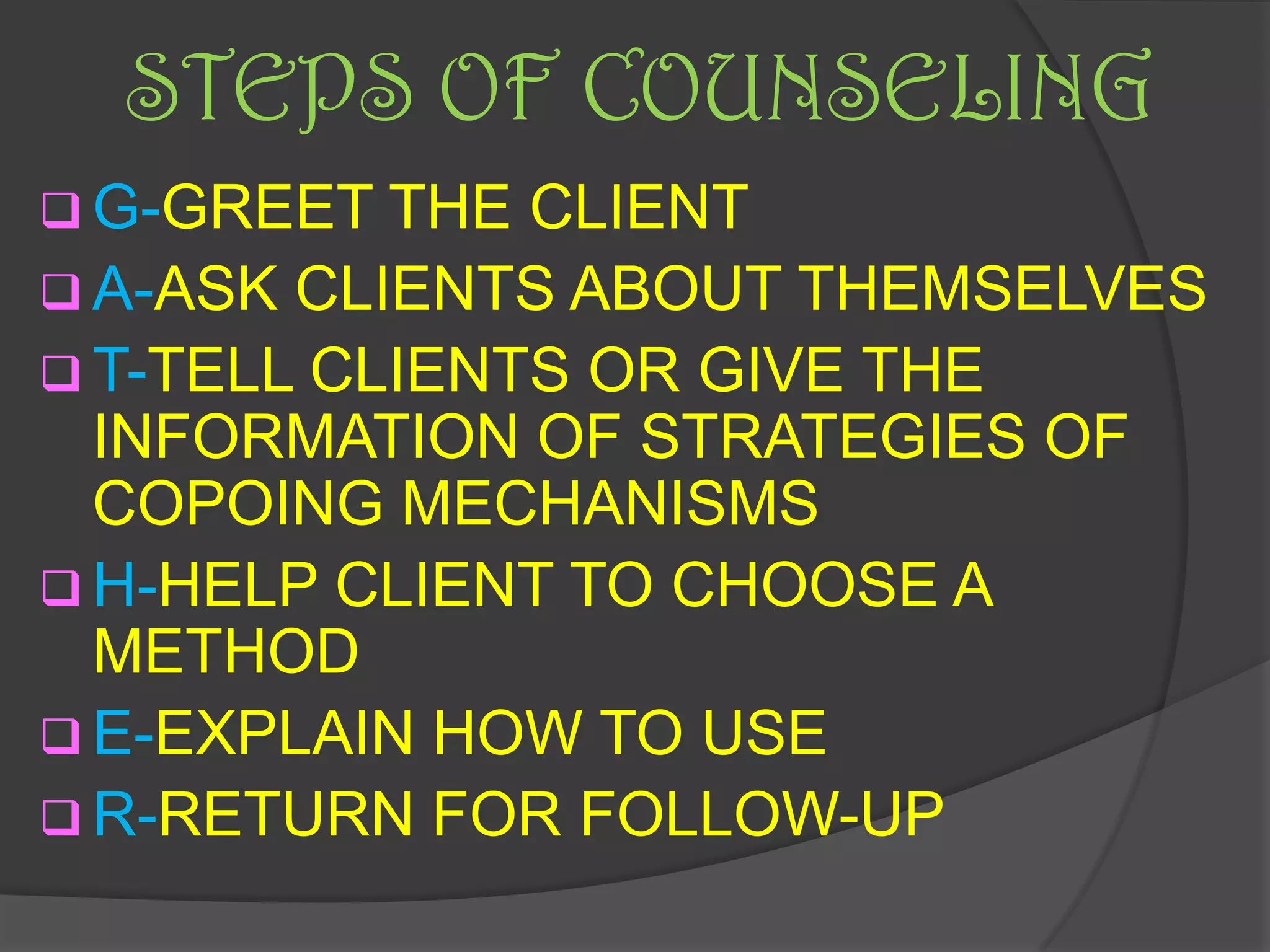
STEPS OF COUNSELING
 G-GREET THE  CLIENT
 A-ASK CLIENTS ABOUT THEMSELVES
 T-TELL CLIENTS OR GIVE THE
  INFORMATION OF STRATEGIES OF
  COPOING MECHANISMS
 H-HELP CLIENT TO CHOOSE A
  METHOD
 E-EXPLAIN HOW TO USE
 R-RETURN FOR FOLLOW-UP
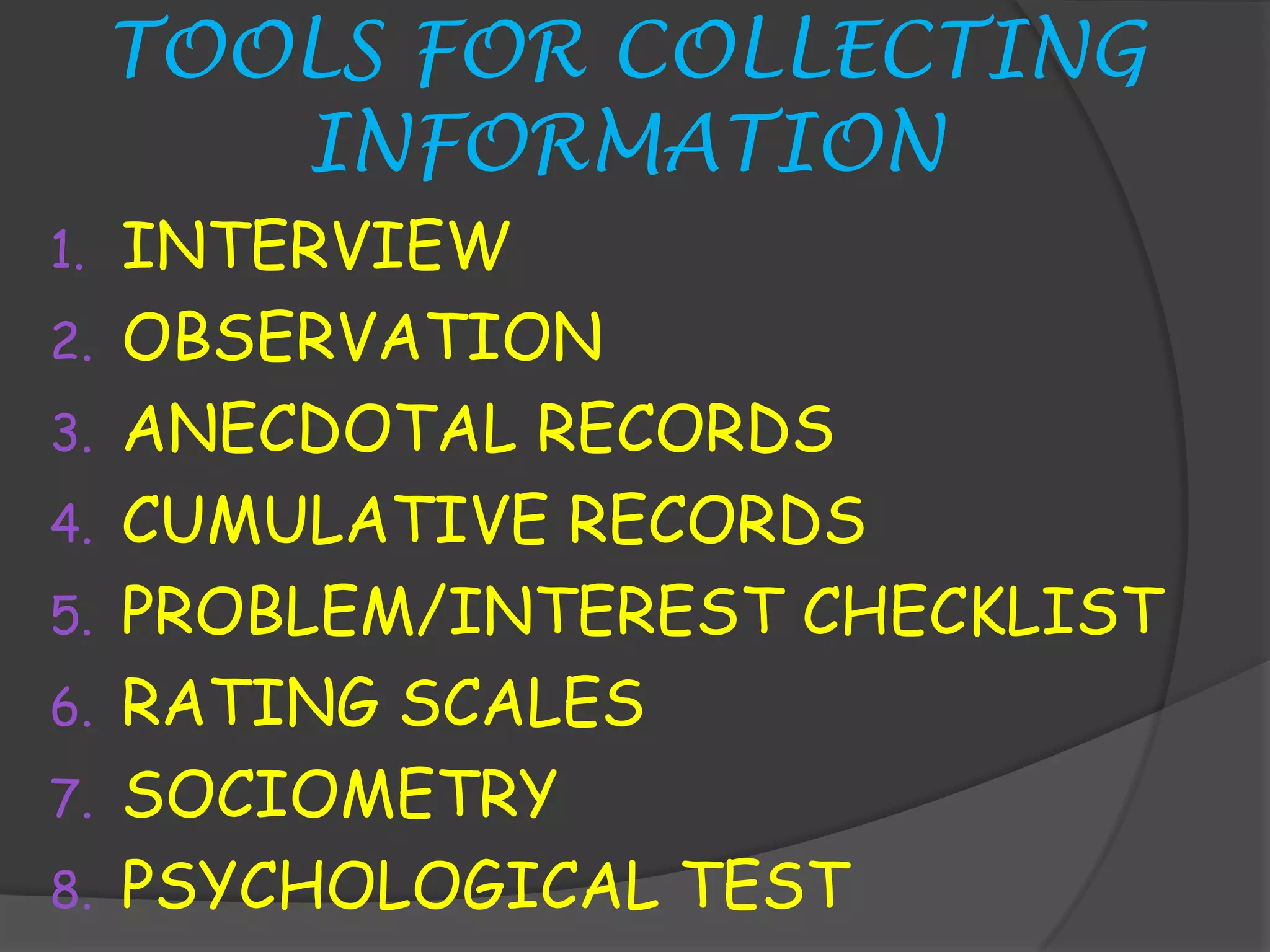
TOOLS FOR COLLECTING
        INFORMATION
1.   INTERVIEW
2.   OBSERVATION
3.   ANECDOTAL RECORDS
4.   CUMULATIVE RECORDS
5.   PROBLEM/INTEREST CHECKLIST
6.   RATING SCALES
7.   SOCIOMETRY
8.   PSYCHOLOGICAL TEST
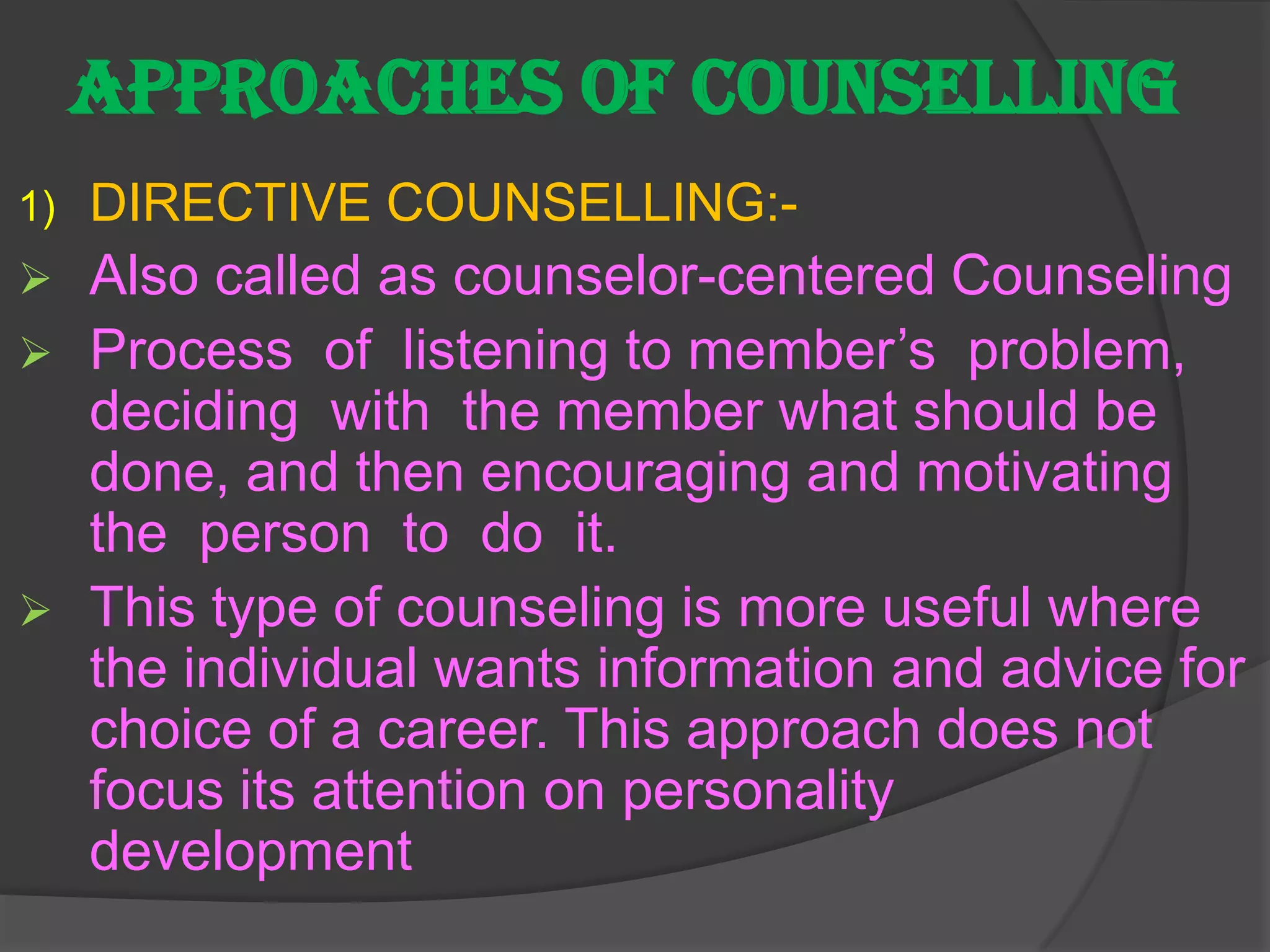
APPROACHES OF COUNSELLING
1)   DIRECTIVE COUNSELLING:-
    Also called as counselor-centered Counseling
    Process of listening to member’s problem,
     deciding with the member what should be
     done, and then encouraging and motivating
     the person to do it.
    This type of counseling is more useful where
     the individual wants information and advice for
     choice of a career. This approach does not
     focus its attention on personality
     development
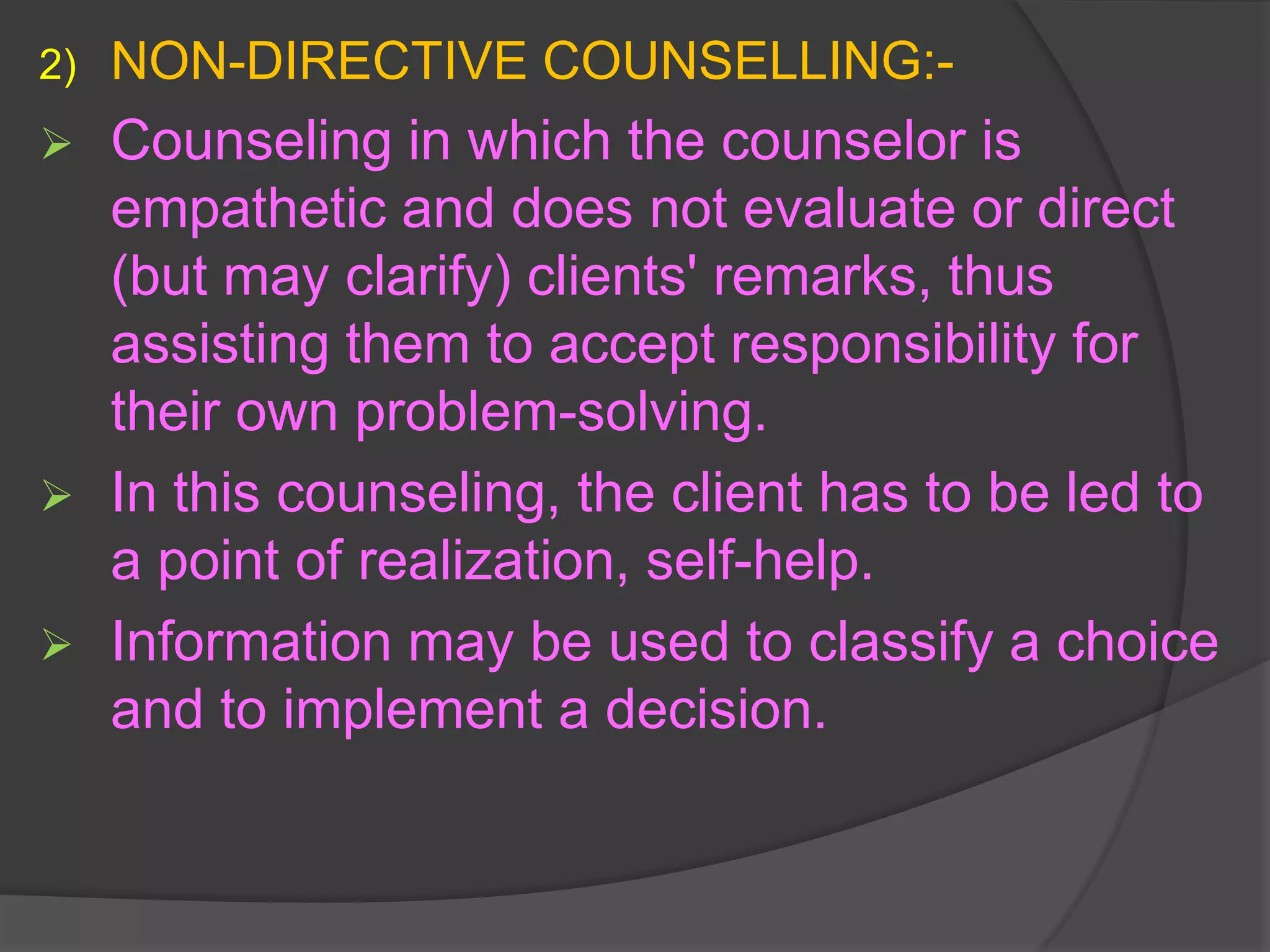
2)   NON-DIRECTIVE COUNSELLING:-
    Counseling in which the counselor is
     empathetic and does not evaluate or direct
     (but may clarify) clients' remarks, thus
     assisting them to accept responsibility for
     their own problem-solving.
    In this counseling, the client has to be led to
     a point of realization, self-help.
    Information may be used to classify a choice
     and to implement a decision.
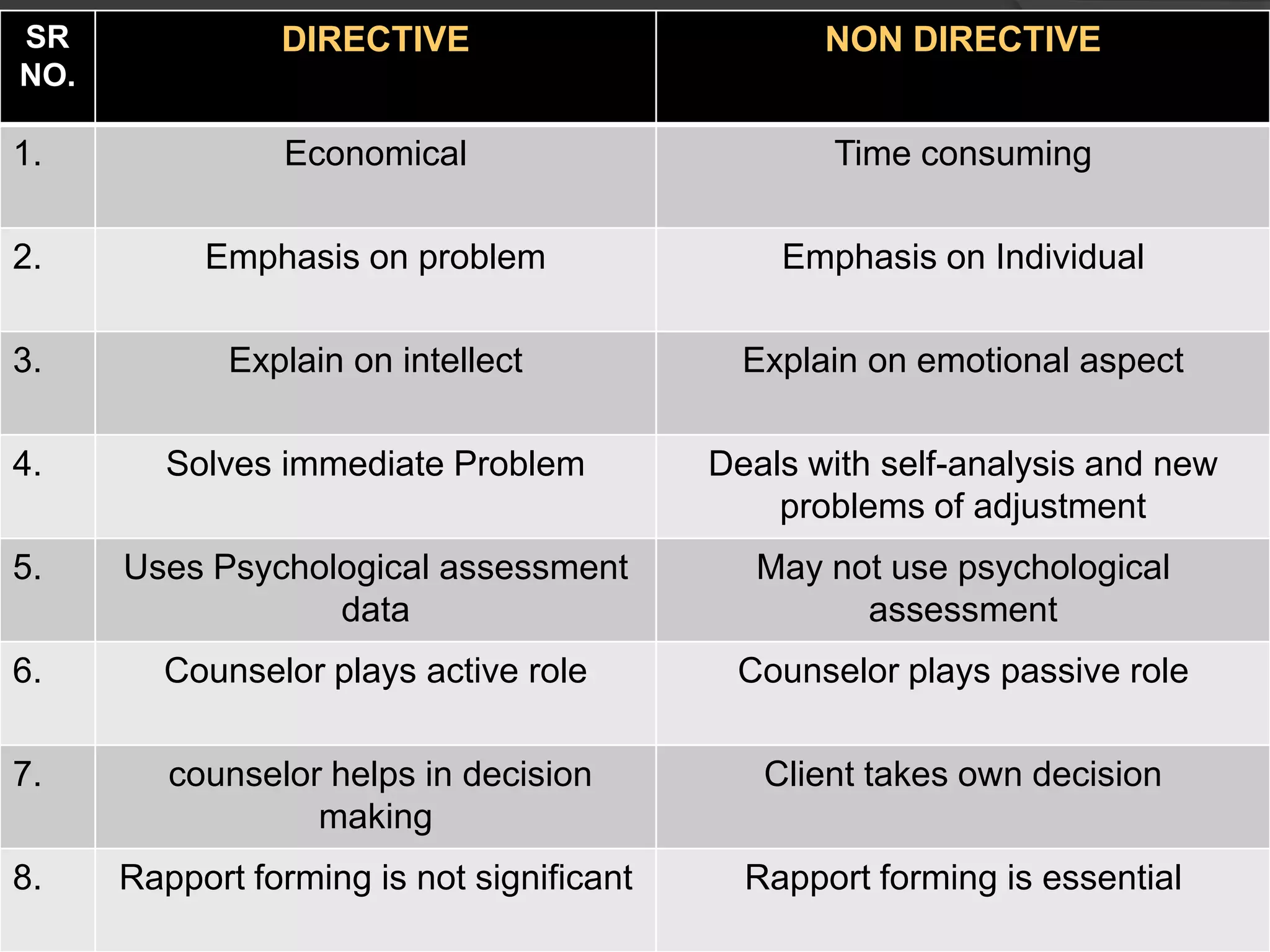
SR              DIRECTIVE                         NON DIRECTIVE
NO.

1.              Economical                        Time consuming

2.         Emphasis on problem                 Emphasis on Individual

3.           Explain on intellect            Explain on emotional aspect

4.       Solves immediate Problem          Deals with self-analysis and new
                                               problems of adjustment
5.    Uses Psychological assessment           May not use psychological
                  data                              assessment
6.      Counselor plays active role         Counselor plays passive role

7.       counselor helps in decision          Client takes own decision
                  making
8.    Rapport forming is not significant     Rapport forming is essential
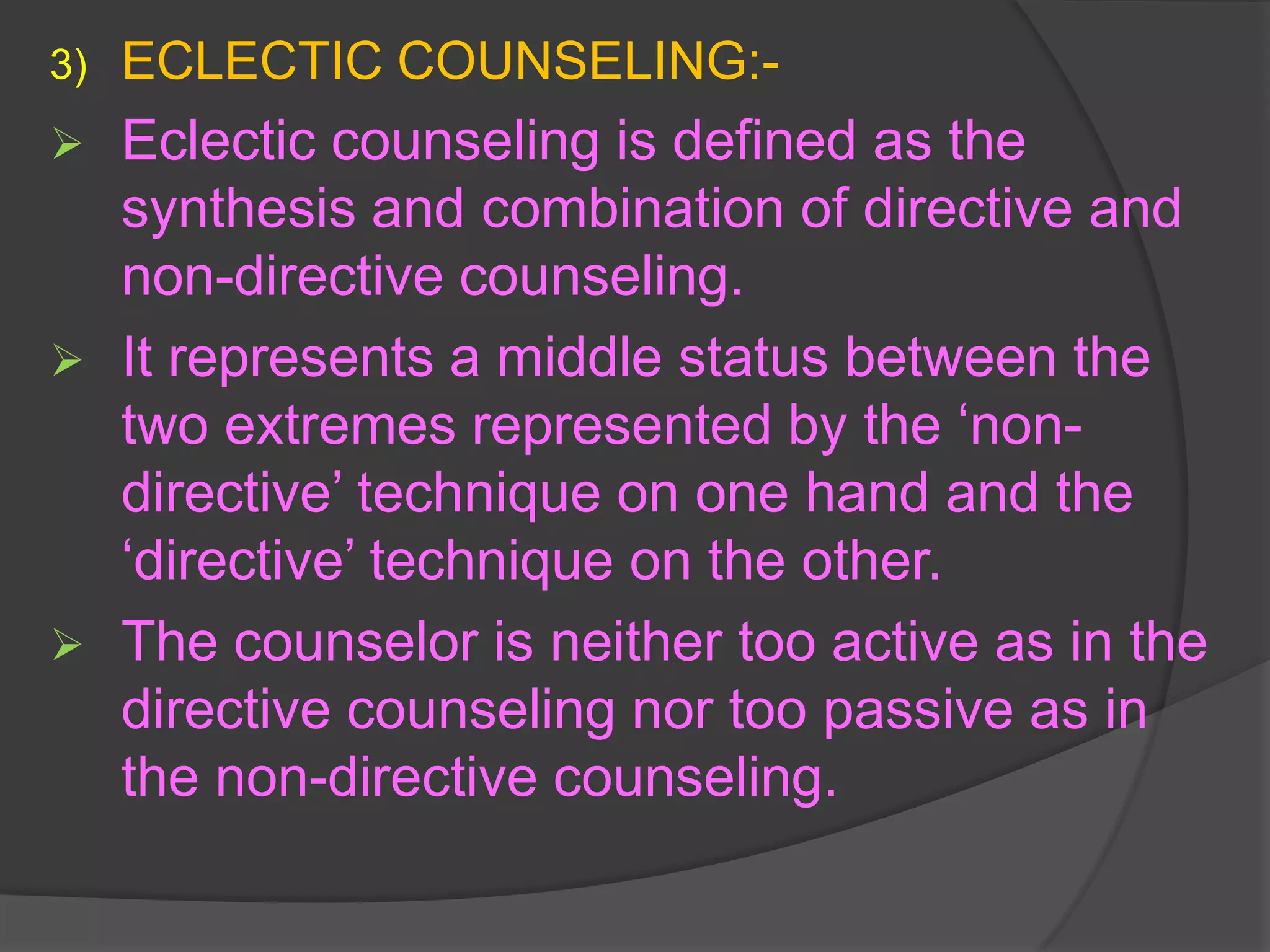
3)   ECLECTIC COUNSELING:-
    Eclectic counseling is defined as the
     synthesis and combination of directive and
     non-directive counseling.
    It represents a middle status between the
     two extremes represented by the ‘non-
     directive’ technique on one hand and the
     ‘directive’ technique on the other.
    The counselor is neither too active as in the
     directive counseling nor too passive as in
     the non-directive counseling.
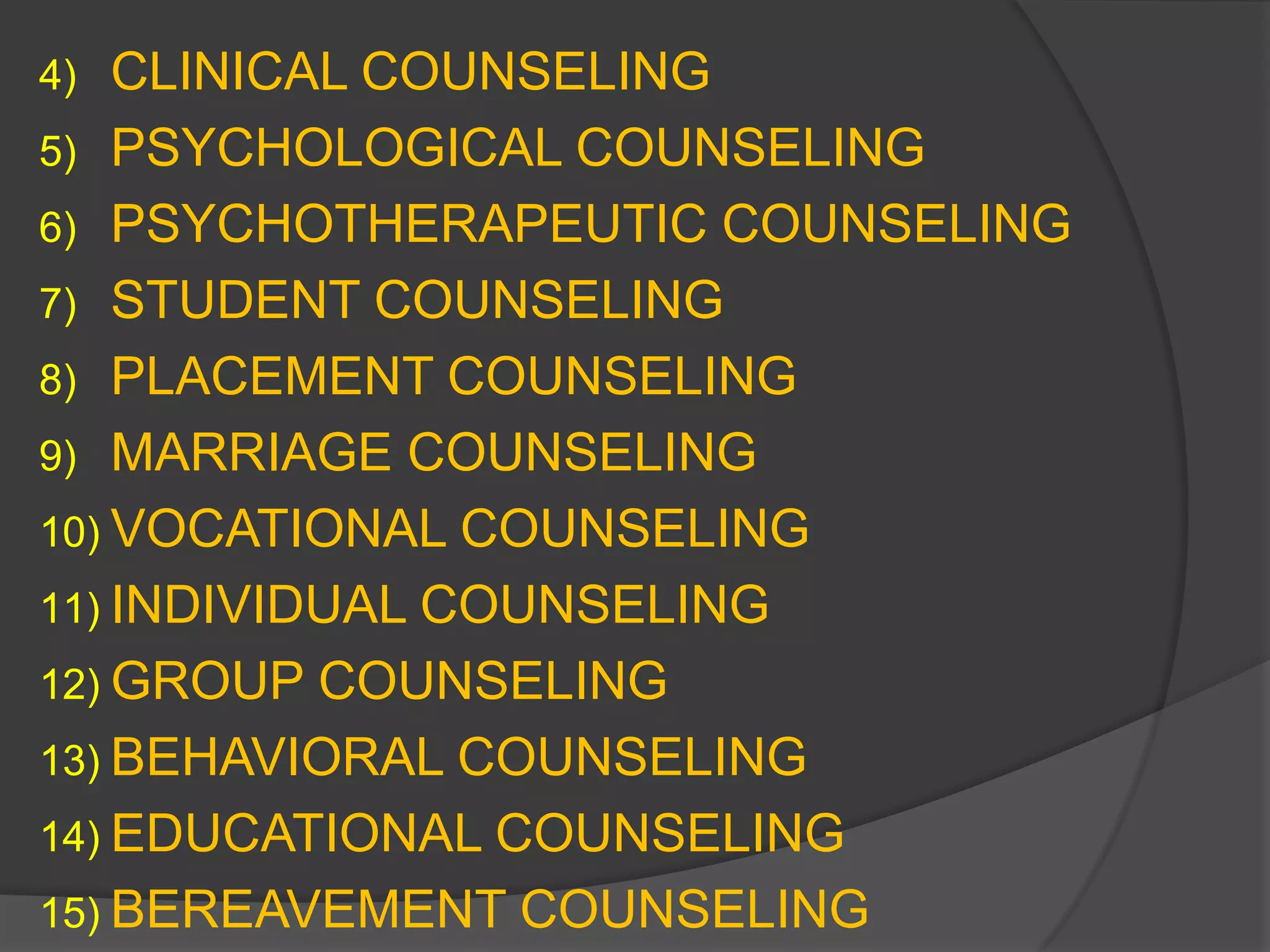
4)  CLINICAL COUNSELING
5) PSYCHOLOGICAL COUNSELING
6) PSYCHOTHERAPEUTIC COUNSELING
7) STUDENT COUNSELING
8) PLACEMENT COUNSELING
9) MARRIAGE COUNSELING
10) VOCATIONAL COUNSELING
11) INDIVIDUAL COUNSELING
12) GROUP COUNSELING
13) BEHAVIORAL COUNSELING
14) EDUCATIONAL COUNSELING
15) BEREAVEMENT COUNSELING

Counselling in nusing

  • 1.
    -Mr. Aaron S.Gogate B.BSc(Nursing)
  • 2.
    MEANING  Counseling denotes ‘giving of advice’.  It is a specialized service of guidance.  It is a process designed to help an individual grow to greater maturity through learning and to makes decisions of an individual.
  • 3.
    DEFINITION  Counseling is a method that helps the client to use a problem solving process to recognize and manage stress and that facilitates interpersonal relationships among client, family and health care team
  • 4.
    AIMS OF COUNSELING ITHELPS STUDENT TO UNDERSTAND:- 1) Self in terms of ability, interest, motivation, and potential. 2) Gain Insight related to emotional difficulties. 3) Alter maladaptive behavior. 4) Achieving integration and fulfill their potentials.
  • 5.
    ETHICS OF COUNSELING i. CONFEDENTIALITY ii. TOLERANCE iii.VOLUNTARY iv.OBJECTIVITY
  • 6.
    PRINCIPLES OF COUNSELING 1) PRINCIPLE OF ACCEPTANCE 2) PRINCIPLE OF RESPECT FOR AN INDIVIDUAL 3) PRINCIPLE OF THINKING WITH AN INDIVIDUAL 4) PRINCIPLE OF PERMISIVENESS 5) PRINCIPLE OF LEARNING 6) PRINCIPLE OF CONSISTENCY
  • 7.
    ATTRIBUTES OF A COUNSELLOR 1) PRE-TRAINING ATTRIBUTES:-  Self awareness and understanding  Good psychological health  Open-minded  Objectivity  Trust worthiness  Approachability
  • 8.
    2) INTER-TRAINING ATTRIBUTES:-  Interview setting:- Physical arrangement-chairs should be kept facing each other. closeness of counselor indicates attentiveness and willingness. A warm friendly greeting. Maintaining Eye-contact.  Problem focus  Identifying an important theme  Directing theme towards a goal  Managing interaction with an individual
  • 9.
    STEPS OF COUNSELING G-GREET THE CLIENT  A-ASK CLIENTS ABOUT THEMSELVES  T-TELL CLIENTS OR GIVE THE INFORMATION OF STRATEGIES OF COPOING MECHANISMS  H-HELP CLIENT TO CHOOSE A METHOD  E-EXPLAIN HOW TO USE  R-RETURN FOR FOLLOW-UP
  • 10.
    TOOLS FOR COLLECTING INFORMATION 1. INTERVIEW 2. OBSERVATION 3. ANECDOTAL RECORDS 4. CUMULATIVE RECORDS 5. PROBLEM/INTEREST CHECKLIST 6. RATING SCALES 7. SOCIOMETRY 8. PSYCHOLOGICAL TEST
  • 11.
    APPROACHES OF COUNSELLING 1) DIRECTIVE COUNSELLING:-  Also called as counselor-centered Counseling  Process of listening to member’s problem, deciding with the member what should be done, and then encouraging and motivating the person to do it.  This type of counseling is more useful where the individual wants information and advice for choice of a career. This approach does not focus its attention on personality development
  • 12.
    2) NON-DIRECTIVE COUNSELLING:-  Counseling in which the counselor is empathetic and does not evaluate or direct (but may clarify) clients' remarks, thus assisting them to accept responsibility for their own problem-solving.  In this counseling, the client has to be led to a point of realization, self-help.  Information may be used to classify a choice and to implement a decision.
  • 13.
    SR DIRECTIVE NON DIRECTIVE NO. 1. Economical Time consuming 2. Emphasis on problem Emphasis on Individual 3. Explain on intellect Explain on emotional aspect 4. Solves immediate Problem Deals with self-analysis and new problems of adjustment 5. Uses Psychological assessment May not use psychological data assessment 6. Counselor plays active role Counselor plays passive role 7. counselor helps in decision Client takes own decision making 8. Rapport forming is not significant Rapport forming is essential
  • 14.
    3) ECLECTIC COUNSELING:-  Eclectic counseling is defined as the synthesis and combination of directive and non-directive counseling.  It represents a middle status between the two extremes represented by the ‘non- directive’ technique on one hand and the ‘directive’ technique on the other.  The counselor is neither too active as in the directive counseling nor too passive as in the non-directive counseling.
  • 15.
    4) CLINICALCOUNSELING 5) PSYCHOLOGICAL COUNSELING 6) PSYCHOTHERAPEUTIC COUNSELING 7) STUDENT COUNSELING 8) PLACEMENT COUNSELING 9) MARRIAGE COUNSELING 10) VOCATIONAL COUNSELING 11) INDIVIDUAL COUNSELING 12) GROUP COUNSELING 13) BEHAVIORAL COUNSELING 14) EDUCATIONAL COUNSELING 15) BEREAVEMENT COUNSELING