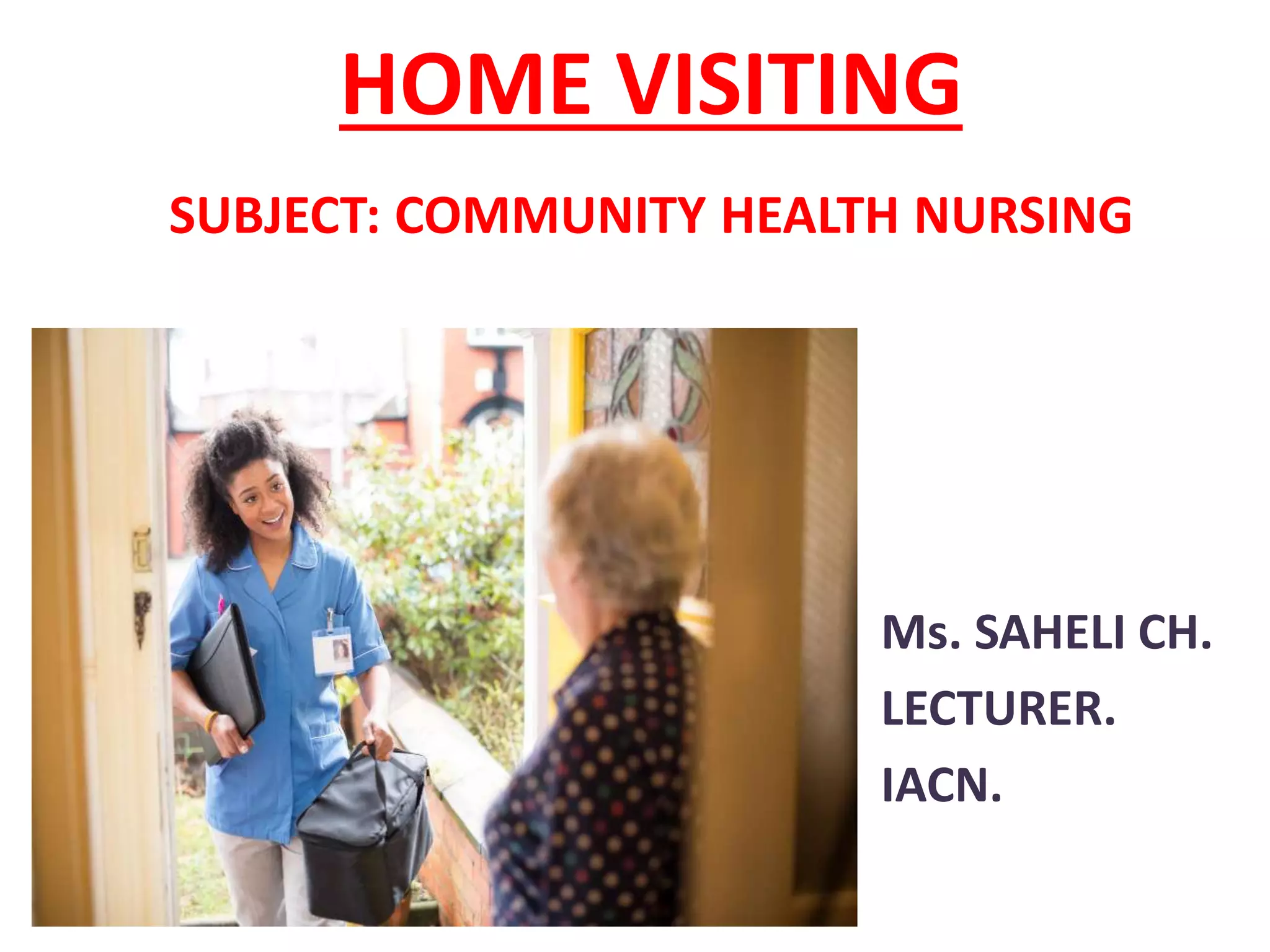
HOME VISITING
SUBJECT: COMMUNITY HEALTH NURSING
Ms. SAHELI CH.
LECTURER.
IACN.
INTRODUCTION
• A home visit is one of the essential parts of the
community health services because most of the
people are found in a home.
• Home visit fulfils the needs of individual, family and
community in general for nursing service and health
counselling.
• A home visit is considered as the backbone of
community health service.
• A home visit is a family–nurse contact which allows
the health worker to assess the home and family
situation in order to provide the necessary nursing
care and health-related activities.
• The services in the home requires technical skills,
knowledge of preventive and therapeutic measures,
teaching ability, judgement and full understanding of
human relation.
DEFINITION
• A home visit is defined as the process of providing
the nursing care to patients at their doorsteps. It
requires technical skills, resourcefulness, judgment,
relationships.
• It is defined as providing the services to family at
their door step to maintain the health & to reduce
the mortality & morbidity in family.
PRINCIPLE
When carrying out the home visit, the community health nurse
should follow certain basic principles which are as follow:
• The home visit should have a purpose and objectives.
• The home visit should be planned according to the priority.
• The purpose of the home visit should be clear, regular, and
flexible according to the needs of the family.
• First of all, introduce yourself, your institution, your purpose
of a home visit, and collect facts about an individual, family
and environment.
• Home visit should be educative.
• Home visit should give excellent opportunities for nurses
to demonstrate hygienic principles.
• Home visit should be convenient, acceptable and
educative to the patients.
• Establish a good interpersonal relationship between
families and be polite, courage, friendly.
• Carefully listen the family and understand the others
person view.
• Health education, nursing care should be scientific.
• Use safe technical skills and scientific nursing procedures.
• Involve whole family members as much as possible during
nursing care.
• The nurse and family member must develop a positive
interpersonal relationship in their work to achieve present
goals.
• Evaluate your own work periodically.
• The nurse must respect the patients right.
• Home visit should be recorded in the diary and family
folder.
PURPOSES
• To find out needs of individual, family and community in relation
to health, socioeconomic and cultural aspects.
• To provide domiciliary midwifery as care for pregnant, delivery,
and puerperal mother and infant.
• To give care to the sick, to a postpartum mother and her newborn
with the view to teach a responsible family member to give
subsequent care.
• To assess the living condition of the patient and his family and
their health practices in order to provide the appropriate health
teachings.
• To provide basic health services for minor ailments. (i.e.
injury, boils, abrasions)
• To provide counselling on family planning, immunization,
nutrition.
• To give health teaching regarding the prevention and
control of diseases.
• To establish a close relationship between the nurses and
the public for promotion of health.
• To make use of an inter-referral system and to promote the
utilization of community services.
STEPS IN HOME VISIT
Ms. SAHELI C
LECTURER
IACN
STEPS IN HOME VISITING
Home visit refers to meeting the health needs of
people at doorsteps. The steps of home visiting are
as follow:-
1. Facts finding.
2. Data finding
3. Planning for a visit.
4. Action and health education.
5. Closing the visit
6. Recording the visit
7. Evaluation of the visit.
(A) FACTS FINDING
• Facts findings are the first steps during home visiting.
• It helps to study the clinical and other records to get an
understanding of what has to be done which is given
below:
1. Prepare a map of the area to be visited and i.e. location,
house, road, temples etc and prepare family folders.
2. Collect information of the family member regarding
number of family member, occupation, education, date of
birth, religion, income, past history, present illness, use of
family planning, immunization etc.
3. Use technical skills and nursing procedure.
4. Establish an interpersonal relationship, be polite
and courage, show the interest towards the
family.
5. Identify the needs of individual and family
members.
6. Discuss the problem with the family members and
find out the possible solutions to problems.
(B) DATA FINDINGS
• After completing the fact finding; the process of analysis
begins.
• The data of the members should be honest and based on
the facts and not an opinion.
• The personal, emotional, spiritual aspects should be
involved which are taken together and also constitute the
usual health problem.
• The problem and facts should show exact problems and
what he is expected to do.
• Discuss the point step by step and examine
the matter critically.
• Then only comes to the conclusions.
• Do not jump and do not make hasty
conservation.
• After that, the nurse helps the family to plan
and use local and outside resources.
(C) PLANNING FOR A VISIT
Community health nurse should assess or consider many factors
while making a visit to the family such as:
a) First priority should be given to essential basic need such as
hunger, then only for personal hygiene or safe water or
sanitation.
b) Family’s cultural background. This helps the community health
nurse to understand their attitudes, beliefs, practices
regarding medical practice and diet.
c) Occupation and income of family to determine and assist in
budgetary problems.
d) Age.
e) Psychological factors- this includes family relationships.
f) Educational level.
g) local resources available in a family in order to be practical.
h) Planning should also be based upon short term or long term
objectives of the family.
i) Some alternatives plan or suggestions are also helpful.
j) Do respect the individual’s ideas, suggestion or solution.
k) Good planning always leads to doing a good action and achieve
objectives.
D) ACTION AND HEALTH EDUCATION
I. APPROACH TO FAMILY:
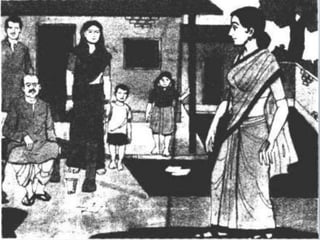
 Locate the right house.
 Knocking at the door and call out.
 Introduce yourself, your agency and the purpose of
your visit.
 Establish good rapport- being courteous, polite,
warm and friendly.
 Good observer of verbal and non-verbal response
from family.
 Use (words) ‘How’, ‘what’, ‘when’, ‘why’, while
questioning.
 Be a good listener.
 Keep in mind agency’s policies during visit regarding
fees and care.
 The talk should be informal, giving plenty of
opportunities to ask a question and provide a
platform for discussion.
 Do not force information.
 Observe local customs eg. Removing shoes or
chappals before entering the house is necessary in
Indian Communities.
II. INTERVIEWING THE FAMILIES:
 Interview is defined as a conversation with a
purpose; an exchange of ideas between two
people ; a process of giving and receiving
information.
 The nurse should be sensitive to the other
person’s point of view.
PRINCIPLES OF INTERIEW TECHNIQUE:
 Provide privacy.
 Establish a good rapport.
 Must maintain an intellectual an alert attitude
 Understand the client’s and families problem and their socio
cultural background.
 Relieve anxieties and fears by providing a conducive
environment.
 Speak the language of the client and use simple terms which
can be understandable.
 Be a good listener.
 Follow through on the interview.
 Record the interview.
 Evaluate the interview.
III. Activities during home visit:
 Providing nursing care with comfort g. Taking
temperature, for giving bath.
 Observing and assessing patient’s condition.
 Knowing the family fully well - assists and guides
them in making plans for solving health problems.
 Demonstrating and teaching eg. Giving insulin
injection.
 Making nursing diagnosis and tentative nursing care
plan.
 Establishing priorities.
 Giving assurance to the individual and family
appropriately.
IV. HEALTH EDUCATION:
 The action and health education should be as per
family time schedule.
 Find out what is the best time for teaching them.
 For example, if they are drying food in a yard, then you
should teach about food storage, and help them for
proper drying.
 This help to provide effective teaching as you are
helping them.
 It also builds good interpersonal relationships.
 Emphasis should be given on practical more often than
theoretical.
(E) CLOSING THE VISIT
• The nurse should summarize the contents of her
visit and plans for next visit.
• For example, say that you will visit next day or
next week.
F) RECORDING THE VISIT
• Record the activity carried out and the services given specifically.
• For eg. Record what foods were advised regarding nutrition
instead of recording ‘discussed well balanced diet’.
• Describe what was done and the reasons for doing the specific
procedure.
• For eg. What demonstration was carried out, what was discussed,
explained, explored, suggested or reviewed.
• A clear, concise and skilfully written records helps in better
patient care.
G) EVALUATION OF THE VISIT
This is necessary in terms of-
A. Was good relationship established ?
B. Was the point of view of community health
nurse understood ?
C. How effective was the teaching?
D. Was the community health nurse able to
recognize and identify the needs of the
family?
 These questions should be raised an
answered at the end of each home visit.
 FREQUENCY OF HOME VISIT
• Making decision regarding frequency of visit is a matter of
judgment.
• It will depend upon the extent of health problems of the
family
Priorities are established on the following guidelines:
 Visits in response to the need felt by the family such as
mother in labour, acute and serious illness etc.
 Visit to premature infants and infants with defects
 Regular visits to post natal mother and antenatal mother
Visits to chronically ill patients
Supervisory visits to infants, toddler, and eligible
couple
Collection of family information and
investigations.
Information, education, counselling and
guidance purposes

Home visit

  • 1.
    HOME VISITING SUBJECT: COMMUNITYHEALTH NURSING Ms. SAHELI CH. LECTURER. IACN.
  • 3.
    INTRODUCTION • A homevisit is one of the essential parts of the community health services because most of the people are found in a home. • Home visit fulfils the needs of individual, family and community in general for nursing service and health counselling. • A home visit is considered as the backbone of community health service.
  • 4.
    • A homevisit is a family–nurse contact which allows the health worker to assess the home and family situation in order to provide the necessary nursing care and health-related activities. • The services in the home requires technical skills, knowledge of preventive and therapeutic measures, teaching ability, judgement and full understanding of human relation.
  • 5.
    DEFINITION • A homevisit is defined as the process of providing the nursing care to patients at their doorsteps. It requires technical skills, resourcefulness, judgment, relationships. • It is defined as providing the services to family at their door step to maintain the health & to reduce the mortality & morbidity in family.
  • 7.
    PRINCIPLE When carrying outthe home visit, the community health nurse should follow certain basic principles which are as follow: • The home visit should have a purpose and objectives. • The home visit should be planned according to the priority. • The purpose of the home visit should be clear, regular, and flexible according to the needs of the family. • First of all, introduce yourself, your institution, your purpose of a home visit, and collect facts about an individual, family and environment.
  • 8.
    • Home visitshould be educative. • Home visit should give excellent opportunities for nurses to demonstrate hygienic principles. • Home visit should be convenient, acceptable and educative to the patients. • Establish a good interpersonal relationship between families and be polite, courage, friendly. • Carefully listen the family and understand the others person view. • Health education, nursing care should be scientific.
  • 9.
    • Use safetechnical skills and scientific nursing procedures. • Involve whole family members as much as possible during nursing care. • The nurse and family member must develop a positive interpersonal relationship in their work to achieve present goals. • Evaluate your own work periodically. • The nurse must respect the patients right. • Home visit should be recorded in the diary and family folder.
  • 10.
    PURPOSES • To findout needs of individual, family and community in relation to health, socioeconomic and cultural aspects. • To provide domiciliary midwifery as care for pregnant, delivery, and puerperal mother and infant. • To give care to the sick, to a postpartum mother and her newborn with the view to teach a responsible family member to give subsequent care. • To assess the living condition of the patient and his family and their health practices in order to provide the appropriate health teachings.
  • 12.
    • To providebasic health services for minor ailments. (i.e. injury, boils, abrasions) • To provide counselling on family planning, immunization, nutrition. • To give health teaching regarding the prevention and control of diseases. • To establish a close relationship between the nurses and the public for promotion of health. • To make use of an inter-referral system and to promote the utilization of community services.
  • 20.
    STEPS IN HOMEVISIT Ms. SAHELI C LECTURER IACN
  • 21.
    STEPS IN HOMEVISITING Home visit refers to meeting the health needs of people at doorsteps. The steps of home visiting are as follow:- 1. Facts finding. 2. Data finding 3. Planning for a visit. 4. Action and health education. 5. Closing the visit 6. Recording the visit 7. Evaluation of the visit.
  • 22.
    (A) FACTS FINDING •Facts findings are the first steps during home visiting. • It helps to study the clinical and other records to get an understanding of what has to be done which is given below: 1. Prepare a map of the area to be visited and i.e. location, house, road, temples etc and prepare family folders. 2. Collect information of the family member regarding number of family member, occupation, education, date of birth, religion, income, past history, present illness, use of family planning, immunization etc.
  • 23.
    3. Use technicalskills and nursing procedure. 4. Establish an interpersonal relationship, be polite and courage, show the interest towards the family. 5. Identify the needs of individual and family members. 6. Discuss the problem with the family members and find out the possible solutions to problems.
  • 24.
    (B) DATA FINDINGS •After completing the fact finding; the process of analysis begins. • The data of the members should be honest and based on the facts and not an opinion. • The personal, emotional, spiritual aspects should be involved which are taken together and also constitute the usual health problem. • The problem and facts should show exact problems and what he is expected to do.
  • 25.
    • Discuss thepoint step by step and examine the matter critically. • Then only comes to the conclusions. • Do not jump and do not make hasty conservation. • After that, the nurse helps the family to plan and use local and outside resources.
  • 26.
    (C) PLANNING FORA VISIT Community health nurse should assess or consider many factors while making a visit to the family such as: a) First priority should be given to essential basic need such as hunger, then only for personal hygiene or safe water or sanitation. b) Family’s cultural background. This helps the community health nurse to understand their attitudes, beliefs, practices regarding medical practice and diet.
  • 27.
    c) Occupation andincome of family to determine and assist in budgetary problems. d) Age. e) Psychological factors- this includes family relationships. f) Educational level. g) local resources available in a family in order to be practical. h) Planning should also be based upon short term or long term objectives of the family. i) Some alternatives plan or suggestions are also helpful. j) Do respect the individual’s ideas, suggestion or solution. k) Good planning always leads to doing a good action and achieve objectives.
  • 28.
    D) ACTION ANDHEALTH EDUCATION I. APPROACH TO FAMILY:  Locate the right house.  Knocking at the door and call out.  Introduce yourself, your agency and the purpose of your visit.  Establish good rapport- being courteous, polite, warm and friendly.  Good observer of verbal and non-verbal response from family.  Use (words) ‘How’, ‘what’, ‘when’, ‘why’, while questioning.  Be a good listener.
  • 29.
     Keep inmind agency’s policies during visit regarding fees and care.  The talk should be informal, giving plenty of opportunities to ask a question and provide a platform for discussion.  Do not force information.  Observe local customs eg. Removing shoes or chappals before entering the house is necessary in Indian Communities.
  • 30.
    II. INTERVIEWING THEFAMILIES:  Interview is defined as a conversation with a purpose; an exchange of ideas between two people ; a process of giving and receiving information.  The nurse should be sensitive to the other person’s point of view.
  • 31.
    PRINCIPLES OF INTERIEWTECHNIQUE:  Provide privacy.  Establish a good rapport.  Must maintain an intellectual an alert attitude  Understand the client’s and families problem and their socio cultural background.  Relieve anxieties and fears by providing a conducive environment.  Speak the language of the client and use simple terms which can be understandable.  Be a good listener.  Follow through on the interview.  Record the interview.  Evaluate the interview.
  • 32.
    III. Activities duringhome visit:  Providing nursing care with comfort g. Taking temperature, for giving bath.  Observing and assessing patient’s condition.  Knowing the family fully well - assists and guides them in making plans for solving health problems.  Demonstrating and teaching eg. Giving insulin injection.  Making nursing diagnosis and tentative nursing care plan.  Establishing priorities.  Giving assurance to the individual and family appropriately.
  • 33.
    IV. HEALTH EDUCATION: The action and health education should be as per family time schedule.  Find out what is the best time for teaching them.  For example, if they are drying food in a yard, then you should teach about food storage, and help them for proper drying.  This help to provide effective teaching as you are helping them.  It also builds good interpersonal relationships.  Emphasis should be given on practical more often than theoretical.
  • 34.
    (E) CLOSING THEVISIT • The nurse should summarize the contents of her visit and plans for next visit. • For example, say that you will visit next day or next week.
  • 35.
    F) RECORDING THEVISIT • Record the activity carried out and the services given specifically. • For eg. Record what foods were advised regarding nutrition instead of recording ‘discussed well balanced diet’. • Describe what was done and the reasons for doing the specific procedure. • For eg. What demonstration was carried out, what was discussed, explained, explored, suggested or reviewed. • A clear, concise and skilfully written records helps in better patient care.
  • 36.
    G) EVALUATION OFTHE VISIT This is necessary in terms of- A. Was good relationship established ? B. Was the point of view of community health nurse understood ? C. How effective was the teaching? D. Was the community health nurse able to recognize and identify the needs of the family?  These questions should be raised an answered at the end of each home visit.
  • 37.
     FREQUENCY OFHOME VISIT • Making decision regarding frequency of visit is a matter of judgment. • It will depend upon the extent of health problems of the family Priorities are established on the following guidelines:  Visits in response to the need felt by the family such as mother in labour, acute and serious illness etc.  Visit to premature infants and infants with defects  Regular visits to post natal mother and antenatal mother
  • 38.
    Visits to chronicallyill patients Supervisory visits to infants, toddler, and eligible couple Collection of family information and investigations. Information, education, counselling and guidance purposes