M. Nageswar Rao, Sr.Mgr.(EMD) Date: 24.03.2015
Venue: EDC, Simhadri
Contents
 Introduction
 Types of Transformers
 Transformers in SMPP
 Specifications
 Components
 Loading & Overloading capacity
 Condition Monitoring
 Testing
2
Types of transformers
 Power transformation
 Power transformer ,
 Distribution transformer,
 Auto transformers
 Voltage transformation (Step up, Step down)
 Voltage class (LT, MV, EHV)
 Cooling
 Oil filled (ONAN, ONAF, OFAF, ODAF)
 Dry type
 Core material (CRGO, AMT)
 Construction (Core type, Shell type)
 Phase (1Φ, 3Φ, Multi-phase)
3
Transformers in SMPP
 St#1 Transformers
 St#2 Transformers
4
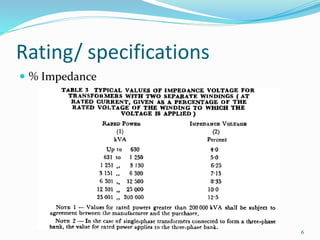
Rating/ specifications
 Voltage HV/LV
 Power rating, MVA
 Cooling method
 % impedance
 Vector group & clock
 Taps, tap changer
 Losses & Loss capitalization charges
 Terminal arrangement
5
Rating/ specifications
 % Impedance
6
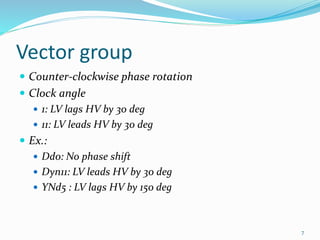
Vector group
 Counter-clockwise phase rotation
 Clock angle
 1: LV lags HV by 30 deg
 11: LV leads HV by 30 deg
 Ex.:
 Dd0: No phase shift
 Dyn11: LV leads HV by 30 deg
 YNd5 : LV lags HV by 150 deg
7
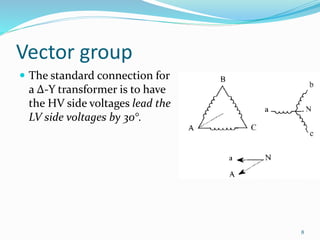
Vector group
 The standard connection for
a Δ-Y transformer is to have
the HV side voltages lead the
LV side voltages by 30°.
8
Vector group
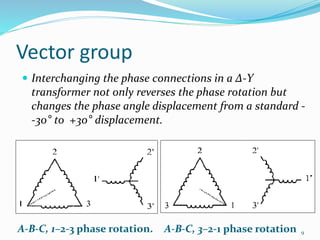
A-B-C, 1–2-3 phase rotation. A-B-C, 3–2-1 phase rotation 9
 Interchanging the phase connections in a Δ-Y
transformer not only reverses the phase rotation but
changes the phase angle displacement from a standard -
-30° to +30° displacement.
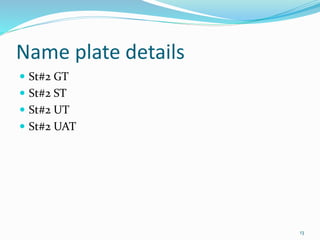
Cooling Arrangement
 ONAN
 For smaller T/f ratings
 Oil is kept in circulation
by the gravitational
buoyancy in the closed-
loop cooling system
 ONAF
 Fans are mounted just
below the radiators, to
blow air from bottom.
 more fans should be
mounted at the top of
radiator height. 10
Cooling Arrangement
OFAF ODAF
11
 Heat dissipation of winding is
less
 Oil ducting system is used to
direct the oil over the windings,
hence more heat dissipation.
Cooling Arrangement
 Cooling pump
 Used for circulating oil against low and high frictional head
losses respectively.
 Two types of pump designs:
 axial flow in-line type and
 radial flow type
 The axial flow type offers less resistance when switched-off,
and is used with
 mixed cooling (ONAN/ ONAF/OFAF) since it
 The radial flow type pumps, which offer very high resistance
to oil flow under the switched-off condition, are used with
 oil-to-air heat exchangers (unit cooler arrangement) or
 oil-to-water heat exchangers in which no natural cooling is provided 12
Name plate details
 St#2 GT
 St#2 ST
 St#2 UT
 St#2 UAT
13
Components
of a Transformer
 Windings
 Core
 Insulation (paper)
 Cooling medium (oil)
 Bushings
 Protective devices
 PRD, Buch.Relay
 Monitoring devices
 MOG, Oil level indicators,
 RTD & Temperature gauges (WTI, OTI)
 Accessories
 Tap changer,
 Radiators, Cooling fans & pumps,
 Oil flow indicators.
 Conservator, Breather, Aircell
 Aux. power supply (Marshalling box)
 Lightning protection
 Earthing arrangement
14
Oil filled Transformer
15
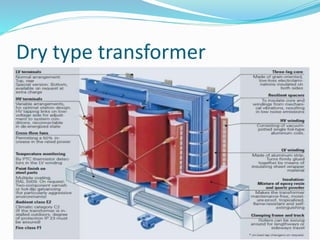
Dry type transformer
16
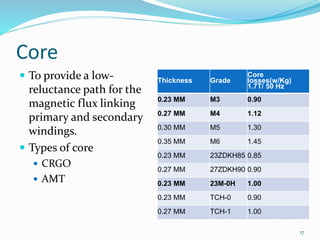
Core
Thickness Grade
Core
losses(w/Kg)
1.7T/ 50 Hz
0.23 MM M3 0.90
0.27 MM M4 1.12
0.30 MM M5 1.30
0.35 MM M6 1.45
0.23 MM 23ZDKH85 0.85
0.27 MM 27ZDKH90 0.90
0.23 MM 23M-0H 1.00
0.23 MM TCH-0 0.90
0.27 MM TCH-1 1.00
 To provide a low-
reluctance path for the
magnetic flux linking
primary and secondary
windings.
 Types of core
 CRGO
 AMT
17
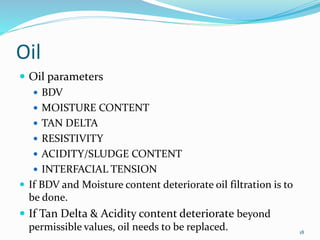
Oil
 Oil parameters
 BDV
 MOISTURE CONTENT
 TAN DELTA
 RESISTIVITY
 ACIDITY/SLUDGE CONTENT
 INTERFACIAL TENSION
 If BDV and Moisture content deteriorate oil filtration is to
be done.
 If Tan Delta & Acidity content deteriorate beyond
permissible values, oil needs to be replaced. 18
Insulation
 Minor insulation Like inter turn insulation, is achieved
using cellulosic paper.
 Major insulation like between primary and secondary,
phase to phase and inner coil to core is achieved by
Bakelite, wooden blocks, cellulosic paper cylinders.
19
Bushing
 Types
 Plain type bushings (<25kV)
 Oil-impregnated, Paper-insulated Condenser Bushing
 Air-Oil
 SF6 Gas- Oil
20
Bushing
21
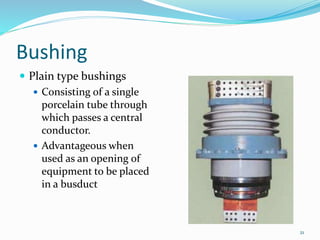
 Plain type bushings
 Consisting of a single
porcelain tube through
which passes a central
conductor.
 Advantageous when
used as an opening of
equipment to be placed
in a busduct
Bushing
22
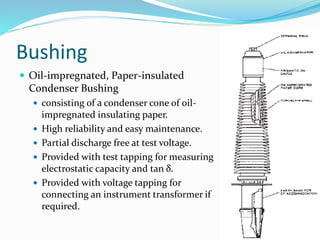
 Oil-impregnated, Paper-insulated
Condenser Bushing
 consisting of a condenser cone of oil-
impregnated insulating paper.
 High reliability and easy maintenance.
 Partial discharge free at test voltage.
 Provided with test tapping for measuring
electrostatic capacity and tan δ.
 Provided with voltage tapping for
connecting an instrument transformer if
required.
OTI
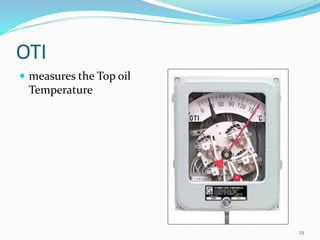
 measures the Top oil
Temperature
23
WTI
 Winding is the highest
temperature component
of transformer
 Thermowell method
24
Buchholz relay
 This is mounted in the connecting pipe line between
conservator and main tank.
 This has two Floats, one of them with surge catching baffle
and gas collecting space at top.
 Alarm float operates when
 Broken down core bolt insulation
 Shorted Laminations
 Bad Contacts
 Overheating of winding parts
 Trip float operates when
 Short Circuit between Winding Phases or within Windings
 Puncture of Bushing
25
PRD
 Qualitrol catalogue
26
Overloading capacity
 IS:6600 – Guide for loading of oil immersed
transformers.
 k1 = initial load, S1 as a fraction of rated kVA, Sr.
 K2 = permissible load, S2 as a fraction of rated kVA, Sr.
 h = duration of k2 in hours
 θa = temp. of oil (weighted average)
27
Overloading capacity
 Sr = 1000kVA
 S1 = 500 kVA for h = 2
hrs.
 k1 = 500/1000 = 0.5
 From table, k2 = 1.43
 S2 = k2* Sr = 1430kVA.
28
Condition Monitoring
 Dissolved gas-in-oil analysis (DGA)
 Moisture level in oil
 Condition assessment of cellulose insulation
 Degree of Polymerization (DP)
 Furanic compounds
 Metals in oil
 Insulation p.f. test-
 insulation degradation,
 excessive water in cellulose structures
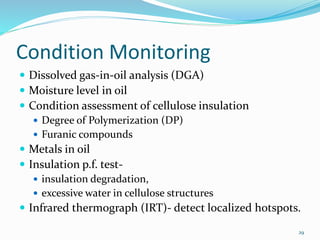
 Infrared thermograph (IRT)- detect localized hotspots.
29
DGA- Key gases
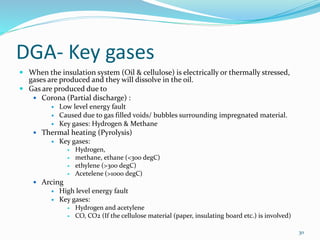
 When the insulation system (Oil & cellulose) is electrically or thermally stressed,
gases are produced and they will dissolve in the oil.
 Gas are produced due to
 Corona (Partial discharge) :
 Low level energy fault
 Caused due to gas filled voids/ bubbles surrounding impregnated material.
 Key gases: Hydrogen & Methane
 Thermal heating (Pyrolysis)
 Key gases:
 Hydrogen,
 methane, ethane (<300 degC)
 ethylene (>300 degC)
 Acetelene (>1000 degC)
 Arcing
 High level energy fault
 Key gases:
 Hydrogen and acetylene
 CO, CO2 (If the cellulose material (paper, insulating board etc.) is involved)
30
DGA
 The distribution of released gases can be related to the type
of electrical fault and the rate of gas generation can
indicate the severity of the fault.
 Methods
 Rogers Ratio Method,
 IEC Basic Ratio Method,
 Duval Triangle method and
 Key Gas Method
31
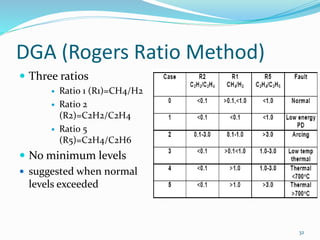
DGA (Rogers Ratio Method)
 Three ratios
 Ratio 1 (R1)=CH4/H2
 Ratio 2
(R2)=C2H2/C2H4
 Ratio 5
(R5)=C2H4/C2H6
 No minimum levels
 suggested when normal
levels exceeded
32
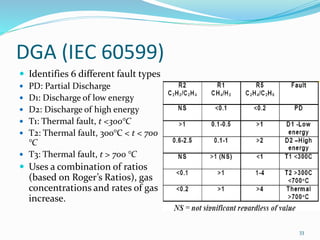
DGA (IEC 60599)
 Identifies 6 different fault types
 PD: Partial Discharge
 D1: Discharge of low energy
 D2: Discharge of high energy
 T1: Thermal fault, t <300°C
 T2: Thermal fault, 300°C < t < 700
°C
 T3: Thermal fault, t > 700 °C
 Uses a combination of ratios
(based on Roger’s Ratios), gas
concentrations and rates of gas
increase.
33
Moisture content in cellulose insulation
 Water heat run test
 Relative saturation (RS) of water in oil
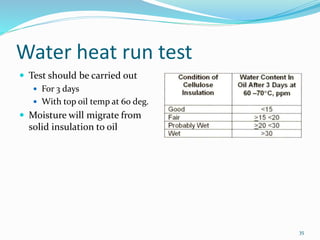
Water heat run test
 Test should be carried out
 For 3 days
 With top oil temp at 60 deg.
 Moisture will migrate from
solid insulation to oil
35
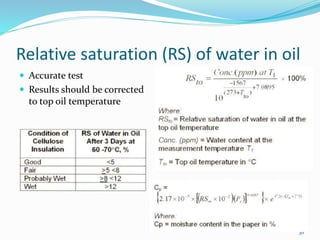
Relative saturation (RS) of water in oil
 Accurate test
 Results should be corrected
to top oil temperature
36
Transformer testing
 Voltage ratio test
 1Φ Excitation Current at 415V
 Polarity check
 Winding Resistance
 IR of winding & core
 Capacitance & Tan delta of winding & bushing
37
Voltage ratio test
 To measure the voltage ratio
of one winding to another
associated with a lower or
equal voltage.
 Accepted criteria
 % Ratio Error : ± 0.5 % of declared
ratio on all taps
 Phase Angle error: 0.5% radian
 % Ratio error (Deviation) =
[(measured ratio – calculated ratio) /
calculated ratio] x 100
 Calculated voltage ratio = HV
winding voltage / LV winding voltage
38
1Φ Excitation Current at 415V
 To measure the excitation current at 415v in order to
cross check the results at site before commissioning.
 Procedure:
 Single phase 415V, 50Hz supply is given to low voltage
winding. Other windings are kept open.
 Excitation current is measured of supplied winding.
39
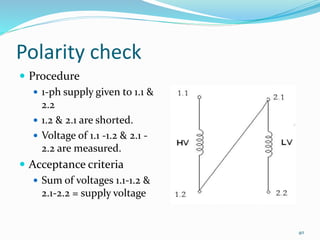
Polarity check
 Procedure
 1-ph supply given to 1.1 &
2.2
 1.2 & 2.1 are shorted.
 Voltage of 1.1 -1.2 & 2.1 -
2.2 are measured.
 Acceptance criteria
 Sum of voltages 1.1-1.2 &
2.1-2.2 = supply voltage
40
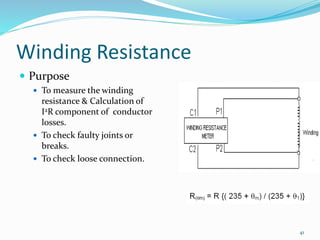
Winding Resistance
 Purpose
 To measure the winding
resistance & Calculation of
I2R component of conductor
losses.
 To check faulty joints or
breaks.
 To check loose connection.
41
IR of winding & core
 To determine the
insulation resistance
from individual windings
to ground or between
individual windings.
 Insulation Resistance
will be measured
between
 (HV+N) / LV
 (HV+N) / (LV+E)
 LV / (HV+N+E)
42
IR of winding & core
 Calculate the Polarization index (P.I) which is equal to
ratio of IR after 600 sec.to IR after 60 sec.
 Acceptance:
 P.I value should be greater than or equal to 1.3
43
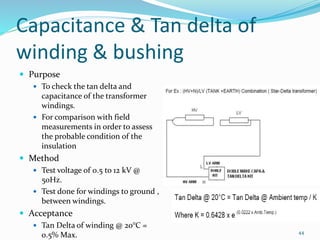
Capacitance & Tan delta of
winding & bushing
 Purpose
 To check the tan delta and
capacitance of the transformer
windings.
 For comparison with field
measurements in order to assess
the probable condition of the
insulation
 Method
 Test voltage of 0.5 to 12 kV @
50Hz.
 Test done for windings to ground ,
between windings.
 Acceptance
 Tan Delta of winding @ 20°C =
0.5% Max. 44
Diagnostic testing
 Frequency response analysis (SFRA)
 Degree of polymerization index
 Furan analysis (furfural content)
45
SFRA
 To detect movement of windings under short
circuit conditions
 Procedure
 Low voltage sinusoidal output to one end of winding
from Network Analyser (NA).
 Voltage transfer function measured from 5hz to 10mhz
 NA programmed to measure amplitude and phase shift
at discreet intervals of frequencies.
46
SFRA
 Condition assessment based on
 comparison of responses from different phases for each
winding and tap position
 comparison of responses from different transformer of
the same design
 Frequency bandwidth
 5hz to 2khz indicate mag circuit condition
 2khz to 200 khz changes in leakage impedance
 1mhz and above indicate capacitance changes
47
dP index
 Length of cellulose molecule is measured in terms of
dp index.
 Depends on dp index of paper
 New paper 1200 to 2000
 Below 250 a matter of concern
 Below 150 little life left and close to failure
48
49
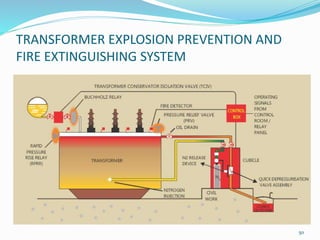
TRANSFORMER EXPLOSION PREVENTION AND
FIRE EXTINGUISHING SYSTEM
50
 Air cell is made from Nylon fabric coated with Nitrile
rubber
51
Transportation
 With oil
 10% of the tank volume is left clear for expansion to limit
the excess internal air pressure to 0.35 kg/cm2.
 Fittings dismantled before transport are packed in
packing cases in line with shipping list.
 With N2
 Transformer tank is filled with dry Nitrogen at a positive
pressure of 0.175 kg/cm2 (2.5 psi)
 N2regulator reduces cylinder high pressure of 120 to 140
kscto required low pressure of 0.175 ksc.
52

Presentation_Power_Transformers-1

  • 1.
    M. Nageswar Rao,Sr.Mgr.(EMD) Date: 24.03.2015 Venue: EDC, Simhadri
  • 2.
    Contents  Introduction  Typesof Transformers  Transformers in SMPP  Specifications  Components  Loading & Overloading capacity  Condition Monitoring  Testing 2
  • 3.
    Types of transformers Power transformation  Power transformer ,  Distribution transformer,  Auto transformers  Voltage transformation (Step up, Step down)  Voltage class (LT, MV, EHV)  Cooling  Oil filled (ONAN, ONAF, OFAF, ODAF)  Dry type  Core material (CRGO, AMT)  Construction (Core type, Shell type)  Phase (1Φ, 3Φ, Multi-phase) 3
  • 4.
    Transformers in SMPP St#1 Transformers  St#2 Transformers 4
  • 5.
    Rating/ specifications  VoltageHV/LV  Power rating, MVA  Cooling method  % impedance  Vector group & clock  Taps, tap changer  Losses & Loss capitalization charges  Terminal arrangement 5
  • 6.
  • 7.
    Vector group  Counter-clockwisephase rotation  Clock angle  1: LV lags HV by 30 deg  11: LV leads HV by 30 deg  Ex.:  Dd0: No phase shift  Dyn11: LV leads HV by 30 deg  YNd5 : LV lags HV by 150 deg 7
  • 8.
    Vector group  Thestandard connection for a Δ-Y transformer is to have the HV side voltages lead the LV side voltages by 30°. 8
  • 9.
    Vector group A-B-C, 1–2-3phase rotation. A-B-C, 3–2-1 phase rotation 9  Interchanging the phase connections in a Δ-Y transformer not only reverses the phase rotation but changes the phase angle displacement from a standard - -30° to +30° displacement.
  • 10.
    Cooling Arrangement  ONAN For smaller T/f ratings  Oil is kept in circulation by the gravitational buoyancy in the closed- loop cooling system  ONAF  Fans are mounted just below the radiators, to blow air from bottom.  more fans should be mounted at the top of radiator height. 10
  • 11.
    Cooling Arrangement OFAF ODAF 11 Heat dissipation of winding is less  Oil ducting system is used to direct the oil over the windings, hence more heat dissipation.
  • 12.
    Cooling Arrangement  Coolingpump  Used for circulating oil against low and high frictional head losses respectively.  Two types of pump designs:  axial flow in-line type and  radial flow type  The axial flow type offers less resistance when switched-off, and is used with  mixed cooling (ONAN/ ONAF/OFAF) since it  The radial flow type pumps, which offer very high resistance to oil flow under the switched-off condition, are used with  oil-to-air heat exchangers (unit cooler arrangement) or  oil-to-water heat exchangers in which no natural cooling is provided 12
  • 13.
    Name plate details St#2 GT  St#2 ST  St#2 UT  St#2 UAT 13
  • 14.
    Components of a Transformer Windings  Core  Insulation (paper)  Cooling medium (oil)  Bushings  Protective devices  PRD, Buch.Relay  Monitoring devices  MOG, Oil level indicators,  RTD & Temperature gauges (WTI, OTI)  Accessories  Tap changer,  Radiators, Cooling fans & pumps,  Oil flow indicators.  Conservator, Breather, Aircell  Aux. power supply (Marshalling box)  Lightning protection  Earthing arrangement 14
  • 15.
  • 16.
  • 17.
    Core Thickness Grade Core losses(w/Kg) 1.7T/ 50Hz 0.23 MM M3 0.90 0.27 MM M4 1.12 0.30 MM M5 1.30 0.35 MM M6 1.45 0.23 MM 23ZDKH85 0.85 0.27 MM 27ZDKH90 0.90 0.23 MM 23M-0H 1.00 0.23 MM TCH-0 0.90 0.27 MM TCH-1 1.00  To provide a low- reluctance path for the magnetic flux linking primary and secondary windings.  Types of core  CRGO  AMT 17
  • 18.
    Oil  Oil parameters BDV  MOISTURE CONTENT  TAN DELTA  RESISTIVITY  ACIDITY/SLUDGE CONTENT  INTERFACIAL TENSION  If BDV and Moisture content deteriorate oil filtration is to be done.  If Tan Delta & Acidity content deteriorate beyond permissible values, oil needs to be replaced. 18
  • 19.
    Insulation  Minor insulationLike inter turn insulation, is achieved using cellulosic paper.  Major insulation like between primary and secondary, phase to phase and inner coil to core is achieved by Bakelite, wooden blocks, cellulosic paper cylinders. 19
  • 20.
    Bushing  Types  Plaintype bushings (<25kV)  Oil-impregnated, Paper-insulated Condenser Bushing  Air-Oil  SF6 Gas- Oil 20
  • 21.
    Bushing 21  Plain typebushings  Consisting of a single porcelain tube through which passes a central conductor.  Advantageous when used as an opening of equipment to be placed in a busduct
  • 22.
    Bushing 22  Oil-impregnated, Paper-insulated CondenserBushing  consisting of a condenser cone of oil- impregnated insulating paper.  High reliability and easy maintenance.  Partial discharge free at test voltage.  Provided with test tapping for measuring electrostatic capacity and tan δ.  Provided with voltage tapping for connecting an instrument transformer if required.
  • 23.
    OTI  measures theTop oil Temperature 23
  • 24.
    WTI  Winding isthe highest temperature component of transformer  Thermowell method 24
  • 25.
    Buchholz relay  Thisis mounted in the connecting pipe line between conservator and main tank.  This has two Floats, one of them with surge catching baffle and gas collecting space at top.  Alarm float operates when  Broken down core bolt insulation  Shorted Laminations  Bad Contacts  Overheating of winding parts  Trip float operates when  Short Circuit between Winding Phases or within Windings  Puncture of Bushing 25
  • 26.
  • 27.
    Overloading capacity  IS:6600– Guide for loading of oil immersed transformers.  k1 = initial load, S1 as a fraction of rated kVA, Sr.  K2 = permissible load, S2 as a fraction of rated kVA, Sr.  h = duration of k2 in hours  θa = temp. of oil (weighted average) 27
  • 28.
    Overloading capacity  Sr= 1000kVA  S1 = 500 kVA for h = 2 hrs.  k1 = 500/1000 = 0.5  From table, k2 = 1.43  S2 = k2* Sr = 1430kVA. 28
  • 29.
    Condition Monitoring  Dissolvedgas-in-oil analysis (DGA)  Moisture level in oil  Condition assessment of cellulose insulation  Degree of Polymerization (DP)  Furanic compounds  Metals in oil  Insulation p.f. test-  insulation degradation,  excessive water in cellulose structures  Infrared thermograph (IRT)- detect localized hotspots. 29
  • 30.
    DGA- Key gases When the insulation system (Oil & cellulose) is electrically or thermally stressed, gases are produced and they will dissolve in the oil.  Gas are produced due to  Corona (Partial discharge) :  Low level energy fault  Caused due to gas filled voids/ bubbles surrounding impregnated material.  Key gases: Hydrogen & Methane  Thermal heating (Pyrolysis)  Key gases:  Hydrogen,  methane, ethane (<300 degC)  ethylene (>300 degC)  Acetelene (>1000 degC)  Arcing  High level energy fault  Key gases:  Hydrogen and acetylene  CO, CO2 (If the cellulose material (paper, insulating board etc.) is involved) 30
  • 31.
    DGA  The distributionof released gases can be related to the type of electrical fault and the rate of gas generation can indicate the severity of the fault.  Methods  Rogers Ratio Method,  IEC Basic Ratio Method,  Duval Triangle method and  Key Gas Method 31
  • 32.
    DGA (Rogers RatioMethod)  Three ratios  Ratio 1 (R1)=CH4/H2  Ratio 2 (R2)=C2H2/C2H4  Ratio 5 (R5)=C2H4/C2H6  No minimum levels  suggested when normal levels exceeded 32
  • 33.
    DGA (IEC 60599) Identifies 6 different fault types  PD: Partial Discharge  D1: Discharge of low energy  D2: Discharge of high energy  T1: Thermal fault, t <300°C  T2: Thermal fault, 300°C < t < 700 °C  T3: Thermal fault, t > 700 °C  Uses a combination of ratios (based on Roger’s Ratios), gas concentrations and rates of gas increase. 33
  • 34.
    Moisture content incellulose insulation  Water heat run test  Relative saturation (RS) of water in oil
  • 35.
    Water heat runtest  Test should be carried out  For 3 days  With top oil temp at 60 deg.  Moisture will migrate from solid insulation to oil 35
  • 36.
    Relative saturation (RS)of water in oil  Accurate test  Results should be corrected to top oil temperature 36
  • 37.
    Transformer testing  Voltageratio test  1Φ Excitation Current at 415V  Polarity check  Winding Resistance  IR of winding & core  Capacitance & Tan delta of winding & bushing 37
  • 38.
    Voltage ratio test To measure the voltage ratio of one winding to another associated with a lower or equal voltage.  Accepted criteria  % Ratio Error : ± 0.5 % of declared ratio on all taps  Phase Angle error: 0.5% radian  % Ratio error (Deviation) = [(measured ratio – calculated ratio) / calculated ratio] x 100  Calculated voltage ratio = HV winding voltage / LV winding voltage 38
  • 39.
    1Φ Excitation Currentat 415V  To measure the excitation current at 415v in order to cross check the results at site before commissioning.  Procedure:  Single phase 415V, 50Hz supply is given to low voltage winding. Other windings are kept open.  Excitation current is measured of supplied winding. 39
  • 40.
    Polarity check  Procedure 1-ph supply given to 1.1 & 2.2  1.2 & 2.1 are shorted.  Voltage of 1.1 -1.2 & 2.1 - 2.2 are measured.  Acceptance criteria  Sum of voltages 1.1-1.2 & 2.1-2.2 = supply voltage 40
  • 41.
    Winding Resistance  Purpose To measure the winding resistance & Calculation of I2R component of conductor losses.  To check faulty joints or breaks.  To check loose connection. 41
  • 42.
    IR of winding& core  To determine the insulation resistance from individual windings to ground or between individual windings.  Insulation Resistance will be measured between  (HV+N) / LV  (HV+N) / (LV+E)  LV / (HV+N+E) 42
  • 43.
    IR of winding& core  Calculate the Polarization index (P.I) which is equal to ratio of IR after 600 sec.to IR after 60 sec.  Acceptance:  P.I value should be greater than or equal to 1.3 43
  • 44.
    Capacitance & Tandelta of winding & bushing  Purpose  To check the tan delta and capacitance of the transformer windings.  For comparison with field measurements in order to assess the probable condition of the insulation  Method  Test voltage of 0.5 to 12 kV @ 50Hz.  Test done for windings to ground , between windings.  Acceptance  Tan Delta of winding @ 20°C = 0.5% Max. 44
  • 45.
    Diagnostic testing  Frequencyresponse analysis (SFRA)  Degree of polymerization index  Furan analysis (furfural content) 45
  • 46.
    SFRA  To detectmovement of windings under short circuit conditions  Procedure  Low voltage sinusoidal output to one end of winding from Network Analyser (NA).  Voltage transfer function measured from 5hz to 10mhz  NA programmed to measure amplitude and phase shift at discreet intervals of frequencies. 46
  • 47.
    SFRA  Condition assessmentbased on  comparison of responses from different phases for each winding and tap position  comparison of responses from different transformer of the same design  Frequency bandwidth  5hz to 2khz indicate mag circuit condition  2khz to 200 khz changes in leakage impedance  1mhz and above indicate capacitance changes 47
  • 48.
    dP index  Lengthof cellulose molecule is measured in terms of dp index.  Depends on dp index of paper  New paper 1200 to 2000  Below 250 a matter of concern  Below 150 little life left and close to failure 48
  • 49.
  • 50.
    TRANSFORMER EXPLOSION PREVENTIONAND FIRE EXTINGUISHING SYSTEM 50
  • 51.
     Air cellis made from Nylon fabric coated with Nitrile rubber 51
  • 52.
    Transportation  With oil 10% of the tank volume is left clear for expansion to limit the excess internal air pressure to 0.35 kg/cm2.  Fittings dismantled before transport are packed in packing cases in line with shipping list.  With N2  Transformer tank is filled with dry Nitrogen at a positive pressure of 0.175 kg/cm2 (2.5 psi)  N2regulator reduces cylinder high pressure of 120 to 140 kscto required low pressure of 0.175 ksc. 52

Editor's Notes

  • #8 The angle is called “phase angle displacement”. Phase angle displacement must not be confused with phase rotation. Phase rotation is the order in which the phase voltages reach their peak values. In three-phase systems, the phase rotation can be either A-B-C or C-B-A. The phase rotation can be reversed by interchanging any two phases of the primary circuit or any two phases of the secondary circuit. Interchanging two phases on both the primary circuit and the secondary circuit will revert back to the original phase rotation.
  • #9 The angle is called “phase angle displacement”. Phase angle displacement must not be confused with phase rotation. Phase rotation is the order in which the phase voltages reach their peak values. In three-phase systems, the phase rotation can be either A-B-C or C-B-A. The phase rotation can be reversed by interchanging any two phases of the primary circuit or any two phases of the secondary circuit. Interchanging two phases on both the primary circuit and the secondary circuit will revert back to the original phase rotation.
  • #10 SLD St#2 the 1-3 winding is still magnetically linked to the 1′-N winding, the 2-1 winding is still magnetically linked to the 2′-N winding, and the 3-2 winding is still magnetically linked to the 3′-N winding in exactly the same way.
  • #12 When the oil is forced into the transformer, its flow is governed by the least resistance path as well as the buoyancy. Hence, part of the oil may not enter either windings or core, and may form a parallel path outside these two.
  • #18 The Amorphous Metal, an alloy of Fe78-B13-Si9, has non crystalline structure which is formed by cooling molten metal rapidly at cooling rates of 106 °C/sec. The atoms do not get arranged as proper grain structure, but are arranged randomly. After annealing under a magnetic field, this alloy exhibits low losses as it gains excellent Magnetic and Chemical properties as compared to the conventional material. Amorphous Metal Distribution Transformers are the proven energy savers and this is because the Amorphous Metal core reduces the No load losses by about 75% when compared to the conventional CRGO grade.
  • #31 Thermal faults:As the fault temperature rises, the formation of the degradation gases change from methane (CH4) to ethane (C2H6) to ethylene (C2H4).
  • #36 When the oil is forced into the transformer, its flow is governed by the least resistance path as well as the buoyancy. Hence, part of the oil may not enter either windings or core, and may form a parallel path outside these two.
  • #37 Ps = Saturation vapor pressure at temperature Tto.