07
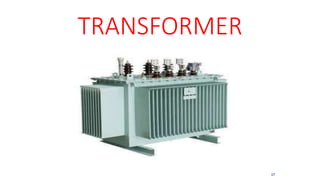
TRANSFORMER
What Does a Transformer Do?
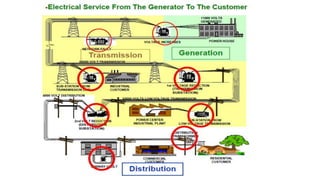
• Changes voltage level on a power system
Step up - increase voltage
Step down - decrease voltage
• Allows for long distance, high voltage power transmission
Generator step up transformers
Power transmission transformers
Distribution transformers
• Distribution transformer:
The final voltage change to meet customer needs in the power
network
How does a Transformer
work ?
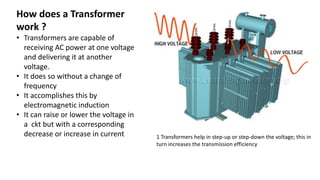
• Transformers are capable of
receiving AC power at one voltage
and delivering it at another
voltage.
• It does so without a change of
frequency
• It accomplishes this by
electromagnetic induction
• It can raise or lower the voltage in
a ckt but with a corresponding
decrease or increase in current 1 Transformers help in step-up or step-down the voltage; this in
turn increases the transmission efficiency
The Basic Working Principle
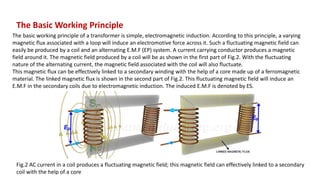
The basic working principle of a transformer is simple, electromagnetic induction. According to this principle, a varying
magnetic flux associated with a loop will induce an electromotive force across it. Such a fluctuating magnetic field can
easily be produced by a coil and an alternating E.M.F (EP) system. A current carrying conductor produces a magnetic
field around it. The magnetic field produced by a coil will be as shown in the first part of Fig.2. With the fluctuating
nature of the alternating current, the magnetic field associated with the coil will also fluctuate.
This magnetic flux can be effectively linked to a secondary winding with the help of a core made up of a ferromagnetic
material. The linked magnetic flux is shown in the second part of Fig.2. This fluctuating magnetic field will induce an
E.M.F in the secondary coils due to electromagnetic induction. The induced E.M.F is denoted by ES.
Fig.2 AC current in a coil produces a fluctuating magnetic field; this magnetic field can effectively linked to a secondary
coil with the help of a core
3 Phase Transformer
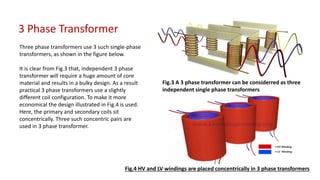
Three phase transformers use 3 such single-phase
transformers, as shown in the figure below.
It is clear from Fig.3 that, independent 3 phase
transformer will require a huge amount of core
material and results in a bulky design. As a result
practical 3 phase transformers use a slightly
different coil configuration. To make it more
economical the design illustrated in Fig.4 is used.
Here, the primary and secondary coils sit
concentrically. Three such concentric pairs are
used in 3 phase transformer.
Fig.3 A 3 phase transformer can be considerred as three
independent single phase transformers
Fig.4 HV and LV windings are placed concentrically in 3 phase transformers
Winding Connection
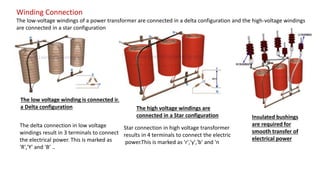
The low-voltage windings of a power transformer are connected in a delta configuration and the high-voltage windings
are connected in a star configuration
The low voltage winding is connected in
a Delta configuration
The delta connection in low voltage
windings result in 3 terminals to connect
the electrical power. This is marked as
'R','Y' and 'B’ ..
The high voltage windings are
connected in a Star configuration
Star connection in high voltage transformer
results in 4 terminals to connect the electric
power.This is marked as 'r','y','b' and 'n
Insulated bushings
are required for
smooth transfer of
electrical power
35
Connections
Energy losses in a
Transformer
Various kinds of energy
loss happen while
transferring power from
the primary to secondary
coil. Following are the
major source of energy
losses.
• Eddy current loss
• Hysteresis loss
• I2R loss
All these energy loss are
dissipated as heat, so a
proper cooling mechanism
is necessary to keep the
core and winding
temperature of the
transformer below a
specified limit
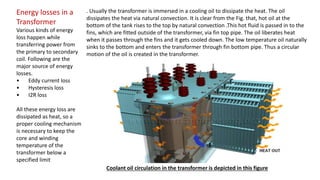
. Usually the transformer is immersed in a cooling oil to dissipate the heat. The oil
dissipates the heat via natural convection. It is clear from the Fig. that, hot oil at the
bottom of the tank rises to the top by natural convection .This hot fluid is passed in to the
fins, which are fitted outside of the transformer, via fin top pipe. The oil liberates heat
when it passes through the fins and it gets cooled down. The low temperature oil naturally
sinks to the bottom and enters the transformer through fin bottom pipe. Thus a circular
motion of the oil is created in the transformer.
Coolant oil circulation in the transformer is depicted in this figure
Type of Transformer- Type of Cooling :
Air Cooled :
Dry Type Transformer:
1. Air Natural(AN)
2. Air Blast (AB)
Oil Cooled :
Oil Type Transformer
1. Oil Natural Air Natural (ONAN)
2. Oil Natural Air Forced (ONAF)
3. Oil Forced Air Natural (OFAN)
4. Oil Forced Air Forced (OFAF)
1.Air Cooling (Dry Type Transformers)In this method, the heat
generated is conducted across the core and windings and is
dissipated from the outer surface of the core and windings to the
surrounding air.
Air Natural (AN)
This method uses the ambient air as the cooling medium. The
natural circulation of the air is used for dissipation of heat
generated by natural convection. The core and the windings are
protected from mechanical damage by providing a metal enclosure.
This method is suitable for transformers of rating up to 1.5MVA.
This method is adopted in the places where fire is a great hazard.
Air Blast (AB)
In this method, the transformer is cooled by circulating continuous
blast of cool air through the core and the windings. For this
external fans are used. The air supply must be filtered to prevent
accumulation of dust particles in the ventilating ducts.
2. Oil cooling (Oil immersed transformers)
In this method, heat is transferred to the oil surrounding the core and windings and it is conducted to the walls of the
transformer tank. Finally, the heat is transferred to the surrounding air by radiation and convection.
Oil coolant has two distinct advantages over the air coolants.
It provides better conduction than the air
High coefficient of conduction which results in the natural circulation of the oil.
Oil Natural Air natural (ONAN)
The transformer is immersed in oil and the heat generated in
the cores and the windings is passed on to oil by conduction. Oil
in contact with the surface of windings and core gets heated up
and moves towards the top and is replaced by the cool oil from
the bottom. The heated oil transfers its heat to the transformer
tank through convection and which in turn transfers the heat to
the surrounding air by convection and radiation.
This method can be used for the transformers having the ratings
up to 30MVA. The rate of heat dissipation can be increased by
providing fins, tubes and radiator tanks. Here the oil takes the
heat from inside the transformer and the surrounding air takes
away the heat from the tank. Hence it can also be called as Oil
Natural Air natural (ONAN) method.
Oil Natural Air Forced (ONAF)
In this method, the heated oil transfers its
heat to the transformer tank. The tank is made
hollow, and the air is blown to cool the
transformer. This increases the cooling of
transformer tank to five to six time its natural
means. Normally this method is adopted by
externally connecting elliptical tubes or
radiator separated from the transformer tank
and cooling it by air blast produced by fans.
These fans are provided with automatic
switching. When the temperature goes
beyond the predetermined value, the fans will
be automatically switched on.
Oil Forced Air Natural (OFAN)
In this method, copper cooling coils are
mounted above the transformer core. The
copper coils will be fully immersed in the
oil. Along with the oil natural cooling, the
heat from the core passes to the copper
coils, and the circulating water inside the
copper coil takes away the heat. The
disadvantage of this method is that since
water enters inside the transformer any
kind of leakage will contaminate the
transformer oil.
Oil Forced Air Forced (OFAF)
In this method, the oil is cooled in the cooling plant using
air blast produced by the fans. These fans need not be
used all the time. During low loads, fans are turned off.
Hence the system will be similar to that of Oil Natural Air
natural (ONAN). At higher loads, the pumps and fans are
switched on, and the system changes to Oil Forced Air
Forced (OFAF).
Automated switching methods are used for this
conversion such that as soon as the temperature reaches
a certain level, the fans are automatically switched on by
the sensing elements. This method increases the system
efficiency. This is a flexible method of cooling in which up
to 50% of rating ONAN can be used, and OFAF can be
used for higher loads. This method is used in transformers
having ratings above 30MVA.
Dry Type Transformer
Dry type transformer never uses any insulating
liquid where its winding with core be immerged.
Rather windings with core are kept within a
sealed tank that is pressurized with air.
Type of Dry Type Transformer
The dry type transformer is of two types. They
are
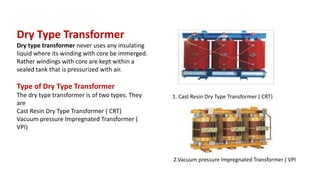
Cast Resin Dry Type Transformer ( CRT)
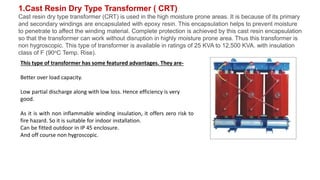
Vacuum pressure Impregnated Transformer (
VPI)
1. Cast Resin Dry Type Transformer ( CRT)
2.Vacuum pressure Impregnated Transformer ( VPI
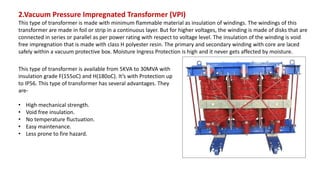
1.Cast Resin Dry Type Transformer ( CRT)
Cast resin dry type transformer (CRT) is used in the high moisture prone areas. It is because of its primary
and secondary windings are encapsulated with epoxy resin. This encapsulation helps to prevent moisture
to penetrate to affect the winding material. Complete protection is achieved by this cast resin encapsulation
so that the transformer can work without disruption in highly moisture prone area. Thus this transformer is
non hygroscopic. This type of transformer is available in ratings of 25 KVA to 12,500 KVA. with insulation
class of F (90oC Temp. Rise).
This type of transformer has some featured advantages. They are-
Better over load capacity.
Low partial discharge along with low loss. Hence efficiency is very
good.
As it is with non inflammable winding insulation, it offers zero risk to
fire hazard. So it is suitable for indoor installation.
Can be fitted outdoor in IP 45 enclosure.
And off course non hygroscopic.
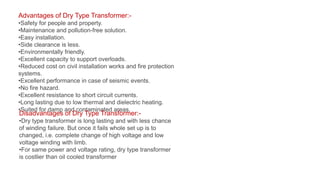
2.Vacuum Pressure Impregnated Transformer (VPI)
This type of transformer is made with minimum flammable material as insulation of windings. The windings of this
transformer are made in foil or strip in a continuous layer. But for higher voltages, the winding is made of disks that are
connected in series or parallel as per power rating with respect to voltage level. The insulation of the winding is void
free impregnation that is made with class H polyester resin. The primary and secondary winding with core are laced
safely within a vacuum protective box. Moisture Ingress Protection is high and it never gets affected by moisture.
This type of transformer is available from 5KVA to 30MVA with
insulation grade F(155oC) and H(180oC). It’s with Protection up
to IP56. This type of transformer has several advantages. They
are-
• High mechanical strength.
• Void free insulation.
• No temperature fluctuation.
• Easy maintenance.
• Less prone to fire hazard.
Advantages of Dry Type Transformer:-
•Safety for people and property.
•Maintenance and pollution-free solution.
•Easy installation.
•Side clearance is less.
•Environmentally friendly.
•Excellent capacity to support overloads.
•Reduced cost on civil installation works and fire protection
systems.
•Excellent performance in case of seismic events.
•No fire hazard.
•Excellent resistance to short circuit currents.
•Long lasting due to low thermal and dielectric heating.
•Suited for damp and contaminated areas.
Disadvantages of Dry Type Transformer:-
•Dry type transformer is long lasting and with less chance
of winding failure. But once it fails whole set up is to
changed, i.e. complete change of high voltage and low
voltage winding with limb.
•For same power and voltage rating, dry type transformer
is costlier than oil cooled transformer
ON-LOAD & OFF-LOAD TAP CHANGER OF TRANSFORMER ( OLTC Vs OCTC )
Power Generation, Transmission & Distribution Mainly on AC [Alternating Current]
System, Which is common in the World. So In Alternating Current System having
losses in the Generation as well as in Transmission.
When you are designing a building with high Demand power, then you need
permission to avail power from the Local EB. Meanwhile you have to install
Distribution Transformer to step-down the Voltage level from HT to LT, In Most
Common Voltage Distribution Class is 11 kV / 433 V
All LT Loads attains full Efficiency when LT System [i.e.433V] gets constant
voltage having Zero Voltage drop. This Scenario is possible only if HT Gets
Uniform Voltage level from the EB End. [i.e 11kV]. We known that
Transmission system having more losses due to the distance and amount of
common losses of AC System.So we difficult to achieve 11kV at HT End. So
the system which is co-ordinate with Grid to support to the Transformer to
achieve proper voltage level for the Distribution Purpose is Called as Tap
Change.
Tap-changing
Transformers
The change of voltage is
affected by changing the
numbers of turns of the
transformer provided with
taps. For sufficiently close
control of voltage, taps are
usually provided on the high
voltage windings of the
transformer. There are two
types of tap-changing
transformers:
1. Off-load tap changer-
OCTC
2. On-load tap changer
OLTC
OFF-Load Tap Change: Mainly Used in Solar Power Project, Wind
Projects. Here Generating voltage level is LT at Conversion Level.[i.e
Inverter Level]Solar Inverter Duty oil type Transformer & Dry Type
Transformer having OFF-Load Tap Change. Concept.
Concept:
Tap Changing will happen While Transformer is in OFF-Load or No-
Load. In Dry Type Transformer, Cooling Phenomenon mainly Air
Natural. Normally In ON-Load Tap Changer, Arc Quenching will be
limited by medium of Oil When Transformer is ON-Load. But OFF-
Load Tap Changer, Tapping will be done only When Transformer is in
OFF-Switch Condition. In Dry Type Transformer Air is the only cooling
medium which is limited Energy to Arc Quench.
ON-Load Tap Change: Most of the Generating Station, Substation
system having Power Transformer with ON-Load Tap Changer. Not
only in Generating Station Transformer also in Distribution Class
Transformer too.
Concept
Tap Changing will happen While Transformer is in ON-Load. Tap
Changer System Monitors the Voltage level with the help of AVR
[Automatic Voltage Regulator]. AVR is in housed cubicle Called
RTCC Panel. It also houses Push button for Tap Riser & Lower,
Indicator for HT Voltage level, Heat Sensor etc., Most of the Oil
Impregnated Transformer having ON-Load Tap Changer Type.
On-Load Tap Changer :
The on-load tap-changer has to provide uninterrupted current flow during the transition operation from one tap to the
other. The current flow must be maintained uninterrupted without partial short-circuiting of the tapped winding.
Operation:-
The operation of an on-load tap-changer can be understood by two identifiable functions.
It implies a switching device that transfers the throughput power from one tap of the transformer to an adjacent one.
During this operation the two taps will be connected through fitted transition impedance. In this phase the two taps
will share the load current.
Thereafter the connection to the former tap will be interrupted and the load has been transferred to the new tap.
The device that performs this switching is called diverter switch.
The connections to the two taps that involve the diverter switch are maybe transferred one position along the series
of physical taps of the regulating winding for each operation. This is the tap selector function. The tap selection is
conducted without any current rupture.
A rather important improvement of tap-changers resulted from the invention of the fast acting flip-flop diverter
switch, named the Jantzen principle after the inventor. The Jantzen principle imply that the switch contacts are
spring-loaded and they flip over from one position to a new with only a very short interval of connection between the
two taps and through transition resistor.
An alternative to the principle with fast acting switching sequence and resistors is to use reactor. In a reactor type tap-
changer it is instead more difficult to break the circulative reactive current and this will rather limit step voltages but
it will works well at relatively high currents.
Off-Circuit Tap Changer
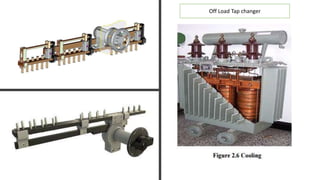
The off-circuit tap-changer is of rather simple design, giving connection to a selected tap in the winding. As the name says
it is designed only to be operated only when the transformer is de-energised.
Operation:
The contact pressure may occur to be retained by some kind of spring arrangement and then some vibration
is possible.
In off-circuit tap-changers operating on the same tap position for years the contact resistance then may slowly
increase due to local degradation and oxidation of material in the contact point. Heating will take place
resulting in a build up of pyrolytic formed carbon, which will increase the contact resistance further, and also
reduce the cooling.
Ultimately a runaway situation is reached and the transformer will probably trip on gas actuated protection or
worse – a step short circuit occurs.
To avoid this it is vital that the tap changer is operated, off circuit, through its complete range a few times
during regular routine maintenance to wipe the contact surfaces clean before returning it back to the selected
tapping.
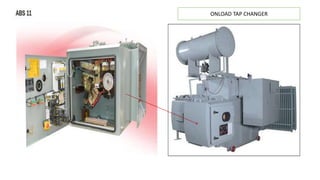
ONLOAD TAP CHANGER
Off Load Tap changer
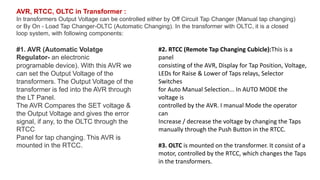
AVR, RTCC, OLTC in Transformer :
In transformers Output Voltage can be controlled either by Off Circuit Tap Changer (Manual tap changing)
or By On - Load Tap Changer-OLTC (Automatic Changing). In the transformer with OLTC, it is a closed
loop system, with following components:
#1. AVR (Automatic Volatge
Regulator- an electronic
programable device). With this AVR we
can set the Output Voltage of the
transformers. The Output Voltage of the
transformer is fed into the AVR through
the LT Panel.
The AVR Compares the SET voltage &
the Output Voltage and gives the error
signal, if any, to the OLTC through the
RTCC
Panel for tap changing. This AVR is
mounted in the RTCC.
#2. RTCC (Remote Tap Changing Cubicle):This is a
panel
consisting of the AVR, Display for Tap Position, Voltage,
LEDs for Raise & Lower of Taps relays, Selector
Switches
for Auto Manual Selection... In AUTO MODE the
voltage is
controlled by the AVR. I manual Mode the operator
can
Increase / decrease the voltage by changing the Taps
manually through the Push Button in the RTCC.
#3. OLTC is mounted on the transformer. It consist of a
motor, controlled by the RTCC, which changes the Taps
in the transformers.
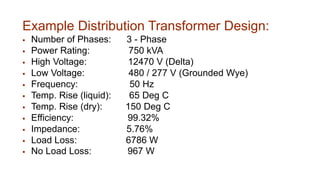
Example Distribution Transformer Design:
 Number of Phases: 3 - Phase
 Power Rating: 750 kVA
 High Voltage: 12470 V (Delta)
 Low Voltage: 480 / 277 V (Grounded Wye)
 Frequency: 50 Hz
 Temp. Rise (liquid): 65 Deg C
 Temp. Rise (dry): 150 Deg C
 Efficiency: 99.32%
 Impedance: 5.76%
 Load Loss: 6786 W
 No Load Loss: 967 W
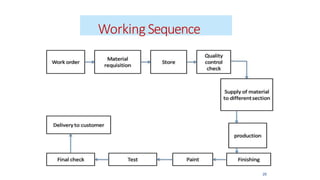
WorkingSequence
25
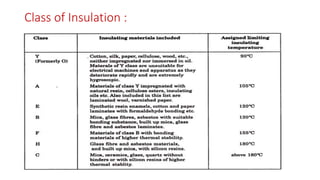
Class of Insulation :
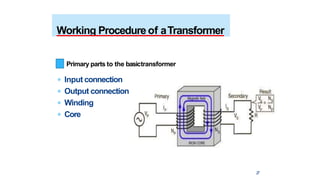
Working Procedure of aTransformer
Primary parts to the basictransformer
 Input connection
 Output connection
 Winding
 Core
27
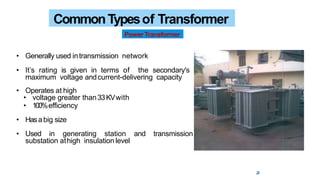
• Generally used intransmission network
• It’s rating is given in terms of the secondary's
maximum voltage andcurrent-delivering capacity
• Operates at high
• voltage greater than33KVwith
• 100%efficiency
• Hasabig size
• Used in generating station and transmission
substation athigh insulation level
CommonTypesof Transformer
PowerTransformer
28
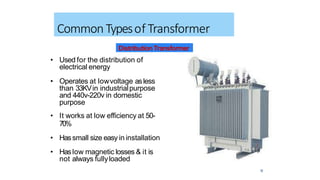
• Used for the distribution of
electrical energy
• Operates at lowvoltage asless
than 33KVin industrialpurpose
and 440v-220v in domestic
purpose
• It works at low efficiency at 50-
70%
• Hassmall size easy in installation
• Haslow magnetic losses & it is
not always fullyloaded
12
Common Typesof Transformer
DistributionTransformer
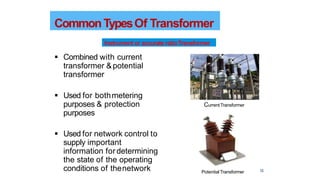
 Combined with current
transformer &potential
transformer
 Used for bothmetering
purposes & protection
purposes
 Used for network control to
supply important
information fordetermining
the state of the operating
conditions of thenetwork 13
CommonTypesOf Transformer
Instrument or accurate ratioTransformer
CurrentTransformer
PotentialTransformer
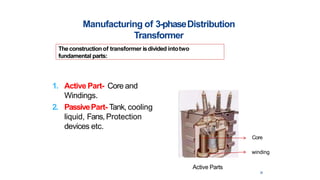
1. Active Part- Core and
Windings.
2. PassivePart- Tank, cooling
liquid, Fans, Protection
devices etc.
Manufacturing of 3-phaseDistribution
Transformer
Theconstruction of transformer isdivided intotwo
fundamental parts:
Core
winding
Active Parts
31
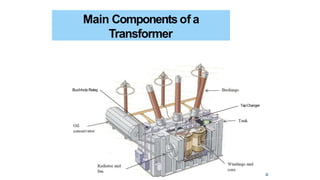
Main Componentsof a
Transformer
TapChanger
BuchholzRelay
32
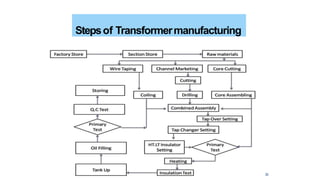
Stepsof Transformermanufacturing
33
18
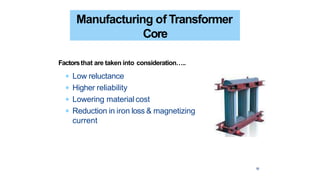
Manufacturing of Transformer
Core
Factorsthat are taken into consideration…..
 Low reluctance
 Higher reliability
 Lowering materialcost
 Reduction in iron loss & magnetizing
current
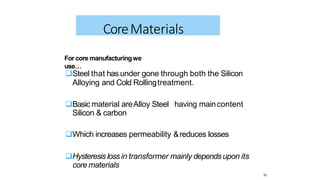
CoreMaterials
For core manufacturingwe
use…
Steel that has under gone through both the Silicon
Alloying and Cold Rollingtreatment.
Basic material areAlloy Steel having maincontent
Silicon & carbon
Which increases permeability &reduces losses
Hysteresis lossin transformer mainly dependsupon its
core materials
35
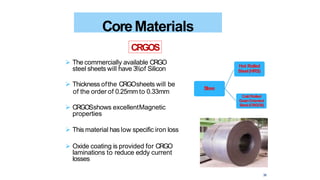
 The commercially available CRGO
steel sheets will have 3%of Silicon
 Thickness ofthe CRGOsheets will be
of the order of 0.25mm to 0.33mm
 CRGOSshows excellentMagnetic
properties
 This material has low specific iron loss
 Oxide coating is provided for CRGO
laminations to reduce eddy current
losses
CoreMaterials
CRGOS
Steel
Hot Rolled
Steel(HRS)
ColdRolled
GrainOriented
Steel(CRGOS)
36
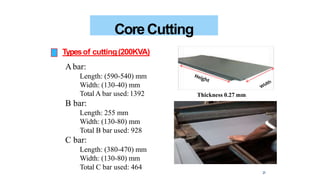
CoreCutting
Typesof cutting(200KVA)
Abar:
Length: (590-540) mm
Width: (130-40) mm
Total A bar used:1392
B bar:
Length: 255 mm
Width: (130-80) mm
Total B bar used: 928
C bar:
Length: (380-470) mm
Width: (130-80) mm
Total C bar used: 464
Thickness 0.27 mm
21
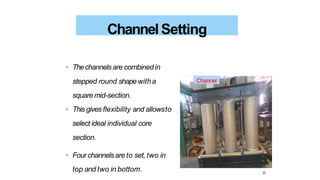
 Thechannelsare combinedin
stepped round shapewitha
squaremid-section.
 This gives flexibility and allowsto
select ideal individual core
section.
 Fourchannelsare to set, two in
ChannelSetting
Channel
top and two in bottom. 22
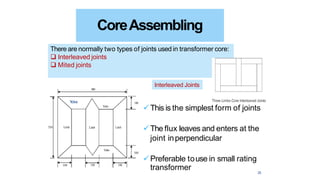
This is the simplest form of joints
The flux leaves and enters at the
joint inperpendicular
Preferable touse in small rating
CoreAssembling
There are normally two types of joints used in transformer core:
 Interleaved joints
 Mited joints
Interleaved Joints
Yoke
transformer 23
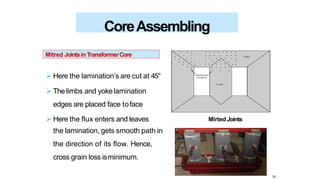
 Here the lamination’s are cut at 45°
 The limbs and yokelamination
edges are placed face toface
 Here the flux enters and leaves
the lamination, gets smooth path in
the direction of its flow. Hence,
cross grain loss isminimum.
24
CoreAssembling
Mitred Jointsin TransformerCore
Mirted Joints
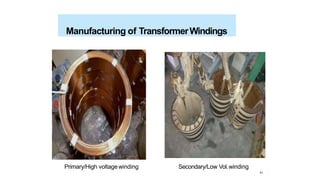
Manufacturing of TransformerWindings
Primary/High voltagewinding Secondary/Low Vol.winding
41
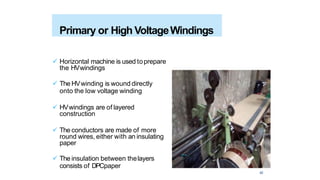
 Horizontal machine is used toprepare
the HVwindings
 The HVwinding is wound directly
onto the low voltage winding
 HVwindings are of layered
construction
 The conductors are made of more
round wires, either with an insulating
paper
 The insulation between thelayers
consists of DPCpaper
Primary or High VoltageWindings
42
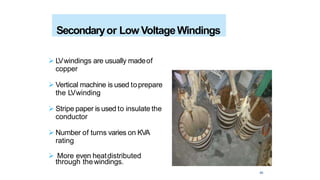
 LVwindings are usually madeof
copper
 Vertical machine is used toprepare
the LVwinding
 Stripe paper is used to insulate the
conductor
 Number of turns varies on KVA
rating
 More even heatdistributed
Secondaryor Low VoltageWindings
through thewindings.
43
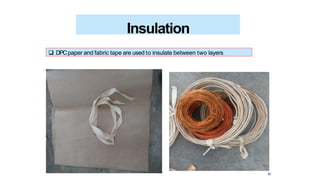
Insulation
30
 DPCpaper and fabric tape are used to insulate between two layers
31
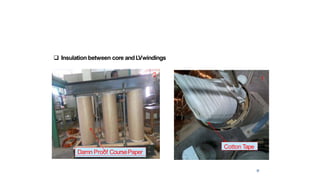
 Insulation between core andLVwindings
Cotton Tape
Damn Proof CoursePaper
Insulation
1
2
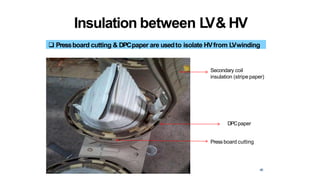
Insulation between LV& HV
 Pressboard cutting & DPCpaper are usedto isolate HVfrom LVwinding
Secondary coil
insulation (stripe paper)
DPCpaper
Pressboard cutting
46
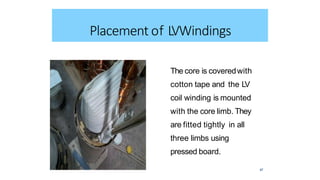
The core is coveredwith
cotton tape and the LV
coil winding is mounted
with the core limb. They
are fitted tightly in all
three limbs using
pressed board.
Placement of LVWindings
47
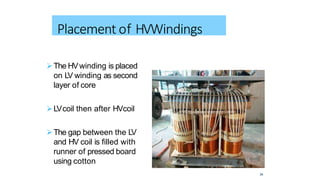
The HVwinding is placed
on LV winding as second
layer of core
LVcoil then after HVcoil
The gap between the LV
and HV coil is filled with
runner of pressed board
using cotton
Placement of HVWindings
34
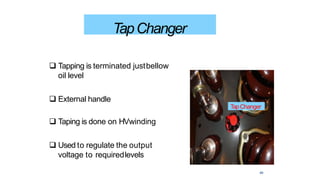
TapChanger
TapChanger
 Tapping is terminated justbellow
oil level
 External handle
 Taping is done on HVwinding
 Used to regulate the output
voltage to requiredlevels
49
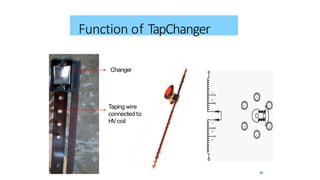
Function of TapChanger
Changer
Taping wire
connected to
HVcoil
50
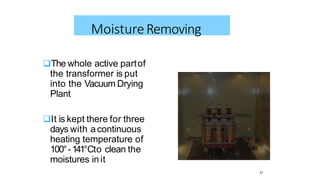
The whole active partof
the transformer is put
into the Vacuum Drying
Plant
It is kept there for three
days with acontinuous
heating temperature of
100°-141°Cto clean the
moistures init
MoistureRemoving
51
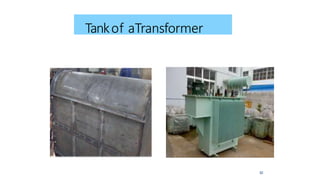
Tankof aTransformer
52
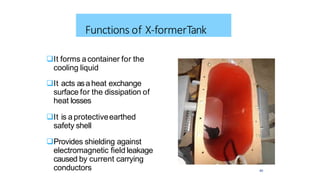
It forms acontainer for the
cooling liquid
It acts asaheat exchange
surface for the dissipation of
heat losses
It is aprotectiveearthed
safety shell
Provides shielding against
electromagnetic field leakage
caused by current carrying
conductors
Functions of X-formerTank
40
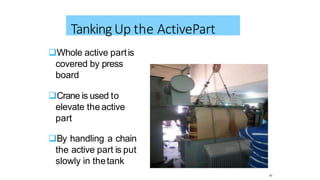
Whole active partis
covered by press
board
Crane is used to
elevate the active
part
By handling a chain
the active part is put
slowly in thetank
41
TankingUp the ActivePart
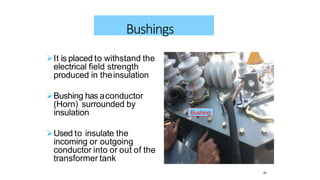
It is placed to withstand the
electrical field strength
produced in theinsulation
Bushing has aconductor
(Horn) surrounded by
insulation
Used to insulate the
incoming or outgoing
conductor into or out of the
transformer tank
42
Bushings
Bushing
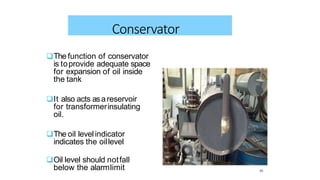
The function of conservator
is toprovide adequate space
for expansion of oil inside
the tank
It also acts asareservoir
for transformerinsulating
oil.
The oil levelindicator
indicates the oillevel
Oil level should notfall
below the alarmlimit 43
Conservator
44
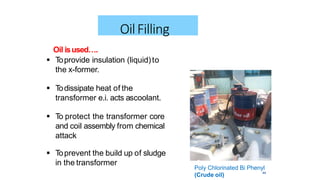
OilFilling
 Toprevent the build up of sludge
in the transformer
Oil isused….
 Toprovide insulation (liquid)to
the x-former.
 Todissipate heat of the
transformer e.i. acts ascoolant.
 To protect the transformer core
and coil assembly from chemical
attack
Poly Chlorinated Bi Phenyl
(Crude oil)
45
Quality ControlTest
 Testingof transformer
continuity test
Ratio test
Magnetizing test
No loadcurrent
test
Short circuit test
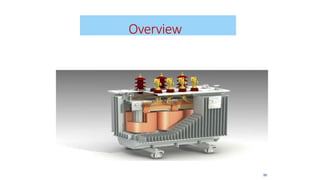
Overview
59
Identification
60
Transformer Manufacturing
Companies- for MEP Projects
ABB
Siemens
Schneider
CGL
Kirloskar
Voltamp
Essnar
UNIMAG- Universal
Raychem
Sudhir
Kahor
And ALL MSEDCL Approved Transformer
ThankYou

Transformer - Detailed Presentation 50 slids

  • 1.
  • 3.
    What Does aTransformer Do? • Changes voltage level on a power system Step up - increase voltage Step down - decrease voltage • Allows for long distance, high voltage power transmission Generator step up transformers Power transmission transformers Distribution transformers • Distribution transformer: The final voltage change to meet customer needs in the power network
  • 4.
    How does aTransformer work ? • Transformers are capable of receiving AC power at one voltage and delivering it at another voltage. • It does so without a change of frequency • It accomplishes this by electromagnetic induction • It can raise or lower the voltage in a ckt but with a corresponding decrease or increase in current 1 Transformers help in step-up or step-down the voltage; this in turn increases the transmission efficiency
  • 5.
    The Basic WorkingPrinciple The basic working principle of a transformer is simple, electromagnetic induction. According to this principle, a varying magnetic flux associated with a loop will induce an electromotive force across it. Such a fluctuating magnetic field can easily be produced by a coil and an alternating E.M.F (EP) system. A current carrying conductor produces a magnetic field around it. The magnetic field produced by a coil will be as shown in the first part of Fig.2. With the fluctuating nature of the alternating current, the magnetic field associated with the coil will also fluctuate. This magnetic flux can be effectively linked to a secondary winding with the help of a core made up of a ferromagnetic material. The linked magnetic flux is shown in the second part of Fig.2. This fluctuating magnetic field will induce an E.M.F in the secondary coils due to electromagnetic induction. The induced E.M.F is denoted by ES. Fig.2 AC current in a coil produces a fluctuating magnetic field; this magnetic field can effectively linked to a secondary coil with the help of a core
  • 6.
    3 Phase Transformer Threephase transformers use 3 such single-phase transformers, as shown in the figure below. It is clear from Fig.3 that, independent 3 phase transformer will require a huge amount of core material and results in a bulky design. As a result practical 3 phase transformers use a slightly different coil configuration. To make it more economical the design illustrated in Fig.4 is used. Here, the primary and secondary coils sit concentrically. Three such concentric pairs are used in 3 phase transformer. Fig.3 A 3 phase transformer can be considerred as three independent single phase transformers Fig.4 HV and LV windings are placed concentrically in 3 phase transformers
  • 7.
    Winding Connection The low-voltagewindings of a power transformer are connected in a delta configuration and the high-voltage windings are connected in a star configuration The low voltage winding is connected in a Delta configuration The delta connection in low voltage windings result in 3 terminals to connect the electrical power. This is marked as 'R','Y' and 'B’ .. The high voltage windings are connected in a Star configuration Star connection in high voltage transformer results in 4 terminals to connect the electric power.This is marked as 'r','y','b' and 'n Insulated bushings are required for smooth transfer of electrical power
  • 8.
  • 9.
    Energy losses ina Transformer Various kinds of energy loss happen while transferring power from the primary to secondary coil. Following are the major source of energy losses. • Eddy current loss • Hysteresis loss • I2R loss All these energy loss are dissipated as heat, so a proper cooling mechanism is necessary to keep the core and winding temperature of the transformer below a specified limit . Usually the transformer is immersed in a cooling oil to dissipate the heat. The oil dissipates the heat via natural convection. It is clear from the Fig. that, hot oil at the bottom of the tank rises to the top by natural convection .This hot fluid is passed in to the fins, which are fitted outside of the transformer, via fin top pipe. The oil liberates heat when it passes through the fins and it gets cooled down. The low temperature oil naturally sinks to the bottom and enters the transformer through fin bottom pipe. Thus a circular motion of the oil is created in the transformer. Coolant oil circulation in the transformer is depicted in this figure
  • 10.
    Type of Transformer-Type of Cooling : Air Cooled : Dry Type Transformer: 1. Air Natural(AN) 2. Air Blast (AB) Oil Cooled : Oil Type Transformer 1. Oil Natural Air Natural (ONAN) 2. Oil Natural Air Forced (ONAF) 3. Oil Forced Air Natural (OFAN) 4. Oil Forced Air Forced (OFAF) 1.Air Cooling (Dry Type Transformers)In this method, the heat generated is conducted across the core and windings and is dissipated from the outer surface of the core and windings to the surrounding air. Air Natural (AN) This method uses the ambient air as the cooling medium. The natural circulation of the air is used for dissipation of heat generated by natural convection. The core and the windings are protected from mechanical damage by providing a metal enclosure. This method is suitable for transformers of rating up to 1.5MVA. This method is adopted in the places where fire is a great hazard. Air Blast (AB) In this method, the transformer is cooled by circulating continuous blast of cool air through the core and the windings. For this external fans are used. The air supply must be filtered to prevent accumulation of dust particles in the ventilating ducts.
  • 11.
    2. Oil cooling(Oil immersed transformers) In this method, heat is transferred to the oil surrounding the core and windings and it is conducted to the walls of the transformer tank. Finally, the heat is transferred to the surrounding air by radiation and convection. Oil coolant has two distinct advantages over the air coolants. It provides better conduction than the air High coefficient of conduction which results in the natural circulation of the oil. Oil Natural Air natural (ONAN) The transformer is immersed in oil and the heat generated in the cores and the windings is passed on to oil by conduction. Oil in contact with the surface of windings and core gets heated up and moves towards the top and is replaced by the cool oil from the bottom. The heated oil transfers its heat to the transformer tank through convection and which in turn transfers the heat to the surrounding air by convection and radiation. This method can be used for the transformers having the ratings up to 30MVA. The rate of heat dissipation can be increased by providing fins, tubes and radiator tanks. Here the oil takes the heat from inside the transformer and the surrounding air takes away the heat from the tank. Hence it can also be called as Oil Natural Air natural (ONAN) method. Oil Natural Air Forced (ONAF) In this method, the heated oil transfers its heat to the transformer tank. The tank is made hollow, and the air is blown to cool the transformer. This increases the cooling of transformer tank to five to six time its natural means. Normally this method is adopted by externally connecting elliptical tubes or radiator separated from the transformer tank and cooling it by air blast produced by fans. These fans are provided with automatic switching. When the temperature goes beyond the predetermined value, the fans will be automatically switched on.
  • 12.
    Oil Forced AirNatural (OFAN) In this method, copper cooling coils are mounted above the transformer core. The copper coils will be fully immersed in the oil. Along with the oil natural cooling, the heat from the core passes to the copper coils, and the circulating water inside the copper coil takes away the heat. The disadvantage of this method is that since water enters inside the transformer any kind of leakage will contaminate the transformer oil. Oil Forced Air Forced (OFAF) In this method, the oil is cooled in the cooling plant using air blast produced by the fans. These fans need not be used all the time. During low loads, fans are turned off. Hence the system will be similar to that of Oil Natural Air natural (ONAN). At higher loads, the pumps and fans are switched on, and the system changes to Oil Forced Air Forced (OFAF). Automated switching methods are used for this conversion such that as soon as the temperature reaches a certain level, the fans are automatically switched on by the sensing elements. This method increases the system efficiency. This is a flexible method of cooling in which up to 50% of rating ONAN can be used, and OFAF can be used for higher loads. This method is used in transformers having ratings above 30MVA.
  • 13.
    Dry Type Transformer Drytype transformer never uses any insulating liquid where its winding with core be immerged. Rather windings with core are kept within a sealed tank that is pressurized with air. Type of Dry Type Transformer The dry type transformer is of two types. They are Cast Resin Dry Type Transformer ( CRT) Vacuum pressure Impregnated Transformer ( VPI) 1. Cast Resin Dry Type Transformer ( CRT) 2.Vacuum pressure Impregnated Transformer ( VPI
  • 14.
    1.Cast Resin DryType Transformer ( CRT) Cast resin dry type transformer (CRT) is used in the high moisture prone areas. It is because of its primary and secondary windings are encapsulated with epoxy resin. This encapsulation helps to prevent moisture to penetrate to affect the winding material. Complete protection is achieved by this cast resin encapsulation so that the transformer can work without disruption in highly moisture prone area. Thus this transformer is non hygroscopic. This type of transformer is available in ratings of 25 KVA to 12,500 KVA. with insulation class of F (90oC Temp. Rise). This type of transformer has some featured advantages. They are- Better over load capacity. Low partial discharge along with low loss. Hence efficiency is very good. As it is with non inflammable winding insulation, it offers zero risk to fire hazard. So it is suitable for indoor installation. Can be fitted outdoor in IP 45 enclosure. And off course non hygroscopic.
  • 15.
    2.Vacuum Pressure ImpregnatedTransformer (VPI) This type of transformer is made with minimum flammable material as insulation of windings. The windings of this transformer are made in foil or strip in a continuous layer. But for higher voltages, the winding is made of disks that are connected in series or parallel as per power rating with respect to voltage level. The insulation of the winding is void free impregnation that is made with class H polyester resin. The primary and secondary winding with core are laced safely within a vacuum protective box. Moisture Ingress Protection is high and it never gets affected by moisture. This type of transformer is available from 5KVA to 30MVA with insulation grade F(155oC) and H(180oC). It’s with Protection up to IP56. This type of transformer has several advantages. They are- • High mechanical strength. • Void free insulation. • No temperature fluctuation. • Easy maintenance. • Less prone to fire hazard.
  • 16.
    Advantages of DryType Transformer:- •Safety for people and property. •Maintenance and pollution-free solution. •Easy installation. •Side clearance is less. •Environmentally friendly. •Excellent capacity to support overloads. •Reduced cost on civil installation works and fire protection systems. •Excellent performance in case of seismic events. •No fire hazard. •Excellent resistance to short circuit currents. •Long lasting due to low thermal and dielectric heating. •Suited for damp and contaminated areas. Disadvantages of Dry Type Transformer:- •Dry type transformer is long lasting and with less chance of winding failure. But once it fails whole set up is to changed, i.e. complete change of high voltage and low voltage winding with limb. •For same power and voltage rating, dry type transformer is costlier than oil cooled transformer
  • 17.
    ON-LOAD & OFF-LOADTAP CHANGER OF TRANSFORMER ( OLTC Vs OCTC ) Power Generation, Transmission & Distribution Mainly on AC [Alternating Current] System, Which is common in the World. So In Alternating Current System having losses in the Generation as well as in Transmission. When you are designing a building with high Demand power, then you need permission to avail power from the Local EB. Meanwhile you have to install Distribution Transformer to step-down the Voltage level from HT to LT, In Most Common Voltage Distribution Class is 11 kV / 433 V All LT Loads attains full Efficiency when LT System [i.e.433V] gets constant voltage having Zero Voltage drop. This Scenario is possible only if HT Gets Uniform Voltage level from the EB End. [i.e 11kV]. We known that Transmission system having more losses due to the distance and amount of common losses of AC System.So we difficult to achieve 11kV at HT End. So the system which is co-ordinate with Grid to support to the Transformer to achieve proper voltage level for the Distribution Purpose is Called as Tap Change.
  • 18.
    Tap-changing Transformers The change ofvoltage is affected by changing the numbers of turns of the transformer provided with taps. For sufficiently close control of voltage, taps are usually provided on the high voltage windings of the transformer. There are two types of tap-changing transformers: 1. Off-load tap changer- OCTC 2. On-load tap changer OLTC OFF-Load Tap Change: Mainly Used in Solar Power Project, Wind Projects. Here Generating voltage level is LT at Conversion Level.[i.e Inverter Level]Solar Inverter Duty oil type Transformer & Dry Type Transformer having OFF-Load Tap Change. Concept. Concept: Tap Changing will happen While Transformer is in OFF-Load or No- Load. In Dry Type Transformer, Cooling Phenomenon mainly Air Natural. Normally In ON-Load Tap Changer, Arc Quenching will be limited by medium of Oil When Transformer is ON-Load. But OFF- Load Tap Changer, Tapping will be done only When Transformer is in OFF-Switch Condition. In Dry Type Transformer Air is the only cooling medium which is limited Energy to Arc Quench. ON-Load Tap Change: Most of the Generating Station, Substation system having Power Transformer with ON-Load Tap Changer. Not only in Generating Station Transformer also in Distribution Class Transformer too. Concept Tap Changing will happen While Transformer is in ON-Load. Tap Changer System Monitors the Voltage level with the help of AVR [Automatic Voltage Regulator]. AVR is in housed cubicle Called RTCC Panel. It also houses Push button for Tap Riser & Lower, Indicator for HT Voltage level, Heat Sensor etc., Most of the Oil Impregnated Transformer having ON-Load Tap Changer Type.
  • 19.
    On-Load Tap Changer: The on-load tap-changer has to provide uninterrupted current flow during the transition operation from one tap to the other. The current flow must be maintained uninterrupted without partial short-circuiting of the tapped winding. Operation:- The operation of an on-load tap-changer can be understood by two identifiable functions. It implies a switching device that transfers the throughput power from one tap of the transformer to an adjacent one. During this operation the two taps will be connected through fitted transition impedance. In this phase the two taps will share the load current. Thereafter the connection to the former tap will be interrupted and the load has been transferred to the new tap. The device that performs this switching is called diverter switch. The connections to the two taps that involve the diverter switch are maybe transferred one position along the series of physical taps of the regulating winding for each operation. This is the tap selector function. The tap selection is conducted without any current rupture. A rather important improvement of tap-changers resulted from the invention of the fast acting flip-flop diverter switch, named the Jantzen principle after the inventor. The Jantzen principle imply that the switch contacts are spring-loaded and they flip over from one position to a new with only a very short interval of connection between the two taps and through transition resistor. An alternative to the principle with fast acting switching sequence and resistors is to use reactor. In a reactor type tap- changer it is instead more difficult to break the circulative reactive current and this will rather limit step voltages but it will works well at relatively high currents.
  • 20.
    Off-Circuit Tap Changer Theoff-circuit tap-changer is of rather simple design, giving connection to a selected tap in the winding. As the name says it is designed only to be operated only when the transformer is de-energised. Operation: The contact pressure may occur to be retained by some kind of spring arrangement and then some vibration is possible. In off-circuit tap-changers operating on the same tap position for years the contact resistance then may slowly increase due to local degradation and oxidation of material in the contact point. Heating will take place resulting in a build up of pyrolytic formed carbon, which will increase the contact resistance further, and also reduce the cooling. Ultimately a runaway situation is reached and the transformer will probably trip on gas actuated protection or worse – a step short circuit occurs. To avoid this it is vital that the tap changer is operated, off circuit, through its complete range a few times during regular routine maintenance to wipe the contact surfaces clean before returning it back to the selected tapping.
  • 21.
  • 22.
    Off Load Tapchanger
  • 23.
    AVR, RTCC, OLTCin Transformer : In transformers Output Voltage can be controlled either by Off Circuit Tap Changer (Manual tap changing) or By On - Load Tap Changer-OLTC (Automatic Changing). In the transformer with OLTC, it is a closed loop system, with following components: #1. AVR (Automatic Volatge Regulator- an electronic programable device). With this AVR we can set the Output Voltage of the transformers. The Output Voltage of the transformer is fed into the AVR through the LT Panel. The AVR Compares the SET voltage & the Output Voltage and gives the error signal, if any, to the OLTC through the RTCC Panel for tap changing. This AVR is mounted in the RTCC. #2. RTCC (Remote Tap Changing Cubicle):This is a panel consisting of the AVR, Display for Tap Position, Voltage, LEDs for Raise & Lower of Taps relays, Selector Switches for Auto Manual Selection... In AUTO MODE the voltage is controlled by the AVR. I manual Mode the operator can Increase / decrease the voltage by changing the Taps manually through the Push Button in the RTCC. #3. OLTC is mounted on the transformer. It consist of a motor, controlled by the RTCC, which changes the Taps in the transformers.
  • 24.
    Example Distribution TransformerDesign:  Number of Phases: 3 - Phase  Power Rating: 750 kVA  High Voltage: 12470 V (Delta)  Low Voltage: 480 / 277 V (Grounded Wye)  Frequency: 50 Hz  Temp. Rise (liquid): 65 Deg C  Temp. Rise (dry): 150 Deg C  Efficiency: 99.32%  Impedance: 5.76%  Load Loss: 6786 W  No Load Loss: 967 W
  • 25.
  • 26.
  • 27.
    Working Procedure ofaTransformer Primary parts to the basictransformer  Input connection  Output connection  Winding  Core 27
  • 28.
    • Generally usedintransmission network • It’s rating is given in terms of the secondary's maximum voltage andcurrent-delivering capacity • Operates at high • voltage greater than33KVwith • 100%efficiency • Hasabig size • Used in generating station and transmission substation athigh insulation level CommonTypesof Transformer PowerTransformer 28
  • 29.
    • Used forthe distribution of electrical energy • Operates at lowvoltage asless than 33KVin industrialpurpose and 440v-220v in domestic purpose • It works at low efficiency at 50- 70% • Hassmall size easy in installation • Haslow magnetic losses & it is not always fullyloaded 12 Common Typesof Transformer DistributionTransformer
  • 30.
     Combined withcurrent transformer &potential transformer  Used for bothmetering purposes & protection purposes  Used for network control to supply important information fordetermining the state of the operating conditions of thenetwork 13 CommonTypesOf Transformer Instrument or accurate ratioTransformer CurrentTransformer PotentialTransformer
  • 31.
    1. Active Part-Core and Windings. 2. PassivePart- Tank, cooling liquid, Fans, Protection devices etc. Manufacturing of 3-phaseDistribution Transformer Theconstruction of transformer isdivided intotwo fundamental parts: Core winding Active Parts 31
  • 32.
  • 33.
  • 34.
    18 Manufacturing of Transformer Core Factorsthatare taken into consideration…..  Low reluctance  Higher reliability  Lowering materialcost  Reduction in iron loss & magnetizing current
  • 35.
    CoreMaterials For core manufacturingwe use… Steelthat has under gone through both the Silicon Alloying and Cold Rollingtreatment. Basic material areAlloy Steel having maincontent Silicon & carbon Which increases permeability &reduces losses Hysteresis lossin transformer mainly dependsupon its core materials 35
  • 36.
     The commerciallyavailable CRGO steel sheets will have 3%of Silicon  Thickness ofthe CRGOsheets will be of the order of 0.25mm to 0.33mm  CRGOSshows excellentMagnetic properties  This material has low specific iron loss  Oxide coating is provided for CRGO laminations to reduce eddy current losses CoreMaterials CRGOS Steel Hot Rolled Steel(HRS) ColdRolled GrainOriented Steel(CRGOS) 36
  • 37.
    CoreCutting Typesof cutting(200KVA) Abar: Length: (590-540)mm Width: (130-40) mm Total A bar used:1392 B bar: Length: 255 mm Width: (130-80) mm Total B bar used: 928 C bar: Length: (380-470) mm Width: (130-80) mm Total C bar used: 464 Thickness 0.27 mm 21
  • 38.
     Thechannelsare combinedin steppedround shapewitha squaremid-section.  This gives flexibility and allowsto select ideal individual core section.  Fourchannelsare to set, two in ChannelSetting Channel top and two in bottom. 22
  • 39.
    This is thesimplest form of joints The flux leaves and enters at the joint inperpendicular Preferable touse in small rating CoreAssembling There are normally two types of joints used in transformer core:  Interleaved joints  Mited joints Interleaved Joints Yoke transformer 23
  • 40.
     Here thelamination’s are cut at 45°  The limbs and yokelamination edges are placed face toface  Here the flux enters and leaves the lamination, gets smooth path in the direction of its flow. Hence, cross grain loss isminimum. 24 CoreAssembling Mitred Jointsin TransformerCore Mirted Joints
  • 41.
    Manufacturing of TransformerWindings Primary/Highvoltagewinding Secondary/Low Vol.winding 41
  • 42.
     Horizontal machineis used toprepare the HVwindings  The HVwinding is wound directly onto the low voltage winding  HVwindings are of layered construction  The conductors are made of more round wires, either with an insulating paper  The insulation between thelayers consists of DPCpaper Primary or High VoltageWindings 42
  • 43.
     LVwindings areusually madeof copper  Vertical machine is used toprepare the LVwinding  Stripe paper is used to insulate the conductor  Number of turns varies on KVA rating  More even heatdistributed Secondaryor Low VoltageWindings through thewindings. 43
  • 44.
    Insulation 30  DPCpaper andfabric tape are used to insulate between two layers
  • 45.
    31  Insulation betweencore andLVwindings Cotton Tape Damn Proof CoursePaper Insulation 1 2
  • 46.
    Insulation between LV&HV  Pressboard cutting & DPCpaper are usedto isolate HVfrom LVwinding Secondary coil insulation (stripe paper) DPCpaper Pressboard cutting 46
  • 47.
    The core iscoveredwith cotton tape and the LV coil winding is mounted with the core limb. They are fitted tightly in all three limbs using pressed board. Placement of LVWindings 47
  • 48.
    The HVwinding isplaced on LV winding as second layer of core LVcoil then after HVcoil The gap between the LV and HV coil is filled with runner of pressed board using cotton Placement of HVWindings 34
  • 49.
    TapChanger TapChanger  Tapping isterminated justbellow oil level  External handle  Taping is done on HVwinding  Used to regulate the output voltage to requiredlevels 49
  • 50.
    Function of TapChanger Changer Tapingwire connected to HVcoil 50
  • 51.
    The whole activepartof the transformer is put into the Vacuum Drying Plant It is kept there for three days with acontinuous heating temperature of 100°-141°Cto clean the moistures init MoistureRemoving 51
  • 52.
  • 53.
    It forms acontainerfor the cooling liquid It acts asaheat exchange surface for the dissipation of heat losses It is aprotectiveearthed safety shell Provides shielding against electromagnetic field leakage caused by current carrying conductors Functions of X-formerTank 40
  • 54.
    Whole active partis coveredby press board Crane is used to elevate the active part By handling a chain the active part is put slowly in thetank 41 TankingUp the ActivePart
  • 55.
    It is placedto withstand the electrical field strength produced in theinsulation Bushing has aconductor (Horn) surrounded by insulation Used to insulate the incoming or outgoing conductor into or out of the transformer tank 42 Bushings Bushing
  • 56.
    The function ofconservator is toprovide adequate space for expansion of oil inside the tank It also acts asareservoir for transformerinsulating oil. The oil levelindicator indicates the oillevel Oil level should notfall below the alarmlimit 43 Conservator
  • 57.
    44 OilFilling  Toprevent thebuild up of sludge in the transformer Oil isused….  Toprovide insulation (liquid)to the x-former.  Todissipate heat of the transformer e.i. acts ascoolant.  To protect the transformer core and coil assembly from chemical attack Poly Chlorinated Bi Phenyl (Crude oil)
  • 58.
    45 Quality ControlTest  Testingoftransformer continuity test Ratio test Magnetizing test No loadcurrent test Short circuit test
  • 59.
  • 60.
  • 61.
    Transformer Manufacturing Companies- forMEP Projects ABB Siemens Schneider CGL Kirloskar Voltamp Essnar UNIMAG- Universal Raychem Sudhir Kahor And ALL MSEDCL Approved Transformer
  • 62.