HUMAN ANATOMY & PHYSIOLOGY
INSTITUTE OF PHARMACY
WANI 0286
BY:: BHUMAREDDY BODHKURWAR SIR
ENDOCRINE SYSTEM
Endocrinology is the study of effect of different hormones
secreted by endocrine glands. Body glands are of two types:
a) Endocrine gland
b) Exocrine gland
Endocrine gland:
Endocrine gland are ductless gland & secrete their secretion
directly in the surrounding space which is further distributed
throughout the body by blood.
Exocrine gland :
Exocrine gland are the gland which having ducts & secrete
their secretion into ducts which are carried to the body
cavities in lumen of the various organs. eg. Sweat gland,
Salivary gland, Sebasseous gland etc.
 ENDOCRINE SYSTEM:
It is composed of various endocrine glands. Endocrine
gland secret their product into extracellular space around
the secretory cells from where it enters into bloods. Blood
help to transport endocrine secretion throughout
body ,durig this endocrine gland does not take any kind of
help from duct. Thus endocrine gland also called as
ductless gland.
 HORMONES
They are chemical messenger secreted or which are
formed in endocrine glands.
Chemically hormones are peptides steroids amines or
derivative of amino acids. Hormones are carried by blood
to other distant organ or tissue where they controlling
activity.
ENLIST OF ENDOCRINE GLAND WITH THEIR LOCATION
Names of Glands Present in
number
Locations
Pituitary gland 01 Situated in hypophyseal fossa of sphenoid bone at the
base of brain
Thyroid gland 01 Situated in the neck in front of trachea and beside
thyroid cartilage
Parathyroid
gland
04 These are small glands two on each side of thyroid
gland in neck on posterior side
Adrenal gland 02 Situated on the upper pole of each kidney
Islets of
langerhans
(Pancreas)
01 Irregularly distributed throughout pancreas
Thymus gland 01 A thoracic cavity/ thoracic region/ chest
Pineal gland 01 Near the corpus callosum in the brain
Testes in male 02 In scrotum
Ovaries in female 02 One on each side of uterus and below uterine tube.
HYPOTHALAMUS
a) Growth hormones releasing hormone
It stimulate anterior pituitary gland to secrete growth hormone.
b) Growth hormones releasing inhibiting hormone
It Inhibit the release of growth hormone by anterior lobe of pituitary gland.
c) Thyroid releasing hormone
It Stimulate anterior pituitary gland to secrete Thyroid stimulating hormone.
d) Corticotrophin releasing hormone
It stimulate anterior pituitary gland to secrete Adrenocorticotropic hormone
e) Prolacting releasing hormone
It stimulate anterior pituitary gland to secrete Prolaction.
f) Prolactin inhibiting hormone
It Inhibit the secretion of prolactin.
g) Luteinsing hormone releasing hormone
It stimulate anterior pituitary gland to secrete Luteinsing hormone
h) Gonadotrophin releasing hormone
It Stimulate anterior pituitary gland to secrete follicle stimulating hormone
PITUITARY GLAND
 Pituitary gland is a pea shaped gland. It has diameter 1-
1.5 cm & weight 500mg. It is situated in the hypophyseal
fossa of sphenoid bone, below hypothalamus. Pituitary
gland attached to the hypothalamus by a stalk, known as
Infundibulum
 It consist of two lobes i.e
 Anterior lobe
(Adenohyphysis)
 Posterior lobe
(Neurohypophysis)
HORMONES OF ANTERIOR LOBE OF PITUITARY GLAND
a) Growth hormone
It increase growth rate of skeleton & skeletal muscle. It involve
in tissue repair. It promotes healing of injuries, breakdown of fats.
It Increase blood glucose level.
b) Thyroid stimulating hormone
It secrete T3 (Triiodo thyronine) & T4 (Thyroxine) hormones.
c) Adrenocorticotropic hormone
It secrete Glucocorticoids & Mineralocorticoids by adrenal
cortex.
d) Prolactin
It act on breast immediately after child birth. Prolactin stimulate
milk production i.e. lactations. After birth, sucking by infant
stimulate secretion and lactation. The role of prolactin in males in
not known but its hypersecretion cause erectile dysfunction in
male.
e) FSH (Follicle stimulating hormone) Stimulates
i) Ovary in females to synthesis oestrogen.
ii) Testes in male to produce sperm.
f) LH (Luteinizing hormone) Stimulates
i) Ovary in female to produce progesterone.
ii) Testes in to produce testosterone.
 Hormones of posterior pituitary gland
a) Oxytocin
It help in contraction of uterus during delivery & ejection of
milk from the breast.
b) Antidiuretic hormone (Vasopression)
It decrease urine output.
THYROID GLAND
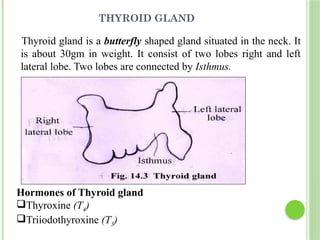
Thyroid gland is a butterfly shaped gland situated in the neck. It
is about 30gm in weight. It consist of two lobes right and left
lateral lobe. Two lobes are connected by Isthmus.
Hormones of Thyroid gland
Thyroxine (T4)
Triiodothyroxine (T3)
ROLE OF THYROID HORMONES
 Increase metabolism of carbohydrates, lipid, protein, fats.
 They stimulate protein synthesis.
 They increase body temperature.
 They stimulate synthesis of Na+
and K+
 Storage of iodine
 Increase the rate of cholesterol.
 Increase absorption and utilization of glucose.
 Increase in O2 consumption and heat production in tissue.
Hyperthyroidism
Excessive secretion of T3 and T4 by thyroid glands is known as
hyperthyroidism. It cause Goiter. In this condition eye look like
protruded.
Hypothyroisidm
Deficiency of T3 & T4 hormones is called hypothyroidism. It cause
cretinism.The clinical symptoms include mental retardation and
dwarfism.
PARATHYROID GLAND
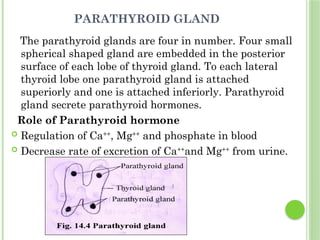
The parathyroid glands are four in number. Four small
spherical shaped gland are embedded in the posterior
surface of each lobe of thyroid gland. To each lateral
thyroid lobe one parathyroid gland is attached
superiorly and one is attached inferiorly. Parathyroid
gland secrete parathyroid hormones.
Role of Parathyroid hormone
 Regulation of Ca++
, Mg++
and phosphate in blood
 Decrease rate of excretion of Ca++
and Mg++
from urine.
ADVENAL GLANDS (SUPRARENAL GLAND)
 It is also called as Suprarenal gland. They are located on
the superior surface or top of kidney. Each adrenal gland
is Pyramidal in shape. It has about 3-5 cm in height, 2.3
cm in width, less than 1 cm in thickness & weight about
3.5-5 gm.
It consist of two parts
 Adrenal cortex
 Adrenal medulla
a) Mineralcorticoids
The main mineralcorticords is Aldosterone. The role of
mineralcorticoid is regulation of sodium ion (Na+
) and
potassium (K+
) ion. It helps to adjust blood pressure. It also
help in maintaining blood volume. It also help to maintain pH
of blood.
b) Glucorticoids
Cortisal, corticosterone and cortisone are the glucocorticoids
secreated by adrenal cortex. Glucocorticoid play a vital role in
various metabolic effect such as.
 Break down of protein
 Gluconeogenesis :- The process conversion of a substance into
glucose
 Lipolysis :- Break down of lipid into fatty acid.
 Anti-Inflammatory effect.
 It used to stop tissue rejection
 Anti- allergic effect.
Hormones of Adrenal medulla
 Epinephrine (Adrenaline)
 Norepinephrine (Noradrenaline)
Role of hormone:
 Adrenaline
Constriction of blood vessels. It maintain blood pressure
 Noradrenaline
Chemical transmitter of sympathetic nervous system. It maintain
blood pressure.
PANCREAS
 Pancreas is located in the abdominal cavity in the curve of the
duodenum.It is about 12.5 - 15 cm in length. It consist of head,
body and tail. In pancreas exocrine cell are presents called
Acini, these acini secrete the pancreatic juice which is digestive
in function. In between acini there are some endocrine cells are
called Islet of langerhans.
Islet of langerhans contain four types of hormones
secreting cells.
 Alpha (α cell) : secrete Glucagon.
 Beta (β cell) : secrete Insulin.
 Delta (δ cell) : secrete Somatostatin.
 F cell : secrete Pancreatic polypeptide.
Insulin and glucagon have action opposite to each other and maintain the
blood glucose level at normal. The normal blood glucose level is 63-144
mg/dl
 If blood glucose level is increased the insulin convert glucose into
glycogen & store it into liver.
Glycogenesis
Glucose Glycogen
Insulin
 If blood glucose level fall below the normal glycogen stored in the liver is
broken down to glucose by the hormone glucagon.
Glycogenolysis
Glycogen Glucose
Glucagon
Somastatin
Somastain is secreted by delta cells. It is peptide hormones. It inhibit
secretion of both insulin and glucagon. It also decrease absorption of
nutrients from GIT tract.
 Reason for: Justify Pancreas is both the endocrine as well as
exocrine gland.
Pancrea consist of acini cells or glandular cell which secretes pancreatic
juice, which is collected in the pancreatic duct and discharge in the
duodenum. Here pancrea discharge their pancreatic juice through with
the help of duct therefore it has a exocrine in function.
Pancrea also contain a group of cells other than acini cells called as islet
of langerhances which has 4 types
a) Alpha cells which secrete the hormone glucogon.
b) Beta cells which secrete the hormone insulin.
c) delta cells which secrete the hormone somastostatin.
d) F cells which secrete pancreatic polypeptide.
All these cells of iset of langerhans discharge their secretion directly
into the blood without help of duct . Here pancreas discharge their
secretion without help of duct therefore it has a endocrine in function.
Hence pancreas is both endocrine as well as exocrine gland.
SEX GLANDS (Gonads)
a) Ovaries
It is a reproductive organ in the female which secrete oestrogen
and progesterone. It is situated in the female pelvic cavity
b) Testes
It lies in scrotum in male. It secrete testoster
Hormones-
 Oestrogen In female
 Progesterone
 Testosterone in male
a) Oestrogen
It is female sex hormone secreted by the ovaries.
Function
Regulation of menstrual cycle.
Development of secondary sex character.
Maintaining pregnanay.
Enlargement of breast and preparing mammary gland for lactation.
b) Progesterone
It is female sex hormone secreted by the ovaries.
Function
Maturation and development of uterus and breast
Preparation of the uterus to receive the fertilized ovum.
c) Testosterone
This are male sex hormone secreted by the interstitial cells of testes.
Function
Regulation of sperm production.
Evelopment and maintenance of secondary sex characteristic in male such as deepening of
voice, masculine character.
Growth of penis
THYMUS
It is a gland present in the upper chest cavity. It is lie behind the
sternum but in front of heart. It is bigger in size at birth. It takes
part in the production of lymphocytes.
PINEAL GLAND
It is a small pine cone shaped gland. It attached to the roof of the
third ventricles of brain. It is about 10mm long, reddish brown in
color & weight about 0.1 - 0.2 g. Pineal gland secrete melatonin
an amine hormone.
Hormone of pineal gland
Melatonin
Role of hormone
Not known exactly but it influences the release of sex hormone
from pituitary gland.
WHICH GLAND IS CALLED AS
“MASTER GLAND”, WHY?
The pituitary gland is known as master gland of the
body because pituitary gland controls the maximum
activities of body. The hormones of the anterior lobe
of pituitary gland control the other endocrine gland
secretion. Any fall of the hormone level in blood
stimulate the hypothalamus which secrete the
respective releasing factor which increase the
secretion of that hormone from anterior lobe of
pituitary gland.
*IMPORTANT QUESTIONS*
 Define hormone. List the endocrine glands with their
locations
 What is endocrine gland
 Mention the hormones of posterior pituitary gland
 Name the hormones of anterior pituitary gland & state the
effect of hyper & hyposecreation of pituitary gland
 Which gland is called as “master gland” & why ?
 Give the function of thyroid gland
 Describe a) Hyperthyroidism b) Hypothyroidism
 Name the secreation of adrenal glands
 What are mineralcorticoids ?
 Justify: Pancreas is both endocrine as well as exocrine gland.
 Explain the role of insulin & glucagon in the body
 Explain the role of oestrogen & progesterone in body.

ENDOCRINE SYSTEM mining engineering.pptx

  • 1.
    HUMAN ANATOMY &PHYSIOLOGY INSTITUTE OF PHARMACY WANI 0286 BY:: BHUMAREDDY BODHKURWAR SIR
  • 2.
  • 3.
    Endocrinology is thestudy of effect of different hormones secreted by endocrine glands. Body glands are of two types: a) Endocrine gland b) Exocrine gland Endocrine gland: Endocrine gland are ductless gland & secrete their secretion directly in the surrounding space which is further distributed throughout the body by blood. Exocrine gland : Exocrine gland are the gland which having ducts & secrete their secretion into ducts which are carried to the body cavities in lumen of the various organs. eg. Sweat gland, Salivary gland, Sebasseous gland etc.
  • 4.
     ENDOCRINE SYSTEM: Itis composed of various endocrine glands. Endocrine gland secret their product into extracellular space around the secretory cells from where it enters into bloods. Blood help to transport endocrine secretion throughout body ,durig this endocrine gland does not take any kind of help from duct. Thus endocrine gland also called as ductless gland.  HORMONES They are chemical messenger secreted or which are formed in endocrine glands. Chemically hormones are peptides steroids amines or derivative of amino acids. Hormones are carried by blood to other distant organ or tissue where they controlling activity.
  • 6.
    ENLIST OF ENDOCRINEGLAND WITH THEIR LOCATION Names of Glands Present in number Locations Pituitary gland 01 Situated in hypophyseal fossa of sphenoid bone at the base of brain Thyroid gland 01 Situated in the neck in front of trachea and beside thyroid cartilage Parathyroid gland 04 These are small glands two on each side of thyroid gland in neck on posterior side Adrenal gland 02 Situated on the upper pole of each kidney Islets of langerhans (Pancreas) 01 Irregularly distributed throughout pancreas Thymus gland 01 A thoracic cavity/ thoracic region/ chest Pineal gland 01 Near the corpus callosum in the brain Testes in male 02 In scrotum Ovaries in female 02 One on each side of uterus and below uterine tube.
  • 7.
    HYPOTHALAMUS a) Growth hormonesreleasing hormone It stimulate anterior pituitary gland to secrete growth hormone. b) Growth hormones releasing inhibiting hormone It Inhibit the release of growth hormone by anterior lobe of pituitary gland. c) Thyroid releasing hormone It Stimulate anterior pituitary gland to secrete Thyroid stimulating hormone. d) Corticotrophin releasing hormone It stimulate anterior pituitary gland to secrete Adrenocorticotropic hormone e) Prolacting releasing hormone It stimulate anterior pituitary gland to secrete Prolaction. f) Prolactin inhibiting hormone It Inhibit the secretion of prolactin. g) Luteinsing hormone releasing hormone It stimulate anterior pituitary gland to secrete Luteinsing hormone h) Gonadotrophin releasing hormone It Stimulate anterior pituitary gland to secrete follicle stimulating hormone
  • 8.
    PITUITARY GLAND  Pituitarygland is a pea shaped gland. It has diameter 1- 1.5 cm & weight 500mg. It is situated in the hypophyseal fossa of sphenoid bone, below hypothalamus. Pituitary gland attached to the hypothalamus by a stalk, known as Infundibulum  It consist of two lobes i.e  Anterior lobe (Adenohyphysis)  Posterior lobe (Neurohypophysis)
  • 9.
    HORMONES OF ANTERIORLOBE OF PITUITARY GLAND a) Growth hormone It increase growth rate of skeleton & skeletal muscle. It involve in tissue repair. It promotes healing of injuries, breakdown of fats. It Increase blood glucose level. b) Thyroid stimulating hormone It secrete T3 (Triiodo thyronine) & T4 (Thyroxine) hormones. c) Adrenocorticotropic hormone It secrete Glucocorticoids & Mineralocorticoids by adrenal cortex. d) Prolactin It act on breast immediately after child birth. Prolactin stimulate milk production i.e. lactations. After birth, sucking by infant stimulate secretion and lactation. The role of prolactin in males in not known but its hypersecretion cause erectile dysfunction in male.
  • 10.
    e) FSH (Folliclestimulating hormone) Stimulates i) Ovary in females to synthesis oestrogen. ii) Testes in male to produce sperm. f) LH (Luteinizing hormone) Stimulates i) Ovary in female to produce progesterone. ii) Testes in to produce testosterone.  Hormones of posterior pituitary gland a) Oxytocin It help in contraction of uterus during delivery & ejection of milk from the breast. b) Antidiuretic hormone (Vasopression) It decrease urine output.
  • 11.
    THYROID GLAND Thyroid glandis a butterfly shaped gland situated in the neck. It is about 30gm in weight. It consist of two lobes right and left lateral lobe. Two lobes are connected by Isthmus. Hormones of Thyroid gland Thyroxine (T4) Triiodothyroxine (T3)
  • 12.
    ROLE OF THYROIDHORMONES  Increase metabolism of carbohydrates, lipid, protein, fats.  They stimulate protein synthesis.  They increase body temperature.  They stimulate synthesis of Na+ and K+  Storage of iodine  Increase the rate of cholesterol.  Increase absorption and utilization of glucose.  Increase in O2 consumption and heat production in tissue. Hyperthyroidism Excessive secretion of T3 and T4 by thyroid glands is known as hyperthyroidism. It cause Goiter. In this condition eye look like protruded. Hypothyroisidm Deficiency of T3 & T4 hormones is called hypothyroidism. It cause cretinism.The clinical symptoms include mental retardation and dwarfism.
  • 13.
    PARATHYROID GLAND The parathyroidglands are four in number. Four small spherical shaped gland are embedded in the posterior surface of each lobe of thyroid gland. To each lateral thyroid lobe one parathyroid gland is attached superiorly and one is attached inferiorly. Parathyroid gland secrete parathyroid hormones. Role of Parathyroid hormone  Regulation of Ca++ , Mg++ and phosphate in blood  Decrease rate of excretion of Ca++ and Mg++ from urine.
  • 14.
    ADVENAL GLANDS (SUPRARENALGLAND)  It is also called as Suprarenal gland. They are located on the superior surface or top of kidney. Each adrenal gland is Pyramidal in shape. It has about 3-5 cm in height, 2.3 cm in width, less than 1 cm in thickness & weight about 3.5-5 gm. It consist of two parts  Adrenal cortex  Adrenal medulla
  • 15.
    a) Mineralcorticoids The mainmineralcorticords is Aldosterone. The role of mineralcorticoid is regulation of sodium ion (Na+ ) and potassium (K+ ) ion. It helps to adjust blood pressure. It also help in maintaining blood volume. It also help to maintain pH of blood. b) Glucorticoids Cortisal, corticosterone and cortisone are the glucocorticoids secreated by adrenal cortex. Glucocorticoid play a vital role in various metabolic effect such as.  Break down of protein  Gluconeogenesis :- The process conversion of a substance into glucose  Lipolysis :- Break down of lipid into fatty acid.  Anti-Inflammatory effect.  It used to stop tissue rejection  Anti- allergic effect.
  • 16.
    Hormones of Adrenalmedulla  Epinephrine (Adrenaline)  Norepinephrine (Noradrenaline) Role of hormone:  Adrenaline Constriction of blood vessels. It maintain blood pressure  Noradrenaline Chemical transmitter of sympathetic nervous system. It maintain blood pressure.
  • 17.
    PANCREAS  Pancreas islocated in the abdominal cavity in the curve of the duodenum.It is about 12.5 - 15 cm in length. It consist of head, body and tail. In pancreas exocrine cell are presents called Acini, these acini secrete the pancreatic juice which is digestive in function. In between acini there are some endocrine cells are called Islet of langerhans. Islet of langerhans contain four types of hormones secreting cells.  Alpha (α cell) : secrete Glucagon.  Beta (β cell) : secrete Insulin.  Delta (δ cell) : secrete Somatostatin.  F cell : secrete Pancreatic polypeptide.
  • 18.
    Insulin and glucagonhave action opposite to each other and maintain the blood glucose level at normal. The normal blood glucose level is 63-144 mg/dl  If blood glucose level is increased the insulin convert glucose into glycogen & store it into liver. Glycogenesis Glucose Glycogen Insulin  If blood glucose level fall below the normal glycogen stored in the liver is broken down to glucose by the hormone glucagon. Glycogenolysis Glycogen Glucose Glucagon Somastatin Somastain is secreted by delta cells. It is peptide hormones. It inhibit secretion of both insulin and glucagon. It also decrease absorption of nutrients from GIT tract.
  • 19.
     Reason for:Justify Pancreas is both the endocrine as well as exocrine gland. Pancrea consist of acini cells or glandular cell which secretes pancreatic juice, which is collected in the pancreatic duct and discharge in the duodenum. Here pancrea discharge their pancreatic juice through with the help of duct therefore it has a exocrine in function. Pancrea also contain a group of cells other than acini cells called as islet of langerhances which has 4 types a) Alpha cells which secrete the hormone glucogon. b) Beta cells which secrete the hormone insulin. c) delta cells which secrete the hormone somastostatin. d) F cells which secrete pancreatic polypeptide. All these cells of iset of langerhans discharge their secretion directly into the blood without help of duct . Here pancreas discharge their secretion without help of duct therefore it has a endocrine in function. Hence pancreas is both endocrine as well as exocrine gland.
  • 20.
    SEX GLANDS (Gonads) a)Ovaries It is a reproductive organ in the female which secrete oestrogen and progesterone. It is situated in the female pelvic cavity b) Testes It lies in scrotum in male. It secrete testoster Hormones-  Oestrogen In female  Progesterone  Testosterone in male
  • 21.
    a) Oestrogen It isfemale sex hormone secreted by the ovaries. Function Regulation of menstrual cycle. Development of secondary sex character. Maintaining pregnanay. Enlargement of breast and preparing mammary gland for lactation. b) Progesterone It is female sex hormone secreted by the ovaries. Function Maturation and development of uterus and breast Preparation of the uterus to receive the fertilized ovum. c) Testosterone This are male sex hormone secreted by the interstitial cells of testes. Function Regulation of sperm production. Evelopment and maintenance of secondary sex characteristic in male such as deepening of voice, masculine character. Growth of penis
  • 22.
    THYMUS It is agland present in the upper chest cavity. It is lie behind the sternum but in front of heart. It is bigger in size at birth. It takes part in the production of lymphocytes. PINEAL GLAND It is a small pine cone shaped gland. It attached to the roof of the third ventricles of brain. It is about 10mm long, reddish brown in color & weight about 0.1 - 0.2 g. Pineal gland secrete melatonin an amine hormone. Hormone of pineal gland Melatonin Role of hormone Not known exactly but it influences the release of sex hormone from pituitary gland.
  • 23.
    WHICH GLAND ISCALLED AS “MASTER GLAND”, WHY? The pituitary gland is known as master gland of the body because pituitary gland controls the maximum activities of body. The hormones of the anterior lobe of pituitary gland control the other endocrine gland secretion. Any fall of the hormone level in blood stimulate the hypothalamus which secrete the respective releasing factor which increase the secretion of that hormone from anterior lobe of pituitary gland.
  • 24.
    *IMPORTANT QUESTIONS*  Definehormone. List the endocrine glands with their locations  What is endocrine gland  Mention the hormones of posterior pituitary gland  Name the hormones of anterior pituitary gland & state the effect of hyper & hyposecreation of pituitary gland  Which gland is called as “master gland” & why ?  Give the function of thyroid gland  Describe a) Hyperthyroidism b) Hypothyroidism  Name the secreation of adrenal glands  What are mineralcorticoids ?  Justify: Pancreas is both endocrine as well as exocrine gland.  Explain the role of insulin & glucagon in the body  Explain the role of oestrogen & progesterone in body.