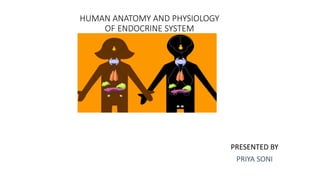
HUMAN ANATOMY AND PHYSIOLOGY
OF ENDOCRINE SYSTEM
PRESENTED BY
PRIYA SONI
ENDOCRINE SYSTEM
• The endocrine system is a system in the body that plays an important role in
hormones
TYPES OF GLANDS
• Endocrine glands are ductless glands that secrete hormones directly into the bloodstream
or surrounding tissues.
• In contrast, exocrine glands, or glands with ducts, such as salivary and sweat glands,
secrete their products directly into ducts that open to specific areas.
Endocrine glands include;
• Pituitary gland
• Hypothalamus
• Pineal gland
• Thyroid gland
• Parathyroid glands
• Pancreas
• Adrenal glands
• Ovaries /Testes
FUNCTIONS OF ENDOCRINE SYSTEM
• Growth and development.
• Homeostasis (the internal balance of
body systems).
• Metabolism (body energy levels).
• Reproduction.
• Response to stimuli.
• Controlling thirst and hunger.
SOME IMPORTANT HORMONES
1. Estrogen
• This is the main sex hormone present in women which bring about
puberty, prepares the uterus and body for pregnancy and even
regulates the menstrual cycle.
• Estrogen level changes during menopause because of which women
experience many uncomfortable symptoms.
2. Progesterone
• It is a female sex hormone also responsible for menstrual cycle,
pregnancy and embryo genesis.
3. Cortisol
• It has been named as the “stress
hormone” as it helps the body in
responding to stress.
• This is done by increasing the heart
rate, elevating blood sugar levels etc.
4. Melatonin
• It primarily controls the circadian
rhythm or sleep cycles.
5. Testosterone
• This is the main sex hormone present in
men which cause puberty, muscle mass
growth, and strength, increases bone
density and handles facial hair growth.
ENDOCRINE GLAND
• Unlike exocrine glands (sweat, salivary), endocrine glands secrete their respective
substances directly into the bloodstream rather than through a duct, that is they are
ductless glands.
• These endocrine glands belong to the body’s control system and they produce
hormones which help to regulate the functions of cells and tissues.
• Some glands are specific to either male (testes) or female(ovaries).
PITUITARY GLAND
• Pituitary Gland has its location at the base of the brain.
• It is known as the master gland, because it is responsible to control the function of
other glands to put forth their hormones.
• Growth, body metabolism, sexual development, and reproduction happen to be the
elements which come under the domain of the pituitary gland.
• It develops the hormones that trigger growth and development.
PITUITARY GLAND
FUNCTIONS
• Growth
• Blood pressure
• Sex organ functions
• Pain relief
• Temperature regulation
• Water and osmolarity
regulations in the body.
HORMONES PRODUCED BY PITUITARY GLAND
• Antidiuretic hormone (vasopressin) – Its primary function is to help the kidneys to
retain water in the body.
• Corticotropin (ACTH) – These hormones are there for regulating the hormones of the
adrenal glands.
• Luteinizing hormone and follicle-stimulating hormone
• Important functions like the production of sperm and semen, and menstruation, are looked after by
this particular hormone.
• Secondary sexual characteristics such as hair growth pattern, muscles, texture and thickness of the
skin, nature of the voice, etc.
• Oxytocin – Helps contraction of the uterus muscles and mammary ducts in the breast.
• Prolactin – The process of milk production in the mammary glands is carried out by this
hormone.
•
• Thyroid-stimulating hormone – Again, as the name suggests, this hormone is
responsible for the functions of the hormones of the thyroid gland.
• Human growth hormone – it is associated with the growth and development of the
body. It is also known to encourage the production of protein.
DISORDERS:
• Gigantism and acromegaly caused by an excess of growth hormone in childhood and
adult respectively.
• Hypothyroidism caused by a deficiency of thyroid stimulating hormone.
ACROMEGALY
GIGANTISM HYPOTHYROIDISM
HYPOTHALAMUS
• The hypothalamus gland is actually a part of the
pituitary gland.
• The hormones that it secretes do the work of
inducing the master gland, so that it can go on with
its normal function.
• Growth-hormone-releasing hormone (GHRH),
somatostatin, and dopamine, are the hormones
which are released by this gland, which we
discussed.
POSITION OF HYPOTHALAMUS
FUNCTIONS:
• Controls blood pressure.
• Regulates body temperature, energy metabolism, and reproduction
• Directs responses to stress.
• The hypothalamus also plays a role in the awareness of pleasure and pain, the
expression of emotions, and sexual behaviors.
• HORMONES-
• Releasing hormone (GHRH) – It is known as the growth hormone.
• Somatostatin – It works by regulating the endocrine system.
• Dopamine – It inhibits the release of prolactin from the anterior lobe of the pituitary
gland.
DISORDERS
• Hypopituitarism.
• Hypothyroidism.
• Kallmann’s Syndrome.
• Neurogenic diabetes.
KALLAMANN’S SYNDROME
PINEAL GLAND
• It is at the base of the brain, and is
responsible for alertness or
consciousness of one’s self.
• Pineal is also known as the thalamus, it
develops serotonin derivatives of
melatonin, which can affect sleep.
LOCATION OF PINEAL GLAND
FUNCTIONS
• The function of this endocrine gland is to secrete Melatonin Hormones
produced .
• Melatonin – Maintains the body’s circadian rhythm, apart from what has been
mentioned in the earlier segment.
DISORDERS
• Cancer,
• Sexual dysfunction,
• Hypertension,
• Epilepsy,
• Paget's disease
THYROID GLAND
• Just below the Adam’s apple, is located what is known as the
thyroid gland.
• The thyroid gland releases two main hormones, thyroxine and
triiodothyronine.
• It produces hormones that affect the heart rate and how calories
are burnt.
THYROID GLAND
POSITION OF THYROID GLAND
PARATHYROID
• These are located behind the
thyroid gland, and that may be
the reason they are known as
parathyroid glands.
• They are there with the work of
regulating the amount of
calcium in the blood stream.
HORMONES PRODUCED
• Parathyroid hormone – Calcium and phosphorus are eliminated from the body
with the help of this hormone, which is also responsible for bone formation.
DISORDERS
• Hyperparathyroidism
PANCREAS
• Pancreas, as most of us must be
knowing, are the endocrine glands
that are situated in the abdominal
region, behind the stomach.
• Insulin and glucagon are known to be
the important hormones produced by
the glands.
FUNCTIONS
• The hormones which get secreted into the blood stream by these glands, serve to
control proper digestion and blood sugar regulation.
• Maintaining appropriate levels of sugar throughout the body.
• This gland produces insulin crucial to maintain blood sugar levels.
HORMONES PRODUCED BY PANCREAS
• Glucagon – The blood sugar level raises with
its help.
• Insulin – It helps in lowering the blood sugar
level. Apart from this, metabolism of sugar,
protein, and fat are also carried out with its
help.
DISORDERS
• Acute pancreatitis is a sudden
attack causing inflammation of the
pancreas and is usually associated
with severe upper abdominal pain.
• Chronic pancreatitis is the
progressive disorder associated
with the destruction of the
pancreas.
• Hereditary pancreatitis
• Pancreatic cancer
REGULATION OF BLOOD GLUCOSE IN PANCREASE
ADRENAL GLANDS
• On the upper side of the kidneys, are
located these endocrine glands.
• In hormone production, there are two parts
of these adrenal glands which comes into
play.
• One is known as the adrenal cortex. It is
known to steroid hormones, which are
essential for digestion and sexual maturity.
• The other is what is known as the adrenal
medulla. Now the hormones that this part
secretes, are although not essential to
sustain life, but help the body to manage
stress and improve the quality of life.
FUNCTIONS:
• This gland produces the hormones that control the sex drive,
cortisol and stress hormone.
• Essential for digestion and sexual maturity
HUMAN RESPOND DURING EMERGENCY
HORMONES PRODUCED BY ADRENAL GLAND
• Aldosterone – Responsible for maintaining the salt and water balance in the body.
• Cortisol – The functions which regulate the blood sugar level, blood pressure, and
muscle strength in the body is controlled by the cortisol.
• Dehydroepiandrosterone (DHEA) – It is related to the immune system, bones
growth, and also to the mood of an individual.
• Epinephrine and norepinephrine – The nervous system is associated with it.
DISORDERS
• Cushing's syndrome
• Addison's disease.
CUSHING’S SYNDROME
ADDISON’S DISEASE
GONADS
• Male gonads are known as the testes, and ovaries in case of females.
• TESTES:
In men, the testes secrete the male sex hormone, testosterone. It also produces
sperm.
• OVARIES:
In women, the ovaries secrete estrogen, progesterone, testosterone, and other
female sex hormones.
FUNCTIONS
• These glands produce hormones and cells that are vital to reproduction, in males and
females.
HORMONES PRODUCED BY GONADS
• Estrogen –The female sexual characteristics and the function of the reproductive system
are influenced by the secretion of this hormone.
• Progesterone -It plays vital roles in pregnancy. For instance, it helps in preparing the
lining of the uterus for the fertilized egg to get implanted.
• Testosterone – Men’s sexual characteristics and the nature of the reproductive system,
involve the secretion of this hormones.
DISORDERS
• Hypogonadism
endocrine system
endocrine system

endocrine system

  • 1.
    HUMAN ANATOMY ANDPHYSIOLOGY OF ENDOCRINE SYSTEM PRESENTED BY PRIYA SONI
  • 2.
    ENDOCRINE SYSTEM • Theendocrine system is a system in the body that plays an important role in hormones TYPES OF GLANDS • Endocrine glands are ductless glands that secrete hormones directly into the bloodstream or surrounding tissues. • In contrast, exocrine glands, or glands with ducts, such as salivary and sweat glands, secrete their products directly into ducts that open to specific areas.
  • 3.
    Endocrine glands include; •Pituitary gland • Hypothalamus • Pineal gland • Thyroid gland • Parathyroid glands • Pancreas • Adrenal glands • Ovaries /Testes
  • 4.
    FUNCTIONS OF ENDOCRINESYSTEM • Growth and development. • Homeostasis (the internal balance of body systems). • Metabolism (body energy levels). • Reproduction. • Response to stimuli. • Controlling thirst and hunger.
  • 5.
    SOME IMPORTANT HORMONES 1.Estrogen • This is the main sex hormone present in women which bring about puberty, prepares the uterus and body for pregnancy and even regulates the menstrual cycle. • Estrogen level changes during menopause because of which women experience many uncomfortable symptoms. 2. Progesterone • It is a female sex hormone also responsible for menstrual cycle, pregnancy and embryo genesis.
  • 6.
    3. Cortisol • Ithas been named as the “stress hormone” as it helps the body in responding to stress. • This is done by increasing the heart rate, elevating blood sugar levels etc. 4. Melatonin • It primarily controls the circadian rhythm or sleep cycles. 5. Testosterone • This is the main sex hormone present in men which cause puberty, muscle mass growth, and strength, increases bone density and handles facial hair growth.
  • 7.
    ENDOCRINE GLAND • Unlikeexocrine glands (sweat, salivary), endocrine glands secrete their respective substances directly into the bloodstream rather than through a duct, that is they are ductless glands. • These endocrine glands belong to the body’s control system and they produce hormones which help to regulate the functions of cells and tissues. • Some glands are specific to either male (testes) or female(ovaries).
  • 8.
    PITUITARY GLAND • PituitaryGland has its location at the base of the brain. • It is known as the master gland, because it is responsible to control the function of other glands to put forth their hormones. • Growth, body metabolism, sexual development, and reproduction happen to be the elements which come under the domain of the pituitary gland. • It develops the hormones that trigger growth and development.
  • 9.
    PITUITARY GLAND FUNCTIONS • Growth •Blood pressure • Sex organ functions • Pain relief • Temperature regulation • Water and osmolarity regulations in the body.
  • 10.
    HORMONES PRODUCED BYPITUITARY GLAND • Antidiuretic hormone (vasopressin) – Its primary function is to help the kidneys to retain water in the body. • Corticotropin (ACTH) – These hormones are there for regulating the hormones of the adrenal glands. • Luteinizing hormone and follicle-stimulating hormone • Important functions like the production of sperm and semen, and menstruation, are looked after by this particular hormone. • Secondary sexual characteristics such as hair growth pattern, muscles, texture and thickness of the skin, nature of the voice, etc.
  • 11.
    • Oxytocin –Helps contraction of the uterus muscles and mammary ducts in the breast. • Prolactin – The process of milk production in the mammary glands is carried out by this hormone. • • Thyroid-stimulating hormone – Again, as the name suggests, this hormone is responsible for the functions of the hormones of the thyroid gland. • Human growth hormone – it is associated with the growth and development of the body. It is also known to encourage the production of protein.
  • 12.
    DISORDERS: • Gigantism andacromegaly caused by an excess of growth hormone in childhood and adult respectively. • Hypothyroidism caused by a deficiency of thyroid stimulating hormone. ACROMEGALY GIGANTISM HYPOTHYROIDISM
  • 13.
    HYPOTHALAMUS • The hypothalamusgland is actually a part of the pituitary gland. • The hormones that it secretes do the work of inducing the master gland, so that it can go on with its normal function. • Growth-hormone-releasing hormone (GHRH), somatostatin, and dopamine, are the hormones which are released by this gland, which we discussed. POSITION OF HYPOTHALAMUS
  • 14.
    FUNCTIONS: • Controls bloodpressure. • Regulates body temperature, energy metabolism, and reproduction • Directs responses to stress. • The hypothalamus also plays a role in the awareness of pleasure and pain, the expression of emotions, and sexual behaviors. • HORMONES- • Releasing hormone (GHRH) – It is known as the growth hormone. • Somatostatin – It works by regulating the endocrine system. • Dopamine – It inhibits the release of prolactin from the anterior lobe of the pituitary gland.
  • 15.
    DISORDERS • Hypopituitarism. • Hypothyroidism. •Kallmann’s Syndrome. • Neurogenic diabetes. KALLAMANN’S SYNDROME
  • 16.
    PINEAL GLAND • Itis at the base of the brain, and is responsible for alertness or consciousness of one’s self. • Pineal is also known as the thalamus, it develops serotonin derivatives of melatonin, which can affect sleep. LOCATION OF PINEAL GLAND
  • 17.
    FUNCTIONS • The functionof this endocrine gland is to secrete Melatonin Hormones produced . • Melatonin – Maintains the body’s circadian rhythm, apart from what has been mentioned in the earlier segment. DISORDERS • Cancer, • Sexual dysfunction, • Hypertension, • Epilepsy, • Paget's disease
  • 18.
    THYROID GLAND • Justbelow the Adam’s apple, is located what is known as the thyroid gland. • The thyroid gland releases two main hormones, thyroxine and triiodothyronine. • It produces hormones that affect the heart rate and how calories are burnt. THYROID GLAND POSITION OF THYROID GLAND
  • 19.
    PARATHYROID • These arelocated behind the thyroid gland, and that may be the reason they are known as parathyroid glands. • They are there with the work of regulating the amount of calcium in the blood stream.
  • 20.
    HORMONES PRODUCED • Parathyroidhormone – Calcium and phosphorus are eliminated from the body with the help of this hormone, which is also responsible for bone formation. DISORDERS • Hyperparathyroidism
  • 21.
    PANCREAS • Pancreas, asmost of us must be knowing, are the endocrine glands that are situated in the abdominal region, behind the stomach. • Insulin and glucagon are known to be the important hormones produced by the glands.
  • 22.
    FUNCTIONS • The hormoneswhich get secreted into the blood stream by these glands, serve to control proper digestion and blood sugar regulation. • Maintaining appropriate levels of sugar throughout the body. • This gland produces insulin crucial to maintain blood sugar levels.
  • 23.
    HORMONES PRODUCED BYPANCREAS • Glucagon – The blood sugar level raises with its help. • Insulin – It helps in lowering the blood sugar level. Apart from this, metabolism of sugar, protein, and fat are also carried out with its help.
  • 24.
    DISORDERS • Acute pancreatitisis a sudden attack causing inflammation of the pancreas and is usually associated with severe upper abdominal pain. • Chronic pancreatitis is the progressive disorder associated with the destruction of the pancreas. • Hereditary pancreatitis • Pancreatic cancer REGULATION OF BLOOD GLUCOSE IN PANCREASE
  • 25.
    ADRENAL GLANDS • Onthe upper side of the kidneys, are located these endocrine glands. • In hormone production, there are two parts of these adrenal glands which comes into play. • One is known as the adrenal cortex. It is known to steroid hormones, which are essential for digestion and sexual maturity. • The other is what is known as the adrenal medulla. Now the hormones that this part secretes, are although not essential to sustain life, but help the body to manage stress and improve the quality of life.
  • 26.
    FUNCTIONS: • This glandproduces the hormones that control the sex drive, cortisol and stress hormone. • Essential for digestion and sexual maturity HUMAN RESPOND DURING EMERGENCY
  • 27.
    HORMONES PRODUCED BYADRENAL GLAND • Aldosterone – Responsible for maintaining the salt and water balance in the body. • Cortisol – The functions which regulate the blood sugar level, blood pressure, and muscle strength in the body is controlled by the cortisol. • Dehydroepiandrosterone (DHEA) – It is related to the immune system, bones growth, and also to the mood of an individual. • Epinephrine and norepinephrine – The nervous system is associated with it.
  • 28.
    DISORDERS • Cushing's syndrome •Addison's disease. CUSHING’S SYNDROME ADDISON’S DISEASE
  • 29.
    GONADS • Male gonadsare known as the testes, and ovaries in case of females. • TESTES: In men, the testes secrete the male sex hormone, testosterone. It also produces sperm. • OVARIES: In women, the ovaries secrete estrogen, progesterone, testosterone, and other female sex hormones.
  • 30.
    FUNCTIONS • These glandsproduce hormones and cells that are vital to reproduction, in males and females. HORMONES PRODUCED BY GONADS • Estrogen –The female sexual characteristics and the function of the reproductive system are influenced by the secretion of this hormone. • Progesterone -It plays vital roles in pregnancy. For instance, it helps in preparing the lining of the uterus for the fertilized egg to get implanted. • Testosterone – Men’s sexual characteristics and the nature of the reproductive system, involve the secretion of this hormones. DISORDERS • Hypogonadism