





GOOD MORNING!
PAINT ME A
PICTURE!
(Pre-activity)
Athletes
preparing for
Olympic
Uterine
contraction of
a woman in
labor
Control of food
intake and
digestion
BY: PAULA MARIE M. LLIDO
RACHEL M. TACUBAO
GROUP 6
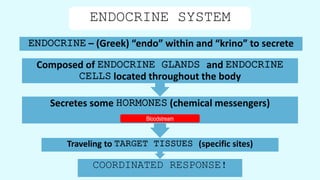
Composed of ENDOCRINE GLANDS and ENDOCRINE
CELLS located throughout the body
ENDOCRINE SYSTEM
ENDOCRINE – (Greek) “endo” within and “krino” to secrete
Traveling to TARGET TISSUES (specific sites)
Secretes some HORMONES (chemical messengers)
COORDINATED RESPONSE!
Bloodstream
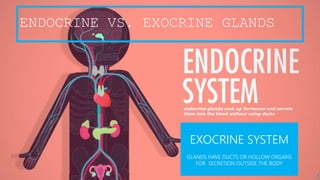
ENDOCRINE VS. EXOCRINE GLANDS
EXOCRINE SYSTEM
GLANDS HAVE DUCTS OR HOLLOW ORGANS
FOR SECRETION OUTSIDE THE BODY
ENDOCRINE SYSTEM FUNCTIONS
1 Metabolism
2 Control of food intake and digestion
3 Tissue development
4 Ion regulation
5 Water balance
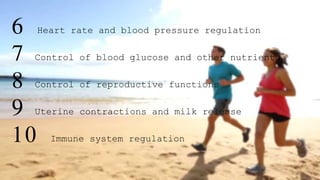
6 Heart rate and blood pressure regulation
7 Control of blood glucose and other nutrients
8 Control of reproductive functions
9 Uterine contractions and milk release
10 Immune system regulation
What are the
3 TYPES OF STIMULI
that regulate hormone release?
HUMORAL
NEURAL
HORMONAL
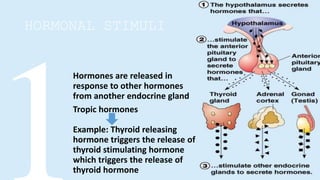
HORMONAL STIMULI
Hormones are released in
response to other hormones
from another endocrine gland
Tropic hormones
Example: Thyroid releasing
hormone triggers the release of
thyroid stimulating hormone
which triggers the release of
thyroid hormone
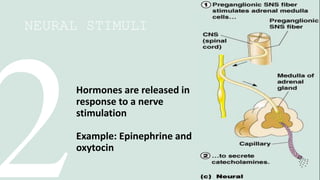
NEURAL STIMULI
Hormones are released in
response to a nerve
stimulation
Example: Epinephrine and
oxytocin
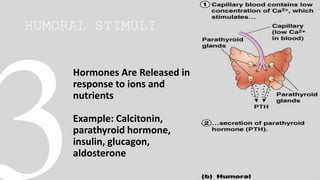
HUMORAL STIMULI
Hormones Are Released in
response to ions and
nutrients
Example: Calcitonin,
parathyroid hormone,
insulin, glucagon,
aldosterone
Hormone levels are
primarily
controlled through
negative feedback,
in which rising
levels of a
hormone inhibit
its further
release
HORMONAL
INHIBITING HORMONES – from the hypothalamus
that prevent the secretion of tropic hormones
from the pituitary gland
NEURAL
Neurons inhibit targets just as often as they
stimulate targets.
If the neurotransmitter is inhibitory, the target
endocrine gland does not secrete its hormone
HUMORAL
a rise in blood glucose levels triggers the
pancreatic release of insulin. Insulin causes blood
glucose levels to drop, which signals the pancreas
to stop producing insulin in a negative feedback
loop.
REGULATION OF HORMONE LEVELS IN THE BLOOD
NEGATIVE FEEDBACK
POSITIVE FEEDBACK
• Hormone’s secretion is inhibited by the hormone
itself once blood levels have reached a certain point
• Self-limiting system
• Promote the synthesis and secretion of the tropic
hormone in addition to stimulating their target cell
• Self-propagating system
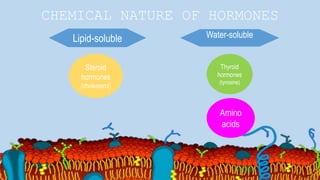
CHEMICAL NATURE OF HORMONES
Lipid-soluble Water-soluble
Steroid
hormones
(cholesterol)
Thyroid
hormones
(tyrosine)
Amino
acids
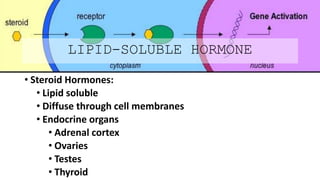
LIPID-SOLUBLE HORMONE
• Steroid Hormones:
• Lipid soluble
• Diffuse through cell membranes
• Endocrine organs
• Adrenal cortex
• Ovaries
• Testes
• Thyroid
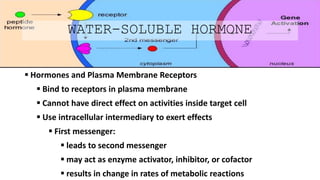
WATER-SOLUBLE HORMONE
 Hormones and Plasma Membrane Receptors
 Bind to receptors in plasma membrane
 Cannot have direct effect on activities inside target cell
 Use intracellular intermediary to exert effects
 First messenger:
 leads to second messenger
 may act as enzyme activator, inhibitor, or cofactor
 results in change in rates of metabolic reactions
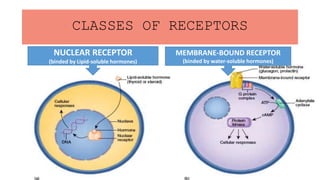
CLASSES OF RECEPTORS
NUCLEAR RECEPTOR
(binded by Lipid-soluble hormones)
MEMBRANE-BOUND RECEPTOR
(binded by water-soluble hormones)
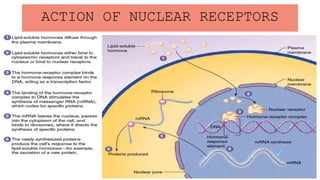
ACTION OF NUCLEAR RECEPTORS
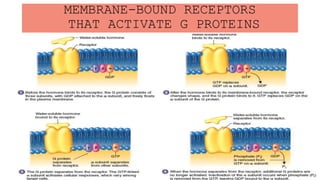
MEMBRANE-BOUND RECEPTORS
THAT ACTIVATE G PROTEINS
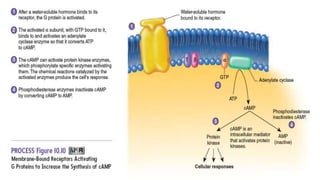
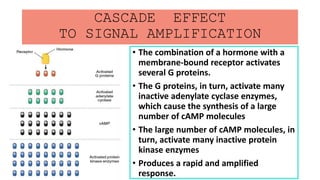
CASCADE EFFECT
TO SIGNAL AMPLIFICATION
• The combination of a hormone with a
membrane-bound receptor activates
several G proteins.
• The G proteins, in turn, activate many
inactive adenylate cyclase enzymes,
which cause the synthesis of a large
number of cAMP molecules
• The large number of cAMP molecules, in
turn, activate many inactive protein
kinase enzymes
• Produces a rapid and amplified
response.
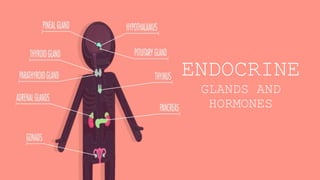
ENDOCRINE
GLANDS AND
HORMONES
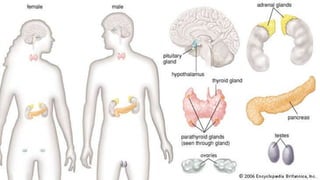
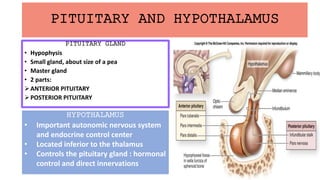
PITUITARY AND HYPOTHALAMUS
PITUITARY GLAND
• Hypophysis
• Small gland, about size of a pea
• Master gland
• 2 parts:
ANTERIOR PITUITARY
POSTERIOR PITUITARY
HYPOTHALAMUS
• Important autonomic nervous system
and endocrine control center
• Located inferior to the thalamus
• Controls the pituitary gland : hormonal
control and direct innervations
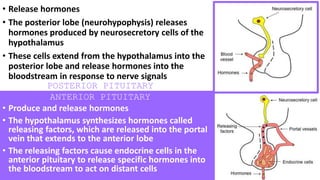
• Produce and release hormones
• The hypothalamus synthesizes hormones called
releasing factors, which are released into the portal
vein that extends to the anterior lobe
• The releasing factors cause endocrine cells in the
anterior pituitary to release specific hormones into
the bloodstream to act on distant cells
• Release hormones
• The posterior lobe (neurohypophysis) releases
hormones produced by neurosecretory cells of the
hypothalamus
• These cells extend from the hypothalamus into the
posterior lobe and release hormones into the
bloodstream in response to nerve signals
POSTERIOR PITUITARY
ANTERIOR PITUITARY
Anterior Pituitary Hormones
•Adrenocorticotropic (ACTH)
•Growth hormone (GH)
•Thyroid-stimulating hormone (TSH)
•Follicle-stimulating hormone (FSH)
•Luteinizing hormone (LH)
•Prolactin (PRL)
•Melanocyte-stimulating hormone (MSH)
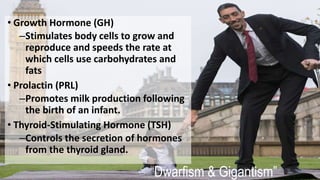
“Dwarfism & Gigantism”
• Growth Hormone (GH)
–Stimulates body cells to grow and
reproduce and speeds the rate at
which cells use carbohydrates and
fats
• Prolactin (PRL)
–Promotes milk production following
the birth of an infant.
• Thyroid-Stimulating Hormone (TSH)
–Controls the secretion of hormones
from the thyroid gland.
Posterior Pituitary Hormones
• Plays a role in childbirth by contracting muscles in the
uterine wall and in milk-letdown by forcing milk into
ducts from the milk glands.
OXYTOCIN
ANTI-DIURETIC HORMONE (ADH)
• Causes the kidneys to conserve water
(prevents dehydration)
• Vasopressin
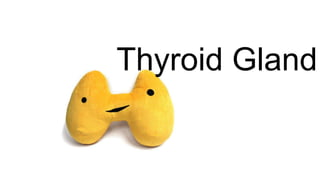
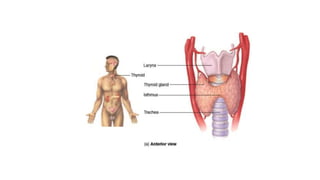
Thyroid Gland
One of the largest
endocrine glands
Highly vascular
Thyroid hormones, bind to
nuclear receptors in cells
and regulate the rate of
metabolism in the body
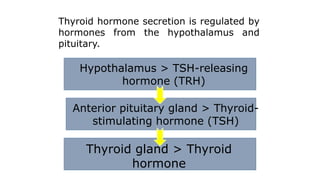
Thyroid hormone secretion is regulated by
hormones from the hypothalamus and
pituitary.
Hypothalamus > TSH-releasing
hormone (TRH)
Anterior pituitary gland > Thyroid-
stimulating hormone (TSH)
Thyroid gland > Thyroid
hormone
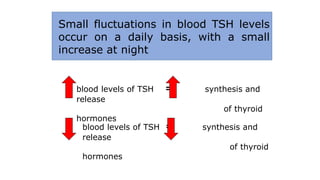
Small fluctuations in blood TSH levels
occur on a daily basis, with a small
increase at night
blood levels of TSH = synthesis and
release
of thyroid
hormones
blood levels of TSH = synthesis and
release
of thyroid
hormones
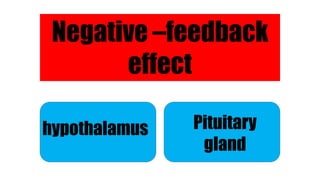
Negative –feedback
effect
hypothalamus Pituitary
gland
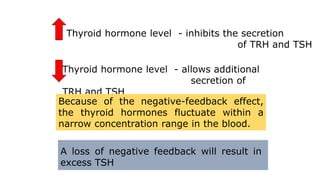
Thyroid hormone level - inhibits the secretion
of TRH and TSH
Thyroid hormone level - allows additional
secretion of
TRH and TSH
Because of the negative-feedback effect,
the thyroid hormones fluctuate within a
narrow concentration range in the blood.
A loss of negative feedback will result in
excess TSH
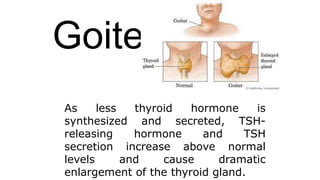
Goiter
As less thyroid hormone is
synthesized and secreted, TSH-
releasing hormone and TSH
secretion increase above normal
levels and cause dramatic
enlargement of the thyroid gland.
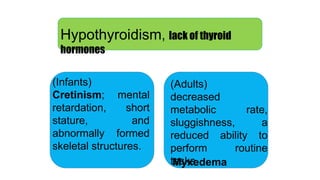
Hypothyroidism, lack of thyroid
hormones
(Infants)
Cretinism; mental
retardation, short
stature, and
abnormally formed
skeletal structures.
(Adults)
decreased
metabolic rate,
sluggishness, a
reduced ability to
perform routine
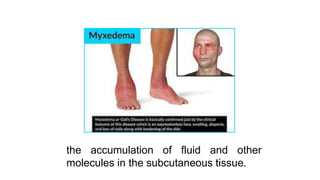
tasksMyxedema
the accumulation of fluid and other
molecules in the subcutaneous tissue.
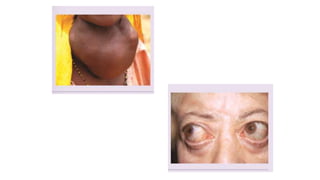
Hyperthyroidism, elevated
rate of
thyroid hormone secretion
increased metabolic rate, extreme
nervousness, and chronic fatigue
Graves disease is a type of hyperthyroidism
that results when the immune system
produces abnormal proteins that are similar
in structure and function to TSH. Graves
disease is often accompanied by bulging of
the eyes, a condition called exophthalmia
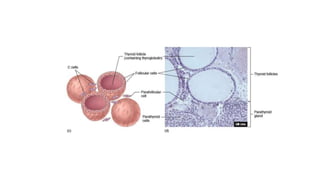
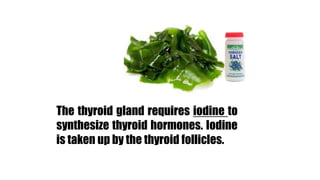
The thyroid gland requires iodine to
synthesize thyroid hormones. Iodine
is taken up by the thyroid follicles.
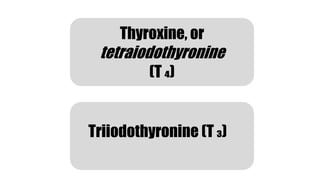
Thyroxine, or
tetraiodothyronine
(T ₄)
Triiodothyronine (T ₃)
Thyroxine, or
tetraiodothyronine
(T ₄)
Triiodothyronine (T ₃)
Insufficient iodine,
production and secretion
of the thyroid hormones
decrease
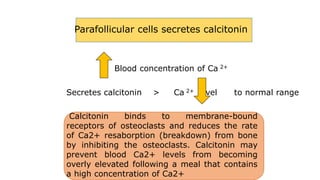
Parafollicular cells secretes calcitonin
Blood concentration of Ca 2+
Secretes calcitonin > Ca 2+ level to normal range
Calcitonin binds to membrane-bound
receptors of osteoclasts and reduces the rate
of Ca2+ resaborption (breakdown) from bone
by inhibiting the osteoclasts. Calcitonin may
prevent blood Ca2+ levels from becoming
overly elevated following a meal that contains
a high concentration of Ca2+
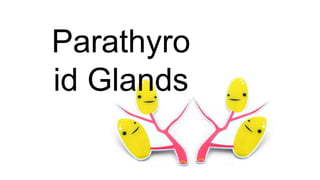
Parathyro
id Glands
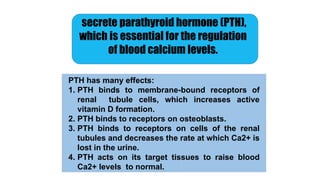
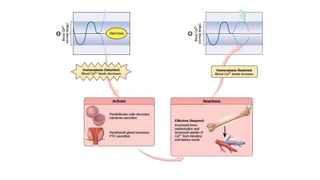
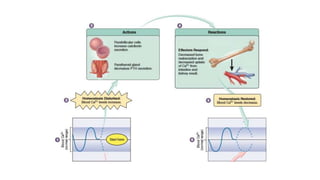
secrete parathyroid hormone (PTH),
which is essential for the regulation
of blood calcium levels.
PTH has many effects:
1. PTH binds to membrane-bound receptors of
renal tubule cells, which increases active
vitamin D formation.
2. PTH binds to receptors on osteoblasts.
3. PTH binds to receptors on cells of the renal
tubules and decreases the rate at which Ca2+ is
lost in the urine.
4. PTH acts on its target tissues to raise blood
Ca2+ levels to normal.
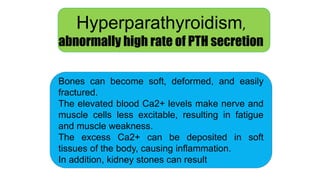
Hyperparathyroidism,
abnormally high rate of PTH secretion
Bones can become soft, deformed, and easily
fractured.
The elevated blood Ca2+ levels make nerve and
muscle cells less excitable, resulting in fatigue
and muscle weakness.
The excess Ca2+ can be deposited in soft
tissues of the body, causing inflammation.
In addition, kidney stones can result
Hypoparathyroidism,
abnormally rate of PTH secretion
The low blood levels of PTH lead to reductions in
the rate of bone reabsorption and the formation
of vitamin D. As a result, blood Ca2+ levels
decrease. In response to low blood Ca2+ levels,
nerves and muscles become excitable and
produce spontaneous action potentials that
cause frequent muscle cramps or tetanus.
Severe tetanus can affect the respiratory
muscles; breathing stops, resulting in death.
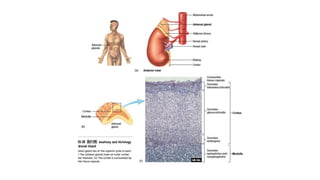
Adrenal Glands
Adrenal medulla
Epinephrine, or
adrenaline
Norepinephrine
Fight-or-flight hormones
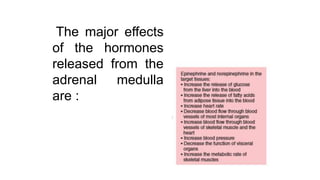
The major effects
of the hormones
released from the
adrenal medulla
are :
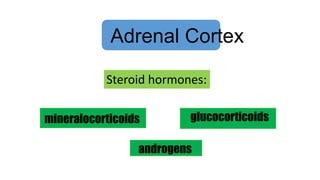
Adrenal Cortex
Steroid hormones:
mineralocorticoids glucocorticoids
androgens
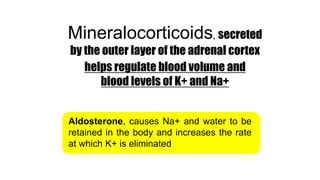
Mineralocorticoids, secreted
by the outer layer of the adrenal cortex
helps regulate blood volume and
blood levels of K+ and Na+
Aldosterone, causes Na+ and water to be
retained in the body and increases the rate
at which K+ is eliminated
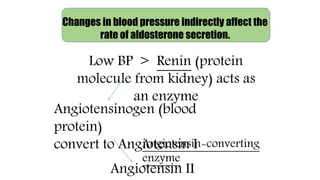
Changes in blood pressure indirectly affect the
rate of aldosterone secretion.
Low BP > Renin (protein
molecule from kidney) acts as
an enzyme
Angiotensinogen (blood
protein)
convert to Angiotensin IAngiotensin-converting
enzyme
Angiotensin II
Angiotensin II causes smooth
muscle in blood vessels to constrict,
and acts on the adrenal cortex to
increase aldosterone secretion.
Aldosterone causes retention of Na+
and water, which leads to an
increase in blood volume. Both blood
vessel constriction and increased
blood volume help raise blood
pressure.
Glucocorticoids, secreted by
the middle layer of the adrenal cortex
helps regulate blood nutrient levels
The major glucocorticoid hormone is
cortisol, which increases the
breakdown of proteins and lipids and
increases their conversion to forms of
energy the body can use.
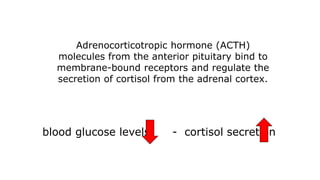
Adrenocorticotropic hormone (ACTH)
molecules from the anterior pituitary bind to
membrane-bound receptors and regulate the
secretion of cortisol from the adrenal cortex.
blood glucose levels - cortisol secretion
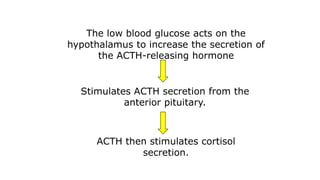
ACTH then stimulates cortisol
secretion.
The low blood glucose acts on the
hypothalamus to increase the secretion of
the ACTH-releasing hormone
Stimulates ACTH secretion from the
anterior pituitary.
Androgen, secreted by the
inner layer of the adrenal cortex
which stimulate the development of
male sexual characteristics
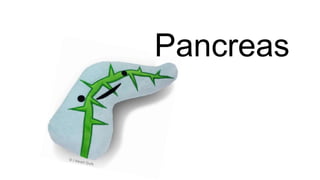
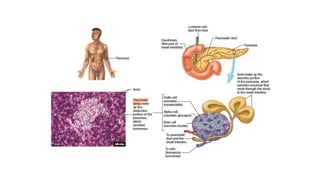
Pancreas
A below-normal blood glucose level
causes the nervous system to
malfunction because glucose is the
nervous system’s main source of energy.
If blood glucose levels are too high, the
kidneys produce large volumes of urine
containing substantial amounts of
glucose. Because of the rapid loss of
water in the form of urine, dehydration
can result.
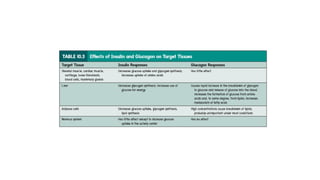
Insulin is released from the beta cells primarily in
response to the elevated blood glucose levels and
increased parasympathetic stimulation
associated with digestion of a meal.
The major target tissues for insulin are the
liver, adipose tissue, muscles, and the
area of the hypothalamus that controls
appetite, called the satiety center.
Insulin binds to membrane-bound
receptors and, either directly or
indirectly, increases the rate of
glucose and amino acid uptake in
these tissues.
Glucose is converted to glycogen or
lipids, and the amino acids are used
to synthesize protein
Diabetes mellitus
Type 1 diabetes
mellitus , too little
insulin is secreted
from the pancreas
Type 2 diabetes
mellitus , insufficient
numbers of insulin
receptors on target
cells or by defective
receptors that do not
respond normally to
insulin.
Type 1 diabetes mellitus,
tissues cannot take up glucose
effectively, causing blood
glucose levels to become very
high, a condition called
hyperglycemia
Glucagon, released from the
alpha cells when blood glucose
levels are low.
Glucagon binds to
membranebound receptors
primarily in the liver, causing the
glycogen stored in the liver to be
converted to glucose. The glucose
is then released into the blood to
increase blood glucose levels
Somatostatin is released by
the delta cells in response to
food intake. Somatostatin
inhibits the secretion of insulin
and glucagon and inhibits
gastric tract activity.
Testes and Ovaries
Testosterone
Estrogen and progesterone
LH and FSH stimulate the
secretion of hormones from the
ovaries and testes.
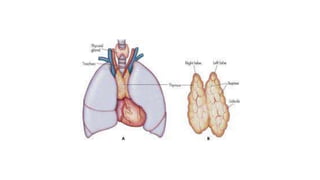
Thymus
It is important in the function of the
immune system
Thymosi
White blood cells called T
cells, help protect the body
against infection by foreign
organisms
Pineal Gland
Melatonin, which is thought to
decrease the secretion of LH and FSH
by decreasing the release of
hypothalamic-releasing hormones
Thus, melatonin inhibits the functions
of the reproductive system
Other hormones
Cells in the lining of the stomach
and small intestine secrete
hormones that stimulate the
production of digestive juices
from the stomach, pancreas,
and liver
Prostaglandins
widely distributed in tissues of the body,
where they function as intercellular
signals
cause relaxation of smooth muscle,
such as dilation of blood vessels
also play a role in inflammation
cause contraction of smooth
muscle, such as contraction of the
uterus during the delivery of a baby
Erythropoietin
hormone secreted by the kidney in
response to reduced oxygen levels in
the kidney
acts on bone marrow to increase the
production of red blood cells
the placenta is an important source of
hormones that maintain pregnancy and
stimulate breast development
estrogen, progesterone, and
human chorionic
gonadotropin, which is similar
in structure and function to LH
Effects Of
Aging On
The
Endocrine

TheEndocrine System

  • 1.
  • 2.
  • 3.
  • 4.
  • 5.
  • 6.
    BY: PAULA MARIEM. LLIDO RACHEL M. TACUBAO GROUP 6
  • 8.
    Composed of ENDOCRINEGLANDS and ENDOCRINE CELLS located throughout the body ENDOCRINE SYSTEM ENDOCRINE – (Greek) “endo” within and “krino” to secrete Traveling to TARGET TISSUES (specific sites) Secretes some HORMONES (chemical messengers) COORDINATED RESPONSE! Bloodstream
  • 9.
    ENDOCRINE VS. EXOCRINEGLANDS EXOCRINE SYSTEM GLANDS HAVE DUCTS OR HOLLOW ORGANS FOR SECRETION OUTSIDE THE BODY
  • 10.
    ENDOCRINE SYSTEM FUNCTIONS 1Metabolism 2 Control of food intake and digestion 3 Tissue development 4 Ion regulation 5 Water balance
  • 11.
    6 Heart rateand blood pressure regulation 7 Control of blood glucose and other nutrients 8 Control of reproductive functions 9 Uterine contractions and milk release 10 Immune system regulation
  • 12.
    What are the 3TYPES OF STIMULI that regulate hormone release? HUMORAL NEURAL HORMONAL
  • 13.
    HORMONAL STIMULI Hormones arereleased in response to other hormones from another endocrine gland Tropic hormones Example: Thyroid releasing hormone triggers the release of thyroid stimulating hormone which triggers the release of thyroid hormone
  • 14.
    NEURAL STIMULI Hormones arereleased in response to a nerve stimulation Example: Epinephrine and oxytocin
  • 15.
    HUMORAL STIMULI Hormones AreReleased in response to ions and nutrients Example: Calcitonin, parathyroid hormone, insulin, glucagon, aldosterone
  • 16.
    Hormone levels are primarily controlledthrough negative feedback, in which rising levels of a hormone inhibit its further release HORMONAL INHIBITING HORMONES – from the hypothalamus that prevent the secretion of tropic hormones from the pituitary gland NEURAL Neurons inhibit targets just as often as they stimulate targets. If the neurotransmitter is inhibitory, the target endocrine gland does not secrete its hormone HUMORAL a rise in blood glucose levels triggers the pancreatic release of insulin. Insulin causes blood glucose levels to drop, which signals the pancreas to stop producing insulin in a negative feedback loop.
  • 17.
    REGULATION OF HORMONELEVELS IN THE BLOOD NEGATIVE FEEDBACK POSITIVE FEEDBACK • Hormone’s secretion is inhibited by the hormone itself once blood levels have reached a certain point • Self-limiting system • Promote the synthesis and secretion of the tropic hormone in addition to stimulating their target cell • Self-propagating system
  • 18.
    CHEMICAL NATURE OFHORMONES Lipid-soluble Water-soluble Steroid hormones (cholesterol) Thyroid hormones (tyrosine) Amino acids
  • 19.
    LIPID-SOLUBLE HORMONE • SteroidHormones: • Lipid soluble • Diffuse through cell membranes • Endocrine organs • Adrenal cortex • Ovaries • Testes • Thyroid
  • 20.
    WATER-SOLUBLE HORMONE  Hormonesand Plasma Membrane Receptors  Bind to receptors in plasma membrane  Cannot have direct effect on activities inside target cell  Use intracellular intermediary to exert effects  First messenger:  leads to second messenger  may act as enzyme activator, inhibitor, or cofactor  results in change in rates of metabolic reactions
  • 21.
    CLASSES OF RECEPTORS NUCLEARRECEPTOR (binded by Lipid-soluble hormones) MEMBRANE-BOUND RECEPTOR (binded by water-soluble hormones)
  • 22.
  • 23.
  • 25.
    CASCADE EFFECT TO SIGNALAMPLIFICATION • The combination of a hormone with a membrane-bound receptor activates several G proteins. • The G proteins, in turn, activate many inactive adenylate cyclase enzymes, which cause the synthesis of a large number of cAMP molecules • The large number of cAMP molecules, in turn, activate many inactive protein kinase enzymes • Produces a rapid and amplified response.
  • 26.
  • 27.
    PITUITARY AND HYPOTHALAMUS PITUITARYGLAND • Hypophysis • Small gland, about size of a pea • Master gland • 2 parts: ANTERIOR PITUITARY POSTERIOR PITUITARY HYPOTHALAMUS • Important autonomic nervous system and endocrine control center • Located inferior to the thalamus • Controls the pituitary gland : hormonal control and direct innervations
  • 29.
    • Produce andrelease hormones • The hypothalamus synthesizes hormones called releasing factors, which are released into the portal vein that extends to the anterior lobe • The releasing factors cause endocrine cells in the anterior pituitary to release specific hormones into the bloodstream to act on distant cells • Release hormones • The posterior lobe (neurohypophysis) releases hormones produced by neurosecretory cells of the hypothalamus • These cells extend from the hypothalamus into the posterior lobe and release hormones into the bloodstream in response to nerve signals POSTERIOR PITUITARY ANTERIOR PITUITARY
  • 30.
    Anterior Pituitary Hormones •Adrenocorticotropic(ACTH) •Growth hormone (GH) •Thyroid-stimulating hormone (TSH) •Follicle-stimulating hormone (FSH) •Luteinizing hormone (LH) •Prolactin (PRL) •Melanocyte-stimulating hormone (MSH)
  • 31.
    “Dwarfism & Gigantism” •Growth Hormone (GH) –Stimulates body cells to grow and reproduce and speeds the rate at which cells use carbohydrates and fats • Prolactin (PRL) –Promotes milk production following the birth of an infant. • Thyroid-Stimulating Hormone (TSH) –Controls the secretion of hormones from the thyroid gland.
  • 32.
    Posterior Pituitary Hormones •Plays a role in childbirth by contracting muscles in the uterine wall and in milk-letdown by forcing milk into ducts from the milk glands. OXYTOCIN ANTI-DIURETIC HORMONE (ADH) • Causes the kidneys to conserve water (prevents dehydration) • Vasopressin
  • 33.
  • 35.
    One of thelargest endocrine glands Highly vascular
  • 36.
    Thyroid hormones, bindto nuclear receptors in cells and regulate the rate of metabolism in the body
  • 38.
    Thyroid hormone secretionis regulated by hormones from the hypothalamus and pituitary. Hypothalamus > TSH-releasing hormone (TRH) Anterior pituitary gland > Thyroid- stimulating hormone (TSH) Thyroid gland > Thyroid hormone
  • 39.
    Small fluctuations inblood TSH levels occur on a daily basis, with a small increase at night blood levels of TSH = synthesis and release of thyroid hormones blood levels of TSH = synthesis and release of thyroid hormones
  • 40.
  • 41.
    Thyroid hormone level- inhibits the secretion of TRH and TSH Thyroid hormone level - allows additional secretion of TRH and TSH Because of the negative-feedback effect, the thyroid hormones fluctuate within a narrow concentration range in the blood. A loss of negative feedback will result in excess TSH
  • 42.
    Goiter As less thyroidhormone is synthesized and secreted, TSH- releasing hormone and TSH secretion increase above normal levels and cause dramatic enlargement of the thyroid gland.
  • 43.
    Hypothyroidism, lack ofthyroid hormones (Infants) Cretinism; mental retardation, short stature, and abnormally formed skeletal structures. (Adults) decreased metabolic rate, sluggishness, a reduced ability to perform routine tasksMyxedema
  • 44.
    the accumulation offluid and other molecules in the subcutaneous tissue.
  • 45.
    Hyperthyroidism, elevated rate of thyroidhormone secretion increased metabolic rate, extreme nervousness, and chronic fatigue Graves disease is a type of hyperthyroidism that results when the immune system produces abnormal proteins that are similar in structure and function to TSH. Graves disease is often accompanied by bulging of the eyes, a condition called exophthalmia
  • 47.
    The thyroid glandrequires iodine to synthesize thyroid hormones. Iodine is taken up by the thyroid follicles.
  • 48.
  • 49.
    Thyroxine, or tetraiodothyronine (T ₄) Triiodothyronine(T ₃) Insufficient iodine, production and secretion of the thyroid hormones decrease
  • 50.
    Parafollicular cells secretescalcitonin Blood concentration of Ca 2+ Secretes calcitonin > Ca 2+ level to normal range Calcitonin binds to membrane-bound receptors of osteoclasts and reduces the rate of Ca2+ resaborption (breakdown) from bone by inhibiting the osteoclasts. Calcitonin may prevent blood Ca2+ levels from becoming overly elevated following a meal that contains a high concentration of Ca2+
  • 51.
  • 53.
    secrete parathyroid hormone(PTH), which is essential for the regulation of blood calcium levels. PTH has many effects: 1. PTH binds to membrane-bound receptors of renal tubule cells, which increases active vitamin D formation. 2. PTH binds to receptors on osteoblasts. 3. PTH binds to receptors on cells of the renal tubules and decreases the rate at which Ca2+ is lost in the urine. 4. PTH acts on its target tissues to raise blood Ca2+ levels to normal.
  • 56.
    Hyperparathyroidism, abnormally high rateof PTH secretion Bones can become soft, deformed, and easily fractured. The elevated blood Ca2+ levels make nerve and muscle cells less excitable, resulting in fatigue and muscle weakness. The excess Ca2+ can be deposited in soft tissues of the body, causing inflammation. In addition, kidney stones can result
  • 57.
    Hypoparathyroidism, abnormally rate ofPTH secretion The low blood levels of PTH lead to reductions in the rate of bone reabsorption and the formation of vitamin D. As a result, blood Ca2+ levels decrease. In response to low blood Ca2+ levels, nerves and muscles become excitable and produce spontaneous action potentials that cause frequent muscle cramps or tetanus. Severe tetanus can affect the respiratory muscles; breathing stops, resulting in death.
  • 58.
  • 60.
  • 61.
    The major effects ofthe hormones released from the adrenal medulla are :
  • 62.
  • 63.
    Mineralocorticoids, secreted by theouter layer of the adrenal cortex helps regulate blood volume and blood levels of K+ and Na+ Aldosterone, causes Na+ and water to be retained in the body and increases the rate at which K+ is eliminated
  • 64.
    Changes in bloodpressure indirectly affect the rate of aldosterone secretion. Low BP > Renin (protein molecule from kidney) acts as an enzyme Angiotensinogen (blood protein) convert to Angiotensin IAngiotensin-converting enzyme Angiotensin II
  • 65.
    Angiotensin II causessmooth muscle in blood vessels to constrict, and acts on the adrenal cortex to increase aldosterone secretion. Aldosterone causes retention of Na+ and water, which leads to an increase in blood volume. Both blood vessel constriction and increased blood volume help raise blood pressure.
  • 66.
    Glucocorticoids, secreted by themiddle layer of the adrenal cortex helps regulate blood nutrient levels The major glucocorticoid hormone is cortisol, which increases the breakdown of proteins and lipids and increases their conversion to forms of energy the body can use.
  • 67.
    Adrenocorticotropic hormone (ACTH) moleculesfrom the anterior pituitary bind to membrane-bound receptors and regulate the secretion of cortisol from the adrenal cortex. blood glucose levels - cortisol secretion
  • 68.
    ACTH then stimulatescortisol secretion. The low blood glucose acts on the hypothalamus to increase the secretion of the ACTH-releasing hormone Stimulates ACTH secretion from the anterior pituitary.
  • 69.
    Androgen, secreted bythe inner layer of the adrenal cortex which stimulate the development of male sexual characteristics
  • 70.
  • 72.
    A below-normal bloodglucose level causes the nervous system to malfunction because glucose is the nervous system’s main source of energy. If blood glucose levels are too high, the kidneys produce large volumes of urine containing substantial amounts of glucose. Because of the rapid loss of water in the form of urine, dehydration can result.
  • 73.
    Insulin is releasedfrom the beta cells primarily in response to the elevated blood glucose levels and increased parasympathetic stimulation associated with digestion of a meal. The major target tissues for insulin are the liver, adipose tissue, muscles, and the area of the hypothalamus that controls appetite, called the satiety center.
  • 74.
    Insulin binds tomembrane-bound receptors and, either directly or indirectly, increases the rate of glucose and amino acid uptake in these tissues. Glucose is converted to glycogen or lipids, and the amino acids are used to synthesize protein
  • 76.
    Diabetes mellitus Type 1diabetes mellitus , too little insulin is secreted from the pancreas Type 2 diabetes mellitus , insufficient numbers of insulin receptors on target cells or by defective receptors that do not respond normally to insulin.
  • 77.
    Type 1 diabetesmellitus, tissues cannot take up glucose effectively, causing blood glucose levels to become very high, a condition called hyperglycemia
  • 78.
    Glucagon, released fromthe alpha cells when blood glucose levels are low. Glucagon binds to membranebound receptors primarily in the liver, causing the glycogen stored in the liver to be converted to glucose. The glucose is then released into the blood to increase blood glucose levels
  • 79.
    Somatostatin is releasedby the delta cells in response to food intake. Somatostatin inhibits the secretion of insulin and glucagon and inhibits gastric tract activity.
  • 80.
  • 81.
    Testosterone Estrogen and progesterone LHand FSH stimulate the secretion of hormones from the ovaries and testes.
  • 82.
  • 84.
    It is importantin the function of the immune system Thymosi
  • 85.
    White blood cellscalled T cells, help protect the body against infection by foreign organisms
  • 86.
  • 87.
    Melatonin, which isthought to decrease the secretion of LH and FSH by decreasing the release of hypothalamic-releasing hormones Thus, melatonin inhibits the functions of the reproductive system
  • 88.
    Other hormones Cells inthe lining of the stomach and small intestine secrete hormones that stimulate the production of digestive juices from the stomach, pancreas, and liver
  • 89.
    Prostaglandins widely distributed intissues of the body, where they function as intercellular signals cause relaxation of smooth muscle, such as dilation of blood vessels also play a role in inflammation cause contraction of smooth muscle, such as contraction of the uterus during the delivery of a baby
  • 90.
    Erythropoietin hormone secreted bythe kidney in response to reduced oxygen levels in the kidney acts on bone marrow to increase the production of red blood cells
  • 91.
    the placenta isan important source of hormones that maintain pregnancy and stimulate breast development estrogen, progesterone, and human chorionic gonadotropin, which is similar in structure and function to LH
  • 92.

Editor's Notes

  • #48 Pic of seaweed, iodized salt and thelikes