By: PALLAVI TIWARI
Class: VIII(8)




Endocrine glands are glands of the endocrine
system that secrete their
products, hormones, directly into the blood
rather than through a duct.
The main endocrine glands include the
pituitary
gland, pancreas, ovaries, testes, thyroid
gland, adrenal glands, and pineal.



1.
2.
3.

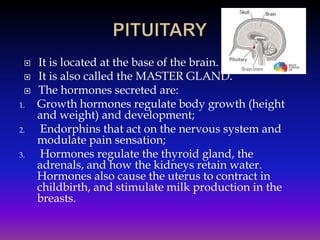
It is located at the base of the brain.
It is also called the MASTER GLAND.
The hormones secreted are:
Growth hormones regulate body growth (height
and weight) and development;
Endorphins that act on the nervous system and
modulate pain sensation;
Hormones regulate the thyroid gland, the
adrenals, and how the kidneys retain water.
Hormones also cause the uterus to contract in
childbirth, and stimulate milk production in the
breasts.




1.

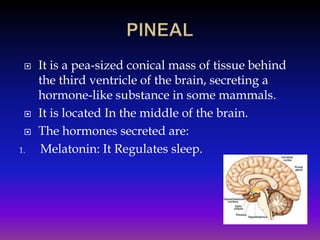
It is a pea-sized conical mass of tissue behind
the third ventricle of the brain, secreting a
hormone-like substance in some mammals.
It is located In the middle of the brain.
The hormones secreted are:
Melatonin: It Regulates sleep.





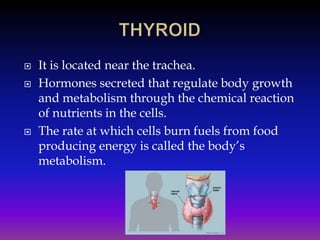
It is located near the trachea.
Hormones secreted that regulate body growth
and metabolism through the chemical reaction
of nutrients in the cells.
The rate at which cells burn fuels from food
producing energy is called the body’s
metabolism.




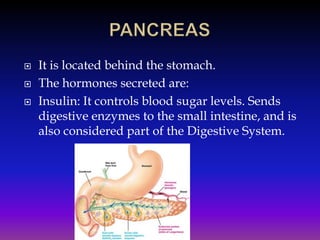
It is located behind the stomach.
The hormones secreted are:
Insulin: It controls blood sugar levels. Sends
digestive enzymes to the small intestine, and is
also considered part of the Digestive System.





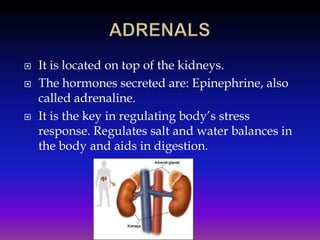
It is located on top of the kidneys.
The hormones secreted are: Epinephrine, also
called adrenaline.
It is the key in regulating body’s stress
response. Regulates salt and water balances in
the body and aids in digestion.






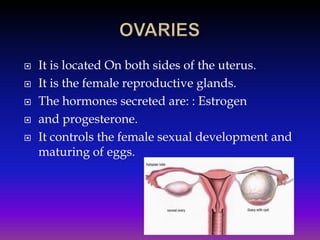
It is located On both sides of the uterus.
It is the female reproductive glands.
The hormones secreted are: : Estrogen
and progesterone.
It controls the female sexual development and
maturing of eggs.





It is located in scrotum sacs behind the penis.
It is the male reproductive glands.
The hormones secreted are: Testosterone.
It Controls the male sexual development and
sperm production.




The glands produce and secrete hormones into
the bloodstream. Blood circulation carries the
hormones to the cells appropriate for the
message. These cells, called target cells, have
receptors that bind only to certain hormones.
Each hormone has its own receptor, so
hormone/target cell communication is very
specific. When the hormones find and attach to
the proper cells the chemical activity of the
hormone is released into the cell.


The Endocrine System regulates the correct
level of each hormone in the body for proper
functioning. This is done through a mechanism
of the pituitary gland that regulates the correct
amount of each hormone in the body.




The Endocrine System is responsible for initiating
and controlling the significant series of physical
and emotional changes that begin somewhere
between 11 and 15 years of age. Growth patterns
and spurts are different for boys and girls, and
certainly differ from one adolescent to the next, but
females typically enter puberty earlier than boys.
Girls can begin changing as early as age eight, and
most are undergoing puberty by age 13. While
some boys begin the process at age 10,others begin
as late as age 15.
FEMALE CHANGES IN
PUBERTY















Female hormone
production starts
• Sudden and rapid growth occurs
• Permanent teeth come in
• Acne may occur
• Hair begins growing in the under
arm and pubic area
• External genitals enlarge
• Breasts develop
• Hips widen
• Body fat increases
• Perspiration increases
• Ovulation begins
• Menstruation begins
• Uterus and ovaries enlarge

MALE CHANGES IN
PUBERTY














Male hormone
production starts
• Sudden and rapid growth occurs
• Permanent teeth come in
• Acne may occur
• Hair begins growing, particularly in
the under arm and pubic area.
• Facial hair increases
• External genitals enlarge.
• Breasts may enlarge
• Muscles develop
• Perspiration increases
• Sperm production begin.
• Larynx enlarges and voice deepens.


The Endocrine System is a body-wide system
since there is no central organ.
Consequently, care of the Endocrine System
requires a health-conscious attention to the
entire body. Given the way our physical body
is affected by our emotions and our
minds, having a healthy Endocrine System
means being healthy physically, mentally, and
emotionally.




Endocrine System health can be enhanced by
attending to healthy stress management. All the
things that manage and discharge stress will help
to keep the entire body healthy.
If stress is effectively managed (thus keeping the
entire body healthy) the Endocrine System will
operate more efficiently and stay in balance.
Healthy stress management activities, behaviors
and habits promote a healthy, energetic body, a
clear mind, and balanced emotions--no small feat
for anyone, much less an adolescent at the mercy
of hormones.


Nevertheless, this may be a very good time to
reinforce the message of the benefits of stress
management by encouraging each student to
commit to their own physical, mental, and
emotional health in the following ways:
Getting good balanced nutrition throughout the day is key.
• Engaging in healthy and regular physical activity has a
positive impact on thyroid glands, essential for growth and
development.
• Getting plenty of restful sleep every night helps regulate the
pineal gland, influencing the adrenals and promoting a
healthy stress response.
• Learn what is important and what is not. Develop perspective
on what’s happening in your life by practicing effective
mental and emotional stress techniques. Doing this will
significantly improve how your physical body feels by
influencing the adrenal glands to recover from any stressinduced adrenaline “rush.” This calms the body and helps
lessen the impact of stress.






Diabetes Mellitus
One of the most significant endocrine problems is
diabetes, a chronic condition in which insulin
production and use is affected. Juvenile diabetes (or
Type 1 diabetes) occurs when the pancreas doesn’t
produce enough insulin.
When it occurs in the In teens and younger children it
may be the result of an autoimmune disorder in which
the person’s immune system attacks pancreatic cells
that make insulin, causing less insulin to be produced.
The symptoms of Type 1 diabetes include weight
loss, fatigue, frequent urination, and extreme thirst.
Type 2 diabetes, however, occurs when the body no
longer responds to insulin normally.


Growth hormones that fail to release in the
proper quantities at the proper time can cause
bone growth abnormalities, resulting in
stunted growth or growth that is excessive for
their age. Gigantism and dwarfism are extreme
forms of growth hormone dysfunction.
Endocrine glands and systems.

Endocrine glands and systems.

  • 1.
  • 2.
      Endocrine glands areglands of the endocrine system that secrete their products, hormones, directly into the blood rather than through a duct. The main endocrine glands include the pituitary gland, pancreas, ovaries, testes, thyroid gland, adrenal glands, and pineal.
  • 3.
       1. 2. 3. It is locatedat the base of the brain. It is also called the MASTER GLAND. The hormones secreted are: Growth hormones regulate body growth (height and weight) and development; Endorphins that act on the nervous system and modulate pain sensation; Hormones regulate the thyroid gland, the adrenals, and how the kidneys retain water. Hormones also cause the uterus to contract in childbirth, and stimulate milk production in the breasts.
  • 4.
       1. It is apea-sized conical mass of tissue behind the third ventricle of the brain, secreting a hormone-like substance in some mammals. It is located In the middle of the brain. The hormones secreted are: Melatonin: It Regulates sleep.
  • 5.
       It is locatednear the trachea. Hormones secreted that regulate body growth and metabolism through the chemical reaction of nutrients in the cells. The rate at which cells burn fuels from food producing energy is called the body’s metabolism.
  • 6.
       It is locatedbehind the stomach. The hormones secreted are: Insulin: It controls blood sugar levels. Sends digestive enzymes to the small intestine, and is also considered part of the Digestive System.
  • 7.
       It is locatedon top of the kidneys. The hormones secreted are: Epinephrine, also called adrenaline. It is the key in regulating body’s stress response. Regulates salt and water balances in the body and aids in digestion.
  • 8.
         It is locatedOn both sides of the uterus. It is the female reproductive glands. The hormones secreted are: : Estrogen and progesterone. It controls the female sexual development and maturing of eggs.
  • 9.
        It is locatedin scrotum sacs behind the penis. It is the male reproductive glands. The hormones secreted are: Testosterone. It Controls the male sexual development and sperm production.
  • 10.
      The glands produceand secrete hormones into the bloodstream. Blood circulation carries the hormones to the cells appropriate for the message. These cells, called target cells, have receptors that bind only to certain hormones. Each hormone has its own receptor, so hormone/target cell communication is very specific. When the hormones find and attach to the proper cells the chemical activity of the hormone is released into the cell.
  • 11.
     The Endocrine Systemregulates the correct level of each hormone in the body for proper functioning. This is done through a mechanism of the pituitary gland that regulates the correct amount of each hormone in the body.
  • 12.
      The Endocrine Systemis responsible for initiating and controlling the significant series of physical and emotional changes that begin somewhere between 11 and 15 years of age. Growth patterns and spurts are different for boys and girls, and certainly differ from one adolescent to the next, but females typically enter puberty earlier than boys. Girls can begin changing as early as age eight, and most are undergoing puberty by age 13. While some boys begin the process at age 10,others begin as late as age 15.
  • 13.
    FEMALE CHANGES IN PUBERTY               Femalehormone production starts • Sudden and rapid growth occurs • Permanent teeth come in • Acne may occur • Hair begins growing in the under arm and pubic area • External genitals enlarge • Breasts develop • Hips widen • Body fat increases • Perspiration increases • Ovulation begins • Menstruation begins • Uterus and ovaries enlarge MALE CHANGES IN PUBERTY              Male hormone production starts • Sudden and rapid growth occurs • Permanent teeth come in • Acne may occur • Hair begins growing, particularly in the under arm and pubic area. • Facial hair increases • External genitals enlarge. • Breasts may enlarge • Muscles develop • Perspiration increases • Sperm production begin. • Larynx enlarges and voice deepens.
  • 14.
     The Endocrine Systemis a body-wide system since there is no central organ. Consequently, care of the Endocrine System requires a health-conscious attention to the entire body. Given the way our physical body is affected by our emotions and our minds, having a healthy Endocrine System means being healthy physically, mentally, and emotionally.
  • 15.
      Endocrine System healthcan be enhanced by attending to healthy stress management. All the things that manage and discharge stress will help to keep the entire body healthy. If stress is effectively managed (thus keeping the entire body healthy) the Endocrine System will operate more efficiently and stay in balance. Healthy stress management activities, behaviors and habits promote a healthy, energetic body, a clear mind, and balanced emotions--no small feat for anyone, much less an adolescent at the mercy of hormones.
  • 16.
     Nevertheless, this maybe a very good time to reinforce the message of the benefits of stress management by encouraging each student to commit to their own physical, mental, and emotional health in the following ways:
  • 17.
    Getting good balancednutrition throughout the day is key. • Engaging in healthy and regular physical activity has a positive impact on thyroid glands, essential for growth and development. • Getting plenty of restful sleep every night helps regulate the pineal gland, influencing the adrenals and promoting a healthy stress response. • Learn what is important and what is not. Develop perspective on what’s happening in your life by practicing effective mental and emotional stress techniques. Doing this will significantly improve how your physical body feels by influencing the adrenal glands to recover from any stressinduced adrenaline “rush.” This calms the body and helps lessen the impact of stress. 
  • 18.
       Diabetes Mellitus One ofthe most significant endocrine problems is diabetes, a chronic condition in which insulin production and use is affected. Juvenile diabetes (or Type 1 diabetes) occurs when the pancreas doesn’t produce enough insulin. When it occurs in the In teens and younger children it may be the result of an autoimmune disorder in which the person’s immune system attacks pancreatic cells that make insulin, causing less insulin to be produced. The symptoms of Type 1 diabetes include weight loss, fatigue, frequent urination, and extreme thirst. Type 2 diabetes, however, occurs when the body no longer responds to insulin normally.
  • 19.
     Growth hormones thatfail to release in the proper quantities at the proper time can cause bone growth abnormalities, resulting in stunted growth or growth that is excessive for their age. Gigantism and dwarfism are extreme forms of growth hormone dysfunction.