Content Provider & Resolver
By Priyanka Rana
• Two classes in the package help enforce this requirement:
• ContentResolver & ContentProvider
• Contains classes for accessing and publishing data.
• Applications are not allowed direct access to other application’s
internal data.
• The Android framework enforces a robust and secure data sharing
model.
The android.content Package
What is the Content Resolver?
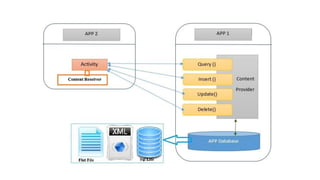
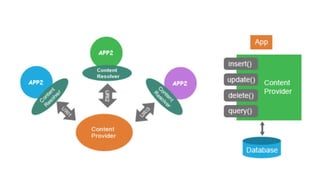
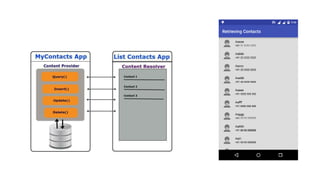
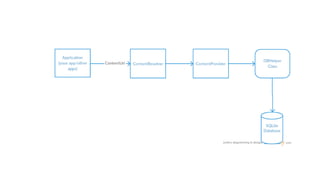
• The Content Resolver is the single, global instance in your application that provides access to your
(and other applications’) content providers.
• The Content Resolver behaves exactly as its name implies: it accepts requests from clients,
and resolves these requests by directing them to the content provider with a distinct authority.
• To do this, the Content Resolver stores a mapping from authorities to Content Providers. This design
is important, as it allows a simple and secure means of accessing other applications’ Content
Providers.
• The Content Resolver includes the CRUD (create, read, update, delete) methods corresponding to the
abstract methods (insert, query, update, delete) in the Content Provider class.
• The Content Resolver does not know the implementation of the Content Providers it is interacting
with (nor does it need to know); each method is passed an URI that specifies the Content Provider to
interact with.
What is a Content Provider?
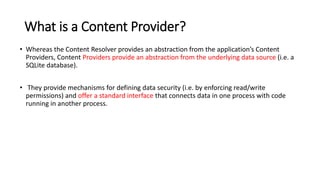
• Whereas the Content Resolver provides an abstraction from the application’s Content
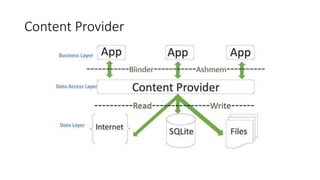
Providers, Content Providers provide an abstraction from the underlying data source (i.e. a
SQLite database).
• They provide mechanisms for defining data security (i.e. by enforcing read/write
permissions) and offer a standard interface that connects data in one process with code
running in another process.
Content Provider
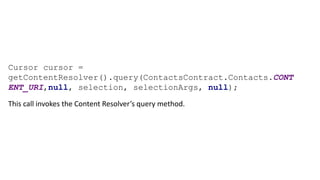
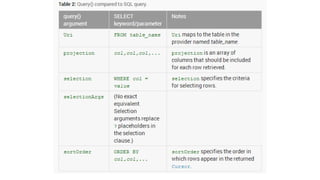
Cursor cursor =
getContentResolver().query(ContactsContract.Contacts.CONT
ENT_URI,null, selection, selectionArgs, null);
This call invokes the Content Resolver’s query method.
Content package - Mobile computing

Content package - Mobile computing

  • 1.
    Content Provider &Resolver By Priyanka Rana
  • 2.
    • Two classesin the package help enforce this requirement: • ContentResolver & ContentProvider • Contains classes for accessing and publishing data. • Applications are not allowed direct access to other application’s internal data. • The Android framework enforces a robust and secure data sharing model. The android.content Package
  • 5.
    What is theContent Resolver? • The Content Resolver is the single, global instance in your application that provides access to your (and other applications’) content providers. • The Content Resolver behaves exactly as its name implies: it accepts requests from clients, and resolves these requests by directing them to the content provider with a distinct authority. • To do this, the Content Resolver stores a mapping from authorities to Content Providers. This design is important, as it allows a simple and secure means of accessing other applications’ Content Providers. • The Content Resolver includes the CRUD (create, read, update, delete) methods corresponding to the abstract methods (insert, query, update, delete) in the Content Provider class. • The Content Resolver does not know the implementation of the Content Providers it is interacting with (nor does it need to know); each method is passed an URI that specifies the Content Provider to interact with.
  • 7.
    What is aContent Provider? • Whereas the Content Resolver provides an abstraction from the application’s Content Providers, Content Providers provide an abstraction from the underlying data source (i.e. a SQLite database). • They provide mechanisms for defining data security (i.e. by enforcing read/write permissions) and offer a standard interface that connects data in one process with code running in another process.
  • 8.
  • 10.
    Cursor cursor = getContentResolver().query(ContactsContract.Contacts.CONT ENT_URI,null,selection, selectionArgs, null); This call invokes the Content Resolver’s query method.