Scrum retrospective
By
Priyanka Rana
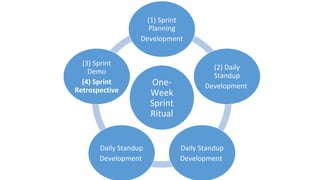
One-
Week
Sprint
Ritual
(1) Sprint
Planning
Development
(2) Daily
Standup
Development
Daily Standup
Development
Daily Standup
Development
(3) Sprint
Demo
(4) Sprint
Retrospective
SCRUM retrospective
The retrospective includes three main questions/points for discussion:
• What went well during the sprint cycle?
• What went wrong during the sprint cycle?
• What could we do differently to improve?
Key elements of the sprint retrospective:
• Process improvements are made at the end of every sprint. This ensures that
the project team is always improving the way it works.
• The retrospective is a collaborative process among all members, including the
team, the product owner, and the Scrum Master.
• All team members identify what went well and what could be improved.
• The Scrum Master prioritizes actions and lessons learned based on team
direction.
• The retrospective supports team formation and bonding, particularly as any
areas of conflict can be identified and dealt with.
• The retrospective helps build the team's sense of ownership and its self-
management.
Focus on 3 Ws
WWW means it worked, kind of worked, and didn't work at all.
As the words suggest, the team is focused on the items that worked well for them in the last sprint.
On items that worked but still need a few tweaks in the next sprint.
Also, the team focuses on items that didn't work well or couldn't be implemented in this sprint but
could be improved or implemented in upcoming sprints.
Retrospective tricks
Please discuss each question on Handouts in team and answer
accordingly.

Scrum retrospective

  • 1.
  • 2.
    One- Week Sprint Ritual (1) Sprint Planning Development (2) Daily Standup Development DailyStandup Development Daily Standup Development (3) Sprint Demo (4) Sprint Retrospective
  • 3.
    SCRUM retrospective The retrospectiveincludes three main questions/points for discussion: • What went well during the sprint cycle? • What went wrong during the sprint cycle? • What could we do differently to improve?
  • 4.
    Key elements ofthe sprint retrospective: • Process improvements are made at the end of every sprint. This ensures that the project team is always improving the way it works. • The retrospective is a collaborative process among all members, including the team, the product owner, and the Scrum Master. • All team members identify what went well and what could be improved. • The Scrum Master prioritizes actions and lessons learned based on team direction. • The retrospective supports team formation and bonding, particularly as any areas of conflict can be identified and dealt with. • The retrospective helps build the team's sense of ownership and its self- management.
  • 15.
    Focus on 3Ws WWW means it worked, kind of worked, and didn't work at all. As the words suggest, the team is focused on the items that worked well for them in the last sprint. On items that worked but still need a few tweaks in the next sprint. Also, the team focuses on items that didn't work well or couldn't be implemented in this sprint but could be improved or implemented in upcoming sprints.
  • 16.
  • 21.
    Please discuss eachquestion on Handouts in team and answer accordingly.

Editor's Notes

  • #3 <number>
  • #4 The sprint retrospective is an important mechanism that allows a team to continuously evolve and improve throughout the life of a project. <number>
  • #6 Empower teams Let off the frustration Team energiser As a place to learn Quality <number>
  • #15 <number>
  • #16 <number>
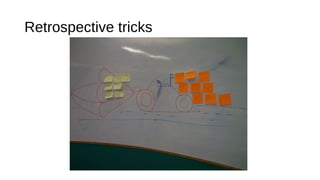
  • #17 Speed Car This retrospective forces the team to think of the push-and-pull factors they face in the sprint. Method: Draw a speed car with a parachute attached to the back. The engine of the car pushes it forward (i.e., things that help you) and the parachute pulls the car back (i.e., things that hinder you).Outcome: The team focuses on negative factors that pull them back in a sprint <number>
  • #18 Method: Draw three columns with the headings What, Who, and Due. Ask each member to come up with a wish-list item . The wish can be something that he or she wants to do or wants other team members to help him or her out with. The Due column will have a date assigned to each wish. <number>
  • #19 Method:Quadrant 1: Things that you love at work.Quadrant 2: Things that you love outside of work.Quadrant 3: Things that you don't like outside of work.Quadrant 4: Things that you don't like at work Outcome: You understand the personal traits of your team. Make sure that the ScrumMaster is also in this game. If the team is close, it can keep the retrospective lighthearted, and team members can laugh at themselves. <number>