
Home-Mess System Presentation II: Design & Prototype 1 Arundhati, Ihab, Ibrahim, Fareed, Zain
IntroductionPrototyping provides us with tangible models which help users visualize possibilities and identify failures.Explore the development from an idea to a prototype Construct part of the development lifecycle used to provide valuable insight into the look-and-feel, and the general workflow of an application. Prototypingis the keynode of iterativedevelopment
ObjectivesDefining the ProblemIdentifying user requirementsDevelopment of a supportive design solutionDesigning of a low-fidelity prototype.Creating a working model of the system so that conceptual ideas can be 'road tested', alternatives explored and user feedback gathered at an early stage.
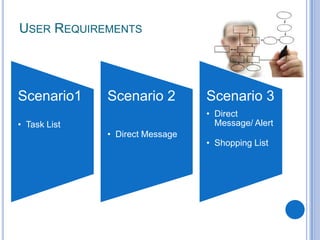
User Requirements
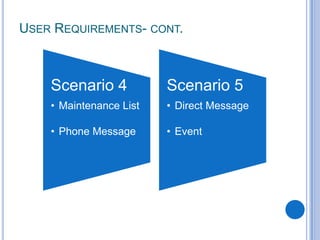
User Requirements- cont.
Design Stage
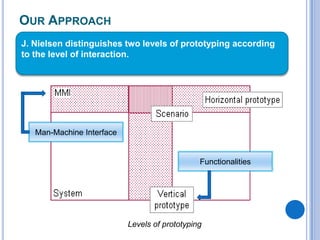
Our ApproachJ. Nielsen distinguishestwolevels of prototypingaccording to the level of interaction.Man-Machine InterfaceFunctionalitiesLevels of prototyping
Horizontal prototypeIt isthe 'surface interface'. Functionalitiesare not working, but itallows to achieve a perception test.Allowsto check the local behaviour of the interface Identifies the critical points whereusabilityproblems are likely to appear.
Vertical prototypeIt implements a consistent set of functionalities in order to allow the user to achieve a typical scenario of use. Some of thisfunctionalitiescouldbesimulated.This second stage of the prototyping phase consists in a series of user tests duringwhich the critical points raisedpreviously are evaluated.
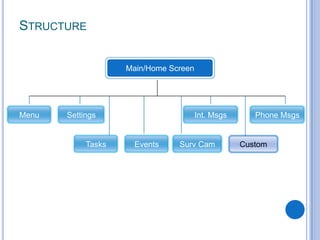
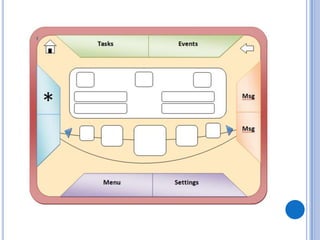
StructureMain/Home ScreenMenuInt. MsgsSettingsPhone MsgsEventsSurv CamCustomTasks
Prototyping Stage
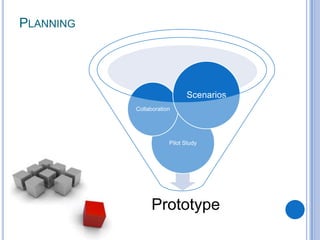
Planning
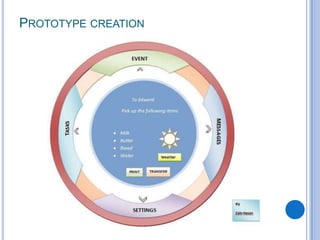
Prototype creation
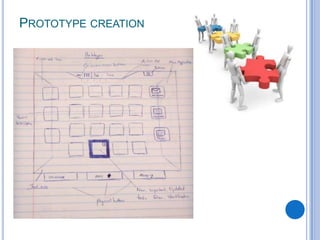
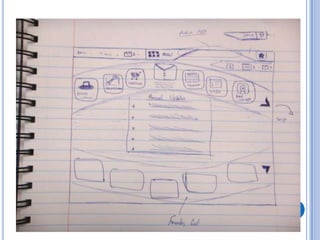
Prototype creation
DemoIhab, Arundhati
ConclusionPrototypes start off as empty shellsUsability problems detected It will be used to to evaluatethe usabilityof the wholesystem.
What’s Next?Evaluation:Data Analysis: What is new, what could we improve?
User Testing: What new problems present themselves?

Home Mess System: Design & Prototype