Algorithms and Data Structures
Algorithm analysis
By- Priyanka
Session 4 is about
 Seven Functions
 Analysis of algorithms
1. Constant Function
Simplest function:
f(n) = c (some fixed constant)
Value of n doesn’t matter.
Ex: adding two numbers, assigning variable,
comparing two numbers
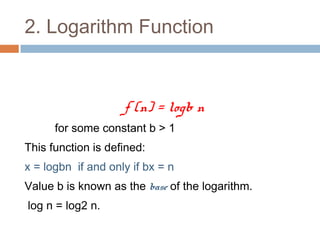
2. Logarithm Function
f (n) = logb n
for some constant b > 1
This function is defined:
x = logbn if and only if bx = n
Value b is known as the base of the logarithm.
log n = log2 n.
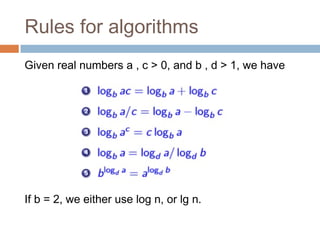
Rules for algorithms
Given real numbers a , c > 0, and b , d > 1, we have
If b = 2, we either use log n, or lg n.
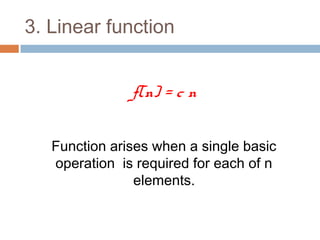
3. Linear function
f(n) = c n
Function arises when a single basic
operation is required for each of n
elements.
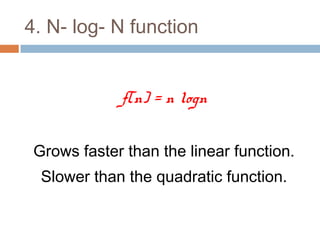
4. N- log- N function
f(n) = n logn
Grows faster than the linear function.
Slower than the quadratic function.
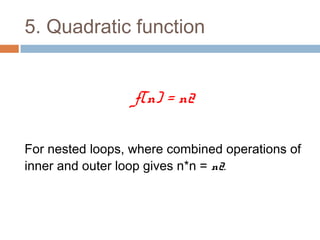
5. Quadratic function
f(n) = n2
For nested loops, where combined operations of
inner and outer loop gives n*n = n2.
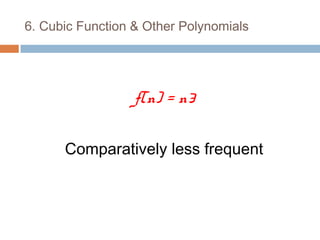
6. Cubic Function & Other Polynomials
f(n) = n3
Comparatively less frequent
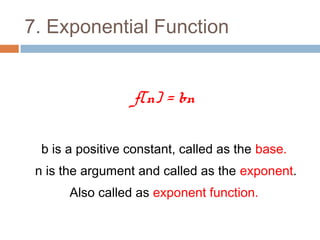
7. Exponential Function
f(n) = bn
b is a positive constant, called as the base.
n is the argument and called as the exponent.
Also called as exponent function.
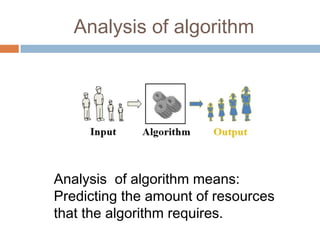
Analysis of algorithm
Analysis of algorithm means:
Predicting the amount of resources
that the algorithm requires.
Analysis of algorithms
 Experimental Studies
 Primitive Operations
 Asymptotic Notation
Experimental Studies
Running time of implemented algorithm is calculated
by:
 Executing it on various test inputs.
 Recording the actual time spent in each
execution.
 Using the System.curent Time Millis () method.
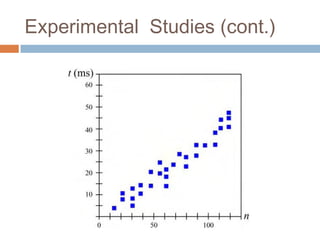
Experimental Studies (cont.)
Steps :
1. Write a program implementing the algorithm.
2. Run the program with inputs of varying size and
composition.
3. Use a system call to get running time measure.
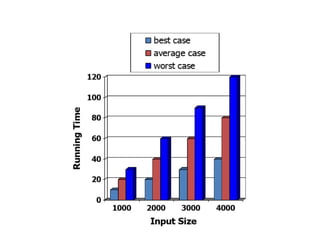
4. Plot the results.
5. Perform a statistical analysis.
Experimental Studies (cont.)
Limitations of Experimental analysis
 Need limited set of test inputs.
 Need same hardware and software
environments.
 have to fully implement and execute an
algorithm.
Primitive operations
Set of primitive operations:
1. Assigning a value to a variable.
2. Calling a method.
3. Performing an arithmetic operation (for example, adding two numbers).
4. Comparing two numbers.
5. Indexing into an array.
6. Following an object reference.
7. Returning from a method.
Example
Algorithm arrayMax(A, n)
# operations
currentMax ← A[0] 2
for i ← 1 to n − 1 do 2n
if A[i] > currentMax then 2(n − 1)
currentMax ← A[i] 2(n − 1)
{ increment counter i } 2(n − 1)
return currentMax 1
Total 8n − 2
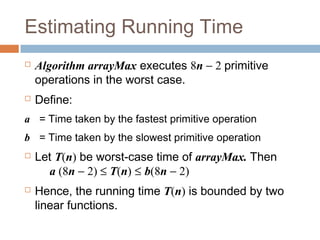
Estimating Running Time
 Algorithm arrayMax executes 8n − 2 primitive
operations in the worst case.
 Define:
a = Time taken by the fastest primitive operation
b = Time taken by the slowest primitive operation
 Let T(n) be worst-case time of arrayMax. Then
a (8n − 2) ≤ T(n) ≤ b(8n − 2)
 Hence, the running time T(n) is bounded by two
linear functions.
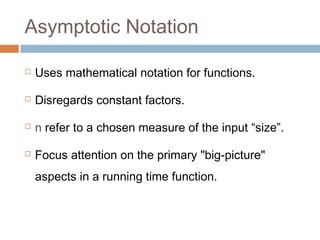
Asymptotic Notation
 Uses mathematical notation for functions.
 Disregards constant factors.
 n refer to a chosen measure of the input “size”.
 Focus attention on the primary "big-picture"
aspects in a running time function.
Asymptotic Notation(cont.)
 Big-Oh Notation
 Big-Omega Notation
 Big-Theta Notation
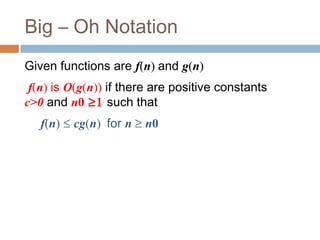
Big – Oh Notation
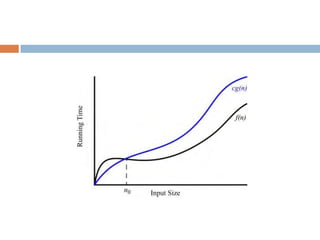
Given functions are f(n) and g(n)
f(n) is O(g(n)) if there are positive constants
c>0 and n0 ≥1 such that
f(n) ≤ cg(n) for n ≥ n0
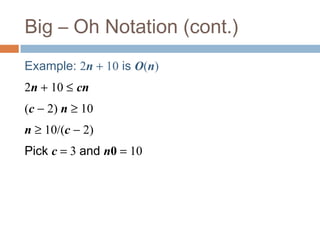
Big – Oh Notation (cont.)
Example: 2n + 10 is O(n)
2n + 10 ≤ cn
(c − 2) n ≥ 10
n ≥ 10/(c − 2)
Pick c = 3 and n0 = 10
Big – Oh Notation (cont.)
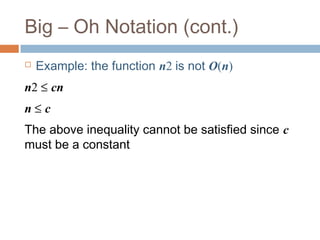
 Example: the function n2 is not O(n)
n2 ≤ cn
n ≤ c
The above inequality cannot be satisfied since c
must be a constant
Big – Omega Notation
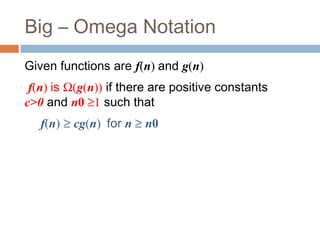
Given functions are f(n) and g(n)
f(n) is Ω(g(n)) if there are positive constants
c>0 and n0 ≥1 such that
f(n) ≥ cg(n) for n ≥ n0
Big – Omega Notation(cont.)
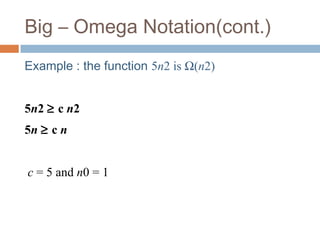
Example : the function 5n2 is Ω(n2)
5n2 ≥ c n2
5n ≥ c n
c = 5 and n0 = 1
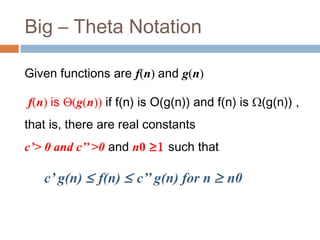
Big – Theta Notation
Given functions are f(n) and g(n)
f(n) is Θ(g(n)) if f(n) is O(g(n)) and f(n) is Ω(g(n)) ,
that is, there are real constants
c’> 0 and c’’ >0 and n0 ≥1 such that
c’ g(n) ≤ f(n) ≤ c’’ g(n) for n ≥ n0
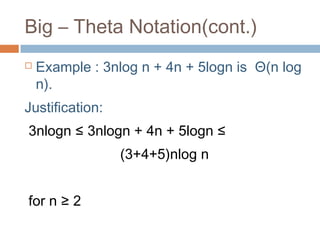
Big – Theta Notation(cont.)
 Example : 3nlog n + 4n + 5logn is Θ(n log
n).
Justification:
3nlogn ≤ 3nlogn + 4n + 5logn ≤
(3+4+5)nlog n
for n ≥ 2
Thank You

Algorithm analysis basics - Seven Functions/Big-Oh/Omega/Theta

  • 1.
    Algorithms and DataStructures Algorithm analysis By- Priyanka
  • 2.
    Session 4 isabout  Seven Functions  Analysis of algorithms
  • 3.
    1. Constant Function Simplestfunction: f(n) = c (some fixed constant) Value of n doesn’t matter. Ex: adding two numbers, assigning variable, comparing two numbers
  • 4.
    2. Logarithm Function f(n) = logb n for some constant b > 1 This function is defined: x = logbn if and only if bx = n Value b is known as the base of the logarithm. log n = log2 n.
  • 5.
    Rules for algorithms Givenreal numbers a , c > 0, and b , d > 1, we have If b = 2, we either use log n, or lg n.
  • 6.
    3. Linear function f(n)= c n Function arises when a single basic operation is required for each of n elements.
  • 7.
    4. N- log-N function f(n) = n logn Grows faster than the linear function. Slower than the quadratic function.
  • 8.
    5. Quadratic function f(n)= n2 For nested loops, where combined operations of inner and outer loop gives n*n = n2.
  • 9.
    6. Cubic Function& Other Polynomials f(n) = n3 Comparatively less frequent
  • 10.
    7. Exponential Function f(n)= bn b is a positive constant, called as the base. n is the argument and called as the exponent. Also called as exponent function.
  • 11.
    Analysis of algorithm Analysisof algorithm means: Predicting the amount of resources that the algorithm requires.
  • 13.
    Analysis of algorithms Experimental Studies  Primitive Operations  Asymptotic Notation
  • 14.
    Experimental Studies Running timeof implemented algorithm is calculated by:  Executing it on various test inputs.  Recording the actual time spent in each execution.  Using the System.curent Time Millis () method.
  • 15.
    Experimental Studies (cont.) Steps: 1. Write a program implementing the algorithm. 2. Run the program with inputs of varying size and composition. 3. Use a system call to get running time measure. 4. Plot the results. 5. Perform a statistical analysis.
  • 16.
  • 17.
    Limitations of Experimentalanalysis  Need limited set of test inputs.  Need same hardware and software environments.  have to fully implement and execute an algorithm.
  • 18.
    Primitive operations Set ofprimitive operations: 1. Assigning a value to a variable. 2. Calling a method. 3. Performing an arithmetic operation (for example, adding two numbers). 4. Comparing two numbers. 5. Indexing into an array. 6. Following an object reference. 7. Returning from a method.
  • 19.
    Example Algorithm arrayMax(A, n) #operations currentMax ← A[0] 2 for i ← 1 to n − 1 do 2n if A[i] > currentMax then 2(n − 1) currentMax ← A[i] 2(n − 1) { increment counter i } 2(n − 1) return currentMax 1 Total 8n − 2
  • 20.
    Estimating Running Time Algorithm arrayMax executes 8n − 2 primitive operations in the worst case.  Define: a = Time taken by the fastest primitive operation b = Time taken by the slowest primitive operation  Let T(n) be worst-case time of arrayMax. Then a (8n − 2) ≤ T(n) ≤ b(8n − 2)  Hence, the running time T(n) is bounded by two linear functions.
  • 21.
    Asymptotic Notation  Usesmathematical notation for functions.  Disregards constant factors.  n refer to a chosen measure of the input “size”.  Focus attention on the primary "big-picture" aspects in a running time function.
  • 22.
    Asymptotic Notation(cont.)  Big-OhNotation  Big-Omega Notation  Big-Theta Notation
  • 23.
    Big – OhNotation Given functions are f(n) and g(n) f(n) is O(g(n)) if there are positive constants c>0 and n0 ≥1 such that f(n) ≤ cg(n) for n ≥ n0
  • 24.
    Big – OhNotation (cont.) Example: 2n + 10 is O(n) 2n + 10 ≤ cn (c − 2) n ≥ 10 n ≥ 10/(c − 2) Pick c = 3 and n0 = 10
  • 25.
    Big – OhNotation (cont.)  Example: the function n2 is not O(n) n2 ≤ cn n ≤ c The above inequality cannot be satisfied since c must be a constant
  • 27.
    Big – OmegaNotation Given functions are f(n) and g(n) f(n) is Ω(g(n)) if there are positive constants c>0 and n0 ≥1 such that f(n) ≥ cg(n) for n ≥ n0
  • 28.
    Big – OmegaNotation(cont.) Example : the function 5n2 is Ω(n2) 5n2 ≥ c n2 5n ≥ c n c = 5 and n0 = 1
  • 29.
    Big – ThetaNotation Given functions are f(n) and g(n) f(n) is Θ(g(n)) if f(n) is O(g(n)) and f(n) is Ω(g(n)) , that is, there are real constants c’> 0 and c’’ >0 and n0 ≥1 such that c’ g(n) ≤ f(n) ≤ c’’ g(n) for n ≥ n0
  • 30.
    Big – ThetaNotation(cont.)  Example : 3nlog n + 4n + 5logn is Θ(n log n). Justification: 3nlogn ≤ 3nlogn + 4n + 5logn ≤ (3+4+5)nlog n for n ≥ 2
  • 31.

Editor's Notes

  • #2 <number>
  • #7 <number>