Priority Queues
(Algorithms and Data Structures)
By
Priyanka Rana
By – Priyanka Rana
Priority Queues
Which assets (stock, company, real-estate) the company should
purchase for investment.
Priority Queues
Many factors determine the future value of an asset.
Let’s call this “Utility”.
Utility(asset) = priority or importance that Utility() return the
minimum value.
Use Utility() as key or order of assets in the list.
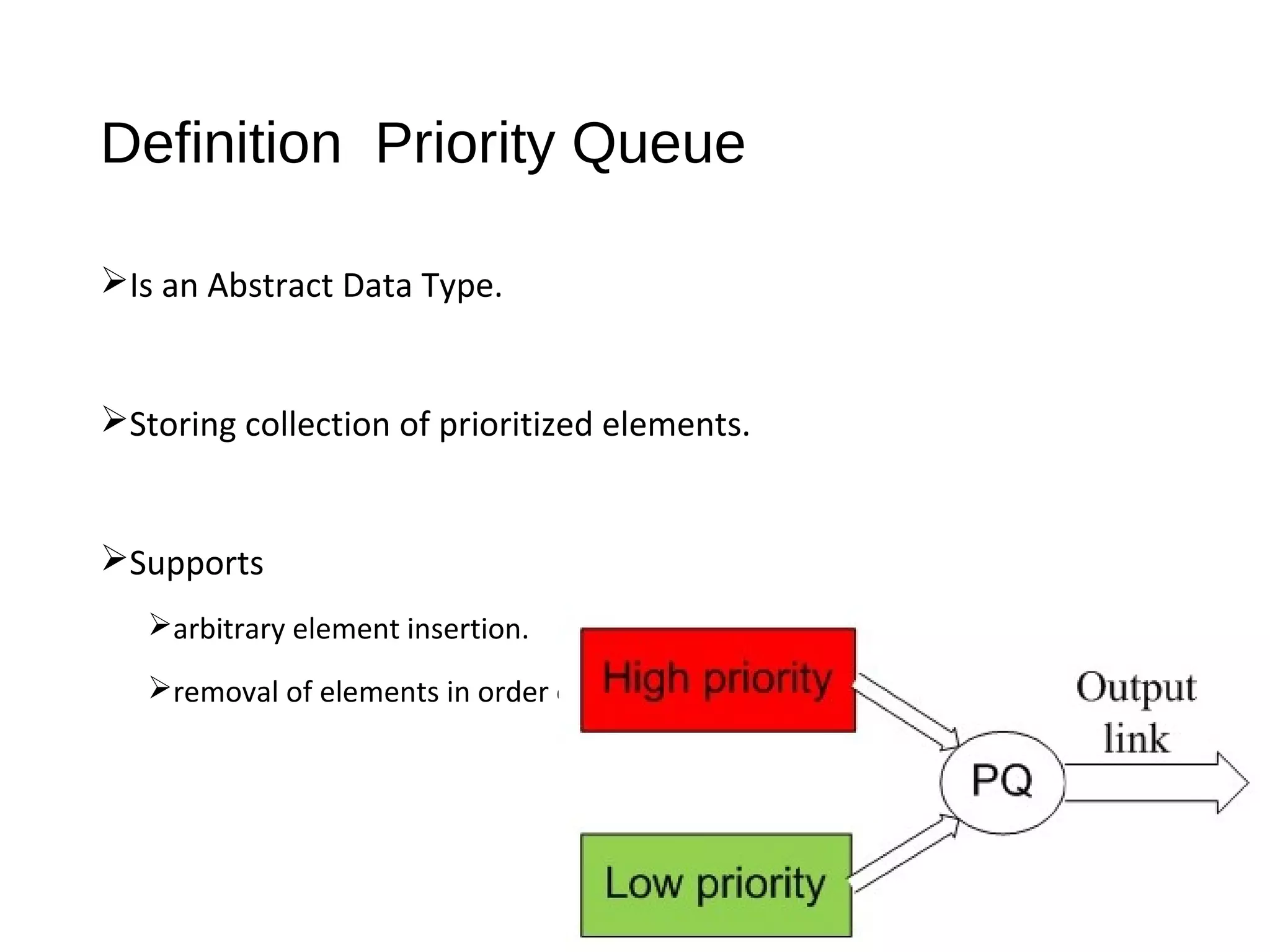
Definition Priority Queue
Is an Abstract Data Type.
Storing collection of prioritized elements.
Supports
arbitrary element insertion.
removal of elements in order of priority.
Priority Queue ADT
Each entry is a pair (key, value).
Key: used to identify or weigh that element.
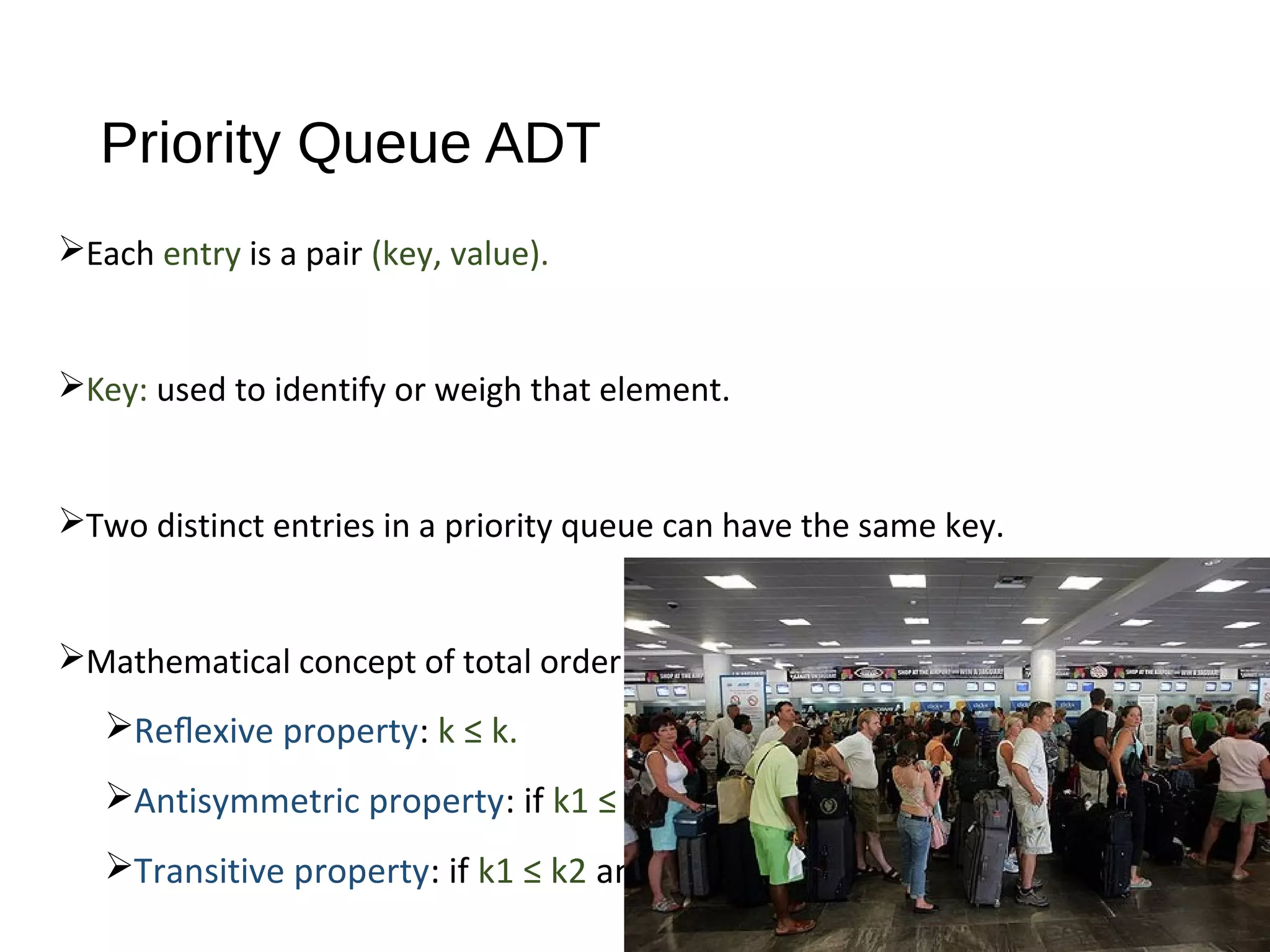
Two distinct entries in a priority queue can have the same key.
Mathematical concept of total order relation, must satisfy:
Reflexive property: k ≤ k.
Antisymmetric property: if k1 ≤ k2 and k2 ≤ k1 , then k1 = k2.
Transitive property: if k1 ≤ k2 and k2 ≤ k3, then k1 ≤ k3.
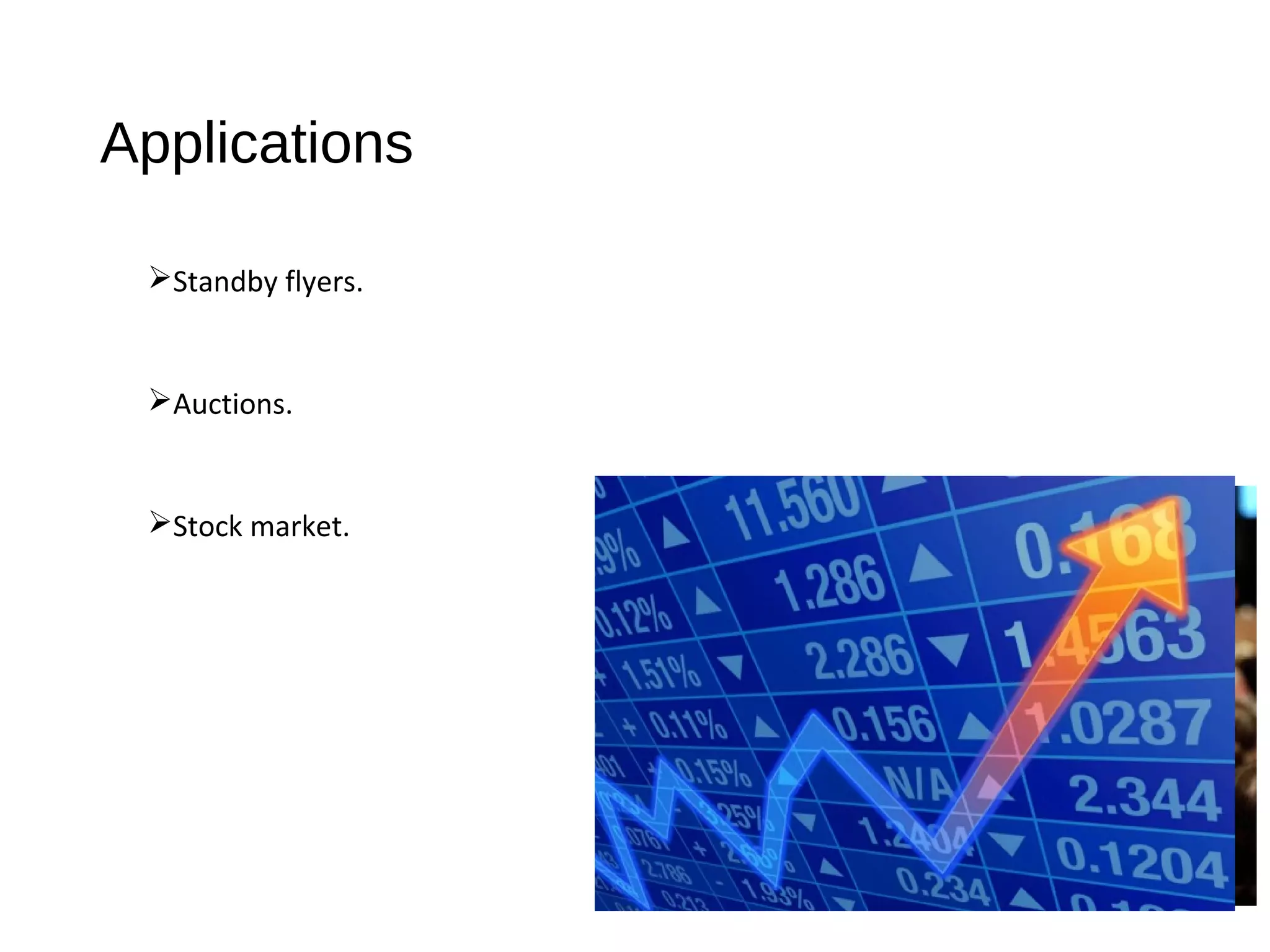
Applications
Standby flyers.
Auctions.
Stock market.
Main methods of Priority Queue ADT
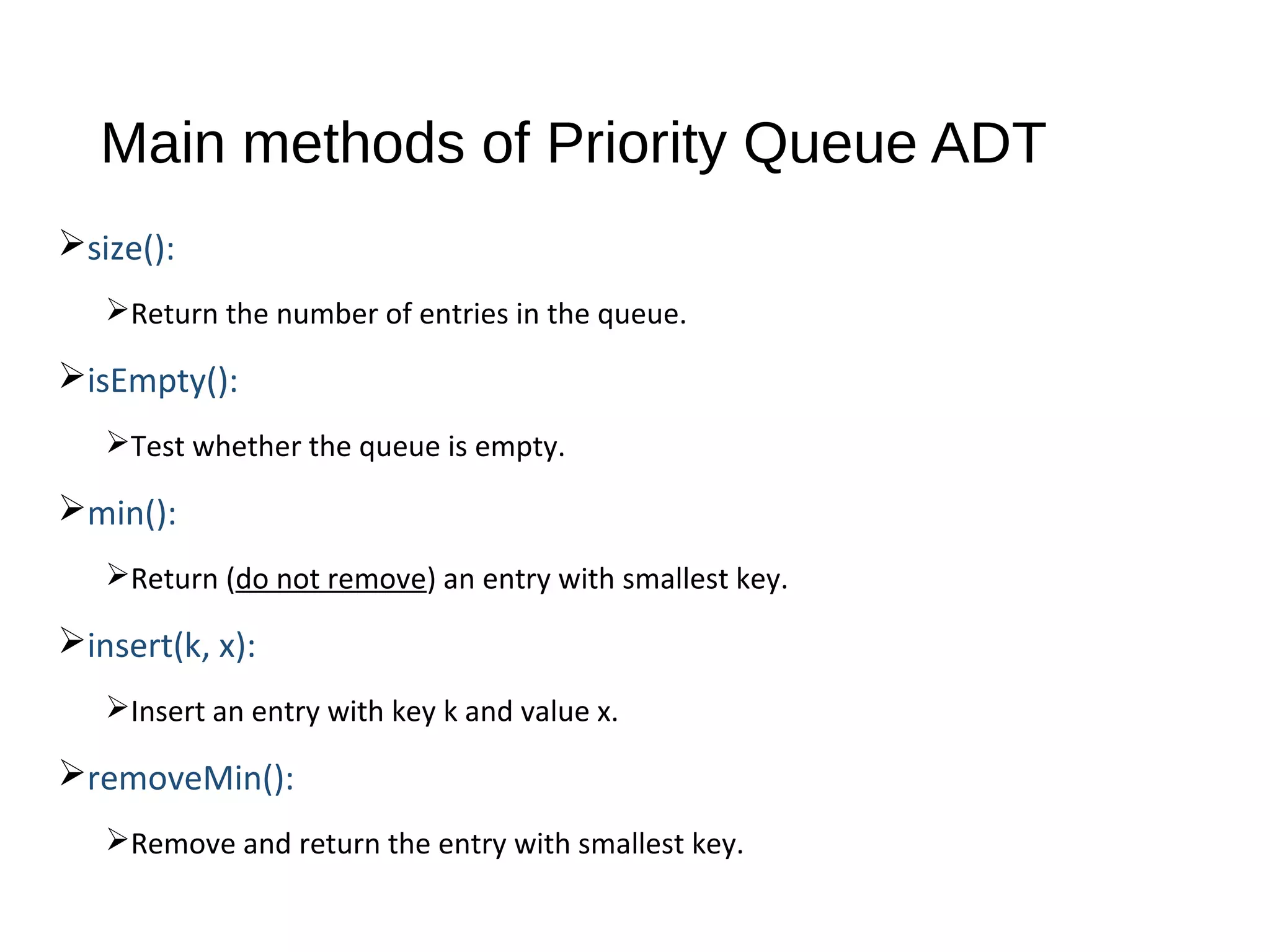
size():
Return the number of entries in the queue.
isEmpty():
Test whether the queue is empty.
min():
Return (do not remove) an entry with smallest key.
insert(k, x):
Insert an entry with key k and value x.
removeMin():
Remove and return the entry with smallest key.
Sorting with a Priority Queue
Sorting a collection S of n comparable elements
with a priority queue Q, called PriorityQueueSort.
Hint: Using insert() and removeMin()
Exercise
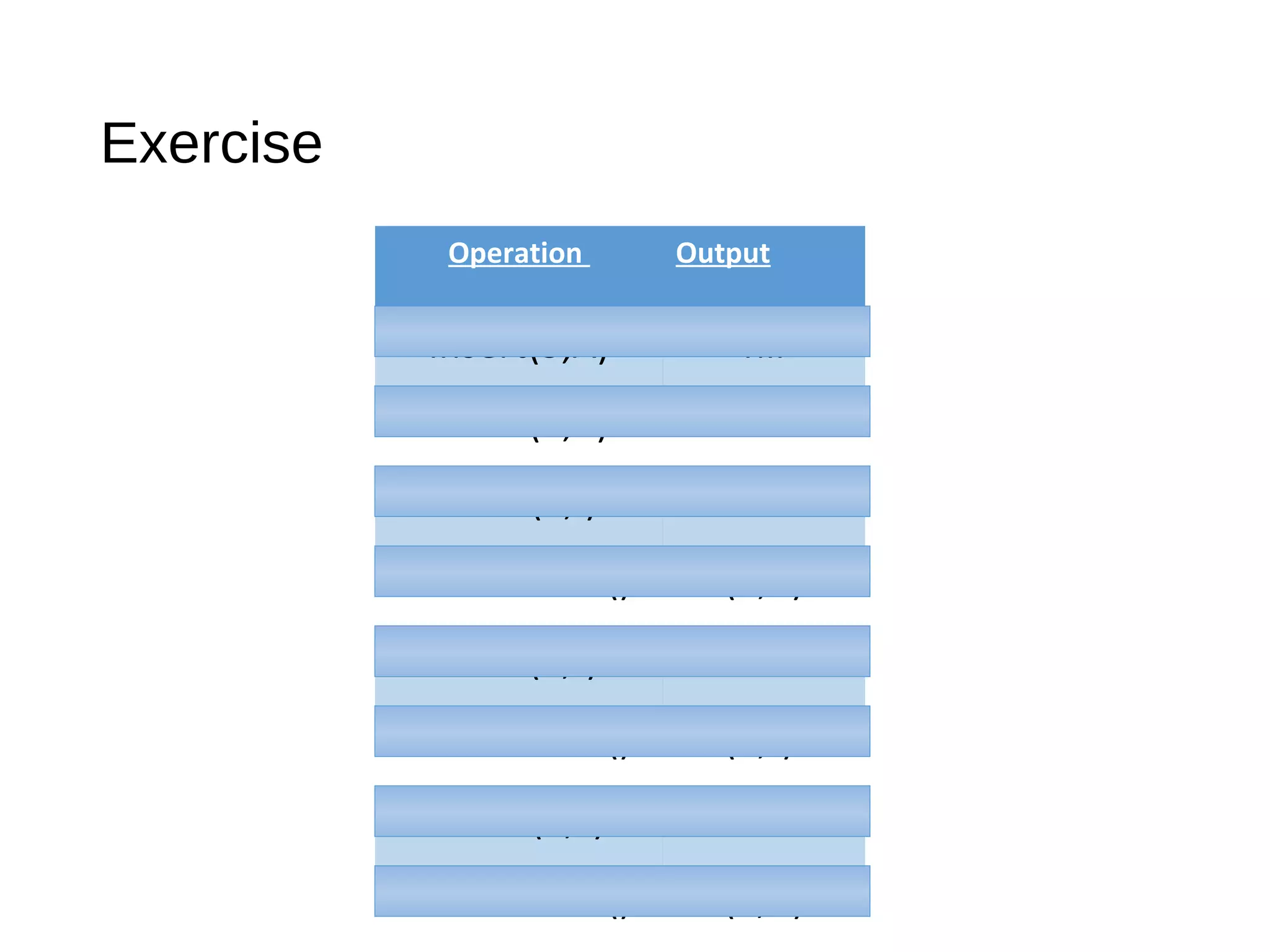
Operation Output
Insert(5,A) nil
Insert(4,B) nil
Insert(7,I) nil
removeMin() (4,B)
insert(3,J) Nil
removeMin() (3,J)
insert(6,L) nil
removeMin() (5,A)
Implementing a Priority Queue
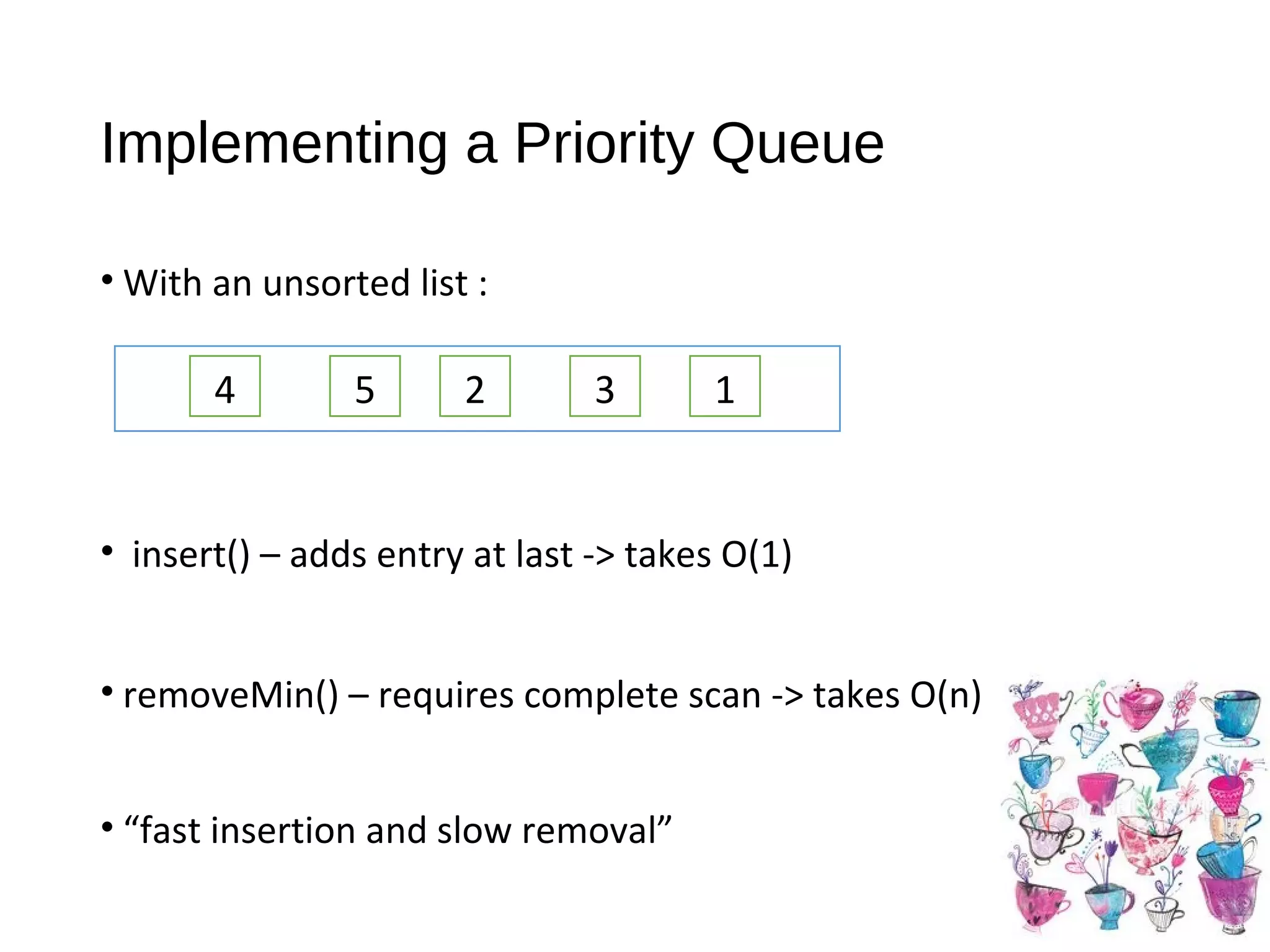
• With an unsorted list :
• insert() – adds entry at last -> takes O(1)
• removeMin() – requires complete scan -> takes O(n)
• “fast insertion and slow removal”
4 5 2 3 1
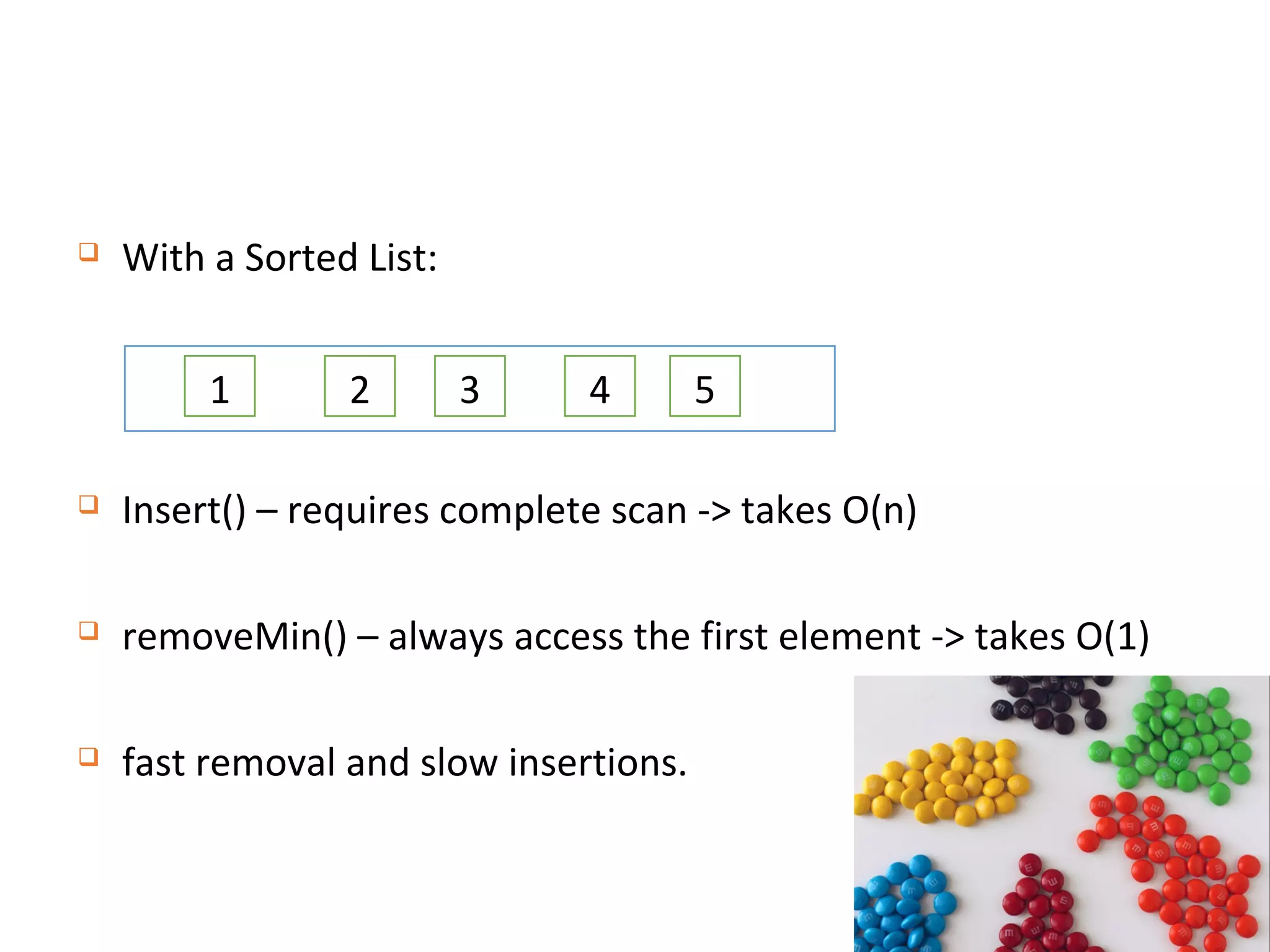
 With a Sorted List:
 Insert() – requires complete scan -> takes O(n)
 removeMin() – always access the first element -> takes O(1)
 fast removal and slow insertions.
1 2 3 4 5
Method Unsorted List Sorted List
size, isEmpty O(1) O(1)
insert O(1) O(n)
Min, removeMin O(n) O(1)
Sorting using priority Queues
• Selection – Sort
• Insertion - Sort
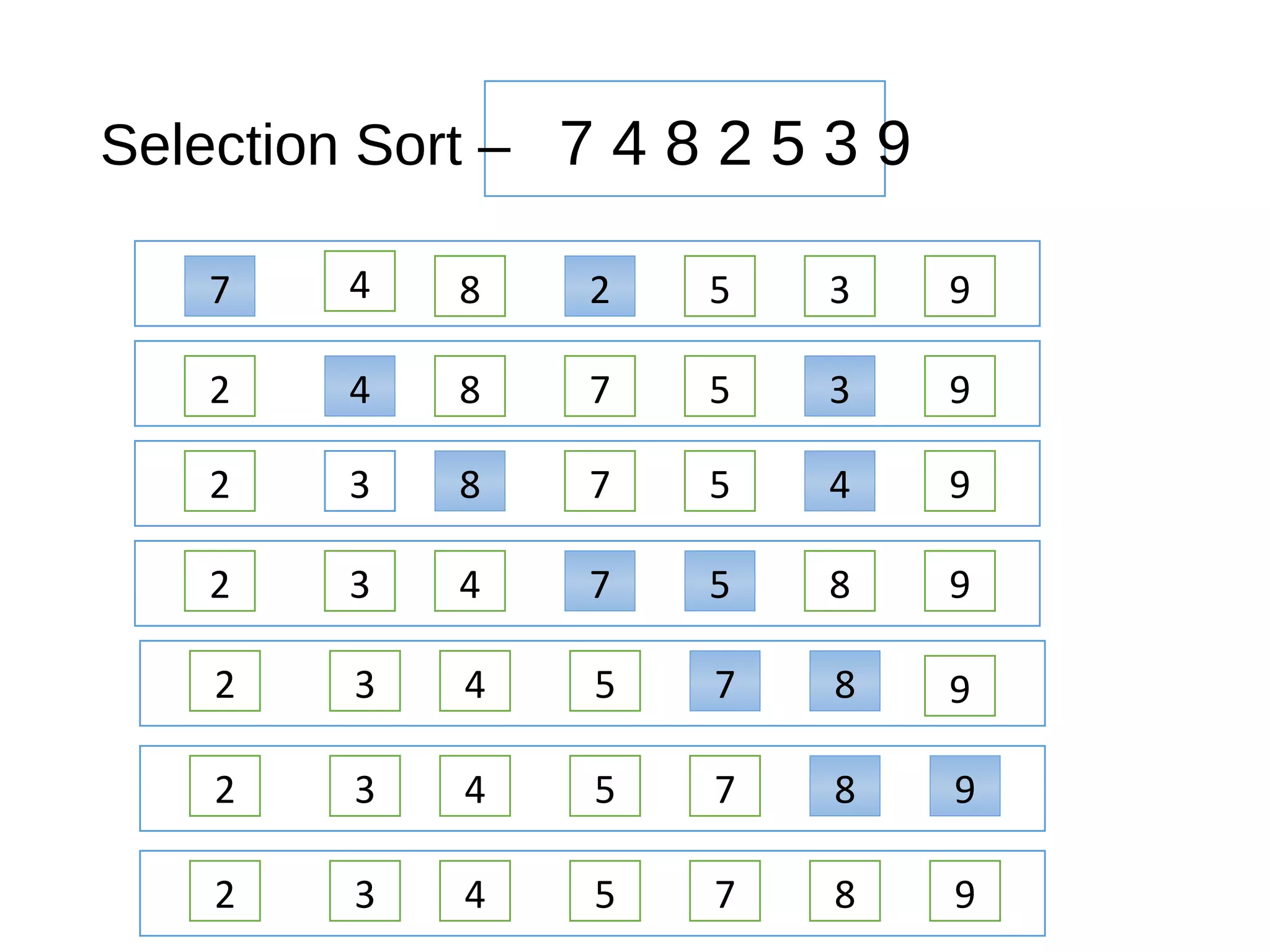
Selection Sort – 7 4 8 2 5 3 9
7 4 8 2 5 3 9
2 4 8 7 5 3 9
2 3 8 7 5 4 9
2 3 4 7 5 8 9
2 3 4 5 7 8 9
2 3 4 5 7 8 9
2 3 4 5 7 8 9
Selection- Sorting using priority Queues
Sequence S Priority Queue P
Input (7,4,8,2,5,3,9) ()
Phase 1 (a)
(b)
.
.
.
(g)
(4,8,2,5,3,9)
(8,2,5,3,9)
.
.
.
()
(7)
(7,4)
.
.
.
(7,4,8,2,5,3,9)
Phase 2 (a)
(b)
(c)
(d)
(e)
(f)
(g)
(2)
(2,3)
(2,3,4)
(2,3,4,5)
(2,3,4,5,7)
(2,3,4,5,7,8)
(2,3,4,5,7,8,9)
(7,4,8,2,5,3,9)
(7,4,8,5,9)
(7,8,5,9)
(7,8,9)
(8,9)
(9)
()
Running Time
• First removeMin takes O(n) time
• Second removeMin takes O(n-1) time) and so on
• Till last n operation takes O(1) time
= O(n2)O(n
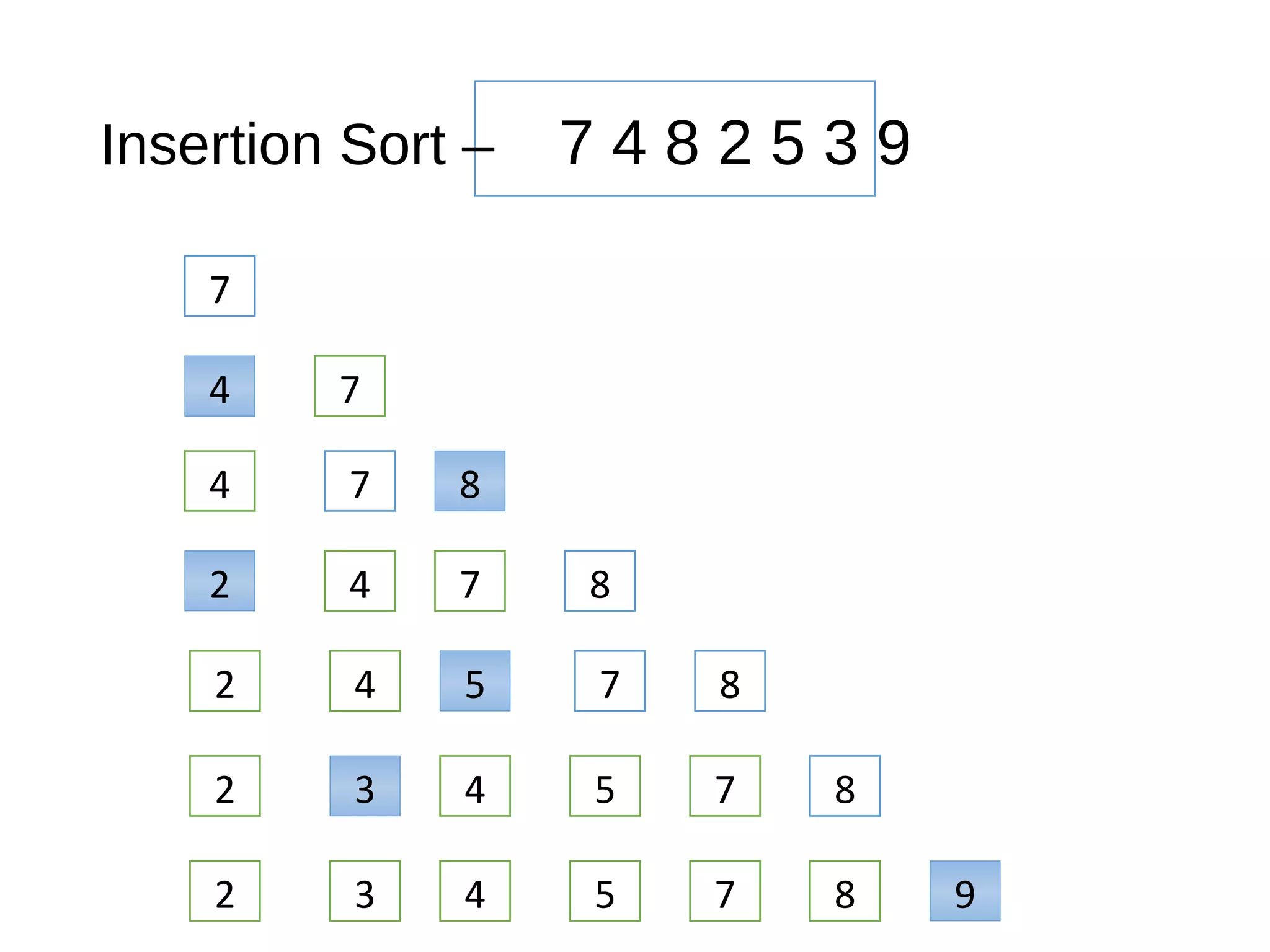
Insertion Sort – 7 4 8 2 5 3 9
7
4 7
4 7 8
2 4 7 8
2 3 4 5 7 8 9
2 3 4 5 7 8
2 4 5 7 8
Insertion -Sorting using priority Queues
Sequence S Priority Queue P
Input (7,4,8,2,5,3,9) ()
Phase 1 (a)
(b)
(c)
(d)
(e)
(f)
(g)
(4,8,2,5,3,9)
(8,2,5,3,9)
(2,5,3,9)
(5,3,9)
(3,9)
(9)
()
(7)
(4,7)
(4,7,8)
(2,4,7,8)
(2,4,5,7,8)
(2,3,4,5,7,8)
(2,3,4,5,7,8,9)
Phase 2 (a)
(b)
●
.
(2)
(2,3)
● .
● .
● .
(2,3,4,5,7,8,9)
(3,4,5,7,8,9)
(4,5,7,8,9)
.
.
.
()
Running Time
• First element -no comparison
• Second element – 1 comparison
• Third element – 2 comparisons and so on.
= O(n2)O(n
THANK YOU

Priority queues

  • 1.
    Priority Queues (Algorithms andData Structures) By Priyanka Rana By – Priyanka Rana
  • 2.
    Priority Queues Which assets(stock, company, real-estate) the company should purchase for investment.
  • 3.
    Priority Queues Many factorsdetermine the future value of an asset. Let’s call this “Utility”. Utility(asset) = priority or importance that Utility() return the minimum value. Use Utility() as key or order of assets in the list.
  • 4.
    Definition Priority Queue Isan Abstract Data Type. Storing collection of prioritized elements. Supports arbitrary element insertion. removal of elements in order of priority.
  • 5.
    Priority Queue ADT Eachentry is a pair (key, value). Key: used to identify or weigh that element. Two distinct entries in a priority queue can have the same key. Mathematical concept of total order relation, must satisfy: Reflexive property: k ≤ k. Antisymmetric property: if k1 ≤ k2 and k2 ≤ k1 , then k1 = k2. Transitive property: if k1 ≤ k2 and k2 ≤ k3, then k1 ≤ k3.
  • 6.
  • 7.
    Main methods ofPriority Queue ADT size(): Return the number of entries in the queue. isEmpty(): Test whether the queue is empty. min(): Return (do not remove) an entry with smallest key. insert(k, x): Insert an entry with key k and value x. removeMin(): Remove and return the entry with smallest key.
  • 8.
    Sorting with aPriority Queue Sorting a collection S of n comparable elements with a priority queue Q, called PriorityQueueSort. Hint: Using insert() and removeMin()
  • 9.
    Exercise Operation Output Insert(5,A) nil Insert(4,B)nil Insert(7,I) nil removeMin() (4,B) insert(3,J) Nil removeMin() (3,J) insert(6,L) nil removeMin() (5,A)
  • 10.
    Implementing a PriorityQueue • With an unsorted list : • insert() – adds entry at last -> takes O(1) • removeMin() – requires complete scan -> takes O(n) • “fast insertion and slow removal” 4 5 2 3 1
  • 11.
     With aSorted List:  Insert() – requires complete scan -> takes O(n)  removeMin() – always access the first element -> takes O(1)  fast removal and slow insertions. 1 2 3 4 5
  • 12.
    Method Unsorted ListSorted List size, isEmpty O(1) O(1) insert O(1) O(n) Min, removeMin O(n) O(1)
  • 13.
    Sorting using priorityQueues • Selection – Sort • Insertion - Sort
  • 14.
    Selection Sort –7 4 8 2 5 3 9 7 4 8 2 5 3 9 2 4 8 7 5 3 9 2 3 8 7 5 4 9 2 3 4 7 5 8 9 2 3 4 5 7 8 9 2 3 4 5 7 8 9 2 3 4 5 7 8 9
  • 15.
    Selection- Sorting usingpriority Queues Sequence S Priority Queue P Input (7,4,8,2,5,3,9) () Phase 1 (a) (b) . . . (g) (4,8,2,5,3,9) (8,2,5,3,9) . . . () (7) (7,4) . . . (7,4,8,2,5,3,9) Phase 2 (a) (b) (c) (d) (e) (f) (g) (2) (2,3) (2,3,4) (2,3,4,5) (2,3,4,5,7) (2,3,4,5,7,8) (2,3,4,5,7,8,9) (7,4,8,2,5,3,9) (7,4,8,5,9) (7,8,5,9) (7,8,9) (8,9) (9) ()
  • 16.
    Running Time • FirstremoveMin takes O(n) time • Second removeMin takes O(n-1) time) and so on • Till last n operation takes O(1) time = O(n2)O(n
  • 17.
    Insertion Sort –7 4 8 2 5 3 9 7 4 7 4 7 8 2 4 7 8 2 3 4 5 7 8 9 2 3 4 5 7 8 2 4 5 7 8
  • 18.
    Insertion -Sorting usingpriority Queues Sequence S Priority Queue P Input (7,4,8,2,5,3,9) () Phase 1 (a) (b) (c) (d) (e) (f) (g) (4,8,2,5,3,9) (8,2,5,3,9) (2,5,3,9) (5,3,9) (3,9) (9) () (7) (4,7) (4,7,8) (2,4,7,8) (2,4,5,7,8) (2,3,4,5,7,8) (2,3,4,5,7,8,9) Phase 2 (a) (b) ● . (2) (2,3) ● . ● . ● . (2,3,4,5,7,8,9) (3,4,5,7,8,9) (4,5,7,8,9) . . . ()
  • 19.
    Running Time • Firstelement -no comparison • Second element – 1 comparison • Third element – 2 comparisons and so on. = O(n2)O(n
  • 20.

Editor's Notes

  • #2 <number>
  • #3 If you have been asked which assets the company should purchase for investment. There are many assets like stock, , real-estate which you can choose from a big list.// What would be your criteria for choosing any asset that you would like to buy? <number>
  • #4 <number>
  • #5 <number>
  • #6 <number>
  • #7 <number>
  • #8 <number>
  • #9 An important application of a priority queue is sorting. The algorithm for sorting a collection S of n comparable elements with a priority queue Q, called PriorityQueueSort, consists of two phases: <number>
  • #10 Let it be an exercise for you, if you have understood the priority queue methods in previous slide this exercise wont be very challenging,// here hint has also been given Note that the running time of this sorting method depends on the priority queue implementation. <number>
  • #11 In this session we'll learn how to implement a priority queue by storing its entries in a list S , where the list can be sorted or unsorted. for unsorted list, //simple way of performing insert operation is to add the element at the end of list , by executing method addLast()./ / This implementation of method insert takes O(1) time as inserting entries at the end of list does not take into account the ordering of the keys. To perform removeMin method , we have to inspect all the elements of list to find an entry with minimum k. So it taken O(n) time, where n is the number of entries, or data size.// thats make implementation with an unsorted list is also called as "fast insertion and slow removal". <number>
  • #12 An alternative implementation of a priority queue is in a sorted list. ,// here insertion requires a complete scan of the list to find the appropriate position to insert the new entry so it takes O(n) time, while// removeMin method just needs to access the first element of the list as that will be the one which is least in the sorted list.and so it takes O(1) times.// it is also called as fast removal and slow insertions, <number>
  • #13 <number>
  • #14 Ttwo most popular techniques for sorting, selection-sort and insertion-sort. <number>
  • #15 In selection -sort Consider we have to sort n numbers stored in array A by first finding the smallest element of A and exchanging it with the element in A[0], the first element. Then finding the second smallest element of A, and exchanging it with A[1], the second element. Continue in this manner for the first n−1 elements of A. This method of sorting is known as selection sort. <number>
  • #16 // Selection sort occurs in two phases, in first phase we insert all the elements in priority queue P using simple insert() method,// we ll pick first item// from the sequence insert into P,then second element// , third and so on, this way we have complete data in prority queue now, now in Phase 2 //we repeatedly remove the elements from P using the removeMin() method. we ll find the least element in the qyueue, and put it back in sequence S, // //, we ll do this till the last element in priority queue , when all the elements of queue are moved to sequence S in order. In this whole process bottleneck is in phase 2, where we repeatedly remove an entry with smallest key from Queue P. We start with priority queue size equals n and incrementally decreases with each removeMin until it becomes 0. <number>
  • #17 //Thus, the first removeMin operation takes time O(n) as there are n entries, then the second one// takes time O(n − 1) as one entry has already been moved to sequence S and so number of elements are (n-1) now and so on, //until the last (nth) operation takes time O(1). Therefore, //the total time needed for the second phase is // <number>
  • #18 // Insertion of the second entry requires one comparison with the first entry, in order to find its proper position. //Insertion of the third entry requires two comparisons, and // fourth entry requires three comparisons and so on. This method is known as insertion sort, where in each iteration, one entry is added to the sorted list. Inserting after comparison <number>
  • #19 In Phase 1, we remove the// first element of list and insert it into Priority queue P,, then second element// is removed from the sequence and we scan the data in priority queue , until we find the correct place for this element. , same step is repeated for //third element, it is compared with existing two elements in priority queue and placed at right position, and this is repeated for the whole data set.// // // In Phase 2, we call removeMin method on Priority queue repeatedly,// here because of phase 1 every time it returns the first element of the list and// // we add that element at the end of Sequence S, and this way we get sorted sequence S. <number>
  • #20 Analyzing the running time of this whole process, we see that phase 1 is the bottleneck of this sorting ,//as for placing first element , there is no comparison , //while for second element , there is 1 comparison and so on. and like selection sort, //insertion sort also runs in O(n2) time <number>