 Software engineering and the design
process for interactive systems
 Usability engineering
 Iterative design and prototyping
 Design rationale
 Software engineering is the discipline
for understanding the software design
process, or life cycle
 Designing for usability occurs at all
stages of the life cycle, not as a single
isolated activity
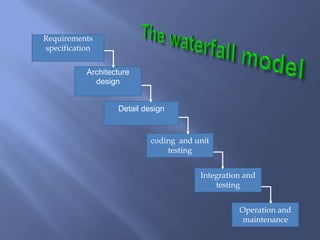
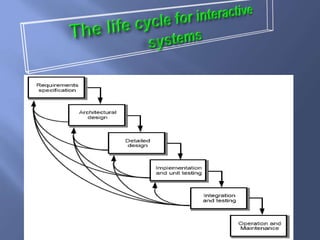
Requirements
specification
Architecture
design
Detail design
coding and unit
testing
Integration and
testing
Operation and
maintenance
 Requirements specification
 Designer and customer try capture what the
system is expected to provide
 Expressed in natural language or more precise
languages, such as a task analysis would
provide
 Architectural design
 High-level description of how the system will
provide the services required
 Factor system into major components and how
they are interrelated
 Must satisfy both functional and nonfunctional
requirements
 Detailed design
 Refinement of architectural components and
interrelations to identify modules to be
implemented separately
 Coding and unit testing
 Implementing and testing the individual
modules in some executable programming
language
 Integration and testing
 Combining modules to produce components
from the architectural description
 Operation and maintenance
 Product is delivered to customer and any
problems/enhancements are provided by
designer while product is still live
 The largest share of the life cycle
 Verification
Designing the product right
 Validation
Designing the right product
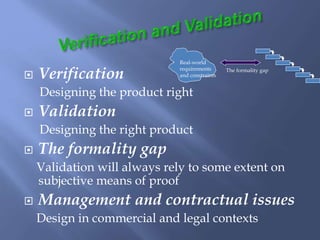
 The formality gap
Validation will always rely to some extent on
subjective means of proof
 Management and contractual issues
Design in commercial and legal contexts
Real-world
requirements
and constraints
The formality gap
 The ultimate test of usability based
on measurement of user experience
 Demands specific usability measures
be made explicit in requirements
 Usability specification
 Usability attribute/principle
 Measuring concept
 Measuring method
 Now level/ worst case/ planned
level/ best case
 Problems
 Usability specification requires level
of detail that may not be possible
early in design
 Satisfying a usability specification
does not necessarily satisfy usability
 Iterative design overcomes inherent problems
of incomplete requirements
 Prototypes
 Simulate or animate some features of intended
system different types of prototypes
 Different models
 Throw-away
 Incremental
 Evolutionary
 Management issues
 Time
 Planning
 Non-functional features
 Contracts
 Storyboards
 Need not be computer-based can be
animated
 Limited functionality simulations
 Some part of system functionality
provided by designers
 Tools like hypercard are common for
these
 Wizard of oz technique
 Warning about iterative design
 Design inertia – early bad decisions stay
bad
 Diagnosing real usability problems in
prototypes…. and not just the
symptoms
 Team members can communicate
effectively
 You can test out ideas for yourself
 It encourages reflection: very important
aspect of design
 Prototypes answer questions, and
support designers in choosing between
alternatives
 Design rationale is information that
explains why a computer system is
the way it is.
 Rationale has to do with logical
explanations and reasons
 Discussions, debates, negotiations
 Reasons for features
 Reasons against features
Benefits of design rationale
Communication throughout life
cycle
Reuse of design knowledge across
products
Enforces design discipline
Presents arguments for design
trade-offs
Capturing contextual information
Types of DR:
 Process-oriented
Preserves order of deliberation and
decision-making
 Structure-oriented
Emphasizes post hoc structuring of
considered design alternatives
 Two examples:
Issue-based information system (IBIS)
Design space analysis
Hci in software process

Hci in software process

  • 2.
     Software engineeringand the design process for interactive systems  Usability engineering  Iterative design and prototyping  Design rationale
  • 4.
     Software engineeringis the discipline for understanding the software design process, or life cycle  Designing for usability occurs at all stages of the life cycle, not as a single isolated activity
  • 5.
    Requirements specification Architecture design Detail design coding andunit testing Integration and testing Operation and maintenance
  • 7.
     Requirements specification Designer and customer try capture what the system is expected to provide  Expressed in natural language or more precise languages, such as a task analysis would provide  Architectural design  High-level description of how the system will provide the services required  Factor system into major components and how they are interrelated  Must satisfy both functional and nonfunctional requirements
  • 8.
     Detailed design Refinement of architectural components and interrelations to identify modules to be implemented separately  Coding and unit testing  Implementing and testing the individual modules in some executable programming language
  • 9.
     Integration andtesting  Combining modules to produce components from the architectural description  Operation and maintenance  Product is delivered to customer and any problems/enhancements are provided by designer while product is still live  The largest share of the life cycle
  • 10.
     Verification Designing theproduct right  Validation Designing the right product  The formality gap Validation will always rely to some extent on subjective means of proof  Management and contractual issues Design in commercial and legal contexts Real-world requirements and constraints The formality gap
  • 13.
     The ultimatetest of usability based on measurement of user experience  Demands specific usability measures be made explicit in requirements  Usability specification  Usability attribute/principle  Measuring concept  Measuring method  Now level/ worst case/ planned level/ best case
  • 14.
     Problems  Usabilityspecification requires level of detail that may not be possible early in design  Satisfying a usability specification does not necessarily satisfy usability
  • 16.
     Iterative designovercomes inherent problems of incomplete requirements  Prototypes  Simulate or animate some features of intended system different types of prototypes  Different models  Throw-away  Incremental  Evolutionary
  • 17.
     Management issues Time  Planning  Non-functional features  Contracts
  • 18.
     Storyboards  Neednot be computer-based can be animated  Limited functionality simulations  Some part of system functionality provided by designers  Tools like hypercard are common for these  Wizard of oz technique
  • 19.
     Warning aboutiterative design  Design inertia – early bad decisions stay bad  Diagnosing real usability problems in prototypes…. and not just the symptoms
  • 20.
     Team memberscan communicate effectively  You can test out ideas for yourself  It encourages reflection: very important aspect of design  Prototypes answer questions, and support designers in choosing between alternatives
  • 22.
     Design rationaleis information that explains why a computer system is the way it is.  Rationale has to do with logical explanations and reasons  Discussions, debates, negotiations  Reasons for features  Reasons against features
  • 24.
    Benefits of designrationale Communication throughout life cycle Reuse of design knowledge across products Enforces design discipline Presents arguments for design trade-offs Capturing contextual information
  • 25.
    Types of DR: Process-oriented Preserves order of deliberation and decision-making  Structure-oriented Emphasizes post hoc structuring of considered design alternatives  Two examples: Issue-based information system (IBIS) Design space analysis