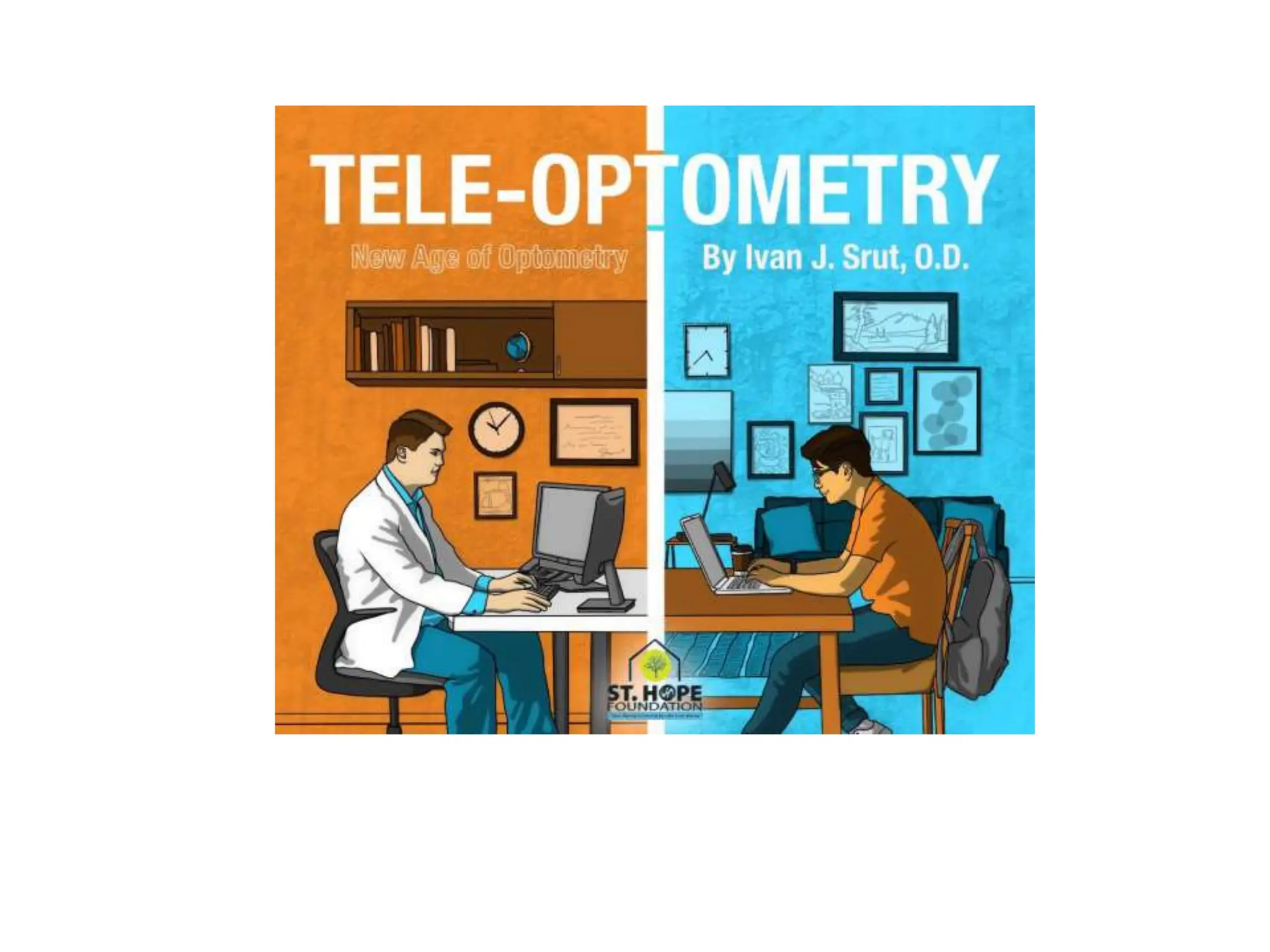
Tele - optometry
Presented by – Kunjvihari
( B. Optom 3rd year)
Guided by – Dr. Kamal Pant sir
(HOD & Associate Professor
Department of optometry
Saifai etawah [UP])
UTTAR PRADESH UNIVERSITY OF MEDICAL SCIENCES
SAIFAI , ETAWAH (206130 ) UTTAR PRADESH
WHAT IS TELE - OPTOMETRY
• Tele-optometry refers to an assessment of a patient’s
ocular health in the absence of a clinician physically in
the location. Prefix Tele is derived from Greek which
means “at a distance”. With the help of assistive devices
such as smartphones, advanced hardware and software
combination and remote video tool technology conjoined
with artificial intelligence.
• And by clicking digital photograph.
• “ Tele optometry is the practice of providing ocular
health and vision care services to patients via
telecommunications technology.”
When can I use Tele-optometry ?
• Use the technology to reach the unreached.
• Here are some ways to use tele-optometry:
• To ask optometrist questions or concerns you might
have about your eyes.
• Analyse eye health reports and results with an
optometrist.
• Obtain a 2nd opinion on test or prescription results.
• Contact lens-related information - Red Eye, eye pain
• Glasses and frames selection - Other situation that
allows communication via virtual platforms
How it works ?
Equipments used
• Software: Video calling software,
• Equipments: Portable , easy to use and accurate,
Good stable high speed internet.
• They are also very accurate at diagnosing:
• 1 Conjunctival hemorrhage Zonal degeneration of the
cornea Eyelid tumors Pterygium Corneal scarring
Keratitis.
How it works ?
A tele-optometry eye exam typically consists of three
steps, including:
1. Collect Patient Information: Your optometrist will ask
a series of questions before beginning the eye exam.
These questions may include those related to your
insurance , medical history allergies and medications .
2. Perform an Eye Exam: The pre-screening portion of a
remote eye exam may include the following tests:
• Autorefraction.
• Lensometry.
• Retinal imaging.
• Subjective refraction test.
How it works ?
3. Review Exam Results & New Prescription: After
the pre-screening tests and eye exam, your eye doctor
will discuss your eye health status and any
concerns.They will recommend new contact lenses and
eyeglass frames if your prescription changes.
Used for the consaltation of
1. Red eye
2. Dry eye
3. Digital eye strain
4. Abnormalities of lids
Distance and near visual acuity
• At 3 m
• Convergence
• NPC
• Cover test
• Pupialliry reaction
• Duochrome test
• Color vision
• Dry eye evaluation
• Cataract detection
Optical despensing
• Measuring IPD
• Frame measurment
• ED and lends diameter
1. HVID / VVID
2. Conversion chart specs to cl and D to mm
3. K readings
Advantages
• Can be used in private practices
• Community outreach via virtual examination rooms
• For patients , reduced travel cost and saves visit to
hospital for trivial problems like refractive errors .
Summary
• Tele-optometry exams are eye appointment
exams conducted virtually. They're a great
option for those who don't have the time to go to
a doctor's office. While tele-optometry exams
offer various benefits, remember that they still
have limitations.
THANK
YOU

Tele Optometry (kunj'sppt) / Basics of tele optometry.

  • 1.
    Tele - optometry Presentedby – Kunjvihari ( B. Optom 3rd year) Guided by – Dr. Kamal Pant sir (HOD & Associate Professor Department of optometry Saifai etawah [UP]) UTTAR PRADESH UNIVERSITY OF MEDICAL SCIENCES SAIFAI , ETAWAH (206130 ) UTTAR PRADESH
  • 2.
    WHAT IS TELE- OPTOMETRY • Tele-optometry refers to an assessment of a patient’s ocular health in the absence of a clinician physically in the location. Prefix Tele is derived from Greek which means “at a distance”. With the help of assistive devices such as smartphones, advanced hardware and software combination and remote video tool technology conjoined with artificial intelligence. • And by clicking digital photograph. • “ Tele optometry is the practice of providing ocular health and vision care services to patients via telecommunications technology.”
  • 4.
    When can Iuse Tele-optometry ? • Use the technology to reach the unreached. • Here are some ways to use tele-optometry: • To ask optometrist questions or concerns you might have about your eyes. • Analyse eye health reports and results with an optometrist. • Obtain a 2nd opinion on test or prescription results. • Contact lens-related information - Red Eye, eye pain • Glasses and frames selection - Other situation that allows communication via virtual platforms
  • 5.
    How it works? Equipments used • Software: Video calling software, • Equipments: Portable , easy to use and accurate, Good stable high speed internet. • They are also very accurate at diagnosing: • 1 Conjunctival hemorrhage Zonal degeneration of the cornea Eyelid tumors Pterygium Corneal scarring Keratitis.
  • 6.
    How it works? A tele-optometry eye exam typically consists of three steps, including: 1. Collect Patient Information: Your optometrist will ask a series of questions before beginning the eye exam. These questions may include those related to your insurance , medical history allergies and medications . 2. Perform an Eye Exam: The pre-screening portion of a remote eye exam may include the following tests: • Autorefraction. • Lensometry. • Retinal imaging. • Subjective refraction test.
  • 7.
    How it works? 3. Review Exam Results & New Prescription: After the pre-screening tests and eye exam, your eye doctor will discuss your eye health status and any concerns.They will recommend new contact lenses and eyeglass frames if your prescription changes.
  • 9.
    Used for theconsaltation of 1. Red eye 2. Dry eye 3. Digital eye strain 4. Abnormalities of lids
  • 10.
    Distance and nearvisual acuity • At 3 m
  • 12.
    • Convergence • NPC •Cover test • Pupialliry reaction • Duochrome test • Color vision • Dry eye evaluation • Cataract detection
  • 13.
    Optical despensing • MeasuringIPD • Frame measurment • ED and lends diameter 1. HVID / VVID 2. Conversion chart specs to cl and D to mm 3. K readings
  • 14.
    Advantages • Can beused in private practices • Community outreach via virtual examination rooms • For patients , reduced travel cost and saves visit to hospital for trivial problems like refractive errors .
  • 15.
    Summary • Tele-optometry examsare eye appointment exams conducted virtually. They're a great option for those who don't have the time to go to a doctor's office. While tele-optometry exams offer various benefits, remember that they still have limitations.
  • 16.