1
INTRODUCTION
• TINT MEAN COLOUR LENSES.
• TINTED LENSES WAS PURPOSE IN 1980.
• TINTED LENSES ARE WORN IN GLASSES OR
CONTACT LENSES.
• TINT IS A ABSORPTIVE LENS.
• TINTED LENS IS ALSO KNOWN AS ‘COSMETIC
LENS’.
2
ABSORPTIVE LENSES
• AN ABSORPTIVE LENS IS ONE THAT IS USED
FOR THE SPECIFIC PURPOSE OF REDUCING
THE AMOUNT OF TRANSMITTED LIGHT OR
RADIANT ENERGY.
• IT ACT AS A FILTER.
• ABSORPTION MAY BE UNIFORM OR
SELECTIVE.
3
TYPES OF ABSORPTIVE LENS
• (1)TINTED LENS
• (2)PHOTOCHROMATIC LENS
• (3)POLAROID LENS
4
• Tints and coating used on spectacle lens
Serve a fashion purpose can make vision
More comfortable, can improve visibility
And contrast and can protect the eye
from effects of harmful radiations.
5
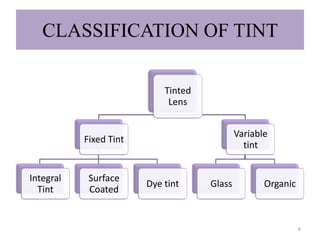
CLASSIFICATION OF TINT
Tinted
Lens
Fixed Tint
Integral
Tint
Surface
Coated
Dye tint
Variable
tint
Glass Organic
6
INTEGRAL TINT
• IT IS ALSO CALLED TINTED SOLID GLASS
LENSES.
• ONE OR MORE METALS OR METALIC OXIDES
ARE ADDED TO THE BASIC BATCH AT THE TIME
OF MANUFACTURING.
• THEY PROVIDE THE DESIRED PHYSICAL AND
CHEMICAL PROPERTIES.
7
• The principal ingredients of white ophthalmic
crown glass are silica , soda & lime to which
small amount of potassium , aluminum &
barium oxides are added to provide the
desired physical & chemical properties
8
• To produce a tinted lens , one or more metals
or metallic oxides are introduced into the
basic batch at the star of the process ( less
than 1 % )
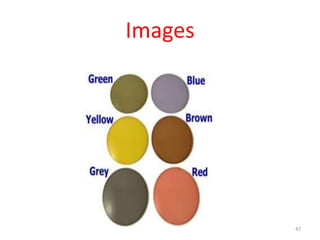
• Iron = green
• Cobalt = blue
• Gold = red
9
• Nickel = brown
• Silver = yellow
• Cerium = pinkish brown
• Manganese = pink
• Didymium = pink
10
Advantages :
- They can be produced in large quantities at
low cost
- The transmission is affected very little by
surface scratches
- There is absence of reflections
- No special equipments is needed for surfacing
& finishing the lenses
11
• Disadvantages :
- Variation in transmission from center to edge
( for lenses of high power ) no equi tint.
- Variation in transmission from one eye to the
other for pts with large amount of
anisometropia
12
- The permanence of the tint ( it can not be
removed )
13
Surface coating
• A lens is tinted by depositing a thin metallic
oxide on the surface the lens
• The coating is deposited on the lens by an
evaporation process conducted under a
vacuum at high temp
• Because of high temp , the process can not be
used with plastic lenses
14
• The density of the coated lens depends on the
thickness of the metallic oxide
• The coating is deposited on the back surface
of the glass
• To reduce the amount of light reflected by the
coating , an AR coating is placed on the
metallic oxide coating
15
• Advantages
- possible to have equip tint lenses in any RX
16
• Disadvantages
- only for glass
- ARC should be done
- Tint can vary with improper handling
, scratches on the surface & general wear &
tear
17
DYE TINT
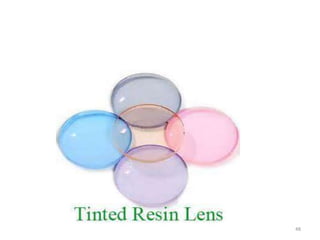
• Resin lenses can be tinted by immersing in a
container of dye.
• Red , yellow , blue are the three primary dyes
from with which almost all other colours can
be made.
• The dye can be purchased either in powder or
liquid from which are then mixed with
previously boiled water.
18
• 92 to 96c temperature
• The longer the lenses remain in the dye , the
more dye will be absorbed.
• Dye tint are not affected by the power of the
lens.
19
Tinted plastic lenses
• Plastic lenses are tinted by dipping them in a solution
containing the appropriate organic dye
• The resulting density depends on the nature of the
dye & the length of time the lens is immersed in the
solution
• If the tint is too dark , or for any reason needs to be
changed , some tint can be removed by dipping the
lens in a bleaching solutions
20
• Advantages
- very easy process
- Any colour possible
- Price factor
21
• Disadvantages
- Glass lenses can not be done
- Fades faster
- Proper tint involves trial , error & lots of
experience
22
-The color of dyed plastic lenses is not as stable
as in glass lenses
-Most dyed lenses fade with time
-Same material from different manufacturing
batch absorbs dye at dis-similar rates
-An old lens may not tint same as a new one
23
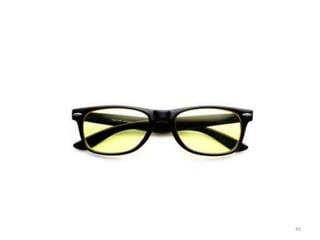
YELLOW TINT
• IT IS ALSO CALLED ASKALICHROME
• CHROMIUM OR SULPHAR OXIDES ARE USED
TO GIVE RISE TO YELLOW TINT FILTER.
• SOME TIME URANIUM OXIDES CAN ALSO
USED.
• IT ABSORB SHORT VISIBLE WAVE LENGTH.
• THESE LENSES ARE TRADITIONALLY USED AS A
SHOOTING GLASS.
24
• YELLOW FILTER ABSORB BLUE,VIOLET AND UV
LIGHT WHILE ALLOWING A LARGER
PERCENTAGE OF OTHER FREQUENCIES
THROUGH.
• CONTRAST ENHANCE
• CAR DRIVING
• SKIING
25
RED TINT
• MATERIAL IS SELANIUM.
Red tint can be helpful for hue discrimination
colour deficiency.
a) skiing.
a) hunting.
b) sharply defind contrast.
26
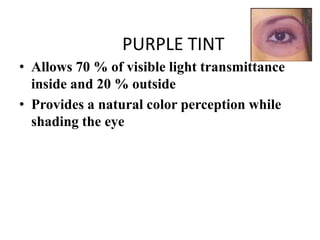
PURPLE TINT
• Allows 70 % of visible light transmittance
inside and 20 % outside
• Provides a natural color perception while
shading the eye
GREY
• Called as NEUTRAL LENS
• Most popular for sunglasses
• Evenness of transmission through whole
visible spectrum
• Allows colors to be seen in there natural state
relative to one another
• Thus satisfactory for use in color deficient
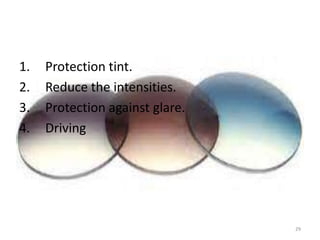
1. Protection tint.
2. Reduce the intensities.
3. Protection against glare.
4. Driving
29
• For sun protection
• Colour vision deficiency
• Fishing
• Boating
• Driving
30
BLUE
• Also called as alpha
• Used in aphakics to reduce glare problems
• Also to absorb the blue end of the spectrum
which is the property of the lens
• Small concentration of cobalt yield blue glass.
• Blue tint is not advisable for outdoor work.
USES
1. Boiler tender.
2. smelters.
3. Foundry work.
4. Furnace work
32
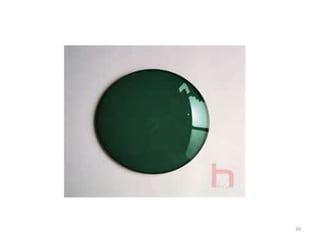
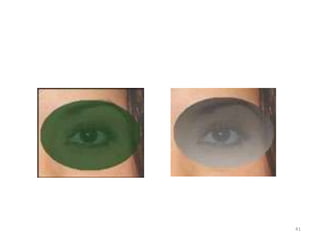
GREEN TINT
• Material is ferrous oxide metal.
• It is also called as colobar.
• Transmission curve closely approximates the
color sensitivity curve of the human eye
• Earlier popularly used in Military & Pilots
• There is good absorption of UV and IR rays
33
34
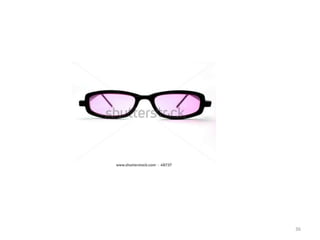
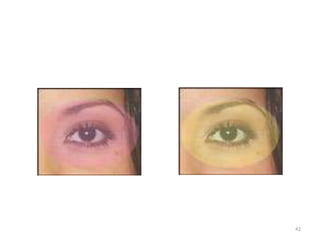
PINK TINT
• Pink is an example of unsaturated red.
• Cerium is added to the batch mix to give rise
to pinkish tint.
• Is is also called as sweetest colour.
• Pink may be the colour of choice when there
is some neurological problem.
• Give for indoor work.
35
36
• Used for unfavorable indoor lighting
situations and best solution for
problems such as change in lighting
• It absorbs ultraviolet radiations
37
BROWN TINT
• Brown tint is good general purpose filter.
• Absorbs blue end in higher proportion than
yellow
• Commonly used to improve contrast on
bright, hazy and smoggy days
• It is an excellent contrast enhancing filter & is
very much suitable for sun protection.
• It is an ideal tint for drivers for day time.
38
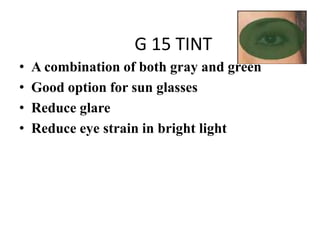
G 15 TINT
• A combination of both gray and green
• Good option for sun glasses
• Reduce glare
• Reduce eye strain in bright light
40
41
42
COMPANY
• ZEISS
• TRANSITION
• DRIVE WEAR
• CARRERA
43
44
45
46
Images
47
48
49
50
51
52
53

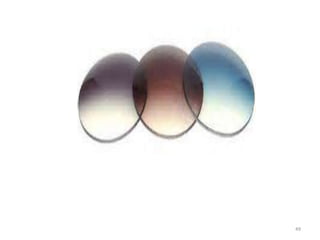
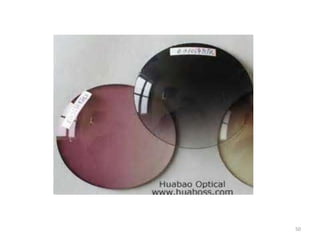
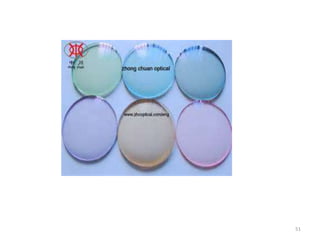
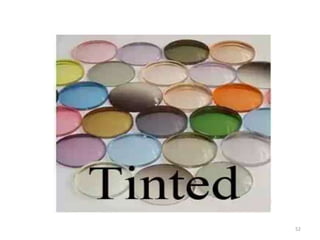
Tinted lenses

  • 1.
  • 2.
    INTRODUCTION • TINT MEANCOLOUR LENSES. • TINTED LENSES WAS PURPOSE IN 1980. • TINTED LENSES ARE WORN IN GLASSES OR CONTACT LENSES. • TINT IS A ABSORPTIVE LENS. • TINTED LENS IS ALSO KNOWN AS ‘COSMETIC LENS’. 2
  • 3.
    ABSORPTIVE LENSES • ANABSORPTIVE LENS IS ONE THAT IS USED FOR THE SPECIFIC PURPOSE OF REDUCING THE AMOUNT OF TRANSMITTED LIGHT OR RADIANT ENERGY. • IT ACT AS A FILTER. • ABSORPTION MAY BE UNIFORM OR SELECTIVE. 3
  • 4.
    TYPES OF ABSORPTIVELENS • (1)TINTED LENS • (2)PHOTOCHROMATIC LENS • (3)POLAROID LENS 4
  • 5.
    • Tints andcoating used on spectacle lens Serve a fashion purpose can make vision More comfortable, can improve visibility And contrast and can protect the eye from effects of harmful radiations. 5
  • 6.
    CLASSIFICATION OF TINT Tinted Lens FixedTint Integral Tint Surface Coated Dye tint Variable tint Glass Organic 6
  • 7.
    INTEGRAL TINT • ITIS ALSO CALLED TINTED SOLID GLASS LENSES. • ONE OR MORE METALS OR METALIC OXIDES ARE ADDED TO THE BASIC BATCH AT THE TIME OF MANUFACTURING. • THEY PROVIDE THE DESIRED PHYSICAL AND CHEMICAL PROPERTIES. 7
  • 8.
    • The principalingredients of white ophthalmic crown glass are silica , soda & lime to which small amount of potassium , aluminum & barium oxides are added to provide the desired physical & chemical properties 8
  • 9.
    • To producea tinted lens , one or more metals or metallic oxides are introduced into the basic batch at the star of the process ( less than 1 % ) • Iron = green • Cobalt = blue • Gold = red 9
  • 10.
    • Nickel =brown • Silver = yellow • Cerium = pinkish brown • Manganese = pink • Didymium = pink 10
  • 11.
    Advantages : - Theycan be produced in large quantities at low cost - The transmission is affected very little by surface scratches - There is absence of reflections - No special equipments is needed for surfacing & finishing the lenses 11
  • 12.
    • Disadvantages : -Variation in transmission from center to edge ( for lenses of high power ) no equi tint. - Variation in transmission from one eye to the other for pts with large amount of anisometropia 12
  • 13.
    - The permanenceof the tint ( it can not be removed ) 13
  • 14.
    Surface coating • Alens is tinted by depositing a thin metallic oxide on the surface the lens • The coating is deposited on the lens by an evaporation process conducted under a vacuum at high temp • Because of high temp , the process can not be used with plastic lenses 14
  • 15.
    • The densityof the coated lens depends on the thickness of the metallic oxide • The coating is deposited on the back surface of the glass • To reduce the amount of light reflected by the coating , an AR coating is placed on the metallic oxide coating 15
  • 16.
    • Advantages - possibleto have equip tint lenses in any RX 16
  • 17.
    • Disadvantages - onlyfor glass - ARC should be done - Tint can vary with improper handling , scratches on the surface & general wear & tear 17
  • 18.
    DYE TINT • Resinlenses can be tinted by immersing in a container of dye. • Red , yellow , blue are the three primary dyes from with which almost all other colours can be made. • The dye can be purchased either in powder or liquid from which are then mixed with previously boiled water. 18
  • 19.
    • 92 to96c temperature • The longer the lenses remain in the dye , the more dye will be absorbed. • Dye tint are not affected by the power of the lens. 19
  • 20.
    Tinted plastic lenses •Plastic lenses are tinted by dipping them in a solution containing the appropriate organic dye • The resulting density depends on the nature of the dye & the length of time the lens is immersed in the solution • If the tint is too dark , or for any reason needs to be changed , some tint can be removed by dipping the lens in a bleaching solutions 20
  • 21.
    • Advantages - veryeasy process - Any colour possible - Price factor 21
  • 22.
    • Disadvantages - Glasslenses can not be done - Fades faster - Proper tint involves trial , error & lots of experience 22
  • 23.
    -The color ofdyed plastic lenses is not as stable as in glass lenses -Most dyed lenses fade with time -Same material from different manufacturing batch absorbs dye at dis-similar rates -An old lens may not tint same as a new one 23
  • 24.
    YELLOW TINT • ITIS ALSO CALLED ASKALICHROME • CHROMIUM OR SULPHAR OXIDES ARE USED TO GIVE RISE TO YELLOW TINT FILTER. • SOME TIME URANIUM OXIDES CAN ALSO USED. • IT ABSORB SHORT VISIBLE WAVE LENGTH. • THESE LENSES ARE TRADITIONALLY USED AS A SHOOTING GLASS. 24
  • 25.
    • YELLOW FILTERABSORB BLUE,VIOLET AND UV LIGHT WHILE ALLOWING A LARGER PERCENTAGE OF OTHER FREQUENCIES THROUGH. • CONTRAST ENHANCE • CAR DRIVING • SKIING 25
  • 26.
    RED TINT • MATERIALIS SELANIUM. Red tint can be helpful for hue discrimination colour deficiency. a) skiing. a) hunting. b) sharply defind contrast. 26
  • 27.
    PURPLE TINT • Allows70 % of visible light transmittance inside and 20 % outside • Provides a natural color perception while shading the eye
  • 28.
    GREY • Called asNEUTRAL LENS • Most popular for sunglasses • Evenness of transmission through whole visible spectrum • Allows colors to be seen in there natural state relative to one another • Thus satisfactory for use in color deficient
  • 29.
    1. Protection tint. 2.Reduce the intensities. 3. Protection against glare. 4. Driving 29
  • 30.
    • For sunprotection • Colour vision deficiency • Fishing • Boating • Driving 30
  • 31.
    BLUE • Also calledas alpha • Used in aphakics to reduce glare problems • Also to absorb the blue end of the spectrum which is the property of the lens • Small concentration of cobalt yield blue glass. • Blue tint is not advisable for outdoor work.
  • 32.
    USES 1. Boiler tender. 2.smelters. 3. Foundry work. 4. Furnace work 32
  • 33.
    GREEN TINT • Materialis ferrous oxide metal. • It is also called as colobar. • Transmission curve closely approximates the color sensitivity curve of the human eye • Earlier popularly used in Military & Pilots • There is good absorption of UV and IR rays 33
  • 34.
  • 35.
    PINK TINT • Pinkis an example of unsaturated red. • Cerium is added to the batch mix to give rise to pinkish tint. • Is is also called as sweetest colour. • Pink may be the colour of choice when there is some neurological problem. • Give for indoor work. 35
  • 36.
  • 37.
    • Used forunfavorable indoor lighting situations and best solution for problems such as change in lighting • It absorbs ultraviolet radiations 37
  • 38.
    BROWN TINT • Browntint is good general purpose filter. • Absorbs blue end in higher proportion than yellow • Commonly used to improve contrast on bright, hazy and smoggy days • It is an excellent contrast enhancing filter & is very much suitable for sun protection. • It is an ideal tint for drivers for day time. 38
  • 39.
    G 15 TINT •A combination of both gray and green • Good option for sun glasses • Reduce glare • Reduce eye strain in bright light
  • 40.
  • 41.
  • 42.
  • 43.
    COMPANY • ZEISS • TRANSITION •DRIVE WEAR • CARRERA 43
  • 44.
  • 45.
  • 46.
  • 47.
  • 48.
  • 49.
  • 50.
  • 51.
  • 52.
  • 53.