CULTURAL
CHANGES
Christine May P. Petajen
Louie A. Sicio
Kia S. Soneja
CULTURAL CHANGES
Multiculturalism
 Multicultural Education
 Dimensions of Multicultural Education
Subcultures
- Growth of Student Subcultures
- Functions of Subcultures
 Cultural Dimensions of Learning
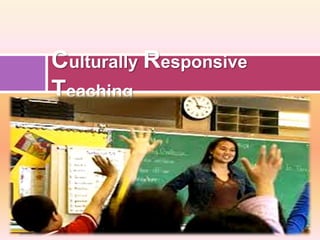
 Culturally Responsive Teaching
MULTICULTURAL
Multiculturalism
Multicultural Education is at least three things:
 An idea or concept
 An educational reform movement
 A process
Multiculturalism
 A theory about the foundations of a culture rather than a
practice which subsumes cultural ideas
 Harrison (1984)
 A systematic and comprehensive response to cultural and
ethnic diversity, with educational, linguistic, economic and
social components and specific institutional mechanisms
 A policy that emphasizes the unique characteristics of
different cultures especially as they relate to one another in
receiving nations.
Multiculturalism
Advantages of Multiculturalism
Lead cultural exchanges
Add variety in the life of all citizens
Bridges the chasm of ignorance and
arrogance
Multiculturalism
Disadvantages of Multiculturalism
Brings anxiety to stability of national
identity
Creates national disunity
Questionable loyalties
1. Demographic-Descriptive
2. Ideological-Normative
3. Programmatic-political
Three Referents of
Multiculturalism
Demographic-Descriptive
Occurs where the word multicultural refers
to the existence of linguistically, culturally
and ethnically diverse segments in the
population of a society
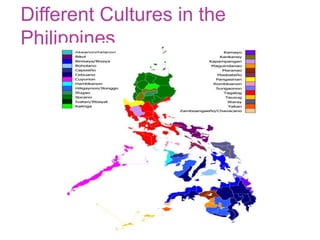
Different Cultures in the
Philippines
Ideological-Normative
This usage of multiculturalism constitutes a
specific focus towards the management
and organization of governmental
responses to ethnic diversity
 Exclusion
process of progressive social rupture, detaching groups
and individuals from social relations and institutions
and preventing them from full participation in the
normal, normatively prescribed activities of the society
in which they live.
 Apartheid
Inhuman acts committed for the purpose of establishing
and maintaining domination by one racial group of
persons over any other racial group of persons and
systematically oppressing them
 Ethnic cleansing
the attempt to create ethnically homogeneous
geographic areas through the deportation or forcible
displacement of persons belonging to particular ethnic
groups.
 Genocide
the deliberate and systematic destruction of a group of
people because of their ethnicity, nationality, religion, or
race.
Programmatic-political
Usage of multiculturalism refers to the
specific policies developed to respond and
manage ethnic diversity
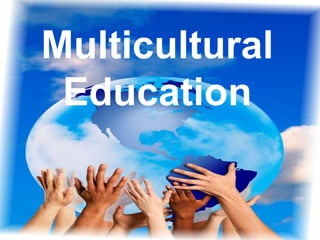
Multicultural
Education
Multicultural Education
 Field of study and an emerging discipline
whose major aim is to create equal
educational opportunities from racial, ethnic,
social class and cultural groups
 Banks and Banks (1995)
• a progressive approach for transforming
education that holistically critiques and
addresses current shortcomings, failings and
discriminatory practices in education.
A progressive approach for transforming
education that hollistically critiques and
addresses current shortcomings, failings and
discriminatory practices in education
4–17Copyright © Houghton Mifflin Company. All rights reserved
Goals of Multicultural Education
 To transform school so that male and female
students, exceptional students from diverse
cultural, social-class, racial and ethnic groups
experience an equal opportunity to learn.
 To help students to acquire knowledge,
attitudes and skills needed to function
effectively in pluralistic democratic society
Goals of Multicultural Education
 To help students to acquire knowledge and
commitments needed to make reflective
decisions
 To promote democracy and democratic living
 To help students develop more positive
attitudes toward different racial, ethnic, cultural
and religious groups.
Four Approaches in
Achieving Multicultural
Education
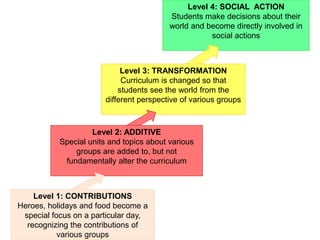
Level 4: SOCIAL ACTION
Students make decisions about their
world and become directly involved in
social actions
Level 3: TRANSFORMATION
Curriculum is changed so that
students see the world from the
different perspective of various groups
Level 2: ADDITIVE
Special units and topics about various
groups are added to, but not
fundamentally alter the curriculum
Level 1: CONTRIBUTIONS
Heroes, holidays and food become a
special focus on a particular day,
recognizing the contributions of
various groups
 Every student must have an equal opportunity to
achieve her or his full potential
 Every student must be prepared to competently
participate in an increasingly intercultural society
 Teachers must be prepared to effectively facilitate
learning for every individual student
Shared Ideals of Multicultural
Education
 Schools must be active participants in ending
oppression of all types
 Education must become more fully student-
centered
 Educators, activists and others must take a more
active role in reexamining all educational practice
and how they affect the learning of all students
Shared Ideals of Multicultural
Education
- Dr. James A. Banks
 Content Integration
 Knowledge Construction Process
 Prejudice Reduction
 Equity Pedagogy
 Empowering School Culture and Social
Structure
Dimensions of Multicultural
Education
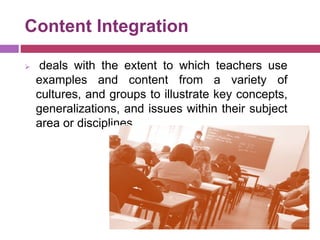
Content Integration
 deals with the extent to which teachers use
examples and content from a variety of
cultures, and groups to illustrate key concepts,
generalizations, and issues within their subject
area or disciplines
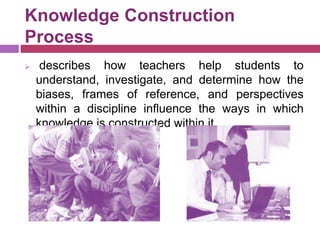
Knowledge Construction
Process
 describes how teachers help students to
understand, investigate, and determine how the
biases, frames of reference, and perspectives
within a discipline influence the ways in which
knowledge is constructed within it
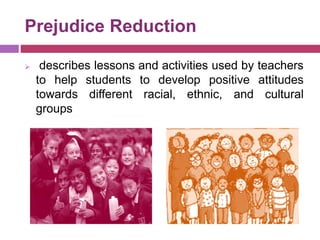
Prejudice Reduction
 describes lessons and activities used by teachers
to help students to develop positive attitudes
towards different racial, ethnic, and cultural
groups
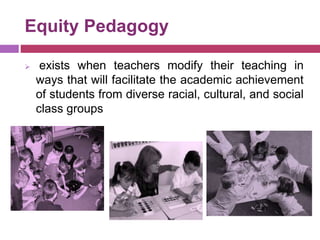
Equity Pedagogy
 exists when teachers modify their teaching in
ways that will facilitate the academic achievement
of students from diverse racial, cultural, and social
class groups
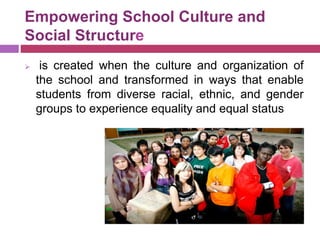
Empowering School Culture and
Social Structure
 is created when the culture and organization of
the school and transformed in ways that enable
students from diverse racial, ethnic, and gender
groups to experience equality and equal status
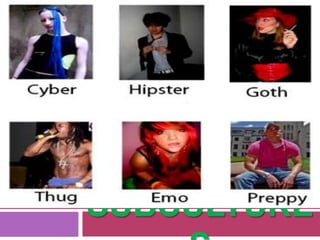
SUBCULTURE
 refers to cultural patterns that set apart some
segment of a society’s population
 can be based on age, ethnicity, residence,
sexual preference, occupation, and many
factors
 are much smaller groups formed within a
society
• A subcultural group can develop around
number of social activities (family, work,
education, religion, geographic region, and so
forth).
• They must have opportunities for
communicating with one another, both directly
(face-to-face contact) and indirectly (through
The Growth of Student
Subcultures
Subculture Sociologically
 refers to a group of people whose behavior has
features that set apart from the wider (or dominant)
culture of the society in which it develops
 they retain links to and features of the wider culture
The Growth of Student
Subcultures
Two Main Types of Sub-cultural Groups
 Reactive
- members of subcultures do not necessarily reject the
dominant culture, but they embrace their own culture as
valid and important
 Independent
- while actively participating in the dominant culture, they
often participate in a subculture containing shared norms
and values
The Growth of Student
Subcultures
 Some groups of people share a particular way of life and
we term these smaller groups subculture.
Example:
being a part of “college student subculture”
 You chose to join a particular subcultural group with its
own particular way of life. But it doesn’t mean that you
cannot be a part of other sub-cultural groups or indeed the
society as a whole.
The Growth of Student
Subcultures
 Deviant Cultures
- subcultures that directly oppose dominant
norms and values
 Countercultures
- subcultures that are oriented toward
challenging dominant culture or deliberately
trying to change it
The Growth of Student
Subcultures
 Dominant Culture
- refers to the values, norms, and practices of the group
within society that is most powerful in terms of wealth,
prestige, status, and influence.
 Subculture
- is a group within society that is differentiated by its
distinctive values, norms, and lifestyle.
The Growth of Student
Subcultures
1. Permitting specialized activity
2. Identity in mass society
3. Cultural adaptation and change
Functions of Subcultures
 Children of various cultures may think and act differently
and carry these differences into the classroom.
 Helping children of various cultures to achieve as fully as
possible, while simultaneously adapting to each other,
demands innovative strategies on the part of the parents,
teachers, and administrators.
Cultural Dimensions of Learning,
Teaching and Educational Processes
Culturally Responsive
Teaching
Culturally responsive Instruction covers
areas related to:
 Inclusive content in the curriculum that reflects
the diversity of society.
 Students’ prior knowledge, including their
culture and language.
 The idea that culture is central to student
learning because there is strong evidence that
cultural practices affect thinking process.
Culturally Responsive Teaching
encompass elements such as:
 Active teaching methods that promote students
engagement
 Teacher as facilitator
 Positive perspectives on parents and families
of culturally and linguistically diverse students.
 Culturally sensitive
Culturally Responsive Teaching
encompass elements such as:
 Reshaping the curriculum so that it is culturally
responsive to the background of students.
 Culturally mediated instruction that is
characterized by the use culturally mediated
cognition, culturally appropriate social
situations for learning, and culturally valued
knowledge in curriculum content.
 Small group instruction and academically-
related discourse
Culturally responsive teaching
acknowledges cultural diversity in
classrooms and accommodates this
diversity in instruction.
It does this in three important ways:
1. By recognizing and accepting student diversity, it
communicates that all students are welcome and
valued as human beings.
2. by building on students’ cultural backgrounds,
culturally responsive teaching communicates
positive images about the students’ home cultures.
3. By being responsive to different student learning
styles, culturally responsive teaching builds on
students’ strengths and uses these to help students
learn.
THANKS
FOR
LISTENING!
  
COOPERATIV
E LEARNING
ACTIVITY

Cultural Changes

  • 1.
    CULTURAL CHANGES Christine May P.Petajen Louie A. Sicio Kia S. Soneja
  • 2.
    CULTURAL CHANGES Multiculturalism  MulticulturalEducation  Dimensions of Multicultural Education Subcultures - Growth of Student Subcultures - Functions of Subcultures  Cultural Dimensions of Learning  Culturally Responsive Teaching
  • 3.
  • 4.
    Multiculturalism Multicultural Education isat least three things:  An idea or concept  An educational reform movement  A process
  • 5.
    Multiculturalism  A theoryabout the foundations of a culture rather than a practice which subsumes cultural ideas  Harrison (1984)  A systematic and comprehensive response to cultural and ethnic diversity, with educational, linguistic, economic and social components and specific institutional mechanisms  A policy that emphasizes the unique characteristics of different cultures especially as they relate to one another in receiving nations.
  • 6.
    Multiculturalism Advantages of Multiculturalism Leadcultural exchanges Add variety in the life of all citizens Bridges the chasm of ignorance and arrogance
  • 7.
    Multiculturalism Disadvantages of Multiculturalism Bringsanxiety to stability of national identity Creates national disunity Questionable loyalties
  • 8.
    1. Demographic-Descriptive 2. Ideological-Normative 3.Programmatic-political Three Referents of Multiculturalism
  • 9.
    Demographic-Descriptive Occurs where theword multicultural refers to the existence of linguistically, culturally and ethnically diverse segments in the population of a society
  • 10.
    Different Cultures inthe Philippines
  • 11.
    Ideological-Normative This usage ofmulticulturalism constitutes a specific focus towards the management and organization of governmental responses to ethnic diversity
  • 12.
     Exclusion process ofprogressive social rupture, detaching groups and individuals from social relations and institutions and preventing them from full participation in the normal, normatively prescribed activities of the society in which they live.  Apartheid Inhuman acts committed for the purpose of establishing and maintaining domination by one racial group of persons over any other racial group of persons and systematically oppressing them
  • 13.
     Ethnic cleansing theattempt to create ethnically homogeneous geographic areas through the deportation or forcible displacement of persons belonging to particular ethnic groups.  Genocide the deliberate and systematic destruction of a group of people because of their ethnicity, nationality, religion, or race.
  • 14.
    Programmatic-political Usage of multiculturalismrefers to the specific policies developed to respond and manage ethnic diversity
  • 15.
  • 16.
    Multicultural Education  Fieldof study and an emerging discipline whose major aim is to create equal educational opportunities from racial, ethnic, social class and cultural groups  Banks and Banks (1995) • a progressive approach for transforming education that holistically critiques and addresses current shortcomings, failings and discriminatory practices in education.
  • 17.
    A progressive approachfor transforming education that hollistically critiques and addresses current shortcomings, failings and discriminatory practices in education 4–17Copyright © Houghton Mifflin Company. All rights reserved
  • 18.
    Goals of MulticulturalEducation  To transform school so that male and female students, exceptional students from diverse cultural, social-class, racial and ethnic groups experience an equal opportunity to learn.  To help students to acquire knowledge, attitudes and skills needed to function effectively in pluralistic democratic society
  • 19.
    Goals of MulticulturalEducation  To help students to acquire knowledge and commitments needed to make reflective decisions  To promote democracy and democratic living  To help students develop more positive attitudes toward different racial, ethnic, cultural and religious groups.
  • 20.
    Four Approaches in AchievingMulticultural Education
  • 21.
    Level 4: SOCIALACTION Students make decisions about their world and become directly involved in social actions Level 3: TRANSFORMATION Curriculum is changed so that students see the world from the different perspective of various groups Level 2: ADDITIVE Special units and topics about various groups are added to, but not fundamentally alter the curriculum Level 1: CONTRIBUTIONS Heroes, holidays and food become a special focus on a particular day, recognizing the contributions of various groups
  • 22.
     Every studentmust have an equal opportunity to achieve her or his full potential  Every student must be prepared to competently participate in an increasingly intercultural society  Teachers must be prepared to effectively facilitate learning for every individual student Shared Ideals of Multicultural Education
  • 23.
     Schools mustbe active participants in ending oppression of all types  Education must become more fully student- centered  Educators, activists and others must take a more active role in reexamining all educational practice and how they affect the learning of all students Shared Ideals of Multicultural Education
  • 24.
    - Dr. JamesA. Banks  Content Integration  Knowledge Construction Process  Prejudice Reduction  Equity Pedagogy  Empowering School Culture and Social Structure Dimensions of Multicultural Education
  • 25.
    Content Integration  dealswith the extent to which teachers use examples and content from a variety of cultures, and groups to illustrate key concepts, generalizations, and issues within their subject area or disciplines
  • 26.
    Knowledge Construction Process  describeshow teachers help students to understand, investigate, and determine how the biases, frames of reference, and perspectives within a discipline influence the ways in which knowledge is constructed within it
  • 27.
    Prejudice Reduction  describeslessons and activities used by teachers to help students to develop positive attitudes towards different racial, ethnic, and cultural groups
  • 28.
    Equity Pedagogy  existswhen teachers modify their teaching in ways that will facilitate the academic achievement of students from diverse racial, cultural, and social class groups
  • 29.
    Empowering School Cultureand Social Structure  is created when the culture and organization of the school and transformed in ways that enable students from diverse racial, ethnic, and gender groups to experience equality and equal status
  • 30.
  • 31.
     refers tocultural patterns that set apart some segment of a society’s population  can be based on age, ethnicity, residence, sexual preference, occupation, and many factors  are much smaller groups formed within a society
  • 32.
    • A subculturalgroup can develop around number of social activities (family, work, education, religion, geographic region, and so forth). • They must have opportunities for communicating with one another, both directly (face-to-face contact) and indirectly (through The Growth of Student Subcultures
  • 33.
    Subculture Sociologically  refersto a group of people whose behavior has features that set apart from the wider (or dominant) culture of the society in which it develops  they retain links to and features of the wider culture The Growth of Student Subcultures
  • 34.
    Two Main Typesof Sub-cultural Groups  Reactive - members of subcultures do not necessarily reject the dominant culture, but they embrace their own culture as valid and important  Independent - while actively participating in the dominant culture, they often participate in a subculture containing shared norms and values The Growth of Student Subcultures
  • 35.
     Some groupsof people share a particular way of life and we term these smaller groups subculture. Example: being a part of “college student subculture”  You chose to join a particular subcultural group with its own particular way of life. But it doesn’t mean that you cannot be a part of other sub-cultural groups or indeed the society as a whole. The Growth of Student Subcultures
  • 36.
     Deviant Cultures -subcultures that directly oppose dominant norms and values  Countercultures - subcultures that are oriented toward challenging dominant culture or deliberately trying to change it The Growth of Student Subcultures
  • 37.
     Dominant Culture -refers to the values, norms, and practices of the group within society that is most powerful in terms of wealth, prestige, status, and influence.  Subculture - is a group within society that is differentiated by its distinctive values, norms, and lifestyle. The Growth of Student Subcultures
  • 38.
    1. Permitting specializedactivity 2. Identity in mass society 3. Cultural adaptation and change Functions of Subcultures
  • 39.
     Children ofvarious cultures may think and act differently and carry these differences into the classroom.  Helping children of various cultures to achieve as fully as possible, while simultaneously adapting to each other, demands innovative strategies on the part of the parents, teachers, and administrators. Cultural Dimensions of Learning, Teaching and Educational Processes
  • 40.
  • 41.
    Culturally responsive Instructioncovers areas related to:  Inclusive content in the curriculum that reflects the diversity of society.  Students’ prior knowledge, including their culture and language.  The idea that culture is central to student learning because there is strong evidence that cultural practices affect thinking process.
  • 42.
    Culturally Responsive Teaching encompasselements such as:  Active teaching methods that promote students engagement  Teacher as facilitator  Positive perspectives on parents and families of culturally and linguistically diverse students.  Culturally sensitive
  • 43.
    Culturally Responsive Teaching encompasselements such as:  Reshaping the curriculum so that it is culturally responsive to the background of students.  Culturally mediated instruction that is characterized by the use culturally mediated cognition, culturally appropriate social situations for learning, and culturally valued knowledge in curriculum content.  Small group instruction and academically- related discourse
  • 44.
    Culturally responsive teaching acknowledgescultural diversity in classrooms and accommodates this diversity in instruction.
  • 45.
    It does thisin three important ways: 1. By recognizing and accepting student diversity, it communicates that all students are welcome and valued as human beings. 2. by building on students’ cultural backgrounds, culturally responsive teaching communicates positive images about the students’ home cultures. 3. By being responsive to different student learning styles, culturally responsive teaching builds on students’ strengths and uses these to help students learn.
  • 46.
  • 47.