
COPYREADING
Reading the Copy 
• Correcting copies (news story, feature story,
editorial. Etc.) with the use of appropriate
symbols universally known by printers.
Copyreader
• sometimes called butcher or mutilator
• Corrects errors in copies
• Should know the basics of all forms of
journalistic writing
C’s of Copyreading
Correct
Check
Condense
Clarify
COPYREADING
What to know in
1. Grammar
2. Styles
3. Font/Typography
4. Unit Count
5. Printer’s Direction
6. Headline Writing
7. Copyreading Symbols
8. Style Book
DUTIES OF A COPYREADER
1. Straighten out grammatical constructions
2. Shorten sentences and tighten paragraphs
3. See that the paper’s style requirements are
strictly followed
4. Check names, addresses, titles, designations,
identifications, figures, attributions, etc.
5. Rewrite the some parts or the story completely
if it is poorly written
6. Delete all libelous biased and derogatory
statements
7. Remove all opinions, speculations and
statements which are not with attribution or
sources.
8. Cut the news story to the required length
9. check sluglines and page sequences
10.Write headline
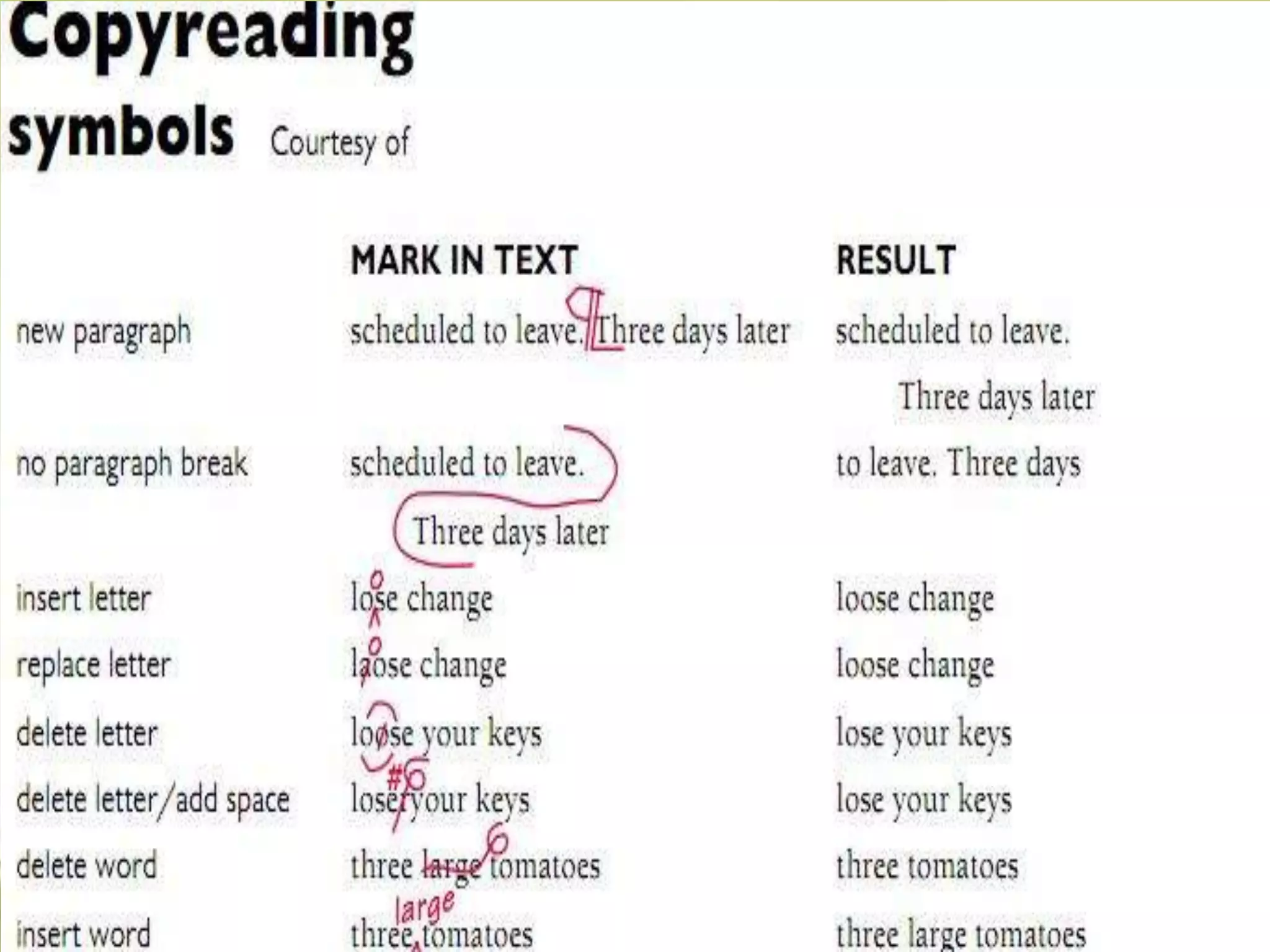
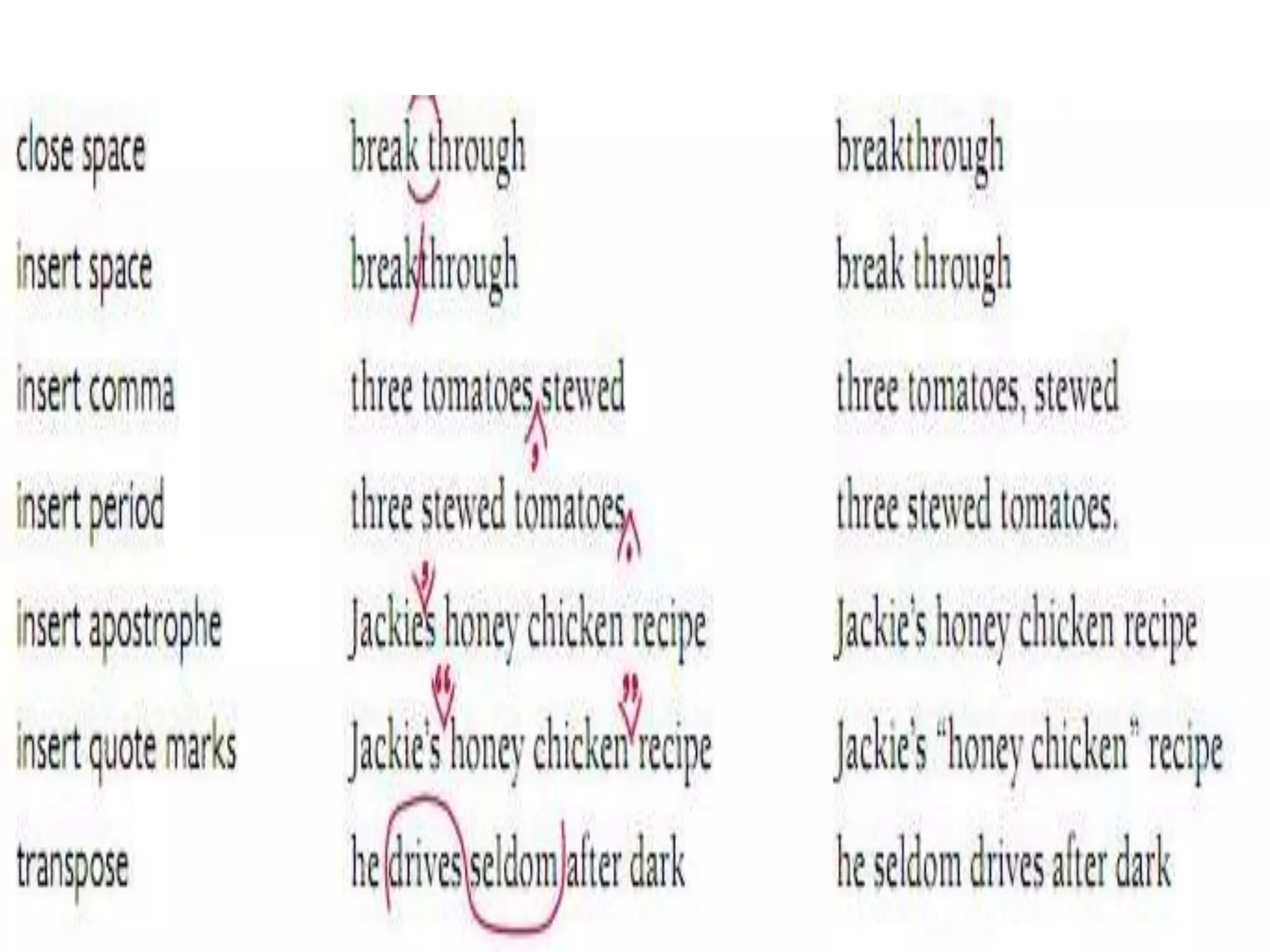
COPYREADING
SYMBOLS
COPYREADING
How oh how?
1. Mechanical Editing
2. Content Editing
3. Headline Writing
4. Printer’s Direction
Mechanical Editing
• 1st reading
• Having a general understanding of the story
• Correcting obvious errors
• Checking vague information
Content Editing
• 2nd reading
• Checking the appropriateness of words
• Finding the lead(news)
• Arranging the paragraphs
Headline Writing
Things to remember in writing a headline:
1. Answer as many W’s as possible in the headline
without making the headline appear kilometric.
2. The headline should not state something that is
not included in the story.
3. Positive heads are preferable than negative
ones.
4. Use a verb, expressed or implied, in main
heads and subheads.
5.The active verb is preferred to passive verb,
except in the instance that the event is more
important than the doer.
6. Delete article like a, an, the, and all forms of
verbs of being.
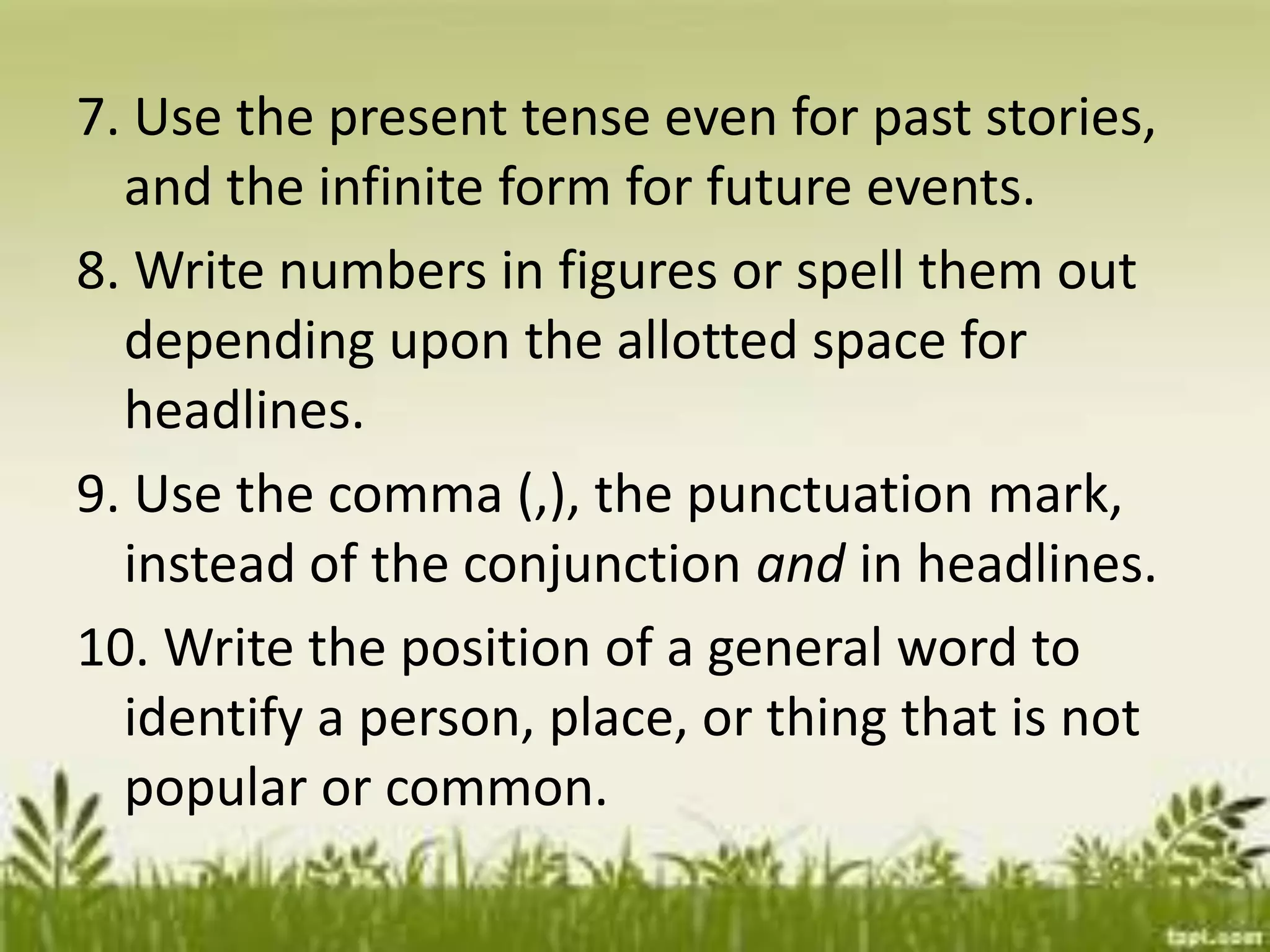
7. Use the present tense even for past stories,
and the infinite form for future events.
8. Write numbers in figures or spell them out
depending upon the allotted space for
headlines.
9. Use the comma (,), the punctuation mark,
instead of the conjunction and in headlines.
10. Write the position of a general word to
identify a person, place, or thing that is not
popular or common.
Headline Vocabs
Instead of… Use..
Increase Hike
Decrease Dip
Examination Quiz
Announced Bared
Highlight Cap
Disapprove Buck
Contest/competition Tilt
Being discussed at Up at
Dominates Rules/lords
Against Vs
Volleyball players Spikers/netters
Approval Ok
Syndicate Gang
Investigation probe
Prohibition Ban
Participate Attend
Celebrate Mark
Students Studes
Senators Solons
Conflagration Fire
Inundated Flooded
Arrests Nabs
Emphasize Stress
Charter change Cha-cha
President Prexy
Unit Counting
A headline should fit the allotted space by a system of
unit counts given to each letter, figures and symbols.
The corresponding unit counts are given as follows:
½ Unit— j, i, l, t, f, all punctuation marks except em dash
(—) and question mark (?)
1 Unit— J, I, L, T, F, question mark (?), space, figures and
all the lowercase letters except j, i, l, t, f, m, w
1 ½ Units— em dash (—), m, w and all the
capital letters except J, I, L, T, F, M, W
2 Units— M, W
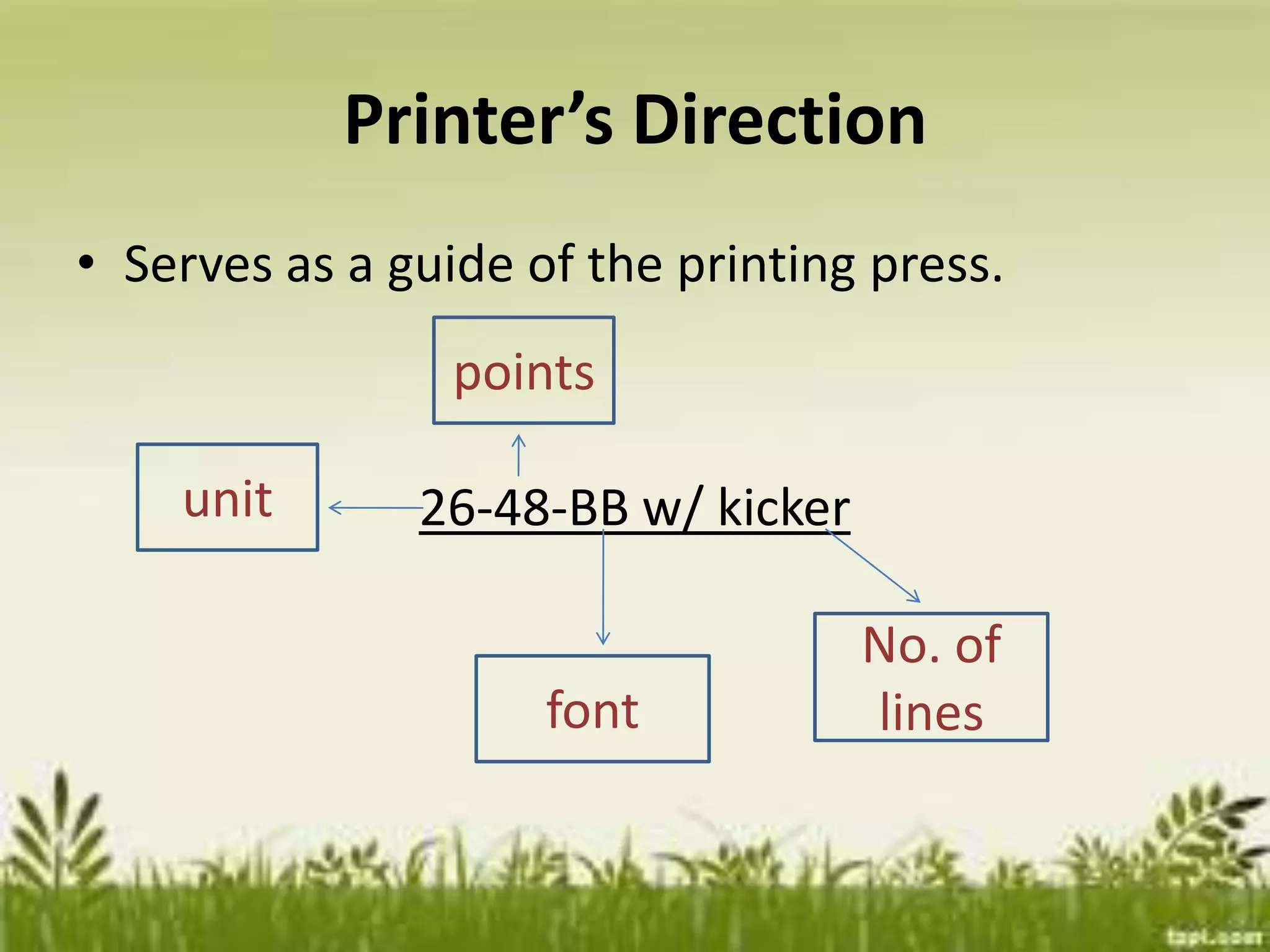
Printer’s Direction
• Serves as a guide of the printing press.
26-48-BB w/ kickerunit
points
font
No. of
lines
PROOFREADING
Reading Proofs   
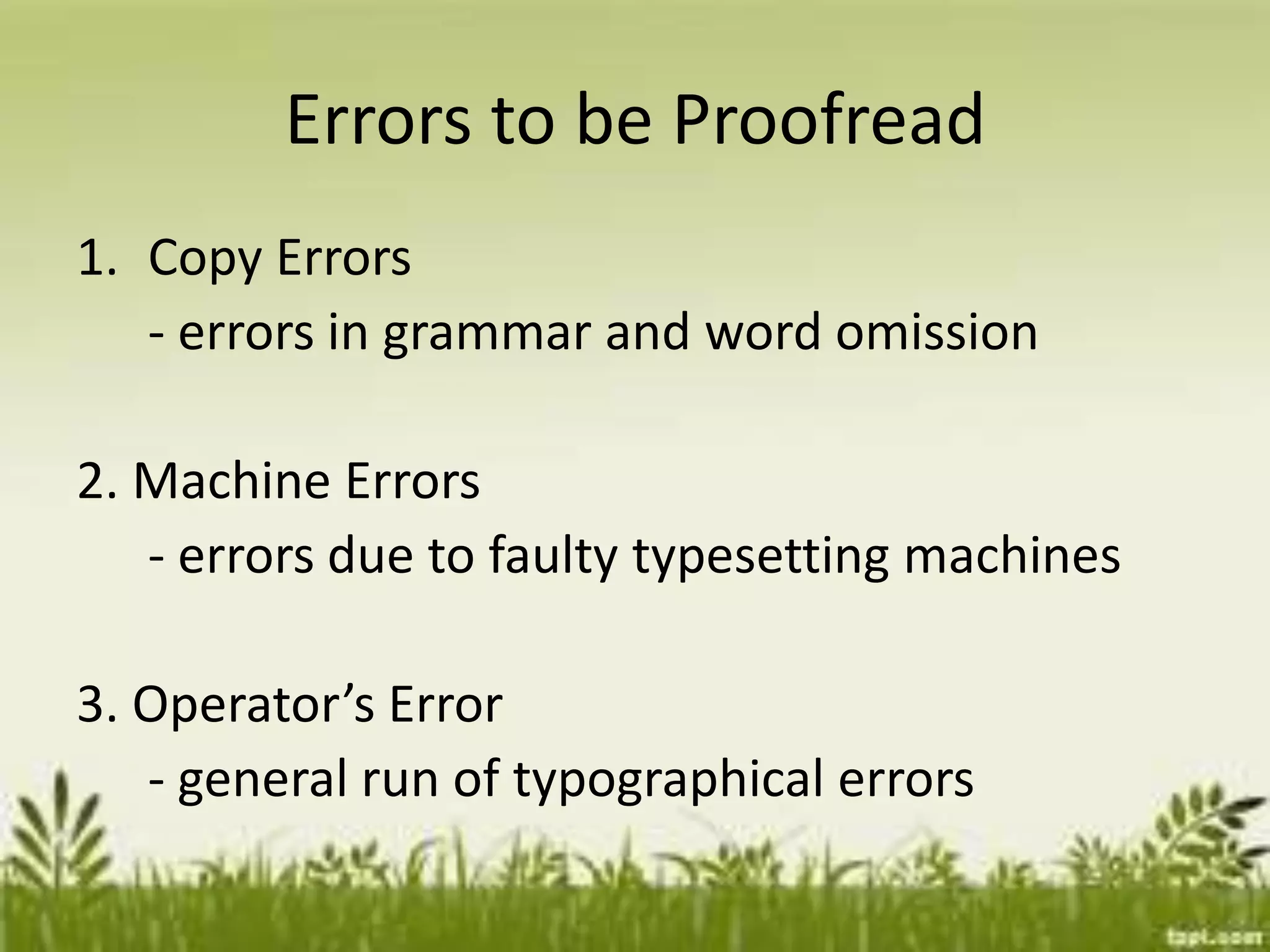
Errors to be Proofread
1. Copy Errors
- errors in grammar and word omission
2. Machine Errors
- errors due to faulty typesetting machines
3. Operator’s Error
- general run of typographical errors
DUTIES OF THE PROOFREADER
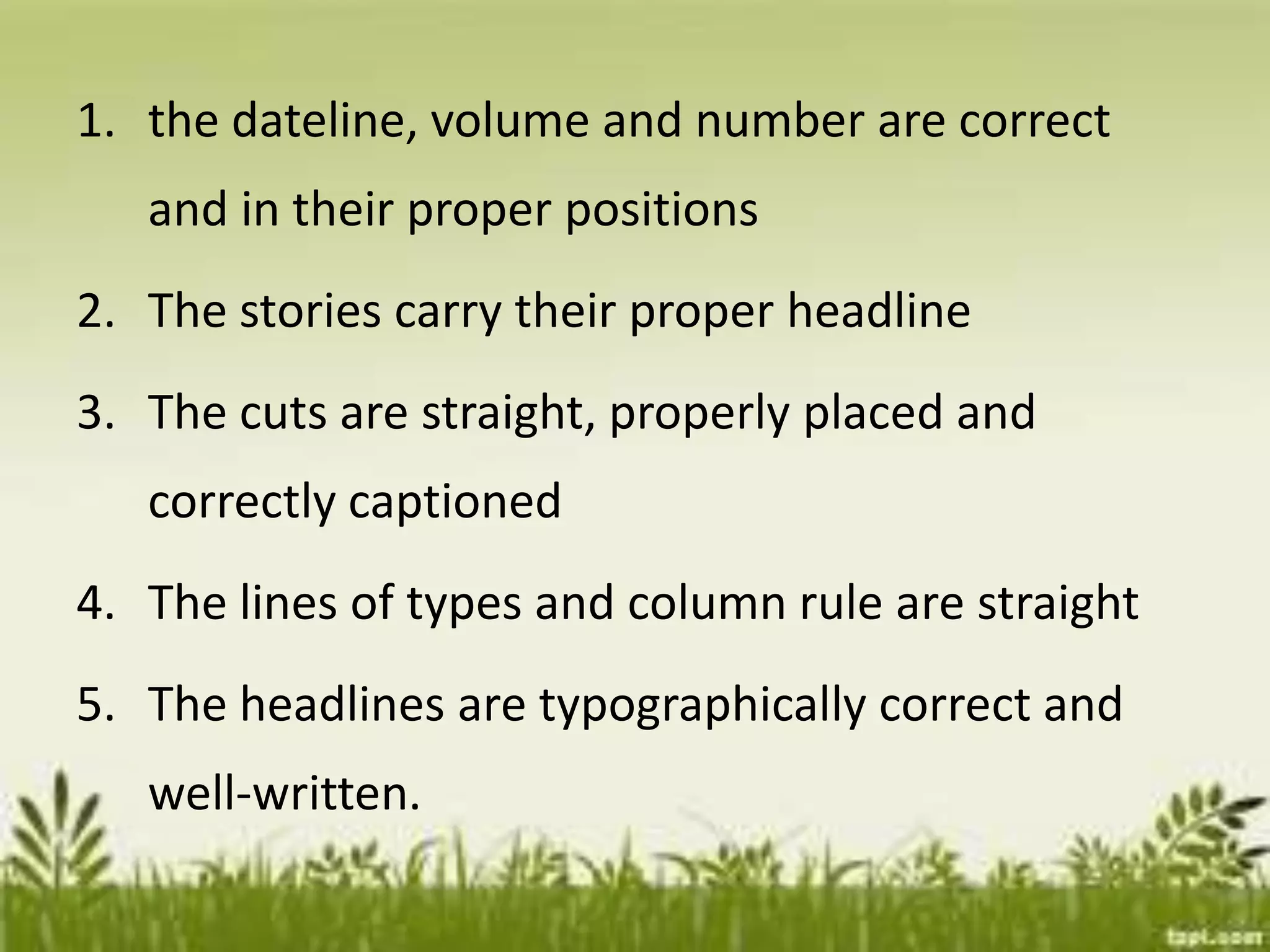
The proofreader should see to it that:
1. the dateline, volume and number are correct
and in their proper positions
2. The stories carry their proper headline
3. The cuts are straight, properly placed and
correctly captioned
4. The lines of types and column rule are straight
5. The headlines are typographically correct and
well-written.
6. “continued” lines and jump heads are
properly placed
7. Long stories, usually more than three-inch
deep, have subheads
8. All killed materials have been deleted
PROFREADER’S MARKS
Yun na pows. 

Copyreading

  • 1.
  • 2.
    • Correcting copies(news story, feature story, editorial. Etc.) with the use of appropriate symbols universally known by printers.
  • 3.
    Copyreader • sometimes calledbutcher or mutilator • Corrects errors in copies • Should know the basics of all forms of journalistic writing
  • 4.
  • 5.
  • 6.
    1. Grammar 2. Styles 3.Font/Typography 4. Unit Count 5. Printer’s Direction 6. Headline Writing 7. Copyreading Symbols 8. Style Book
  • 7.
    DUTIES OF ACOPYREADER
  • 8.
    1. Straighten outgrammatical constructions 2. Shorten sentences and tighten paragraphs 3. See that the paper’s style requirements are strictly followed 4. Check names, addresses, titles, designations, identifications, figures, attributions, etc. 5. Rewrite the some parts or the story completely if it is poorly written
  • 9.
    6. Delete alllibelous biased and derogatory statements 7. Remove all opinions, speculations and statements which are not with attribution or sources. 8. Cut the news story to the required length 9. check sluglines and page sequences 10.Write headline
  • 10.
  • 13.
  • 14.
    1. Mechanical Editing 2.Content Editing 3. Headline Writing 4. Printer’s Direction
  • 15.
    Mechanical Editing • 1streading • Having a general understanding of the story • Correcting obvious errors • Checking vague information
  • 16.
    Content Editing • 2ndreading • Checking the appropriateness of words • Finding the lead(news) • Arranging the paragraphs
  • 17.
    Headline Writing Things toremember in writing a headline: 1. Answer as many W’s as possible in the headline without making the headline appear kilometric. 2. The headline should not state something that is not included in the story. 3. Positive heads are preferable than negative ones.
  • 18.
    4. Use averb, expressed or implied, in main heads and subheads. 5.The active verb is preferred to passive verb, except in the instance that the event is more important than the doer. 6. Delete article like a, an, the, and all forms of verbs of being.
  • 19.
    7. Use thepresent tense even for past stories, and the infinite form for future events. 8. Write numbers in figures or spell them out depending upon the allotted space for headlines. 9. Use the comma (,), the punctuation mark, instead of the conjunction and in headlines. 10. Write the position of a general word to identify a person, place, or thing that is not popular or common.
  • 20.
    Headline Vocabs Instead of…Use.. Increase Hike Decrease Dip Examination Quiz Announced Bared Highlight Cap Disapprove Buck Contest/competition Tilt
  • 21.
    Being discussed atUp at Dominates Rules/lords Against Vs Volleyball players Spikers/netters Approval Ok Syndicate Gang Investigation probe
  • 22.
    Prohibition Ban Participate Attend CelebrateMark Students Studes Senators Solons Conflagration Fire
  • 23.
    Inundated Flooded Arrests Nabs EmphasizeStress Charter change Cha-cha President Prexy
  • 24.
    Unit Counting A headlineshould fit the allotted space by a system of unit counts given to each letter, figures and symbols. The corresponding unit counts are given as follows: ½ Unit— j, i, l, t, f, all punctuation marks except em dash (—) and question mark (?) 1 Unit— J, I, L, T, F, question mark (?), space, figures and all the lowercase letters except j, i, l, t, f, m, w
  • 25.
    1 ½ Units—em dash (—), m, w and all the capital letters except J, I, L, T, F, M, W 2 Units— M, W
  • 26.
    Printer’s Direction • Servesas a guide of the printing press. 26-48-BB w/ kickerunit points font No. of lines
  • 27.
  • 28.
    Errors to beProofread 1. Copy Errors - errors in grammar and word omission 2. Machine Errors - errors due to faulty typesetting machines 3. Operator’s Error - general run of typographical errors
  • 29.
    DUTIES OF THEPROOFREADER The proofreader should see to it that:
  • 30.
    1. the dateline,volume and number are correct and in their proper positions 2. The stories carry their proper headline 3. The cuts are straight, properly placed and correctly captioned 4. The lines of types and column rule are straight 5. The headlines are typographically correct and well-written.
  • 31.
    6. “continued” linesand jump heads are properly placed 7. Long stories, usually more than three-inch deep, have subheads 8. All killed materials have been deleted
  • 32.
  • 33.
    Yun na pows.