SYSTEM’S SPECIFICATIONS
These are the necessary specifications your
computer must have in order to use the
software or hardware.
FACTORS THAT AFFECT
COMPUTER PERFORMANCE
Processor speed and architecture
The architecture of a processor is the most
important factor to determine its performance,
and refers to its basic design and complexity.
Processor speed and architecture
The speed of a computer's processor chip
(technically known as its "clock speed") in
measured in gigahertz (GHz), with the fastest
modern processors currently running at up to
4.7GHz. However, for most computing tasks,
including web browsing, sending e-mails, word
processing and spreadsheet work any processor
running at 1GHz or more remains perfectly
sufficient.
Processor speed and architecture
Cache is a form of very fast memory integrated
into the processor chip, and used to store up
instructions (work for the processor) so that it
has to slow down as little as possible between
tasks.
Processor speed and architecture
Front side bus (FSB) speed is a measure of how
fast a microprocessor communicates with the
computer's main circuit board (or
"motherboard") into which it is physically
connected.
Random Access Memory (RAM)
The part of the computer in which information is
stored temporarily when a program is being
used.
Random Access Memory (RAM)
RAM is measured in megabytes (MB) and
gigabytes (GB), as detailed on the storage page.
Graphics system
determines how well it can work with visual
output. Graphics systems can either be
integrated into a computer's motherboard, or
plugged into the motherboard as a separate
"video card".
Hard Drive Speed and Capacity
A part of the computer that is used for storing
computer data and that contains one or more
hard disks
Two key factors that determine the
speed of traditional, spinning hard
disks
1. rotational velocity of the physical disk itself.
2. interface used to connect it to the
computer's motherboard
Three types of interface
1. Serial Advance Technology Attachment (SATA)-
the most modern and now pretty much the
norm on new PCs
2. Integrated Device Electronics (IDE) (also known
as UDMA)- a slower and older form of interface
3. Small Computer System Interface (SCSI)-the
oldest but in it most modern variant is still the
fastest disk interface standard.
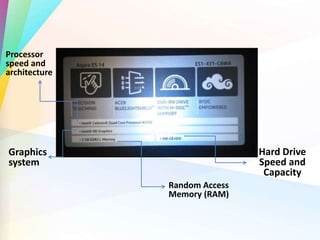
Hard Drive
Speed and
Capacity
Graphics
system
Processor
speed and
architecture
Random Access
Memory (RAM)

System's Specification

  • 1.
  • 2.
    These are thenecessary specifications your computer must have in order to use the software or hardware.
  • 3.
  • 4.
    Processor speed andarchitecture The architecture of a processor is the most important factor to determine its performance, and refers to its basic design and complexity.
  • 5.
    Processor speed andarchitecture The speed of a computer's processor chip (technically known as its "clock speed") in measured in gigahertz (GHz), with the fastest modern processors currently running at up to 4.7GHz. However, for most computing tasks, including web browsing, sending e-mails, word processing and spreadsheet work any processor running at 1GHz or more remains perfectly sufficient.
  • 6.
    Processor speed andarchitecture Cache is a form of very fast memory integrated into the processor chip, and used to store up instructions (work for the processor) so that it has to slow down as little as possible between tasks.
  • 7.
    Processor speed andarchitecture Front side bus (FSB) speed is a measure of how fast a microprocessor communicates with the computer's main circuit board (or "motherboard") into which it is physically connected.
  • 8.
    Random Access Memory(RAM) The part of the computer in which information is stored temporarily when a program is being used.
  • 9.
    Random Access Memory(RAM) RAM is measured in megabytes (MB) and gigabytes (GB), as detailed on the storage page.
  • 10.
    Graphics system determines howwell it can work with visual output. Graphics systems can either be integrated into a computer's motherboard, or plugged into the motherboard as a separate "video card".
  • 11.
    Hard Drive Speedand Capacity A part of the computer that is used for storing computer data and that contains one or more hard disks
  • 12.
    Two key factorsthat determine the speed of traditional, spinning hard disks 1. rotational velocity of the physical disk itself. 2. interface used to connect it to the computer's motherboard
  • 13.
    Three types ofinterface 1. Serial Advance Technology Attachment (SATA)- the most modern and now pretty much the norm on new PCs 2. Integrated Device Electronics (IDE) (also known as UDMA)- a slower and older form of interface 3. Small Computer System Interface (SCSI)-the oldest but in it most modern variant is still the fastest disk interface standard.
  • 14.
    Hard Drive Speed and Capacity Graphics system Processor speedand architecture Random Access Memory (RAM)