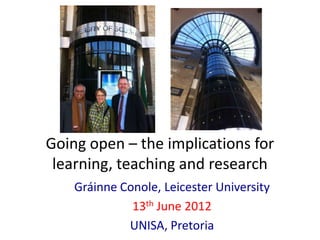
Going open – the implications for
 learning, teaching and research
    Gráinne Conole, Leicester University
              13th June 2012
             UNISA, Pretoria
Outline

•   Social and participatory media
•   Digital literacies
•   Fostering open practices
•   The problem
•   Learning design
•   Conclusions
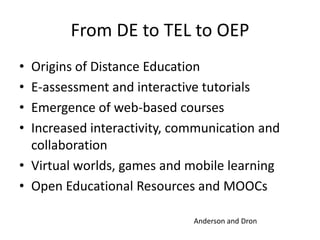
From DE to TEL to OEP
• Origins of Distance Education
• E-assessment and interactive tutorials
• Emergence of web-based courses
• Increased interactivity, communication and
  collaboration
• Virtual worlds, games and mobile learning
• Open Educational Resources and MOOCs

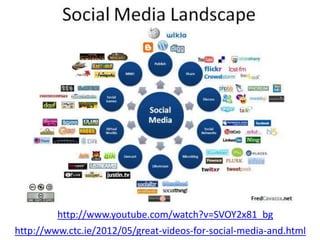
                             Anderson and Dron
http://www.youtube.com/watch?v=SVOY2x81_bg
http://www.ctc.ie/2012/05/great-videos-for-social-media-and.html
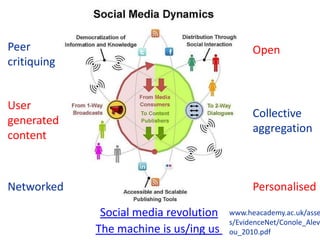
Peer                                          Open
critiquing


User
                                              Collective
generated
                                              aggregation
content


Networked                                     Personalised

              Social media revolution   www.heacademy.ac.uk/asse
                                        s/EvidenceNet/Conole_Alev
             The machine is us/ing us   ou_2010.pdf
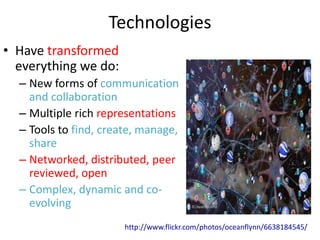
Technologies
• Have transformed
  everything we do:
  – New forms of communication
    and collaboration
  – Multiple rich representations
  – Tools to find, create, manage,
    share
  – Networked, distributed, peer
    reviewed, open
  – Complex, dynamic and co-
    evolving
                       http://www.flickr.com/photos/oceanflynn/6638184545/
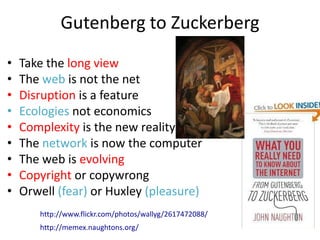
Gutenberg to Zuckerberg
•   Take the long view
•   The web is not the net
•   Disruption is a feature
•   Ecologies not economics
•   Complexity is the new reality
•   The network is now the computer
•   The web is evolving
•   Copyright or copywrong
•   Orwell (fear) or Huxley (pleasure)
       http://www.flickr.com/photos/wallyg/2617472088/
       http://memex.naughtons.org/
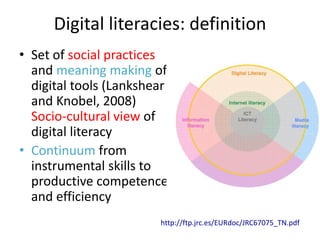
Digital literacies: definition
• Set of social practices
  and meaning making of
  digital tools (Lankshear
  and Knobel, 2008)
  Socio-cultural view of
  digital literacy
• Continuum from
  instrumental skills to
  productive competence
  and efficiency
                        http://ftp.jrc.es/EURdoc/JRC67075_TN.pdf
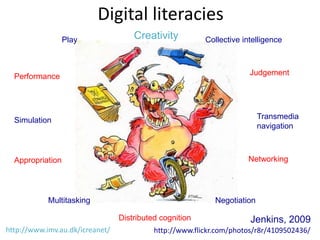
Digital literacies
                  Play               Creativity          Collective intelligence


  Performance                                                         Judgement


  Simulation                                                              Transmedia
                                                                          navigation


  Appropriation                                                      Networking


            Multitasking                                    Negotiation

                                 Distributed cognition                Jenkins, 2009
http://www.imv.au.dk/icreanet/             http://www.flickr.com/photos/r8r/4109502436/
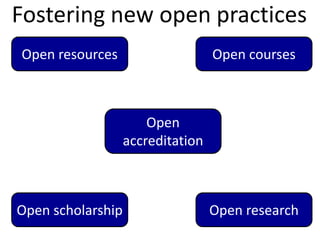
Fostering new open practices
Open resources                     Open courses


                       Open
                   accreditation


Open scholarship                   Open research
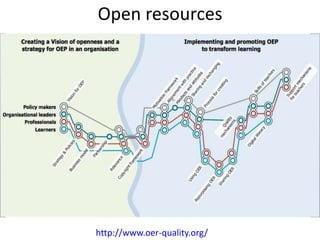
Open resources


http://www.oer-quality.org/
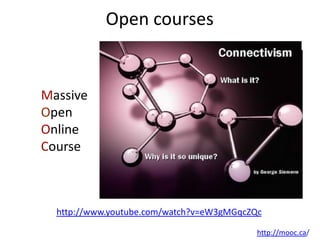
Open courses


Massive
Open
Online
Course


  http://www.youtube.com/watch?v=eW3gMGqcZQc

                                           http://mooc.ca/
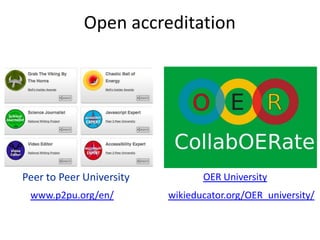
Open accreditation


Peer to Peer University          OER University
 www.p2pu.org/en/         wikieducator.org/OER_university/
Open scholarship

• Exploiting the digital network
• New forms of dissemination
  and communication
• Promoting reflective practice
• Embracing the affordances of
  new technologies
                                            Weller, 2011

                  Weller: http://nogoodreason.typepad.co.uk/
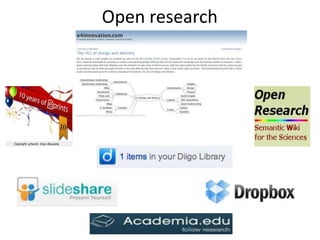
Open research
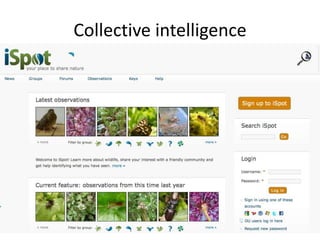
Collective intelligence
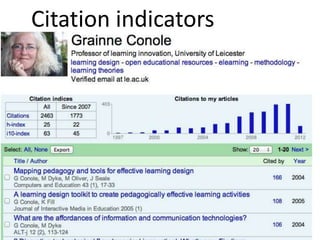
Citation indicators
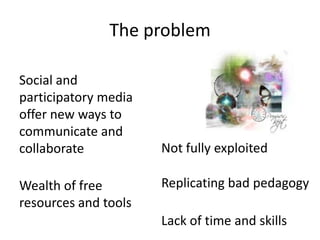
The problem

Social and
participatory media
offer new ways to
communicate and
collaborate           Not fully exploited

Wealth of free        Replicating bad pedagogy
resources and tools
                      Lack of time and skills
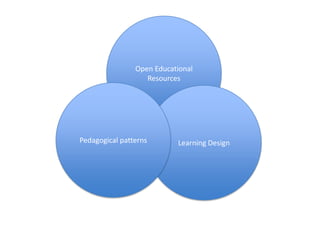
Open Educational
                   Resources


Pedagogical patterns       Learning Design
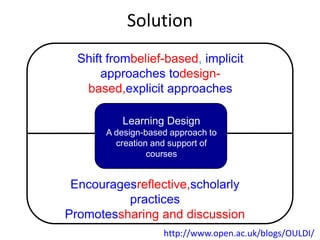
Solution
  Shift frombelief-based, implicit
       approaches todesign-
   based,explicit approaches

          Learning Design
       A design-based approach to
         creation and support of
                 courses


 Encouragesreflective,scholarly
          practices
Promotessharing and discussion
                    http://www.open.ac.uk/blogs/OULDI/
Definition
     A methodology for enabling teachers/designers to make
     more informed decisions in how they go about designing
            learning activities and interventions, which is
        pedagogically informed and makes effective use of
      appropriate resources and technologies. This includes
     the design of resources and individual learning activities
      right up to curriculum-level design. A key principle is to
          help make the design process more explicit and
      shareable. Learning design as an area of research and
     development includes both gathering empirical evidence
         to understand the design process, as well as the
      development of a range of learning design resources,
                         tools and activities.
21
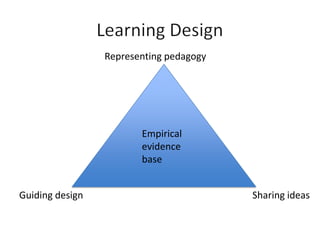
Representing pedagogy


                        Empirical
                        evidence
                        base


Guiding design                           Sharing ideas
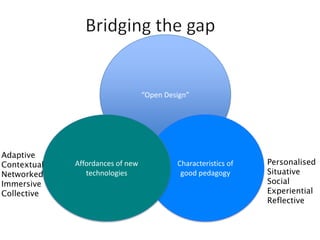
“Open Design”


Adaptive
Contextual   Affordances of new            Characteristics of   Personalised
Networked       technologies                good pedagogy       Situative
Immersive                                                       Social
Collective                                                      Experiential
                                                                Reflective
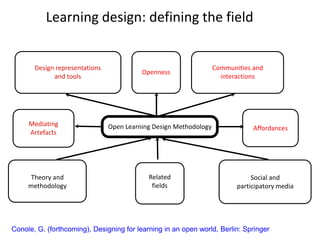
Learning design: defining the field


       Design representations                                      Communities and
                                          Openness
             and tools                                               interactions


     Mediating                  Open Learning Design Methodology               Affordances
     Artefacts


     Theory and                             Related                            Social and
     methodology                             fields                       participatory media


Conole, G. (forthcoming), Designing for learning in an open world, Berlin: Springer
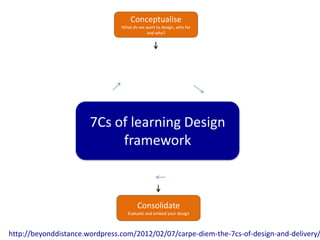
Conceptualise
                                What do we want to design, who for
                                           and why?


                       7Cs of learning Design
                            framework


                                       Consolidate
                                   Evaluate and embed your design


http://beyonddistance.wordpress.com/2012/02/07/carpe-diem-the-7cs-of-design-and-delivery/
•   Think of a resource you have created
•   Describe its inherent design
•   Share with the person next to you
•   Share with the wider group
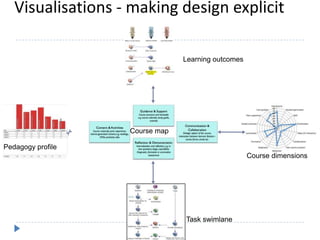
Visualisations - making design explicit

                                Learning outcomes


                   Course map

Pedagogy profile
                                                    Course dimensions


                                Task swimlane
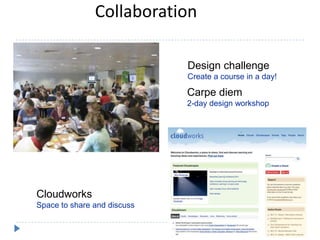
Collaboration

                             Design challenge
                             Create a course in a day!

                             Carpe diem
                             2-day design workshop


Cloudworks
Space to share and discuss
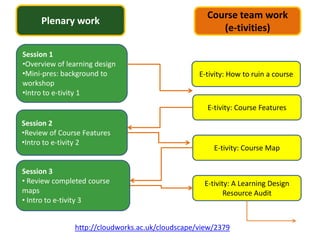
Course team work
     Plenary work
                                                       (e-tivities)

Session 1
•Overview of learning design
•Mini-pres: background to                         E-tivity: How to ruin a course
workshop
•Intro to e-tivity 1
                                                    E-tivity: Course Features
Session 2
•Review of Course Features
•Intro to e-tivity 2
                                                      E-tivity: Course Map

Session 3
• Review completed course                          E-tivity: A Learning Design
maps                                                      Resource Audit
• Intro to e-tivity 3


               http://cloudworks.ac.uk/cloudscape/view/2379
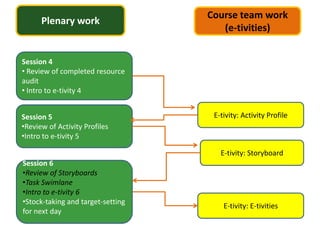
Course team work
      Plenary work
                                      (e-tivities)


Session 4
• Review of completed resource
audit
• Intro to e-tivity 4


Session 5                           E-tivity: Activity Profile
•Review of Activity Profiles
•Intro to e-tivity 5

                                      E-tivity: Storyboard
Session 6
•Review of Storyboards
•Task Swimlane
•Intro to e-tivity 6
•Stock-taking and target-setting
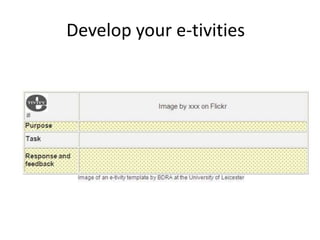
                                       E-tivity: E-tivities
for next day
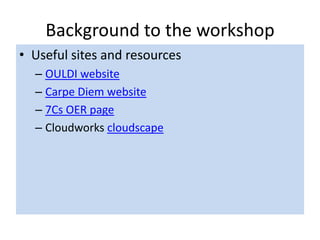
Background to the workshop
• Useful sites and resources
  – OULDI website
  – Carpe Diem website
  – 7Cs OER page
  – Cloudworks cloudscape
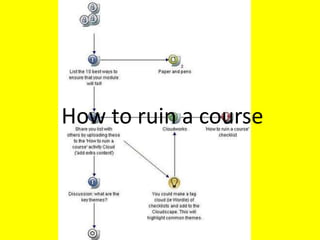
How to ruin a course
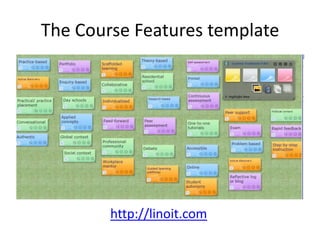
The Course Features template


        http://linoit.com
Course Features resources
• http://tinyurl.com/coursefeatures
• http://tinyurl.com/coursefeatures-Excel
• http://linoit.com
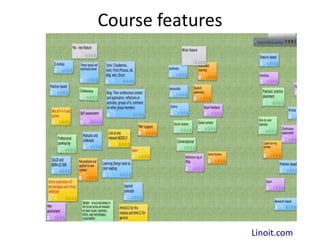
Course features


                  Linoit.com
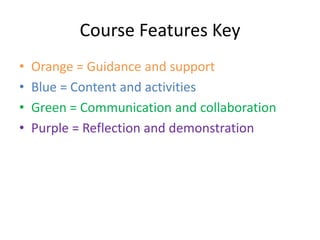
Course Features Key
•   Orange = Guidance and support
•   Blue = Content and activities
•   Green = Communication and collaboration
•   Purple = Reflection and demonstration
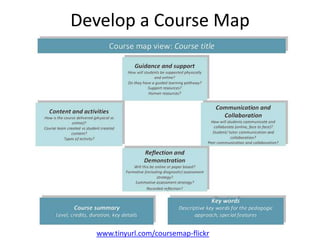
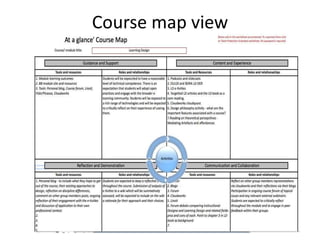
Develop a Course Map


  www.tinyurl.com/coursemap-flickr
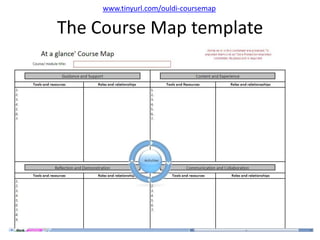
www.tinyurl.com/ouldi-coursemap

The Course Map template
Course map view
Course Map resources
• www.tinyurl.com/coursemap-cloudworks
• www.tinyurl.com/ouldi-coursemap
• www.tinyurl.com/coursemap-ds
• www.tinyurl.com/coursemap-flickr
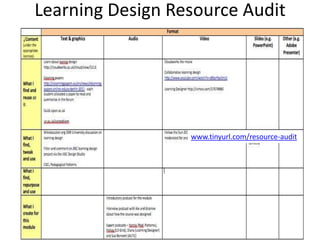
Learning Design Resource Audit


                  www.tinyurl.com/resource-audit
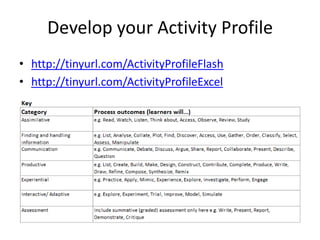
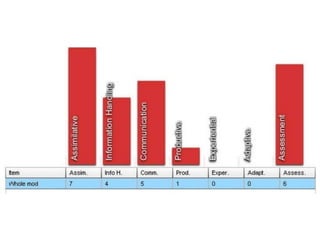
Develop your Activity Profile
• http://tinyurl.com/ActivityProfileFlash
• http://tinyurl.com/ActivityProfileExcel
Activity Profile Resources
• www.cloudworks.ac.uk/cloud/view/3420
• www.tinyurl.com/activity-profile-ds
• www.tinyurl.com/ActivityProfileFlash
• www.tinyurl.com/ActivityProfileExcel
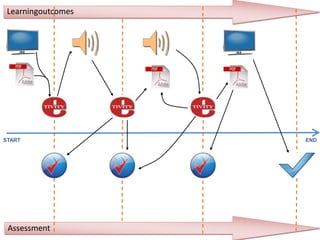
Learningoutcomes


START               END


 Assessment
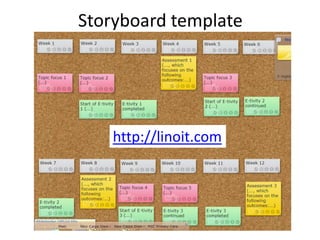
Storyboard template


    http://linoit.com
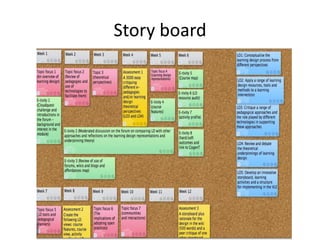
Story board
Develop your e-tivities
Benefits
•   Guides design process
•   Makes design explicit
•   Enables sharing
•   Fosters repurposing
•   Highlights gaps
•   Representations for
    learners
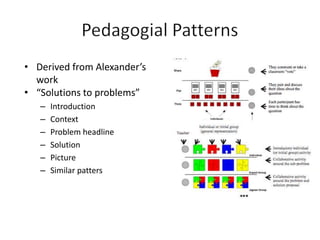
• Derived from Alexander’s
  work
• “Solutions to problems”
   –   Introduction
   –   Context
   –   Problem headline
   –   Solution
   –   Picture
   –   Similar patters
Implications
• New forms of communication
  and collaboration
• Rich multimedia
  representation
• Blurring boundaries
• More open practices
• New business models
• New digital literacies
• Harnessing the global
  network

         http://www.flickr.com/photos/10537908@N07/5904661557/
Conclusion
•   Co-evolving
•   Disruptive
•   Unpredictable
•   Complex
•   New opportunities
•   Social


               http://www.flickr.com/photos/planeta/6239911583/
http://www.slideshare.net/grainne
Conole, G. (forthcoming), Designing for learning in an open world, New York: Springer
                           Chapters available on dropbox
                              grainne.conole@le.ac.uk
References
• Conole, G. (forthcoming), Designing for learning in an
  open world, New York: Springer
• Conole, G. and Culver, J. (2010), The design of
  Cloudworks: applying social networking practice to
  foster the exchange of learning and teaching ideas and
  designs, Computers and Education, 54(3): 679 – 692
• Jameson, J. and De Freitas, S. (2012), The e-learning
  reader
• Jenkins, H. (2009), Confronting the challenges of
  participatory culture: Media education for the 21st
  century, Mit Pr.
• Naughton, J. (2012), From Gutenberg to Zuckerberg,
  what you really need to know about the internet
• Weller, M. (2011), The digital scholar - how technology
  is changing academic practice. London, Bloomsbury
  Academic

Conole openness

  • 1.
    Going open –the implications for learning, teaching and research Gráinne Conole, Leicester University 13th June 2012 UNISA, Pretoria
  • 2.
    Outline • Social and participatory media • Digital literacies • Fostering open practices • The problem • Learning design • Conclusions
  • 3.
    From DE toTEL to OEP • Origins of Distance Education • E-assessment and interactive tutorials • Emergence of web-based courses • Increased interactivity, communication and collaboration • Virtual worlds, games and mobile learning • Open Educational Resources and MOOCs Anderson and Dron
  • 4.
  • 5.
    Peer Open critiquing User Collective generated aggregation content Networked Personalised Social media revolution www.heacademy.ac.uk/asse s/EvidenceNet/Conole_Alev The machine is us/ing us ou_2010.pdf
  • 6.
    Technologies • Have transformed everything we do: – New forms of communication and collaboration – Multiple rich representations – Tools to find, create, manage, share – Networked, distributed, peer reviewed, open – Complex, dynamic and co- evolving http://www.flickr.com/photos/oceanflynn/6638184545/
  • 7.
    Gutenberg to Zuckerberg • Take the long view • The web is not the net • Disruption is a feature • Ecologies not economics • Complexity is the new reality • The network is now the computer • The web is evolving • Copyright or copywrong • Orwell (fear) or Huxley (pleasure) http://www.flickr.com/photos/wallyg/2617472088/ http://memex.naughtons.org/
  • 8.
    Digital literacies: definition •Set of social practices and meaning making of digital tools (Lankshear and Knobel, 2008) Socio-cultural view of digital literacy • Continuum from instrumental skills to productive competence and efficiency http://ftp.jrc.es/EURdoc/JRC67075_TN.pdf
  • 9.
    Digital literacies Play Creativity Collective intelligence Performance Judgement Simulation Transmedia navigation Appropriation Networking Multitasking Negotiation Distributed cognition Jenkins, 2009 http://www.imv.au.dk/icreanet/ http://www.flickr.com/photos/r8r/4109502436/
  • 10.
    Fostering new openpractices Open resources Open courses Open accreditation Open scholarship Open research
  • 11.
  • 12.
    Open courses Massive Open Online Course http://www.youtube.com/watch?v=eW3gMGqcZQc http://mooc.ca/
  • 13.
    Open accreditation Peer toPeer University OER University www.p2pu.org/en/ wikieducator.org/OER_university/
  • 14.
    Open scholarship • Exploitingthe digital network • New forms of dissemination and communication • Promoting reflective practice • Embracing the affordances of new technologies Weller, 2011 Weller: http://nogoodreason.typepad.co.uk/
  • 15.
  • 16.
  • 17.
  • 18.
    The problem Social and participatorymedia offer new ways to communicate and collaborate Not fully exploited Wealth of free Replicating bad pedagogy resources and tools Lack of time and skills
  • 19.
    Open Educational Resources Pedagogical patterns Learning Design
  • 20.
    Solution Shiftfrombelief-based, implicit approaches todesign- based,explicit approaches Learning Design A design-based approach to creation and support of courses Encouragesreflective,scholarly practices Promotessharing and discussion http://www.open.ac.uk/blogs/OULDI/
  • 21.
    Definition A methodology for enabling teachers/designers to make more informed decisions in how they go about designing learning activities and interventions, which is pedagogically informed and makes effective use of appropriate resources and technologies. This includes the design of resources and individual learning activities right up to curriculum-level design. A key principle is to help make the design process more explicit and shareable. Learning design as an area of research and development includes both gathering empirical evidence to understand the design process, as well as the development of a range of learning design resources, tools and activities. 21
  • 22.
    Representing pedagogy Empirical evidence base Guiding design Sharing ideas
  • 23.
    “Open Design” Adaptive Contextual Affordances of new Characteristics of Personalised Networked technologies good pedagogy Situative Immersive Social Collective Experiential Reflective
  • 24.
    Learning design: definingthe field Design representations Communities and Openness and tools interactions Mediating Open Learning Design Methodology Affordances Artefacts Theory and Related Social and methodology fields participatory media Conole, G. (forthcoming), Designing for learning in an open world, Berlin: Springer
  • 25.
    Conceptualise What do we want to design, who for and why? 7Cs of learning Design framework Consolidate Evaluate and embed your design http://beyonddistance.wordpress.com/2012/02/07/carpe-diem-the-7cs-of-design-and-delivery/
  • 26.
    Think of a resource you have created • Describe its inherent design • Share with the person next to you • Share with the wider group
  • 27.
    Visualisations - makingdesign explicit Learning outcomes Course map Pedagogy profile Course dimensions Task swimlane
  • 28.
    Collaboration Design challenge Create a course in a day! Carpe diem 2-day design workshop Cloudworks Space to share and discuss
  • 29.
    Course team work Plenary work (e-tivities) Session 1 •Overview of learning design •Mini-pres: background to E-tivity: How to ruin a course workshop •Intro to e-tivity 1 E-tivity: Course Features Session 2 •Review of Course Features •Intro to e-tivity 2 E-tivity: Course Map Session 3 • Review completed course E-tivity: A Learning Design maps Resource Audit • Intro to e-tivity 3 http://cloudworks.ac.uk/cloudscape/view/2379
  • 30.
    Course team work Plenary work (e-tivities) Session 4 • Review of completed resource audit • Intro to e-tivity 4 Session 5 E-tivity: Activity Profile •Review of Activity Profiles •Intro to e-tivity 5 E-tivity: Storyboard Session 6 •Review of Storyboards •Task Swimlane •Intro to e-tivity 6 •Stock-taking and target-setting E-tivity: E-tivities for next day
  • 31.
    Background to theworkshop • Useful sites and resources – OULDI website – Carpe Diem website – 7Cs OER page – Cloudworks cloudscape
  • 32.
    How to ruina course
  • 33.
    How to ruina course
  • 34.
    The Course Featurestemplate http://linoit.com
  • 35.
    Course Features resources •http://tinyurl.com/coursefeatures • http://tinyurl.com/coursefeatures-Excel • http://linoit.com
  • 36.
    Course features Linoit.com
  • 37.
    Course Features Key • Orange = Guidance and support • Blue = Content and activities • Green = Communication and collaboration • Purple = Reflection and demonstration
  • 38.
    Develop a CourseMap www.tinyurl.com/coursemap-flickr
  • 39.
  • 40.
  • 41.
    Course Map resources •www.tinyurl.com/coursemap-cloudworks • www.tinyurl.com/ouldi-coursemap • www.tinyurl.com/coursemap-ds • www.tinyurl.com/coursemap-flickr
  • 42.
    Learning Design ResourceAudit www.tinyurl.com/resource-audit
  • 43.
    Develop your ActivityProfile • http://tinyurl.com/ActivityProfileFlash • http://tinyurl.com/ActivityProfileExcel
  • 45.
    Activity Profile Resources •www.cloudworks.ac.uk/cloud/view/3420 • www.tinyurl.com/activity-profile-ds • www.tinyurl.com/ActivityProfileFlash • www.tinyurl.com/ActivityProfileExcel
  • 46.
  • 47.
    Storyboard template http://linoit.com
  • 48.
  • 49.
  • 50.
    Benefits • Guides design process • Makes design explicit • Enables sharing • Fosters repurposing • Highlights gaps • Representations for learners
  • 51.
    • Derived fromAlexander’s work • “Solutions to problems” – Introduction – Context – Problem headline – Solution – Picture – Similar patters
  • 52.
    Implications • New formsof communication and collaboration • Rich multimedia representation • Blurring boundaries • More open practices • New business models • New digital literacies • Harnessing the global network http://www.flickr.com/photos/10537908@N07/5904661557/
  • 53.
    Conclusion • Co-evolving • Disruptive • Unpredictable • Complex • New opportunities • Social http://www.flickr.com/photos/planeta/6239911583/
  • 54.
    http://www.slideshare.net/grainne Conole, G. (forthcoming),Designing for learning in an open world, New York: Springer Chapters available on dropbox grainne.conole@le.ac.uk
  • 55.
    References • Conole, G.(forthcoming), Designing for learning in an open world, New York: Springer • Conole, G. and Culver, J. (2010), The design of Cloudworks: applying social networking practice to foster the exchange of learning and teaching ideas and designs, Computers and Education, 54(3): 679 – 692 • Jameson, J. and De Freitas, S. (2012), The e-learning reader • Jenkins, H. (2009), Confronting the challenges of participatory culture: Media education for the 21st century, Mit Pr. • Naughton, J. (2012), From Gutenberg to Zuckerberg, what you really need to know about the internet • Weller, M. (2011), The digital scholar - how technology is changing academic practice. London, Bloomsbury Academic

Editor's Notes

  • #30 http://cloudworks.ac.uk/cloudscape/view/2379 –Cloudscape for the SAIDE workshop
  • #32 Add all the URLs here
  • #33 For participants to fill in – silent brainstorm.
  • #38 First askparticipants to guesswhat the colours represent. (See previous slide.)
  • #39 Include link to Course Map in Excel
  • #40 Include link to Course Map in Excel
  • #41 Include link to Course Map in Excel