Learning design: an overview


Gráinne Conole,
Leicester University, grainne.conole@le.ac.uk
ASLD workshop, London, 13th October 2011
A new learning design methodology                                                     2


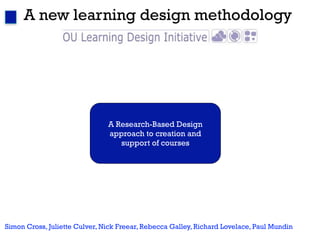
                               A Research-Based Design
                               approach to creation and
                                  support of courses


Simon Cross, Juliette Culver, Nick Freear, Rebecca Galley, Richard Lovelace, Paul Mundin
A new learning design methodology                                                     2


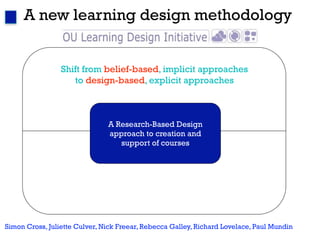
                 Shift from belief-based, implicit approaches
                    to design-based, explicit approaches


                               A Research-Based Design
                               approach to creation and
                                  support of courses


Simon Cross, Juliette Culver, Nick Freear, Rebecca Galley, Richard Lovelace, Paul Mundin
A new learning design methodology                                                     2


                 Shift from belief-based, implicit approaches
                    to design-based, explicit approaches


                               A Research-Based Design
                               approach to creation and
                                  support of courses


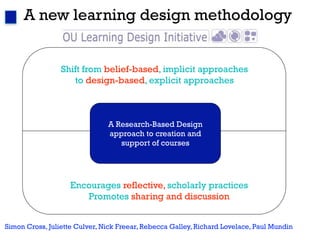
                   Encourages reflective, scholarly practices
                      Promotes sharing and discussion


Simon Cross, Juliette Culver, Nick Freear, Rebecca Galley, Richard Lovelace, Paul Mundin
Definition                                             3


 A methodology for enabling teachers/designers to
   make more informed decisions in how they go
       about designing learning activities and
interventions, which is pedagogically informed and
 makes effective use of appropriate resources and
technologies. This includes the design of resources
    and individual learning activities right up to
 curriculum-level design. A key principle is to help
     make the design process more explicit and
 shareable. Learning design as an area of research
and development includes both gathering empirical
evidence to understand the design process, as well
 as the development of a range of learning design
           resources, tools and activities.
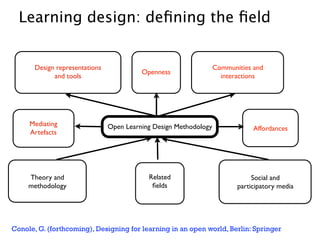
Learning design: defining the field


                             Open Learning Design Methodology


Conole, G. (forthcoming), Designing for learning in an open world, Berlin: Springer
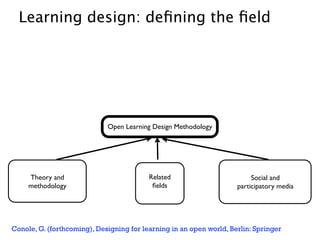
Learning design: defining the field


                             Open Learning Design Methodology


     Theory and                           Related                         Social and
     methodology                           fields                     participatory media


Conole, G. (forthcoming), Designing for learning in an open world, Berlin: Springer
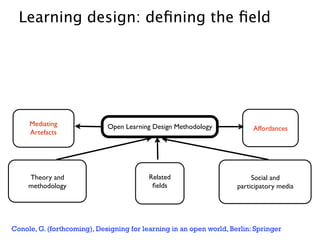
Learning design: defining the field


     Mediating               Open Learning Design Methodology             Affordances
     Artefacts


     Theory and                           Related                         Social and
     methodology                           fields                     participatory media


Conole, G. (forthcoming), Designing for learning in an open world, Berlin: Springer
Learning design: defining the field


       Design representations                                      Communities and
                                          Openness
             and tools                                               interactions


     Mediating                  Open Learning Design Methodology               Affordances
     Artefacts


     Theory and                             Related                            Social and
     methodology                             fields                        participatory media


Conole, G. (forthcoming), Designing for learning in an open world, Berlin: Springer
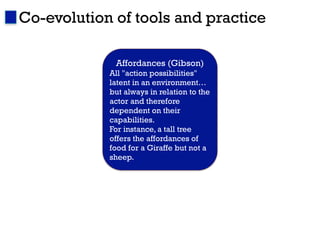
Co-evolution of tools and practice

             Affordances (Gibson)
            All "action possibilities"
            latent in an environment…
            but always in relation to the
            actor and therefore
            dependent on their
            capabilities.
            For instance, a tall tree
            offers the affordances of
            food for a Giraffe but not a
            sheep.
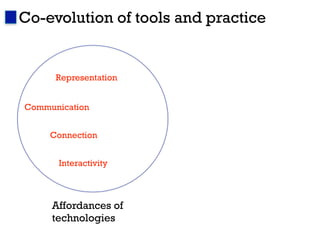
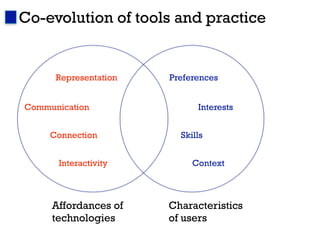
Co-evolution of tools and practice


      Representation


Communication


     Connection


      Interactivity


     Affordances of
     technologies
Co-evolution of tools and practice


      Representation   Preferences


Communication                Interests


     Connection          Skills


      Interactivity         Context


     Affordances of    Characteristics
     technologies      of users
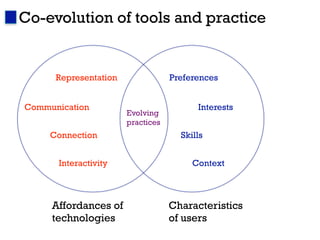
Co-evolution of tools and practice


      Representation               Preferences


Communication                            Interests
                       Evolving
                       practices
     Connection                      Skills


      Interactivity                     Context


     Affordances of                Characteristics
     technologies                  of users
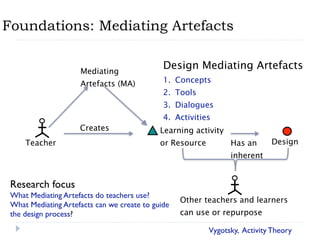
Foundations: Mediating Artefacts


                            Vygotsky, Activity Theory
Foundations: Mediating Artefacts


   Teacher


                            Vygotsky, Activity Theory
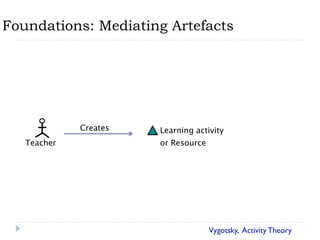
Foundations: Mediating Artefacts


             Creates   Learning activity
   Teacher             or Resource


                                     Vygotsky, Activity Theory
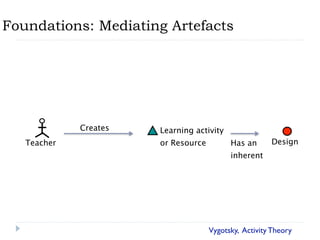
Foundations: Mediating Artefacts


             Creates   Learning activity
   Teacher             or Resource         Has an      Design
                                           inherent


                                     Vygotsky, Activity Theory
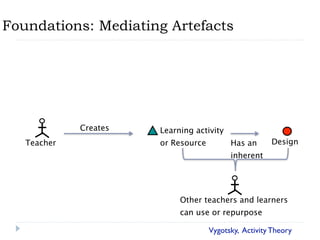
Foundations: Mediating Artefacts


             Creates   Learning activity
   Teacher             or Resource         Has an      Design
                                           inherent


                            Other teachers and learners
                            can use or repurpose

                                     Vygotsky, Activity Theory
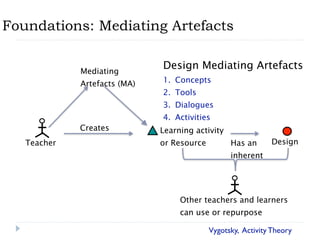
Foundations: Mediating Artefacts


             Mediating
                              Design Mediating Artefacts
             Artefacts (MA)   1. Concepts
                              2. Tools
                              3. Dialogues
                              4. Activities
             Creates          Learning activity
   Teacher                    or Resource         Has an      Design
                                                  inherent


                                   Other teachers and learners
                                   can use or repurpose

                                            Vygotsky, Activity Theory
Foundations: Mediating Artefacts


                     Mediating
                                              Design Mediating Artefacts
                     Artefacts (MA)           1. Concepts
                                              2. Tools
                                              3. Dialogues
                                              4. Activities
                     Creates                 Learning activity
     Teacher                                 or Resource         Has an      Design
                                                                 inherent


 Research focus
 What Mediating Artefacts do teachers use?
                                                   Other teachers and learners
 What Mediating Artefacts can we create to guide
 the design process?                               can use or repurpose

                                                           Vygotsky, Activity Theory
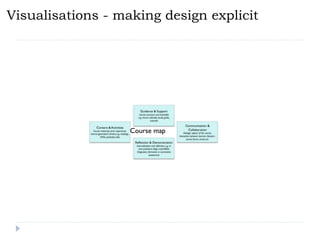
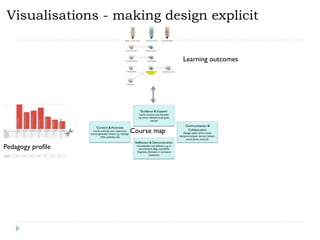
Visualisations - making design explicit


                   Course map
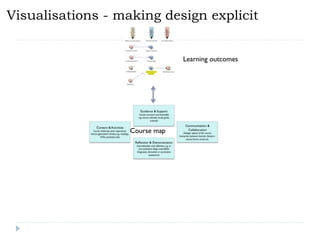
Visualisations - making design explicit


                                Learning outcomes


                   Course map
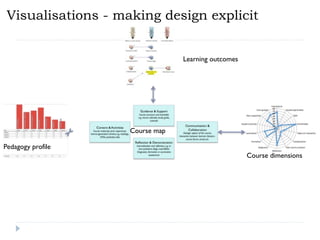
Visualisations - making design explicit


                                 Learning outcomes


                    Course map

Pedagogy profile
Visualisations - making design explicit


                                 Learning outcomes


                    Course map

Pedagogy profile
                                                     Course dimensions
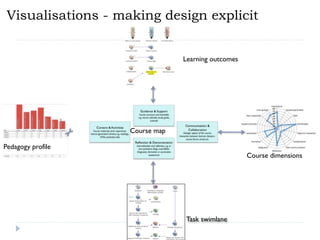
Visualisations - making design explicit


                                 Learning outcomes


                    Course map

Pedagogy profile
                                                     Course dimensions


                                 Task swimlane
Collaboration
Collaboration

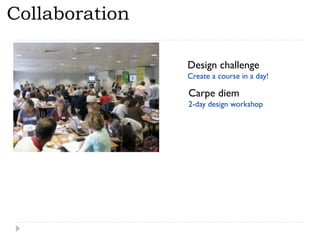
                Design challenge
                Create a course in a day!

                Carpe diem
                2-day design workshop
Collaboration

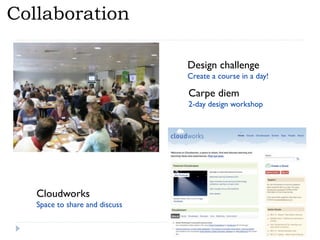
                                Design challenge
                                Create a course in a day!

                                Carpe diem
                                2-day design workshop


   Cloudworks
   Space to share and discuss
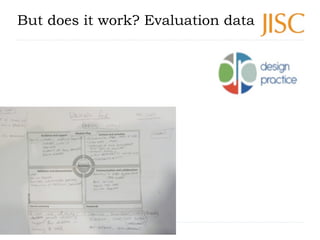
But does it work? Evaluation data


9
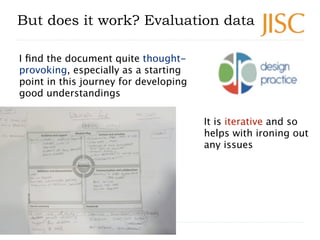
But does it work? Evaluation data

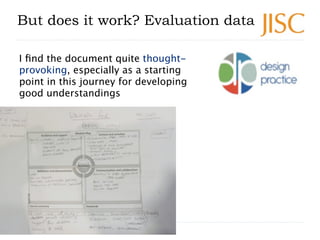
I find the document quite thought-
provoking, especially as a starting
point in this journey for developing
good understandings


9
But does it work? Evaluation data

I find the document quite thought-
provoking, especially as a starting
point in this journey for developing
good understandings

                                       It is iterative and so
                                       helps with ironing out
                                       any issues


9
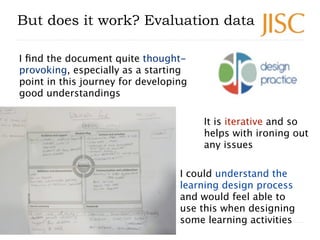
But does it work? Evaluation data

I find the document quite thought-
provoking, especially as a starting
point in this journey for developing
good understandings

                                       It is iterative and so
                                       helps with ironing out
                                       any issues

                                  I could understand the
                                  learning design process
                                  and would feel able to
                                  use this when designing
                                  some learning activities
9
Questions
    What would a coherent learning design language
     look like and how might it be shared?
    What other Mediating Artefacts do we need to develop to
     enable learners and teachers make more effective use of
     technologies to support learning? What are the different ways
     in which learning interventions can be represented?
    How can we foster a global network and Community of
     Practice to enable learners and teachers to share and discuss
     learning and teaching ideas?
    What tools do we need to guide design practice, visualise
     designs and provide a digital environment for learners and
     teachers to share and discuss?


    10
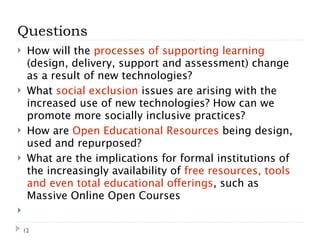
Questions
    What are the implications and likely impact of social
     and participatory media for education and how can
     they be harnessed more effectively to support
     learning?
    What will be the impact of new emergent
     technologies on the stakeholders involved in
     education?
    What new pedagogies are emerging as a result of
     these new technologies?What are the implications for
     learners, teachers and institutions of new social and
     participatory media?


    11
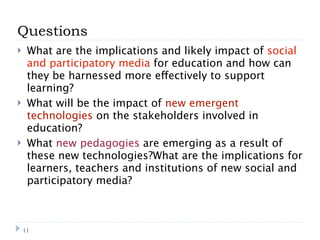
Questions
    How will the processes of supporting learning
     (design, delivery, support and assessment) change
     as a result of new technologies?
    What social exclusion issues are arising with the
     increased use of new technologies? How can we
     promote more socially inclusive practices?
    How are Open Educational Resources being design,
     used and repurposed?
    What are the implications for formal institutions of
     the increasingly availability of free resources, tools
     and even total educational offerings, such as
     Massive Online Open Courses


    12
Questions
    What digital literacy skills do learners and teachers
     need to make effective use of these technologies
     and resources? To what extent are they evident and
     how can they be developed?
    How are the ways in which learners and teachers
     communicate and collaborate changing with the use
     of these technologies?
    How can we create effective new digital learning
     environments to promote the use of social and
     participatory media and OER?
    How can informal learning using OER be assessed
     and accredited?


    13
    What kinds of policy directives are in place to
     promote social inclusion through the use of OER and
     how effective are they?
    What new methodologies and theoretical
     perspectives will be needed to address these
     research questions and to interpret the findings?


    14
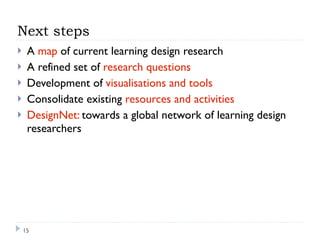
Next steps
    A map of current learning design research
    A refined set of research questions
    Development of visualisations and tools
    Consolidate existing resources and activities
    DesignNet: towards a global network of learning design
     researchers


    15
URLs
•   http://robwall.ca/2009/03/10/creativity-is-the-new-technology/

•   http://www.youtube.com/watch?v=nvIQP-EBPqc

•   http://vimeo.com/3365942

•   http://blogs.hbr.org/video/2010/05/andrew-klavan-on-
    how-21st-cent.html

•   Questionmark http://www.flickr.com/photos/crystaljingsr/
    3914729343/

Conole ld

  • 1.
    Learning design: anoverview Gráinne Conole, Leicester University, grainne.conole@le.ac.uk ASLD workshop, London, 13th October 2011
  • 2.
    A new learningdesign methodology 2 A Research-Based Design approach to creation and support of courses Simon Cross, Juliette Culver, Nick Freear, Rebecca Galley, Richard Lovelace, Paul Mundin
  • 3.
    A new learningdesign methodology 2 Shift from belief-based, implicit approaches to design-based, explicit approaches A Research-Based Design approach to creation and support of courses Simon Cross, Juliette Culver, Nick Freear, Rebecca Galley, Richard Lovelace, Paul Mundin
  • 4.
    A new learningdesign methodology 2 Shift from belief-based, implicit approaches to design-based, explicit approaches A Research-Based Design approach to creation and support of courses Encourages reflective, scholarly practices Promotes sharing and discussion Simon Cross, Juliette Culver, Nick Freear, Rebecca Galley, Richard Lovelace, Paul Mundin
  • 5.
    Definition 3 A methodology for enabling teachers/designers to make more informed decisions in how they go about designing learning activities and interventions, which is pedagogically informed and makes effective use of appropriate resources and technologies. This includes the design of resources and individual learning activities right up to curriculum-level design. A key principle is to help make the design process more explicit and shareable. Learning design as an area of research and development includes both gathering empirical evidence to understand the design process, as well as the development of a range of learning design resources, tools and activities.
  • 6.
    Learning design: definingthe field Open Learning Design Methodology Conole, G. (forthcoming), Designing for learning in an open world, Berlin: Springer
  • 7.
    Learning design: definingthe field Open Learning Design Methodology Theory and Related Social and methodology fields participatory media Conole, G. (forthcoming), Designing for learning in an open world, Berlin: Springer
  • 8.
    Learning design: definingthe field Mediating Open Learning Design Methodology Affordances Artefacts Theory and Related Social and methodology fields participatory media Conole, G. (forthcoming), Designing for learning in an open world, Berlin: Springer
  • 9.
    Learning design: definingthe field Design representations Communities and Openness and tools interactions Mediating Open Learning Design Methodology Affordances Artefacts Theory and Related Social and methodology fields participatory media Conole, G. (forthcoming), Designing for learning in an open world, Berlin: Springer
  • 10.
    Co-evolution of toolsand practice Affordances (Gibson) All "action possibilities" latent in an environment… but always in relation to the actor and therefore dependent on their capabilities. For instance, a tall tree offers the affordances of food for a Giraffe but not a sheep.
  • 11.
  • 12.
    Co-evolution of toolsand practice Representation Communication Connection Interactivity Affordances of technologies
  • 13.
    Co-evolution of toolsand practice Representation Preferences Communication Interests Connection Skills Interactivity Context Affordances of Characteristics technologies of users
  • 14.
    Co-evolution of toolsand practice Representation Preferences Communication Interests Evolving practices Connection Skills Interactivity Context Affordances of Characteristics technologies of users
  • 15.
    Foundations: Mediating Artefacts Vygotsky, Activity Theory
  • 16.
    Foundations: Mediating Artefacts Teacher Vygotsky, Activity Theory
  • 17.
    Foundations: Mediating Artefacts Creates Learning activity Teacher or Resource Vygotsky, Activity Theory
  • 18.
    Foundations: Mediating Artefacts Creates Learning activity Teacher or Resource Has an Design inherent Vygotsky, Activity Theory
  • 19.
    Foundations: Mediating Artefacts Creates Learning activity Teacher or Resource Has an Design inherent Other teachers and learners can use or repurpose Vygotsky, Activity Theory
  • 20.
    Foundations: Mediating Artefacts Mediating Design Mediating Artefacts Artefacts (MA) 1. Concepts 2. Tools 3. Dialogues 4. Activities Creates Learning activity Teacher or Resource Has an Design inherent Other teachers and learners can use or repurpose Vygotsky, Activity Theory
  • 21.
    Foundations: Mediating Artefacts Mediating Design Mediating Artefacts Artefacts (MA) 1. Concepts 2. Tools 3. Dialogues 4. Activities Creates Learning activity Teacher or Resource Has an Design inherent Research focus What Mediating Artefacts do teachers use? Other teachers and learners What Mediating Artefacts can we create to guide the design process? can use or repurpose Vygotsky, Activity Theory
  • 22.
    Visualisations - makingdesign explicit
  • 23.
    Visualisations - makingdesign explicit Course map
  • 24.
    Visualisations - makingdesign explicit Learning outcomes Course map
  • 25.
    Visualisations - makingdesign explicit Learning outcomes Course map Pedagogy profile
  • 26.
    Visualisations - makingdesign explicit Learning outcomes Course map Pedagogy profile Course dimensions
  • 27.
    Visualisations - makingdesign explicit Learning outcomes Course map Pedagogy profile Course dimensions Task swimlane
  • 28.
  • 29.
    Collaboration Design challenge Create a course in a day! Carpe diem 2-day design workshop
  • 30.
    Collaboration Design challenge Create a course in a day! Carpe diem 2-day design workshop Cloudworks Space to share and discuss
  • 31.
    But does itwork? Evaluation data 9
  • 32.
    But does itwork? Evaluation data I find the document quite thought- provoking, especially as a starting point in this journey for developing good understandings 9
  • 33.
    But does itwork? Evaluation data I find the document quite thought- provoking, especially as a starting point in this journey for developing good understandings It is iterative and so helps with ironing out any issues 9
  • 34.
    But does itwork? Evaluation data I find the document quite thought- provoking, especially as a starting point in this journey for developing good understandings It is iterative and so helps with ironing out any issues I could understand the learning design process and would feel able to use this when designing some learning activities 9
  • 35.
    Questions  What would a coherent learning design language look like and how might it be shared?  What other Mediating Artefacts do we need to develop to enable learners and teachers make more effective use of technologies to support learning? What are the different ways in which learning interventions can be represented?  How can we foster a global network and Community of Practice to enable learners and teachers to share and discuss learning and teaching ideas?  What tools do we need to guide design practice, visualise designs and provide a digital environment for learners and teachers to share and discuss? 10
  • 36.
    Questions  What are the implications and likely impact of social and participatory media for education and how can they be harnessed more effectively to support learning?  What will be the impact of new emergent technologies on the stakeholders involved in education?  What new pedagogies are emerging as a result of these new technologies?What are the implications for learners, teachers and institutions of new social and participatory media? 11
  • 37.
    Questions  How will the processes of supporting learning (design, delivery, support and assessment) change as a result of new technologies?  What social exclusion issues are arising with the increased use of new technologies? How can we promote more socially inclusive practices?  How are Open Educational Resources being design, used and repurposed?  What are the implications for formal institutions of the increasingly availability of free resources, tools and even total educational offerings, such as Massive Online Open Courses  12
  • 38.
    Questions  What digital literacy skills do learners and teachers need to make effective use of these technologies and resources? To what extent are they evident and how can they be developed?  How are the ways in which learners and teachers communicate and collaborate changing with the use of these technologies?  How can we create effective new digital learning environments to promote the use of social and participatory media and OER?  How can informal learning using OER be assessed and accredited?  13
  • 39.
    What kinds of policy directives are in place to promote social inclusion through the use of OER and how effective are they?  What new methodologies and theoretical perspectives will be needed to address these research questions and to interpret the findings? 14
  • 40.
    Next steps  A map of current learning design research  A refined set of research questions  Development of visualisations and tools  Consolidate existing resources and activities  DesignNet: towards a global network of learning design researchers 15
  • 41.
    URLs • http://robwall.ca/2009/03/10/creativity-is-the-new-technology/ • http://www.youtube.com/watch?v=nvIQP-EBPqc • http://vimeo.com/3365942 • http://blogs.hbr.org/video/2010/05/andrew-klavan-on- how-21st-cent.html • Questionmark http://www.flickr.com/photos/crystaljingsr/ 3914729343/