
Contemporary perspectives in
     e-learning research
 Gráinne Conole, University of Leicester
       University of Hertfordshire
           21st March 12012
Outline
•   The e-learning landscape
•   Affordances of new technologies
•   From Gutenberg to Zuckerberg
•   Learner experience
•   New pedagogies
•   Open practices
•   Teacher practice and paradoxes
•   Strategies for change
    – TheVLE as a Trojan horse
    – New approaches to design
• Metaphors
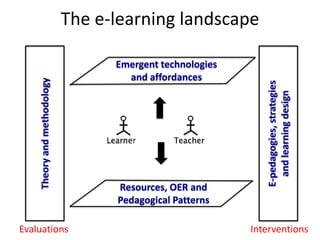
The e-learning landscape

                                   Emergent technologies
                                     and affordances
    Theory and methodology


                                                              E-pedagogies, strategies
                                                                and learning design
                                   Resources, OER and
                                   Pedagogical Patterns

Evaluations                                                Interventions
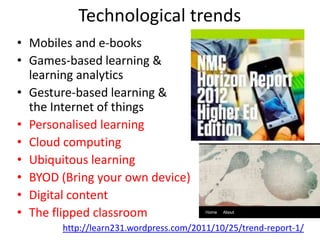
Technological trends
• Mobiles and e-books
• Games-based learning &
  learning analytics
• Gesture-based learning &
  the Internet of things
• Personalised learning
• Cloud computing
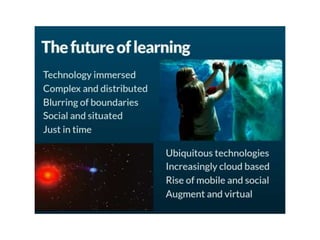
• Ubiquitous learning
• BYOD (Bring your own device)
• Digital content
• The flipped classroom
       http://learn231.wordpress.com/2011/10/25/trend-report-1/
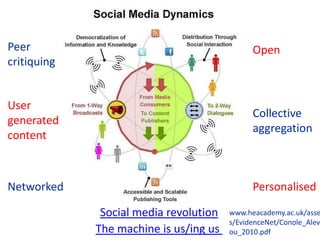
Peer                                          Open
critiquing


User
                                              Collective
generated
                                              aggregation
content


Networked                                     Personalised

              Social media revolution   www.heacademy.ac.uk/asse
                                        s/EvidenceNet/Conole_Alev
             The machine is us/ing us   ou_2010.pdf
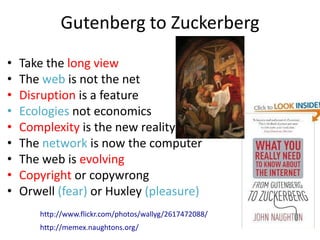
Gutenberg to Zuckerberg
•   Take the long view
•   The web is not the net
•   Disruption is a feature
•   Ecologies not economics
•   Complexity is the new reality
•   The network is now the computer
•   The web is evolving
•   Copyright or copywrong
•   Orwell (fear) or Huxley (pleasure)
       http://www.flickr.com/photos/wallyg/2617472088/
       http://memex.naughtons.org/
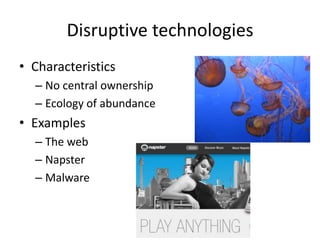
Disruptive technologies
• Characteristics
  – No central ownership
  – Ecology of abundance
• Examples
  – The web
  – Napster
  – Malware
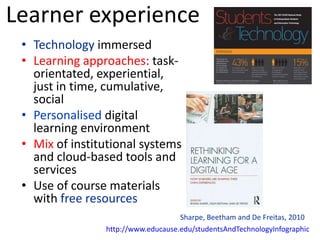
Learner experience
 • Technology immersed
 • Learning approaches: task-
   orientated, experiential,
   just in time, cumulative,
   social
 • Personalised digital
   learning environment
 • Mix of institutional systems
   and cloud-based tools and
   services
 • Use of course materials
   with free resources
                                    Sharpe, Beetham and De Freitas, 2010
                http://www.educause.edu/studentsAndTechnologyInfographic
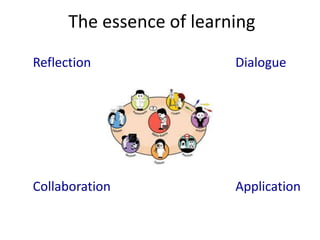
The essence of learning

Reflection                Dialogue


Collaboration             Application
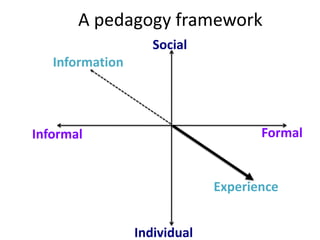
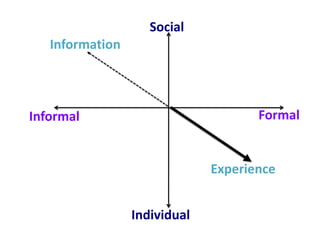
A pedagogy framework
                    Social
   Information


Informal                             Formal


                              Experience


                 Individual
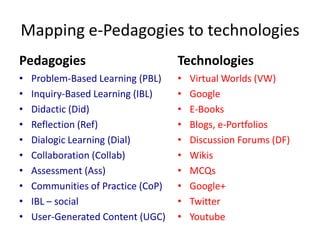
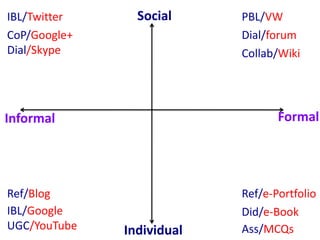
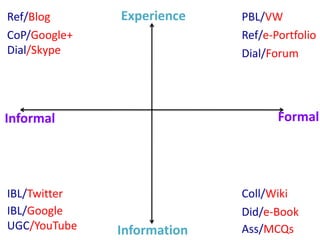
Mapping e-Pedagogies to technologies
Pedagogies                          Technologies
•   Problem-Based Learning (PBL)    •   Virtual Worlds (VW)
•   Inquiry-Based Learning (IBL)    •   Google
•   Didactic (Did)                  •   E-Books
•   Reflection (Ref)                •   Blogs, e-Portfolios
•   Dialogic Learning (Dial)        •   Discussion Forums (DF)
•   Collaboration (Collab)          •   Wikis
•   Assessment (Ass)                •   MCQs
•   Communities of Practice (CoP)   •   Google+
•   IBL – social                    •   Twitter
•   User-Generated Content (UGC)    •   Youtube
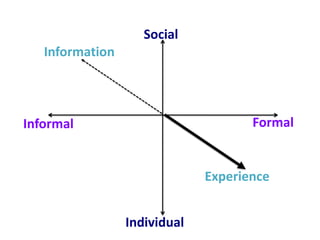
Social
   Information


Informal                             Formal


                              Experience


                 Individual
IBL/Twitter     Social     PBL/VW
CoP/Google+                Dial/forum
Dial/Skype                 Collab/Wiki


Informal                          Formal


Ref/Blog                   Ref/e-Portfolio
IBL/Google                 Did/e-Book
UGC/YouTube   Individual   Ass/MCQs
Social
   Information


Informal                             Formal


                              Experience


                 Individual
Ref/Blog      Experience    PBL/VW
CoP/Google+                 Ref/e-Portfolio
Dial/Skype                  Dial/Forum


Informal                           Formal


IBL/Twitter                 Coll/Wiki
IBL/Google                  Did/e-Book
UGC/YouTube   Information   Ass/MCQs
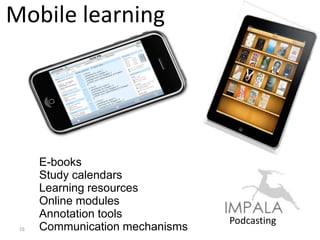
Mobile learning


      E-books
      Study calendars
      Learning resources
      Online modules
      Annotation tools
                                 Podcasting
 16   Communication mechanisms
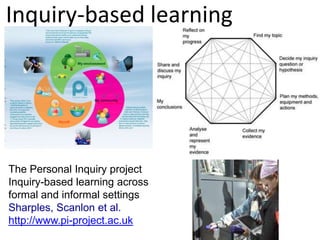
Inquiry-based learning


                 My community


The Personal Inquiry project
Inquiry-based learning across
formal and informal settings
Sharples, Scanlon et al.
http://www.pi-project.ac.uk
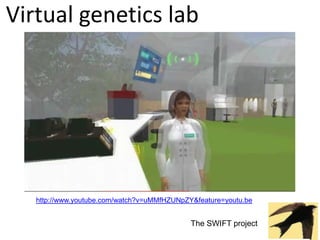
Virtual genetics lab


   http://www.youtube.com/watch?v=uMMfHZUNpZY&feature=youtu.be


                                             The SWIFT project
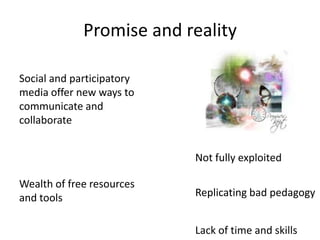
Promise and reality

Social and participatory
media offer new ways to
communicate and
collaborate


                           Not fully exploited

Wealth of free resources
and tools                  Replicating bad pedagogy


                           Lack of time and skills
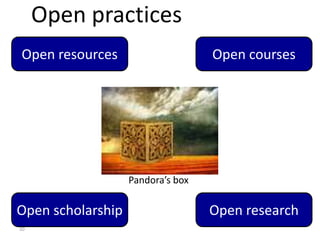
Open practices
Open resources                     Open courses


                   Pandora’s box

Open scholarship                   Open research
20
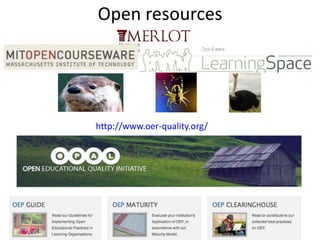
Open resources


http://www.oer-quality.org/
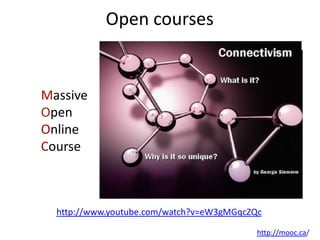
Open courses


Massive
Open
Online
Course


  http://www.youtube.com/watch?v=eW3gMGqcZQc

                                           http://mooc.ca/
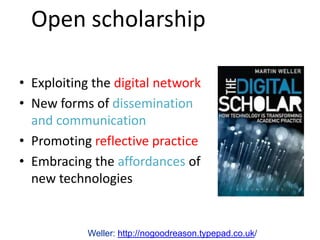
Open scholarship

• Exploiting the digital network
• New forms of dissemination
  and communication
• Promoting reflective practice
• Embracing the affordances of
  new technologies


            Weller: http://nogoodreason.typepad.co.uk/
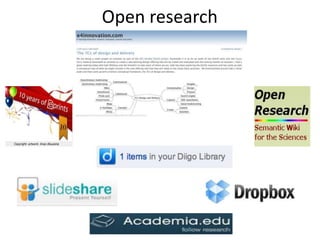
Open research
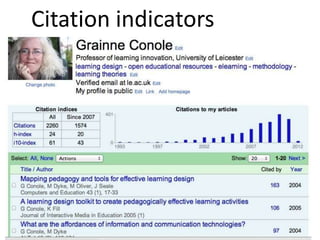
Citation indicators
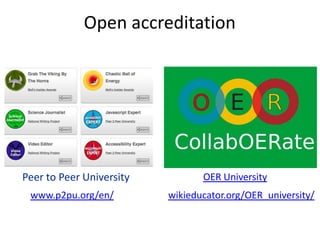
Open accreditation


Peer to Peer University          OER University
 www.p2pu.org/en/         wikieducator.org/OER_university/
Teacher practices: paradoxes
• Technologiesnot extensively
  used (Molenda)
• Lack of uptake of OER
  (McAndrew et al.)
• Little use beyond early
  adopters (Rogers)
• Despite rhetoric and funding   Pandora’s box
  little evidence of
  transformation (Cuban,
  Ehlers)
 27
TheVLEas a Trojan horse

• VLEas a safe nursery slope
• Shift from content to
  activities
• Promote reflection and
  collaboration
• MobileVLE
• Integration with cloud
  computing
Blackboard audit
• Data
   – Online survey (260 returns)
   – Departmental visits
• Key findings
   – Used as content repository
     and administration
   – Pockets of innovation
   – More support needed on
     effective design strategies
   – Tension between teaching
     and research
   – Usability issue
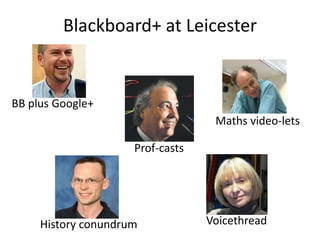
Blackboard+ at Leicester


BB plus Google+
                                   Maths video-lets

                     Prof-casts


     History conundrum            Voicethread
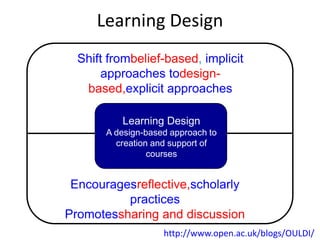
Learning Design
  Shift frombelief-based, implicit
       approaches todesign-
   based,explicit approaches

          Learning Design
       A design-based approach to
         creation and support of
                 courses


 Encouragesreflective,scholarly
          practices
Promotessharing and discussion
                    http://www.open.ac.uk/blogs/OULDI/
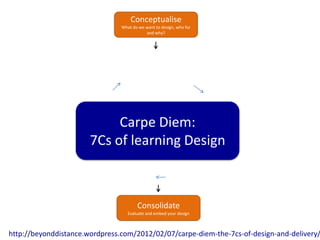
Conceptualise
                                What do we want to design, who for
                                           and why?


                            Carpe Diem:
                       7Cs of learning Design


                                       Consolidate
                                   Evaluate and embed your design


http://beyonddistance.wordpress.com/2012/02/07/carpe-diem-the-7cs-of-design-and-delivery/
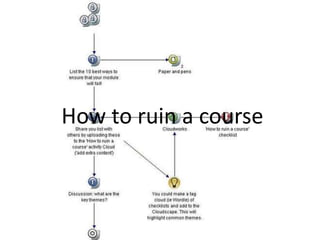
How to ruin a course
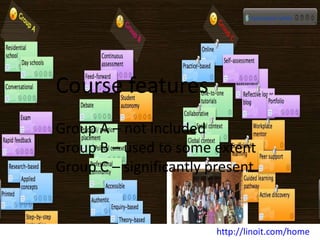
Course features
Group A – not included
Group B – used to some extent
Group C – significantly present


                        http://linoit.com/home
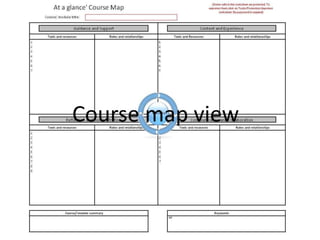
Course map view
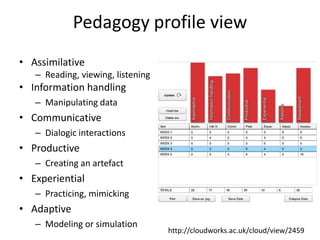
Pedagogy profile view
• Assimilative
   – Reading, viewing, listening
• Information handling
   – Manipulating data
• Communicative
   – Dialogic interactions
• Productive
   – Creating an artefact
• Experiential
   – Practicing, mimicking
• Adaptive
   – Modeling or simulation
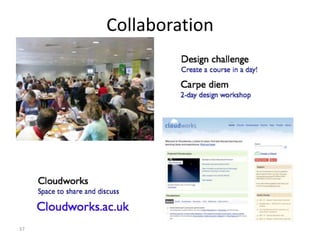
                                   http://cloudworks.ac.uk/cloud/view/2459
Collaboration


37
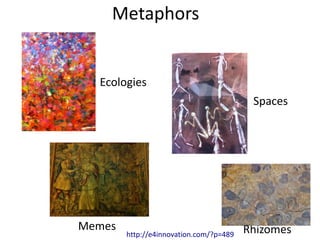
Metaphors


  Ecologies
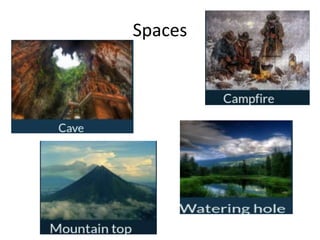
                                          Spaces


Memes                                    Rhizomes
        http://e4innovation.com/?p=489
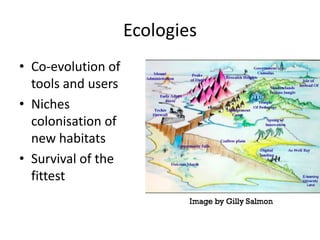
Ecologies
• Co-evolution of
  tools and users
• Niches
  colonisation of
  new habitats
• Survival of the
  fittest
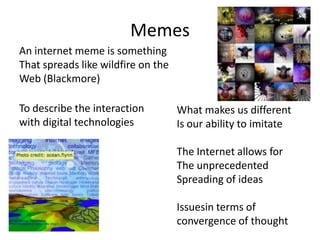
Memes
An internet meme is something
That spreads like wildfire on the
Web (Blackmore)

To describe the interaction         What makes us different
with digital technologies           Is our ability to imitate

                                    The Internet allows for
                                    The unprecedented
                                    Spreading of ideas

                                    Issuesin terms of
                                    convergence of thought
Spaces
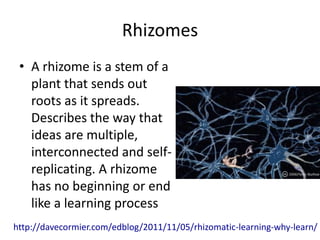
Rhizomes
 • A rhizome is a stem of a
   plant that sends out
   roots as it spreads.
   Describes the way that
   ideas are multiple,
   interconnected and self-
   replicating. A rhizome
   has no beginning or end
   like a learning process
http://davecormier.com/edblog/2011/11/05/rhizomatic-learning-why-learn/
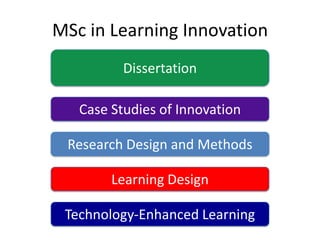
MSc in Learning Innovation
          Dissertation

   Case Studies of Innovation

 Research Design and Methods

        Learning Design

 Technology-Enhanced Learning
28 – 30th March 2012


http://www2.le.ac.uk/departments/beyond-distance-research-alliance/festival
Conole, G. (forthcoming), Designing for learning in an open world, New York: Springer
                           Chapters available on dropbox
                              grainne.conole@le.ac.uk

Conole hertfordshire

  • 1.
    Contemporary perspectives in e-learning research Gráinne Conole, University of Leicester University of Hertfordshire 21st March 12012
  • 2.
    Outline • The e-learning landscape • Affordances of new technologies • From Gutenberg to Zuckerberg • Learner experience • New pedagogies • Open practices • Teacher practice and paradoxes • Strategies for change – TheVLE as a Trojan horse – New approaches to design • Metaphors
  • 3.
    The e-learning landscape Emergent technologies and affordances Theory and methodology E-pedagogies, strategies and learning design Resources, OER and Pedagogical Patterns Evaluations Interventions
  • 4.
    Technological trends • Mobilesand e-books • Games-based learning & learning analytics • Gesture-based learning & the Internet of things • Personalised learning • Cloud computing • Ubiquitous learning • BYOD (Bring your own device) • Digital content • The flipped classroom http://learn231.wordpress.com/2011/10/25/trend-report-1/
  • 5.
    Peer Open critiquing User Collective generated aggregation content Networked Personalised Social media revolution www.heacademy.ac.uk/asse s/EvidenceNet/Conole_Alev The machine is us/ing us ou_2010.pdf
  • 6.
    Gutenberg to Zuckerberg • Take the long view • The web is not the net • Disruption is a feature • Ecologies not economics • Complexity is the new reality • The network is now the computer • The web is evolving • Copyright or copywrong • Orwell (fear) or Huxley (pleasure) http://www.flickr.com/photos/wallyg/2617472088/ http://memex.naughtons.org/
  • 7.
    Disruptive technologies • Characteristics – No central ownership – Ecology of abundance • Examples – The web – Napster – Malware
  • 8.
    Learner experience •Technology immersed • Learning approaches: task- orientated, experiential, just in time, cumulative, social • Personalised digital learning environment • Mix of institutional systems and cloud-based tools and services • Use of course materials with free resources Sharpe, Beetham and De Freitas, 2010 http://www.educause.edu/studentsAndTechnologyInfographic
  • 9.
    The essence oflearning Reflection Dialogue Collaboration Application
  • 10.
    A pedagogy framework Social Information Informal Formal Experience Individual
  • 11.
    Mapping e-Pedagogies totechnologies Pedagogies Technologies • Problem-Based Learning (PBL) • Virtual Worlds (VW) • Inquiry-Based Learning (IBL) • Google • Didactic (Did) • E-Books • Reflection (Ref) • Blogs, e-Portfolios • Dialogic Learning (Dial) • Discussion Forums (DF) • Collaboration (Collab) • Wikis • Assessment (Ass) • MCQs • Communities of Practice (CoP) • Google+ • IBL – social • Twitter • User-Generated Content (UGC) • Youtube
  • 12.
    Social Information Informal Formal Experience Individual
  • 13.
    IBL/Twitter Social PBL/VW CoP/Google+ Dial/forum Dial/Skype Collab/Wiki Informal Formal Ref/Blog Ref/e-Portfolio IBL/Google Did/e-Book UGC/YouTube Individual Ass/MCQs
  • 14.
    Social Information Informal Formal Experience Individual
  • 15.
    Ref/Blog Experience PBL/VW CoP/Google+ Ref/e-Portfolio Dial/Skype Dial/Forum Informal Formal IBL/Twitter Coll/Wiki IBL/Google Did/e-Book UGC/YouTube Information Ass/MCQs
  • 16.
    Mobile learning E-books Study calendars Learning resources Online modules Annotation tools Podcasting 16 Communication mechanisms
  • 17.
    Inquiry-based learning My community The Personal Inquiry project Inquiry-based learning across formal and informal settings Sharples, Scanlon et al. http://www.pi-project.ac.uk
  • 18.
    Virtual genetics lab http://www.youtube.com/watch?v=uMMfHZUNpZY&feature=youtu.be The SWIFT project
  • 19.
    Promise and reality Socialand participatory media offer new ways to communicate and collaborate Not fully exploited Wealth of free resources and tools Replicating bad pedagogy Lack of time and skills
  • 20.
    Open practices Open resources Open courses Pandora’s box Open scholarship Open research 20
  • 21.
  • 22.
    Open courses Massive Open Online Course http://www.youtube.com/watch?v=eW3gMGqcZQc http://mooc.ca/
  • 23.
    Open scholarship • Exploitingthe digital network • New forms of dissemination and communication • Promoting reflective practice • Embracing the affordances of new technologies Weller: http://nogoodreason.typepad.co.uk/
  • 24.
  • 25.
  • 26.
    Open accreditation Peer toPeer University OER University www.p2pu.org/en/ wikieducator.org/OER_university/
  • 27.
    Teacher practices: paradoxes •Technologiesnot extensively used (Molenda) • Lack of uptake of OER (McAndrew et al.) • Little use beyond early adopters (Rogers) • Despite rhetoric and funding Pandora’s box little evidence of transformation (Cuban, Ehlers) 27
  • 28.
    TheVLEas a Trojanhorse • VLEas a safe nursery slope • Shift from content to activities • Promote reflection and collaboration • MobileVLE • Integration with cloud computing
  • 29.
    Blackboard audit • Data – Online survey (260 returns) – Departmental visits • Key findings – Used as content repository and administration – Pockets of innovation – More support needed on effective design strategies – Tension between teaching and research – Usability issue
  • 30.
    Blackboard+ at Leicester BBplus Google+ Maths video-lets Prof-casts History conundrum Voicethread
  • 31.
    Learning Design Shift frombelief-based, implicit approaches todesign- based,explicit approaches Learning Design A design-based approach to creation and support of courses Encouragesreflective,scholarly practices Promotessharing and discussion http://www.open.ac.uk/blogs/OULDI/
  • 32.
    Conceptualise What do we want to design, who for and why? Carpe Diem: 7Cs of learning Design Consolidate Evaluate and embed your design http://beyonddistance.wordpress.com/2012/02/07/carpe-diem-the-7cs-of-design-and-delivery/
  • 33.
    How to ruina course
  • 34.
    Course features Group A– not included Group B – used to some extent Group C – significantly present http://linoit.com/home
  • 35.
  • 36.
    Pedagogy profile view •Assimilative – Reading, viewing, listening • Information handling – Manipulating data • Communicative – Dialogic interactions • Productive – Creating an artefact • Experiential – Practicing, mimicking • Adaptive – Modeling or simulation http://cloudworks.ac.uk/cloud/view/2459
  • 37.
  • 38.
    Metaphors Ecologies Spaces Memes Rhizomes http://e4innovation.com/?p=489
  • 39.
    Ecologies • Co-evolution of tools and users • Niches colonisation of new habitats • Survival of the fittest
  • 40.
    Memes An internet memeis something That spreads like wildfire on the Web (Blackmore) To describe the interaction What makes us different with digital technologies Is our ability to imitate The Internet allows for The unprecedented Spreading of ideas Issuesin terms of convergence of thought
  • 41.
  • 42.
    Rhizomes • Arhizome is a stem of a plant that sends out roots as it spreads. Describes the way that ideas are multiple, interconnected and self- replicating. A rhizome has no beginning or end like a learning process http://davecormier.com/edblog/2011/11/05/rhizomatic-learning-why-learn/
  • 44.
    MSc in LearningInnovation Dissertation Case Studies of Innovation Research Design and Methods Learning Design Technology-Enhanced Learning
  • 45.
    28 – 30thMarch 2012 http://www2.le.ac.uk/departments/beyond-distance-research-alliance/festival
  • 46.
    Conole, G. (forthcoming),Designing for learning in an open world, New York: Springer Chapters available on dropbox grainne.conole@le.ac.uk