

Design-Based Research in TEL
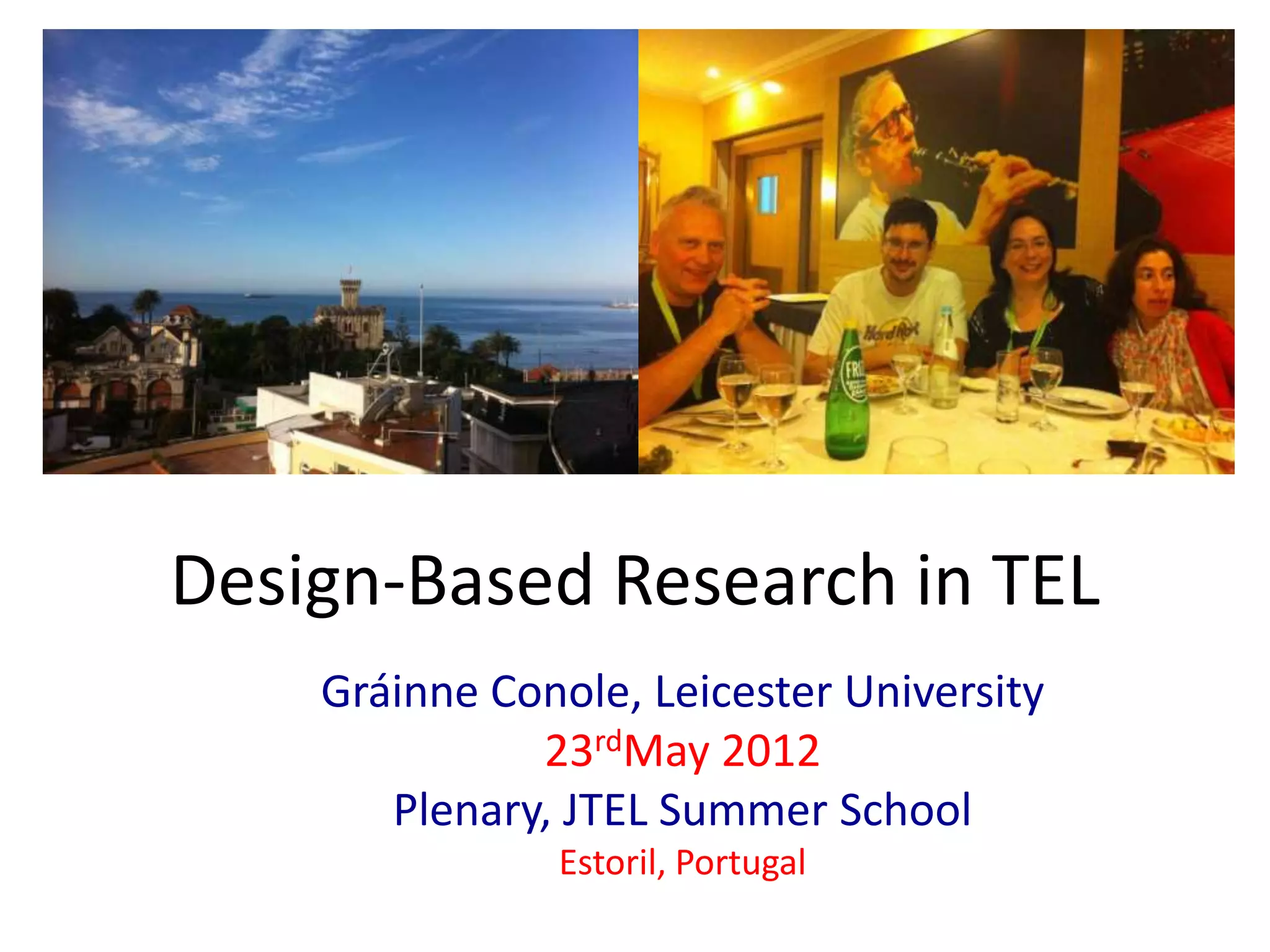
    Gráinne Conole, Leicester University
              23rdMay 2012
       Plenary, JTEL Summer School
               Estoril, Portugal
Outline
•   The TEL landscape
•   Potential of new technologies
•   Digital literacies
•   Fostering open practices
•   Mapping pedagogies to
    technologies
•   The problem
•   Learning design
•   Design-Based Research
•   Conclusions
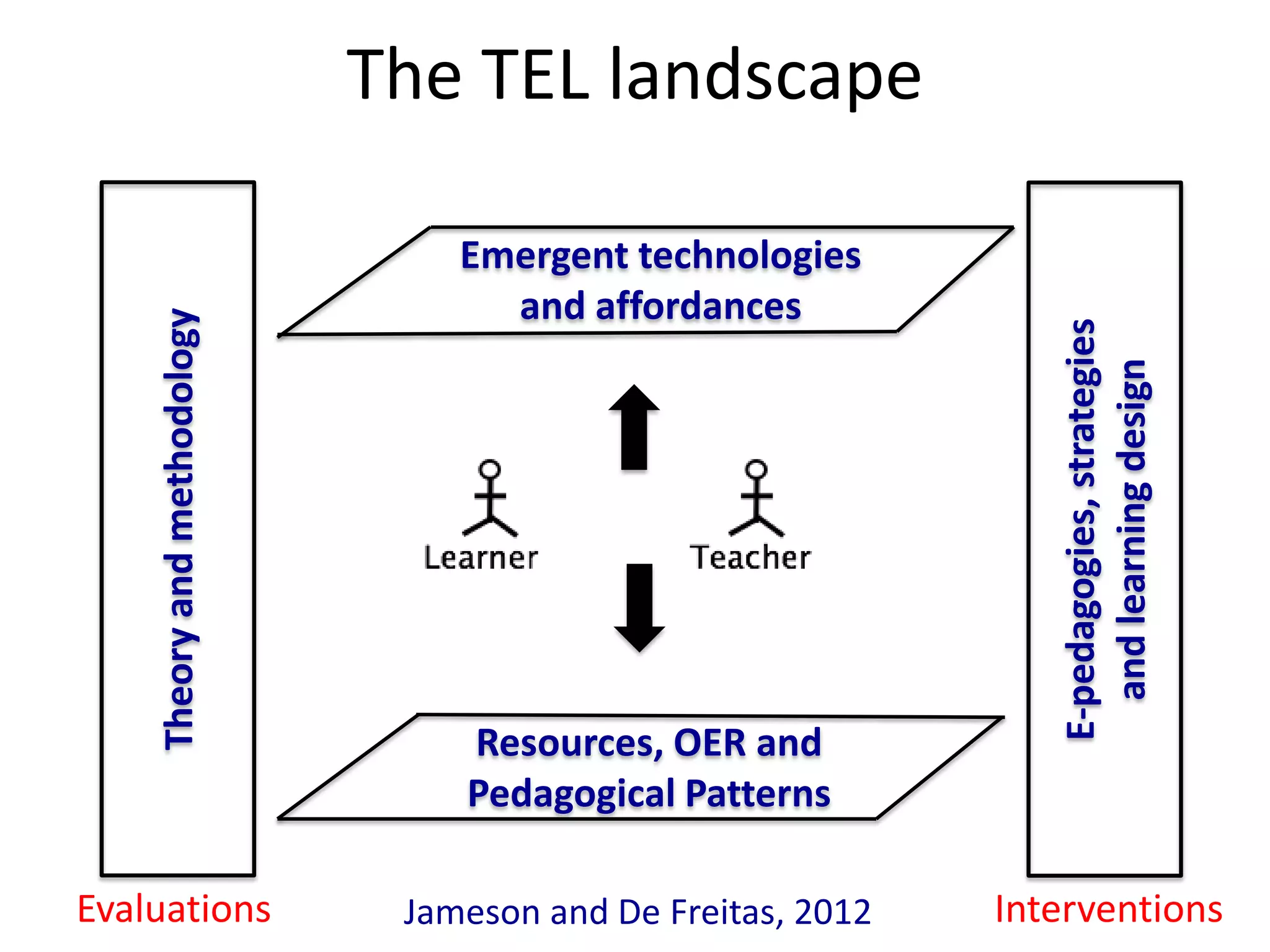
The TEL landscape

                                 Emergent technologies
                                   and affordances
    Theory and methodology


                                                                E-pedagogies, strategies
                                                                  and learning design
                                 Resources, OER and
                                 Pedagogical Patterns

Evaluations                   Jameson and De Freitas, 2012   Interventions
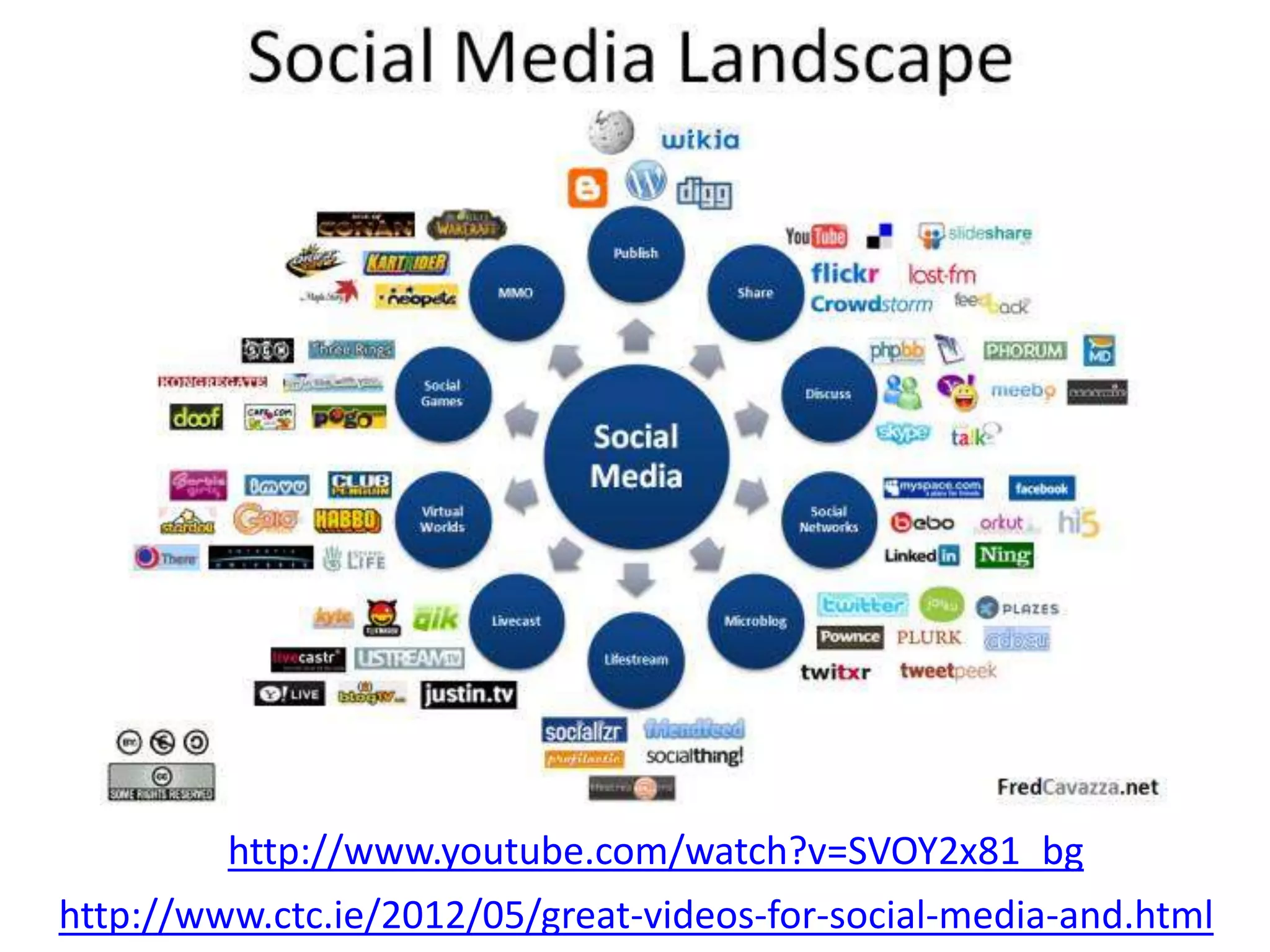
http://www.youtube.com/watch?v=SVOY2x81_bg
http://www.ctc.ie/2012/05/great-videos-for-social-media-and.html
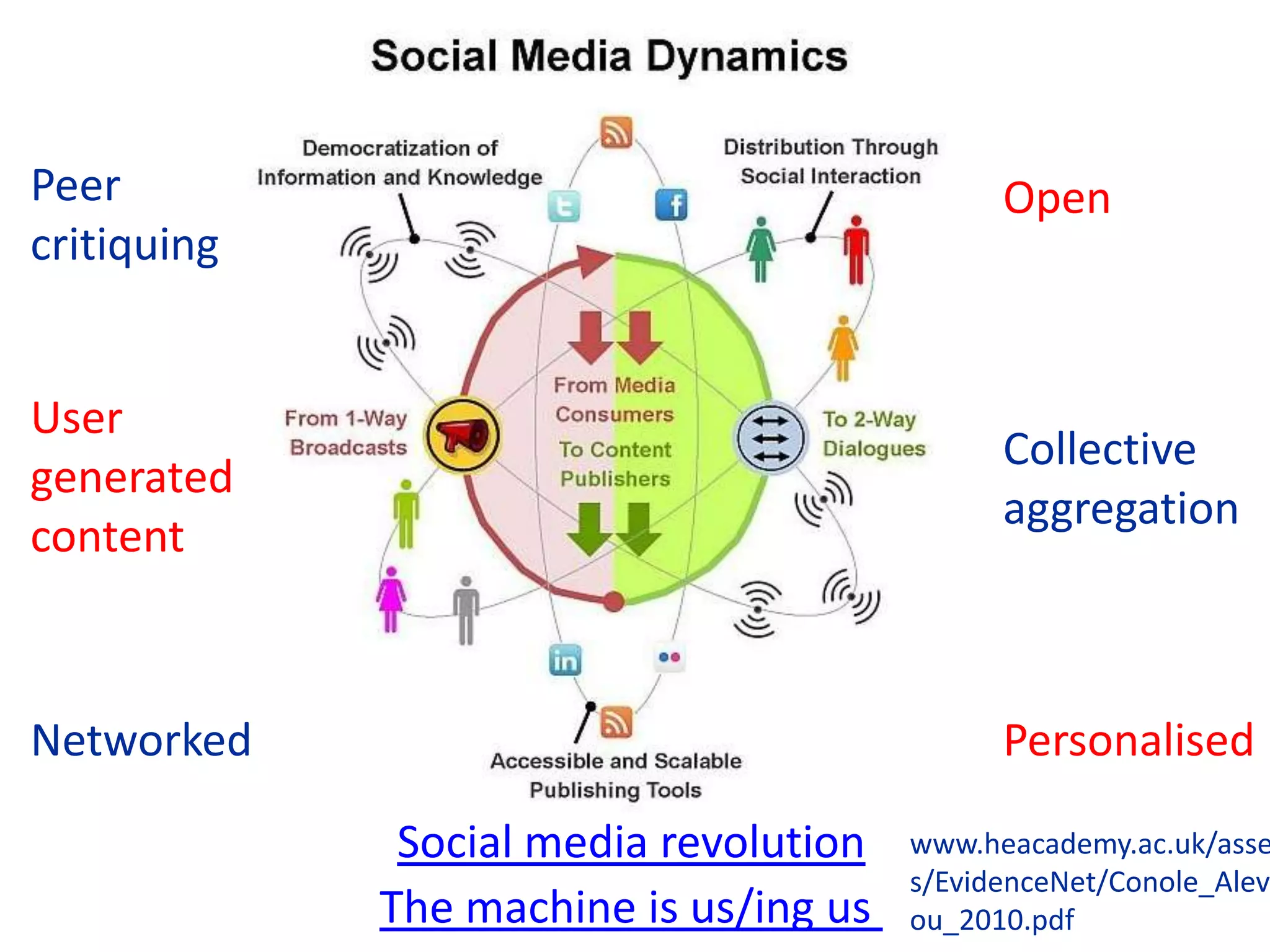
Peer                                          Open
critiquing


User
                                              Collective
generated
                                              aggregation
content


Networked                                     Personalised

              Social media revolution   www.heacademy.ac.uk/asse
                                        s/EvidenceNet/Conole_Alev
             The machine is us/ing us   ou_2010.pdf
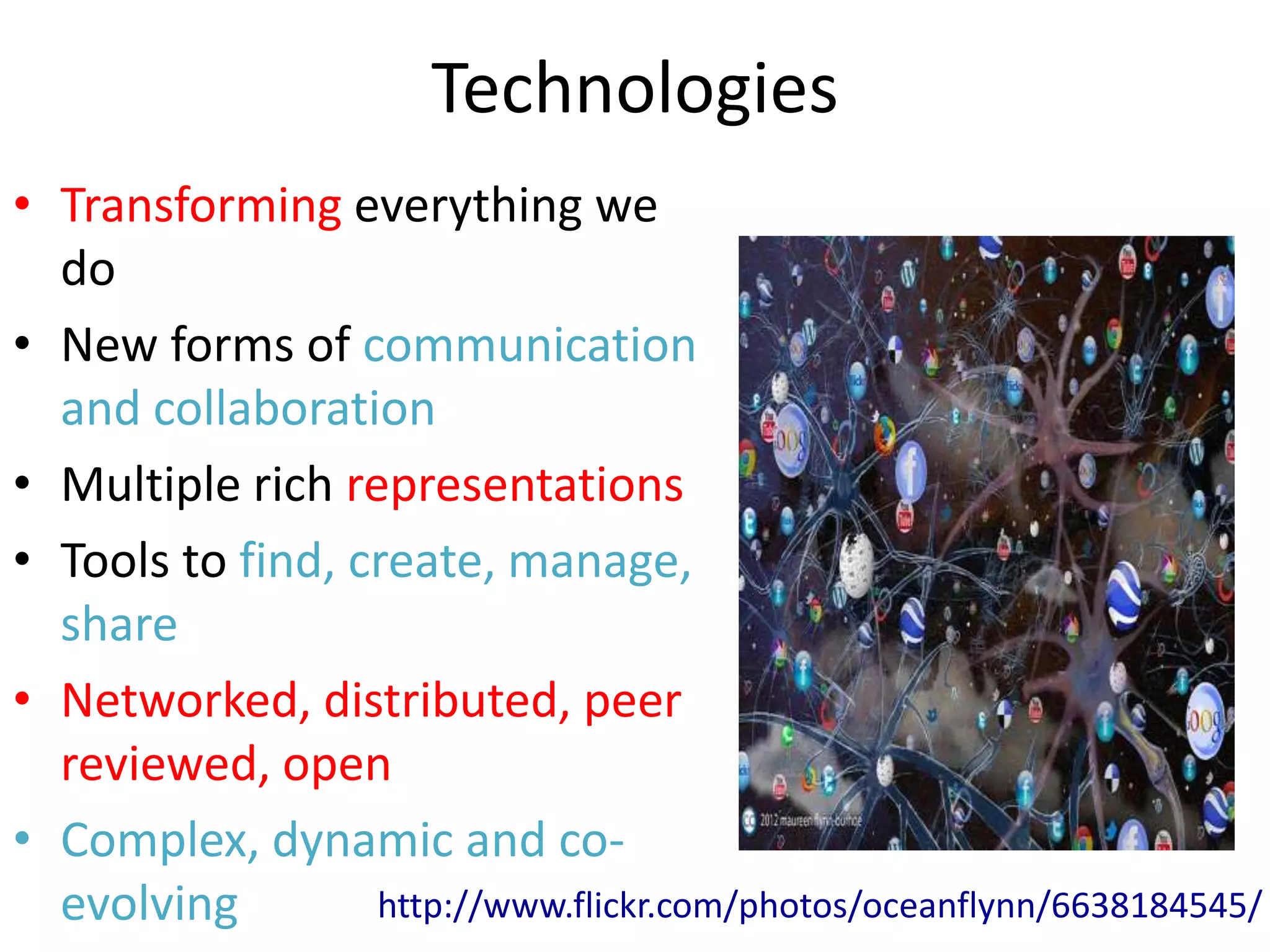
Technologies
• Transforming everything we
  do
• New forms of communication
  and collaboration
• Multiple rich representations
• Tools to find, create, manage,
  share
• Networked, distributed, peer
  reviewed, open
• Complex, dynamic and co-
  evolving        http://www.flickr.com/photos/oceanflynn/6638184545/
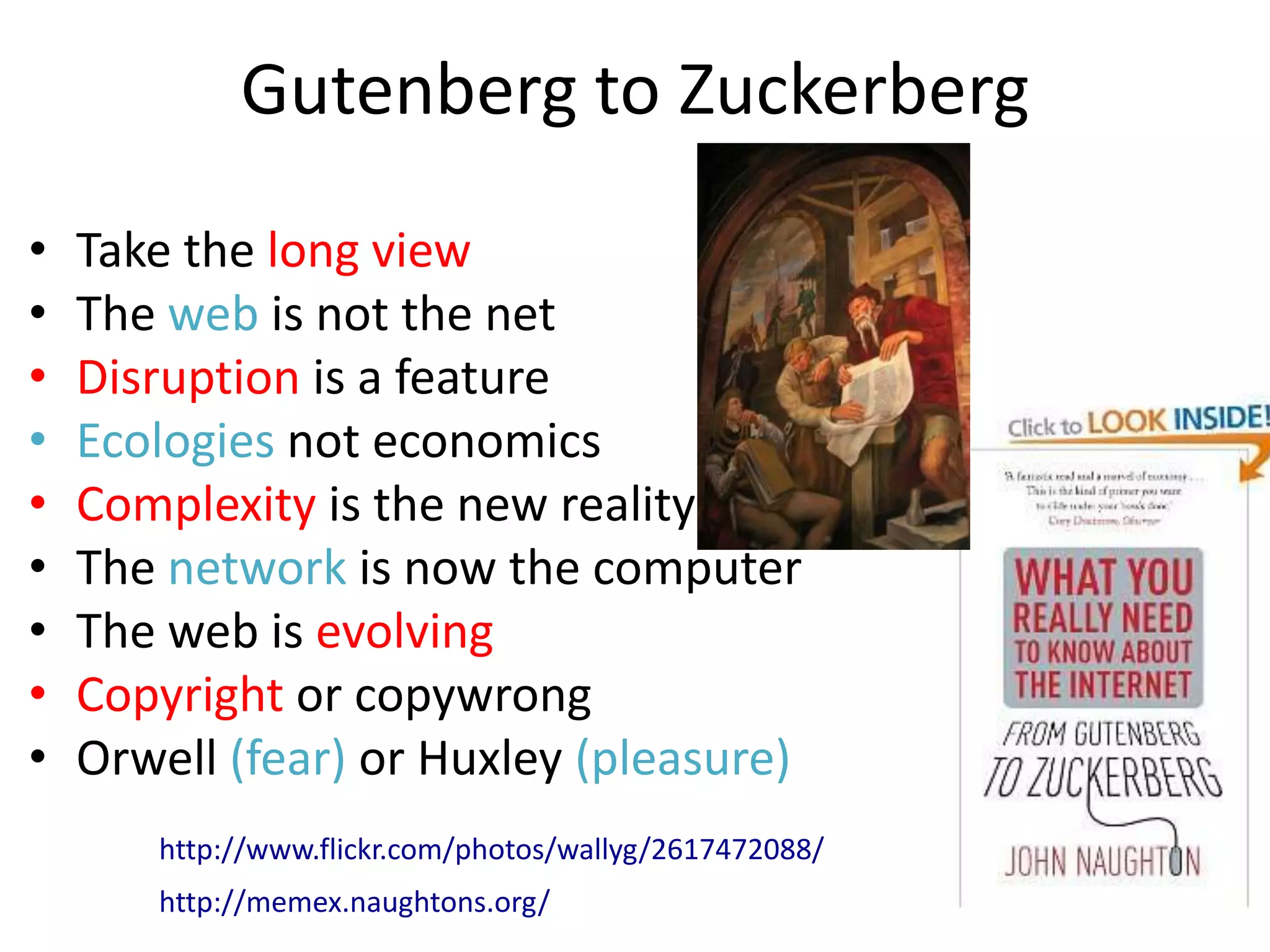
Gutenberg to Zuckerberg
•   Take the long view
•   The web is not the net
•   Disruption is a feature
•   Ecologies not economics
•   Complexity is the new reality
•   The network is now the computer
•   The web is evolving
•   Copyright or copywrong
•   Orwell (fear) or Huxley (pleasure)
       http://www.flickr.com/photos/wallyg/2617472088/
       http://memex.naughtons.org/
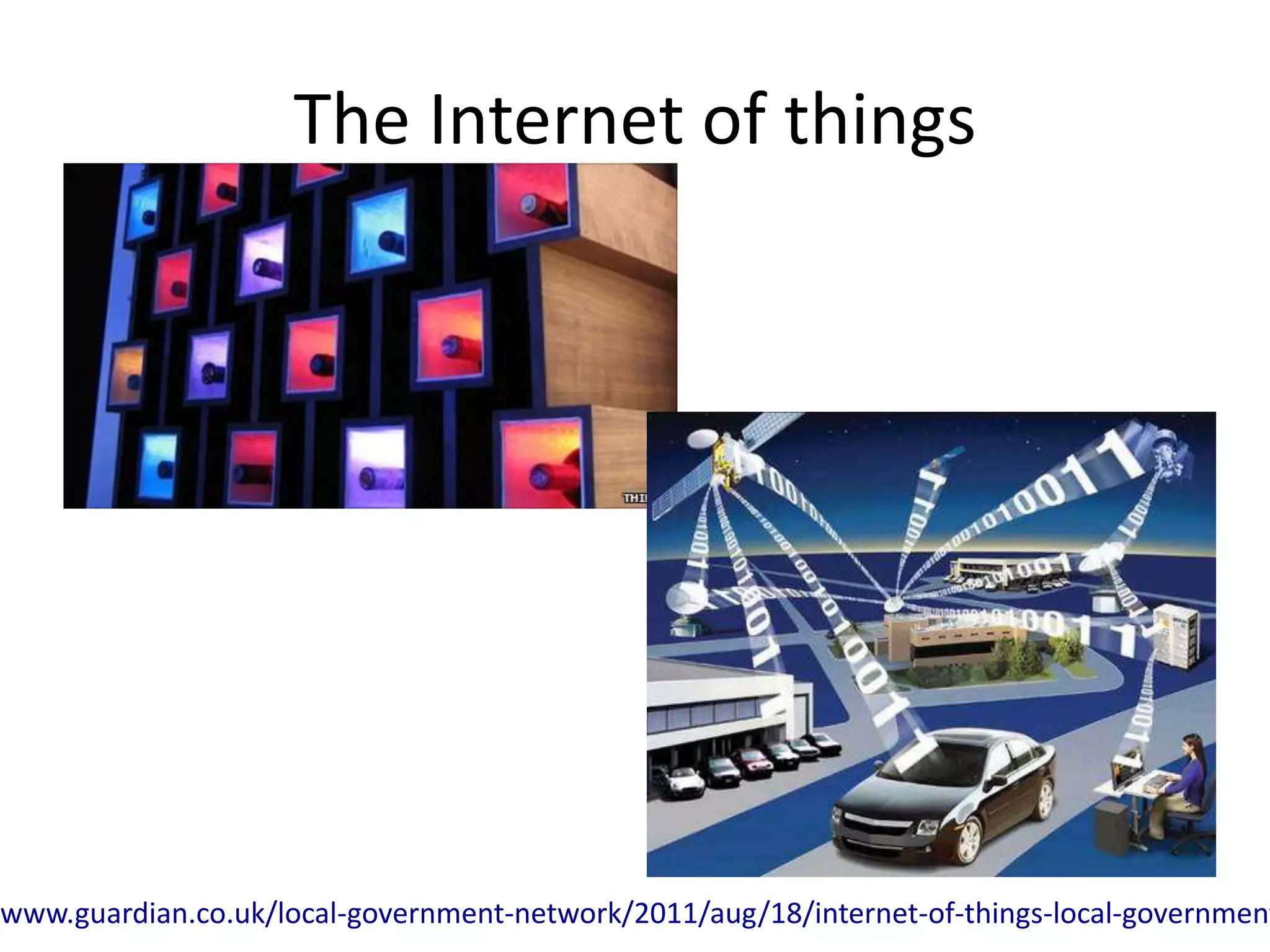
The Internet of things


www.guardian.co.uk/local-government-network/2011/aug/18/internet-of-things-local-government
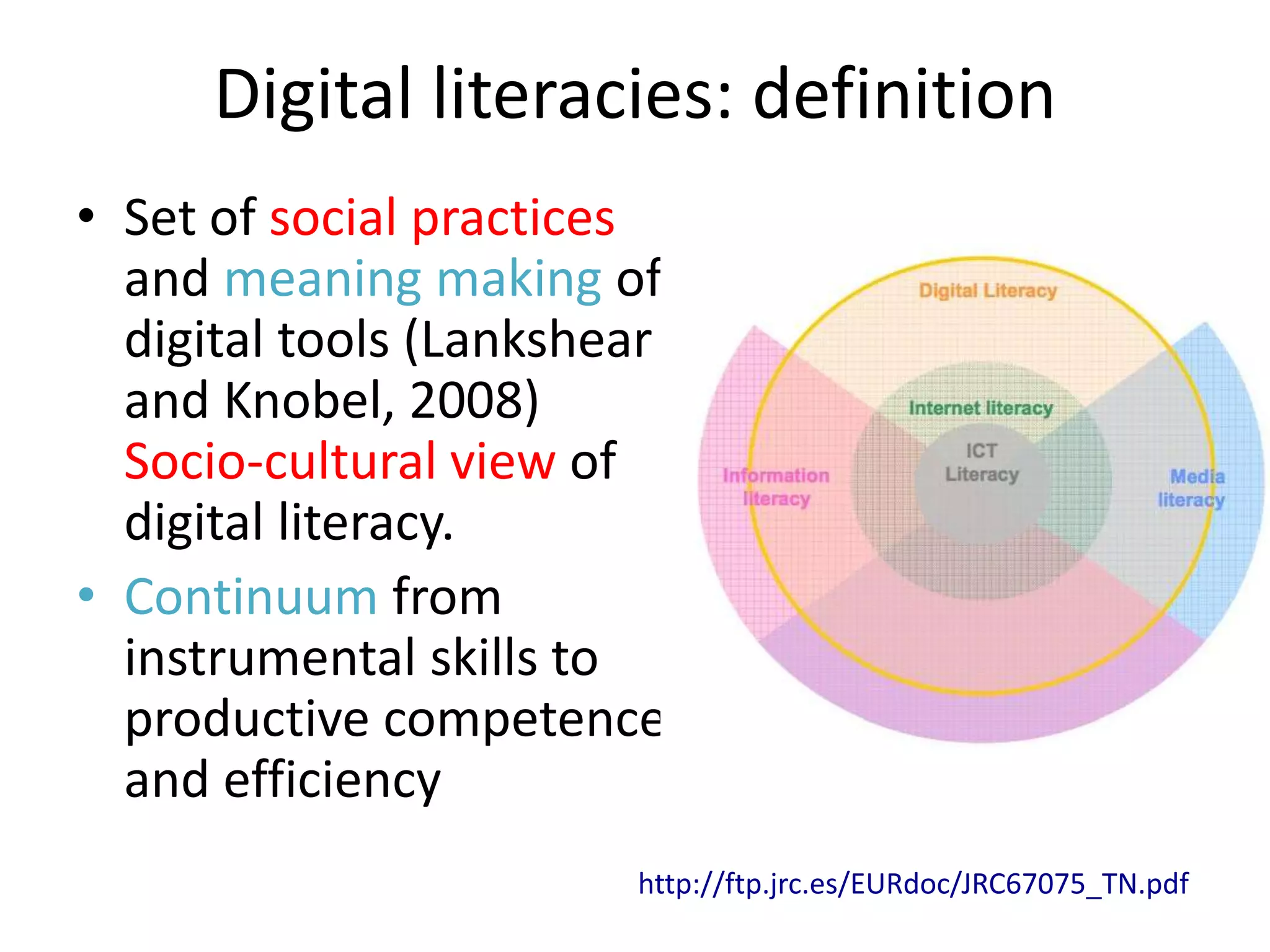
Digital literacies: definition
• Set of social practices
  and meaning making of
  digital tools (Lankshear
  and Knobel, 2008)
  Socio-cultural view of
  digital literacy.
• Continuum from
  instrumental skills to
  productive competence
  and efficiency
                        http://ftp.jrc.es/EURdoc/JRC67075_TN.pdf
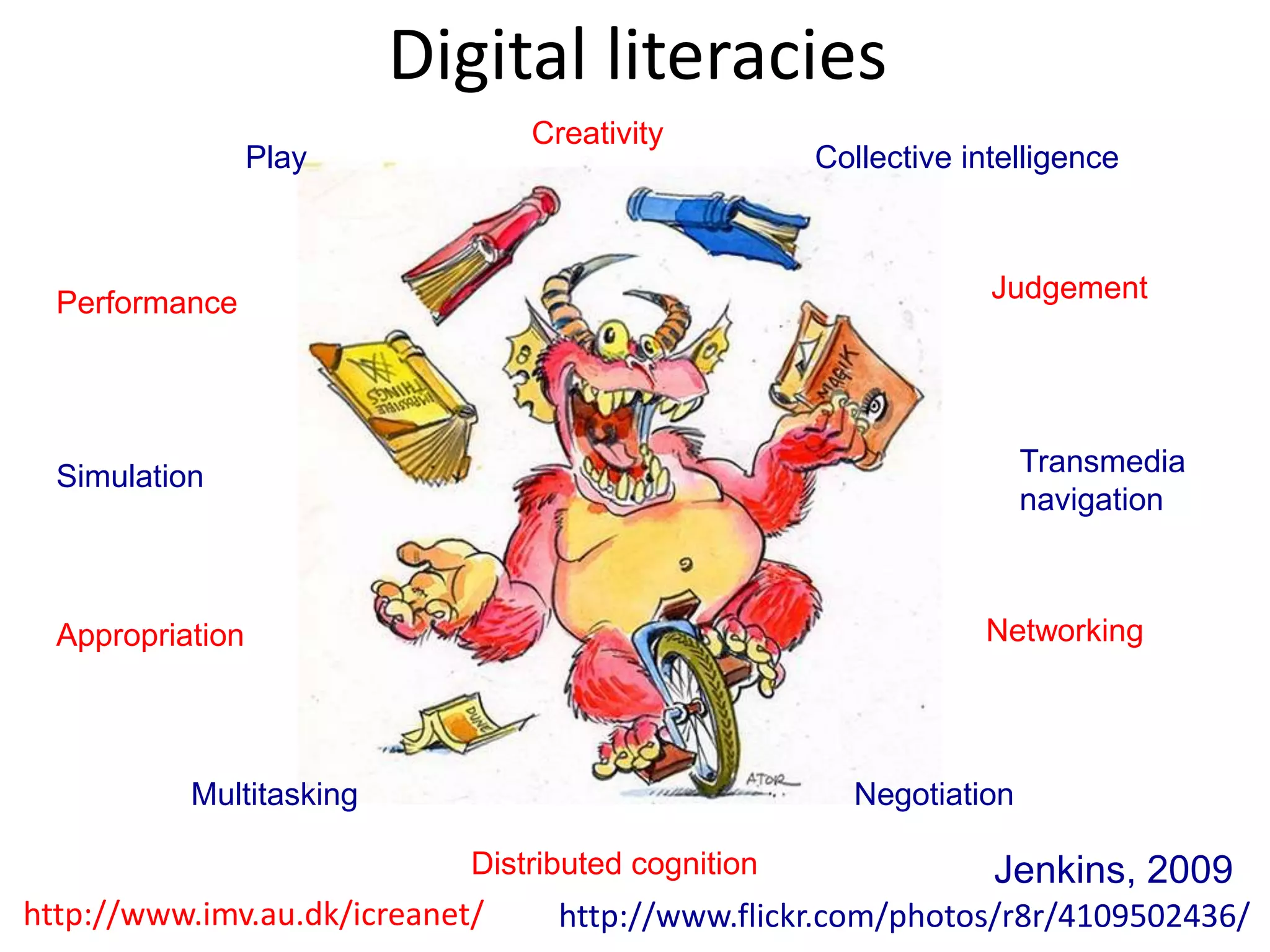
Digital literacies
                                 Creativity
                  Play                               Collective intelligence


  Performance                                                     Judgement


  Simulation                                                         Transmedia
                                                                     navigation


  Appropriation                                                  Networking


           Multitasking                                Negotiation

                             Distributed cognition                Jenkins, 2009
http://www.imv.au.dk/icreanet/     http://www.flickr.com/photos/r8r/4109502436/
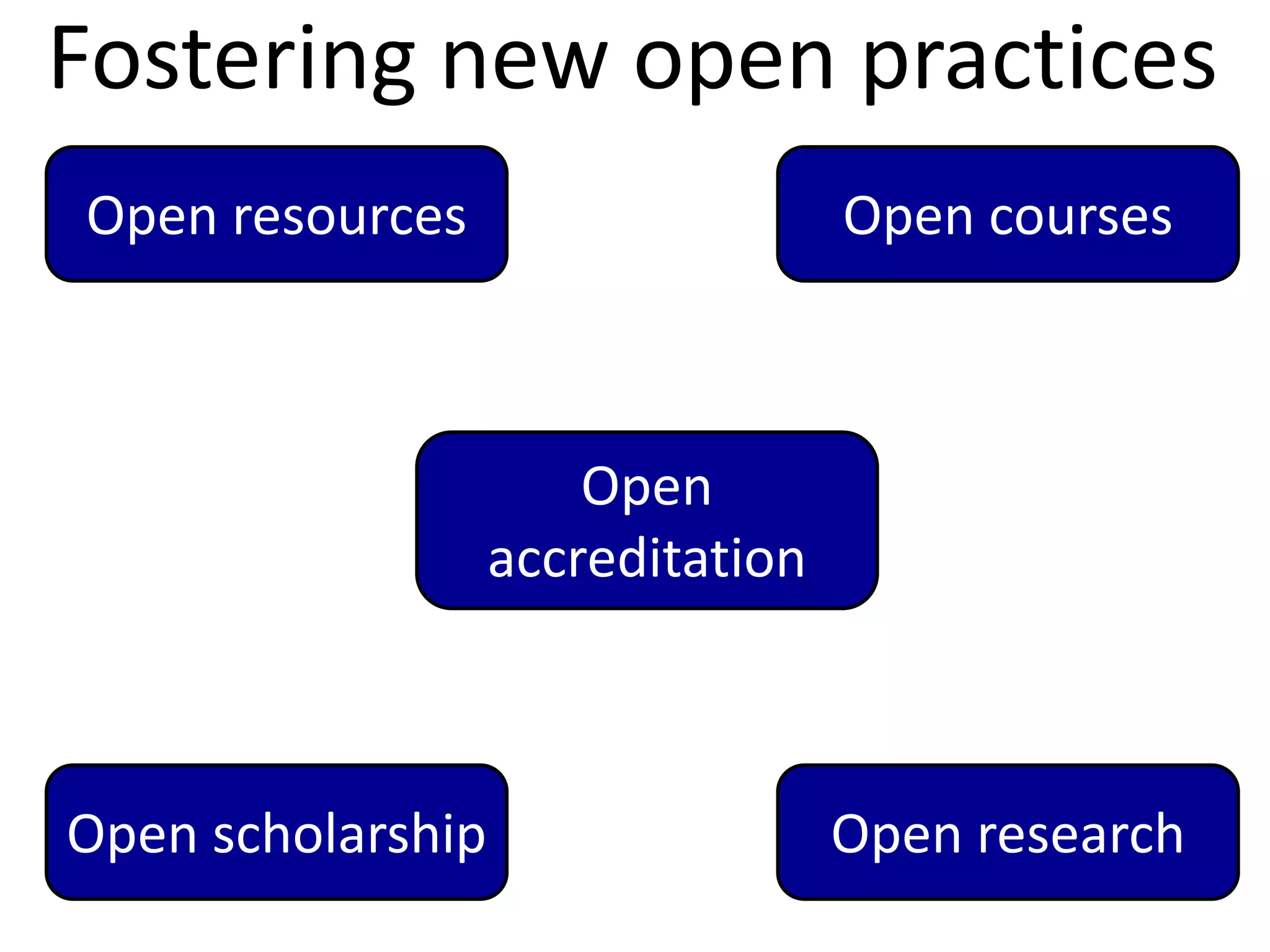
Fostering new open practices
Open resources                     Open courses


                       Open
                   accreditation


Open scholarship                   Open research
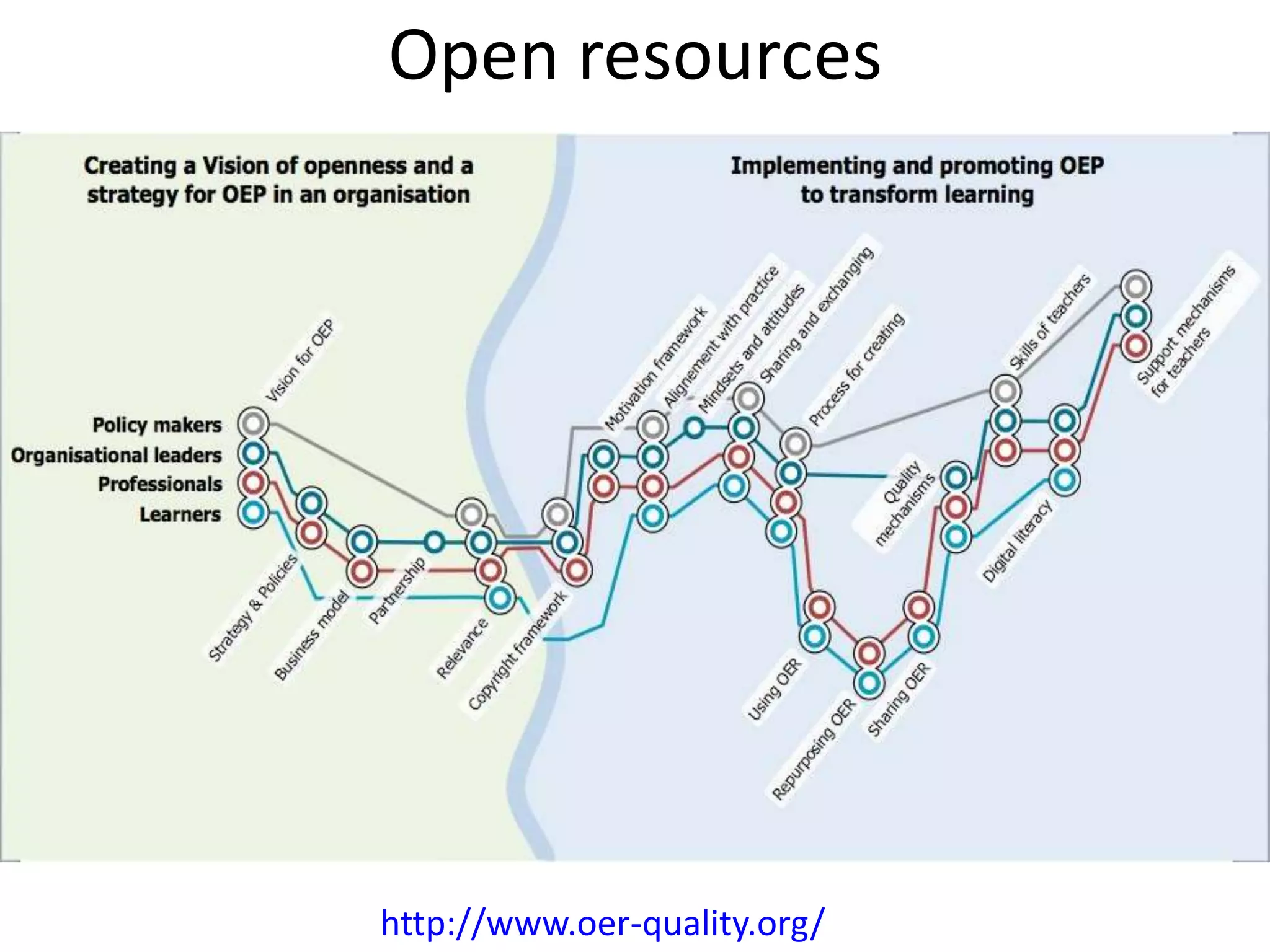
Open resources


http://www.oer-quality.org/
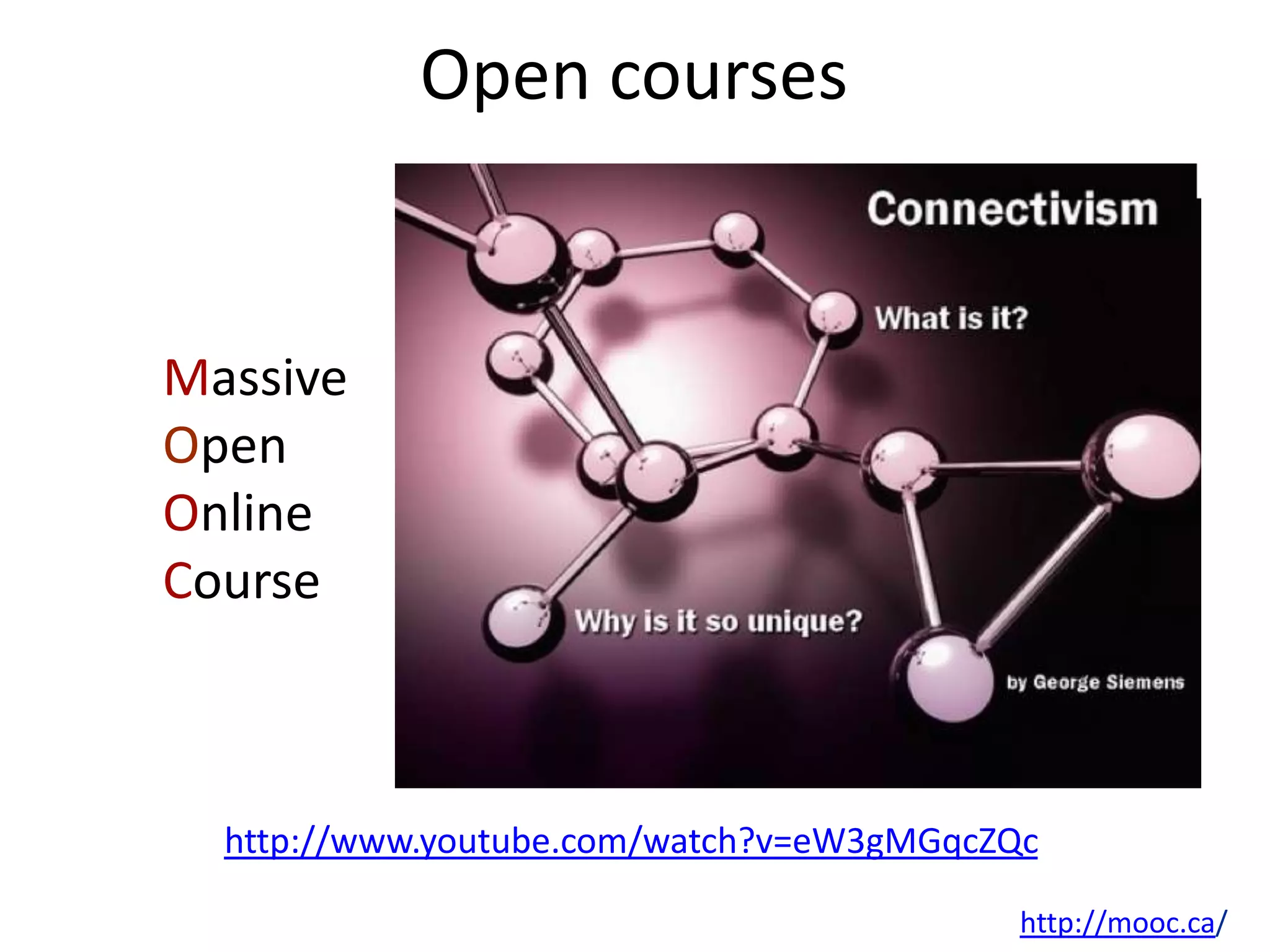
Open courses


Massive
Open
Online
Course


  http://www.youtube.com/watch?v=eW3gMGqcZQc

                                           http://mooc.ca/
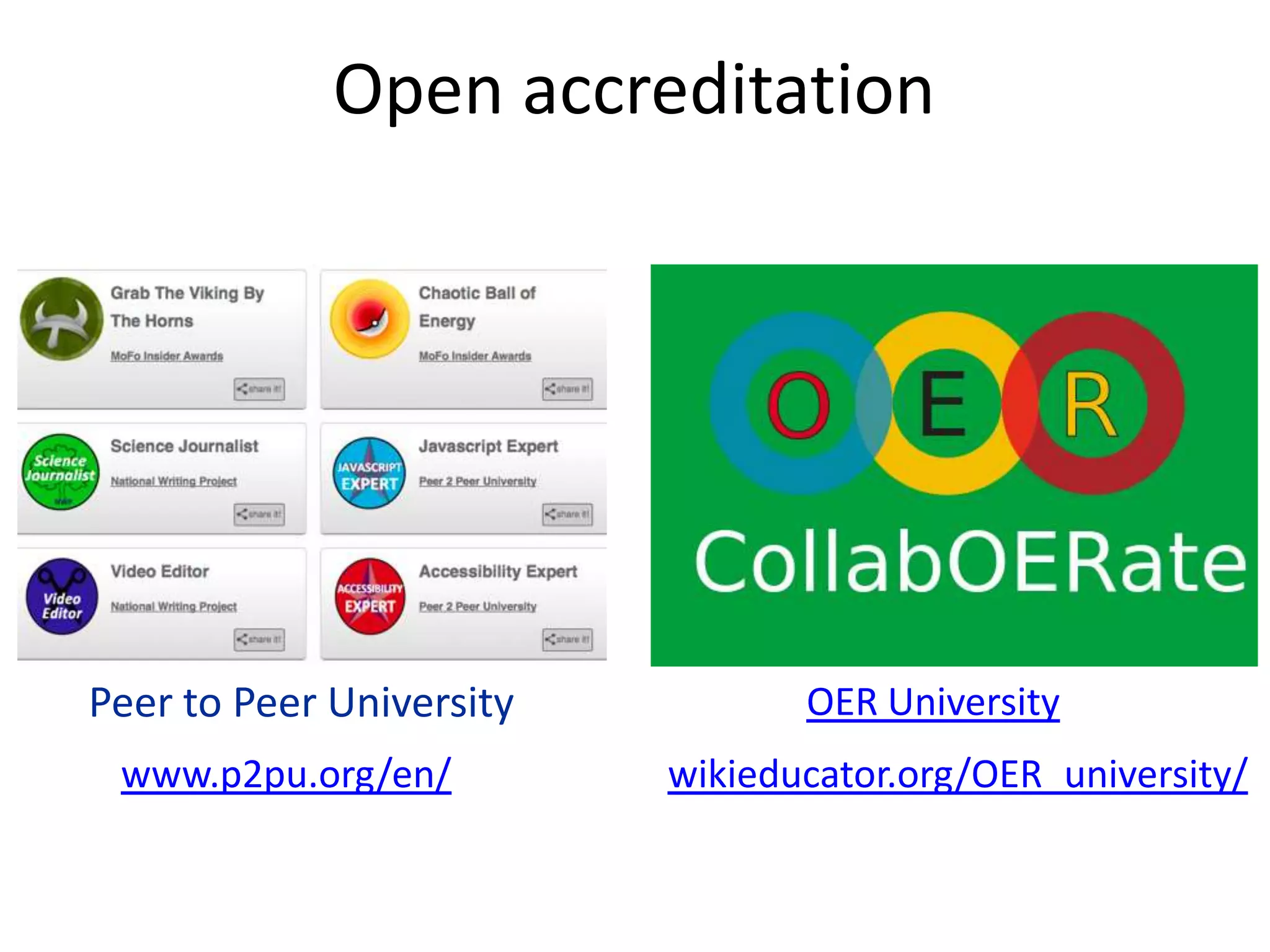
Open accreditation


Peer to Peer University          OER University
 www.p2pu.org/en/         wikieducator.org/OER_university/
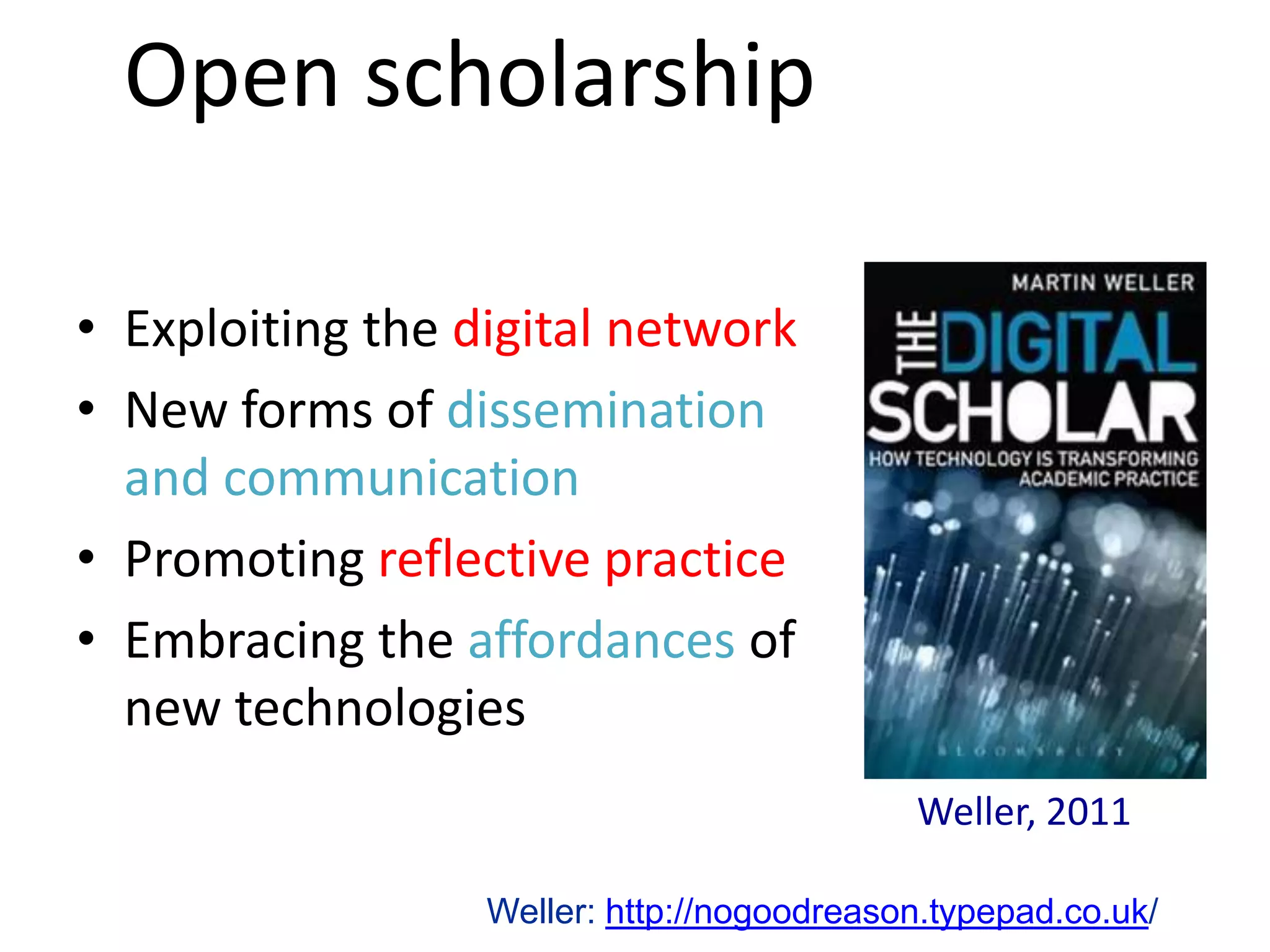
Open scholarship

• Exploiting the digital network
• New forms of dissemination
  and communication
• Promoting reflective practice
• Embracing the affordances of
  new technologies
                                            Weller, 2011

                  Weller: http://nogoodreason.typepad.co.uk/
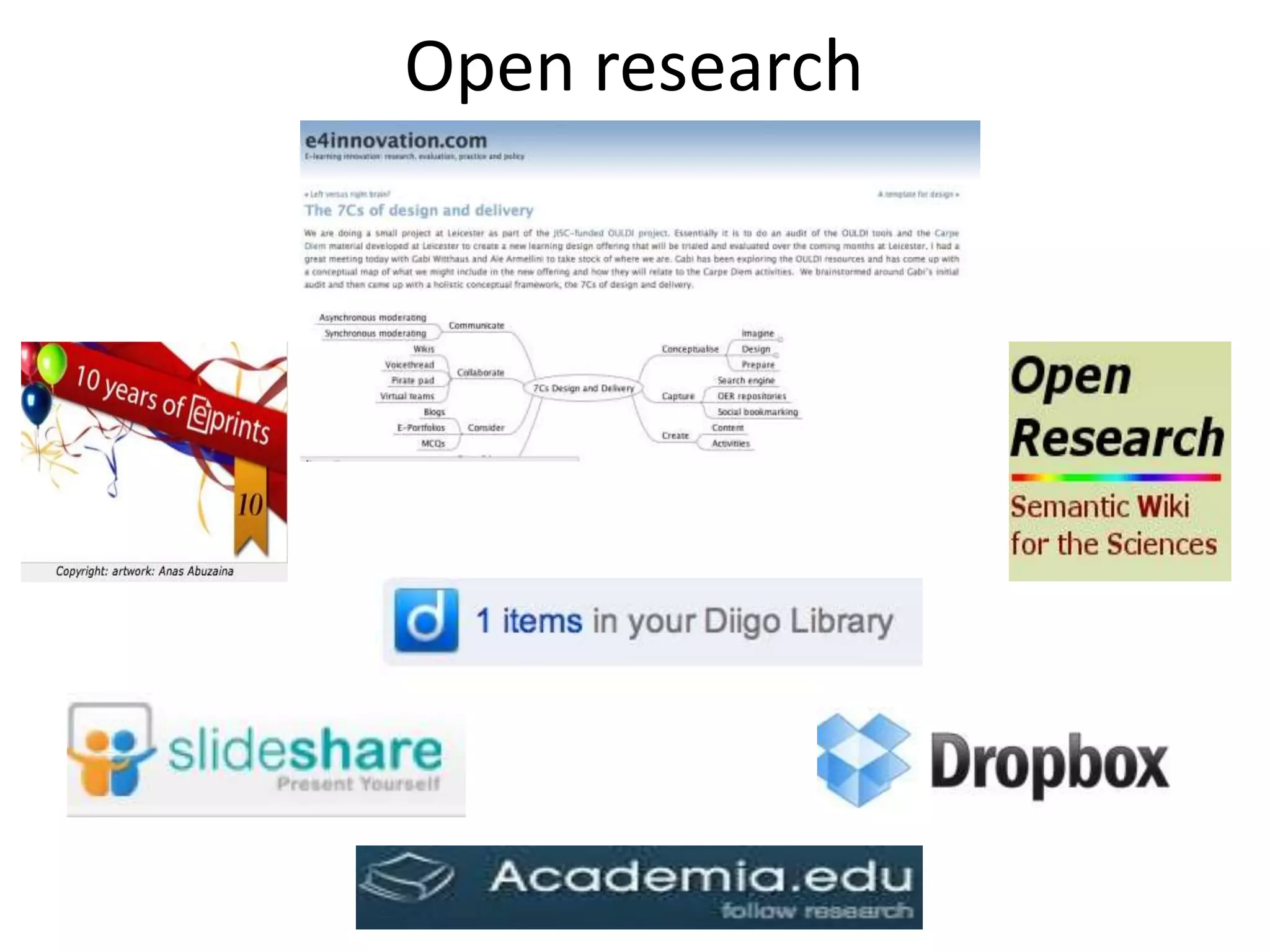
Open research
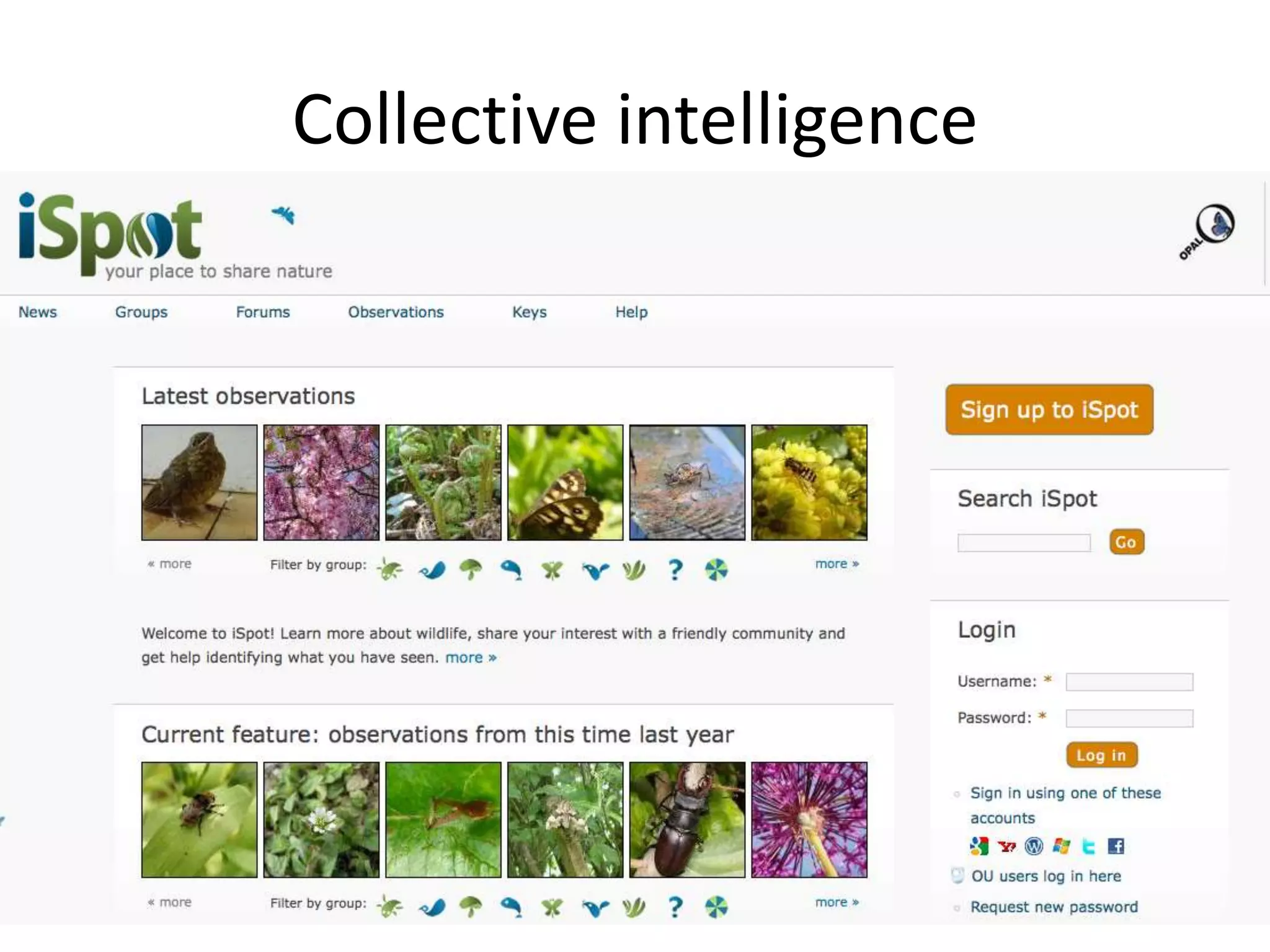
Collective intelligence
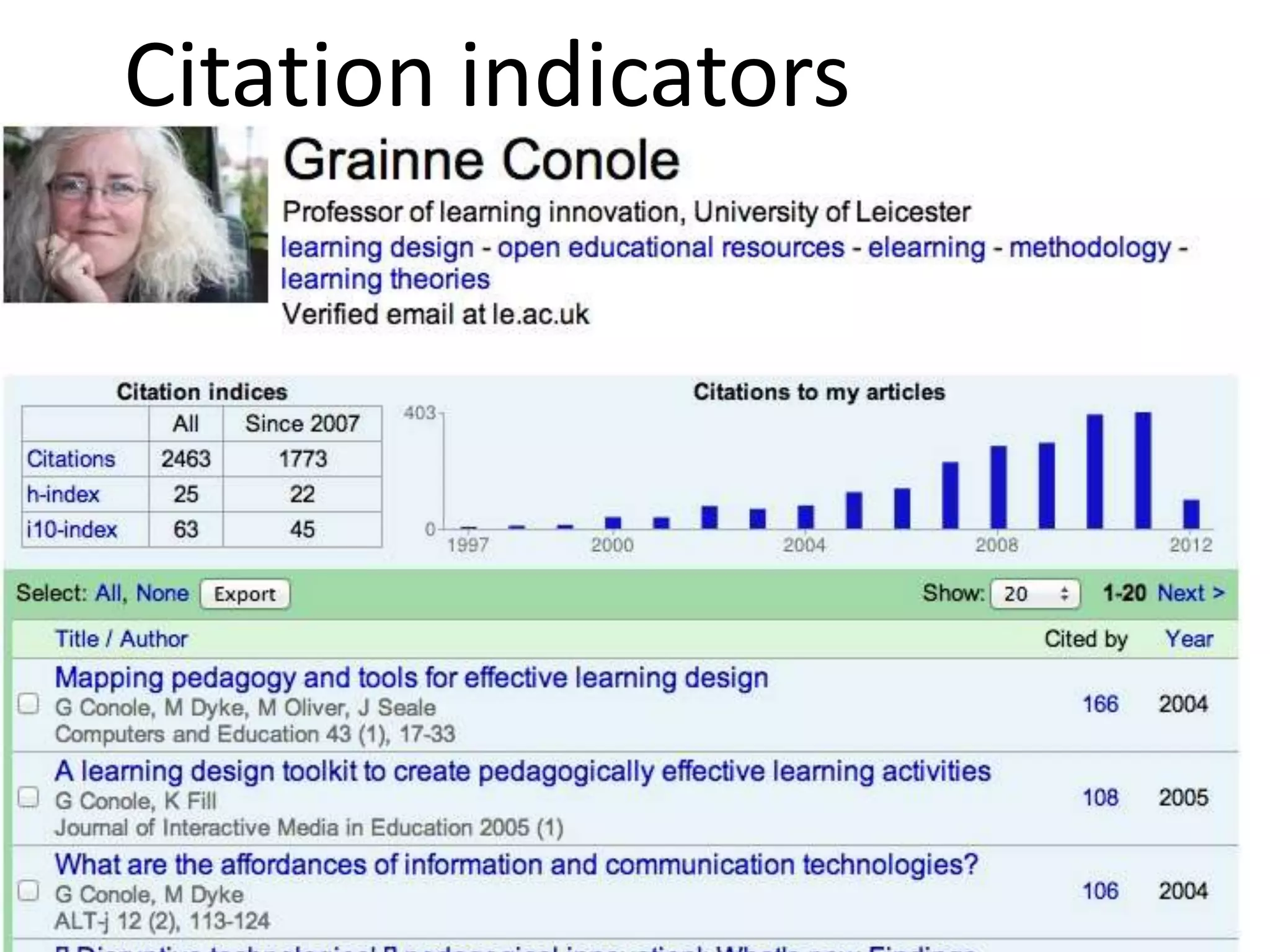
Citation indicators
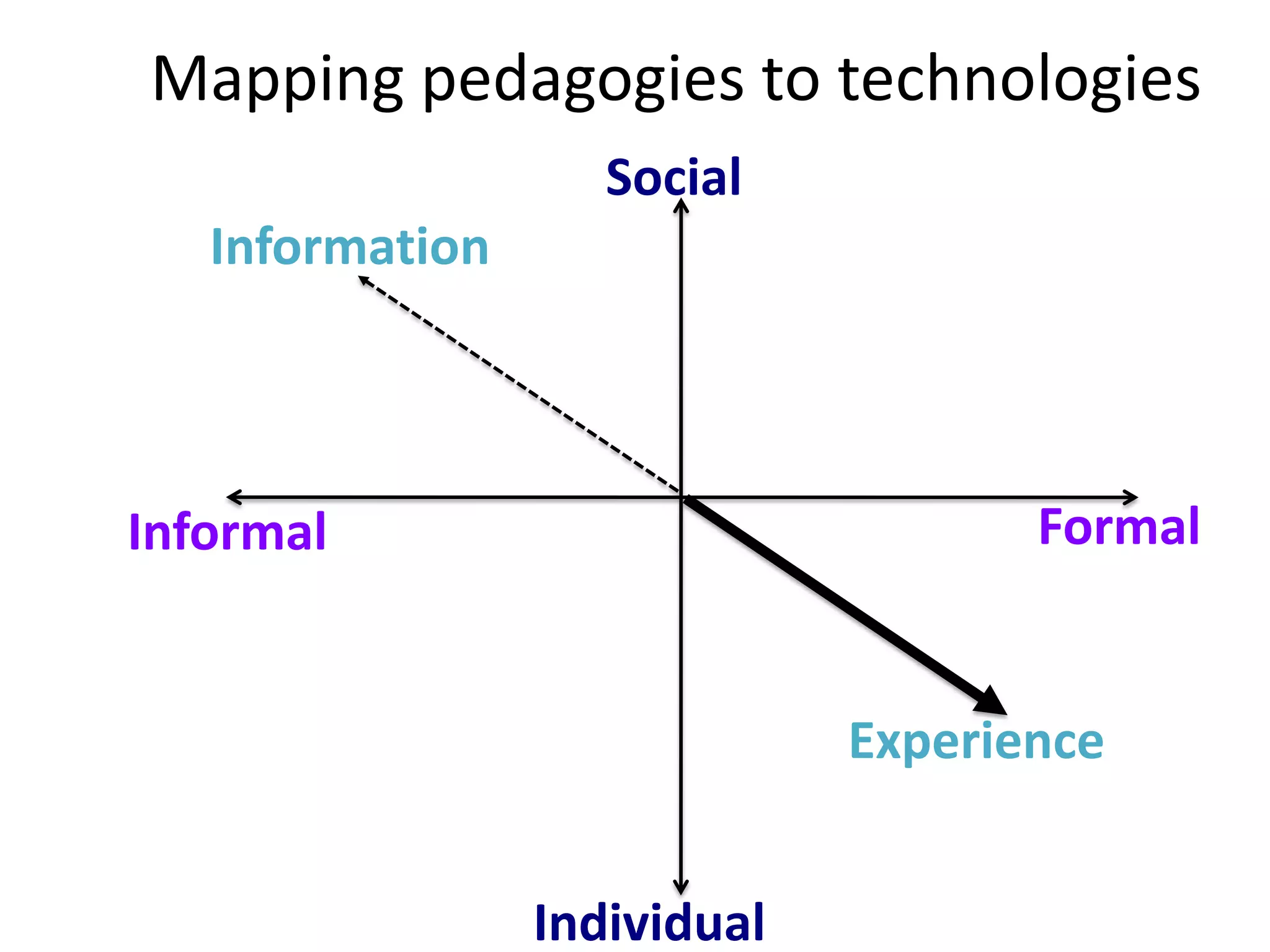
Mapping pedagogies to technologies
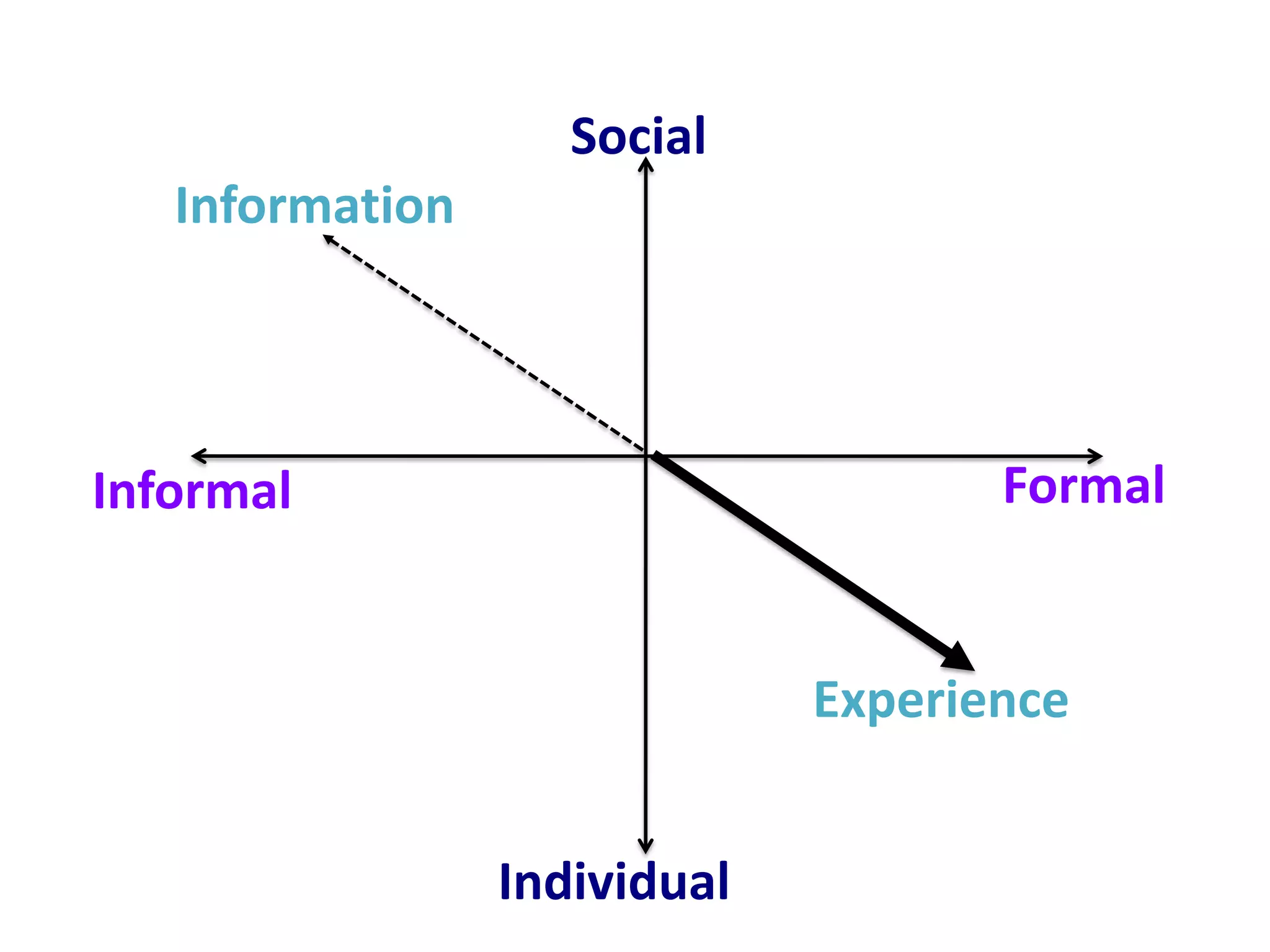
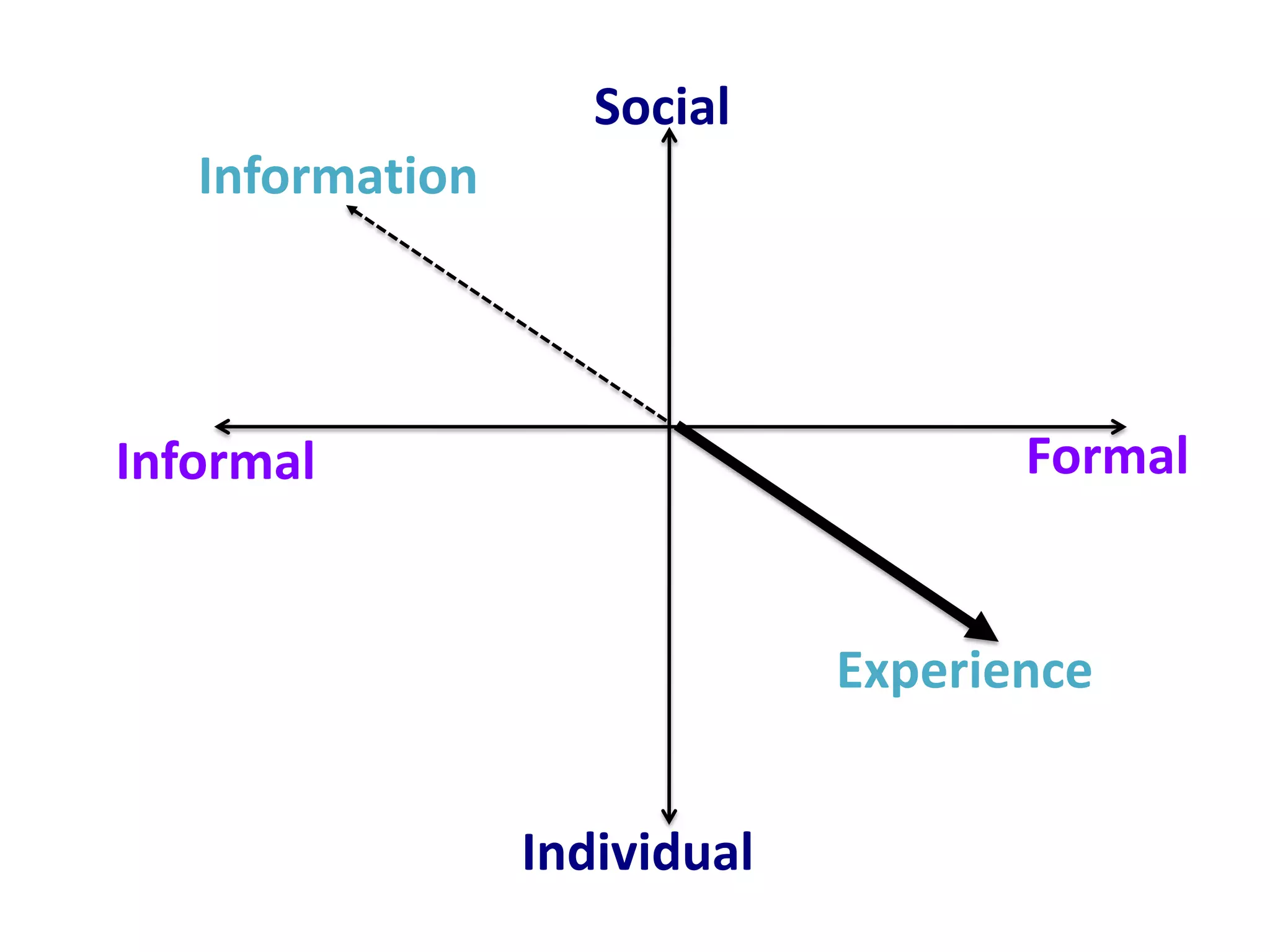
                    Social
   Information


Informal                             Formal


                              Experience


                 Individual
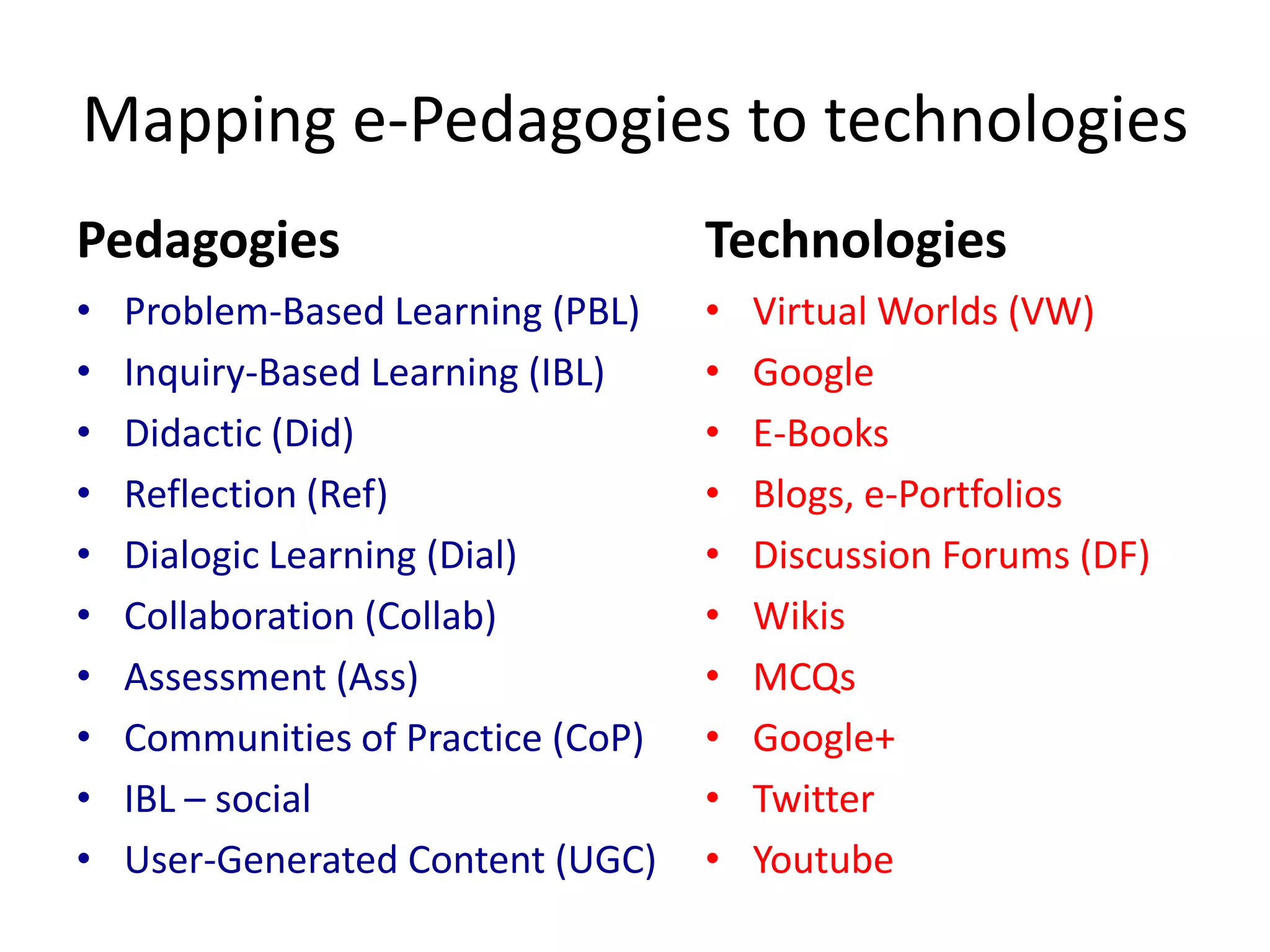
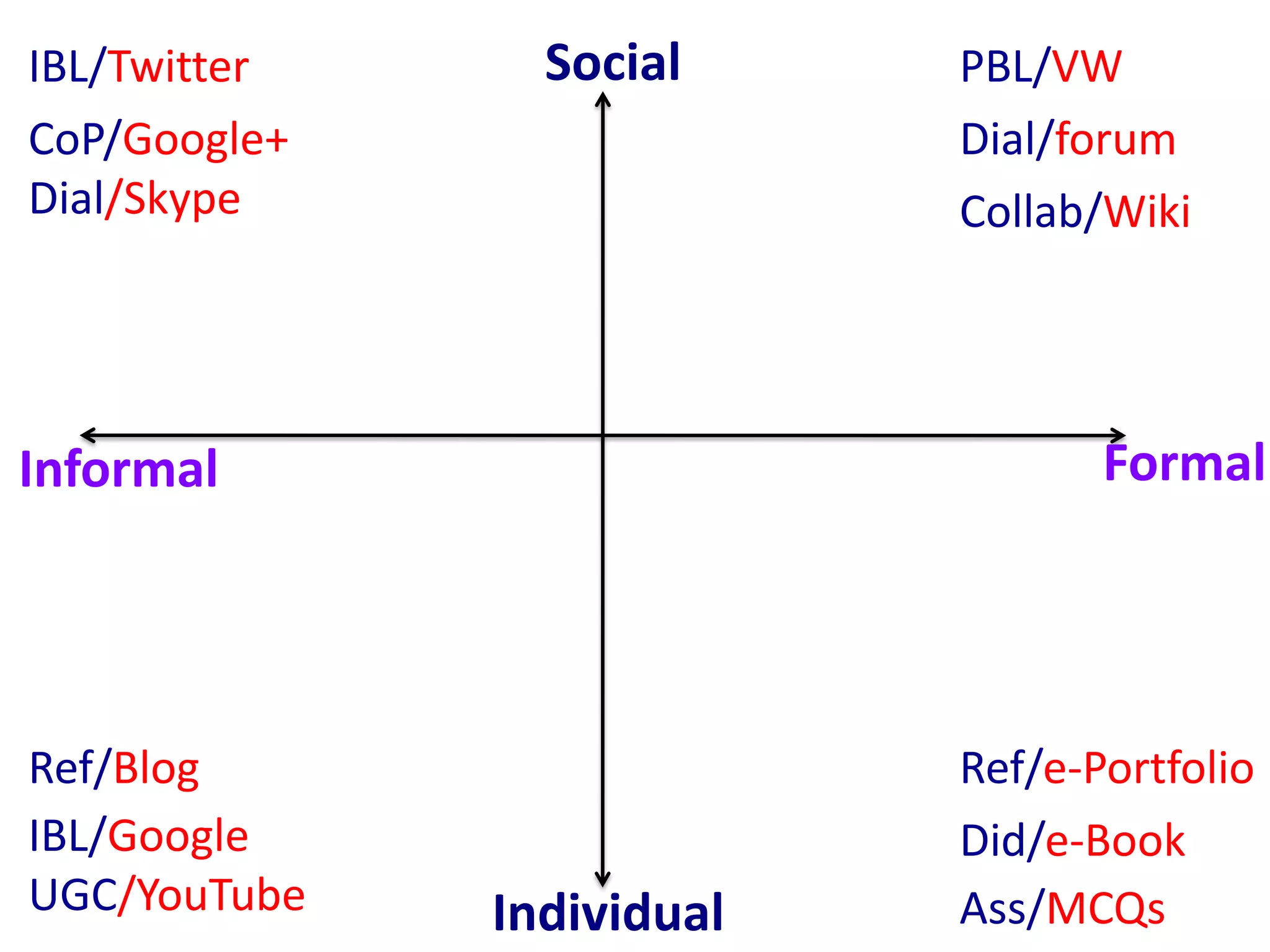
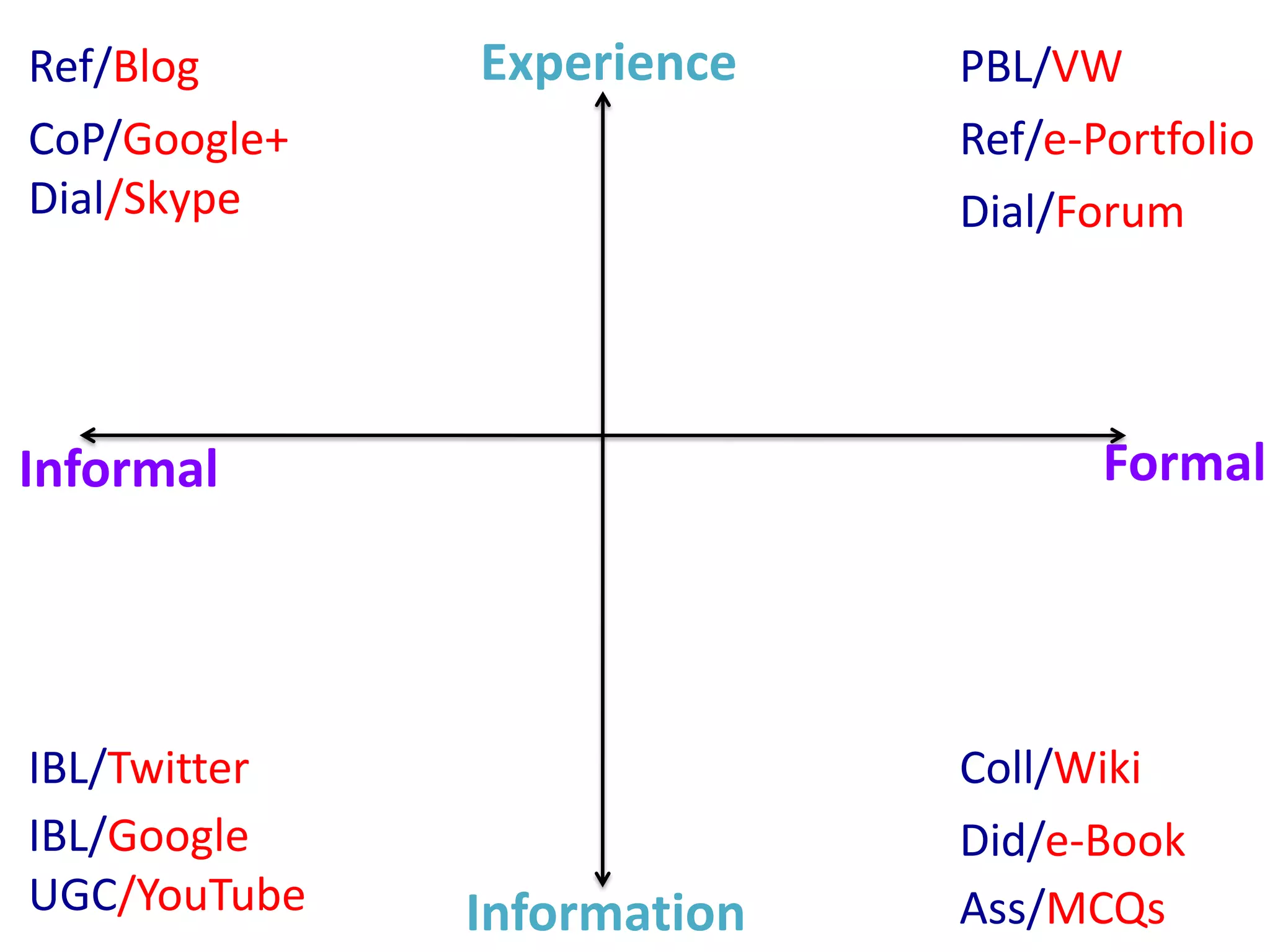
Mapping e-Pedagogies to technologies
Pedagogies                          Technologies
•   Problem-Based Learning (PBL)    •   Virtual Worlds (VW)
•   Inquiry-Based Learning (IBL)    •   Google
•   Didactic (Did)                  •   E-Books
•   Reflection (Ref)                •   Blogs, e-Portfolios
•   Dialogic Learning (Dial)        •   Discussion Forums (DF)
•   Collaboration (Collab)          •   Wikis
•   Assessment (Ass)                •   MCQs
•   Communities of Practice (CoP)   •   Google+
•   IBL – social                    •   Twitter
•   User-Generated Content (UGC)    •   Youtube
Social
   Information


Informal                             Formal


                              Experience


                 Individual
IBL/Twitter     Social     PBL/VW
CoP/Google+                Dial/forum
Dial/Skype                 Collab/Wiki


Informal                          Formal


Ref/Blog                   Ref/e-Portfolio
IBL/Google                 Did/e-Book
UGC/YouTube   Individual   Ass/MCQs
Social
   Information


Informal                             Formal


                              Experience


                 Individual
Ref/Blog      Experience    PBL/VW
CoP/Google+                 Ref/e-Portfolio
Dial/Skype                  Dial/Forum


Informal                           Formal


IBL/Twitter                 Coll/Wiki
IBL/Google                  Did/e-Book
UGC/YouTube   Information   Ass/MCQs
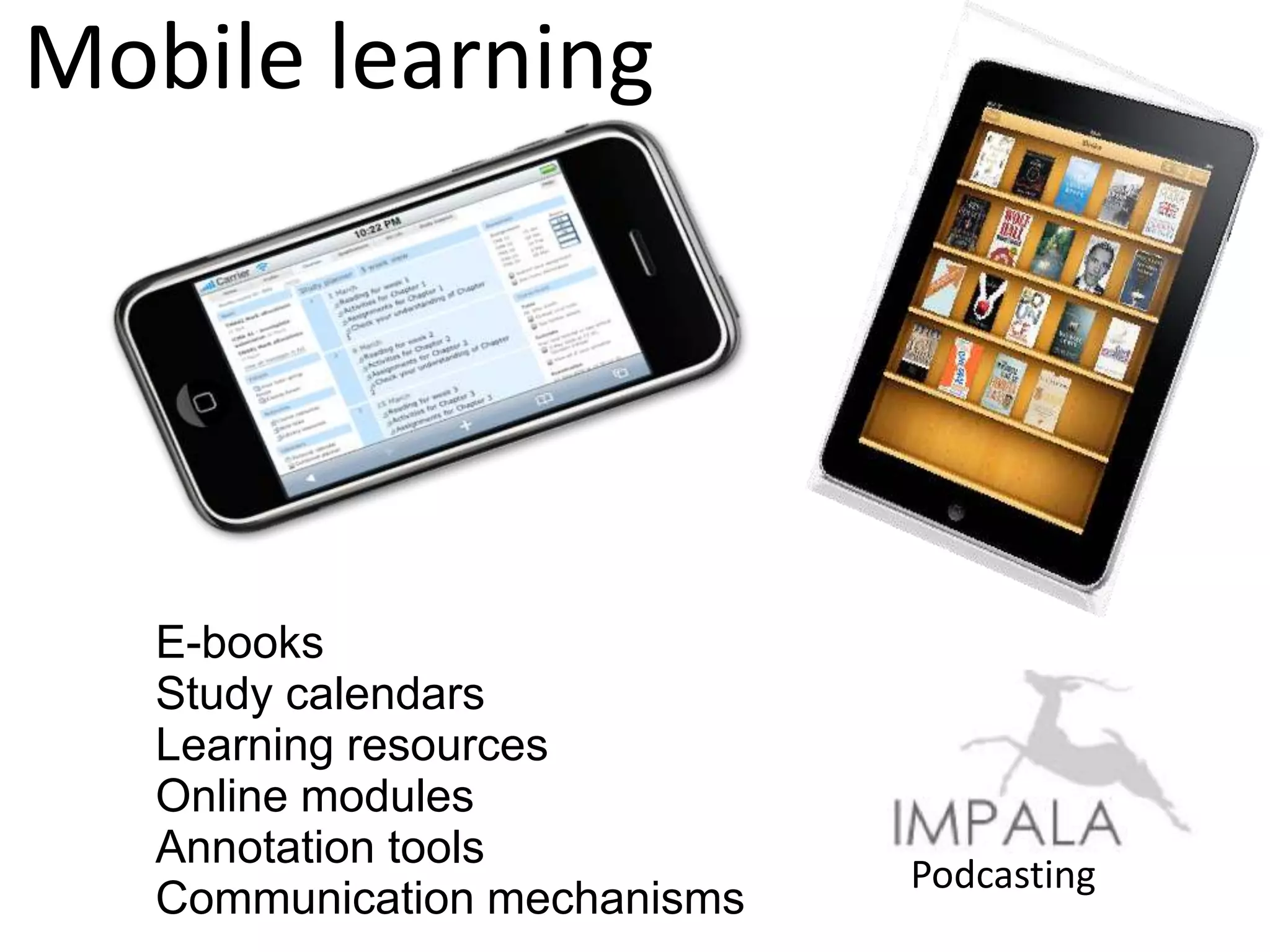
Mobile learning


   E-books
   Study calendars
   Learning resources
   Online modules
   Annotation tools
                              Podcasting
   Communication mechanisms
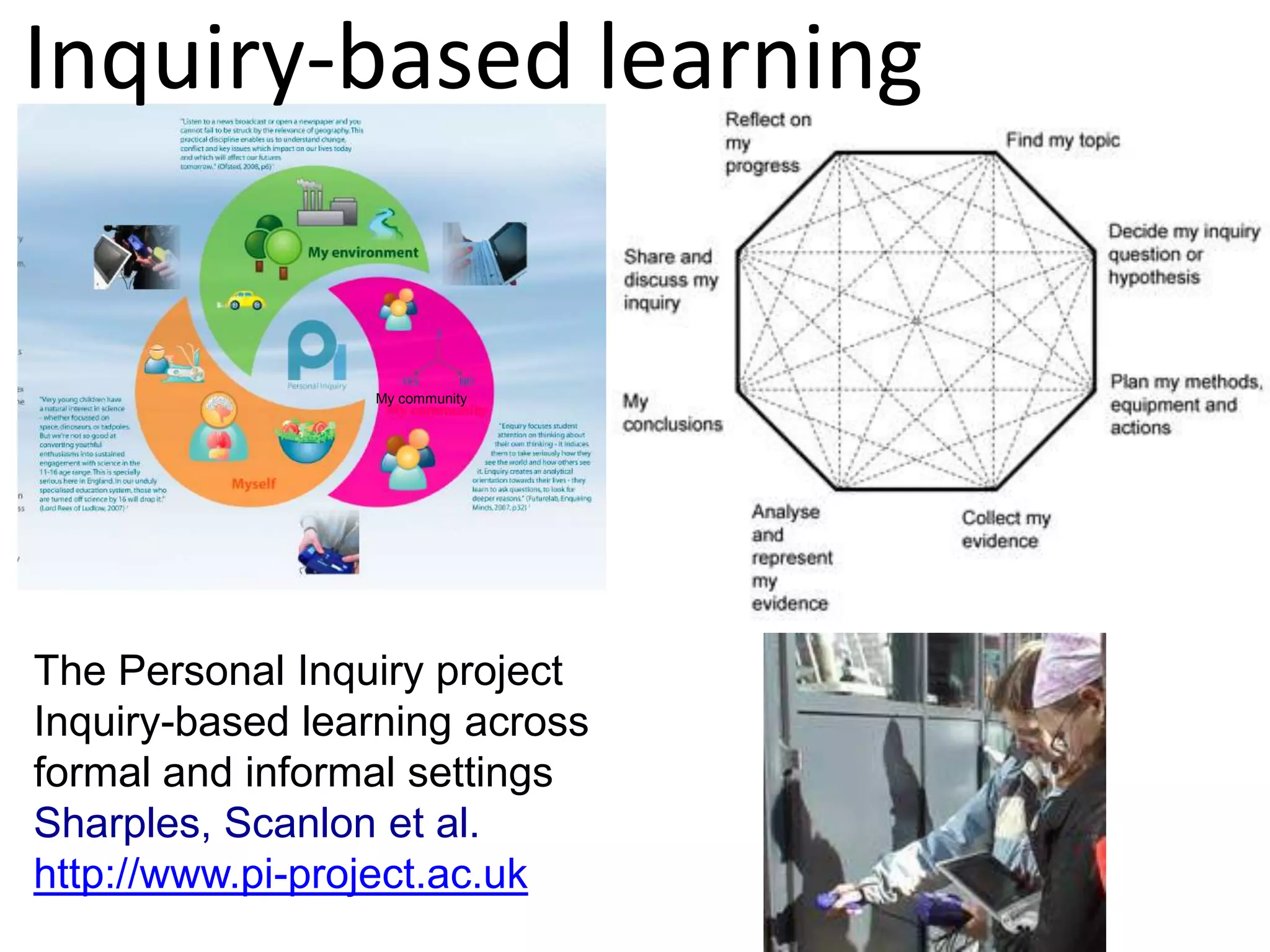
Inquiry-based learning


                 My community


The Personal Inquiry project
Inquiry-based learning across
formal and informal settings
Sharples, Scanlon et al.
http://www.pi-project.ac.uk
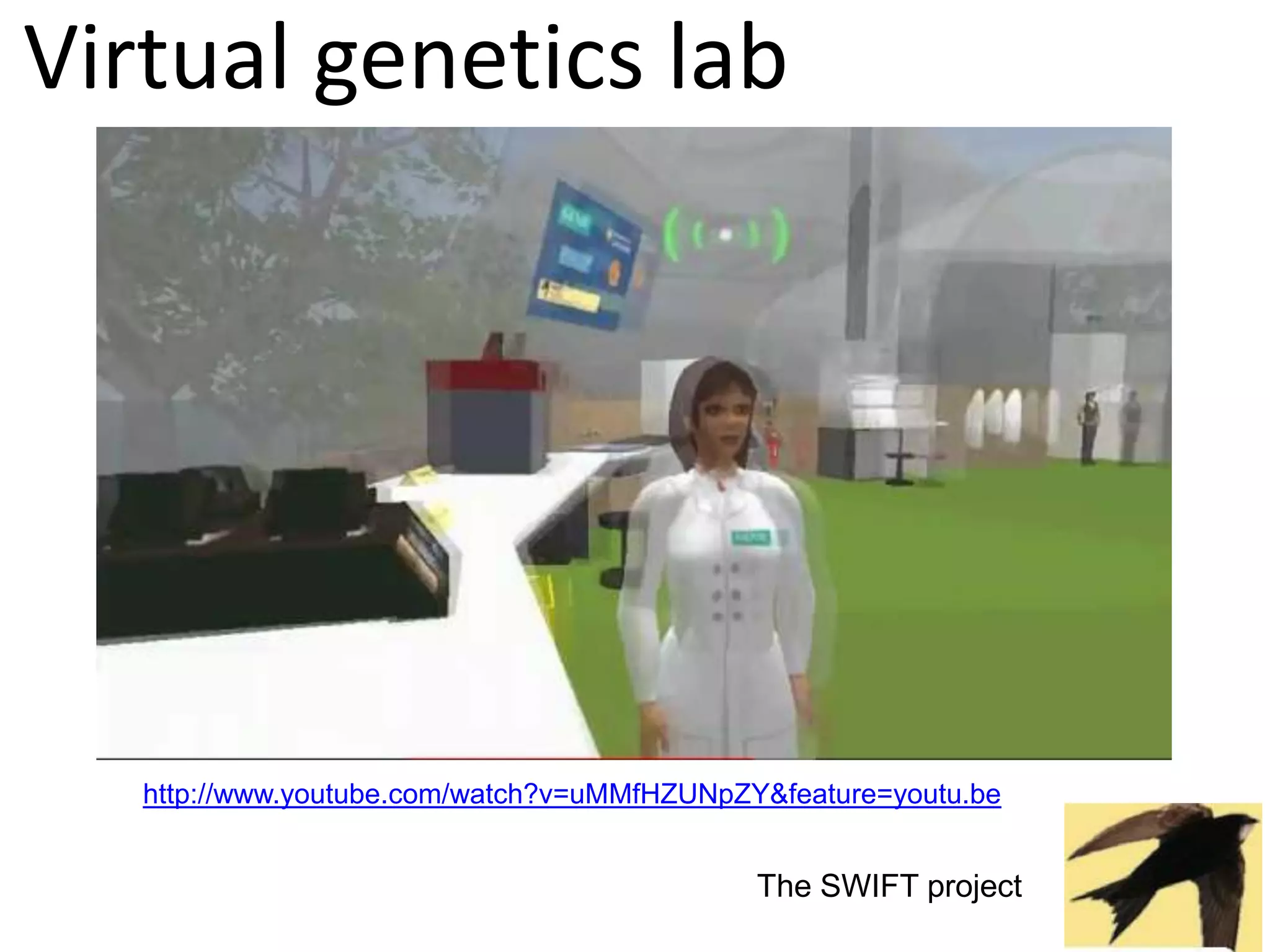
Virtual genetics lab


   http://www.youtube.com/watch?v=uMMfHZUNpZY&feature=youtu.be


                                             The SWIFT project
The problem

Social and
participatory media
offer new ways to
communicate and
collaborate           Not fully exploited

Wealth of free        Replicating bad pedagogy
resources and tools
                      Lack of time and skills
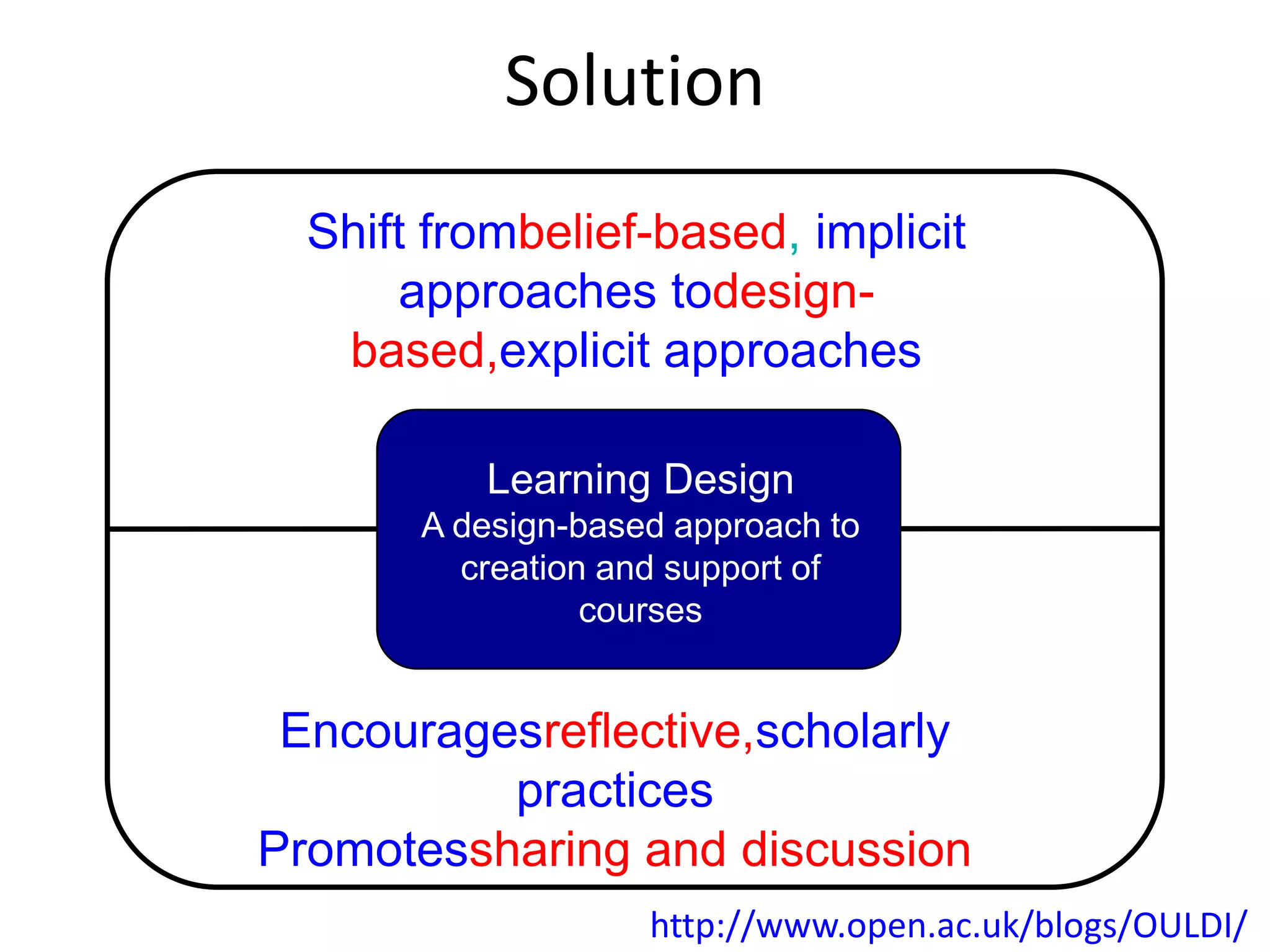
Solution
  Shift frombelief-based, implicit
       approaches todesign-
   based,explicit approaches

          Learning Design
       A design-based approach to
         creation and support of
                 courses


 Encouragesreflective,scholarly
          practices
Promotessharing and discussion
                    http://www.open.ac.uk/blogs/OULDI/
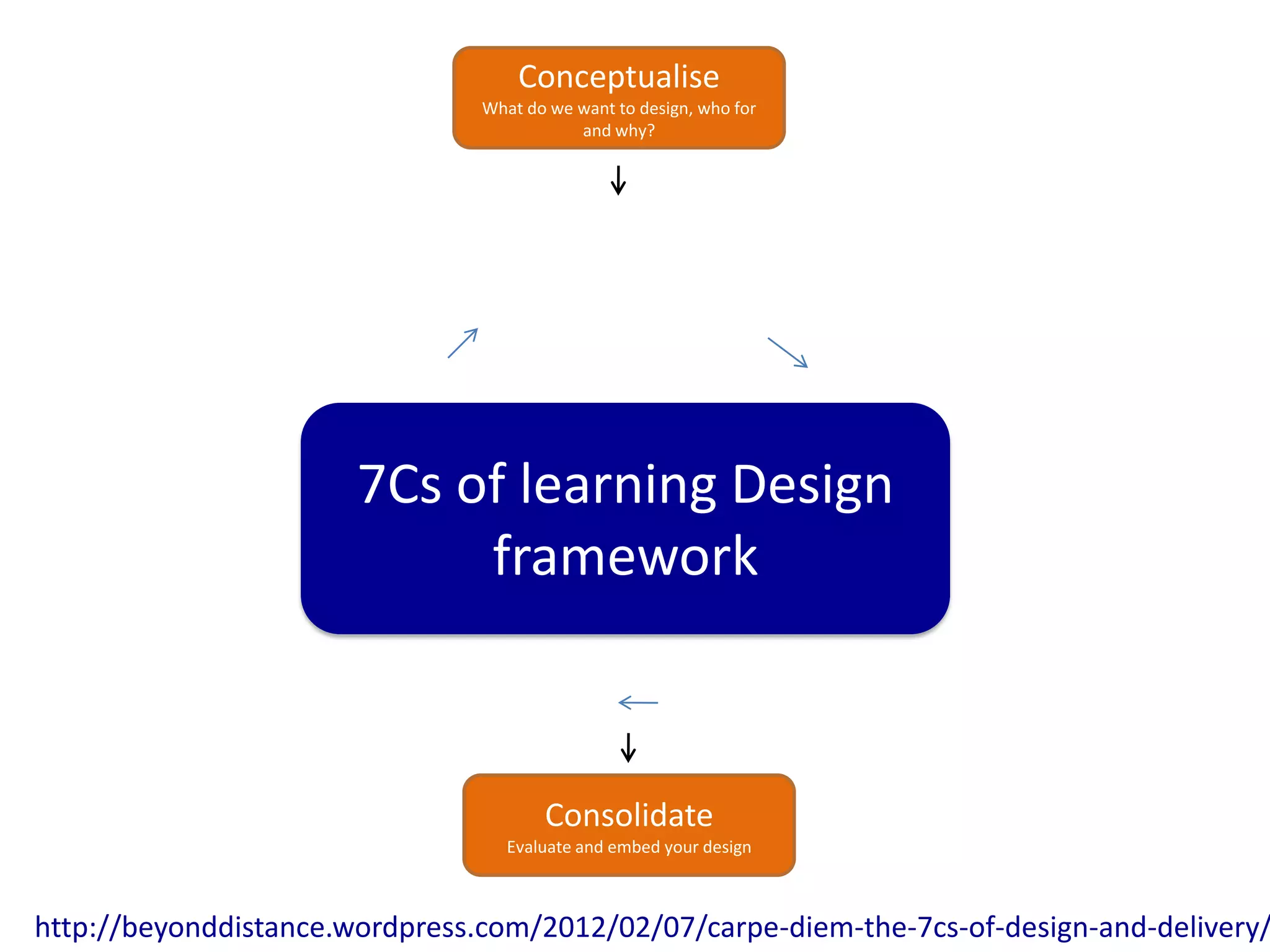
Conceptualise
                                What do we want to design, who for
                                           and why?


                       7Cs of learning Design
                            framework


                                       Consolidate
                                   Evaluate and embed your design


http://beyonddistance.wordpress.com/2012/02/07/carpe-diem-the-7cs-of-design-and-delivery/
Benefits
•   Guides design process
•   Makes design explicit
•   Enables sharing
•   Fosters repurposing
•   Highlights gaps
•   Representations for
    learners
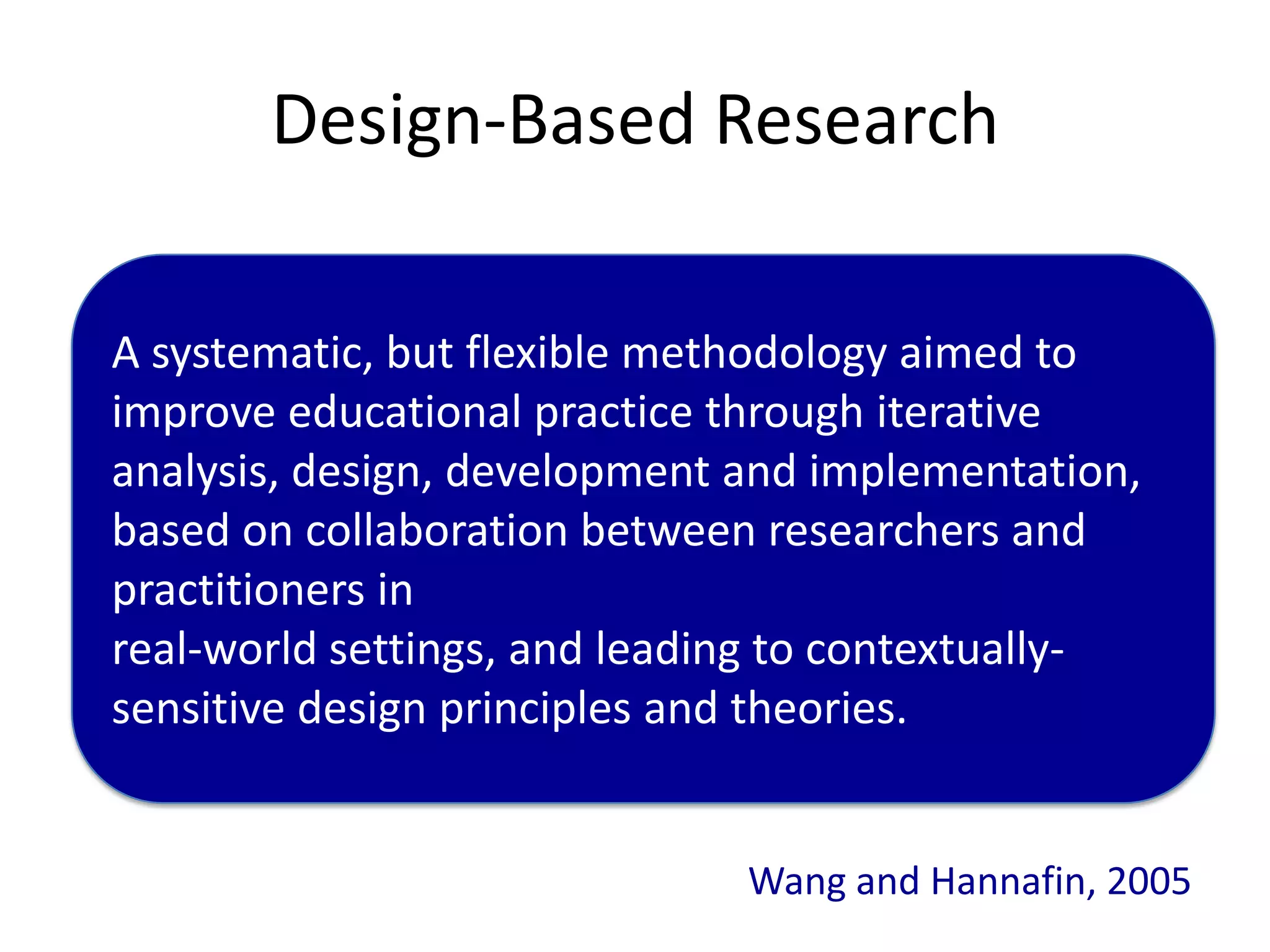
Design-Based Research

A systematic, but flexible methodology aimed to
improve educational practice through iterative
analysis, design, development and implementation,
based on collaboration between researchers and
practitioners in
real-world settings, and leading to contextually-
sensitive design principles and theories.


                              Wang and Hannafin, 2005
Benefits
• Means of dealing
  with real learning
  contexts
• Iterative: design,
  implementation,
  evaluation, refine
• Gives rich insights
  into complex
  dynamics
Facets
•   Make assumptions and theoretical basesexplicit
•   Collect multiple types of data
•   Conduct ongoing data analysis
•   Invite multiple voices to critique
•   Have multiple accountability structures
•   Engage in dialectic among theory, design and
    extant literature

                                        Barab, 2006
DBR and Learning Design
• Builds on theory & prior   • Builds on ID, OER, Ped
  research                     Patterns research etc.
• Pragmatic                  • Practical tools & resources
• Collaborative              • Work with practitioners
• Contextual                 • Real, authentic contexts
• Integrative                • Mixed-method approach
• Iterative – problem,       • Problem, implementation,
  solution, evaluation         evaluation and refinement
• Adaptive and flexible      • Agile, based on practice
• Generalisation             • Coherent LD framework
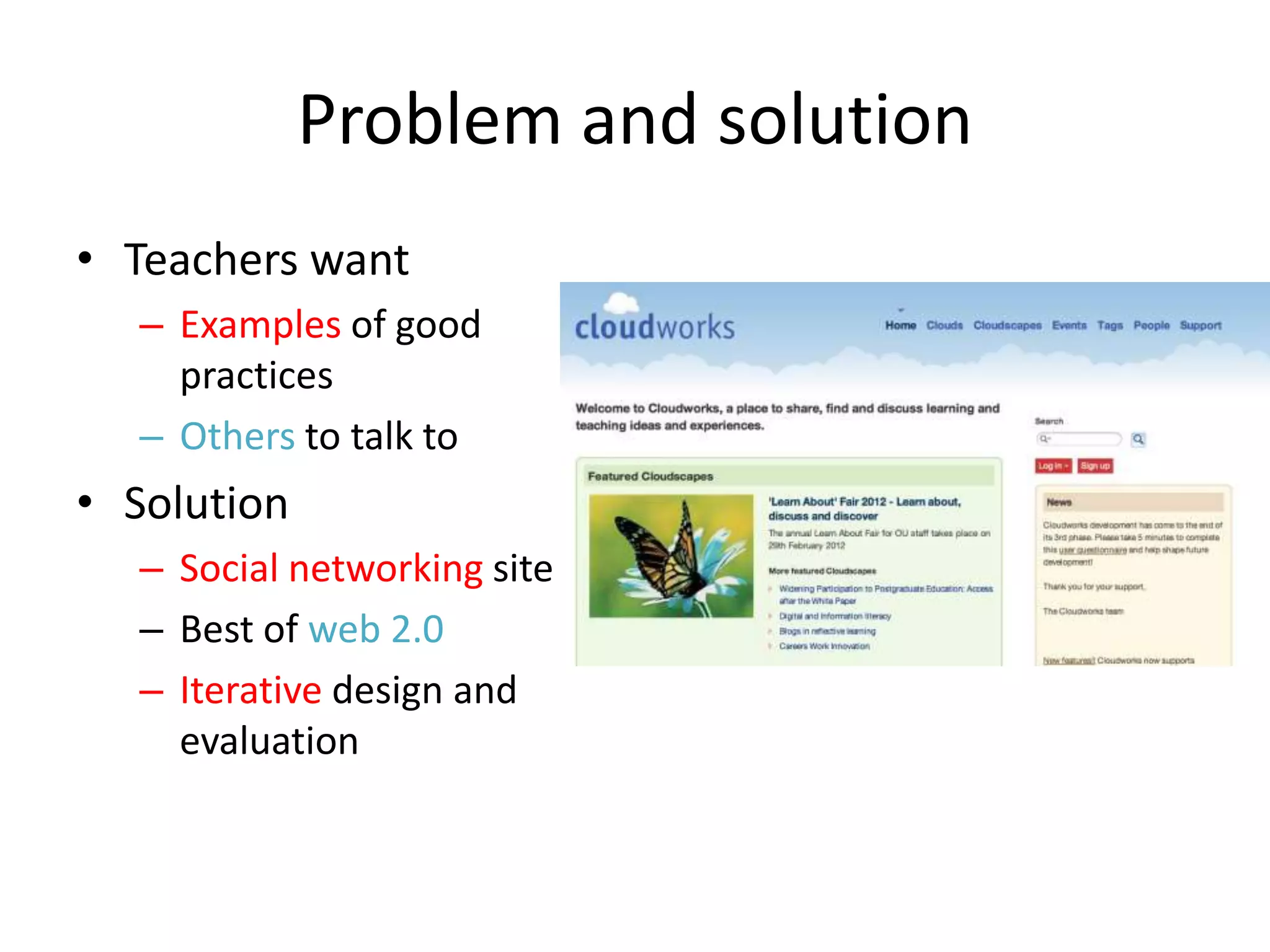
Problem and solution
• Teachers want
  – Examples of good
    practices
  – Others to talk to
• Solution
  – Social networking site
  – Best of web 2.0
  – Iterative design and
    evaluation
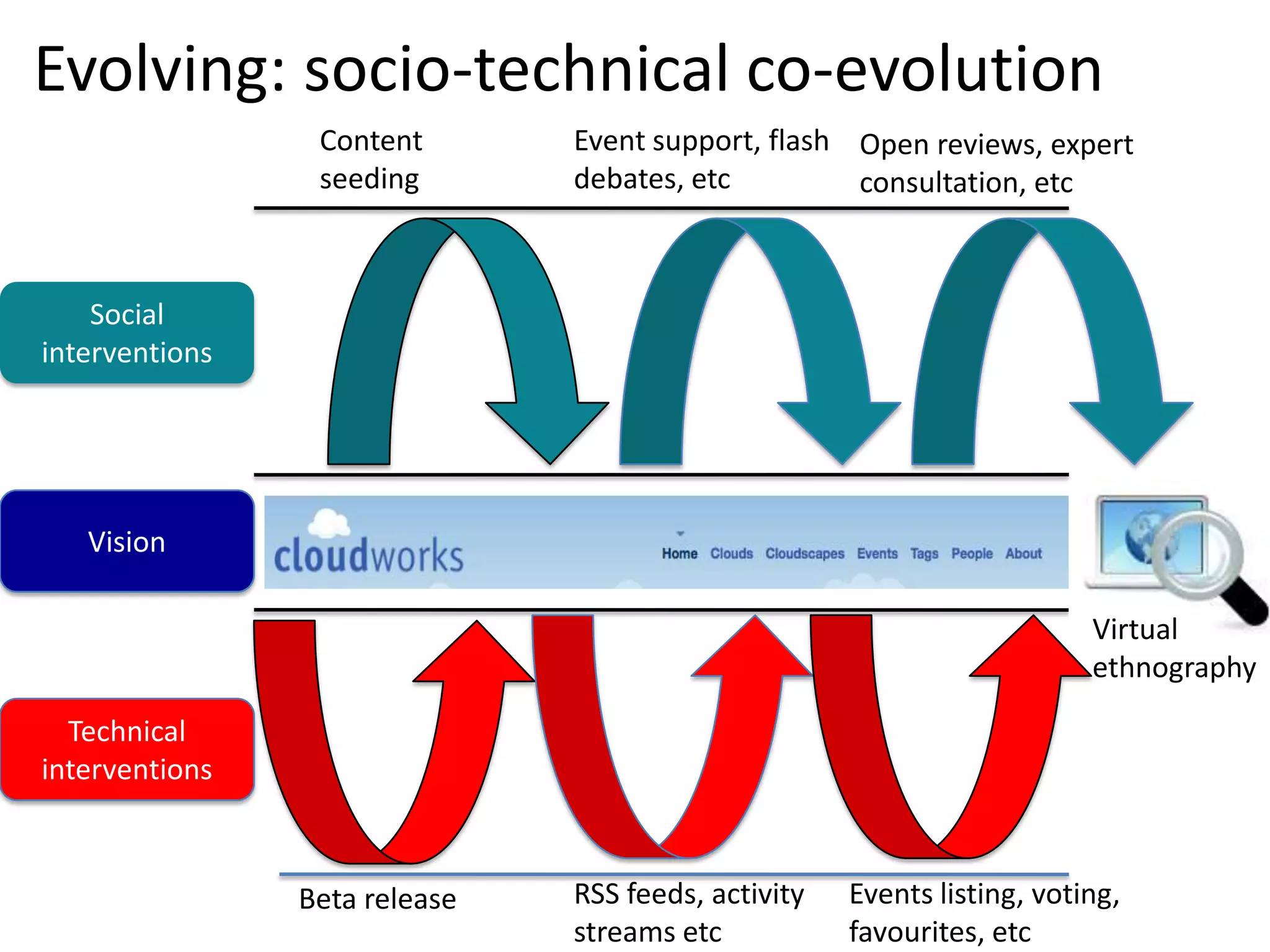
Evolving: socio-technical co-evolution
                 Content       Event support, flash Open reviews, expert
                 seeding       debates, etc         consultation, etc


    Social
interventions


   Vision

                                                                         Virtual
                                                                         ethnography

  Technical
interventions


                Beta release   RSS feeds, activity   Events listing, voting,
                               streams etc           favourites, etc
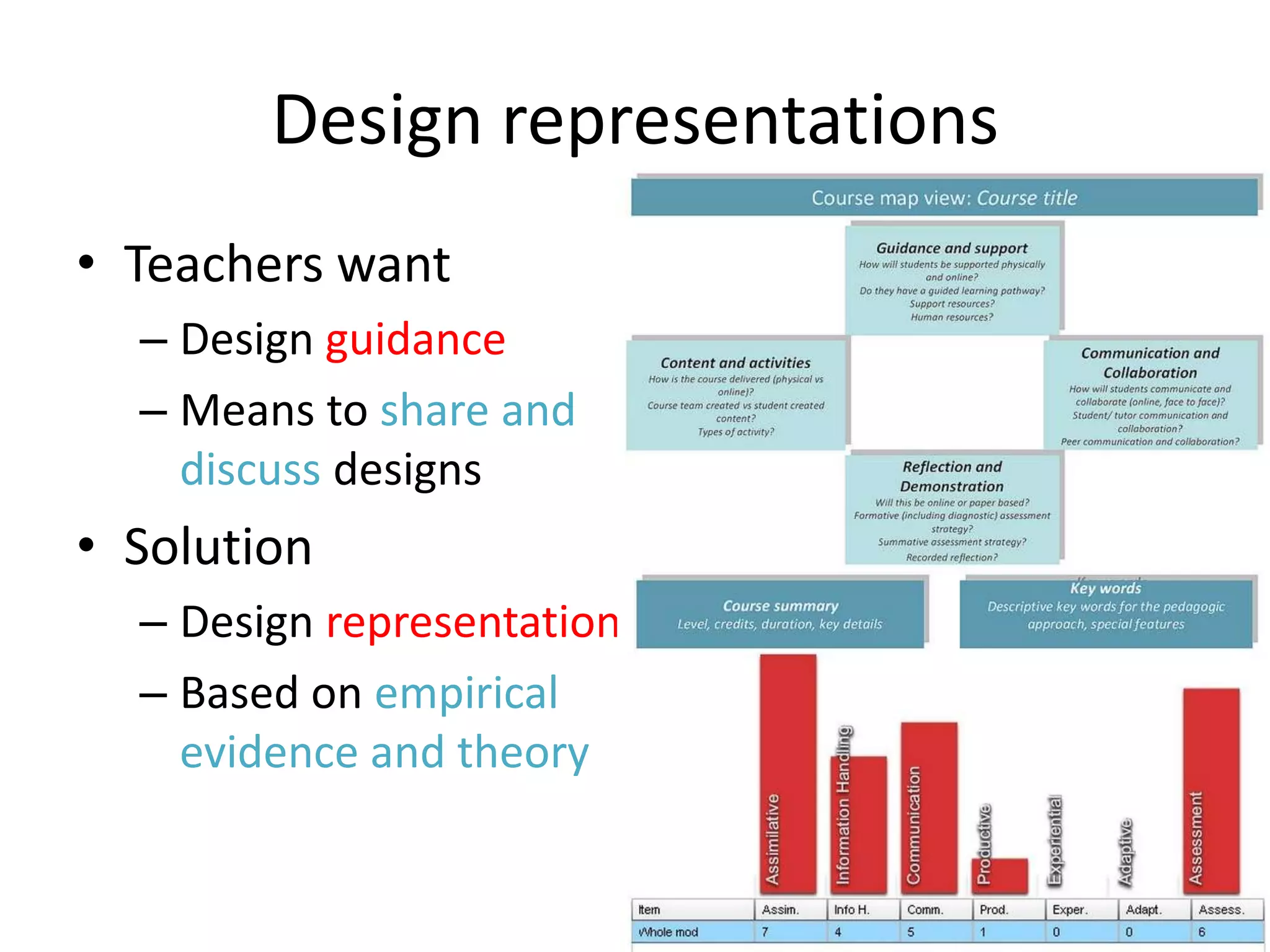
Design representations
• Teachers want
  – Design guidance
  – Means to share and
    discuss designs
• Solution
  – Design representations
  – Based on empirical
    evidence and theory
Implications
• New forms of communication
  and collaboration
• Rich multimedia
  representation
• Blurring boundaries
• More open practices
• New business models
• New digital literacies
• Harnessing the global
  network

         http://www.flickr.com/photos/10537908@N07/5904661557/
Conclusion
•   Co-evolving
•   Disruptive
•   Unpredictable
•   Complex
•   New opportunities
•   Social


               http://www.flickr.com/photos/planeta/6239911583/
Conole, G. (forthcoming), Designing for learning in an open world, New York: Springer
                           Chapters available on dropbox
                              grainne.conole@le.ac.uk
References
• Conole, G. (forthcoming), Designing for learning in an
  open world, New York: Springer
• Conole, G. and Culver, J. (2010), The design of
  Cloudworks: applying social networking practice to
  foster the exchange of learning and teaching ideas and
  designs, Computers and Education, 54(3): 679 – 692
• Jameson, J. and De Freitas, S. (2012), The e-learning
  reader
• Jenkins, H. (2009), Confronting the challenges of
  participatory culture: Media education for the 21st
  century, Mit Pr.
• Naughton, J. (2012), From Gutenberg to Zuckerberg,
  what you really need to know about the internet
• Weller, M. (2011), The digital scholar - how technology
  is changing academic practice. London, Bloomsbury
  Academic

Conole plenary

  • 1.
    Design-Based Research inTEL Gráinne Conole, Leicester University 23rdMay 2012 Plenary, JTEL Summer School Estoril, Portugal
  • 2.
    Outline • The TEL landscape • Potential of new technologies • Digital literacies • Fostering open practices • Mapping pedagogies to technologies • The problem • Learning design • Design-Based Research • Conclusions
  • 3.
    The TEL landscape Emergent technologies and affordances Theory and methodology E-pedagogies, strategies and learning design Resources, OER and Pedagogical Patterns Evaluations Jameson and De Freitas, 2012 Interventions
  • 4.
  • 5.
    Peer Open critiquing User Collective generated aggregation content Networked Personalised Social media revolution www.heacademy.ac.uk/asse s/EvidenceNet/Conole_Alev The machine is us/ing us ou_2010.pdf
  • 6.
    Technologies • Transforming everythingwe do • New forms of communication and collaboration • Multiple rich representations • Tools to find, create, manage, share • Networked, distributed, peer reviewed, open • Complex, dynamic and co- evolving http://www.flickr.com/photos/oceanflynn/6638184545/
  • 7.
    Gutenberg to Zuckerberg • Take the long view • The web is not the net • Disruption is a feature • Ecologies not economics • Complexity is the new reality • The network is now the computer • The web is evolving • Copyright or copywrong • Orwell (fear) or Huxley (pleasure) http://www.flickr.com/photos/wallyg/2617472088/ http://memex.naughtons.org/
  • 8.
    The Internet ofthings www.guardian.co.uk/local-government-network/2011/aug/18/internet-of-things-local-government
  • 9.
    Digital literacies: definition •Set of social practices and meaning making of digital tools (Lankshear and Knobel, 2008) Socio-cultural view of digital literacy. • Continuum from instrumental skills to productive competence and efficiency http://ftp.jrc.es/EURdoc/JRC67075_TN.pdf
  • 10.
    Digital literacies Creativity Play Collective intelligence Performance Judgement Simulation Transmedia navigation Appropriation Networking Multitasking Negotiation Distributed cognition Jenkins, 2009 http://www.imv.au.dk/icreanet/ http://www.flickr.com/photos/r8r/4109502436/
  • 11.
    Fostering new openpractices Open resources Open courses Open accreditation Open scholarship Open research
  • 12.
  • 13.
    Open courses Massive Open Online Course http://www.youtube.com/watch?v=eW3gMGqcZQc http://mooc.ca/
  • 14.
    Open accreditation Peer toPeer University OER University www.p2pu.org/en/ wikieducator.org/OER_university/
  • 15.
    Open scholarship • Exploitingthe digital network • New forms of dissemination and communication • Promoting reflective practice • Embracing the affordances of new technologies Weller, 2011 Weller: http://nogoodreason.typepad.co.uk/
  • 16.
  • 17.
  • 18.
  • 19.
    Mapping pedagogies totechnologies Social Information Informal Formal Experience Individual
  • 20.
    Mapping e-Pedagogies totechnologies Pedagogies Technologies • Problem-Based Learning (PBL) • Virtual Worlds (VW) • Inquiry-Based Learning (IBL) • Google • Didactic (Did) • E-Books • Reflection (Ref) • Blogs, e-Portfolios • Dialogic Learning (Dial) • Discussion Forums (DF) • Collaboration (Collab) • Wikis • Assessment (Ass) • MCQs • Communities of Practice (CoP) • Google+ • IBL – social • Twitter • User-Generated Content (UGC) • Youtube
  • 21.
    Social Information Informal Formal Experience Individual
  • 22.
    IBL/Twitter Social PBL/VW CoP/Google+ Dial/forum Dial/Skype Collab/Wiki Informal Formal Ref/Blog Ref/e-Portfolio IBL/Google Did/e-Book UGC/YouTube Individual Ass/MCQs
  • 23.
    Social Information Informal Formal Experience Individual
  • 24.
    Ref/Blog Experience PBL/VW CoP/Google+ Ref/e-Portfolio Dial/Skype Dial/Forum Informal Formal IBL/Twitter Coll/Wiki IBL/Google Did/e-Book UGC/YouTube Information Ass/MCQs
  • 25.
    Mobile learning E-books Study calendars Learning resources Online modules Annotation tools Podcasting Communication mechanisms
  • 26.
    Inquiry-based learning My community The Personal Inquiry project Inquiry-based learning across formal and informal settings Sharples, Scanlon et al. http://www.pi-project.ac.uk
  • 27.
    Virtual genetics lab http://www.youtube.com/watch?v=uMMfHZUNpZY&feature=youtu.be The SWIFT project
  • 28.
    The problem Social and participatorymedia offer new ways to communicate and collaborate Not fully exploited Wealth of free Replicating bad pedagogy resources and tools Lack of time and skills
  • 29.
    Solution Shiftfrombelief-based, implicit approaches todesign- based,explicit approaches Learning Design A design-based approach to creation and support of courses Encouragesreflective,scholarly practices Promotessharing and discussion http://www.open.ac.uk/blogs/OULDI/
  • 30.
    Conceptualise What do we want to design, who for and why? 7Cs of learning Design framework Consolidate Evaluate and embed your design http://beyonddistance.wordpress.com/2012/02/07/carpe-diem-the-7cs-of-design-and-delivery/
  • 31.
    Benefits • Guides design process • Makes design explicit • Enables sharing • Fosters repurposing • Highlights gaps • Representations for learners
  • 32.
    Design-Based Research A systematic,but flexible methodology aimed to improve educational practice through iterative analysis, design, development and implementation, based on collaboration between researchers and practitioners in real-world settings, and leading to contextually- sensitive design principles and theories. Wang and Hannafin, 2005
  • 33.
    Benefits • Means ofdealing with real learning contexts • Iterative: design, implementation, evaluation, refine • Gives rich insights into complex dynamics
  • 34.
    Facets • Make assumptions and theoretical basesexplicit • Collect multiple types of data • Conduct ongoing data analysis • Invite multiple voices to critique • Have multiple accountability structures • Engage in dialectic among theory, design and extant literature Barab, 2006
  • 35.
    DBR and LearningDesign • Builds on theory & prior • Builds on ID, OER, Ped research Patterns research etc. • Pragmatic • Practical tools & resources • Collaborative • Work with practitioners • Contextual • Real, authentic contexts • Integrative • Mixed-method approach • Iterative – problem, • Problem, implementation, solution, evaluation evaluation and refinement • Adaptive and flexible • Agile, based on practice • Generalisation • Coherent LD framework
  • 36.
    Problem and solution •Teachers want – Examples of good practices – Others to talk to • Solution – Social networking site – Best of web 2.0 – Iterative design and evaluation
  • 39.
    Evolving: socio-technical co-evolution Content Event support, flash Open reviews, expert seeding debates, etc consultation, etc Social interventions Vision Virtual ethnography Technical interventions Beta release RSS feeds, activity Events listing, voting, streams etc favourites, etc
  • 40.
    Design representations • Teacherswant – Design guidance – Means to share and discuss designs • Solution – Design representations – Based on empirical evidence and theory
  • 41.
    Implications • New formsof communication and collaboration • Rich multimedia representation • Blurring boundaries • More open practices • New business models • New digital literacies • Harnessing the global network http://www.flickr.com/photos/10537908@N07/5904661557/
  • 42.
    Conclusion • Co-evolving • Disruptive • Unpredictable • Complex • New opportunities • Social http://www.flickr.com/photos/planeta/6239911583/
  • 43.
    Conole, G. (forthcoming),Designing for learning in an open world, New York: Springer Chapters available on dropbox grainne.conole@le.ac.uk
  • 44.
    References • Conole, G.(forthcoming), Designing for learning in an open world, New York: Springer • Conole, G. and Culver, J. (2010), The design of Cloudworks: applying social networking practice to foster the exchange of learning and teaching ideas and designs, Computers and Education, 54(3): 679 – 692 • Jameson, J. and De Freitas, S. (2012), The e-learning reader • Jenkins, H. (2009), Confronting the challenges of participatory culture: Media education for the 21st century, Mit Pr. • Naughton, J. (2012), From Gutenberg to Zuckerberg, what you really need to know about the internet • Weller, M. (2011), The digital scholar - how technology is changing academic practice. London, Bloomsbury Academic