Digital media:
tools for excellent teaching

 Gráinne Conole, Leicester University
             12th September, 2012
Gesekkschaft fur Medien in derWissenschafte. V.
                Vienna, Austria
Outline

•   Technologies trends
•   E-pedagogies
•   Open Educational Resources
•   Teacher practice and paradoxes
•   The 7Cs of Learning Design
•   Implications
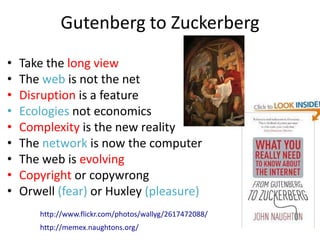
Gutenberg to Zuckerberg
•   Take the long view
•   The web is not the net
•   Disruption is a feature
•   Ecologies not economics
•   Complexity is the new reality
•   The network is now the computer
•   The web is evolving
•   Copyright or copywrong
•   Orwell (fear) or Huxley (pleasure)
       http://www.flickr.com/photos/wallyg/2617472088/
       http://memex.naughtons.org/
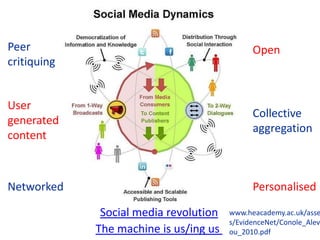
Peer                                          Open
critiquing


User
                                              Collective
generated
                                              aggregation
content


Networked                                     Personalised

              Social media revolution   www.heacademy.ac.uk/asse
                                        s/EvidenceNet/Conole_Alev
             The machine is us/ing us   ou_2010.pdf
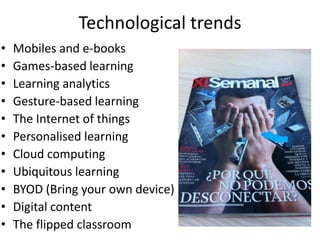
Technological trends
•   Mobiles and e-books
•   Games-based learning
•   Learning analytics
•   Gesture-based learning
•   The Internet of things
•   Personalised learning
•   Cloud computing
•   Ubiquitous learning
•   BYOD (Bring your own device)
•   Digital content
•   The flipped classroom
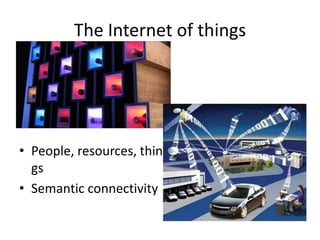
The Internet of things


• People, resources, thin
  gs
• Semantic connectivity
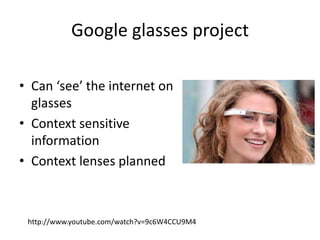
Google glasses project

• Can ‘see’ the internet on
  glasses
• Context sensitive
  information
• Context lenses planned


 http://www.youtube.com/watch?v=9c6W4CCU9M4
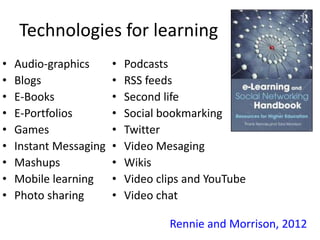
Technologies for learning
•   Audio-graphics      •   Podcasts
•   Blogs               •   RSS feeds
•   E-Books             •   Second life
•   E-Portfolios        •   Social bookmarking
•   Games               •   Twitter
•   Instant Messaging   •   Video Mesaging
•   Mashups             •   Wikis
•   Mobile learning     •   Video clips and YouTube
•   Photo sharing       •   Video chat

                                    Rennie and Morrison, 2012
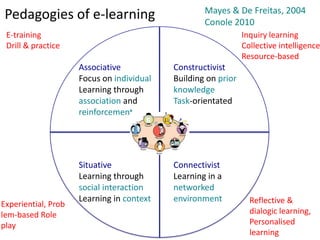
Mayes & De Freitas, 2004
 Pedagogies of e-learning                          Conole 2010
 E-training                                                    Inquiry learning
 Drill & practice                                              Collective intelligence
                                                               Resource-based
                     Associative           Constructivist
                     Focus on individual   Building on prior
                     Learning through      knowledge
                     association and       Task-orientated
                     reinforcement

                      A


                     Situative             Connectivist
                     Learning through      Learning in a
                     social interaction    networked
                     Learning in context   environment           Reflective &
Experiential, Prob
lem-based Role                                                   dialogic learning,
play                                                             Personalised
                                                                 learning
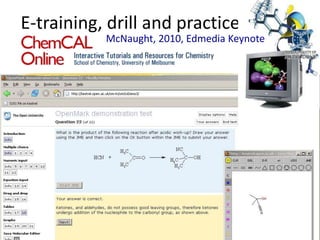
E-training, drill and practice
           McNaught, 2010, Edmedia Keynote
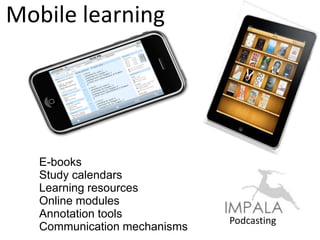
Mobile learning


   E-books
   Study calendars
   Learning resources
   Online modules
   Annotation tools
                              Podcasting
   Communication mechanisms
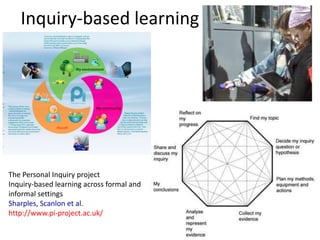
Inquiry-based learning


                          My community


The Personal Inquiry project
Inquiry-based learning across formal and
informal settings
Sharples, Scanlon et al.
http://www.pi-project.ac.uk/
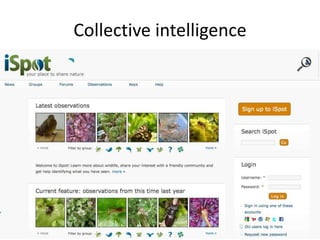
Collective intelligence
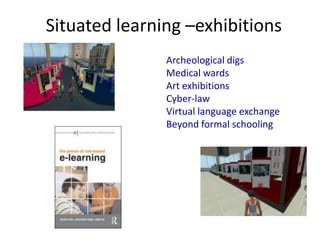
Situated learning –exhibitions
               Archeological digs
               Medical wards
               Art exhibitions
               Cyber-law
               Virtual language exchange
               Beyond formal schooling
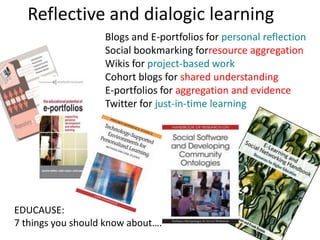
Reflective and dialogic learning
                   Blogs and E-portfolios for personal reflection
                   Social bookmarking forresource aggregation
                   Wikis for project-based work
                   Cohort blogs for shared understanding
                   E-portfolios for aggregation and evidence
                   Twitter for just-in-time learning


EDUCAUSE:
7 things you should know about….
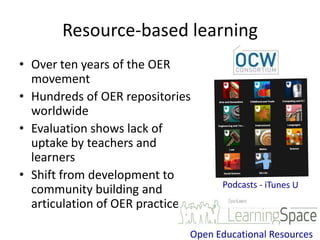
Resource-based learning
• Over ten years of the OER
  movement
• Hundreds of OER repositories
  worldwide
• Evaluation shows lack of
  uptake by teachers and
  learners
• Shift from development to
  community building and
  articulation of OER practice

                             Open Educational Resources
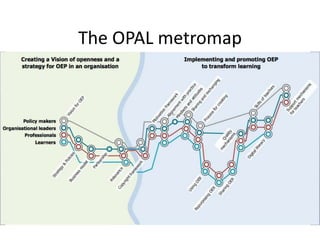
The OPAL metromap
Outputs
•   Inventory of more than 100 OER initiatives
•   11 country reports and 13 mini-reports
•   7 in-depth case studies
•   3 EU-wide policy papers
•   7 options brief packs for EU nations/regions
Country reports: key themes
• Diversity of educational contexts and maturity
  of internet provision and use of e-learning
• Differences in policy support and funding for
  OER initiatives
• Diversity from basic OER awareness to OER
  maturity and embedding
• Few national OER initiatives
Emergent themes
• Shift from development to OER practices
• Broader notion of open practices – open
  learning, teaching and research
• Use of social and participatory media to foster
  OER communities
UK Country Report
• Significant funding from JISC/HEA – three
  phase OER programme with around 100 OER
  initiatives
• Individual fellowships through SCORE and
  Olnet funding
• Institutionally supported initiatives
• Main activity in England, little in other
  countries                               Ming Nie
UK Country Report
• Funding mainly from government – top-down
• Funding mainly on production/producers, little
  on end-users or impact on learning
• Mainly HE/FE, little school-based
• Most institutions don’t have an OER strategy
• Lots on cascading and transferring of experience
• Most institutions have an OER repository
• Related work: iTunesU and MOOCs
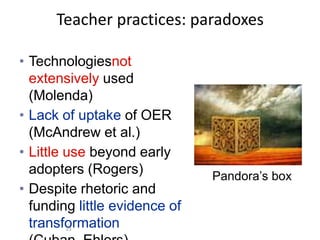
Teacher practices: paradoxes

• Technologiesnot
  extensively used
  (Molenda)
• Lack of uptake of OER
  (McAndrew et al.)
• Little use beyond early
  adopters (Rogers)            Pandora’s box
• Despite rhetoric and
  funding little evidence of
  transformation
        23
Promise and reality

Social and
participatory media
offer new ways to
communicate and
collaborate           Not fully exploited

Wealth of free        Replicating bad pedagogy
resources and tools
                      Lack of time and skills
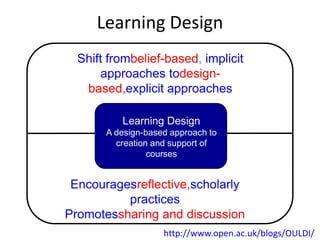
Learning Design
  Shift frombelief-based, implicit
       approaches todesign-
   based,explicit approaches

          Learning Design
       A design-based approach to
         creation and support of
                 courses


 Encouragesreflective,scholarly
          practices
Promotessharing and discussion
                    http://www.open.ac.uk/blogs/OULDI/
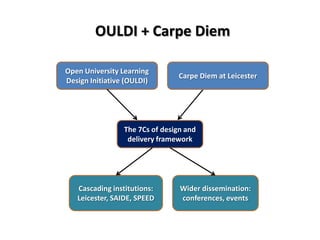
OULDI + Carpe Diem

Open University Learning
                                 Carpe Diem at Leicester
Design Initiative (OULDI)


                 The 7Cs of design and
                  delivery framework


   Cascading institutions:       Wider dissemination:
   Leicester, SAIDE, SPEED       conferences, events
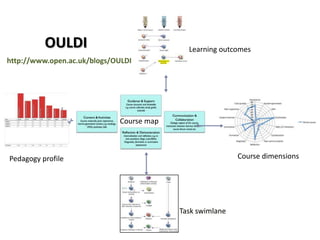
OULDI                             Learning outcomes
http://www.open.ac.uk/blogs/OULDI


                             Course map


Pedagogy profile                                          Course dimensions


                                          Task swimlane
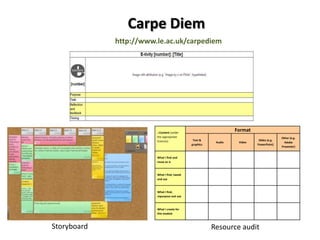
Carpe Diem
             http://www.le.ac.uk/carpediem


                          Content (under
                                                                 Format
                        the appropriate                                                   Other (e.g.
                        licences)             Text &                       Slides (e.g.
                                                         Audio    Video                     Adobe
                                             graphics                     PowerPoint)
                                                                                          Presenter)


                        What I find and
                        reuse as is


                        What I find, tweak
                        and use


                        What I find,
                        repurpose and use


                        What I create for
                        this module


Storyboard                                              Resource audit
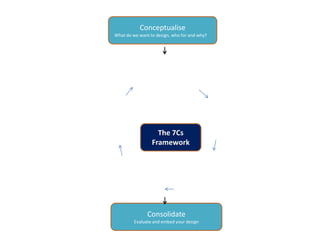
Conceptualise
What do we want to design, who for and why?


                   The 7Cs
                 Framework


               Consolidate
         Evaluate and embed your design
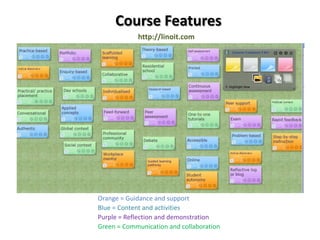
Course Features
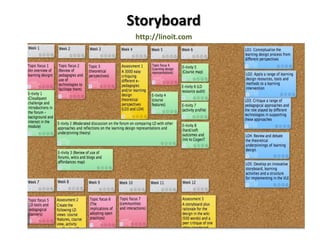
            http://linoit.com


Orange = Guidance and support
Blue = Content and activities
Purple = Reflection and demonstration
Green = Communication and collaboration
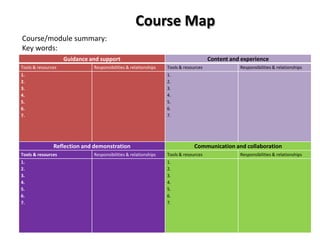
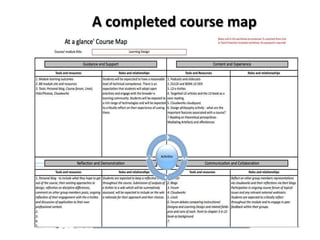
Course Map
Course/module summary:
Key words:
                    Guidance and support                                             Content and experience
Tools & resources             Responsibilities & relationships   Tools & resources              Responsibilities & relationships
1.                                                               1.
2.                                                               2.
3.                                                               3.
4.                                                               4.
5.                                                               5.
6.                                                               6.
7.                                                               7.


               Reflection and demonstration                                   Communication and collaboration
Tools & resources             Responsibilities & relationships   Tools & resources              Responsibilities & relationships
1.                                                               1.
2.                                                               2.
3.                                                               3.
4.                                                               4.
5.                                                               5.
6.                                                               6.
7.                                                               7.
A completed course map
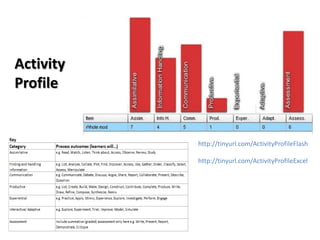
Activity
Profile


           http://tinyurl.com/ActivityProfileFlash

           http://tinyurl.com/ActivityProfileExcel
Storyboard
 http://linoit.com
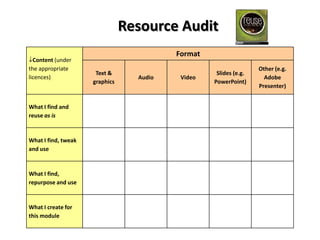
Resource Audit
                                          Format
  Content (under
the appropriate                                                    Other (e.g.
                      Text &                        Slides (e.g.
licences)                         Audio    Video                     Adobe
                     graphics                      PowerPoint)
                                                                   Presenter)


What I find and
reuse as is


What I find, tweak
and use


What I find,
repurpose and use


What I create for
this module
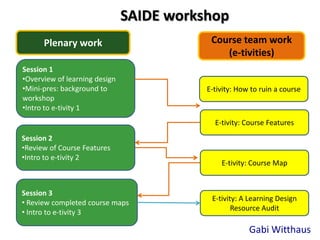
SAIDE workshop
      Plenary work                         Course team work
                                              (e-tivities)
Session 1
•Overview of learning design
•Mini-pres: background to                 E-tivity: How to ruin a course
workshop
•Intro to e-tivity 1
                                            E-tivity: Course Features
Session 2
•Review of Course Features
•Intro to e-tivity 2
                                              E-tivity: Course Map


Session 3
                                           E-tivity: A Learning Design
• Review completed course maps
                                                  Resource Audit
• Intro to e-tivity 3

                                                       Gabi Witthaus
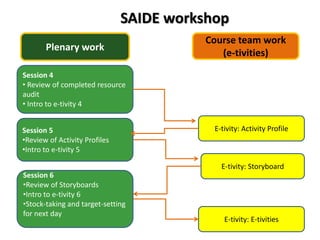
SAIDE workshop
                                         Course team work
       Plenary work
                                            (e-tivities)

Session 4
• Review of completed resource
audit
• Intro to e-tivity 4


Session 5                                  E-tivity: Activity Profile
•Review of Activity Profiles
•Intro to e-tivity 5

                                             E-tivity: Storyboard
Session 6
•Review of Storyboards
•Intro to e-tivity 6
•Stock-taking and target-setting
for next day
                                              E-tivity: E-tivities
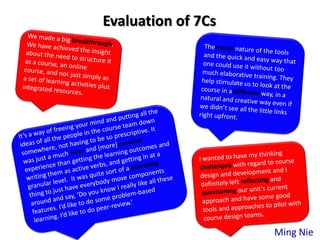
Evaluation of 7Cs


                    Ming Nie
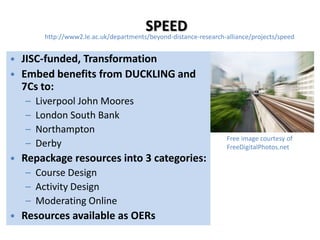
SPEED
        http://www2.le.ac.uk/departments/beyond-distance-research-alliance/projects/speed


• JISC-funded, Transformation
• Embed benefits from DUCKLING and
  7Cs to:
   –   Liverpool John Moores
   –   London South Bank
   –   Northampton
                                                                   Free image courtesy of
   –   Derby                                                       FreeDigitalPhotos.net
• Repackage resources into 3 categories:
   – Course Design
   – Activity Design
   – Moderating Online
• Resources available as OERs
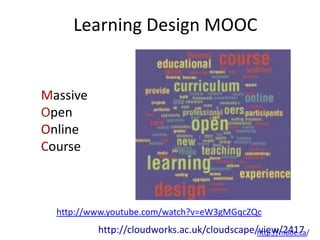
Learning Design MOOC


Massive
Open
Online
Course


  http://www.youtube.com/watch?v=eW3gMGqcZQc
          http://cloudworks.ac.uk/cloudscape/view/2417
                                             http://mooc.ca/
Useful sites and resources
• OULDI website
  http://www.open.ac.uk/blogs/OULDI/
• Carpe Diem website
  http://www.le.ac.uk/carpediem
• 7CsOER page
  http://www2.le.ac.uk/projects/oer/oers/beyond-
  distance-research-alliance/7cs-workshop-resources
• Cloudworkshttp://cloudworks.ac.uk/cloudscape/vie
  w/2406
• Slideshare
http://tinyurl.com/7cs-bdra-11april
Implications
• Blurring of
  boundaries and
  changing roles
• New pedagogies
  emerging
• New business models
• More open practices
• Disruptive, complex, c
  o-evolving
                 http://www.flickr.com/photos/ssoosay/6738302627/
Conole vienna keynote

Conole vienna keynote

  • 1.
    Digital media: tools forexcellent teaching Gráinne Conole, Leicester University 12th September, 2012 Gesekkschaft fur Medien in derWissenschafte. V. Vienna, Austria
  • 2.
    Outline • Technologies trends • E-pedagogies • Open Educational Resources • Teacher practice and paradoxes • The 7Cs of Learning Design • Implications
  • 3.
    Gutenberg to Zuckerberg • Take the long view • The web is not the net • Disruption is a feature • Ecologies not economics • Complexity is the new reality • The network is now the computer • The web is evolving • Copyright or copywrong • Orwell (fear) or Huxley (pleasure) http://www.flickr.com/photos/wallyg/2617472088/ http://memex.naughtons.org/
  • 4.
    Peer Open critiquing User Collective generated aggregation content Networked Personalised Social media revolution www.heacademy.ac.uk/asse s/EvidenceNet/Conole_Alev The machine is us/ing us ou_2010.pdf
  • 5.
    Technological trends • Mobiles and e-books • Games-based learning • Learning analytics • Gesture-based learning • The Internet of things • Personalised learning • Cloud computing • Ubiquitous learning • BYOD (Bring your own device) • Digital content • The flipped classroom
  • 6.
    The Internet ofthings • People, resources, thin gs • Semantic connectivity
  • 7.
    Google glasses project •Can ‘see’ the internet on glasses • Context sensitive information • Context lenses planned http://www.youtube.com/watch?v=9c6W4CCU9M4
  • 8.
    Technologies for learning • Audio-graphics • Podcasts • Blogs • RSS feeds • E-Books • Second life • E-Portfolios • Social bookmarking • Games • Twitter • Instant Messaging • Video Mesaging • Mashups • Wikis • Mobile learning • Video clips and YouTube • Photo sharing • Video chat Rennie and Morrison, 2012
  • 9.
    Mayes & DeFreitas, 2004 Pedagogies of e-learning Conole 2010 E-training Inquiry learning Drill & practice Collective intelligence Resource-based Associative Constructivist Focus on individual Building on prior Learning through knowledge association and Task-orientated reinforcement A Situative Connectivist Learning through Learning in a social interaction networked Learning in context environment Reflective & Experiential, Prob lem-based Role dialogic learning, play Personalised learning
  • 10.
    E-training, drill andpractice McNaught, 2010, Edmedia Keynote
  • 11.
    Mobile learning E-books Study calendars Learning resources Online modules Annotation tools Podcasting Communication mechanisms
  • 12.
    Inquiry-based learning My community The Personal Inquiry project Inquiry-based learning across formal and informal settings Sharples, Scanlon et al. http://www.pi-project.ac.uk/
  • 13.
  • 14.
    Situated learning –exhibitions Archeological digs Medical wards Art exhibitions Cyber-law Virtual language exchange Beyond formal schooling
  • 15.
    Reflective and dialogiclearning Blogs and E-portfolios for personal reflection Social bookmarking forresource aggregation Wikis for project-based work Cohort blogs for shared understanding E-portfolios for aggregation and evidence Twitter for just-in-time learning EDUCAUSE: 7 things you should know about….
  • 16.
    Resource-based learning • Overten years of the OER movement • Hundreds of OER repositories worldwide • Evaluation shows lack of uptake by teachers and learners • Shift from development to community building and articulation of OER practice Open Educational Resources
  • 17.
  • 18.
    Outputs • Inventory of more than 100 OER initiatives • 11 country reports and 13 mini-reports • 7 in-depth case studies • 3 EU-wide policy papers • 7 options brief packs for EU nations/regions
  • 19.
    Country reports: keythemes • Diversity of educational contexts and maturity of internet provision and use of e-learning • Differences in policy support and funding for OER initiatives • Diversity from basic OER awareness to OER maturity and embedding • Few national OER initiatives
  • 20.
    Emergent themes • Shiftfrom development to OER practices • Broader notion of open practices – open learning, teaching and research • Use of social and participatory media to foster OER communities
  • 21.
    UK Country Report •Significant funding from JISC/HEA – three phase OER programme with around 100 OER initiatives • Individual fellowships through SCORE and Olnet funding • Institutionally supported initiatives • Main activity in England, little in other countries Ming Nie
  • 22.
    UK Country Report •Funding mainly from government – top-down • Funding mainly on production/producers, little on end-users or impact on learning • Mainly HE/FE, little school-based • Most institutions don’t have an OER strategy • Lots on cascading and transferring of experience • Most institutions have an OER repository • Related work: iTunesU and MOOCs
  • 23.
    Teacher practices: paradoxes •Technologiesnot extensively used (Molenda) • Lack of uptake of OER (McAndrew et al.) • Little use beyond early adopters (Rogers) Pandora’s box • Despite rhetoric and funding little evidence of transformation 23
  • 24.
    Promise and reality Socialand participatory media offer new ways to communicate and collaborate Not fully exploited Wealth of free Replicating bad pedagogy resources and tools Lack of time and skills
  • 25.
    Learning Design Shift frombelief-based, implicit approaches todesign- based,explicit approaches Learning Design A design-based approach to creation and support of courses Encouragesreflective,scholarly practices Promotessharing and discussion http://www.open.ac.uk/blogs/OULDI/
  • 26.
    OULDI + CarpeDiem Open University Learning Carpe Diem at Leicester Design Initiative (OULDI) The 7Cs of design and delivery framework Cascading institutions: Wider dissemination: Leicester, SAIDE, SPEED conferences, events
  • 27.
    OULDI Learning outcomes http://www.open.ac.uk/blogs/OULDI Course map Pedagogy profile Course dimensions Task swimlane
  • 28.
    Carpe Diem http://www.le.ac.uk/carpediem Content (under Format the appropriate Other (e.g. licences) Text & Slides (e.g. Audio Video Adobe graphics PowerPoint) Presenter) What I find and reuse as is What I find, tweak and use What I find, repurpose and use What I create for this module Storyboard Resource audit
  • 29.
    Conceptualise What do wewant to design, who for and why? The 7Cs Framework Consolidate Evaluate and embed your design
  • 30.
    Course Features http://linoit.com Orange = Guidance and support Blue = Content and activities Purple = Reflection and demonstration Green = Communication and collaboration
  • 31.
    Course Map Course/module summary: Keywords: Guidance and support Content and experience Tools & resources Responsibilities & relationships Tools & resources Responsibilities & relationships 1. 1. 2. 2. 3. 3. 4. 4. 5. 5. 6. 6. 7. 7. Reflection and demonstration Communication and collaboration Tools & resources Responsibilities & relationships Tools & resources Responsibilities & relationships 1. 1. 2. 2. 3. 3. 4. 4. 5. 5. 6. 6. 7. 7.
  • 32.
  • 33.
    Activity Profile http://tinyurl.com/ActivityProfileFlash http://tinyurl.com/ActivityProfileExcel
  • 34.
  • 35.
    Resource Audit Format Content (under the appropriate Other (e.g. Text & Slides (e.g. licences) Audio Video Adobe graphics PowerPoint) Presenter) What I find and reuse as is What I find, tweak and use What I find, repurpose and use What I create for this module
  • 36.
    SAIDE workshop Plenary work Course team work (e-tivities) Session 1 •Overview of learning design •Mini-pres: background to E-tivity: How to ruin a course workshop •Intro to e-tivity 1 E-tivity: Course Features Session 2 •Review of Course Features •Intro to e-tivity 2 E-tivity: Course Map Session 3 E-tivity: A Learning Design • Review completed course maps Resource Audit • Intro to e-tivity 3 Gabi Witthaus
  • 37.
    SAIDE workshop Course team work Plenary work (e-tivities) Session 4 • Review of completed resource audit • Intro to e-tivity 4 Session 5 E-tivity: Activity Profile •Review of Activity Profiles •Intro to e-tivity 5 E-tivity: Storyboard Session 6 •Review of Storyboards •Intro to e-tivity 6 •Stock-taking and target-setting for next day E-tivity: E-tivities
  • 38.
  • 39.
    SPEED http://www2.le.ac.uk/departments/beyond-distance-research-alliance/projects/speed • JISC-funded, Transformation • Embed benefits from DUCKLING and 7Cs to: – Liverpool John Moores – London South Bank – Northampton Free image courtesy of – Derby FreeDigitalPhotos.net • Repackage resources into 3 categories: – Course Design – Activity Design – Moderating Online • Resources available as OERs
  • 40.
    Learning Design MOOC Massive Open Online Course http://www.youtube.com/watch?v=eW3gMGqcZQc http://cloudworks.ac.uk/cloudscape/view/2417 http://mooc.ca/
  • 41.
    Useful sites andresources • OULDI website http://www.open.ac.uk/blogs/OULDI/ • Carpe Diem website http://www.le.ac.uk/carpediem • 7CsOER page http://www2.le.ac.uk/projects/oer/oers/beyond- distance-research-alliance/7cs-workshop-resources • Cloudworkshttp://cloudworks.ac.uk/cloudscape/vie w/2406 • Slideshare http://tinyurl.com/7cs-bdra-11april
  • 42.
    Implications • Blurring of boundaries and changing roles • New pedagogies emerging • New business models • More open practices • Disruptive, complex, c o-evolving http://www.flickr.com/photos/ssoosay/6738302627/