Examining the impact of e-learning on
  the traditional role of a university
    Gráinne Conole, University of Leicester
         E-Learning Summit, Sydney
            27-28th February 2012
Outline
• Affordances of new technologies
• From Gutenberg to Zuckerberg
• Learner experience & teacher
  practice
• New pedagogies & Implications
• Strategies for change
  – Linking research to policy and
    practice
  – The VLE as a Trojan horse
  – New approaches to design
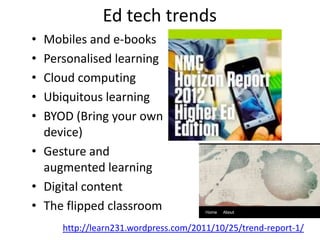
Ed tech trends
• Mobiles and e-books
• Personalised learning
• Cloud computing
• Ubiquitous learning
• BYOD (Bring your own
  device)
• Gesture and
  augmented learning
• Digital content
• The flipped classroom
     http://learn231.wordpress.com/2011/10/25/trend-report-1/
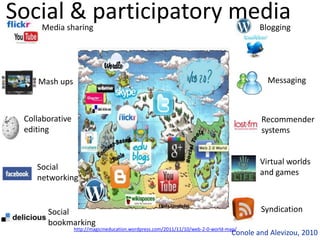
Social & participatory media
         Media sharing                                                                       Blogging


        Mash ups                                                                               Messaging


     Collaborative                                                                           Recommender
     editing                                                                                 systems


                                                                                             Virtual worlds
        Social
                                                                                             and games
        networking


           Social                                                                            Syndication
           bookmarking
 4                   http://magicineducation.wordpress.com/2011/11/10/web-2-0-world-map/
                                                                                     Conole and Alevizou, 2010
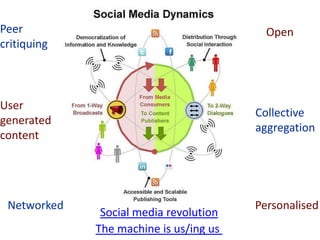
Peer                                      Open
critiquing


User
                                        Collective
generated
                                        aggregation
content


 Networked                              Personalised
              Social media revolution
             The machine is us/ing us
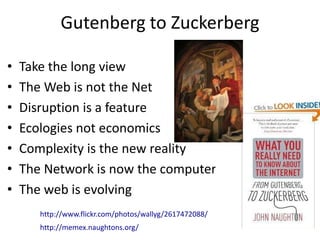
Gutenberg to Zuckerberg

•   Take the long view
•   The Web is not the Net
•   Disruption is a feature
•   Ecologies not economics
•   Complexity is the new reality
•   The Network is now the computer
•   The web is evolving
       http://www.flickr.com/photos/wallyg/2617472088/
       http://memex.naughtons.org/
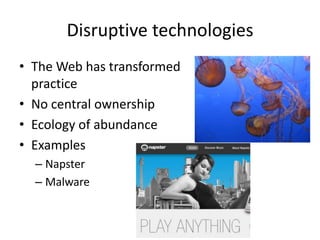
Disruptive technologies
• The Web has transformed
  practice
• No central ownership
• Ecology of abundance
• Examples
  – Napster
  – Malware
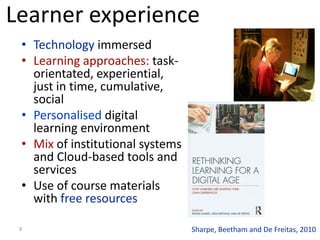
Learner experience
 • Technology immersed
 • Learning approaches: task-
   orientated, experiential,
   just in time, cumulative,
   social
 • Personalised digital
   learning environment
 • Mix of institutional systems
   and Cloud-based tools and
   services
 • Use of course materials
   with free resources

 8                                Sharpe, Beetham and De Freitas, 2010
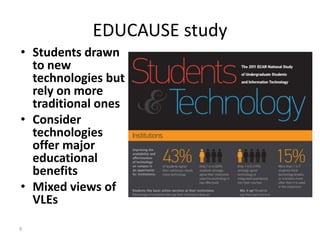
EDUCAUSE study
• Students drawn
  to new
  technologies but
  rely on more
  traditional ones
• Consider
  technologies
  offer major
  educational
  benefits
• Mixed views of
  VLEs

9
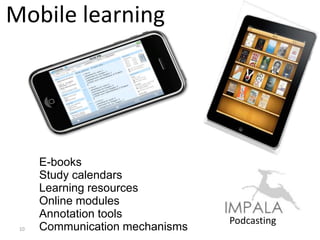
Mobile learning


      E-books
      Study calendars
      Learning resources
      Online modules
      Annotation tools
                                 Podcasting
 10   Communication mechanisms
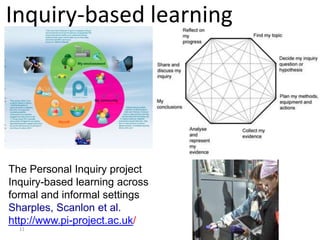
Inquiry-based learning


                 My community


The Personal Inquiry project
Inquiry-based learning across
formal and informal settings
Sharples, Scanlon et al.
http://www.pi-project.ac.uk/
  11
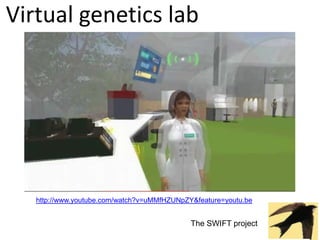
Virtual genetics lab


   http://www.youtube.com/watch?v=uMMfHZUNpZY&feature=youtu.be


                                             The SWIFT project
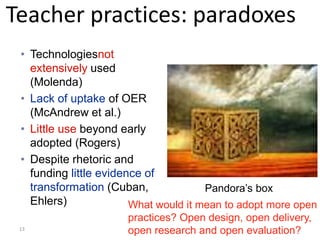
Teacher practices: paradoxes
 • Technologiesnot
   extensively used
   (Molenda)
 • Lack of uptake of OER
   (McAndrew et al.)
 • Little use beyond early
   adopted (Rogers)
 • Despite rhetoric and
   funding little evidence of
   transformation (Cuban,              Pandora’s box
   Ehlers)              What would it mean to adopt more open
                      practices? Open design, open delivery,
 13
                      open research and open evaluation?
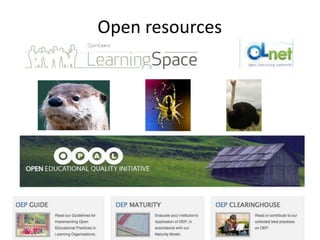
Open resources
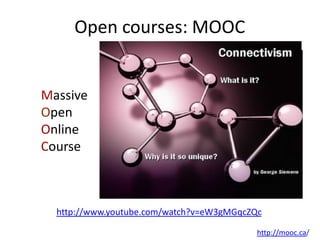
Open courses: MOOC


Massive
Open
Online
Course


  http://www.youtube.com/watch?v=eW3gMGqcZQc

                                           http://mooc.ca/
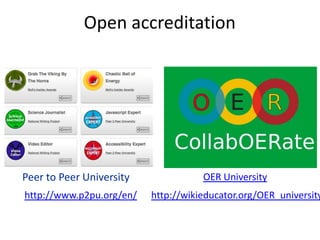
Open accreditation


Peer to Peer University              OER University
http://www.p2pu.org/en/   http://wikieducator.org/OER_university
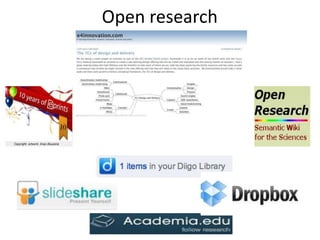
Open research
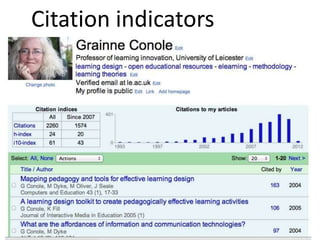
Citation indicators
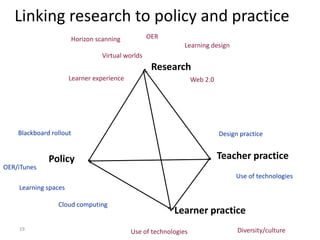
Linking research to policy and practice
                         Horizon scanning           OER
                                                              Learning design
                                   Virtual worlds
                                                     Research
                      Learner experience                          Web 2.0


    Blackboard rollout                                                      Design practice


              Policy                                                        Teacher practice
OER/iTunes
                                                                                 Use of technologies
    Learning spaces

                 Cloud computing
                                                          Learner practice
    19                                                                            Diversity/culture
                                            Use of technologies
The VLE as a Trojan horse
• VlE as a safe nursery
  slope
• Shift from content to
  activities
• Promote reflection and
  collaboration
• Mobile VLE
• Integration with cloud
  computing
VLE audit
• Data
   – Online survey (260 returns)
   – Departmental visits
• Key findings
   – Used as content repository
     and administration
   – Pockets of innovation
   – More support needed on
     effective design strategies
   – Tension between teaching
     and research
   – Useability issue
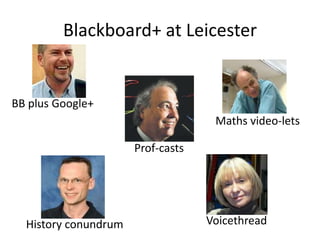
Blackboard+ at Leicester


BB plus Google+
                                    Maths video-lets

                      Prof-casts


  History conundrum                Voicethread
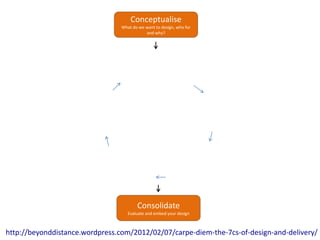
Conceptualise
                                 What do we want to design, who for
                                            and why?


                                        Consolidate
                                    Evaluate and embed your design


http://beyonddistance.wordpress.com/2012/02/07/carpe-diem-the-7cs-of-design-and-delivery/
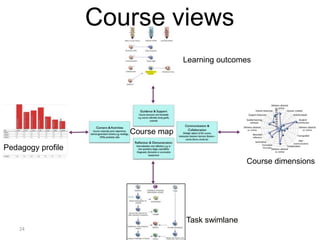
Course views
                                   Learning outcomes


                      Course map

Pedagogy profile
                                                   Course dimensions


                                   Task swimlane
    24
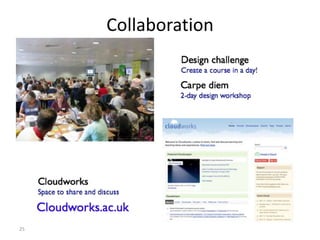
Collaboration


25
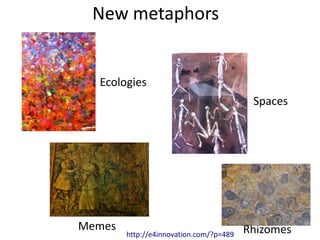
New metaphors


  Ecologies
                                          Spaces


Memes                                    Rhizomes
        http://e4innovation.com/?p=489
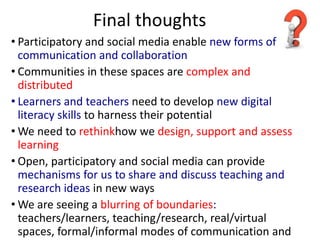
Final thoughts
• Participatory and social media enable new forms of
  communication and collaboration
• Communities in these spaces are complex and
  distributed
• Learners and teachers need to develop new digital
  literacy skills to harness their potential
• We need to rethinkhow we design, support and assess
  learning
• Open, participatory and social media can provide
  mechanisms for us to share and discuss teaching and
  research ideas in new ways
• We are seeing a blurring of boundaries:
  teachers/learners, teaching/research, real/virtual
  spaces, formal/informal modes of communication and
Conole, G. (forthcoming), Designing for learning in an open world, New York: Springer
grainne.conole@le.ac.uk
     28

Conole elearning summit

  • 1.
    Examining the impactof e-learning on the traditional role of a university Gráinne Conole, University of Leicester E-Learning Summit, Sydney 27-28th February 2012
  • 2.
    Outline • Affordances ofnew technologies • From Gutenberg to Zuckerberg • Learner experience & teacher practice • New pedagogies & Implications • Strategies for change – Linking research to policy and practice – The VLE as a Trojan horse – New approaches to design
  • 3.
    Ed tech trends •Mobiles and e-books • Personalised learning • Cloud computing • Ubiquitous learning • BYOD (Bring your own device) • Gesture and augmented learning • Digital content • The flipped classroom http://learn231.wordpress.com/2011/10/25/trend-report-1/
  • 4.
    Social & participatorymedia Media sharing Blogging Mash ups Messaging Collaborative Recommender editing systems Virtual worlds Social and games networking Social Syndication bookmarking 4 http://magicineducation.wordpress.com/2011/11/10/web-2-0-world-map/ Conole and Alevizou, 2010
  • 5.
    Peer Open critiquing User Collective generated aggregation content Networked Personalised Social media revolution The machine is us/ing us
  • 6.
    Gutenberg to Zuckerberg • Take the long view • The Web is not the Net • Disruption is a feature • Ecologies not economics • Complexity is the new reality • The Network is now the computer • The web is evolving http://www.flickr.com/photos/wallyg/2617472088/ http://memex.naughtons.org/
  • 7.
    Disruptive technologies • TheWeb has transformed practice • No central ownership • Ecology of abundance • Examples – Napster – Malware
  • 8.
    Learner experience •Technology immersed • Learning approaches: task- orientated, experiential, just in time, cumulative, social • Personalised digital learning environment • Mix of institutional systems and Cloud-based tools and services • Use of course materials with free resources 8 Sharpe, Beetham and De Freitas, 2010
  • 9.
    EDUCAUSE study • Studentsdrawn to new technologies but rely on more traditional ones • Consider technologies offer major educational benefits • Mixed views of VLEs 9
  • 10.
    Mobile learning E-books Study calendars Learning resources Online modules Annotation tools Podcasting 10 Communication mechanisms
  • 11.
    Inquiry-based learning My community The Personal Inquiry project Inquiry-based learning across formal and informal settings Sharples, Scanlon et al. http://www.pi-project.ac.uk/ 11
  • 12.
    Virtual genetics lab http://www.youtube.com/watch?v=uMMfHZUNpZY&feature=youtu.be The SWIFT project
  • 13.
    Teacher practices: paradoxes • Technologiesnot extensively used (Molenda) • Lack of uptake of OER (McAndrew et al.) • Little use beyond early adopted (Rogers) • Despite rhetoric and funding little evidence of transformation (Cuban, Pandora’s box Ehlers) What would it mean to adopt more open practices? Open design, open delivery, 13 open research and open evaluation?
  • 14.
  • 15.
    Open courses: MOOC Massive Open Online Course http://www.youtube.com/watch?v=eW3gMGqcZQc http://mooc.ca/
  • 16.
    Open accreditation Peer toPeer University OER University http://www.p2pu.org/en/ http://wikieducator.org/OER_university
  • 17.
  • 18.
  • 19.
    Linking research topolicy and practice Horizon scanning OER Learning design Virtual worlds Research Learner experience Web 2.0 Blackboard rollout Design practice Policy Teacher practice OER/iTunes Use of technologies Learning spaces Cloud computing Learner practice 19 Diversity/culture Use of technologies
  • 20.
    The VLE asa Trojan horse • VlE as a safe nursery slope • Shift from content to activities • Promote reflection and collaboration • Mobile VLE • Integration with cloud computing
  • 21.
    VLE audit • Data – Online survey (260 returns) – Departmental visits • Key findings – Used as content repository and administration – Pockets of innovation – More support needed on effective design strategies – Tension between teaching and research – Useability issue
  • 22.
    Blackboard+ at Leicester BBplus Google+ Maths video-lets Prof-casts History conundrum Voicethread
  • 23.
    Conceptualise What do we want to design, who for and why? Consolidate Evaluate and embed your design http://beyonddistance.wordpress.com/2012/02/07/carpe-diem-the-7cs-of-design-and-delivery/
  • 24.
    Course views Learning outcomes Course map Pedagogy profile Course dimensions Task swimlane 24
  • 25.
  • 26.
    New metaphors Ecologies Spaces Memes Rhizomes http://e4innovation.com/?p=489
  • 27.
    Final thoughts • Participatoryand social media enable new forms of communication and collaboration • Communities in these spaces are complex and distributed • Learners and teachers need to develop new digital literacy skills to harness their potential • We need to rethinkhow we design, support and assess learning • Open, participatory and social media can provide mechanisms for us to share and discuss teaching and research ideas in new ways • We are seeing a blurring of boundaries: teachers/learners, teaching/research, real/virtual spaces, formal/informal modes of communication and
  • 28.
    Conole, G. (forthcoming),Designing for learning in an open world, New York: Springer grainne.conole@le.ac.uk 28