CONFLICT MANAGEMENT
Definition
Conflict

is “an
--expressed struggle
--between at least two interdependent
parties
--who perceive incompatible goals, scare
resources, and
--interference from others in achieving
their goals” (Wilmot and Hocker, 1998)
Conflicts exist whenever incompatible
activities occur.
Thoughts
Traditional

view
Human relations
view
Interactionist view
Sources of Conflict
Conflicts

may originate from a number of
different sources, including:
 Differences in information, beliefs, values,
interests, or desires.
 A scarcity of some resource.
 Rivalries in which one person or group
competes with another.
Desirability of Conflict
Conflict

can be desirable.
Conflict helps eliminate or reduce the
likelihood of groupthink.
A moderate level of conflict across tasks
within a group resulted in increased group
performance while conflict among
personalities resulted in lower group
performance
Undesirability of Conflict
Conflicts

can be hard to control once
they have begun.
◦ The trend is toward escalation and
polarization.
◦ When conflict escalates to the point of being
out of control, it almost always yields negative
results.
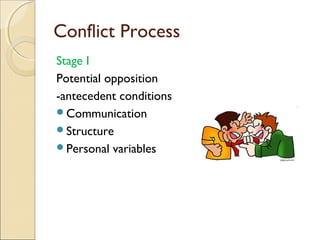
Conflict Process
Stage I
Potential opposition
-antecedent conditions
Communication
Structure
Personal variables
Stage II
Cognition and personalisation
Perceived conflict
Felt conflict
Stage III
Intentions
Competing
Collaborating (win-win solution)
Avoiding
Accommodating (self sacrificing)
Compromising
Stage IV
Behaviour
Stage V
-Outcomes
Functional
Dysfunctional
Conflict management
Conflict management is defined as “the
opportunity to improve situations and
strengthen relationships” .
–proactive conflict management
–collaborative conflict management
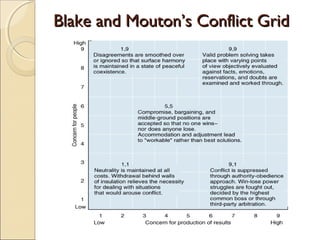
Blake and Mouton’s Conflict Grid
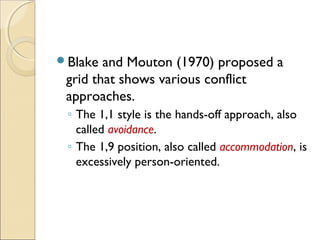
Blake

and Mouton (1970) proposed a
grid that shows various conflict
approaches.
◦ The 1,1 style is the hands-off approach, also
called avoidance.
◦ The 1,9 position, also called accommodation, is
excessively person-oriented.
◦ The 5,5 position represents a willingness to
compromise.
◦ The 9,1 is the bullheaded approach, also
called competing.
◦ The optimum style for reducing conflict is the
9,9 approach, also called collaboration.
Conflict resolution techniques
Problem

solving
Superordinate goals
Expansion of resources
Avoidance
Smoothing
Compromise
Authoritative command
Altering human variables
Altering structural variables
Conflict management

Conflict management