DEFINITION OF CONFLICT
Conflict can be defined as an expressed
struggle between at least two
interdependent parties, who perceive that
incompatible goals, scarce resources, or
interference from others are preventing
them from achieving their goals
GENERAL CAUSES OF CONFLICTS
•Scarcity of resources (finance, equipment,
facilities, etc)
•Different attitudes, values or perceptions.
•Disagreements about needs, goals, priorities
and interests
• Poor communication
•Poor or inadequate organizational structure
•Lack of teamwork
•Lack of clarity in roles and responsibilities
TYPES OF CONFLICTS
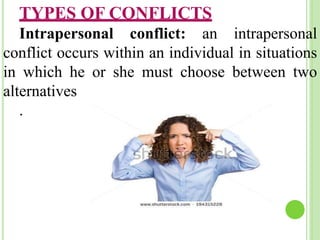
Intrapersonal conflict: an intrapersonal
conflict occurs within an individual in situations
in which he or she must choose between two
alternatives
.
TYPES OF CONFLICTS (cont..,)
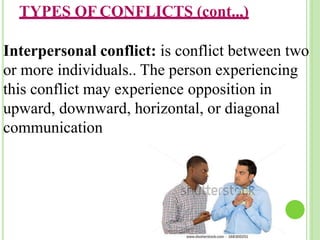
Interpersonal conflict: is conflict between two
or more individuals.. The person experiencing
this conflict may experience opposition in
upward, downward, horizontal, or diagonal
communication
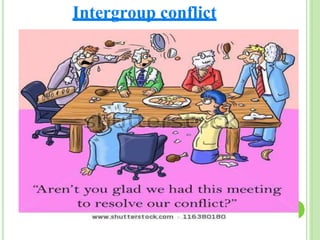
Intergroup conflict
Intergroup conflict refers to disagreements or
differences between the members of two or more
groups or their representatives over authority, territory,
and resources
Organizational conflicts: conflict also occurs
in organization because of differing perceptions or
goals..
Role ambiguity occurs when employees do not
know what to do, how to do it, or what the outcomes
must be
Role conflict occurs when two or more
individuals in different
organization believe that
positions
certain
within the
actions or
responsibilities belong exclusively to them
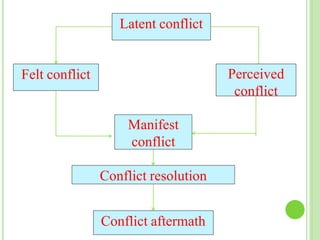
THE CONFLICT PROCESS
called antecedent
•Latent conflict (also
conditions).
•Perceived conflict
•Felt conflict
•Manifest conflict
•Conflict resolution or conflict management
•Conflict aftermath.
Latent conflict
Felt conflict Perceived
conflict
Manifest
conflict
Conflict resolution
Conflict aftermath
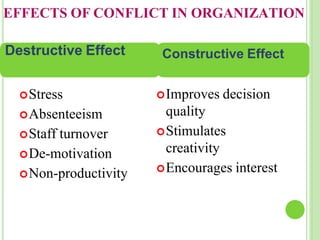
EFFECTS OF CONFLICT IN ORGANIZATION
Destructive Effect
Stress
Absenteeism
Staff turnover
De-motivation
Non-productivity
Constructive Effect
Improves decision
quality
Stimulates
creativity
Encourages interest
SIGNS OF CONFLICT BETWEEN
INDIVIDUALS
•Colleagues not speaking to each other or ignoring
each other
•Deliberately undermining or not co-operating with
each other, to the downfall of the team
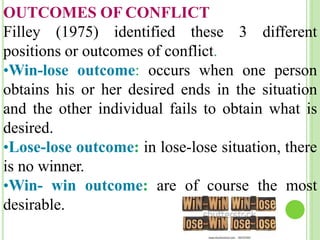
OUTCOMES OF CONFLICT
Filley (1975) identified these 3 different
positions or outcomes of conflict.
•Win-lose outcome: occurs when one person
obtains his or her desired ends in the situation
and the other individual fails to obtain what is
desired.
•Lose-lose outcome: in lose-lose situation, there
is no winner.
•Win- win outcome: are of course the most
desirable.
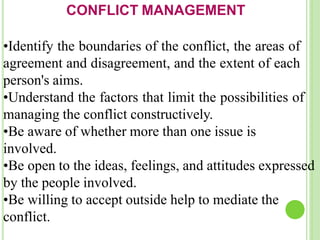
CONFLICT MANAGEMENT
•Identify the boundaries of the conflict, the areas of
agreement and disagreement, and the extent of each
person's aims.
•Understand the factors that limit the possibilities of
managing the conflict constructively.
•Be aware of whether more than one issue is
involved.
•Be open to the ideas, feelings, and attitudes expressed
by the people involved.
•Be willing to accept outside help to mediate the
conflict.
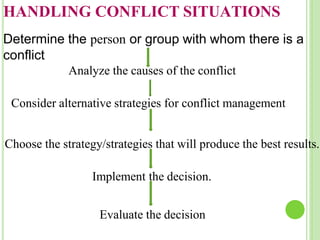
HANDLING CONFLICT SITUATIONS
.
Determine the person or group with whom there is a
conflict
Analyze the causes of the conflict
Consider alternative strategies for conflict management
Choose the strategy/strategies that will produce the best results.
Implement the decision.
Evaluate the decision
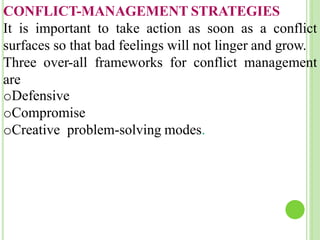
CONFLICT-MANAGEMENT STRATEGIES
It is important to take action as soon as a conflict
surfaces so that bad feelings will not linger and grow.
Three over-all frameworks for conflict management
are
oDefensive
oCompromise
oCreative problem-solving modes.
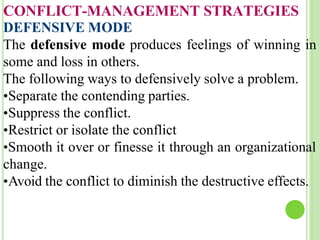
DEFENSIVE MODE
The defensive mode produces feelings of winning in
some and loss in others.
The following ways to defensively solve a problem.
•Separate the contending parties.
•Suppress the conflict.
•Restrict or isolate the conflict
•Smooth it over or finesse it through an organizational
change.
•Avoid the conflict to diminish the destructive effects.
CONFLICT-MANAGEMENT STRATEGIES
COMPROMISE.
With a compromise each party wins something and
loses something.."
CREATIVE PROBLEM SOLVING.
Use of a creative problem-solving mode produces
feelings of gain and no feelings of loss for all conflict
participants.
CONFLICT-MANAGEMENT STRATEGIES
(cont..)
As part of the creative problem-solving process, the
following five steps for conflict management can be
identified:
•Initiate a discussion, timed sensitively and held in an
environment conducive to private discussion.
•Respect individual differences.
•Be empathic with all involved parties.
•Agree on a solution that balances the power and
satisfies all parties, so that a consensus on a win-win
solution is reached
CONFLICT-MANAGEMENT STRATEGIES
(cont..)
•Have an assertive dialogue that consists of separating
facts from feelings, clearly defining the central issue,
differentiating viewpoints, making sure that each
person clearly states their intentions, framing the
main issue based on common principles, and being an
attentive listener consciously focused on what the
other person is saying.
CONFLICT HANDLING INTENTIONS
Blake and moutons five styles of handling
interpersonal conflict are forcing', withdrawing,
smoothing, sharing, and problem solving..
Building on Blake and moutons’ model, Thomas
reported that conflict has two
dimensions, The two dimensions are
1. Assertiveness (satisfying one’s own concerns)
2.Cooperativeness (attempting to satisfy
another’s concerns )
CONFLICT-RESOLUTION STRATEGIES
Conflicts can be a source of chronic frustration, or
they can lead to increased effectiveness in
organizations and groups.Afair proportion of a
leader's or manager's time is spent on handling
conflict.
The following is an overall list for methods or
strategies for conflict resolution
CONFLICT-RESOLUTION STRATEGIES (cont…)
•Avoiding: This is the strategy of avoiding conflict at
all costs. Some people never acknowledge that a
conflict exists.
•Withholding or withdrawing: In this avoidance
strategy, one party opts out of participation. They
remove themselves from the situation. This does not
resolve the conflict. However, this strategy does give
individuals a chance to calm
CONFLICT-RESOLUTION STRATEGIES (cont…)
•Accommodating: This strategy is used when there is
a large power differential. The more powerful party is
accommodated to preserve harmony or build up social
credits. What this means is that the party of lesser
power gives up his or her position in deference to the
more powerful party..
CONFLICT-RESOLUTION STRATEGIES (cont…)
•Smoothing over or reassuring: This is the strategy
of saying "Everything will be OK." By maintaining
surface harmony, parties do not withdraw but simply
attempt to make everyone feel good.
•Forcing: This technique is a dominance move and an
arbitrary way to manage conflict.An issue may be
forced on the table by issuing orders or by putting it to
a majority-rules vote. The hallmark phrase is "Let's
vote on it." Forcing is an all-out power strategy to win
while the other party loses.
CONFLICT-RESOLUTION STRATEGIES (cont…)
•Competing: This is an assertive strategy where one
party's needs are satisfied at the other's expense.
Competing is an all-out effort to win at any cost.
Applying for a job is a form of competition.
•Compromising: This strategy is called "splitting the
difference." In compromising each party gives up
something it wants. It is useful when goals or values
are markedly different. It is a staple of conflict
management.
CONFLICT-RESOLUTION STRATEGIES (cont…)
Confronting: This technique is called assertive
problem solving and is focused on the issues.
Individuals speak for themselves, but in a way that
decreases defensiveness and allows another person to
hear the message. It is a staple of conflict management
but requires courage
Collaborating: This is an assertive and
cooperative means of conflict resolution that
results in a win-win solution. It is a strategy in
which the parties work together to find a
mutually satisfying solution. It is invoked with
the phrase "Two heads are better than one." True
collaboration requires mutual respect; open and
honest communication; and equitable, shared
decision-making powers.
CONFLICT-RESOLUTION STRATEGIES (cont…)
•Bargaining and negotiating: These strategies are
attempts to divide the rewards, power, or benefits so
that everyone gets something. They involve both
parties in a back-and-forth effort at some level of
agreement. The process may be formal or informal.
•Problem solving: This strategy's goal is to try to find
an acceptable, workable solution for all parties. It is
designed to generate feelings of gain by all parties.
The problem-solving process is employed to reach a
mutually agreeable solution to the conflict.
Conflict Management between employees.pptx

Conflict Management between employees.pptx

  • 2.
    DEFINITION OF CONFLICT Conflictcan be defined as an expressed struggle between at least two interdependent parties, who perceive that incompatible goals, scarce resources, or interference from others are preventing them from achieving their goals
  • 3.
    GENERAL CAUSES OFCONFLICTS •Scarcity of resources (finance, equipment, facilities, etc) •Different attitudes, values or perceptions. •Disagreements about needs, goals, priorities and interests • Poor communication •Poor or inadequate organizational structure •Lack of teamwork •Lack of clarity in roles and responsibilities
  • 4.
    TYPES OF CONFLICTS Intrapersonalconflict: an intrapersonal conflict occurs within an individual in situations in which he or she must choose between two alternatives .
  • 5.
    TYPES OF CONFLICTS(cont..,) Interpersonal conflict: is conflict between two or more individuals.. The person experiencing this conflict may experience opposition in upward, downward, horizontal, or diagonal communication
  • 6.
  • 7.
    Intergroup conflict refersto disagreements or differences between the members of two or more groups or their representatives over authority, territory, and resources Organizational conflicts: conflict also occurs in organization because of differing perceptions or goals.. Role ambiguity occurs when employees do not know what to do, how to do it, or what the outcomes must be Role conflict occurs when two or more individuals in different organization believe that positions certain within the actions or responsibilities belong exclusively to them
  • 8.
    THE CONFLICT PROCESS calledantecedent •Latent conflict (also conditions). •Perceived conflict •Felt conflict •Manifest conflict •Conflict resolution or conflict management •Conflict aftermath.
  • 9.
    Latent conflict Felt conflictPerceived conflict Manifest conflict Conflict resolution Conflict aftermath
  • 10.
    EFFECTS OF CONFLICTIN ORGANIZATION Destructive Effect Stress Absenteeism Staff turnover De-motivation Non-productivity Constructive Effect Improves decision quality Stimulates creativity Encourages interest
  • 11.
    SIGNS OF CONFLICTBETWEEN INDIVIDUALS •Colleagues not speaking to each other or ignoring each other •Deliberately undermining or not co-operating with each other, to the downfall of the team
  • 12.
    OUTCOMES OF CONFLICT Filley(1975) identified these 3 different positions or outcomes of conflict. •Win-lose outcome: occurs when one person obtains his or her desired ends in the situation and the other individual fails to obtain what is desired. •Lose-lose outcome: in lose-lose situation, there is no winner. •Win- win outcome: are of course the most desirable.
  • 13.
    CONFLICT MANAGEMENT •Identify theboundaries of the conflict, the areas of agreement and disagreement, and the extent of each person's aims. •Understand the factors that limit the possibilities of managing the conflict constructively. •Be aware of whether more than one issue is involved. •Be open to the ideas, feelings, and attitudes expressed by the people involved. •Be willing to accept outside help to mediate the conflict.
  • 14.
    HANDLING CONFLICT SITUATIONS . Determinethe person or group with whom there is a conflict Analyze the causes of the conflict Consider alternative strategies for conflict management Choose the strategy/strategies that will produce the best results. Implement the decision. Evaluate the decision
  • 15.
    CONFLICT-MANAGEMENT STRATEGIES It isimportant to take action as soon as a conflict surfaces so that bad feelings will not linger and grow. Three over-all frameworks for conflict management are oDefensive oCompromise oCreative problem-solving modes.
  • 16.
    DEFENSIVE MODE The defensivemode produces feelings of winning in some and loss in others. The following ways to defensively solve a problem. •Separate the contending parties. •Suppress the conflict. •Restrict or isolate the conflict •Smooth it over or finesse it through an organizational change. •Avoid the conflict to diminish the destructive effects. CONFLICT-MANAGEMENT STRATEGIES
  • 17.
    CONFLICT-MANAGEMENT STRATEGIES COMPROMISE. With acompromise each party wins something and loses something.." CREATIVE PROBLEM SOLVING. Use of a creative problem-solving mode produces feelings of gain and no feelings of loss for all conflict participants.
  • 18.
    CONFLICT-MANAGEMENT STRATEGIES (cont..) As partof the creative problem-solving process, the following five steps for conflict management can be identified: •Initiate a discussion, timed sensitively and held in an environment conducive to private discussion. •Respect individual differences. •Be empathic with all involved parties. •Agree on a solution that balances the power and satisfies all parties, so that a consensus on a win-win solution is reached
  • 19.
    CONFLICT-MANAGEMENT STRATEGIES (cont..) •Have anassertive dialogue that consists of separating facts from feelings, clearly defining the central issue, differentiating viewpoints, making sure that each person clearly states their intentions, framing the main issue based on common principles, and being an attentive listener consciously focused on what the other person is saying.
  • 20.
    CONFLICT HANDLING INTENTIONS Blakeand moutons five styles of handling interpersonal conflict are forcing', withdrawing, smoothing, sharing, and problem solving.. Building on Blake and moutons’ model, Thomas reported that conflict has two dimensions, The two dimensions are 1. Assertiveness (satisfying one’s own concerns) 2.Cooperativeness (attempting to satisfy another’s concerns )
  • 21.
    CONFLICT-RESOLUTION STRATEGIES Conflicts canbe a source of chronic frustration, or they can lead to increased effectiveness in organizations and groups.Afair proportion of a leader's or manager's time is spent on handling conflict. The following is an overall list for methods or strategies for conflict resolution
  • 22.
    CONFLICT-RESOLUTION STRATEGIES (cont…) •Avoiding:This is the strategy of avoiding conflict at all costs. Some people never acknowledge that a conflict exists. •Withholding or withdrawing: In this avoidance strategy, one party opts out of participation. They remove themselves from the situation. This does not resolve the conflict. However, this strategy does give individuals a chance to calm
  • 23.
    CONFLICT-RESOLUTION STRATEGIES (cont…) •Accommodating:This strategy is used when there is a large power differential. The more powerful party is accommodated to preserve harmony or build up social credits. What this means is that the party of lesser power gives up his or her position in deference to the more powerful party..
  • 24.
    CONFLICT-RESOLUTION STRATEGIES (cont…) •Smoothingover or reassuring: This is the strategy of saying "Everything will be OK." By maintaining surface harmony, parties do not withdraw but simply attempt to make everyone feel good. •Forcing: This technique is a dominance move and an arbitrary way to manage conflict.An issue may be forced on the table by issuing orders or by putting it to a majority-rules vote. The hallmark phrase is "Let's vote on it." Forcing is an all-out power strategy to win while the other party loses.
  • 25.
    CONFLICT-RESOLUTION STRATEGIES (cont…) •Competing:This is an assertive strategy where one party's needs are satisfied at the other's expense. Competing is an all-out effort to win at any cost. Applying for a job is a form of competition. •Compromising: This strategy is called "splitting the difference." In compromising each party gives up something it wants. It is useful when goals or values are markedly different. It is a staple of conflict management.
  • 26.
    CONFLICT-RESOLUTION STRATEGIES (cont…) Confronting:This technique is called assertive problem solving and is focused on the issues. Individuals speak for themselves, but in a way that decreases defensiveness and allows another person to hear the message. It is a staple of conflict management but requires courage
  • 27.
    Collaborating: This isan assertive and cooperative means of conflict resolution that results in a win-win solution. It is a strategy in which the parties work together to find a mutually satisfying solution. It is invoked with the phrase "Two heads are better than one." True collaboration requires mutual respect; open and honest communication; and equitable, shared decision-making powers. CONFLICT-RESOLUTION STRATEGIES (cont…)
  • 28.
    CONFLICT-RESOLUTION STRATEGIES (cont…) •Bargainingand negotiating: These strategies are attempts to divide the rewards, power, or benefits so that everyone gets something. They involve both parties in a back-and-forth effort at some level of agreement. The process may be formal or informal. •Problem solving: This strategy's goal is to try to find an acceptable, workable solution for all parties. It is designed to generate feelings of gain by all parties. The problem-solving process is employed to reach a mutually agreeable solution to the conflict.