Extern conference
Ext พรพรหม สิทธิเวทยานนท์
Patient profile
ผู้ป่วยหญิงไทยคู่ อายุ 77 ปี เป็นแม่บ้าน
ภูมิลาเนาจังหวัดนครราชสีมา
Chief complaint
ล้มเอาไหล่ซ้ายกระแทกเสา 2 ชั่วโมงก่อนมารพ.
Present illness
2 ชั่วโมงก่อนมา รพ ขณะที่กาลังกวาดบ้านอยู่หน้าบ้าน กาลังจะเดินเลี้ยวเข้าบ้าน เกิดลื่นเสียหลัก ล้มหงาย
หลัง เอาแขนซ้ายบริเวณไหล่กระแทกกับเสาหน้าบ้าน (เสาอยู่ด้านหลัง) ไม่มีศีรษะกระแทกพื้น ไม่มีหมดสติ จาเหตุการณ์
ได้ตลอด หลังจากที่ล้ม หัวไหล่ข้างซ้ายมีอาการผิดรูปและปวดตรงหัวไหล่ซ้ายทันที ยกแขนซ้ายไม่ได้เนื่องจากเจ็บ แต่ยัง
ขยับข้อมือและข้อศอกได้ ไม่มีอาการชาบริเวณใดๆ ไม่มีแผลเปิด จากนั้นผู้ป่วยได้เข้าไปนอนในบ้าน กินยาแก้ปวด และ
เอายาหม่องมานวดทา แต่อาการไม่ดีขึ้น จึงมารพ.
 ABCDE - pass
Past history
• Underlying disease OA knees ปัจจุบันรักษาอยู่ที่ รพ.โนนฝรั่ง ด้วย medication ปวด
เข่าไม่บ่อย
• เคยประสบอุบัติเหตุรถชนเมื่อ 10+ ปีก่อน ทาให้ขาขวาหัก จึงต้องผ่าตัดดามเหล็กที่ขาขวา
• ไม่เคยไหล่หลุดมาก่อน
• No drug and food allergy
• Current med : Naproxen(250) 1x2 PO pc , Omeprazole(20) 1xhs
Personal history
• No alcohol drinking , not smoke
• No herbal used
• No family history of genetic disease
Physical examination
• Vital signs – T 36.8 , PR 76 bpm , RR 18 /min , BP 161/75 mmHg
• General appearance – A Thai old woman , alert , good conscious
• HEENT - not pale conjunctivae , anicteric sclerae , no wound
• CVS – normal s1 s2 sound , no murmur
• Respiratory – Clear and equal breath sound both lung , no
adventitious sound
• Abdomen – soft , not tender
• Skin – no ecchymosis , no laceration or abrasion wound
• Extremities
Lt.shoulder – loss of normal shoulder contour , no external wound seen
Arm position is in abduction and external rotation
Tender along shoulder , palpable head of Lt. humerus
limit ROM of shoulder joint due to pain
full ROM of elbow and wrist joint
Ruler’s test positive , Duga’s test negative (can touch)
sensory intact , radial pulse 2+
Other - WNL
Investigation
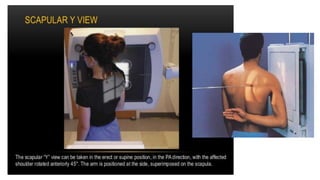
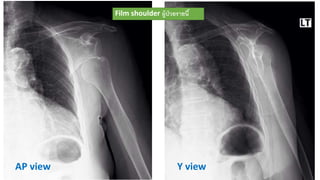
• Film Lt shoulder in AP view , lateral scapula Y view
Y viewAP view
Film shoulder ผู้ป่วยรายนี้
Finding
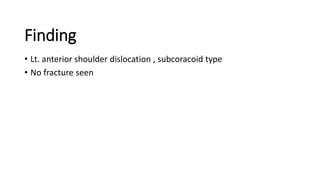
• Lt. anterior shoulder dislocation , subcoracoid type
• No fracture seen
Diagnosis
Lt. anterior shoulder dislocation
Management
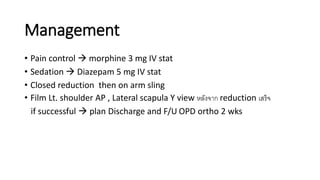
• Pain control  morphine 3 mg IV stat
• Sedation  Diazepam 5 mg IV stat
• Closed reduction then on arm sling
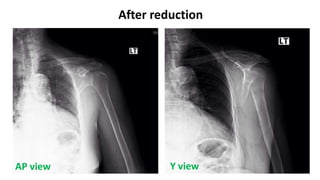
• Film Lt. shoulder AP , Lateral scapula Y view หลังจาก reduction เสร็จ
if successful  plan Discharge and F/U OPD ortho 2 wks
After reduction
AP view Y view
Successful reduction
• Discharge ได้
• นัด F/U OPD ortho 1 wks
• Advice early ROM เพื่อป้องกันไหล่ติด เริ่มทันทีที่หายปวด
Shoulder dislocation
• 50% of all major joint dislocations.
• Anterior dislocation is most common  95 - 97 % of cases.
Posterior dislocation 2 – 4%
Inferior dislocation 0.5 %
• high recurrence rate that correlates with age at dislocation
up to 80-90% in teenagers (90% chance for recurrence in age >20)
Anterior shoulder dislocation
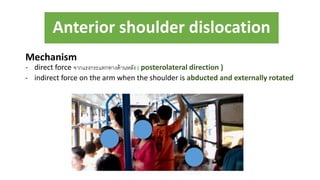
Mechanism
- direct force จากแรงกระแทกทางด้านหลัง ( posterolateral direction )
- indirect force on the arm when the shoulder is abducted and externally rotated
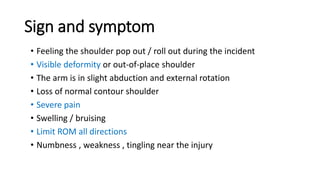
Sign and symptom
• Feeling the shoulder pop out / roll out during the incident
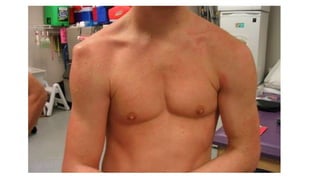
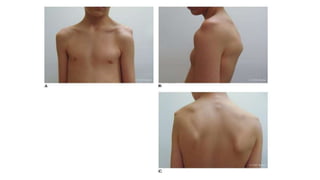
• Visible deformity or out-of-place shoulder
• The arm is in slight abduction and external rotation
• Loss of normal contour shoulder
• Severe pain
• Swelling / bruising
• Limit ROM all directions
• Numbness , weakness , tingling near the injury
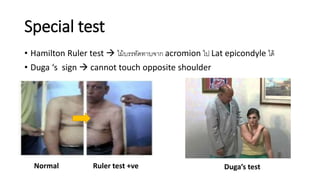
• Hamilton Ruler test  ไม้บรรทัดทาบจาก acromion ไป Lat epicondyle ได้
• Duga ‘s sign  cannot touch opposite shoulder
Special test
Normal Ruler test +ve Duga’s test
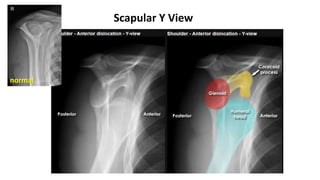
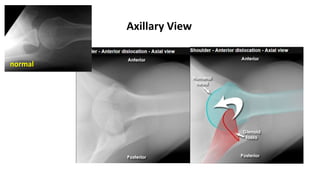
Imaging
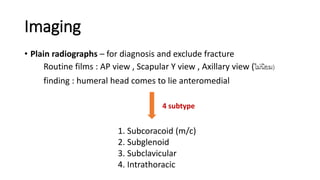
• Plain radiographs – for diagnosis and exclude fracture
Routine films : AP view , Scapular Y view , Axillary view (ไม่นิยม)
finding : humeral head comes to lie anteromedial
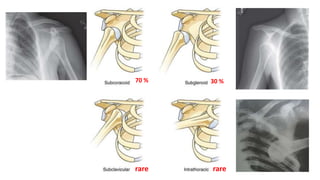
1. Subcoracoid (m/c)
2. Subglenoid
3. Subclavicular
4. Intrathoracic
4 subtype
70 % 30 %
rare rare
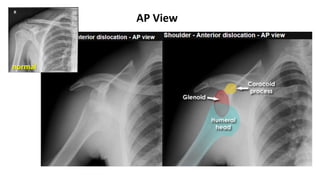
AP View
normal
Scapular Y View
normal
Axillary View
normal
Imaging
• CT and MRI - assess for subtle fractures of the glenoid rim or
ligament/tendon injuries
Treatment
• ABCDE first , look for associated injury
• Analgesia and sedation  control pain , muscle relaxant
• Try manual Closed reduction ก่อน
- Zero position technique
- Traction – Countertraction technique
- Stimson’s method
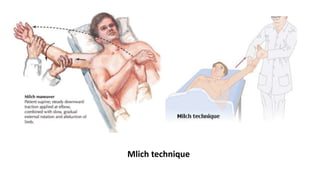
- Milch’s technique
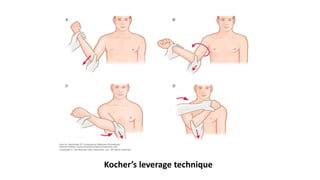
- Kocher’s leverage technique
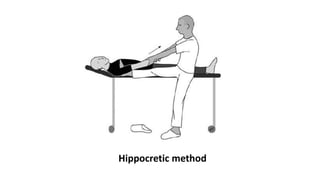
- Hippocretic method
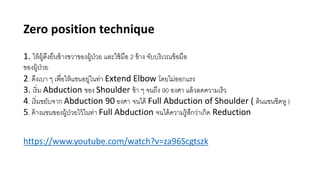
Zero position technique
1. ให้ผู้ดึงยืนข้างขวาของผู้ป่วย และใช้มือ 2 ข้าง จับบริเวณข้อมือ
ของผู้ป่วย
2. ดึงเบา ๆ เพื่อให้แขนอยู่ในท่า Extend Elbow โดยไม่ออกแรง
3. เริ่ม Abduction ของ Shoulder ช้า ๆ จนถึง 90 องศา แล้วลดความเร็ว
4. เริ่มขยับจาก Abduction 90 องศา จนได้ Full Abduction of Shoulder ( ต้นแขนชิดหู )
5. ค้างแขนของผู้ป่วยไว้ในท่า Full Abduction จนได้ความรู้สึกว่าเกิด Reduction
https://www.youtube.com/watch?v=za96Scgtszk
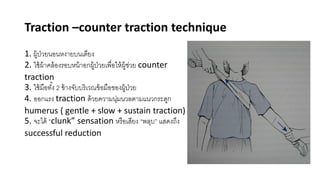
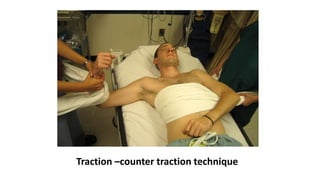
1. ผู้ป่วยนอนหงายบนเตียง
2. ใช้ผ้าคล้องรอบหน้าอกผู้ป่วยเพื่อให้ผู้ช่วย counter
traction
3. ใช้มือทั้ง 2 ข้างจับบริเวณข้อมือของผู้ป่วย
4. ออกแรง traction ด้วยความนุ่มนวลตามแนวกระดูก
humerus ( gentle + slow + sustain traction)
5. จะได้ “clunk” sensation หรือเสียง “พลุบ” แสดงถึง
successful reduction
Traction –counter traction technique
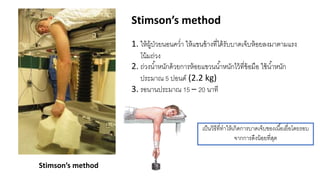
Stimson’s method
Stimson’s method
1. ให้ผู้ป่วยนอนคว่า ให้แขนข้างที่ได้รับบาดเจ็บห้อยลงมาตามแรง
โน้มถ่วง
2. ถ่วงน้าหนักด้วยการห้อยแขวนน้าหนักไว้ที่ข้อมือ ใช้น้าหนัก
ประมาณ 5 ปอนด์ (2.2 kg)
3. รอนานประมาณ 15 – 20 นาที
เป็นวิธีที่ทาให้เกิดการบาดเจ็บของเนื้อเยื่อโดยรอบ
จากการดึงน้อยที่สุด
Hippocretic method
Kocher’s leverage technique
Mlich technique
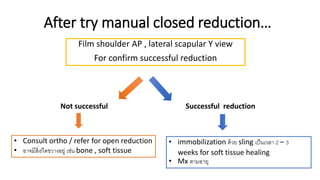
After try manual closed reduction…
Film shoulder AP , lateral scapular Y view
For confirm successful reduction
Not successful
• immobilization ด้วย sling เป็นเวลา 2 – 3
weeks for soft tissue healing
• Mx ตามอายุ
• Consult ortho / refer for open reduction
• อาจมีสิ่งกีดขวางอยู่ เช่น bone , soft tissue
Successful reduction
Early I/C for surgery
• Irreducible dislocations
• Displaced greater tuberosity fractures
• Bankart fractures that create glenohumeral instability
Follow up care
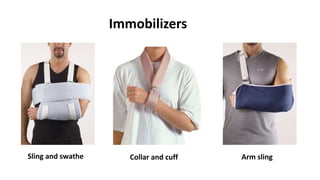
• Immobilized  refer to ortho ใน 1 wk (ป้องกัน recurrent + complication)
ให้อยู่ในท่า adduction , internal rotation
- age < 30 y : immobilized 3 wks
- age > 30 y : gentle pendular motion exercise while immobilization
(reduce rate frozen shoulder)
: early mobilization after 1 wk (prevent joint stiffness)
• Rehabilitation  avoid abduction , external rotation ในช่วงแรก
• Patient eduction  advice recurrent risk , isometric strengthening exercise
Sling and swathe Collar and cuff Arm sling
Immobilizers
Complication
• Recurrent shoulder dislocation (m/c complication)
- Age is the most important indicator for prognosis  90% of teenagers
• Fracture
- m/c is Hill-Sachs lesion (compression fracture of the posterior humeral head)
- proximal humerus , greater tuberosity , coracoid , acromion
• Rotator cuffs tear
- increases with age  30-35% of patients aged 40 years or older
• Nerve injury
- m/c is axillary nerve  up to 33% of acute anterior dislocations
• Vascular injury
- rare , older patients
- more common with inferior dislocations , branch of axillary a.
Reference
• https://radiopaedia.org/articles/shoulder-lateral-scapula-view-1
• เอกสารคาสอน หัวข้อ Introduction to musculoskeletal radiology (Extremities) โดย
อ.พญ.วราพัฒน์ วิระยะวานิช หน่วยรังสีวินิจฉัย ภาควิชารังสีวิทยา คณะแพทยศาสตร์โรงพยาบาลรามาธิบดี
• https://www.mayoclinic.org/diseases-conditions/dislocated-
shoulder/basics/complications/con-20032590
• https://emedicine.medscape.com/article/93323-
clinical?src=refgatesrc1#b4
• https://www.orthobullets.com/sports/3050/traumatic-anterior-shoulder-
instability-tubs
• https://www.radiologymasterclass.co.uk/gallery/trauma/x-
ray_arm_1/fractures_2#top_1st_img
Conference ortho

Conference ortho

  • 1.
    Extern conference Ext พรพรหมสิทธิเวทยานนท์
  • 2.
    Patient profile ผู้ป่วยหญิงไทยคู่ อายุ77 ปี เป็นแม่บ้าน ภูมิลาเนาจังหวัดนครราชสีมา
  • 3.
  • 4.
    Present illness 2 ชั่วโมงก่อนมารพ ขณะที่กาลังกวาดบ้านอยู่หน้าบ้าน กาลังจะเดินเลี้ยวเข้าบ้าน เกิดลื่นเสียหลัก ล้มหงาย หลัง เอาแขนซ้ายบริเวณไหล่กระแทกกับเสาหน้าบ้าน (เสาอยู่ด้านหลัง) ไม่มีศีรษะกระแทกพื้น ไม่มีหมดสติ จาเหตุการณ์ ได้ตลอด หลังจากที่ล้ม หัวไหล่ข้างซ้ายมีอาการผิดรูปและปวดตรงหัวไหล่ซ้ายทันที ยกแขนซ้ายไม่ได้เนื่องจากเจ็บ แต่ยัง ขยับข้อมือและข้อศอกได้ ไม่มีอาการชาบริเวณใดๆ ไม่มีแผลเปิด จากนั้นผู้ป่วยได้เข้าไปนอนในบ้าน กินยาแก้ปวด และ เอายาหม่องมานวดทา แต่อาการไม่ดีขึ้น จึงมารพ.  ABCDE - pass
  • 5.
    Past history • Underlyingdisease OA knees ปัจจุบันรักษาอยู่ที่ รพ.โนนฝรั่ง ด้วย medication ปวด เข่าไม่บ่อย • เคยประสบอุบัติเหตุรถชนเมื่อ 10+ ปีก่อน ทาให้ขาขวาหัก จึงต้องผ่าตัดดามเหล็กที่ขาขวา • ไม่เคยไหล่หลุดมาก่อน • No drug and food allergy • Current med : Naproxen(250) 1x2 PO pc , Omeprazole(20) 1xhs
  • 6.
    Personal history • Noalcohol drinking , not smoke • No herbal used • No family history of genetic disease
  • 7.
    Physical examination • Vitalsigns – T 36.8 , PR 76 bpm , RR 18 /min , BP 161/75 mmHg • General appearance – A Thai old woman , alert , good conscious • HEENT - not pale conjunctivae , anicteric sclerae , no wound • CVS – normal s1 s2 sound , no murmur • Respiratory – Clear and equal breath sound both lung , no adventitious sound • Abdomen – soft , not tender • Skin – no ecchymosis , no laceration or abrasion wound
  • 8.
    • Extremities Lt.shoulder –loss of normal shoulder contour , no external wound seen Arm position is in abduction and external rotation Tender along shoulder , palpable head of Lt. humerus limit ROM of shoulder joint due to pain full ROM of elbow and wrist joint Ruler’s test positive , Duga’s test negative (can touch) sensory intact , radial pulse 2+ Other - WNL
  • 9.
    Investigation • Film Ltshoulder in AP view , lateral scapula Y view
  • 11.
    Y viewAP view Filmshoulder ผู้ป่วยรายนี้
  • 12.
    Finding • Lt. anteriorshoulder dislocation , subcoracoid type • No fracture seen
  • 13.
  • 14.
    Management • Pain control morphine 3 mg IV stat • Sedation  Diazepam 5 mg IV stat • Closed reduction then on arm sling • Film Lt. shoulder AP , Lateral scapula Y view หลังจาก reduction เสร็จ if successful  plan Discharge and F/U OPD ortho 2 wks
  • 15.
  • 16.
    Successful reduction • Dischargeได้ • นัด F/U OPD ortho 1 wks • Advice early ROM เพื่อป้องกันไหล่ติด เริ่มทันทีที่หายปวด
  • 17.
  • 18.
    Shoulder dislocation • 50%of all major joint dislocations. • Anterior dislocation is most common  95 - 97 % of cases. Posterior dislocation 2 – 4% Inferior dislocation 0.5 % • high recurrence rate that correlates with age at dislocation up to 80-90% in teenagers (90% chance for recurrence in age >20)
  • 19.
    Anterior shoulder dislocation Mechanism -direct force จากแรงกระแทกทางด้านหลัง ( posterolateral direction ) - indirect force on the arm when the shoulder is abducted and externally rotated
  • 20.
    Sign and symptom •Feeling the shoulder pop out / roll out during the incident • Visible deformity or out-of-place shoulder • The arm is in slight abduction and external rotation • Loss of normal contour shoulder • Severe pain • Swelling / bruising • Limit ROM all directions • Numbness , weakness , tingling near the injury
  • 23.
    • Hamilton Rulertest  ไม้บรรทัดทาบจาก acromion ไป Lat epicondyle ได้ • Duga ‘s sign  cannot touch opposite shoulder Special test Normal Ruler test +ve Duga’s test
  • 24.
    Imaging • Plain radiographs– for diagnosis and exclude fracture Routine films : AP view , Scapular Y view , Axillary view (ไม่นิยม) finding : humeral head comes to lie anteromedial 1. Subcoracoid (m/c) 2. Subglenoid 3. Subclavicular 4. Intrathoracic 4 subtype
  • 25.
    70 % 30% rare rare
  • 26.
  • 27.
  • 28.
  • 29.
    Imaging • CT andMRI - assess for subtle fractures of the glenoid rim or ligament/tendon injuries
  • 30.
    Treatment • ABCDE first, look for associated injury • Analgesia and sedation  control pain , muscle relaxant • Try manual Closed reduction ก่อน - Zero position technique - Traction – Countertraction technique - Stimson’s method - Milch’s technique - Kocher’s leverage technique - Hippocretic method
  • 31.
    Zero position technique 1.ให้ผู้ดึงยืนข้างขวาของผู้ป่วย และใช้มือ 2 ข้าง จับบริเวณข้อมือ ของผู้ป่วย 2. ดึงเบา ๆ เพื่อให้แขนอยู่ในท่า Extend Elbow โดยไม่ออกแรง 3. เริ่ม Abduction ของ Shoulder ช้า ๆ จนถึง 90 องศา แล้วลดความเร็ว 4. เริ่มขยับจาก Abduction 90 องศา จนได้ Full Abduction of Shoulder ( ต้นแขนชิดหู ) 5. ค้างแขนของผู้ป่วยไว้ในท่า Full Abduction จนได้ความรู้สึกว่าเกิด Reduction https://www.youtube.com/watch?v=za96Scgtszk
  • 32.
    1. ผู้ป่วยนอนหงายบนเตียง 2. ใช้ผ้าคล้องรอบหน้าอกผู้ป่วยเพื่อให้ผู้ช่วยcounter traction 3. ใช้มือทั้ง 2 ข้างจับบริเวณข้อมือของผู้ป่วย 4. ออกแรง traction ด้วยความนุ่มนวลตามแนวกระดูก humerus ( gentle + slow + sustain traction) 5. จะได้ “clunk” sensation หรือเสียง “พลุบ” แสดงถึง successful reduction Traction –counter traction technique
  • 33.
  • 34.
    Stimson’s method Stimson’s method 1.ให้ผู้ป่วยนอนคว่า ให้แขนข้างที่ได้รับบาดเจ็บห้อยลงมาตามแรง โน้มถ่วง 2. ถ่วงน้าหนักด้วยการห้อยแขวนน้าหนักไว้ที่ข้อมือ ใช้น้าหนัก ประมาณ 5 ปอนด์ (2.2 kg) 3. รอนานประมาณ 15 – 20 นาที เป็นวิธีที่ทาให้เกิดการบาดเจ็บของเนื้อเยื่อโดยรอบ จากการดึงน้อยที่สุด
  • 35.
  • 36.
  • 37.
  • 38.
    After try manualclosed reduction… Film shoulder AP , lateral scapular Y view For confirm successful reduction Not successful • immobilization ด้วย sling เป็นเวลา 2 – 3 weeks for soft tissue healing • Mx ตามอายุ • Consult ortho / refer for open reduction • อาจมีสิ่งกีดขวางอยู่ เช่น bone , soft tissue Successful reduction
  • 39.
    Early I/C forsurgery • Irreducible dislocations • Displaced greater tuberosity fractures • Bankart fractures that create glenohumeral instability
  • 40.
    Follow up care •Immobilized  refer to ortho ใน 1 wk (ป้องกัน recurrent + complication) ให้อยู่ในท่า adduction , internal rotation - age < 30 y : immobilized 3 wks - age > 30 y : gentle pendular motion exercise while immobilization (reduce rate frozen shoulder) : early mobilization after 1 wk (prevent joint stiffness) • Rehabilitation  avoid abduction , external rotation ในช่วงแรก • Patient eduction  advice recurrent risk , isometric strengthening exercise
  • 41.
    Sling and swatheCollar and cuff Arm sling Immobilizers
  • 42.
    Complication • Recurrent shoulderdislocation (m/c complication) - Age is the most important indicator for prognosis  90% of teenagers • Fracture - m/c is Hill-Sachs lesion (compression fracture of the posterior humeral head) - proximal humerus , greater tuberosity , coracoid , acromion • Rotator cuffs tear - increases with age  30-35% of patients aged 40 years or older • Nerve injury - m/c is axillary nerve  up to 33% of acute anterior dislocations • Vascular injury - rare , older patients - more common with inferior dislocations , branch of axillary a.

  • 43.
    Reference • https://radiopaedia.org/articles/shoulder-lateral-scapula-view-1 • เอกสารคาสอนหัวข้อ Introduction to musculoskeletal radiology (Extremities) โดย อ.พญ.วราพัฒน์ วิระยะวานิช หน่วยรังสีวินิจฉัย ภาควิชารังสีวิทยา คณะแพทยศาสตร์โรงพยาบาลรามาธิบดี • https://www.mayoclinic.org/diseases-conditions/dislocated- shoulder/basics/complications/con-20032590 • https://emedicine.medscape.com/article/93323- clinical?src=refgatesrc1#b4 • https://www.orthobullets.com/sports/3050/traumatic-anterior-shoulder- instability-tubs • https://www.radiologymasterclass.co.uk/gallery/trauma/x- ray_arm_1/fractures_2#top_1st_img