ORTHOPEDIC CONFERENCE
BY Ext.Prownapat , Ext.Teeradon 11/7/2019
Case	เด็กชาย อายุ + ปี . เดือน
• CC : ล้มตกจากโต๊ะสูง +.= เมตร ? ชัAวโมงก่อนมารพ.
•PI :
• 2 hour PTA ล้มตกจากโต๊ะสูง +.= เมตร ไม่ทราบลักษณะท่าลง
ปวดแขนซ้าย แขนซ้ายบวม,ผิดรูป ไม่มีแผล ขยับแขนขวา และขาสองข้างได้
ปกติศีรษะไม่กระแทกพืPน ไม่หมดสติ ผู้ป่วยไม่ขยับแขนซ้าย จึงไปรพช. >
on arm sling แล้ว referมา MNRH
Past history
•No underlying disease
•No previous surgery/trauma
•No drug/food allergy
•No current medication
Physical Examination
• A : Can talk clearly ,Patent airway, no c-spine tenderness
• B : Clear,equal breath sound both lungs
• C : BP 139/78 mmHg, HR 120 bpm
• D : E4V5M6 , pupil 3mm RTLBE
• E : no external wound , no bleeding
Physical Examination
• Vital signs- BT 36.5 c, PR 90 bpm, BP 139/76,RR 20/min
• GA : A Thai boy, Alert, Good consciousness
• HEENT : no pale conjunctivae, anicteric sclerae
• CVS : Full, regular, symmetrical pulses all extremities,
normal s1,s2,no murmur
• Lungs : Normal breath sound in both lungs
• Abdomen : Soft ,not tender, normoactive bowel sound
• Back : not tender, no wound
Physical Examination
• Lt. elbow :
s shape deformity, swelling, no wound,
tenderness,
limit ROM due to pain,
distal neurological exam can’t evaluate
Capillary refill < 2 sec , radial pulse 2+, ulnar pulse 2+
• Lt. shoulder : no deformity, no wound, not tender, limit ROM due to pain
• Lt. hand : no deformity, no wound, not tender, limit ROM due to pain
• Other limbs : not tender , full ROM , no wound,
can active move
Physical Examination
Investigation
•Film Left elbow AP, lateral
Film interpretation
• Complete transverse fracture at supracondylar
region of left humerus with totally posteromedial
displacement
• Abnormal anterior humoral line and Baumann’s
angle
• +ve posterior fat pad sign
• surrounding soft tissue swelling
Diagnosis
Left supracondylar fracture Gartland type III
Parameters
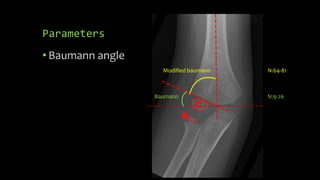
• Baumann angle
Modified baumann N:64-81
Baumann N:9-26
• Anterior humeral line
> supracondylar fracture
Parameters
Anterior humeral line
capitellum
• Radiocapitellar line
> presence of radial head subluxation
or dislocation
Parameters
Supracondylar fracture
• Type
• Extension type(97.7%)
• Flexion type(2.3%)
• Clinical presentation
• Pain and swelling
• S-shaped deformity
• Loss of passive and active motions/pseudoparalysis
Supracondylar fracture
• Gartland’s Classification
I Non-displaced fracture
II Partially displaced , intact Posterior cortex
III Totally displaced
Gartland I
Gartland II
Gartland III
Treatment
• Initial
Temporary splint/ immobilize
• Gartland type 1 : Long arm cast / Locking slab
• Gartland type 2 : Close reduction + Long arm cast / Locking slab
+/- Pinning
• Gartland type 3 : Close reduction + Pinning + Long arm cast /
Locking Slab
Treatment
Operation Note
• Gartland type IV !!!!!
• Complete periosteal disruption with instability in flexion
and extension
• Diagnosed with examination under anesthesia during
surgery
• Treated with most commonly with CRPP or open
reduction if needed
Indication for open reduction
• 1. Inadequate reduction with close reduction
• 2. Vascular injury
• 3. Open fracture
Film post op.
Post operation care
• Elevation / swelling control
• Pain control
• Observe for compartment syndrome
• Observe for nerve , vessel injury
• Remove pins and cast at 3-4 weeks / union
• ROM exercise ,Strengthening exercise arm forearm, wrist, hand
Complications
• Early
1. Anterior interosseous nerve injury
2. Brachial artery injury
3. Compartment syndrome
• Late
1.Cubitus varus
2.Elbow stiffness

Ortho con supra copy

  • 1.
  • 2.
    Case เด็กชาย อายุ +ปี . เดือน • CC : ล้มตกจากโต๊ะสูง +.= เมตร ? ชัAวโมงก่อนมารพ. •PI : • 2 hour PTA ล้มตกจากโต๊ะสูง +.= เมตร ไม่ทราบลักษณะท่าลง ปวดแขนซ้าย แขนซ้ายบวม,ผิดรูป ไม่มีแผล ขยับแขนขวา และขาสองข้างได้ ปกติศีรษะไม่กระแทกพืPน ไม่หมดสติ ผู้ป่วยไม่ขยับแขนซ้าย จึงไปรพช. > on arm sling แล้ว referมา MNRH
  • 3.
    Past history •No underlyingdisease •No previous surgery/trauma •No drug/food allergy •No current medication
  • 4.
    Physical Examination • A: Can talk clearly ,Patent airway, no c-spine tenderness • B : Clear,equal breath sound both lungs • C : BP 139/78 mmHg, HR 120 bpm • D : E4V5M6 , pupil 3mm RTLBE • E : no external wound , no bleeding
  • 5.
    Physical Examination • Vitalsigns- BT 36.5 c, PR 90 bpm, BP 139/76,RR 20/min • GA : A Thai boy, Alert, Good consciousness • HEENT : no pale conjunctivae, anicteric sclerae • CVS : Full, regular, symmetrical pulses all extremities, normal s1,s2,no murmur • Lungs : Normal breath sound in both lungs • Abdomen : Soft ,not tender, normoactive bowel sound • Back : not tender, no wound
  • 7.
    Physical Examination • Lt.elbow : s shape deformity, swelling, no wound, tenderness, limit ROM due to pain, distal neurological exam can’t evaluate Capillary refill < 2 sec , radial pulse 2+, ulnar pulse 2+ • Lt. shoulder : no deformity, no wound, not tender, limit ROM due to pain • Lt. hand : no deformity, no wound, not tender, limit ROM due to pain
  • 8.
    • Other limbs: not tender , full ROM , no wound, can active move Physical Examination
  • 9.
  • 11.
    Film interpretation • Completetransverse fracture at supracondylar region of left humerus with totally posteromedial displacement • Abnormal anterior humoral line and Baumann’s angle • +ve posterior fat pad sign • surrounding soft tissue swelling
  • 12.
  • 13.
    Parameters • Baumann angle Modifiedbaumann N:64-81 Baumann N:9-26
  • 14.
    • Anterior humeralline > supracondylar fracture Parameters Anterior humeral line capitellum
  • 15.
    • Radiocapitellar line >presence of radial head subluxation or dislocation Parameters
  • 16.
    Supracondylar fracture • Type •Extension type(97.7%) • Flexion type(2.3%) • Clinical presentation • Pain and swelling • S-shaped deformity • Loss of passive and active motions/pseudoparalysis
  • 18.
    Supracondylar fracture • Gartland’sClassification I Non-displaced fracture II Partially displaced , intact Posterior cortex III Totally displaced
  • 19.
  • 20.
  • 21.
  • 22.
  • 23.
    • Gartland type1 : Long arm cast / Locking slab • Gartland type 2 : Close reduction + Long arm cast / Locking slab +/- Pinning • Gartland type 3 : Close reduction + Pinning + Long arm cast / Locking Slab Treatment
  • 25.
  • 26.
    • Gartland typeIV !!!!! • Complete periosteal disruption with instability in flexion and extension • Diagnosed with examination under anesthesia during surgery • Treated with most commonly with CRPP or open reduction if needed
  • 27.
    Indication for openreduction • 1. Inadequate reduction with close reduction • 2. Vascular injury • 3. Open fracture
  • 28.
  • 30.
    Post operation care •Elevation / swelling control • Pain control • Observe for compartment syndrome • Observe for nerve , vessel injury • Remove pins and cast at 3-4 weeks / union • ROM exercise ,Strengthening exercise arm forearm, wrist, hand
  • 31.
    Complications • Early 1. Anteriorinterosseous nerve injury 2. Brachial artery injury 3. Compartment syndrome • Late 1.Cubitus varus 2.Elbow stiffness