Extern conference
Ext.Warunporn Maneechote PCM 39
History
◂ HN 199-00-24
◂ ผู้ป่วยชายไทย อายุ 82 ปี
◂ No known underlying disease
◂ เชื้อชาติไทย สัญชาติไทย ศาสนาพุทธ ภูมิลาเนา อ.พระทองคา จ.
นครราชสีมา
2
Chief complaint : เจ็บหัวเข่าขวา 3 ชั่วโมง ก่อนมา รพ
3
Primary Survey
◂ A: patent airway, no posterior spine tenderness
◂ B: normal and equal breath sound,RR 18/min,
trachea in midline
◂ C: no active bleeding, capillary refill < 2 sec, pulse
full and regular, PR 97/min, BP 134/86mmHg,
abdomen soft not tender
◂ D: E4V5M6, pupil 2 mm RTLBE
◂ E: no tenderness along spine
4
Secondary survey
◂ A: no food and drug allergy
◂ M: no current medication, TT < 1 year
◂ P: no underlying disease
◂ L: last meal 19.00 รับประทานข้าว
◂ E: 3 ชั่วโมงก่อนมา โรงพยาบาล ขณะผู้ป่วยกาลังเดินเล่นโทรศัพท์
สะดุดประตูบ้าน ล้มเข่าขวากระแทกพื้นในท่างอ หลังจากนั้นมีอาการ
เข่าบวม เดินลงน้าหนักขาขวาไม่ได้ ไม่มีอาการชา ไม่อ่อนแรง ไม่ล้ม
ศีรษะกระแทก ไม่มีการบาดเจ็บบริเวณอื่น
5
Physical Examination
◂ Vital sign : BT 37 C, BP 134/86 mmHg, PR 97/min RR 18/min
◂ GA: good consciousness, well- cooperated
◂ HEENT : not pale conjunctivae, anicteric sclerae
◂ CVS : pulse full and regular, normal S1S2 no murmur
◂ Lungs: clear both lungs, no adventitious sound
◂ Abdomen: soft, not tender
6
7
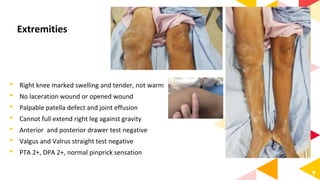
• Right knee marked swelling and tender, not warm
• No laceration wound or opened wound
• Palpable patella defect and joint effusion
• Cannot full extend right leg against gravity
• Anterior and posterior drawer test negative
• Valgus and Valrus straight test negative
• PTA 2+, DPA 2+, normal pinprick sensation
Extremities
1.
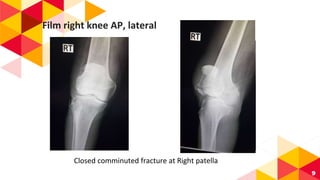
Film Right Knee: AP, lateral
Film right knee AP, lateral
Closed comminuted fracture at Right patella
9
“ Diagnosis : Closed comminuted fracture at right
patella
10
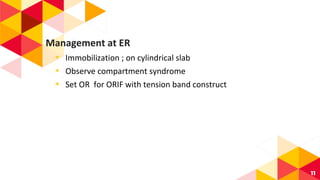
Management at ER
◂ Immobilization ; on cylindrical slab
◂ Observe compartment syndrome
◂ Set OR for ORIF with tension band construct
11
Patella fracture
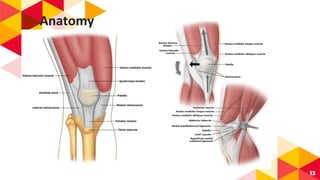
Anatomy
13
14
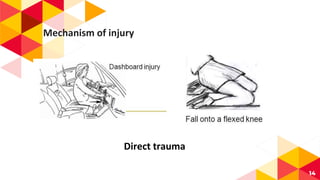
Mechanism of injury
Direct trauma
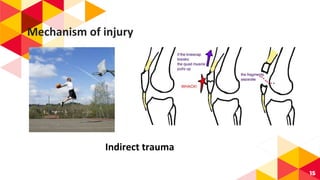
Mechanism of injury
15
Indirect trauma
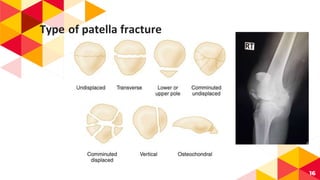
Type of patella fracture
16
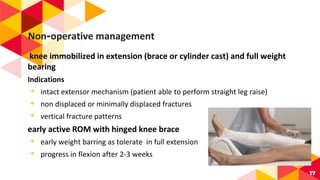
Non-operative management
knee immobilized in extension (brace or cylinder cast) and full weight
bearing
Indications
◂ intact extensor mechanism (patient able to perform straight leg raise)
◂ non displaced or minimally displaced fractures
◂ vertical fracture patterns
early active ROM with hinged knee brace
◂ early weight barring as tolerate in full extension
◂ progress in flexion after 2-3 weeks
17
Indication for Surgery
◂ Fractures with greater than 2 mm of articular step-off
◂ Fractures with greater than 3 mm of fragment separation
◂ Comminuted fractures, with or without displacement of the
articular surface
◂ Disruption of the extensor mechanism
◂ Any open fracture or persistent neurovascular deficit
requires immediate surgical referral
◂ Avulsion of superior or inferior pole of patella
18
Harris, RM. Fracture of the patella. In: Rockwood and Green's Fractures in Adults, Bucholz, RW, Heckman, JD (Eds), Lippincott Williams & Wilkins,
Philadelphia 2002. p.1775.
DeLee, J, Drez, D. Patellar fractures in the adult. In: Orthopaedic Sports Medicine: Principle and Practice, 2nd, WB Saunders, Philadelphia 2003.
p.1760.
19
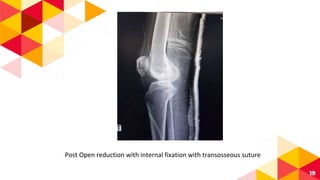
Post Open reduction with internal fixation with transosseous suture
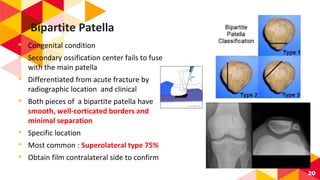
Bipartite Patella
◂ Congenital condition
◂ Secondary ossification center fails to fuse
with the main patella
◂ Differentiated from acute fracture by
radiographic location and clinical
◂ Both pieces of a bipartite patella have
smooth, well-corticated borders and
minimal separation
◂ Specific location
◂ Most common : Superolateral type 75%
◂ Obtain film contralateral side to confirm
20
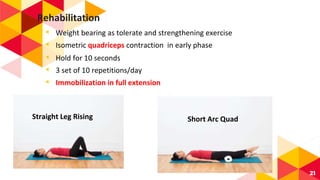
◂ Weight bearing as tolerate and strengthening exercise
◂ Isometric quadriceps contraction in early phase
21
Rehabilitation
◂ Hold for 10 seconds
◂ 3 set of 10 repetitions/day
◂ Immobilization in full extension
Straight Leg Rising Short Arc Quad
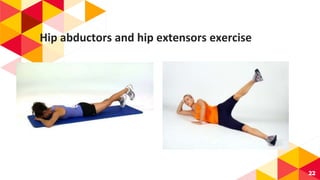
Hip abductors and hip extensors exercise
22
Thank you

Ext.conference..

  • 1.
  • 2.
    History ◂ HN 199-00-24 ◂ผู้ป่วยชายไทย อายุ 82 ปี ◂ No known underlying disease ◂ เชื้อชาติไทย สัญชาติไทย ศาสนาพุทธ ภูมิลาเนา อ.พระทองคา จ. นครราชสีมา 2
  • 3.
    Chief complaint :เจ็บหัวเข่าขวา 3 ชั่วโมง ก่อนมา รพ 3
  • 4.
    Primary Survey ◂ A:patent airway, no posterior spine tenderness ◂ B: normal and equal breath sound,RR 18/min, trachea in midline ◂ C: no active bleeding, capillary refill < 2 sec, pulse full and regular, PR 97/min, BP 134/86mmHg, abdomen soft not tender ◂ D: E4V5M6, pupil 2 mm RTLBE ◂ E: no tenderness along spine 4
  • 5.
    Secondary survey ◂ A:no food and drug allergy ◂ M: no current medication, TT < 1 year ◂ P: no underlying disease ◂ L: last meal 19.00 รับประทานข้าว ◂ E: 3 ชั่วโมงก่อนมา โรงพยาบาล ขณะผู้ป่วยกาลังเดินเล่นโทรศัพท์ สะดุดประตูบ้าน ล้มเข่าขวากระแทกพื้นในท่างอ หลังจากนั้นมีอาการ เข่าบวม เดินลงน้าหนักขาขวาไม่ได้ ไม่มีอาการชา ไม่อ่อนแรง ไม่ล้ม ศีรษะกระแทก ไม่มีการบาดเจ็บบริเวณอื่น 5
  • 6.
    Physical Examination ◂ Vitalsign : BT 37 C, BP 134/86 mmHg, PR 97/min RR 18/min ◂ GA: good consciousness, well- cooperated ◂ HEENT : not pale conjunctivae, anicteric sclerae ◂ CVS : pulse full and regular, normal S1S2 no murmur ◂ Lungs: clear both lungs, no adventitious sound ◂ Abdomen: soft, not tender 6
  • 7.
    7 • Right kneemarked swelling and tender, not warm • No laceration wound or opened wound • Palpable patella defect and joint effusion • Cannot full extend right leg against gravity • Anterior and posterior drawer test negative • Valgus and Valrus straight test negative • PTA 2+, DPA 2+, normal pinprick sensation Extremities
  • 8.
  • 9.
    Film right kneeAP, lateral Closed comminuted fracture at Right patella 9
  • 10.
    “ Diagnosis :Closed comminuted fracture at right patella 10
  • 11.
    Management at ER ◂Immobilization ; on cylindrical slab ◂ Observe compartment syndrome ◂ Set OR for ORIF with tension band construct 11
  • 12.
  • 13.
  • 14.
  • 15.
  • 16.
    Type of patellafracture 16
  • 17.
    Non-operative management knee immobilizedin extension (brace or cylinder cast) and full weight bearing Indications ◂ intact extensor mechanism (patient able to perform straight leg raise) ◂ non displaced or minimally displaced fractures ◂ vertical fracture patterns early active ROM with hinged knee brace ◂ early weight barring as tolerate in full extension ◂ progress in flexion after 2-3 weeks 17
  • 18.
    Indication for Surgery ◂Fractures with greater than 2 mm of articular step-off ◂ Fractures with greater than 3 mm of fragment separation ◂ Comminuted fractures, with or without displacement of the articular surface ◂ Disruption of the extensor mechanism ◂ Any open fracture or persistent neurovascular deficit requires immediate surgical referral ◂ Avulsion of superior or inferior pole of patella 18 Harris, RM. Fracture of the patella. In: Rockwood and Green's Fractures in Adults, Bucholz, RW, Heckman, JD (Eds), Lippincott Williams & Wilkins, Philadelphia 2002. p.1775. DeLee, J, Drez, D. Patellar fractures in the adult. In: Orthopaedic Sports Medicine: Principle and Practice, 2nd, WB Saunders, Philadelphia 2003. p.1760.
  • 19.
    19 Post Open reductionwith internal fixation with transosseous suture
  • 20.
    Bipartite Patella ◂ Congenitalcondition ◂ Secondary ossification center fails to fuse with the main patella ◂ Differentiated from acute fracture by radiographic location and clinical ◂ Both pieces of a bipartite patella have smooth, well-corticated borders and minimal separation ◂ Specific location ◂ Most common : Superolateral type 75% ◂ Obtain film contralateral side to confirm 20
  • 21.
    ◂ Weight bearingas tolerate and strengthening exercise ◂ Isometric quadriceps contraction in early phase 21 Rehabilitation ◂ Hold for 10 seconds ◂ 3 set of 10 repetitions/day ◂ Immobilization in full extension Straight Leg Rising Short Arc Quad
  • 22.
    Hip abductors andhip extensors exercise 22
  • 23.